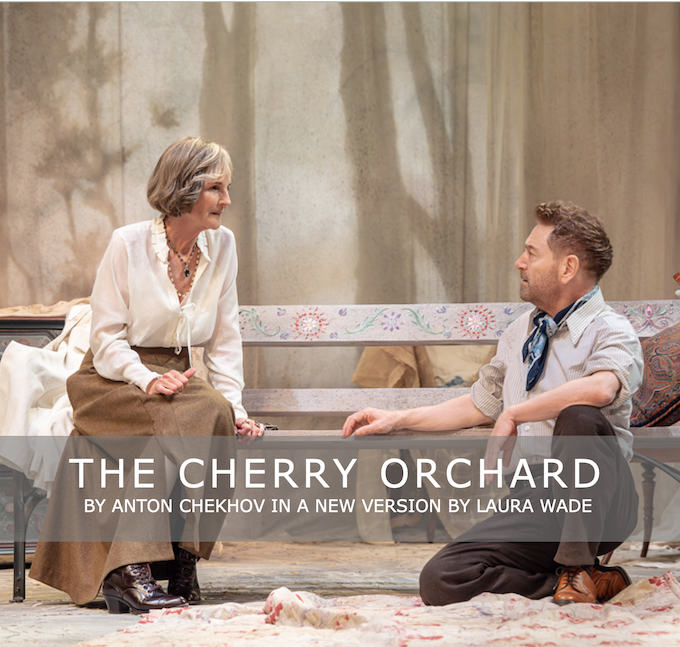
by Anton Chekhov
In a new version by Laura Wade
Directed by Tamara Harvey
Set & costume by Anna Fleischle
Composer Lara Rossi
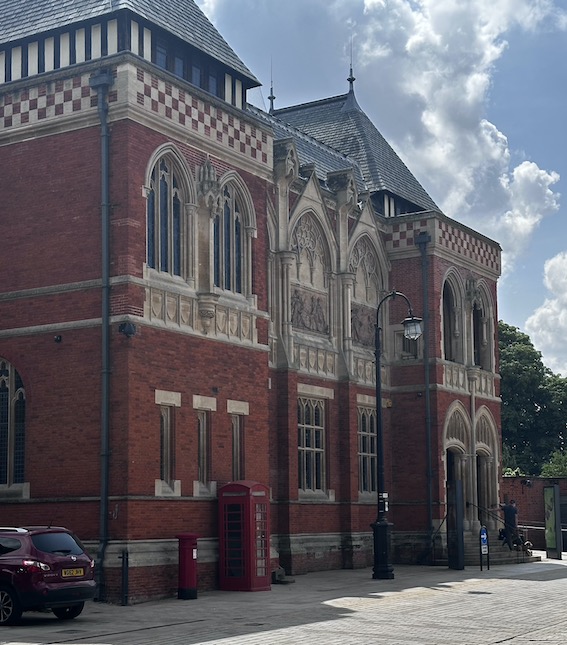
Royal Shakespeare Company
The Swan Theatre
Stratford-upon-Avon
Wednesday 22nd July 2026, 19.30
CAST
Kenneth Branagh – Lopakhin
Helen Hunt- Madame Ranyevskaya
Bill Pullman as Gaev
Rob Alexander-Adams- Passer By
Chumisa Dornford-May – Anya
Alfred Enoch – Trofimov
Michael Elwyn – Firs
Amber Gadd – Dunyasha
Guy Henry – Pishchik
Erion Siobhan Hutching- ensemble
Julian Moore-Cook – Yasha
Andy Rush – Yepilkhodov
Esther Smith – Varya
Sophie Stone – Sharlotta
MUSIC
Tomek Piczora-piano
Sarah Crisp- violin
Daryl Giuliano- cello
Joe Archer- guitar
“What kind of play is The Cherry Orchard? As a new production starring Helen Hunt and Kenneth Branagh beckons in Stratford, I am reminded that it is a question people have been asking since the play’s inception. Chekhov himself wrote that what had emerged in his play was “not a drama but a comedy, in places almost a farce”. Stanislavski, who directed the Moscow premiere in 1904, violently disagreed. “It is a tragedy,” he told Chekhov, “whatever prospect of a better life you hold out in the last act.”
Michael Billington, The Guardian, 24 June 2026
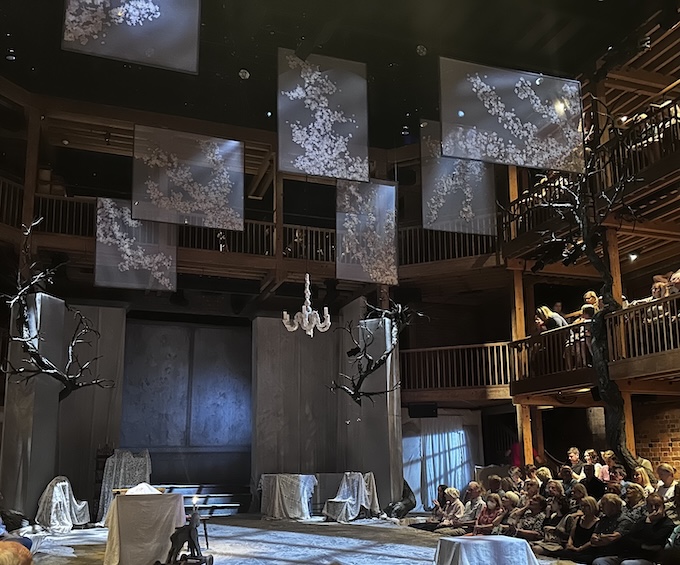
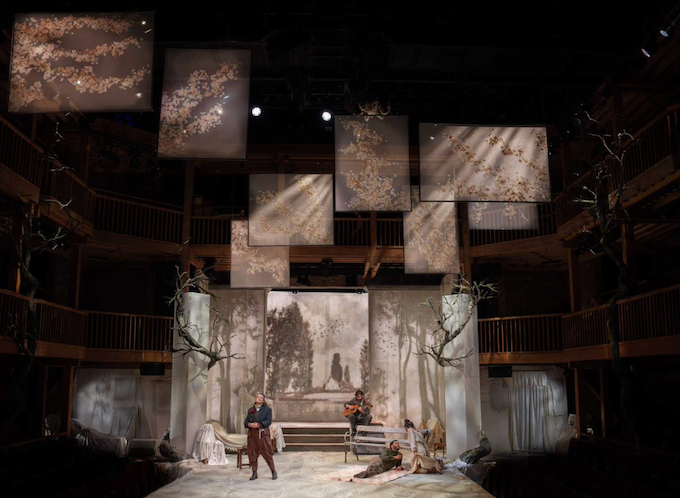
The set is lovely. In the first part the house is sheeted up having been empty for five years, and the house is faded, muted colours, lost glories. Gnarled cherry trees writhe up the sides, and square panels of cherry blossom hang up high above. There’s a surprise discovery under the sheets, no plot spoilers, well, a bit, you don’t expect an actor of that stature to submit to lying motionless for fifteen minutes as we shuffled into our seats. Costume is also very good. The lighting design throughout is extraordinary. As you can see from the production photos, it looks great.
Back to Billington. In my opinion, it’s not a comedy and it’s not a tragedy. Sometimes one’s own prejudices make reviewing difficult. Hands up! I don’t like the play. Yes, I understand that it is ‘widely regarded as a classic of 20th century literature.’ The Cherry Orchard (1903) doesn’t have much of a plot, if any.
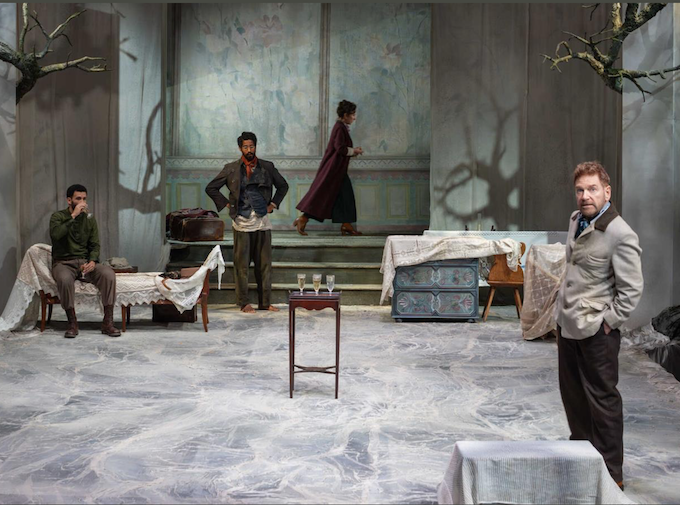
Rich aristocrats have lost their money, return to their ancestral home after 5 years in Paris. They are greeted by Lopakhin. They will have to sell the house and their beloved cherry orchard, which brings back golden memories. Lopakhin is a wealthy businessman, descended from a serf father and a serf grandfather. I bet it goes back further. Madame Ranyevskaya was his childhood idol, but now she’d rather like him to marry her daughter, Varya. His ideas for the estate are to get rid of it, develop the land.
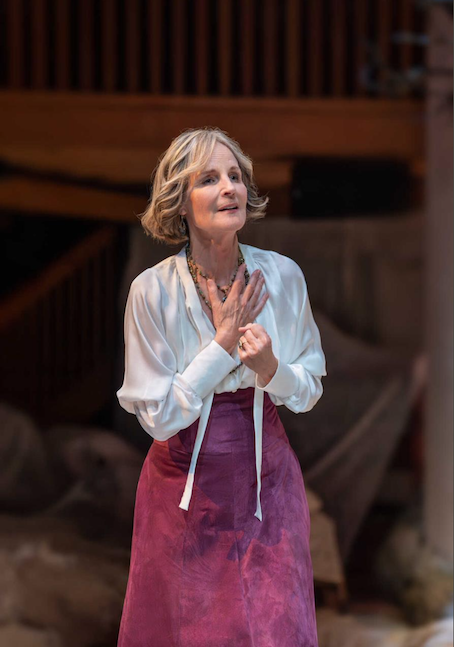
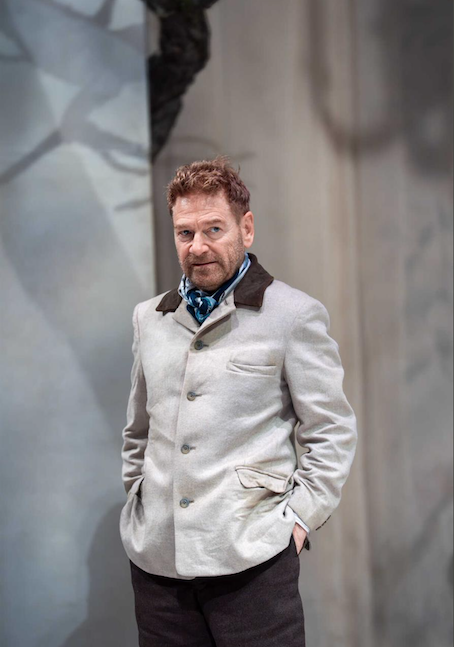
Helen Hunt as Madame Ranyevskaya. Kenneth Branagh as Lopakhin
There are various relationships, a comic landowner, Pishkin and a comic somebody or other, Sharlotta.
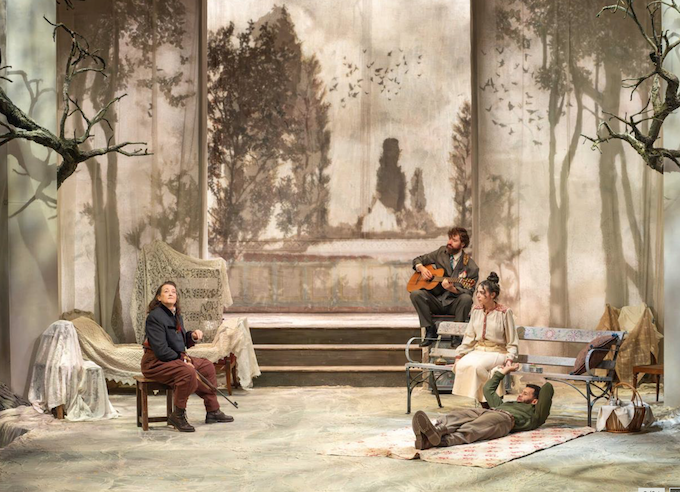
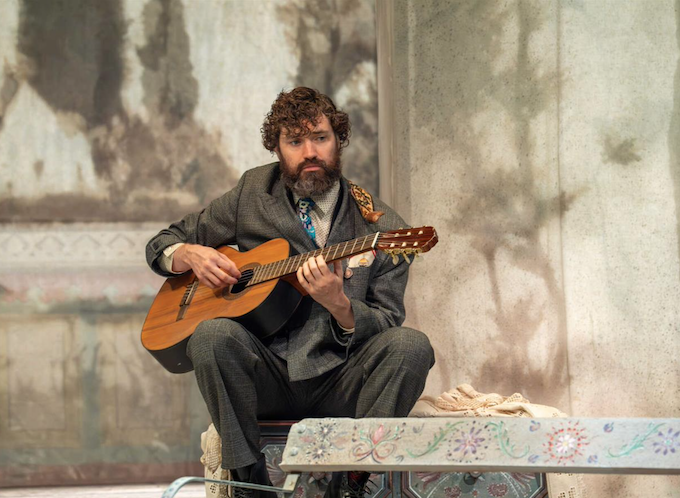
Yepikhodov, a ‘clerk’ is a clumsy fellow falling over everything in sight. Andy Rush is an excellent convincing tripper over. He also plays guitar and does a couple of songs.
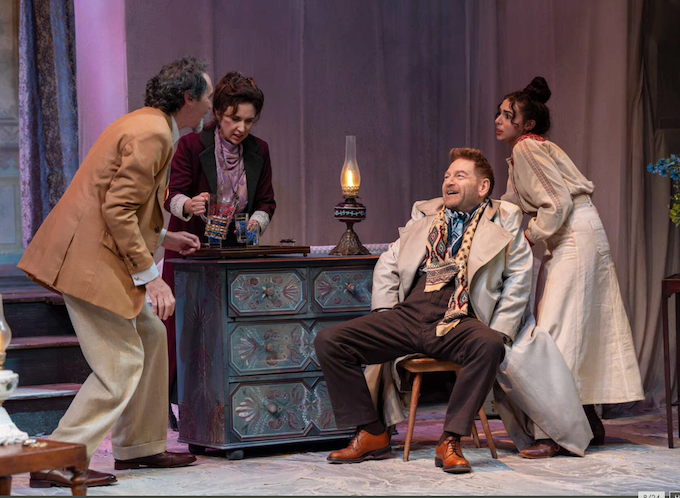
The estate is auctioned. Lopakhin buys it. He’s drunk and cheerful after the auction. He is a property developer and will cut down the cherry orchard to throw up some dachas (summer houses) … we hear a couple of trees fall on speakers at the back. He would not be out of place in Poole and Sandbanks where the sound of chainsaws is a constant. He can’t understand why the family find the idea sad. He will demolish the house too.
There are several deeply meaningful bits declaimed. Yes, aristocracy is finished. The capitalist takes over. With future vision the bourgeois will have a good but short run from 1916 to 1917, be destroyed by the Bolsheviks in October 1917, and not return again until 1989 in the guise of oligarchs. i.e. the play was about Russia. It’s about a society shift 120 years ago. They really need another.
We expect Russian and Nordic plays to end with a suicide, but this one breaks the trend. It was Chekhov’s last play. Kenneth Branagh has chosen it for his return to the RSC this year, following The Tempest. Like buses, particular plays arrive one after the other, and Stephen Mangan is taking the same role in a different London production this autumn. I’m surprised Branagh’s chosen it. It’s not a Hamlet / Henry V / Lear / Prospero / Archie Rice / Leontes / Poirot obvious star vehicle. He doesn’t get overmuch stage time, which IS a tragedy for me because his timing and delivery are always impeccable.
The Laura Wade / Tamara Harvey team dragged The Constant Wife from a rather dull Somerset Maugham play to a truly sparkling and meaningful play in 2025, and I anticipated them waving the same magic wand. Not to the same degree. The problem is the play. Fine acting, fluid direction, excellent set, but it’s still The Cherry Orchard. For starters, I’d have reduced and simplified all the names, though people who love Chekhov would be appalled. It’s like secondary school in my youth. The males only have surnames. The females have first names. OK, Russian uses surnames. I have seen them switched to comprehensible clear first names: Peter, Sasha, Boris, Alex, Vladimir, Sergei. Why not? We’re not listening in Russian.
I’m going to have to state my prejudice. It’s a play I’ve done lighting and sound on, decades ago. For lighting there’s nothing I could do except switch on and off appropriately and make sure a flattering straw colour was on the (older) lead actor. I sat and watched it several times then, script in hand. I still couldn’t work out the relationships, because they all had impenetrable names, and none did anything to make me care. It put me off Chekhov for years. Ironically, seeing Kenneth Branagh in Ivanov, before I started doing these reviews, reawakened my interest. But I haven’t seen The Cherry Orchard in decades. In spite of the acting and production resources of the RSC, I still find it somewhat tedious, plotless, confusing and unfunny. I will readily admit that may well stem from my earlier experience. We spoke to a lady in the lift at the hotel who enthused at its brilliance and magnificent delivery of language, so do take my curmudgeonly attitude with a pinch of salt.
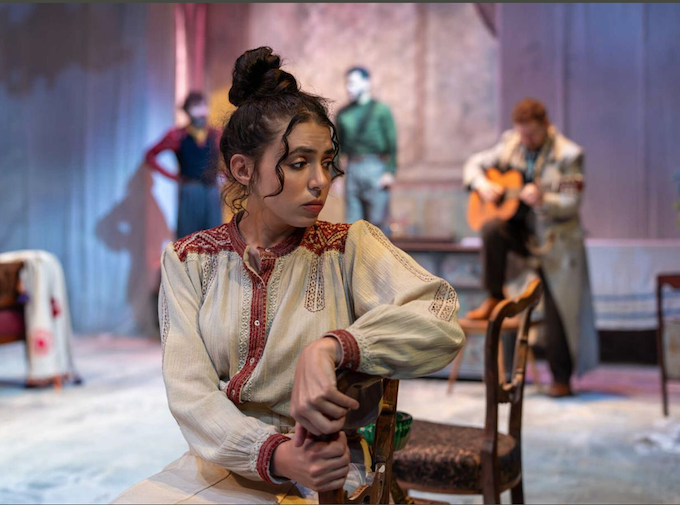
They try so hard to bring life into it, though Chekhov would never imagined mimed (I hope it was mimed) head up skirt apparent cunnilingus, followed by apparent fingering. The trouble is with the play is I’m having to look in the programme and the photos to find the names. This was Yasha, a servant (Julian Moore-Cooke), and Dunyasha, a housemaid (Amber Gadd), Are they Yasha and Dunyasha in the original? “Done by Yasha”? Yes, they are. Maybe the names inspired the stage business. There is constant movement of family and servants across the corridor exposed at the back. Excellent thrust stage positioning, which is not a given.
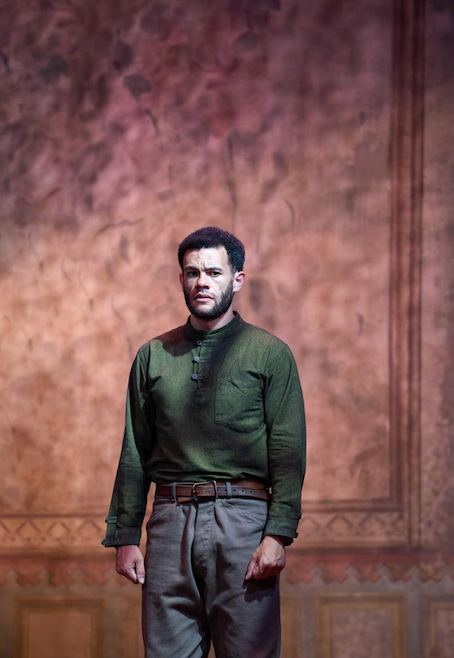
Branagh is Lopakhin, the ‘merchant’ or businessman. He adopts his native Northern Irish accent for added interest. Serfs need a regional accent to contrast with RP from the aristocrats, It can be any one you like, and Ulster has some interesting inflections. Like Branagh, my companion went to primary school in Belfast, moved to England and she got into acting via enforced elocution lessons. I enjoyed him going for the accent. Yasha, as a servant, does Northern Irish too, and very well, though I bet Branagh’s a great dialogue coach. Branagh does a wonderful drunk in this. I wanted him on stage much more. He also attempts guitar (about three chords) and sings. BUT Northern Irish has an urban edge compared to ‘Mummerset’ or ‘Generic Northern.’
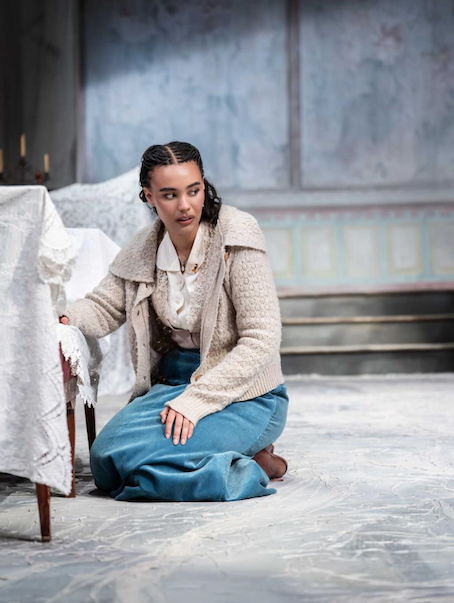
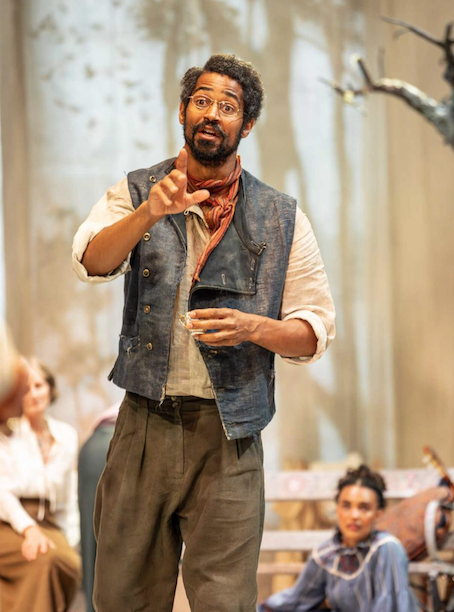
Anya (Chumisa Dornford-May) and Trofimov (Alfred Enoch)
The character (NOT the actor) I dislike most is Trofimov (I had to look in the programme again, I never caught it on the day), the student, valiantly played by Alfred Enoch. I couldn’t deliver those (now) oh so tired clichés with conviction, but Enoch manages. Mind you, Chekhov also makes him idle, still a student at 27 or 28 which would have been a comment in itself on what he spouts. Some of his lines were deleted in Tsarist Russia. Anya, one of Madame Ranyevskaya’s daughters, is the love interest.
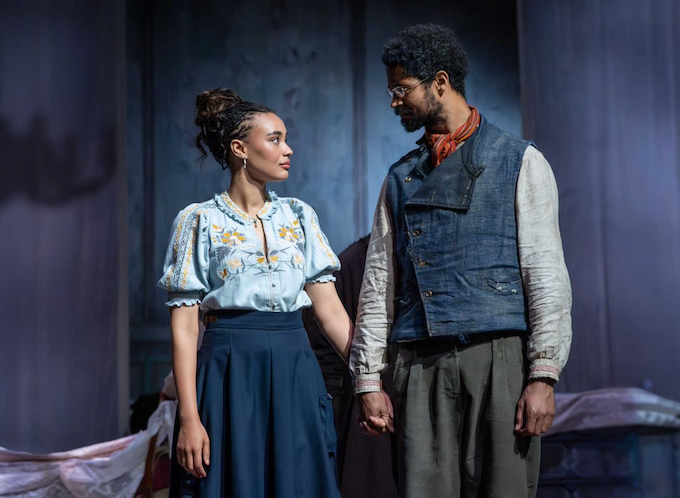
Varya (Esther Smith) is the other daughter, rather hoping Lopakhin will propose. A Jane Austen touch for Chekhov here.
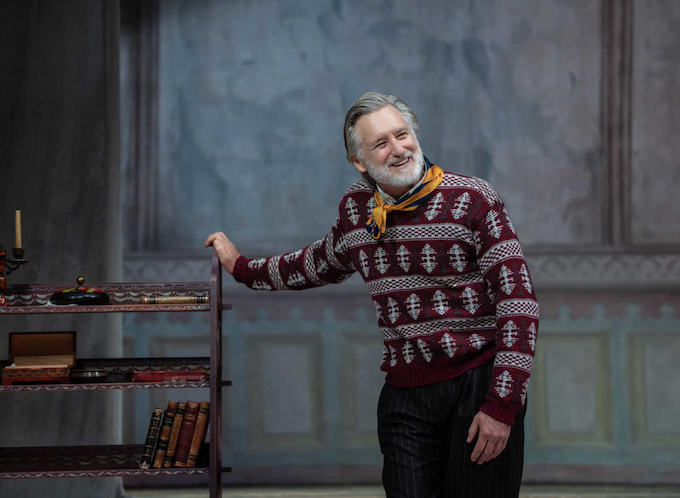
Helen Hunt is the elegantly faded aristocrat, Madame Ranyevskaya, accompanied by her brother, Gaev (Bill Pullman). Both fine, though there’s not a lot of meat in the bland roles. They both have light American accents. We thought she drifted RP to American several times. Madame Ranyevskaya has no idea she’s broke and gives a gold coin to a passing beggar. The issue is, that she never comes across as deserving equal billing on the posters.

Fellow landowner, Pishik, owes money to all and sundry but remains cheerfully bankrupt.
Chekhov studied Shakespeare in switching to comedy.
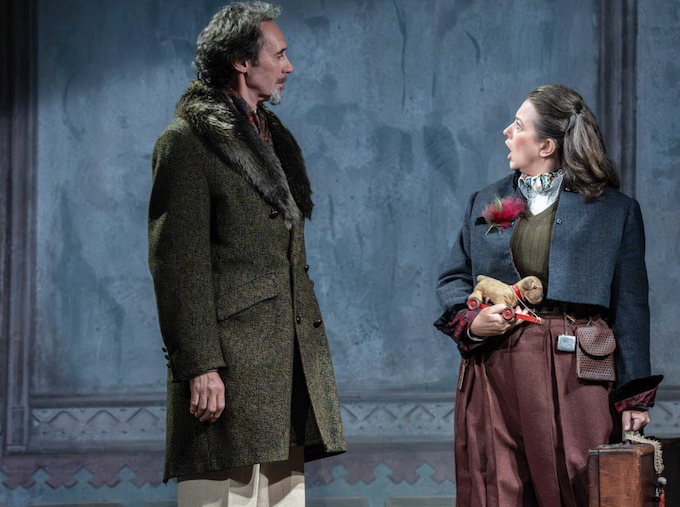
Here Sophie Stone as Sharlotta is a classic Shakespeare clown, with card tricks, and comedy, nicking the family silver. Then we have the clumsy clerk, Yepikhodov. A third comic role is another declining landowner, Pishik (Guy Henry). I found myself looking forward to his languid interventions. He had good lines and has a happy ending when he leases estate to some Englishmen prospecting for his white clay. . I will grudgingly admit that Chekhov hits three different types of comedy in the three characters.
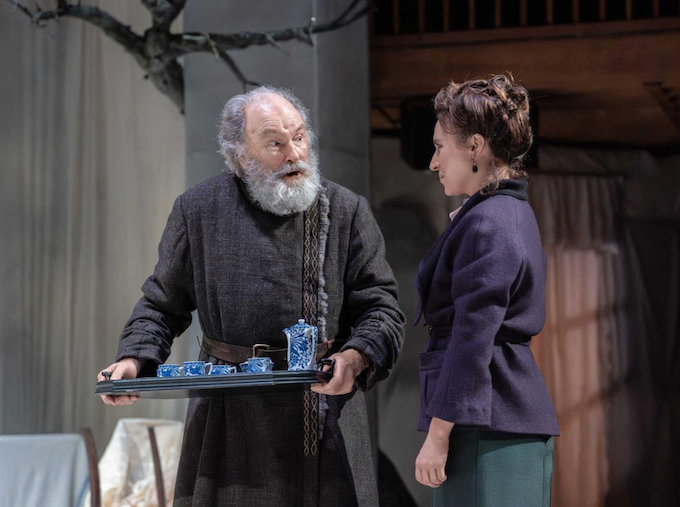
At the end, they all go away. Yasha is deserting Dunyasha. Varya doesn’t get a proposal. The clerk, Yepikhodov, will be employed to oversee things, as Lopakhin is off too, to winter quarters in the city.
They are leaving Firs, the elderly retainer (Michael Elwyn, a great performance) who used to be a serf and wishes he still was. They forgot all about him. I suppose he’s ‘Uncle Tom’ accepting his lot in the world and wanting to continue in the old way, which is why he is literally “left behind.”
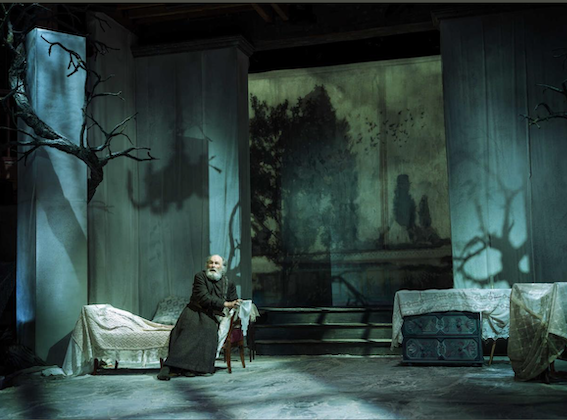
The text is well done, as you would expect from Laura Wade. I can’t fault production, direction or acting. But still, as years ago I was pretty bored in sections.
It was a full house. I thought the applause was at a moderate level. No standers, no whistling or yelling. No second call.
Overall: ***
WHAT THE CRITICS SAID
I reviewed before the critics
4 stars
Michael Davies, What’s On Stage ****
Roni, Theatre & Tonic ****
Mark, Beyond The Curtain ****
3 star
Claire Allfree, Telegraph ***
Holly Williams, The Stage ***
Sarah Hemmings Financial Times ***
2 stars
Arifa Akbar, The Guardian **
Raphael Kohn, All That Dazzles **
The Observer has stopped star ratings but says it is ‘a barren harvest.’ I thought Arifa Akbar’s two star review very good- she justifies it.
LINKS ON THIS BLOG
ANTON CHEKHOV
The Seagull by Anton Chekhov, Headlong / Nuffield Theatre, Southampton
The Seagull, adapted Mike Poulton, Chichester 2025
Young Chekhov Season, Chichester 2015
* The Seagull (adapted by David Hare)
* Platonov (adapted by David Hare)
* Ivanov (adapted by David Hare)
Uncle Vanya (adapted by David Hare), Bath Theatre Royal 2019
Uncle Vanya (adapted by Conor McPherson) 2021 and streaming
The Cherry Orchard by Chekhov, adapted by Laura Wade, RSC 2026
LAURA WADE
The Constant Wife, adapted from Maugham, RSC 2025
The Watsons, Chichester, 2018
Home, I’m Darling, National Theatre 2018
POSH, Salisbury Playhouse 2015
The Cherry Orchard by Chekhov, adapted by Laura Wade, RSC 2026
TAMARA HARVEY
Henry V RSC 2026
The Constant Wife, adapted from Maugham, RSC 2025
Pericles, Prince of Tyre – RSC 2024
Home, I’m Darling, National Theatre 2018
The Famous Five: A New Musical, Chichester 2022
The Cherry Orchard by Chekhov, adapted by Laura Wade, RSC 2026
KENNETH BRANAGH
The Tempest, RSC 2026
The Cherry Orchard by Chekhov, adapted by Laura Wade, RSC 2026
King Lear, 2023 (Lear), Wyndham’s London
The Entertainer
The Winter’s Tale
All On Her Own & Harlequinade by Terence Rattigan
The Painkiller, by Francis Veber
Romeo & Juliet (director)
Death On The Nile
Belfast (FILM)(director, writer)
Dunkirk (FILM)
Fortunes of War (TV series)
HELEN HUNT
World On Fire, TV series 2019
ALFRED ENOCH
Henry V RSC 2026 (Henry V)
Pericles, Prince of Tyre – RSC 2024 (Pericles)
The Cherry Orchard by Chekhov, adapted by Laura Wade, RSC 2026
MICHAEL ELWYN
The Audience 2013
The Country Wife, Chichester 2018
Much Ado About Nothing, Old Vic 2013 (Leonato)


Leave a Reply