
By Bertold Brecht
Translated by Stephen Sharkey
Directed by Seán Linnen
Set & Costume by Georgia Lowe
Music by Placebo
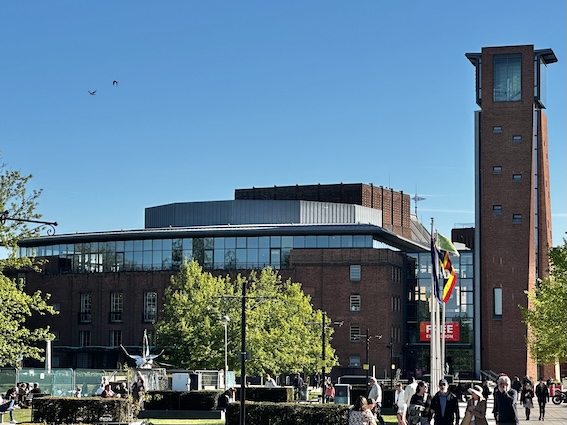
Royal Shakespeare Company
Swan Theatre
Stratford-Upon-Avon
Friday 24th April 2026, 19.30
CAST
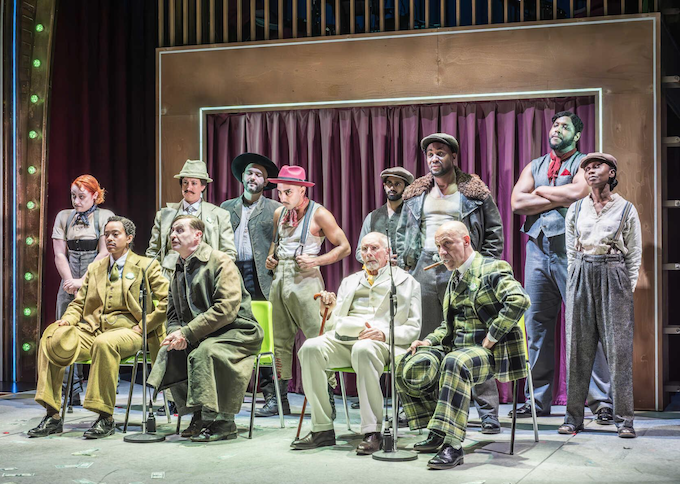
Mark Gatiss – Arturo Ui
with
Joe Alessi- Butcher / Dullfleet / Prosecution
Valerie Antwi- Ensemble / Swing
Janie Dee – Betty Dullfleet / Bowl / O’Casey / Defence
Christopher Godwin- Dogsborough / The Actor / The Priest
Mark Hammersley- Ensemble / Swing
Rebekah Hinds – Flake / Dockdaisy / Trader 1 / Henchman
Cameron Johnson- Jimmy Greenwood / Mulberry / The Judge
Kadiff Kirwan- Roma
Samuel Nunes de Souza – Ensemble
L J Parkinson – Givola
Mahessh Parmar – Dogsborough’s son / Fish / Inna / Ciceronian
Maween Rizwan – The Barker / Giri
Santino Smith – Sheet / Hook
Amanda Wilkin – Clark / Ragg / The Woman
MUSIC
Richie Hart- keyboard, guitar, trumpet
Woody Taylor- guitar, keyboard
Charlie Ward – bass gutar
Toby Ollis-Brownstone- drums
A new production. A new translation, as ever with foreign language plays. Last time we saw it, Bruce Norris’s translation placed it directly in Trump’s MAGA America. Brecht intended it to be a direct allegory on current events, so it worked. The play was written in 1941, but not performed in Germany until after Brecht’s death (1956). The first translated version in English was written in 1957, performed in 1958.
Arturo Ui represents Adolf Hitler. Hitler becomes a gangster based on Al Capone. The conceit is that the battle is not for bootleg liqour, but control of the Chicago market in cauliflowers. The Mafia connection to truck farming was always strong. The Reichstag fire is portrayed as an attack on a yard in Chicago. The Röhm pusch (here Roma) or night of the long knives, when Ernst Röhm and other leading brownshirts were killed in 1934 is paralleled. The events of the Anchluss, Nazi Germany’s take over of Austria, are switched to Chicago (Germany) and Cicero (Austria). Dullfleet is Dolfuss, the Chancellor of Austria from 1932 to 1934 who was murdered by SS men.
Sur-titles accentuate the parallels throughout by having the text of what was happening in Germany. You won’t have to think hard to match play and historical events. There are fifteen scenes, all dated in the titles projected above the stage, running from 1929 to 1938. Other titles are projected with the scene number and locations:
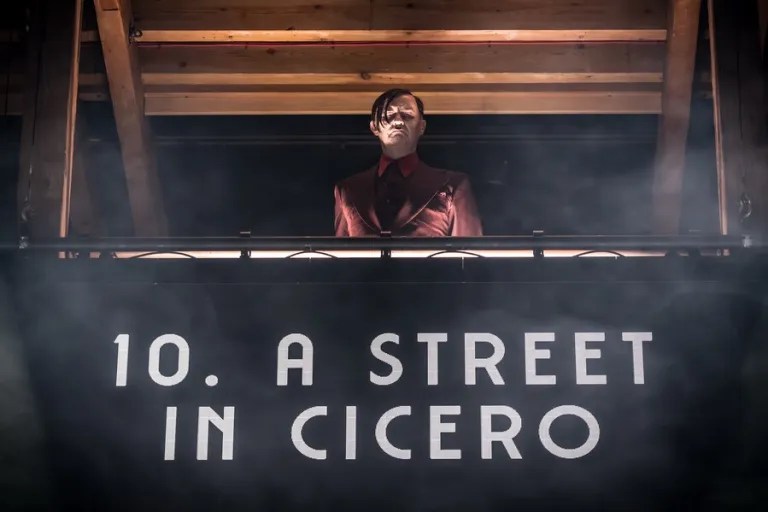
The rise of Hitler took place nearly one hundred years ago. My generation are steeped in the aftermath of the war, and read about the rise of the Third Reich. I would have liked to draw the parallels myself, rather than have them signposted, but then I did a third year Politics option on the rise of fascism. I suspect a younger audience needs help to join the dots. So Dogsborough is the ineffectual President von Hindenburg, Giri, collecting hats is Goering, who collected artworks. The thuggish bodyguard Roma is Ernst Röhm. Givola is Goebbels.
Brecht devotees tend to be somewhat sniffy about the play:
The Resistible Rise of Arturo Ui (1941), a comic allegory of Hitler’s rise to power in terms of the life of the gangster Al Capone … reveals an odd flippancy of treatment. It has some of the humour, and none of the sentimentality of Chaplin’s similar allegory, The Great Dictator, and yet shows no signs of the deep personal concern of Chaplin’s film. Brecht’s aversion to tragedy seems to have led him into a degree of banality
‘Brecht’ by Ronald Gray, Writers & Critics Series 1961
To me that’s why the 2017 Trump related version with Lenny Henry worked well. Sir Ed Davey described Trump in parliament in April 2026 as a ‘dangerous and corrupt gangster.’
This veers towards Mel Brooks Springtime for Hitler in The Producers. It goes for maximum theatricality. The cast mainly play three or more roles each with major costume and wig changes between. For the actors, this is REALLY hard work.
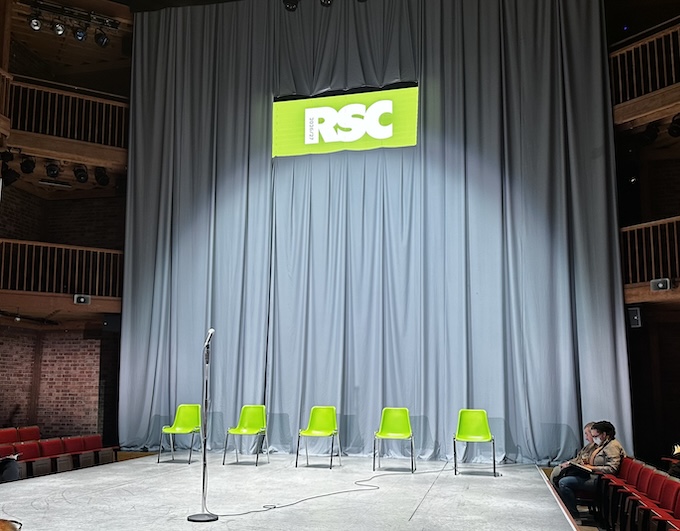
You know you’re in the RSC from the projection above, so you are distanced from the action. The set is screened and curtained off before it starts, and Maween Rizwan does a stand up intro routine, and very well too, before introducing the main characters, of which he is one, Giri. They come through the theatrical curtain, wave and take their seats. Brecht’s original introduction is verse, but it needed impro and audience tie in as here.
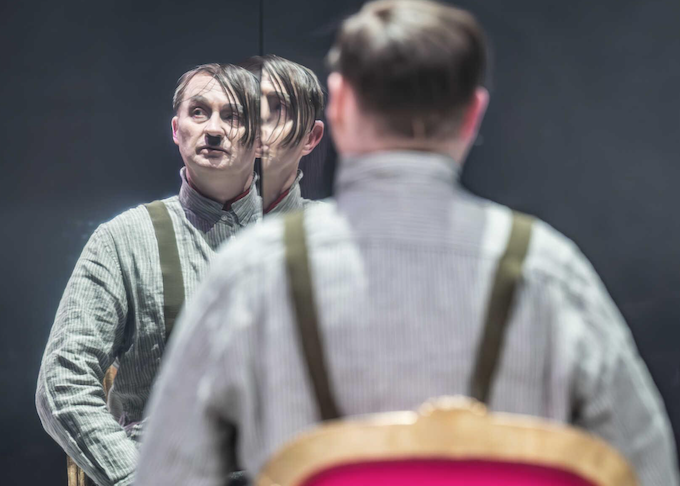
Mark Gatiss is Arturo Ui. Last time we saw him he was a stately balding John Gielgud in The Motive & The Cue. You would never know that this was the same actor.
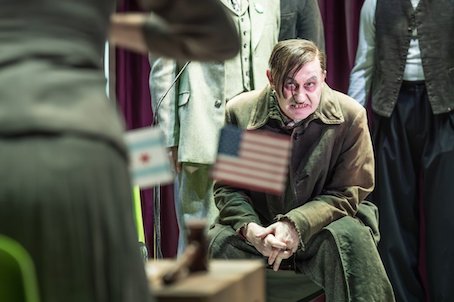
His rise from slimy sleaze in a dirty old man raincoat to powerful and evil dictator is inexorable. Gatiss is reptilian, truly horrific.
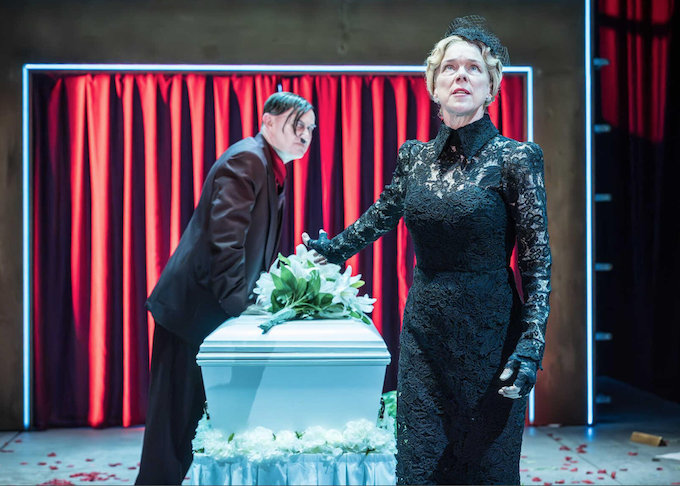
There is a point when he licks Betty Dollfluss’s face next to her husband’s coffin (a Mark Rylance ploy in Richard III, by the way). Overall it’s a powerful and staggeringly good performance by Gattiss.
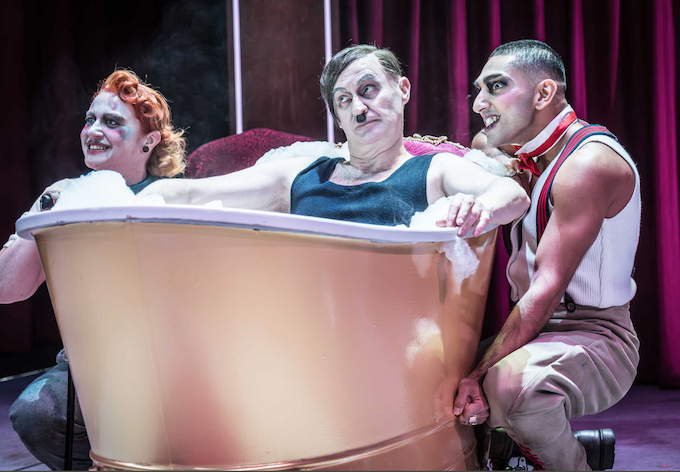
Brecht had placed Ui’s headquarters as the Mammoth Hotel. The symbol of a mammoth is used hanging above the set in parts – in the production, the bathtub has a gilt mammoth stuck on at the front (not here). The bathtub only has bubbles in the photo gallery too. There were no bubbles on stage, so I guess they found getting him wet was impractical. The mammoth represents an elephant, the symbol of the G.O.P. or the US Republican party. I suppose that’s the closest Trump reference and moderately subtle for a Brecht play.

A key scene is when Christopher Godwin as ‘The Actor’ teaches Ui how to walk, gesture and stand, using the Mark Anthony Friends, Romans and countrymen speech from Julius Caesar, which Ui has to repeat. Ui evolves the walk into the goose step. All these fascist dictators were theatrical, in dress, pose and delivery.
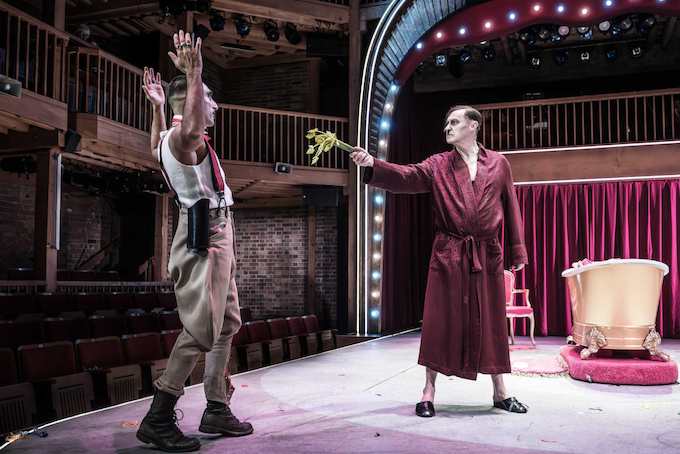
The absurdity of the parable, the context being the gangster takeover of the vegetable markets, starting with cauliflowers, is stressed by the weapons being vegetables, but with loud sound effects.
A branch of Brussels sprouts (I think the word in the supermarket is a ‘tree’) becomes a Tommy gun, sweetcorn cobs are revolvers, Giri holsters a carrot. Ui has celery.
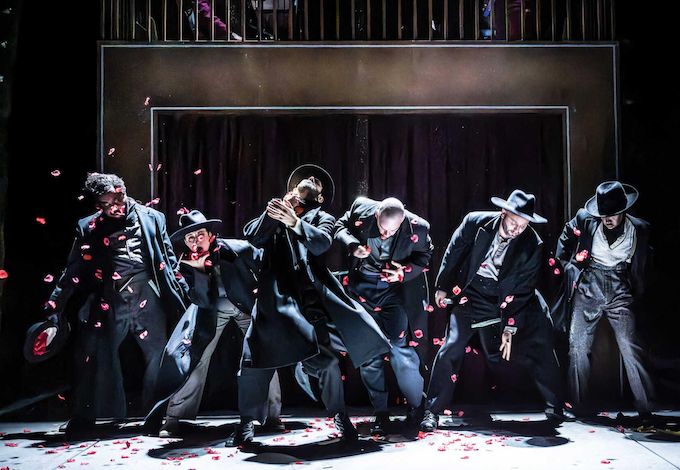
The St Valentine’s Day Massacre machine-gunning is a major effect with lights music and a long quivering dance of the victims, all done with pointing the tree of Brussel sprouts. Then they throw out red petals and end up in a heap holding flowers. Yes, it looks and sounds so good.
Costumes are theatrical, clown like as is make up. Dogsborough’s son is bearded playing a little boy.
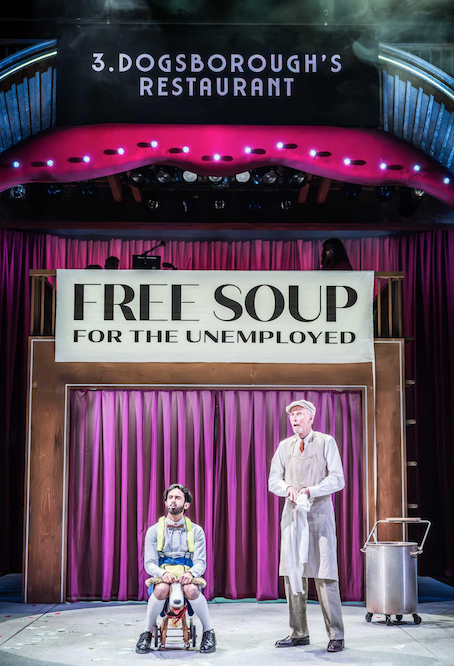
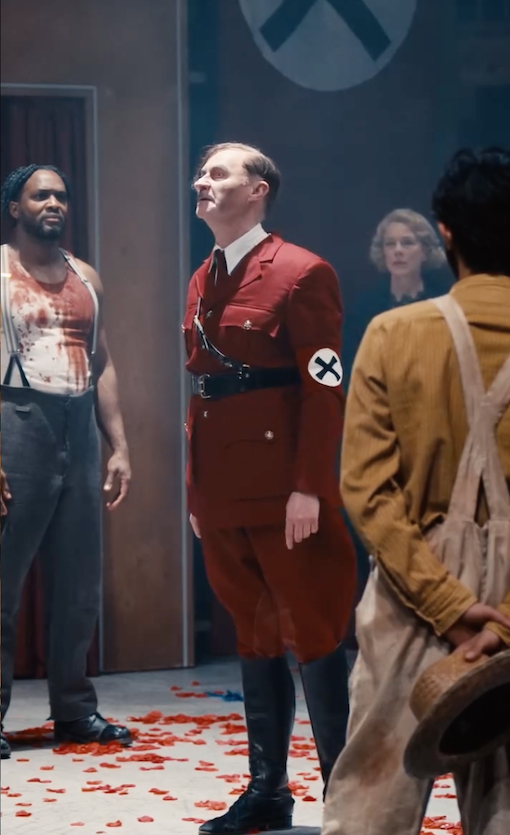
Arturo Ui progresses from dirty raincoat to smart brown suit (brown shirts?) with red shirt (National SOCIALISTS) to eventual scarlet military uniform. They get those strange Fascist trousers too. Germany, Mussolini’s Italy, Franco’s Spain- they all went for them. Most weirdly the trouser style with jackboots persisted in US Sheriff’s Dept uniforms in several areas of the USA. At the end the three main Nazis are in elaborate scarlet “SS” uniforms with the X symbols replacing Swastikas, and even Betty Dullfleet has an X armband. They have the trousers and jackboots. Those uniforms have a powerful effect. There are no photos in the RSC gallery, so I expect they were holding the effect for the live show. Similarly they didn’t photograph the great “acting class” scene with goose steps.
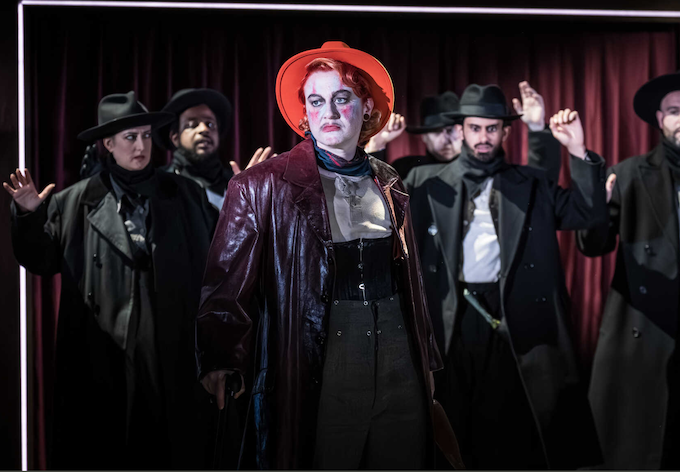
L J Parkinson plays Givola, with walking stick and limp (which others call fake). Givola is the enigmatic and manipulative figure representing Goebbels, the head of propaganda. Al Capone used florists’ shops as a cover, so here Givola runs a florist’s shop. In the programme, L J Parkinson is identified as “they” and does a drag king act. There was a whiff of sexual ambiguity about the SS.
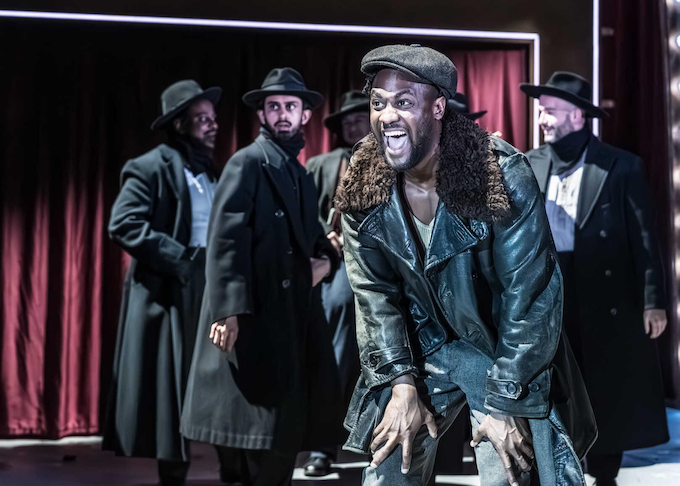
Kadiff Kirwan as Roma is convincingly thuggish. Roma is the bodyguard who has been with Ui for eighteen years since the beginning, until Giri and Givola gang up to persuade Ui to eliminate him
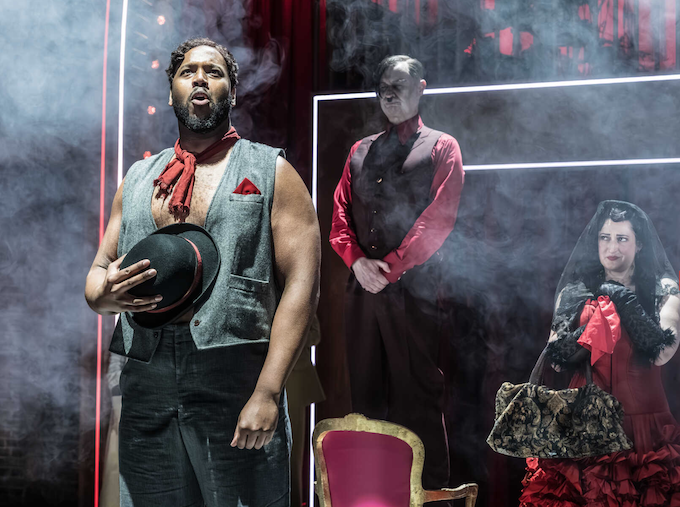
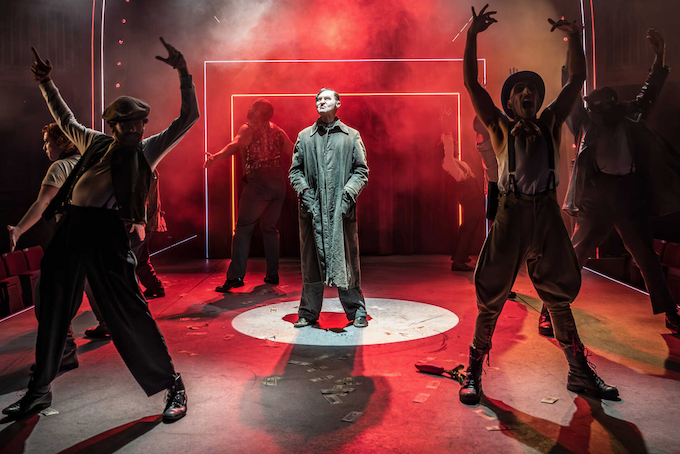
Wisely, the direction here goes with Brecht’s short distinct scenes rather than attempting the impossible task of making it flow. The text goes with the era and style too, largely escewing any attempt to update references to 2026. The scenes are staccato. The live electric band, on view clearly above the stage accentuate this, as does rapid lighting and sound effect changes. There are dance sequences (or dance-like). The music is by Placebo.
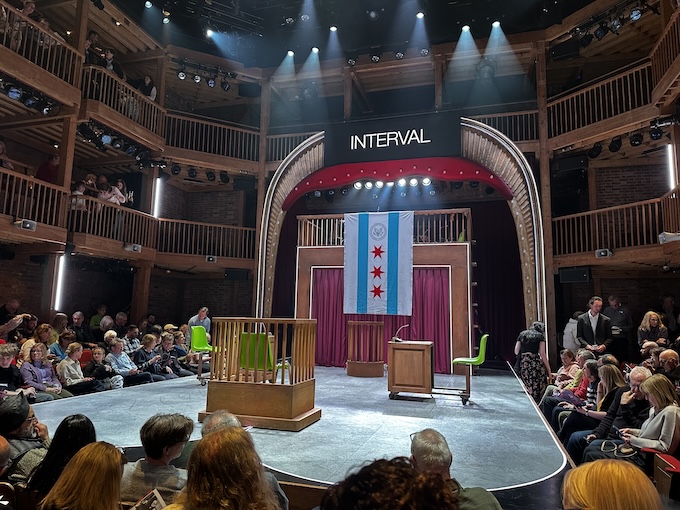
Some pieces are masterly stagecraft, most especially the trial scene in Act Two, where the lawyer, accused and defender are on wheeled platforms, and the stage is totally reconfigured in a series of fast blackouts. Now you see the back. Flash. Now you see the front. Flash. 180 degree turn again.
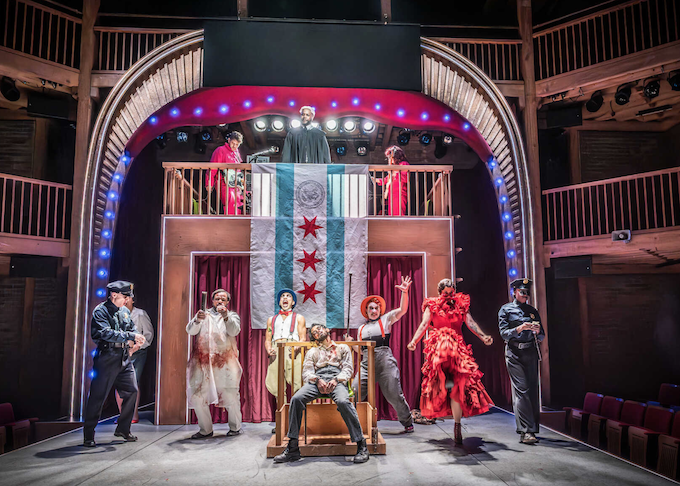
Fish (Mahessh Parmar), the accused is a fall guy, drugged, beaten, blood spattered and set up as the arsonist. The warehouse was burned down (a parallel to the Reichstag fire) and we had seen Giri and accomplices crossing the stage with cans of gasoline. The man sentenced to death over the Reichstag fire of 1933 was an unemployed Dutchman, and he was said to be drugged throughout his trial.
The prosecutor in gold chains and wig makes a mockery of any legal process, sucking a lollipop. The judge stands glaring down from the top gallery. The defending counsel is threatened, ‘We know where you live.’ Stunning direction and production.

The decision was to let the 2026 mad dictator connection to be in your head. They don’t push it, though momentarily when Ui is accused, he sounds like Trump, but only a hint. When he talks about false accusations in the newspapers, I was willing him to say ‘Fake news’ but he never does.
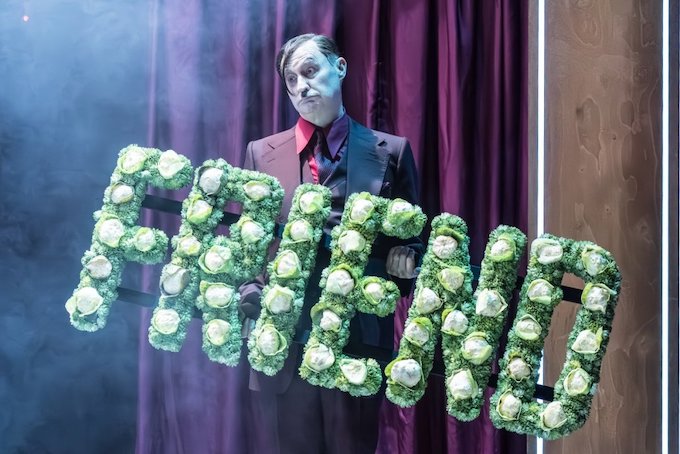
The only current link, as Brecht intended, is when the Epilogue appears, and Mark Gattiss switches to his normal voice, and says ‘The bitch that bore him is in heat again.’ (The 1957 Ralph Mannheim translation is ‘The womb he crawled from is still going strong‘ which is why I wanted to read the current translation). The Mannheim translation has no F bombs. Gangsters kinda need them.
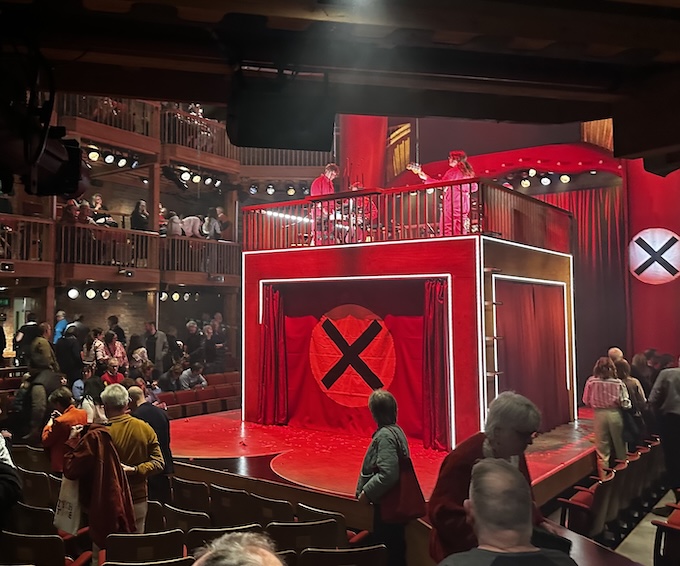
A staging point is the use of a box, with the band on top. It can slide right forward, then back to reveal a scene – Arturo Ui in a bath, or Dullfleet’s coffin. It can slide forward to conceal the slaughtered bodies, then go back with them. It’s a great idea, better than a revolve on the Swan Theatre thrust stage.
The new translation mixes prose and verse. I was extremely annoyed to buy the programme and the text next to it, only to find out afterwards that the text is the 1957 Mannheim translation NOT the one I want to read, which is this text. The RSC should make that clear in the shop. I am so used to seeing programme and text side by side at the counter that I assumed it was the one we’re seeing. Not. Also, the slightly blurry print of the text is photoset from an earlier edition.
When I say the effect is necessarily Brechtian, it’s not a compliment. For me, Brecht was always too heavy-handed in drawing his parables, or allegories. Brecht’s short scenes with bleedin’ obvious references don’t lend themselves to flow. He is not a master of dialogue interaction nor characterisation, but then he never wanted to be. He stressed ‘distancing’ so as to tell a story factually and coldly. He proposed ‘epic’ theatre as opposed to ‘dramatic’ theatre with its irritating (to him) insistence on tragedy, and character and audience emotional involvement. BUT Brecht saw Fascism as clown like and absurd, and this is how he wanted it played. Note most playwrights might have gone for “The Rise of Arturo Ui”, but Brecht has to point out that they should have resisted it. He can’t help the wagging finger.
In terms of production, acting, direction, design, lighting and music this is a true five star production. It has massive impact. I’d call ita “must see.” It still can’t disguise Brecht’s obviousness, and stilted text. That’s why overall, a four for me.
****
WHAT THE CRITICS SAID
Five star
Arifa Akbar, The Guardian *****
Graham Wyles, Stage Talk *****
The Real Chrisparkle *****
Four star
Domenic Cavendish, The Telegraph ****
Dave Fargnoli, The Stage ****
Michael Davies, What’s On Stage ****
LINKS ON THIS BLOG
BERTOLT BRECHT
Life of Galileo by Bertolt Brecht,
The Resistible Rise of Arturo Ui (Lenny Henry), Donmar 2017
MARK GATTIS
The Motive & The Cue, National Theatre 2023
Operation Mincemeat (film 2022)
The Unfriend, by Steven Moffat, Chichester 2022 (DIRECTOR)
Dad’s Army (film, 2016)
Coriolanus (NT Live), 2014
CHRISTOPHER GODWIN
The Grapes of Wrath, National Theatre, 2024
The Crucible, Old Vic, 2014
Candida, Bath 2013
A Midsummer Night’s Dream, RSC 2011
The City Madam, RSC 2011
Cardenio, RSC 2011
JANIE DEE
1984, Bath 2024 (filmed section)
The Motive & The Cue, National Theatre 2023
Follies, National Theatre 2019
Ah! Wilderness, Young Vic 2015
CAMERON JOHNSON
Guys & Dolls, Bridge Theatre 2023

