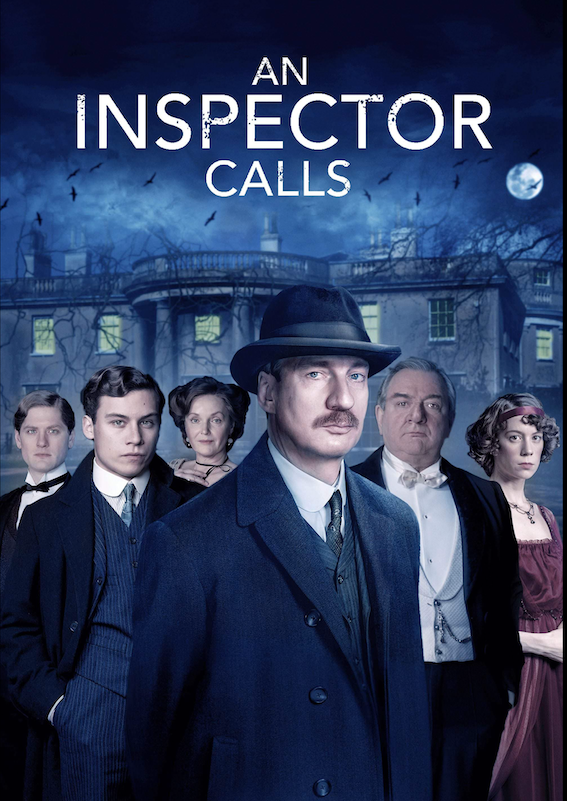
By J.B. Priestley
Adapted for film by Helen Edmundson
Directed by Aisling Walsh
Music by Dominik Scherrer
Originally broadcast on BBC 1 in September 2015
Currently in BBC FOUR “Performance” series on iPlayer (October 2026)
While it is a TV film, I am putting it in the stage section with other filmed plays.
CAST
David Thewlis – Inspector Goole
Sophie Rundle – Eva Smith aka Daisy Renton aka Alice Grey aka Mrs Birling
Chloe Pirrie – Sheila Birling, the daughter
Finlay Cole- Eric Birling, the son
Miranda Richardson – Sybil Birling, the mother
Ken Stott – Arthur Birling, the father
Kyle Soller- Gerald Croft, Sheila’s fiancé.
+
Lucy Chappell- Edna, the maid
Gary Davis – Alderman Meggarty
We saw this in 2015 on TV and I didn’t contemplate reviewing it at the time. Since then grandkids have done it for GCSE, and have seen it at school and been enthralled. We noticed it on BBC FOUR in the “Performance” section, and decided to watch again.
The play was first produced in Russia in 1945, as London theatres were booked solid as World War Two ended. It opened in London in 1946 with Ralph Richardson, Margaret Leighton, Harry Andrews and John Gielgud. There was a film in 1954 with Alistair Sim as the inspector. In the 1954 film, his name was changed from Inspector Goole to Inspector Poole. A Bradford author would have found Goole amusing.
In the 50s and 60s it was beloved of repertory companies and AmDram groups, having just the right size of cast. We saw a tour at Bournemouth Playhouse Theatre in 1974. Bill Fraser was the inspector. Both of us recall Arthur Lowe and his wife in it at Bournemouth Pavilion too, but can find no record.
In 1992 Stephen Daldry put it on at the National Theatre signalling its new reputation as a GCSE standard. That National Theatre production toured on and off for years eventually ending up with a 30th Anniversary tour in 2022. There seems to be another planned for 2027. I think we’ve seen this version twice, Karen thinks three times. We had assumed we were going to a new production, but walked in, saw the set, and realised we weren’t. Though it was a different cast. It has impressed our grandkids as they explained that Inspector Goole sounds like Inspector Ghoul, so we assume it’s in a Pass Notes set. I can’t check. My younger granddaughter has them.
The major difference with the stage play is that the girl who commits suicide, Eva Smith, is made manifest with flashbacks showing the incidents which led to the shared guilt of the five people at the dinner party. She gets several lines too.
The ending is extended, and the final impassioned speech by Inspector Goole, often cut, is reinstated. The idea of flashbacks to scenes with Eva Smith originated in the 1954 film version, and were longer than those in the 2015 version with even more lines.
A repeat for students who might stumble onto this. The flashbacks are NOT in the GCSE play. The events are described in the play by characters.
The scenes in the dining room are very much as in the stage play.
It’s set in 1912. Priestley wrote it at the end of World War Two, but set it before the start of World War One. I have a theory on why novels and plays are often set thirty to fifty years in the past. Hardy, Austen, Dickens … they all did it. The war was looming. The old order was coming to an end. It’s a class that’s going. Capitalism. It fits the theme summed up in Goole’s final speech:
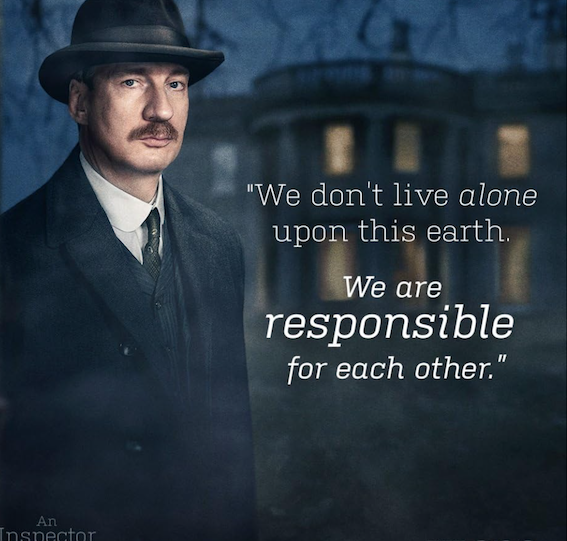
Inspector: We don’t live alone upon this Earth. We are members of one body. We are responsible for each other. And I tell you that the time will come soon when, if men will not learn that lesson, they will be taught it in fire and blood and anguish. Good night.
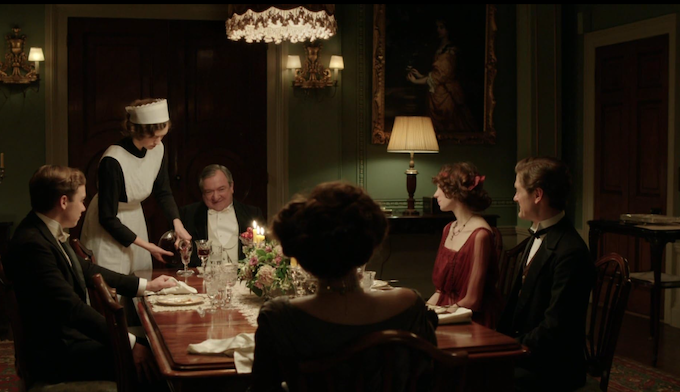
A recap to show the pictures. It starts with a convivial dinner party at the Birlings’ mansion. It’s very posh – white tie and tails. Sheila, the daughter is getting engaged to Gerald Croft, the heir to a rival company, thus uniting the two businesses. It takes place in Brumley, and we assume that it stands in for J.B. Priestley’s Bradford. Gerald (Kyle Stoller) produces an engagement ring for Sheila (Chloe Pirrie). It’s happy (wealthy) families, except that the son, Eric (Finlay Cole), is drinking too quickly and too heavily, and is admonished by his mother (Miranda Richardson).
After dinner, the women will retire to the drawing room, while the men stay in the dining room for port and cigars. This is a formal custom I’ve only experienced once with our 1980s doctor who invited us to dinner. I’d always imagined it was a time for dirty jokes, but it was explained that the women would not like cigar smoke contaminating their hair and evening dress.
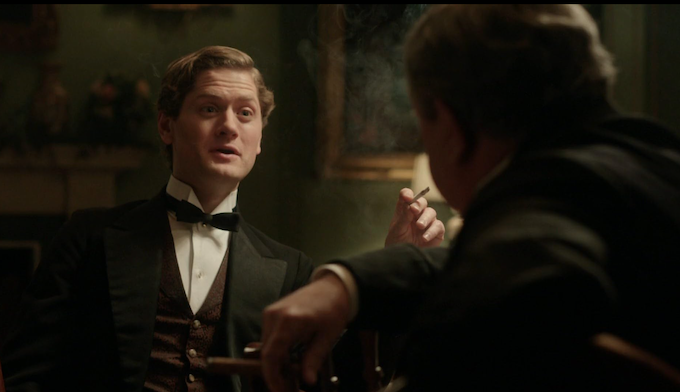
Eric had brought up the prospect of war, but Arthur is confident that united as they were in the pursuit of wealth, there would not be one. The men retire. Arthur Birling (Ken Stott) tells Gerald that he has hopes of an imminent knighthood.
The maid, Edna, comes in and announces that Inspector Goole (David Thewlish) has arrived. He explains that earlier that day he had seen the dead body of a young woman named Eva Smith, who had died by drinking disinfectant. He has been given the duty of investigating her death. He has seen her diary, which mentions members of the Birling family.
Goole shows Arthur her photo, being careful not to let Gerald or Eric see it. Arthur recalls her.
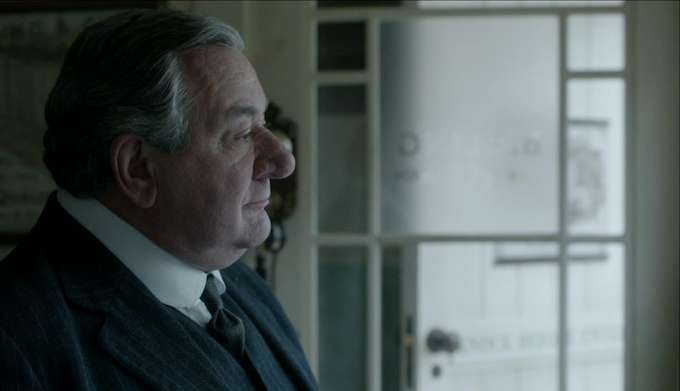
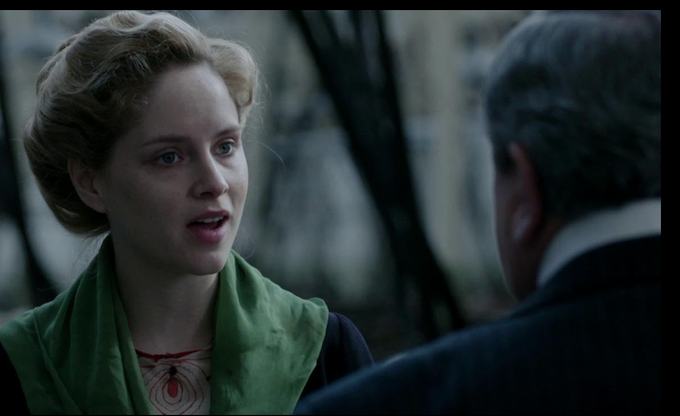
We go to a flashback of the factory. Two years earlier Eva (Sophie Rundle ) was a leading member of a group of women asking for higher wages, and this led to a strike. When the women return, he sacks Eva Smith as a ringleader.
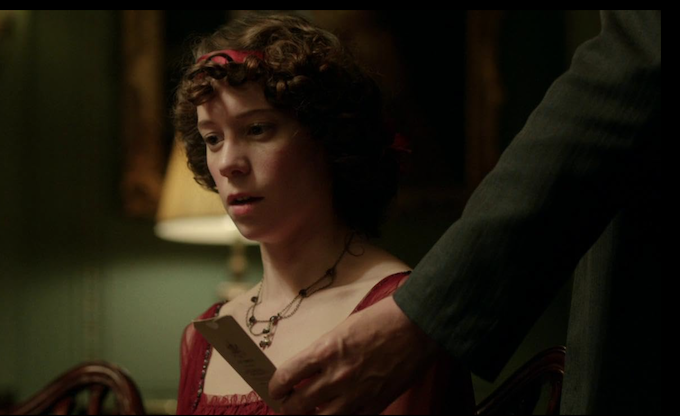
The inspector shows Sheila a photo. She recognises the girl. I can’t check it, but in the play and the 1950s film, I sense there’s more coming and going, and that in this version more of them are in the dining room at once.
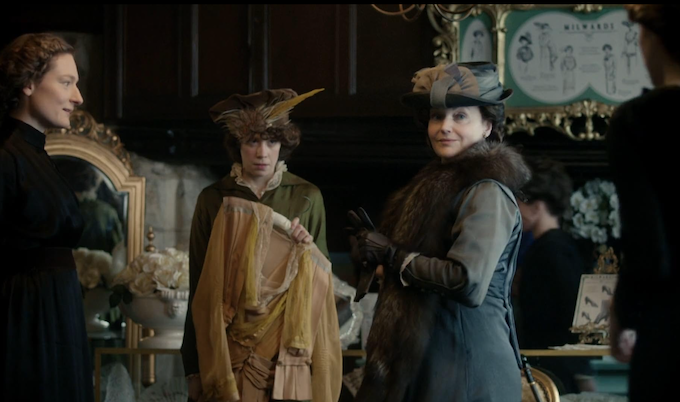
We are into flashback. Sheila was with her mother at a department store. She liked a dress which her mother thought unsuitable for her. The junior assistant, Eva Smith, holds it up against herself. Sheila had a fit of jealousy at the prettier Eva, and accuses her of smirking at her. She demands she be sacked or the store will lose her mother’s account.
From this point, Sheila is the one who feels real guilt, She has also realised that the inspector knows more, and in turn tries to warn the others.
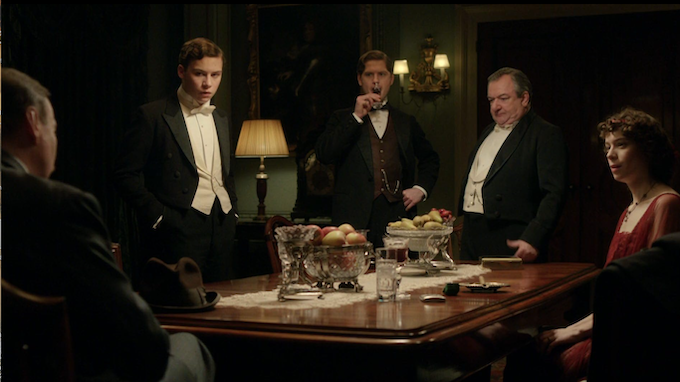
The inspector says that having lost her job, the girl changed her name to Daisy Renton. Gerald is shocked rigid. At this point Sybil is getting very uppity with the inspector and wants to change the subject. Gerald describes meeting her, and spending the previous spring and summer with her.
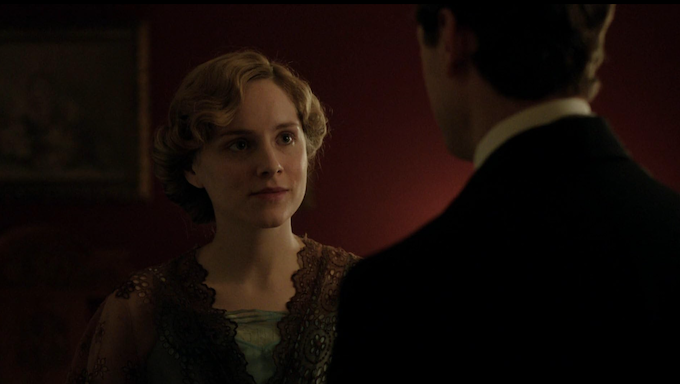
Flashback. He met her in the bar at the Palace Variety Theatre, known as a hang out of “women of the town”. She was being mauled by the fat, vile Alderman Meggarty. He rescues her. He finds she has been thrown out of her flat and offers her accommodation in a friend’s vacant flat. The friend is abroad and Gerald is taking care of it. He escorts her there and says he’ll return the next day. Gerald is a knight errant, des not push himself on her, but she is grateful, and he is handsome.
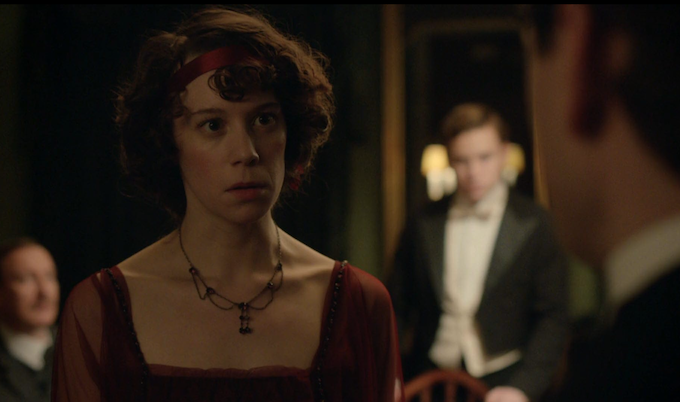
Sheila returns Gerald’s engagement ring, while commending him on his honesty.
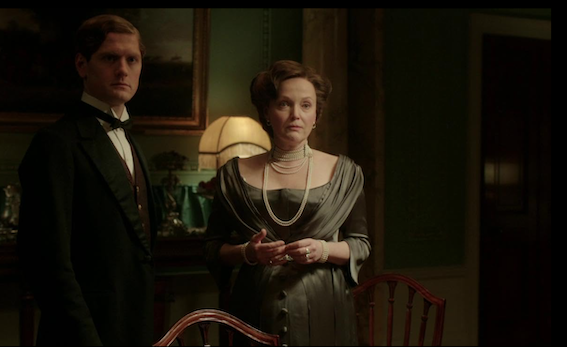
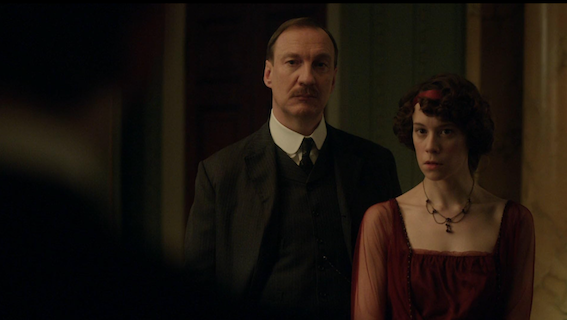
Gerald and Sybil v The Inspector and Sheila
Next up is Sybil. Sybil has been the haughtiest and most aggressive to his questions. We sense that Sheila is on the inspector’s side. Sybil was head of a charity to help women in need.
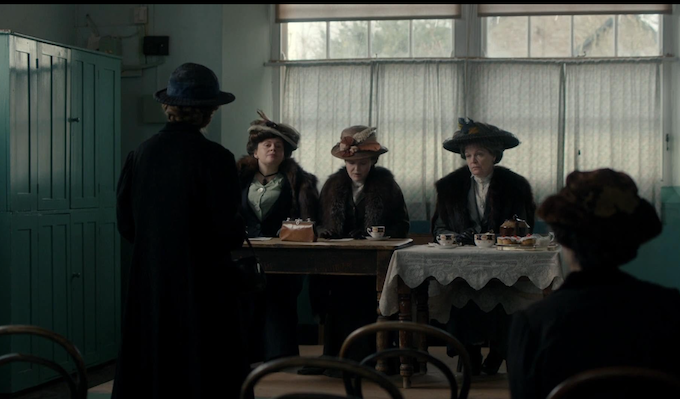
Flashback. Eva Smith had turned up, and infuriated Sybil by calling herself Mrs Birling. She convinces the committee to ignore the girl’s plight. She is pregnant. Sybil blames the drunken young man who fathered the child. The inspector is leading her on.
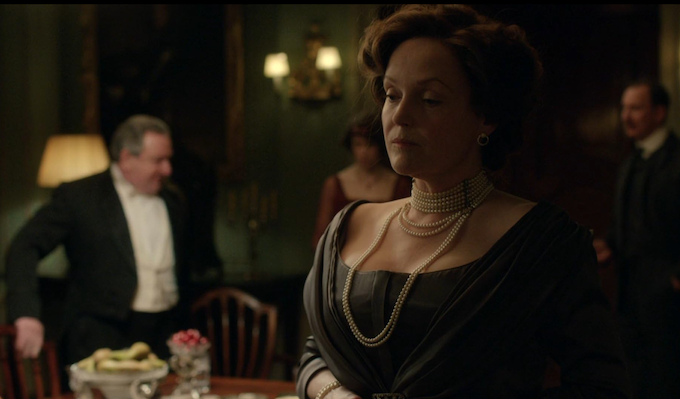
The rest of the family, except Sybil, sense that Eric is the young man in question, and “Mrs. Birling” was the first name that had come to Smith’s mind because he had fathered her child.
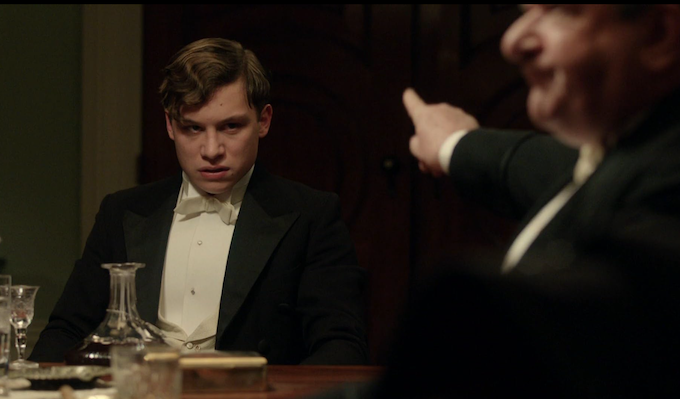
Eric is last up. He looks around.
Eric: You know, don’t you.
Inspector: Yes, we know.
Eric had also met her at the Palace bar. He was, as usual, drunk. He insisted on accompanying her home. He forced himself on her. i.e. rape.
Eric: Well, I was in that state when a chap easily turns nasty …
That’s how the play does it. In the flashback he forces her against a wall. He seeks her out later and they start a kind of relationship. She needs support, and to get money, he fiddles some invoices at work (he works for his father) and steals £50. Wiki says that’s nearly £5000 in modern terms but the online inflation calculator currently puts it at £7413. Eva refused to accept stolen money. He tells Sybil that the child, dead with Eva was ‘My child!’
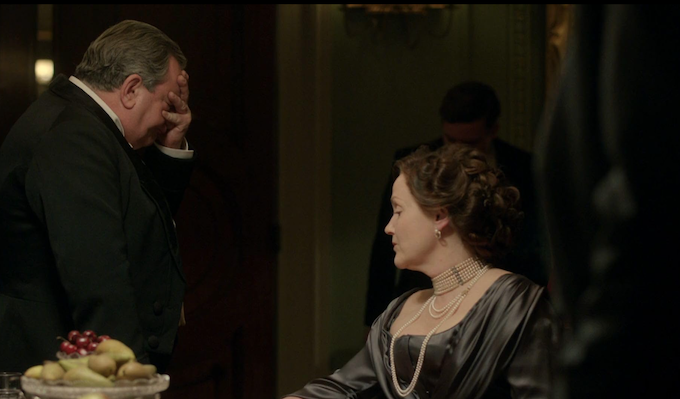
This is where the inspector’s prophetic speech comes and he leaves.
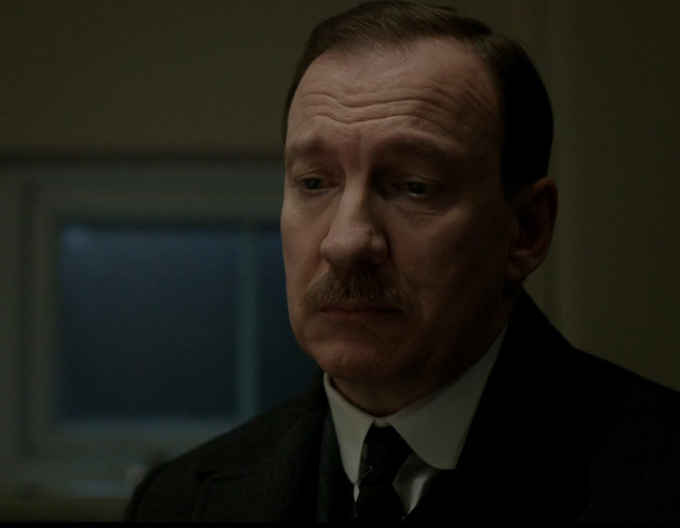
The family begin to discuss it- the terror has turned to Eric’s theft and the consequences if it gets in the papers. Then they begin to wonder about Goole. Were they all shown the same photo of the same girl? Could it be a hoax? Arthur phones the Chief Constable. There is no Inspector Goole on the police force. They phone the hospital.. No young woman has been taken in after a suicide.
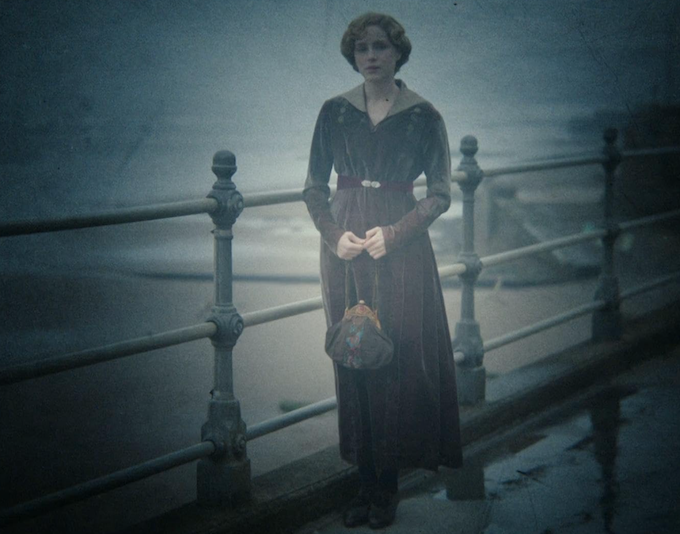
They’re relieved, well Arthur, Sybil and Gerald are. They pour more drinks and laugh. Gerald is emphatically with them. Sheila and Eric, the younger generation, stand aside in shock.
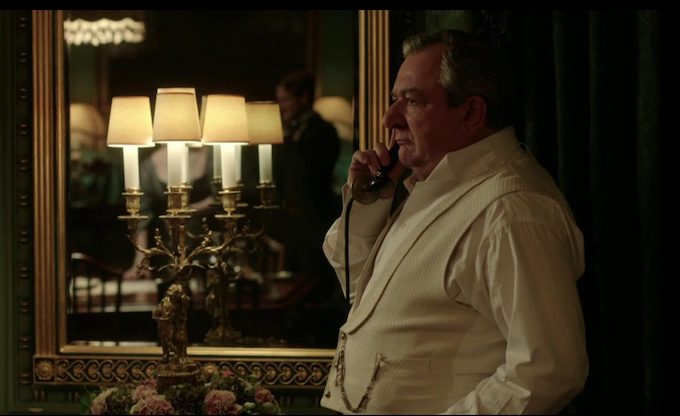
Then the phone rings. It is the hospital. A young woman has arrived after dying from drinking disinfectant. An inspector is on the way to question them.
A closing scene:
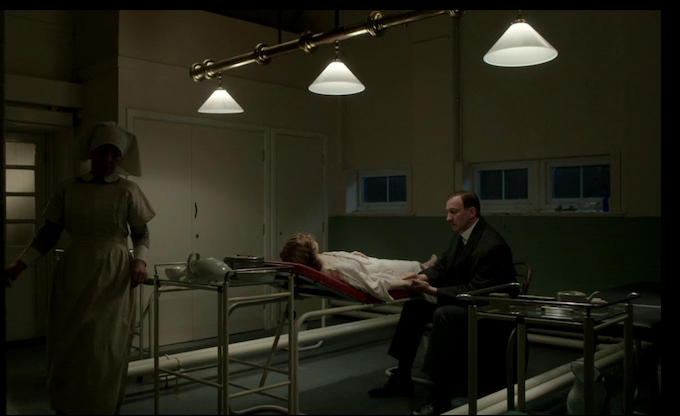
It’s a powerful version. It’s too many years since a stage version to compare it, but the flashbacks enhance rather than detract. David Thewlish is the definitive inspector too. At this point, we’ll say it’s the best version we’ve seen.
We spent so much time talking about it that we decided to watch the 1954 film the next day.
*****
LINKS ON THIS SITE
HELEN EDMUNDSON
Coram Boy, Chichester 2024 (writer)
Queen Anne, RSC 2015 (writer)
Thérèse Raquin, Bath 2014 (adaptor)
DAVID THEWLIS
The Theory of Everything, film
MIRANDA RICHARDSON
Testament of Youth (film)
Made in Dagenham (film)
KEN STOTT
The Dig (film)
The Dresser (play) Chichester 2017 (Sir)


Leave a Reply