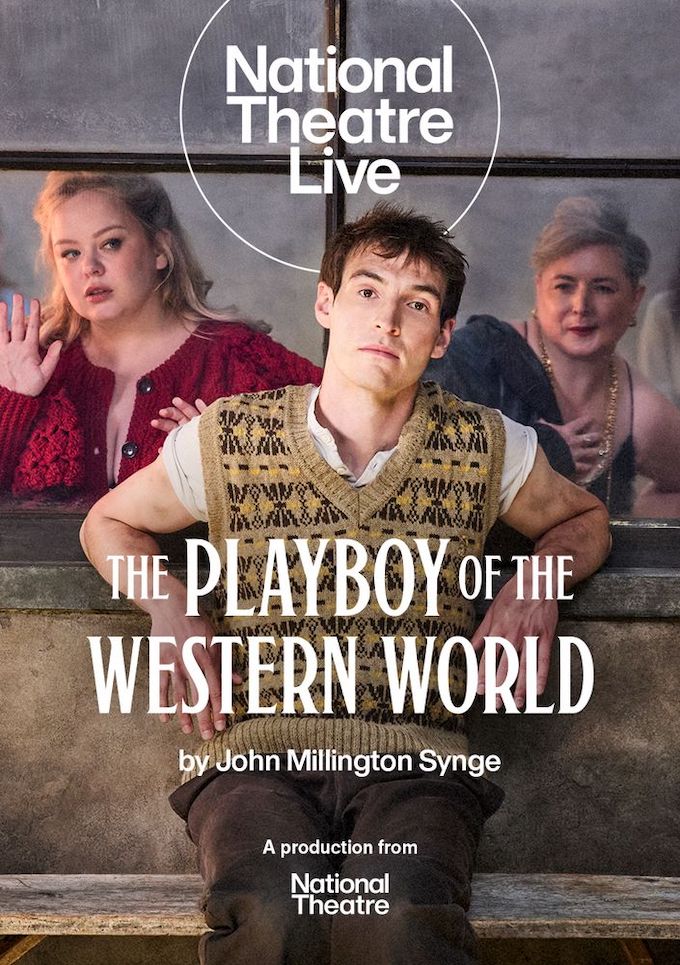
By John Millington Synge
Directed by Caitríona McLaughlin
Set & costume by Katie Davenport
Composer Anna Mullarkey
Lytellton Theatre
National Theatre
4 December 2025 to 28 February 2026
Streamed to cinemas, May 2026
Poole Lighthouse, Saturday 30th May 2026, 15.00
CAST
Nicola Coughlan – Pegeen Mike, Michael’s daughter and barmaid
Éanna Hardwicke- Christy Mahon, a man who brags he killed his father
Siobhán McSweeney – Widow Quin, about thirty
Susan Akintomide- Ensemble
Marty Breen- Sara Tansey
Declan Conlon- Old Mahon, Christ’s father
Lorcan Cranitch- Michael James Flaherty, a publican
Megan Cusack – Susan Brady
Naoise Dunbar – Jimmy Farrell, farmer
Matthew Forest – Philly Cullen, farmer
Sallay Garnett – Nelly
Fionnuala Gygax – Honor Blake
Erin Hennessey- fiddle, ensemble
Peter Mooney- banjo, ensemble
Donncha O’Dea – ensemble
Marty Rea – Shawn Keogh, a young man who loves Pegeen
We were desperate to see this at the National. It just didn’t work on schedules for us. Why were we so desperate? I’m going back fifty-five years to May 1971. I was teaching EFL at Anglo-Continental and was recruited to join the weekly drama shows. The restaurant converted to a 400 seat theatre, and it was usually full. Once a month we did a rehearsed and costumed reading of a play, and that week Colin Granger who produced the shows chose a heavily cut version of the Playboy of The Western World. I think we did selected extracts and he filled in the gaps. Issue. At that time there were only two female teachers (in a staff of 60 plus) and neither of them could act. We could recruit admin staff for small roles, and my boss knew women from his AmDram society who would come in, but they were in their forties (OK for Widow Quin). It was paid, I think £5. Pegeen is a big role and needs to be young. So Nick Keeping (later my Best Man) said, ‘I know a girl, I’ve been in plays with her. She grew up in Ireland. I’ll ask her.’
So that’s the evening I met Karen. Yes, she went to primary school in Ireland. But in Belfast. She got into acting because she was sent to elocution lessons because no one could understand her accent, and it was forced out of her. She still can’t do Belfast, and anyway it’s a LONG way from the West of Ireland. I remember at the end of the play, we said ‘We always go to a pub for a drink just down the road.’ She said, ‘Well this evening, no, we’ll go to a pub in the town centre. Near my bus stop.’ We all dutifully followed like sheep. The next day I got her phone number from Nick. That was it. Fifty-five years have passed. Seeing the play on stage for the first time solved an issue. Karen says that her first impression of me was obnoxiously drunk. Having seen it on stage she now realizes it was a tribute to my acting ability!
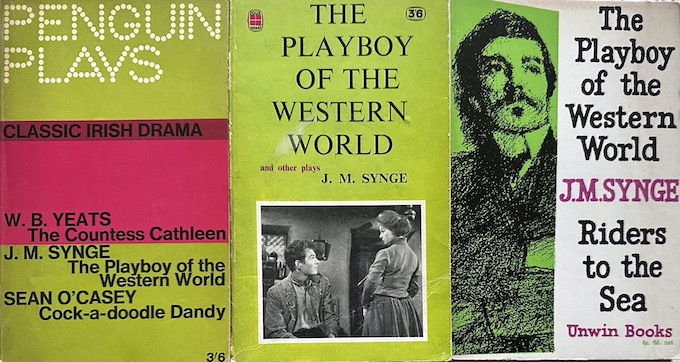
We have three copies. I think the Penguin Plays is mine, and the film tie in is Karen’s. Both 3/6d. The Unwin at 4/6d has a better print face. I can’t remember which part I played. I assume Colin Granger would have played Christy. Memory tells me I spent most of the play trying to think how to get Karen’s phone number. I was hoping to find underlining, which isn’t there, but we usually had French’s Acting Editions. It’s clear that designers thought, ‘Irish? How about a green cover?’
Sorry, the play. J.M. Synge wrote it in 1907 for the Abbey Theatre, Dublin, and this production is directed by Caitríona McLaughlin, the current artistic director at The Abbey. A friend who specializes in Irish folk music and comes from Cork told me that Synge did not so much write in Irish English, as in transliterated Gaelic, a different thing. Then modern Irish playwrights tend to follow Synge rather than actual Irish-English.
Original 1907 review, the play provoked riots in Dublin.
An unmitigated, protracted libel upon Irish peasant men, and worse still upon Irish girlhood
A friend saw it two days earlier at a different cinema and said the accent was too strong and the delivery too fast. That was worrying and the reason we gave up on Derry Girls. As with the Trinidadian accents in Driftwood recently, credits list a dialect coach. I wonder if it’s best not to go out for 100% dialect authenticity, but to lighten it a little. BUT we were OK, maybe because Poole Lighthouse’s sound system is pristinely clear. It’s not so much accent as the timing and phrasing and lilt of West of Ireland Irish, though when the landlord is blind drunk at the end, it wouldn’t matter whether he was in Advanced RP or Irish, but he was brilliantly drunk. A stellar stage drunk.
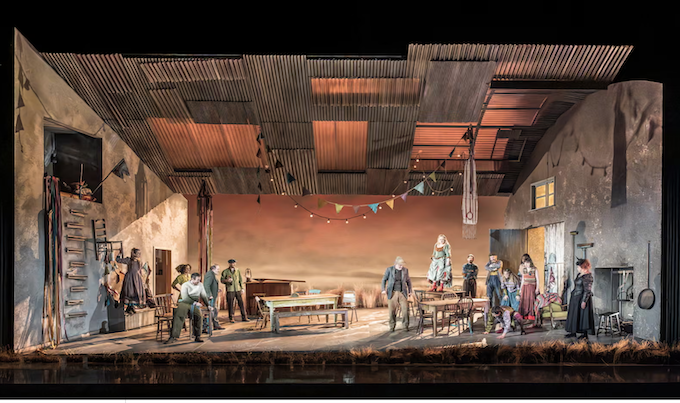
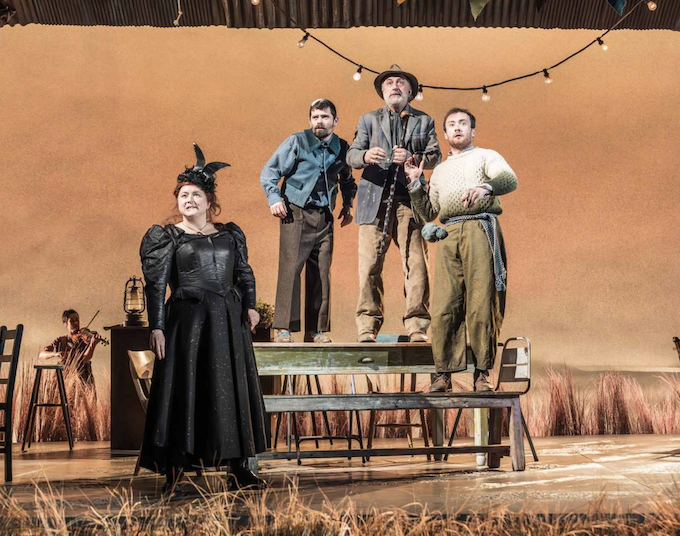
The Lyttelton stage is a challenge for every production there. It is so wide. Too wide. Here the solution is to open the back to the sky. Then they use it to have a straw clad fiddler and various straw clad folk dancers wandering up and down. This has nothing to do with the play, but the sky works well for the pub crew watching the donkey race. Then Christy’s room is in the loft, up steps stage right and the fireplace stage and entrance stage left.
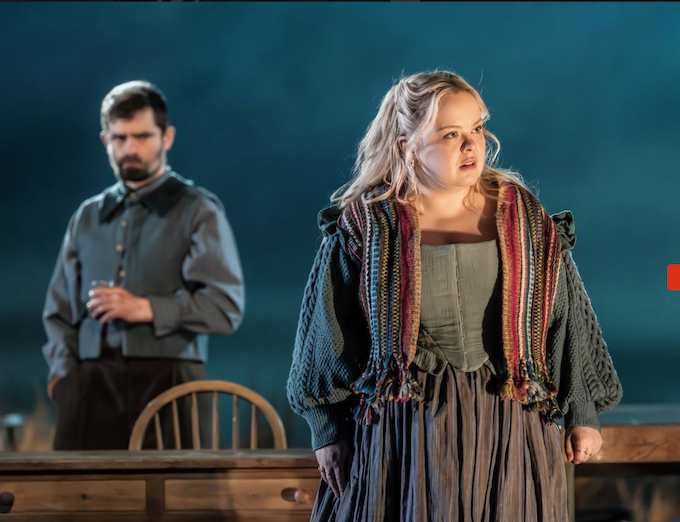
The plot in brief. Pegeen (Nicola Coughlan) is the pub landlord’s daughter and bar person. She is engaged to Shawn Keogh (Marty Rea ) who is about as wet as anyone can be. Incidentally this is an outstanding portrayal by Marty Rea. Snorts and snickers are hilarious.
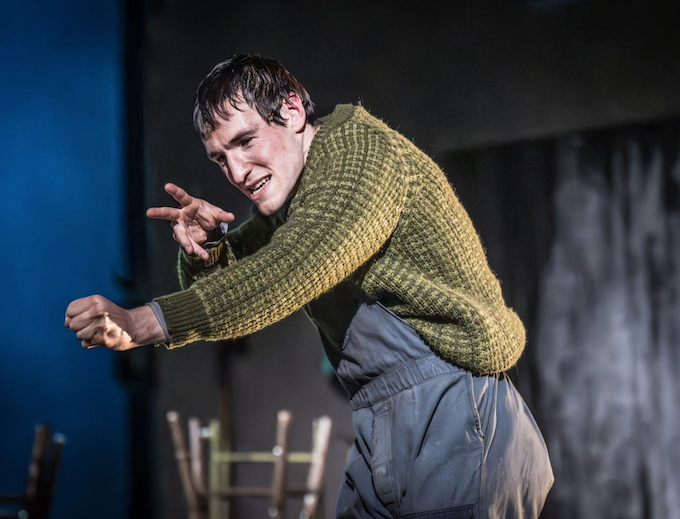
Christy Mahon (Éanna Hardwicke) turns up seemingly a drooling idiot, and after some talk says he has killed his father in the spud field with an agricultural implement. This makes him a hero among the girls, especially Pegeen. Everyone thinks this makes him a fellow of great daring. Widow Quin (Siobhán McSweeney), who might have killed her husband, is particularly thrilled, as she needs a man about the house for work, and other more intimate duties.
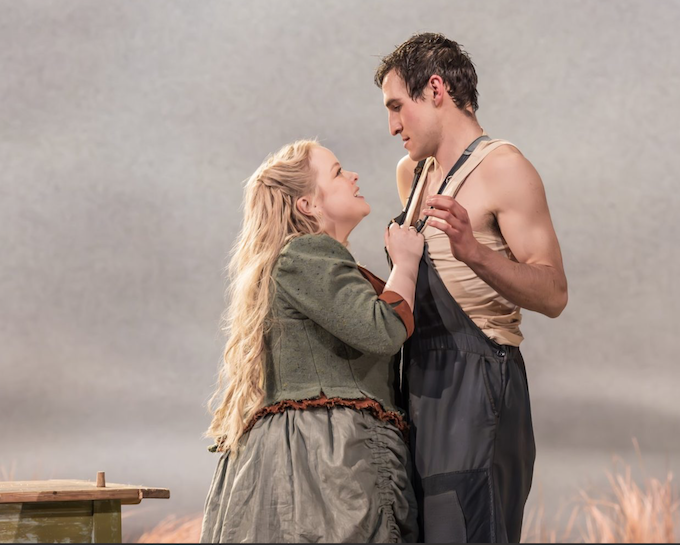
Pegeen has offered Christy a job as pot boy at the pub which he accepts.
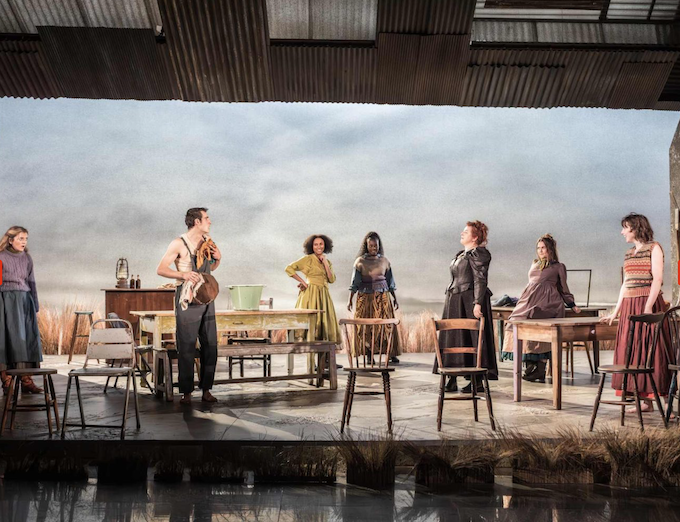
When all the village girls turn up, and they all fancy him, Christy begins to believe himself a hero.
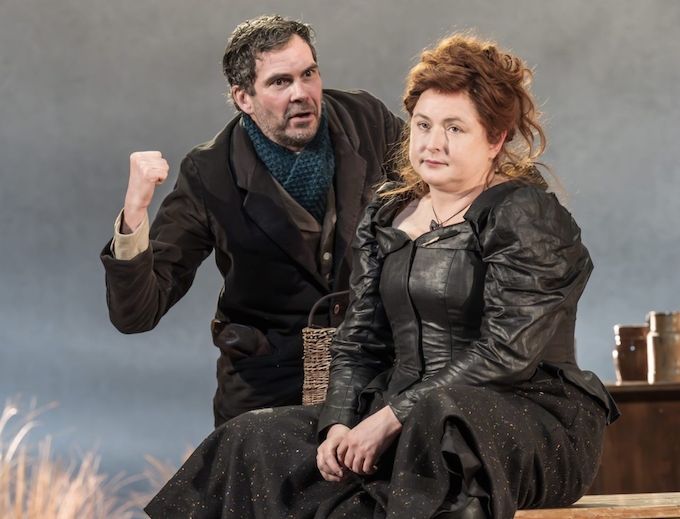
Meanwhile Shawn Keogh is persuading Widow Quin to make her move for Christy, so as to eliminate the competition for Pegeen.
Then Old Mahon (Declan Conlan) turns up with a bloody wound on the back of the head. He is Christy’s dad. Widow Quin tries to get rid of him, sending him off in the wrong direction.
In the last act everyone is paralytically drunk following a wake, and they’re watching Christy in a donkey race (off stage). Old Mahon has returned and now the pub regulars Philly and Jimmy know the story too.
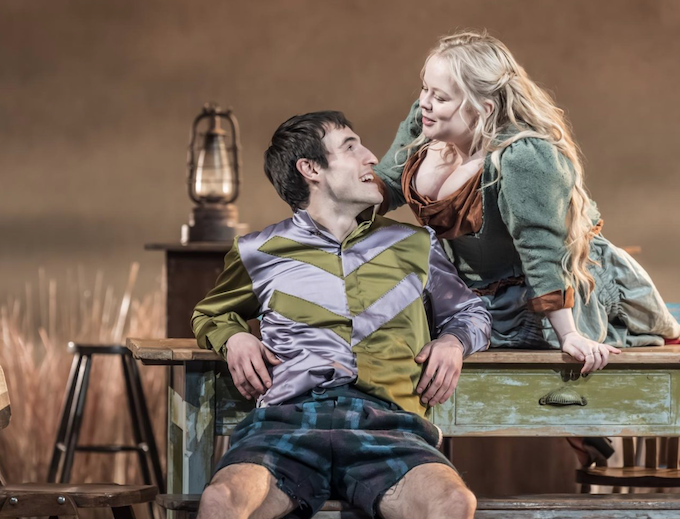
So Christy returns from the donkey race in a jockey shirt, and Pegeen is thrilled to see him.
The landlord, Michael James Flaherty (Lorcan Cranitch) is spectacularly inebriated. The father, Old Mahon, turns up again, and a fight develops, and Christy batters him on the head again. Pegeen rejects him. Finally, the father crawls on, not dead yet, and all decide to tie up Christy for taking to the Peelers (police) for hanging, which is an extremely physical scene, involving Christy dressing up in women’s clothes to escape.
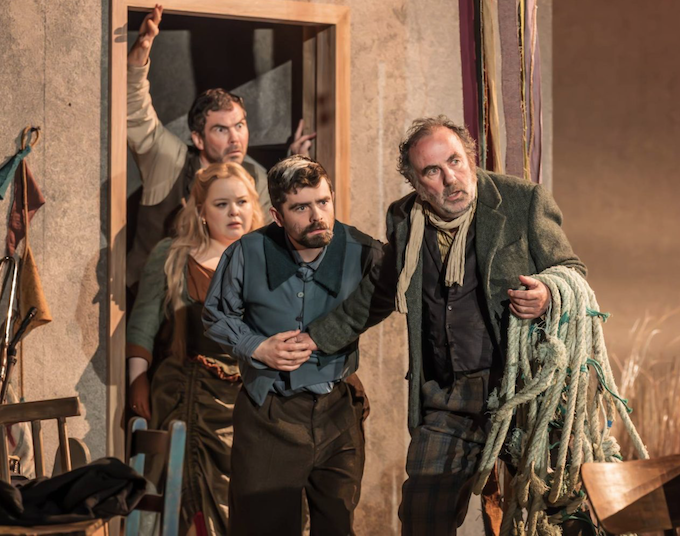
Christy and his dad resolve their differences and return to dig spuds.
There’s the ‘magic realism’ or absurd comedy amidst the violence that goes in a straight line to Martin McDonagh’s plays. The Irish lilt of the lines is intoxicating. The acting is marvellous all around. It is IRISH in capital letters in the twisted logic sense.
We were surprised to see the mainly three star ratings. We both thought four star, though I reckon the difference might be down to the camera in the streamed version taking us into closer scenes. In the Lyttelton theatre with that wide stage, I can imagine it was like watching a tennis match at times, and yes, the straw costumed lot were a touch of added Irish mist that detracted rather than added. It may well be better on film.
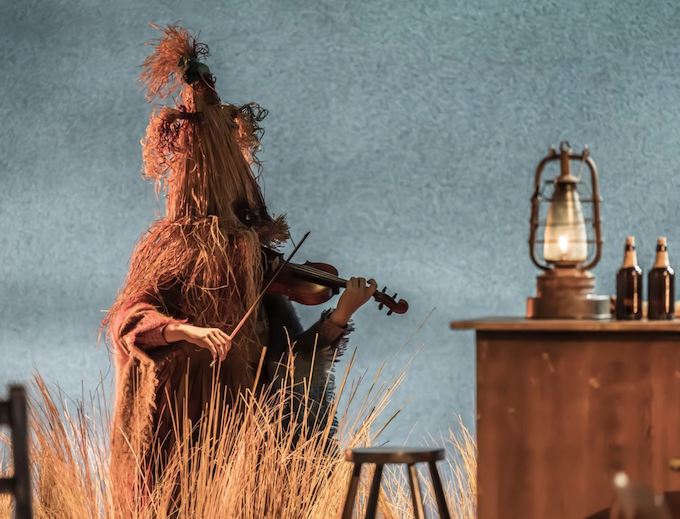
In a short while, it will be on NT AtHome, so it will be one you can see.
****
WHAT THE CRITICS SAID
four stars
Fiona Mountford, The i Paper ****
Alice Saville, The Independent ****
three star
Arifa Akbar, The Guardian ***
The play’s influence is evident: Christy might be a blueprint for Jez Butterworth’s silver-tongued self-mythologising Rooster in Jerusalem The tall tales told in the pub of Conor McPhersons The Weir may contain the imprint of Michael James Flaherty’s public house here, in which the action takes place over two days.
Nick Curtis, The Standard ***
Clive Davis, The Times ***
Claire Allfree, The Telegraph ***
Dave Fargnoli, The Stage ***
Alun Hood, What’s On Stage ***
two stars
Aleks Sierz, The Arts Desk **
The problem with casting a superstar such as Coughlan at the National is that it raises the theatre’s expectation that it can sell out its large Lyttelton auditorium. I’m sure it will, but I also think that this large stage is really not right for this particular story. Quite frankly, Michael Flaherty’s bar should be like the cramped room of Conor McPherson’s The Weir (obviously influenced by Synge). Instead, here it is a huge space like a mega urban Wetherspoon’s. A massive barn. Hardly a place of poverty. To fill the acres of empty space, director Caitríona McLaughlin, who is head of Dublin’s Abbey Theatre, adds a fair amount of over-designed folkloric business, with keening funeral processions, masked mummers and goddess worshippers galore.


Well, hurrah!- something else to look forward to on NT AtHome. I saw a NT production of the play in 1977-ish (we were Doing it for A level) with Stephen Rea playing Christy. Loved it, but- again- there seemed to be a bit too much room!
LikeLike