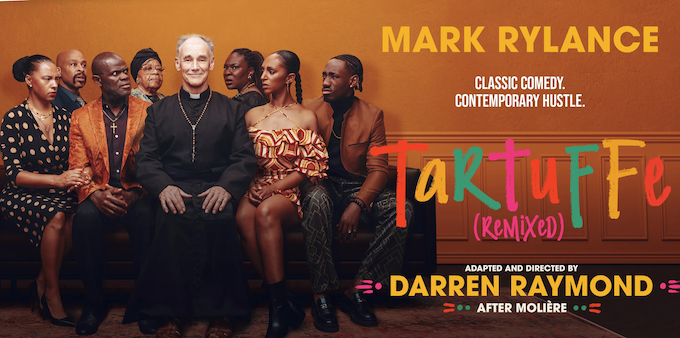
Adapted and Directed by Darren Raymond
After Molière
Designer ULTZ
Sound design & composer Duramaney Kamara
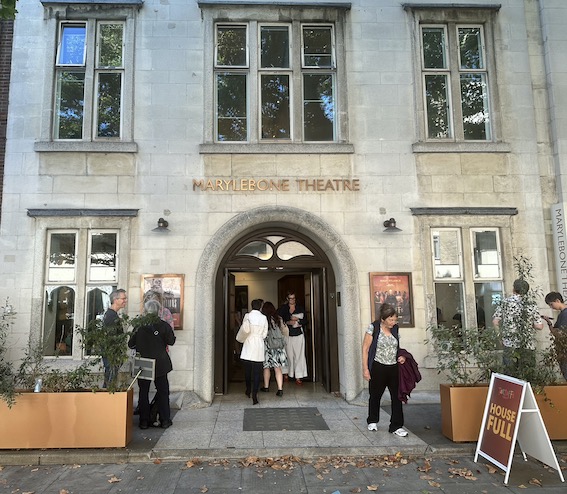
Marylebone Theatre, London
Saturday 12th September 2026
CAST LIST
NIGERIAN FAMILY
Usifa Jalloh – Oga, the father
Nakeba Buchanan – Elmire, Oga’s second wife
Sara Mokonen – Adanna, Oga’s daughter by his first wife
Christopher Mbaki- D-Miz, Adanna’s brother
Suzette Llewellyn – Grandma, Elmire’s mother
JAMAICAN FAMILY
Craig Blake – Delroy, the father
Ivandro Da Gruz Leite – Sinclair, his son
Blanche Williams- Great Grandma
OTHERS
Mark Rylance – Pastor Blake
Morenike Onajobi – Kemi, Adanna’s best friend ‘almost family’
Kwame Bentil- Policeman
ENSEMBLE
From Intermission Youth Theatre. Two appear each show on rotation
Aqos Boadu / Pyerre Clarke / Nicky Dune / Denica George / Jaslene Gyimah / Myanna Haye / Dizole Isaac / Kyle Langlais / Genevieve Marie Mengistu / Chardaè Phillips
THE THEATRE
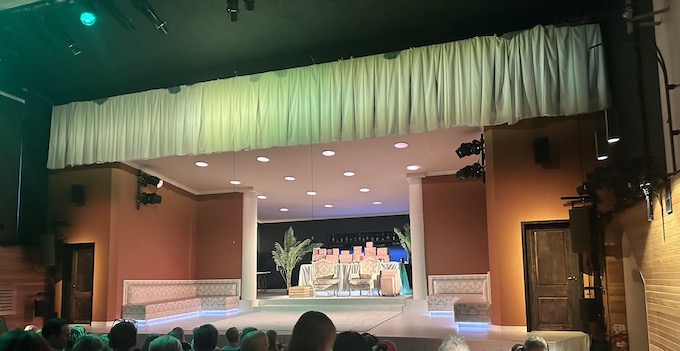
This was our first visit to the Marylebone Theatre. It was established four years ago, and is linked directly to Rudolf Steiner House. I assume they converted an existing large lecture hall. It seats 270, and has a proscenium stage, so is rather like the stalls level of many West End theatres, though the West End theatres have two levels of circles above. It feels like a West End theatre except for clean blonde wood replacing chipped gilded cherubs, and clean blue chairs replacing tattered red velour. You’re instinctively on their side as they are NOT part of the dominant West End commercial theatre chains. As such they’ve had great support from Mark Rylance and others. It was House Full, and that is the Rylance factor. Its prospects as a venue look rosey to me. It’s a five minute walk (even at our elderly pace) from Baker Street underground, and that links it to nearly all the major London railways stations in a few tube stops. It’s not in theatre land but it’s very easy to access from all directions and you get to walk past 221b Baker Street.
It’s not perfect. The winding steps down to the toilets are narrow, and if someone with a walking stick was on the stairs, it meant you couldn’t use up and down sides at the same time. Too few toilets in the Women’s, but that’s every West End theatre. I appreciated the bench seat for the waiting men, who are in and out much quicker, even those of us who wash their hands. Also before the start the air conditioning was a freezing down blast. I thought ‘a couple hours of this and I’m going to need a physio working on a frozen neck and shoulder’ but a woman explained that it switched off as soon as the lights went down. It did, but within ten minutes it was hot and stuffy, which is why they needed it.
FROM THE THEATRE WEBSITE:
The outspoken Afolabi–Williams family gathers at Oga Afolabi’s mansion as preparations begin for the wedding of his daughter. With relatives arriving from far and wide, family traditions are in full swing, emotions are running high, and opinions are never in short supply. But when Pastor Blake, a charismatic man of God who has won Oga’s unwavering trust, takes up residence in the family home, old wounds reopen, loyalties are tested, and faith itself becomes a battleground. As the wedding day draws ever closer, the family must expose the truth before everything they hold dear is torn apart.
The Afolabi-Williams family are a Nigerian-Jamaican family. The family chart in the excellent programme is essential reading. I wish I’d seen it before it started. I spent time trying to work out who was in which family. I’ve added notes to the cast list to assist and put it in three sections.
Last time I saw Tartuffe was at the RSC in 2018, and it was set in a Pakistani Muslim family in Birmingham. I guess you could even do 17th century France, but that doesn’t seem the popular choice. It remains the most performed play ever at the Comedie Français.
ACCENTS
Is it age? For the second time this year we have had accent comprehension problems. The first was Driftwood at the RSC with strong Trinidadian accents. It’s a given and stated here that the older generation have their ethnic accents, the younger generation don’t. They’re Estuary. This was true at the RSC production with Pakistani for the older ones, and Birmingham for the younger, and that was much clearer, and also benefitted from Brummy being funny. Why, I don’t know, but it gets laughs, especially in Stratford-upon-Avon which is not far away.
Here the Jamaican accent was fine, maybe because I’m used to it. The Nigerian accents were not for a good twenty minutes. Because the play is in rhyming couplets it exacerbates the effect because you have competing rhythms. I don’t know many Nigerians who were not born here. Two are a couple and doctors, and have RP accents. A third was a doctor giving injections and when I was in hospital, and I was embarrassed at how often I had to ask him to repeat because his accent was so strong.
In ELT audio recordings we were among the first to insist on regional and ethnic accents for English teaching, but we toned down extreme ones while retaining a flavour. It’s real, because (say) a Glaswegian and a Texan are hard to understand in full local mode, but if they meet each other, both will moderate towards a perceived centre (RP) for comprehension. Neither of us could understand Oga or Grandma until we’d be listening about 20 minutes and got accustomed. They are the two most duped and most important characters too. They also excel at their presence and physical acting. If only we hadn’t taken so long to get up to speed.
Some reviews praise the Nigerian and Jamaican slang. Those are things we probably missed. OK, we don’t live in London. We have less exposure. Then again, as with Trinidad at the RSC, the actors are not necessarily Nigerian. I guess most or nearly all are British born. Usifa Jalloh is from Sierra Leone. Suzette Llewellyn was born in Hammersmith and lists her accents on Spotlight as Jamaican, Barbadian, Trinidad. Sara Mokonen lists her possible languages and accents as Essex, Cockney, Tigrinya and Amheric, which indicates Ethiopian background. In other words getting hung up on “authentic” Nigerian accents is not necessary. A flavour is enough.
THE PLAY
It’s “remixed,” and they have changed the structure considerably as well as dropping major characters. Mark Rylance’s participation is a huge bonus for Darren Raymond and the company and they get him on stage earlier than expected. He glad hands and schmoozes everyone he runs into. It established the character well.
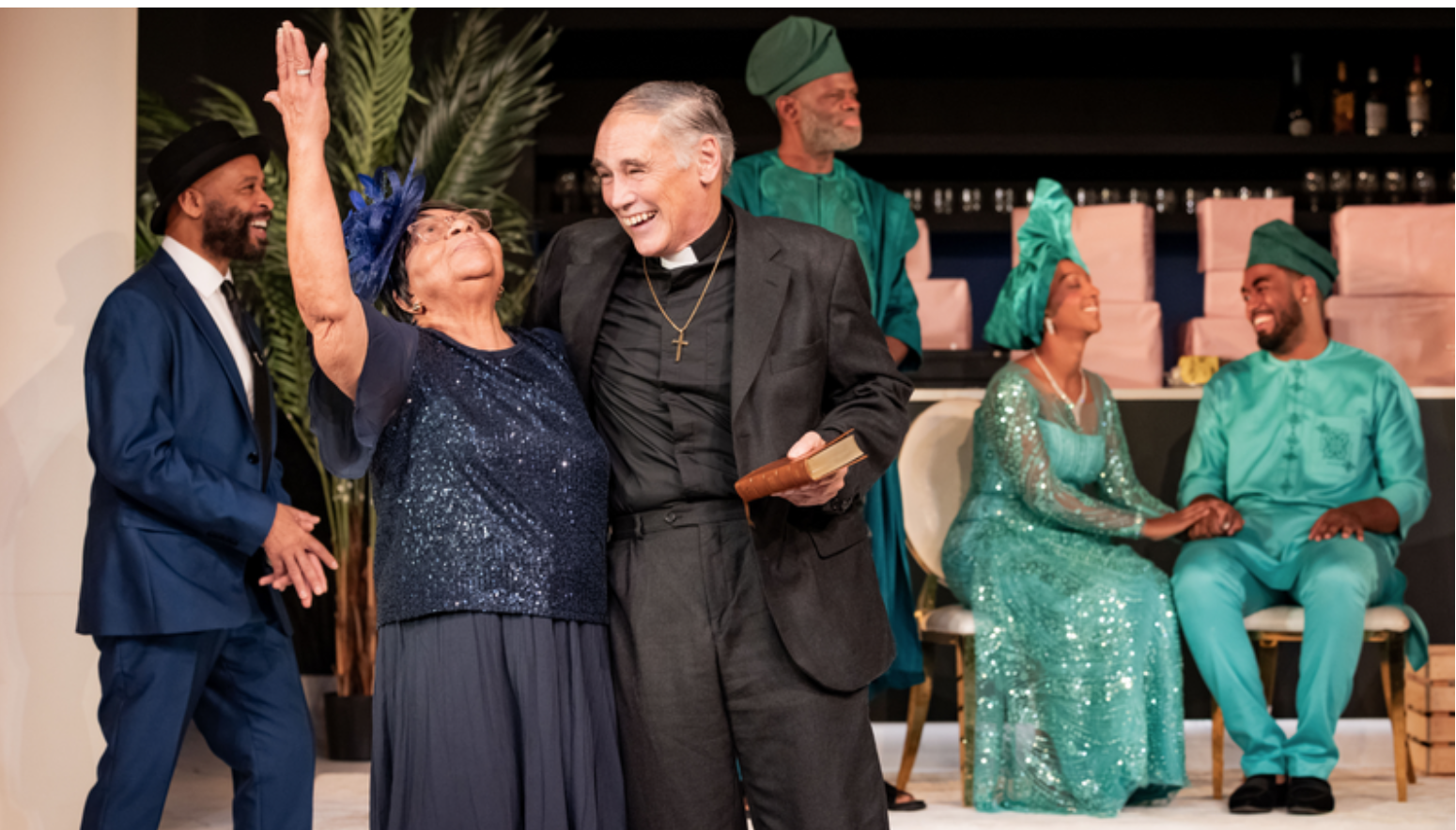
Then he does disappear for a long part of the first act, and sorry, but the play sags in his absence. I found I was struggling to understand Oga, and I got bored in several chunks.
The names puzzled me. Darren Raymond starts out echoing Molière. Oga for Orgon, Elmire is unchanged, I guess Sinclair is the same length as Valere, but then it stops. We wondered who Kemi (Morenike Onajobi ) was, which side was she on. She replaces Dorine, the family servant who helps to expose the Imposter. We couldn’t work out her position, Nigerian side or Jamaican side. Was she related? How? The programme explains she is Adanna’s best friend. It’s a strong performance, and she’s outstanding in the play, whatever.
There are a dizzying number of costume changes. A lot of the budget must have been costumes and furniture. Did Oga really need a different costume every time he came on? Delroy is carefully marked as Jamaican, appearing first in a Two-Tone band style suit and hat, then a Bob Marley T-shirt, but it was very faded indeed, so hard to read. There is a lot of fiddling around with scene changes moving chairs and tables, and I was sitting back and thinking, you could have cut out some of them.
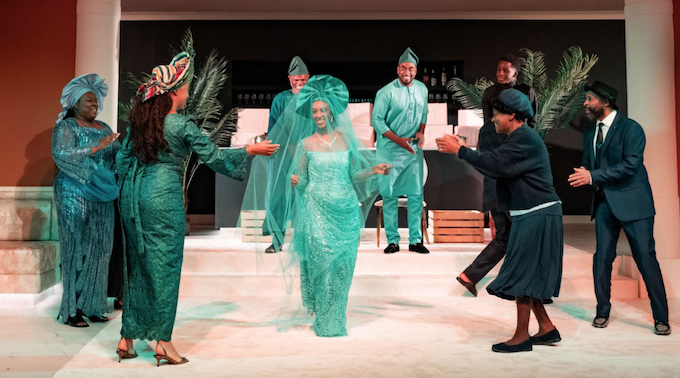
Left Morenike Onoajobi as Kemi, Nakeba Buchanan as Elmire
Right: Suzette Lleweellyn as grandma, Craig Blake as Delroy
The story, if you don’t know it, is that the wealthy Oga invites this seemingly holy man, Pastor Blake, into his house before the wedding of his daughter, Adanna, to Sinclair. Oga is devout and offers the pastor the best room and best food. Elmire and Kemi are both dubious and a Travel Lodge (or was it Premier Inn?) is suggested as a better option. It starts with pre-nuptial celebrations.
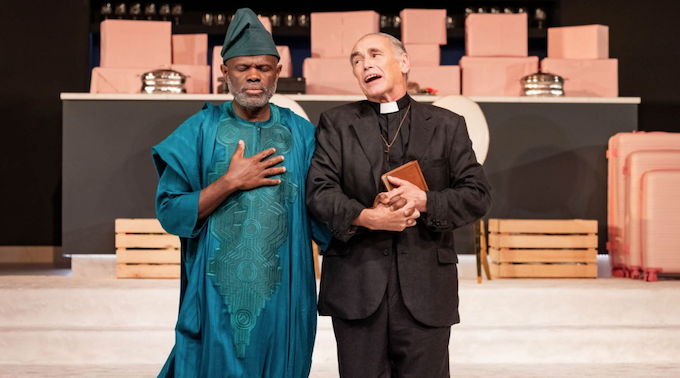
The pastor persuades Oga that Sinclair (Ivandro Da Gruz Leite) is not suitable, as not being religious enough. He will then inveigle himself as the candidate for replacement bridegroom.
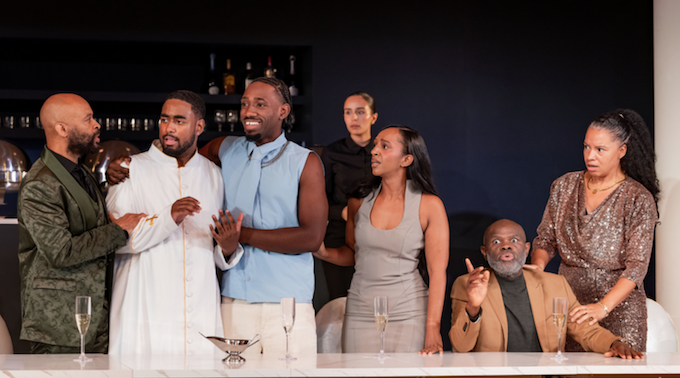
This is aided when the others, who suspect he’s a hypocrite, decide to spike his drink with a ‘truth drug’ before a dinner, and the pastor gives the drink to Sinclair, who has dressed himself in religious robes to persuade Oga of his piety. Sinclair drinks it and lets himself down badly.
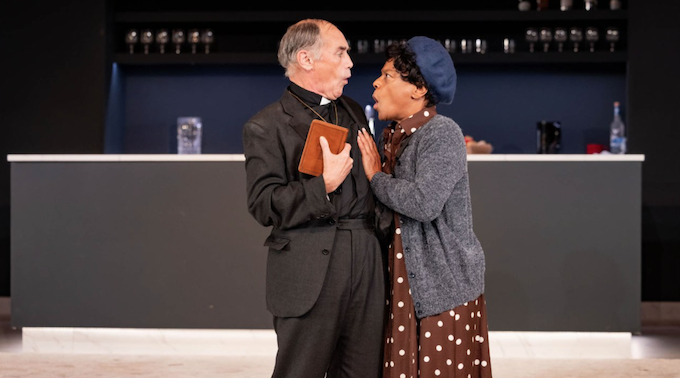
The pastor then cons grandma out of her savings which are stashed under the bed.
Finally he sets out to seduce Elmire, Oga’s wife, which is where he gets found out.
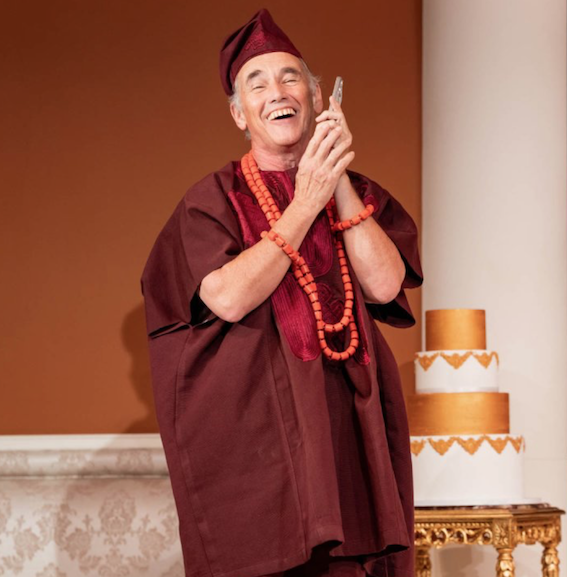
The second act, where Pastor Blake is on stage much of the time was far better than the first. Rylance is an outstanding presence as ever. However, were those false teeth a left over from his astonishing performance in La Bête by David Hirson sixteen years ago? The smile and stutter was in that too. He is capable of being extremely funny, and he was, but we both felt he was reprising La Bête . The seduction attempt with Elmire, then the repeat with Oga and grandma listening behind the sofa is intrinisic comedy gold dust and it is here. Rylance does get his trousers off, and strangely with trousers down the image of Brian Rix in Whitehall farces was in my mind. Perhaps it was in his. He channeled it perfectly, including getting trousers to the ankles but not off so he had difficulty waddling around. I loved him asking for Marvin Gaye’s ‘Sexual Healing’ from the voice activated sound system, which Elmire counters with The Beatles ‘Help!’
Some of Darren Raymond’s rhyming couplets are truly inspired. I can’t recall them, and I wish they’d sold a play text, but one from Pastor Blake, as they’re about to handcuff him at the end, says:
I went to school with Mahatma Gandhi
I think it’s best that you unhand me
Mark Lawson listed a few in his Guardian review:
Some English adaptations prefer prose to approximate the tricky alexandrines of the original but Raymond retains rhyming couplets, alternating clever pairings – “immorality” / “normality”, “psalms” / “my arms” – with blunter runs: “heart” / “smart” / “fart” / “apart.”
There are lines you don’t forget, like Grandma talking about Elmire’s attire as ‘a string in your crack.’ The costume doesn’t echo that though. Elmire (Nakeba Buchanan) is very good, especially in the long attempted seduction scenes, but strangely doesn’t get any decent production photos.
The ending where they finally discover Pastor Blake’s real name … it was Tartuffe … is excellent.
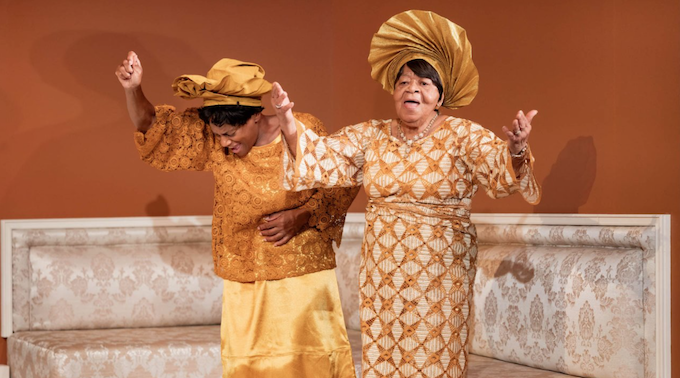
Music and dance? Yes, and Mark Rylance shows how to dad dance, but given the context there could have been more.
OVERALL
The accent issue for us was a star off the rating. The theatre’s advertising uses the “National Theatre standard” tag a lot. This play to us was not actually at the standard of the National, Chichester or the RSC. It was notably Championship not Premier League. So still good, but the pace, fluidity of the highest level was not there.
I’m mildly surprised at the number of four star reviews. Yes, it got an instant standing ovation, not a given in Britain. I looked back at my 5 star review of Tartuffe at the RSC in 2018. It was better than this, and (dare I say it) that even includes the role of The Imposter too. The RSC was rocking with laughter. This got far fewer laughs, and the best laughs were all for Rylance, except when D-Miz discovers the pastor trying to seduce Elmire and shouts ‘What the fuck’s going on here!’ which brought the house down. It happens a lot in London but after the interval I could see four empty seats.
So I’m going with the Guardian at three stars. Mark Lawson says it was almost three hours long. The website says 2.5 hours, and even after long curtain calls, we were out and walking away at five past five. So accurately it is 2.5 hours. I suspect there have been cuts since press night which looks like Thursday.
***
WHAT THE PAPERS SAID
four star
Nick Ferris, Telegraph ****
Neil Norman, The Stage ****
Alun Hood, What’s On Stage ****
West End Theatre ****
Phil McCullough All That Dazzles ****
Mary Pollard Everything Theatre ****
Nick Wayne West End Best Friend ****
three star
Mark Lawson, Guardian ***
LINKS ON THIS BLOG
MOLIERE
Tartuffe by Moliére, 1664, RSC 2018
Tartuffe (remixed) by Molière, Marylebone 2026
The Hypochondriac by Moliére, 1673, Bath Theatre Royal
The Misanthrope ETT by Moliére, 1666, adopted by Roger McGough ETT
The Miser, by Moliére, 1668, adapted by Sean Foley & Phil Porter, 2017
MARK RYLANCE
Dr Semmelweis by Stephen Brown with Mark Rylance, London 2023
Nice Fish by Mark Rylance and Louis Jenkins
Farinelli & The King, by Claire Van Kampen, Wanamaker Playhouse, 2015
Richard III – Apollo 2012 Mark Rylance as Richard III
Twelfth Night – Apollo 2012 Mark Rylance as Olivia
Jerusalem by Jez Butterworth, West End
La Bête by David Hirson, West End, 2010
+ film and TV
Wolf Hall, TV Series (as Thomas Cromwell)
Bridge of Spies, directed by Steven Speilberg
Dunkirk, directed by Christopher Nolan
Don’t Look Up, directed by Adam McKay
Phantom of The Open
The Outfit (film) 2022
+ director
Much Ado About Nothing (Old Vic)


Leave a Reply