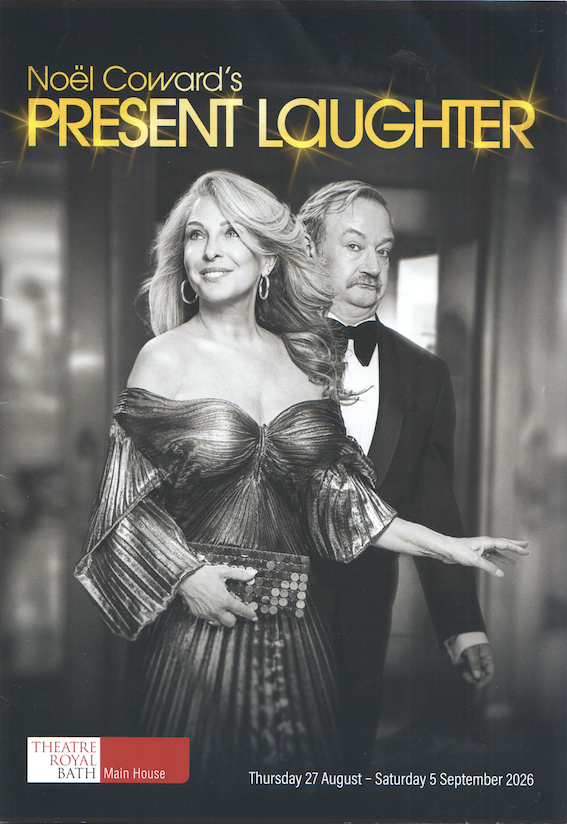
By Noël Coward
Directed by Lindsay Posner
Set and Costume design Peter McIntosh
Composer & sound design Adam Cork
Bath Theatre Royal
(prior to a national tour)
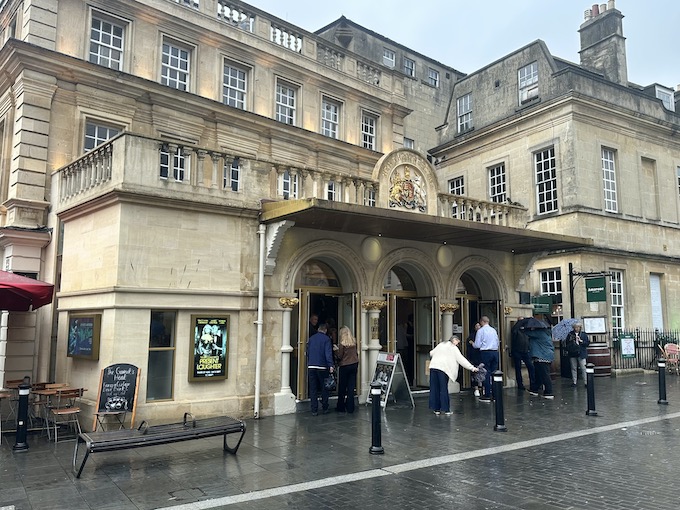
Saturday 29th August 2026, 14.30
CAST
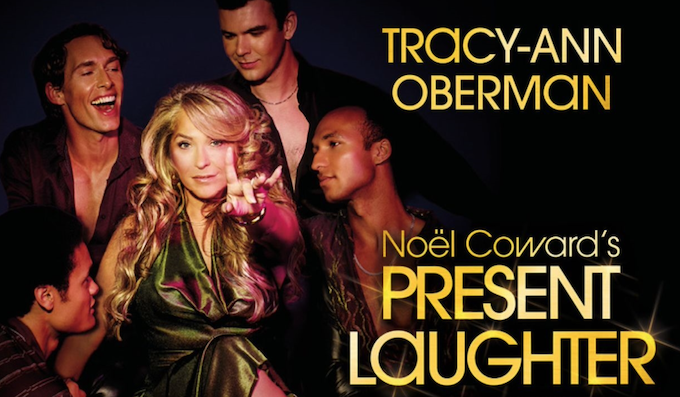
Tracy-Ann Oberman – Geri Essendine
James Dreyfus – Monty
Adrian Lukis – Len
Richenda Carey- Lady Saltburn, David’s aunt
Seb Carrington – David Stillington
Eva Feiler – Rosina Maule
Gabrielle Foley – Miss Erikson, housekeeper
Charlotte Randle- Henrietta
Jonathan Tafler- Morris, Geri’s manager
Perry Williams – Fred, valet
Kit Young- Johanes
This year, gender switched roles have begun to irritate. Once in a while it’s an interesting new look. The RSC have gone overboard with an all-male As You Like It, an all-female Julius Caesar, and a female as Othello. Once in a season? An experiment. Three in a few months? Banging an agenda. They are just about the only three RSC Shakespeare since 2011 we have not booked.
But I saw some sense in this switch. Noël Coward wrote of young women pursuing and pursued by the popular big star (based on himself) and we know he really meant young men. Rather than do what was in Coward’s hidden thoughts, they’ve made the star, Garry Essendine into a female, Geri Essendine. Then the faithful secretary, Monica, becomes Monty, switching female to male. The young drama student Daphne Stillington becomes David. The producer, Henry Lyppiat, becomes Henrietta. The spouse Joanna becomes Johanes. Liz Essendine, the separated wife of Geri, becomes Len. In return the would-be writer Roland Maule (of the same gender as the star giving ambiguity) becomes Rosina Maule (still the same gender as the star, though no ambiguity). So switching all round.
It’s not for the first time to do a gender switch for Henrietta and Joanna. The Old Vic 2019 production, with Andrew Scott as Gary Essendine, changed Henry to Helen, and Joanna to Joe. Johanna / Joe (or here Johanes) is the married one who sets out to seduce Garry. So Garry became overtly bisexual.
In whichever flavour, Geri has her entourage. Secretary, valet, manager, writer husband, producer. They’ve been on board as a group for at least fifteen years. The famous actor on the verge of a major tour is beset by people wanting contact. The famous actor is always up for a bit of physical contact, but once it’s done, wants no more of it.
Tracy-Ann Oberman was in Present Laughter at Chichester in 2016. Rufus Hound was Garry Essendine, and she played Monica, the long-suffering secretary, and was about the best Monica I’ve seen. She is apparently the prime mover behind this production.
Tracy-Ann Oberman: In Coward’s original 1939 play, Garry Essendine is an ageing stage idol, prone to theatrical tantrums and ill-advised affairs, while those around him manage his chaos. But the moment I flipped the gender, the stakes suddenly became even more fascinating. Enter Geri Essendine — who has been thirty-nine for the best part of a decade. The idea of a badly behaved middle-aged actress, conducting herself every bit as outrageously as her male counterparts, immediately intrigued me. But would it work in pre-war London? Or could another setting honour Coward’s original while allowing us to look at it through a different lens, without losing any of its wit, farce and brilliance? I found myself drawn to New York in 1977, at the height of Studio 54. The endless queues outside, the celebrities gliding into those hallowed VIP spaces (sometimes on horseback), where strong charismatic women were centre stage in a world of glamour, excess and intoxicating sense of belonging to “the in crowd”. Where bad behaviour and egotism was rife across all genders. And I began to wonder: what if Geri were an expatriate British actress? A hugely successful West End star who had arrived in America fifteen years earlier with her chosen family — her dashing ex-husband, her fiercely loyal secretary and her producers — all determined that she would conquer Broadway and make all their fortunes.
The Yorkshire Post 26th August 2026 from the programme essay
The accepted Noël Coward “rule” is you can’t set his plays much outside the 1920-1960 time period. It’s a bold choice to ignore it. The Coward revival over the last thirty plus years has had a touch of nostalgia for the past in ageing audiences, but even the oldest audience members nowadays can’t recall 1939. The choice of 1977 is just under fifty years ago, so within living memory for the average audience age, certainly at Bath. However, still a long time ago.
New York 1977? I’m surprised a dramaturg isn’t credited. I’ve seen one credited for less work. It requires a lot of minor line changes, or in the case of Fred, the valet, a move from cheerful lovable ageing cockney to young Afro-haired flared trousered cool dude who says ‘Yo’ a lot, whose part-time job is a bodyguard at Studio 54. Yes, it works too. Coward’s forte was never, never writing cheerful lovable Cockney. Some of the changes are proper nouns. The would-be nerdy playwright Rosina Maule is now from Yonkers, not Uckfield. OK, both “sound” intrinsically funny. Victoria Station becomes Grand Central Station. When everyone turns up bent on accompanying Geri on her tour, she remarks it’s a good day for American Airlines, rather than ‘the Union Castle line’ Then we lose references to coming-up dances, RADA, ‘The Dorsetshire Midwives Conservative Association,’ and to boy scouts as charities. They can’t use the line when the doorbell rings and Geri says ‘With any luck it’s the Lord Chamberlain’ (whose job it was to censor plays). Some is just modernisation. Latchkeys become door keys. I think, but can’t be sure, that adjectives like ‘beastly’ were changed too. (I’m amazed at how many changes I remembered). I thought PA described Monty better than ‘secretary’ but in 1977, my boss’s PA who ran the entire school was still a ‘secretary. Monty has been with Geri for twenty years. In 1957 the job would certainly have been ‘secretary.’ I believe they thought hard about each change. When my first textbooks went from British English to adaptation into American English, I lost a third of the royalty for a similar level of changes. Another change is that her forthcoming tour is Australia, changed from Africa. I suppose she says mildly insulting stuff about the location, and Africa might be sensitive, but for Aussies it’s water off a duck-billed platypus’s back.
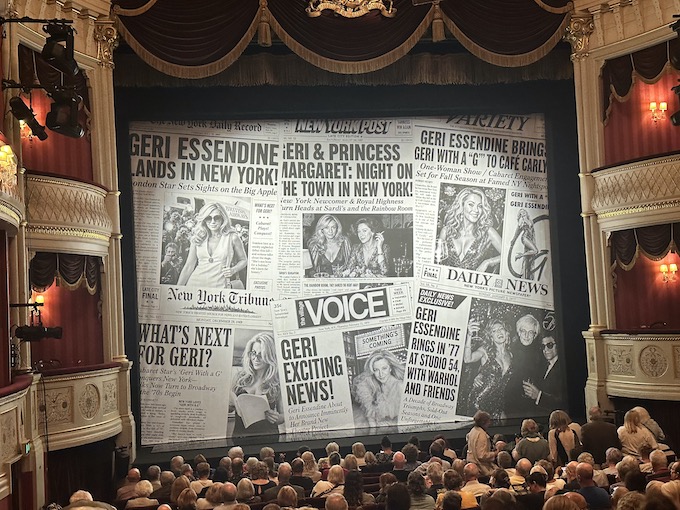
Everyone was chatting about the front curtain, with newspaper front pages, showing Geri with Andy Warhol, and Princess Margaret, cigarette in hand. I was going to say Photoshop, but actually AI would do the pictures. It set the scene way better than a programme note.
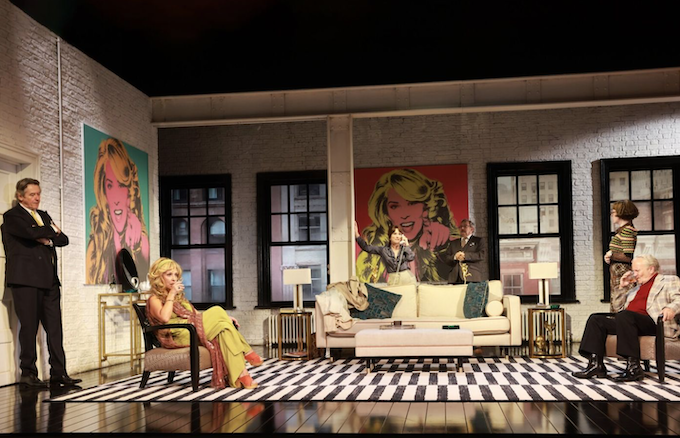
Geri does not play the piano, but we have disco on the record player to sing to. That frees up a lot of stage space. The set is excellent, with a view of a Greenwich Village / SoHo street through four windows behind. Nice light in evening scenes from opposite windows. The walls are white painted exposed brick, with a red metal spiral staircase. I’ve got white powdery emulsion on jackets a few times in NYC coffee shops. The furniture remains elegant. There is a huge Warhol style print of Geri plus a poster from her show, Geri With a G, which made her name on Broadway in its eighteen month run.
We liked the concept of the change, we loved that collage of newspapers, we were primed to like it.
I’m now going to do the thing that annoys me in other reviews. Whenever we see Hamlet and discuss the lead, Karen says, ‘OK, but I saw David Warner at the RSC. No one comes up to that.’ Well, with Present Laughter, we saw Rik Mayall, also at Bath, in 2003, and sorry, but no one comes up to Rik Mayall. Not Andrew Scott, Rufus Hound or Samuel West.
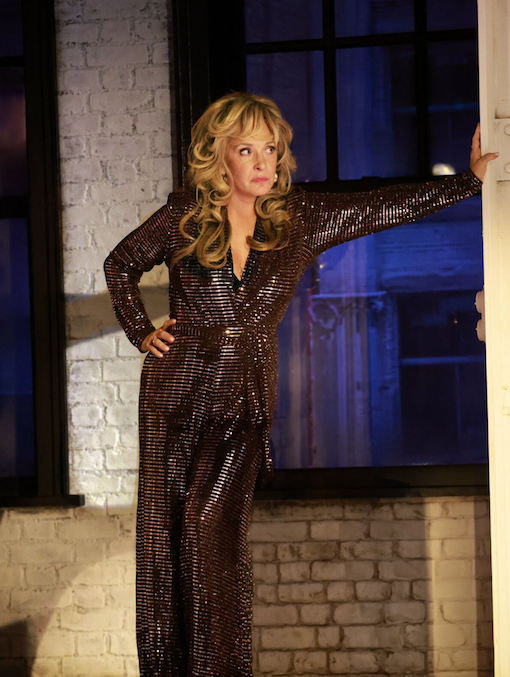
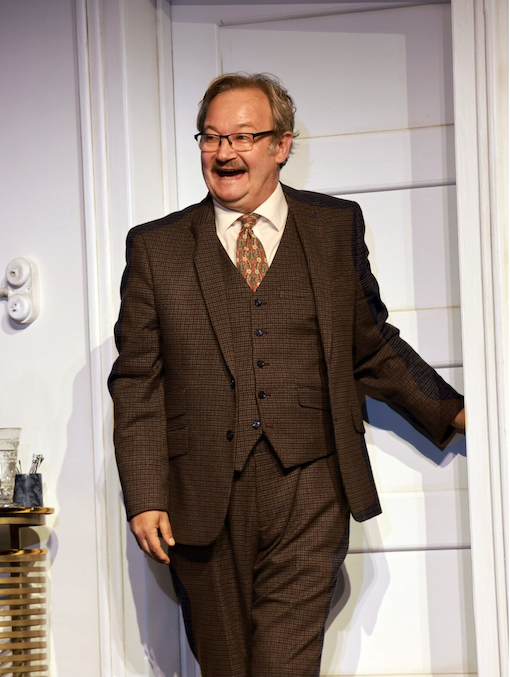
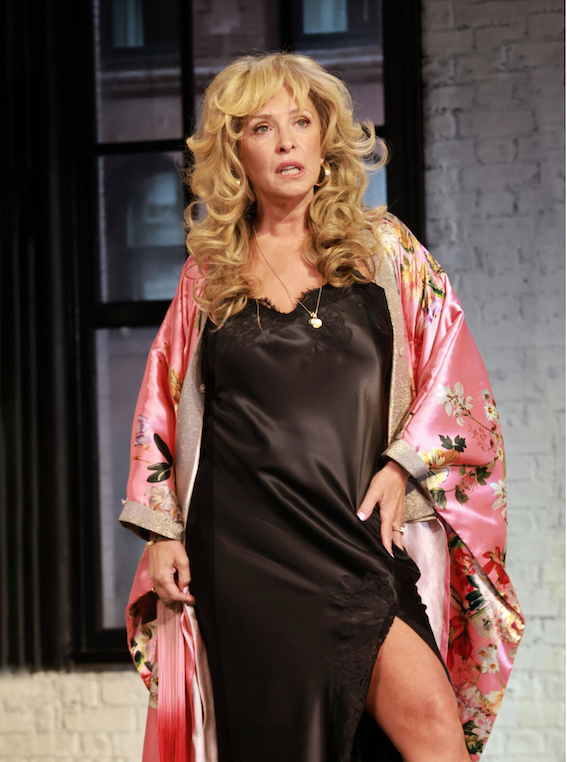
Tracy-Ann Oberman as Geri Essendine. James Dreyfus as Monty.
Tracy-Ann Oberman did a fabulous performance, ably assisted by James Dreyfus as Monty, the role she did as Monica. They both stand out. There are things about the gender switches that lessen the impact however.
There is always something funny about a camp histrionic posturing male. The full Freddy Mercury. Both Rik Mayall and Andrew Scott captured that. This is sexist, but when I think of musical and comedy stars, or divas, like Shirley Bassey, Liza Minelli, Madonna I would expect them to be theatrical and a tad histrionic. It goes with the spangly elaborate dresses and big hair-dos.
The main loss is ambiguity. Coward’s Garry Essendine is definitely ambiguous.
There are discernible allusions to Garry’s bisexuality: he admires an admiral’s son with ‘vast strapping shoulders and tiny hips like a wasp.’ Later the butler announces with undeniable innuendo, ‘The gentleman’s in the office, and the lady’s in the spare room if you want either of them.’
Phlip Hoare: Noël Coward. A Biography 1995
Both Mayall and Scott played him as ambiguous and bisexual. When Mayall’s Garry meets Roland Maule, he screws up his face trying to remember if he’d met him, and is wondering if he had, was it sexual?
Geri is manifestly heterosexual. So was Samuel West as Garry. That misses an element.
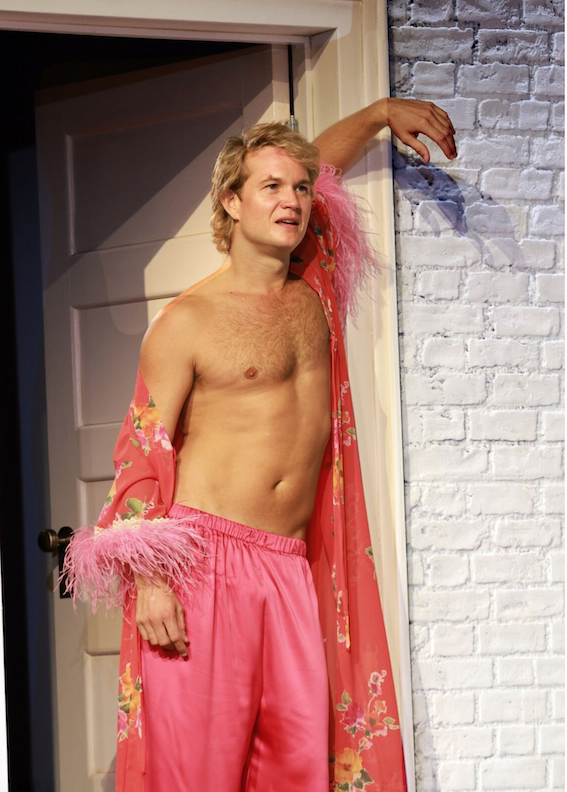
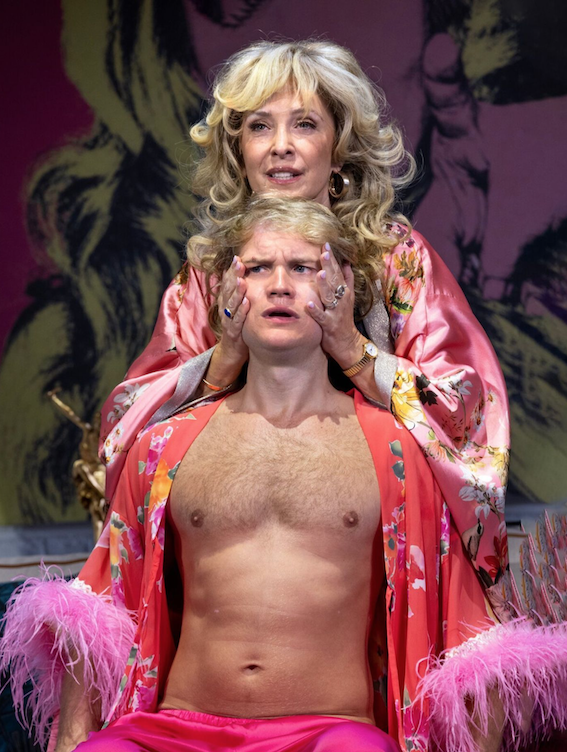
The play starts with David (Seb Carrington) who has woken up in the spare room after a night with Geri. He is wearing her dark pink fluffy edged dressing gown, and that was a good start- funnier than Daphne wearing Garry’s male dressing gown. He’s very good, looks great with a bare chest and blonde hair, but we thought a female character had more possibilities with a wider range after such a night with the star of their dreams. The “let down” scene is great.
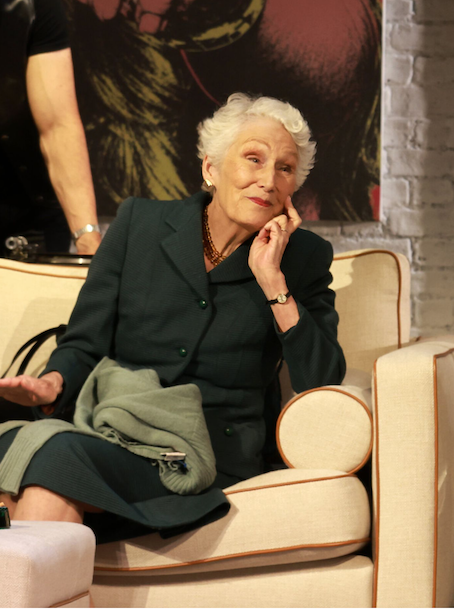
Later, David turns up again with his aunt, Lady Salterton, who has managed to get an audition / appraisal for him by donating a lot to a charity fund Geri is involved with. David does his dance moves to audition, very well too. We preferred Daphne’s attempt at dramatic monologue. Lady Saltburn is a tiny cameo in the play, but has great effect. She is an ideal “listener” for others in a scene.
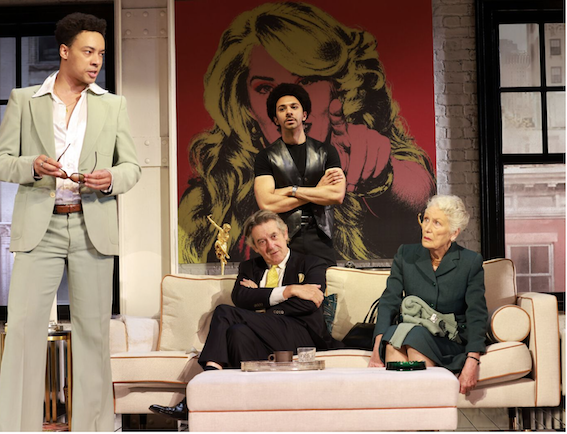
Then there’s the role of Len (Adrian Lukis) as the separated husband who remains part of the entourage. Somehow, Liz, as the separated wife works better. Sexism here again, but for us, women fall more naturally into criticising a man’s appearance, and telling him where he’s going wrong with his life. Mostly men wouldn’t dare. Or rather, I wouldn’t dare. The first scene after Len’s arrival fell very flat, partly having both on the sofa looking forward didn’t help. I’d blame the gender switch, but whenever you ave a high and new concept, some scene will suffer in the transition.

Tracy-Ann Oberman as Geri Essendine, Adrian Lukis as Len Essendine
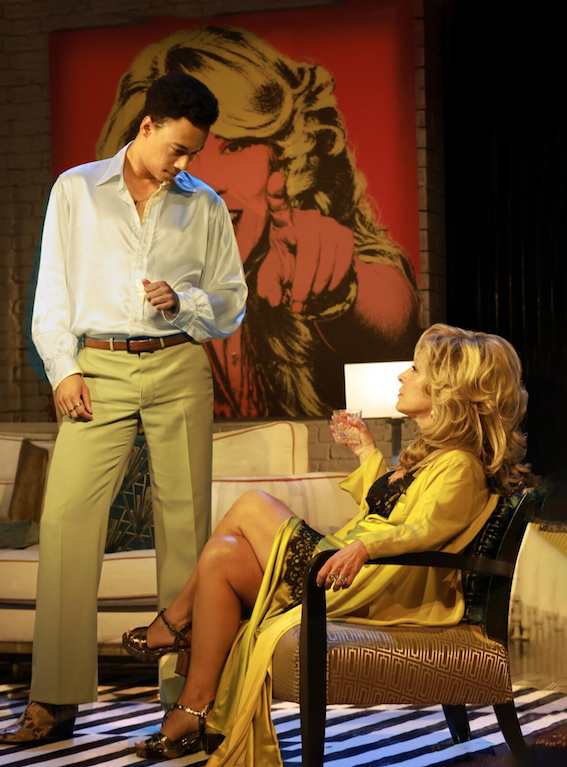
Johanes (Kit Young), the husband of Henrietta (his producer? ) is male, so a heterosexual encounter, though Johanes is bisexual, also having a relationship with Morris (Jonathan Tafler), Geri’s manager. In spite of the silk shirt and the vigorous disco dance turning into bonking, that was a switch that really failed for us. A sexy thirty-something voluptuous woman (Joanna in the original) carries off a seduction better. It wasn’t for want of acting in any way, just the switch jarred, maybe only for us, at this point.
Morris King is the manager, hopelessly in love with Johanes. A row with producer Henrietta over that threatens their entire business model.
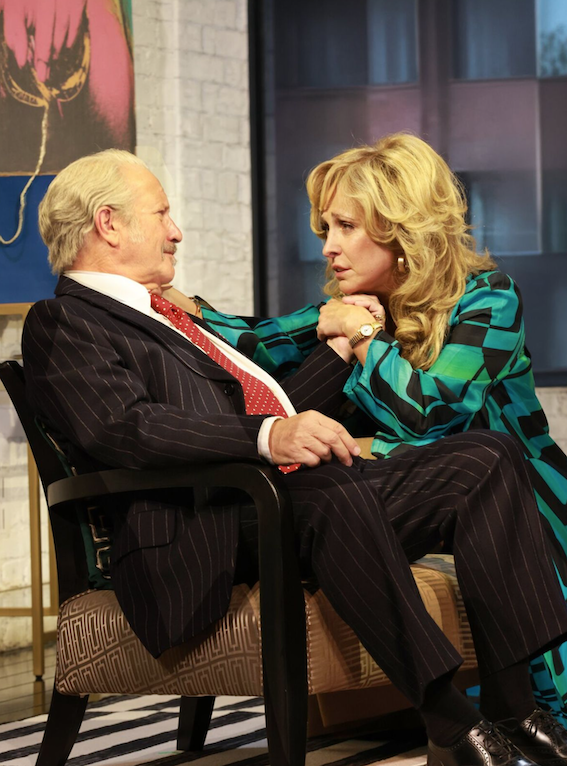
Near the end, Morris is distraught on discovering Johanes has had sex with Geri. As Geri is about to leave she suggests Morris come with her. This is the original text:
Garry: You’re coming with me.
Morris: Where to?
Garry: Hampstead Heath.
Morris: It’s cruel and heartless of you to try to be funny at a time like this!
Coward and his friends would all have got the Hampstead Heath reference as a gay pick up place. While I’m sure such events occur in Central Park, it doesn’t work as well.
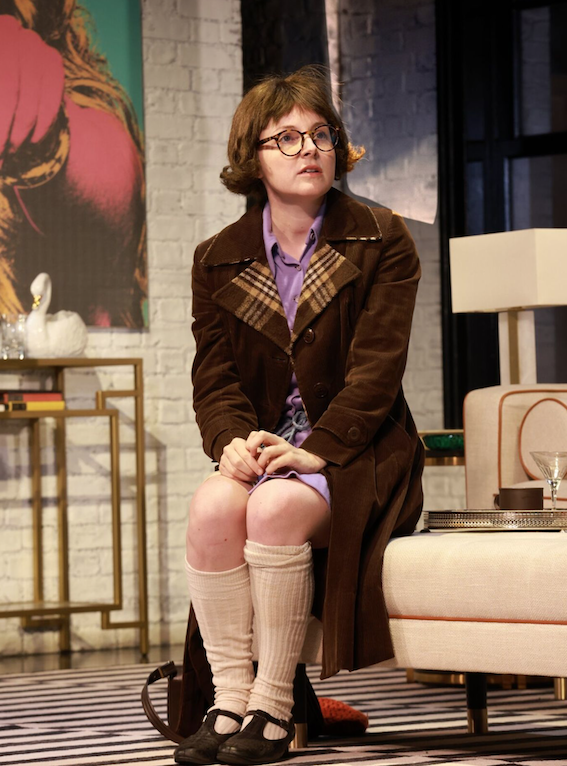
The playwright Rosina Maule is a gem of a cameo (Eva Feiler), and transfers seamlessly from male nerd to female nerd. She gets three different nerdy skirts too. The socks help. As you can see costume is well chosen throughout.
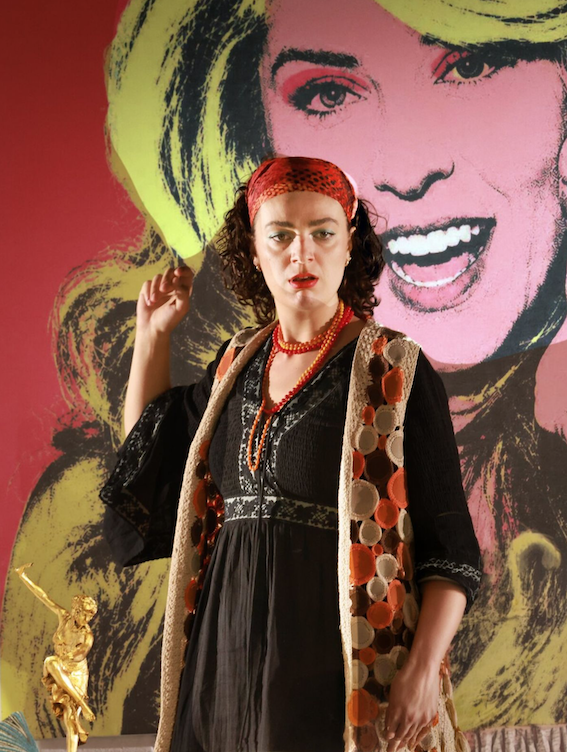
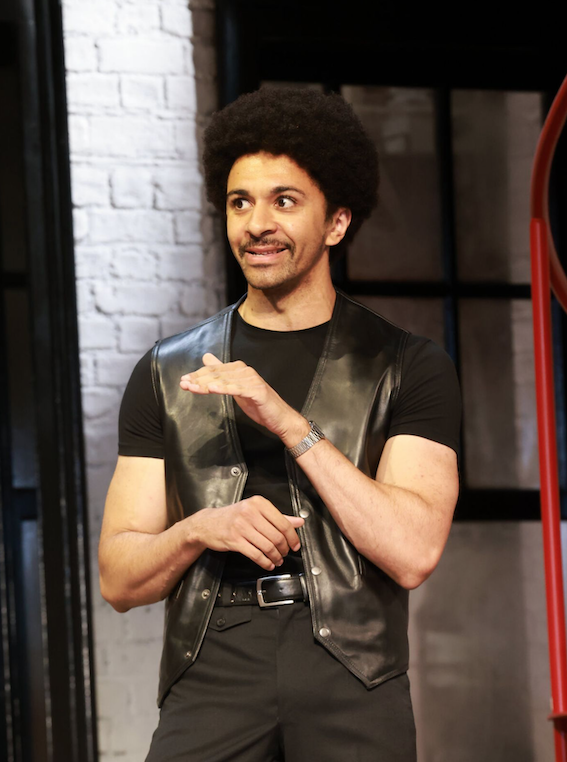
The staff are very good indeed. Gabrielle Foley is the Scandinavian housekeeper, Miss Erikkson, and Perry Williams is Fred, the cool dude valet.
A tiny, tiny thing. The staff address her as Mrs Geri, and then Rosina Maule as Mrs Maule. By 1977 in New York, I think Ms would be normal. But for Geri? I think ‘Miss.’ There used to be a British theatrical backstage convention of calling female stars ‘Miss’ whether married or not (Mrs Mills being the exception) . I guess here, Geri does have her husband’s surname, while most female stars keep their own name.
I was surprised they seem to have kept some of Coward’s many stage directions about lighting a cigarette. Noël laboured long and hard placing ashtrays in his set design instructions, but mostly they didn’t have much purpose here. I’ve been glancing at the play text today and there are several cuts.
The bits that Coward must have enjoyed writing remain and are unaffected – railing at manager’s and agents for their only interest in their ten per cent. Then Rosina Maule’s diatribe on commercial theatre, allows Geri to take a couple of sideswipes at Chekhov, which I’m sure Coward intended to hit a mark. In this version, Geri has a horror of being cast as Hedda in Hedda Gabler. Add Ibsen. The original reference was Ibsen too, Peer Gynt, and Garry threatens to produce it at Drury Lane, which is a jibe perhaps at Ivor Novello, who ran there popular romantic musicals there in the 1930s. I don’t think the reference works easily now anyway (Co-produce Hedda Gabler with Andrew Lloyd-Weber?). Then Len, the husband is now a writer because he was such a dreadful actor. There are endless targets for that barb.
We both noted a lot less audience laughter than we expected. What laughter there was came from Coward’s lines mainly. It’s only three days into its run, which is followed by a tour. I’d say it lacked a certain Snap! which will develop over a few more days. I noticed a couple of very minor instantly corrected line fluffs. Actors don’t feel free to add new visual / facial bits early on, but they will occur to actors as it goes forward. It’ll get funnier. This is an early review, but my rule is ‘Cut price preview: not to be reviewed.’ Full-price production? Game to be reviewed. This was full price.
It’s always a very entertaining play. The production has innovation and a fresh look, and that should appeal to Coward regulars, and it certainly did for us. Oberman and Dreyfus both give five 5 star performances. I’d award the set and costume the same. It doesn’t all match that … or not yet. If you haven’t seen other versions, you’ll just take it as excellent entertainment. But in comparison to the run of other productions, it has lost an element, so overall I can’t go above three stars.
***
OTHER DATES:
● Bath Theatre Royal | 27 August – 5 September 2026
● Cambridge Arts Theatre | 8 September – 12 September 2026
● Malvern Festival Theatres | 15 September – 19 September 2026
● London Richmond Theatre | 22 September – 26 September 2026
● Cheltenham Everyman Theatre | 29 September – 3 October 2026
● York Grand Opera House | 6 October – 10 October 2026
WHAT THE CRITICS SAID
When we saw it, they hadn’t.
LINKS ON THIS BLOG
NOËL COWARD
Blithe Spirit by Noël Coward, Bath Theatre Royal 2010 (Alison Steadman)
Blithe Spirit, by Noël Coward, Bath Theatre Royal 2019 (Jennifer Saunders)
Blithe Spirit by Noël Coward, Salisbury Playhouse 2025 (Susan Wooldridge)
Blithe Spirit FILM 2021 (Judi Dench)
Noël Coward’s Brief Encounter, by Emma Rice, Salisbury Playhouse, 2023
Design for Living, by Noël Coward, BBC Play Of The Month, 1979
Fallen Angels, by Noël Coward, Salisbury Playhouse
Hay Fever by Noël Coward, Bath Theatre Royal 2016
Hay Fever, by Noël Coward, BBC TV Play 1984
Present Laughter, by Noël Coward, Bath Theatre Royal, 2003 Rik Mayall (retrospective)
Present Laughter by Noël Coward, Bath Theatre Royal 2106, Samuel West
Present Laughter by Noël Coward, Chichester 2018, Rufus Hound
Present Laughter by Noël Coward, Old Vic 2019, Andrew Scott
Present Laughter by Noël Coward, Bath Theatre Royal, 2026, Tracy-Ann Oberman
Private Lives by Noël Coward, BBC TV 1976
Private Lives by Noël Coward, Nigel Havers Theatre Company, 2021, Chichester
Private Lives, by Noël Coward, Donmar Warehouse, London 2023
Relative Values by Noël Coward, Bath Theatre Royal
The Marquise, by Noël Coward, Guildford & Tour 2026
The Vortex, by Noël Coward, Chichester Festival Theatre 2023
This Happy Breed by Noël Coward, Bath Theatre Royal
LINDSAY POSNER
Equus, by Peter Shaffer, Bath 2026
Endgame, Samuel Beckett, Bath Ustinov 2025
1984, Adapted by Ryan Craig, Bath 2024
A View From The Bridge, Theatre Royal Haymarket, 2024
The Deep Blue Sea, Bath Ustinov 2024
The Lover / The Collection by Harold Pinter, Bath Ustinov 2024
Farewell Mr Haffman By Jean-Philippe Gaguerre, Bath Ustinov 2023
God of Carnage by Yasmina Reza, Bath Theatre Royal 2018
The Lie by Florian Zeller, Menier Chocolate Factory, 2017
The Truth by Florian Zeller, Menier Chocolate Factory 2016
Communicating Doors by Alan Ayckbourn, Menier Chocolate Factory 2015
Dinner With Saddam by Anthony Horowitz, Menier Chocolate Factory 2015
The Hypochondriac by Moliere, adapted Richard Bean, Bath Theatre Royal, 2014
A Little Hotel On The Side By Feydau, Bath Theatre Royal 2013
She Stoops To Conquer by Goldsmith, Bath Theatre Royal 2014
Hay Fever by Noel Coward, Bath Theatre Royal 2014
Abigail’s Party by Mike Leigh, Poole Lighthouse 2013
TRACY-ANN OBERMAN
Present Laughter by Noël Coward, Chichester 2018, Rufus Hound (Monica)
ADRIAN LUKIS
The Price, Arthur Miller, Bath 2018
The Seagull, by Chekhov, Chichester 2015
The Taming of The Shrew, RSC 2012
EVA FEILER
Macbeth, Watermill, 2019
A Midsummer Night’s Dream, Watermill 2018 (Puck)
Othello, RSC 2015
KIT YOUNG
A Midsummer Night’s Dream, The Bridge 2019 (Lysander)
Macbeth, Wanamaker 2018
RICHENDA CAREY
Summer 1954, Terence Rattigan, Bath 2024
GABRIELLE FOLEY
Blithe Spirit, Salisbury 2025
JONATHAN TAFLER
The Merchant of Venice, Almeida 2015


Leave a Reply