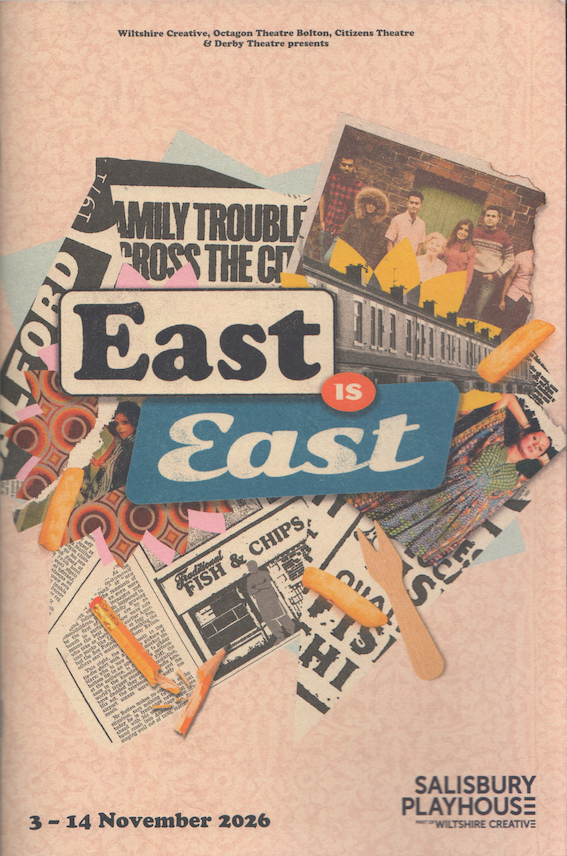
By Ayub Khan Din
Directed by Karsh Asad
Set & Costume by Rachana Jadhav
Wiltshire Creative, Octagon, Bolton & Citizens Derby co-production
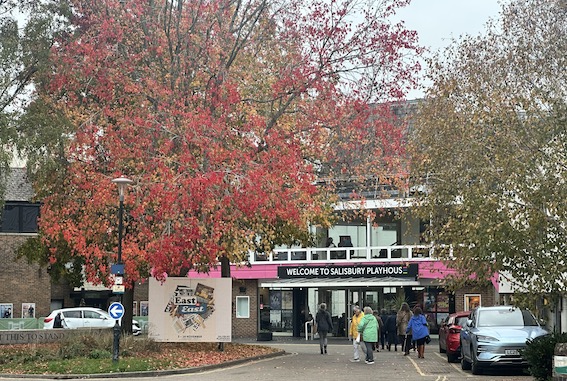
Salisbury Playhouse
Thursday 5th November 2026, 14.15
CAST
Samatha Power – Ella. the mother
Bhasker Patel- George, the father
Victoria Brazier – Auntie Annie
Danyal Ismail- Abdul, the oldest son
Zaki Ali- Tariq, the second son, and the hippest
Matthew Khan – Saleem, the art student
Joeravar Sangha- Maneer, the pious one
Rohan Macleod – Sajit, the youngest one
Maya Dhokhia – Meenah, the daughter
Sushil Chudasama – the Indian doctor / Mr Khan
I hadn’t realised that the play pre-dated the 1999 feature film, and that it got the 1997 Award for Best West End Play. I did know the play was produced somewhere in most years in the last quarter century, so is a modern classic.
The Anglo-Pakistani cross-cultural story rings bells, though I notice that some of the cast names look Indian. Patel can be either, but predominately Indian. Sangha is found in India and Pakistan but is probably Sikh. Chudasama and Dhokia are probably Hindu. So the cast are also cross-cultural.
Nick Ahad in The Guardian said:
East Is East is an important piece of work for people such as myself, Arshad and much of the cast playing Khan’s children. The language of the play describes us as “half-caste”; I tend to use mixed-race and some of the cast prefer dual heritage. Whatever the preferred term, the play captures the nuance of growing up between cultures. Eating bacon while throwing around curry powder to cover the smell, laughing at racist jokes where people who look like your family are the punchline – these are moments recognisable to mixed-race families. Khan Din’s cleverness was to capture the subtleties of having a white mum and a brown dad and, in that specificity, find universal appeal.
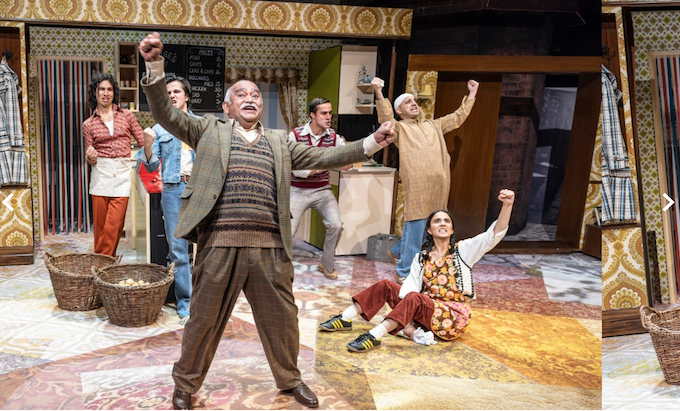
The theme is the generation divide between George who demands Pakistani cultural respect from his wife and children, Ella, his wife who takes his blustering with a pinch of salt, and the mainly Anglophile next generation. The original was set in Salford in 1971. I thought the opening announcement said 1977, no matter, the fashion and props are wonderfully high 1970s style.
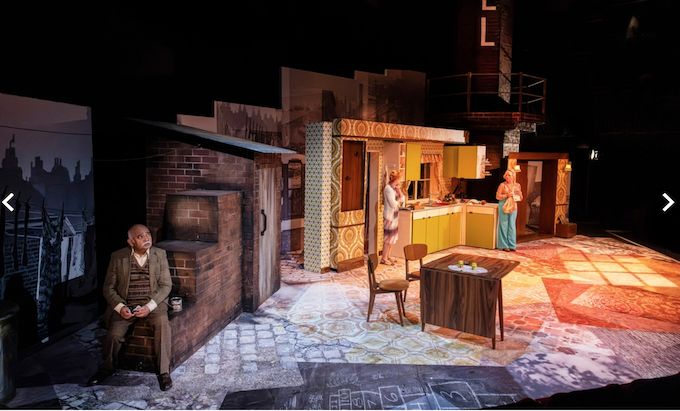
The set is divided into garden with coal shed, the kitchen which swings open to become the chip shop George owns, and a door which might be to a mosque and a raised area around an industrial building. A section can swing forward to create the living room. My in-laws had those green kitchen units. The colours are perfect. The set allows us to see characters in three places.
I was mildly worried that accents might be a problem, but they’re not at all. Only George and Mr Khan have Pakistani accents and both actors are loud and crystal clear. Everyone else is Salford, so Coronation Street, so familiar.
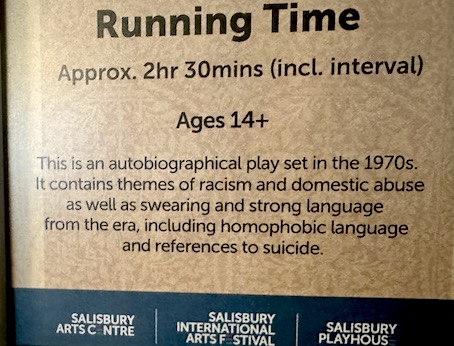
George and Ella Khan have seven children, six boys and a girl. We never see the oldest boy who has left the family to become a hairdresser. The now obligatory warning notice (aka Hamlet contains scenes of death and violence, including stabbing and poisoning, plus suggestions of incestuous relationships) outside suggests there were homophobic comments. We didn’t notice any, so maybe a lad being a hairdresser was enough in the situation.
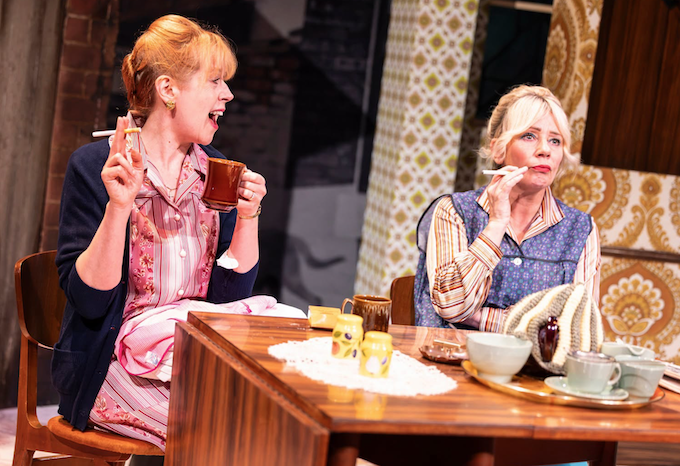
Ella and her sister, Annie, smoke continuously. As the English ones they reflect and comment on the family.
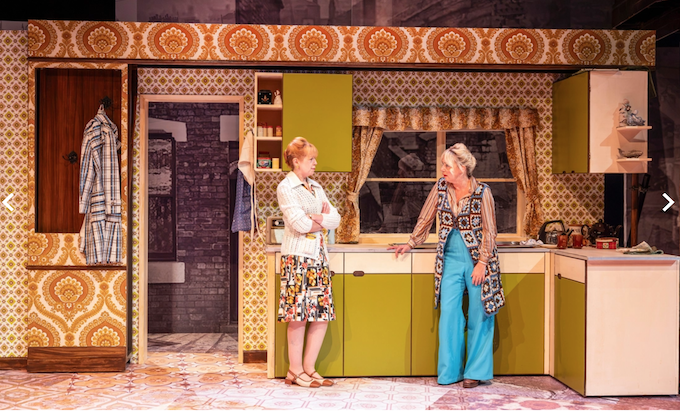
Ella is the mother of six boys. She doesn’t take nonsense from them or her husband.
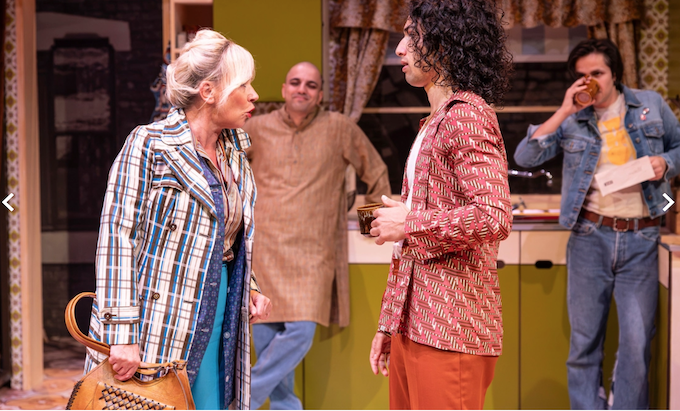
The play starts with George’s horror at discovering they never had Sajit circumcised as a baby. Ella (Samantha Power) avoided it because he was poorly, and George (Bhaskar Patel) had never been near a baby without its nappy so hadn’t known. Sajit (a truly brilliant performance by Rohan McLeod) is a bit “special” with OCD about his filthy parka jacket and OCD physical routines. George insists that the teenage Sajit face the unkindest cut.
The other plot strand is that a Mr Khan wants to marry off his daughters, and George has selected the two older ones, Abdul and Tariq to be the husbands. He has neither asked or informed them.
The siblings are all well delineated and different.
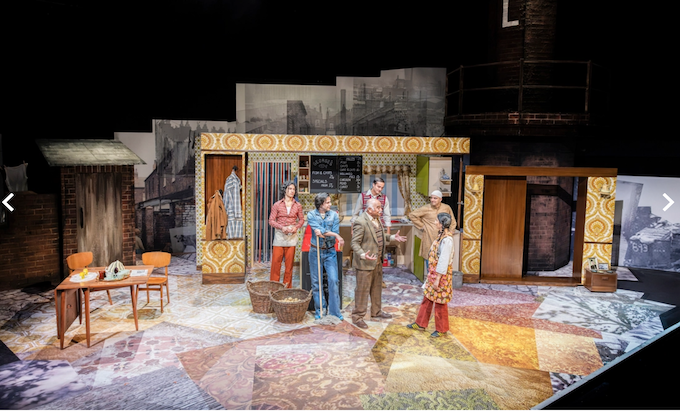
Abdul (Danyal Ismaili) is the oldest one. He’s not part of the group messing around of his younger siblings. As everywhere, the oldest feels responsible for the younger ones, as they would have been pushed into parental roles early on. He is particularly kind to Sajit. Abdul wears a similar style of sleeveless pullover as his father. Abdul is reluctantly prepared to go along with the arranged marriage.
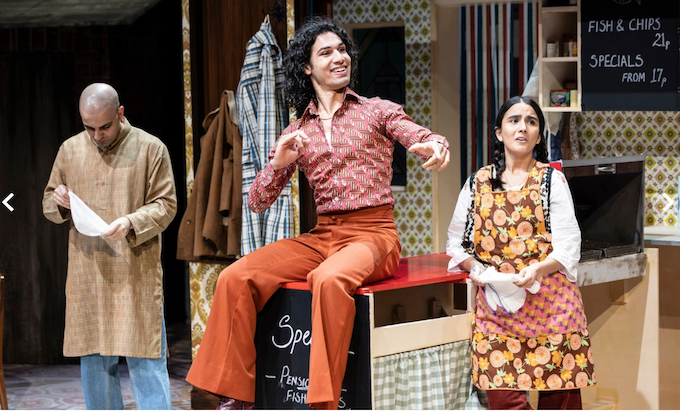
Tariq (Zaki Ali) is the other destined for arranged marriage. He’s the hippest, the most fashionable, has the longest hair. The cool guy. The argumentative one. Tariq is also a bit of a bully to Maneer and Sajit.
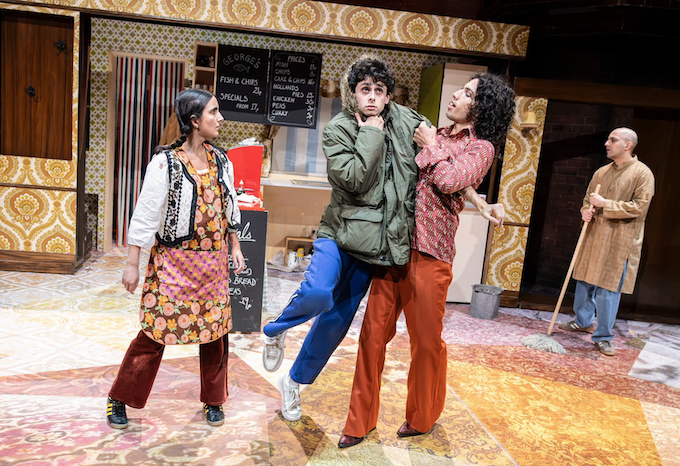
Saleem (Matthew Khan) is the student. His dad tells Mr Khan he’s an engineering student, but no, he is at art college. Hence the blue denims. He is very good at drawing penises and demonstrates Sajit’s fate. He is working on a model as his term project.
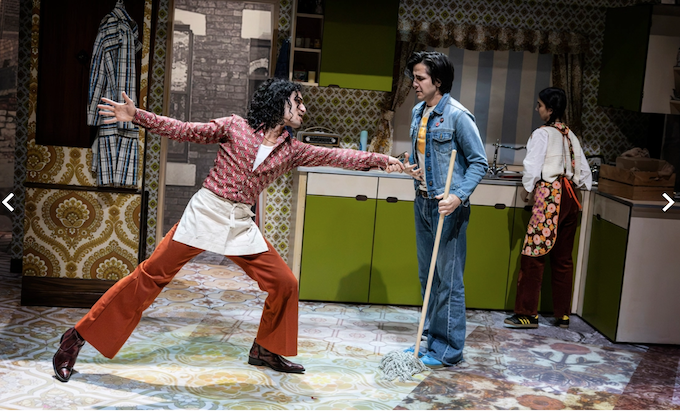
Maneer (Joeravar Sangha) is the pious one, with Muslim dress and hat. Tariq calls him ‘Ghandi.’ Nevertheless, he’s prepared to help cover up the others bacon-eating, and pops a piece in a margarine tub. I spent the rest of the play waiting for it to be discovered, but it never happens.
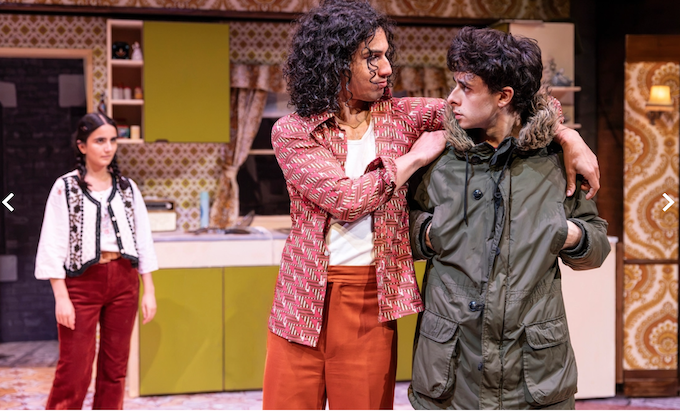
Sajit is mentioned above.
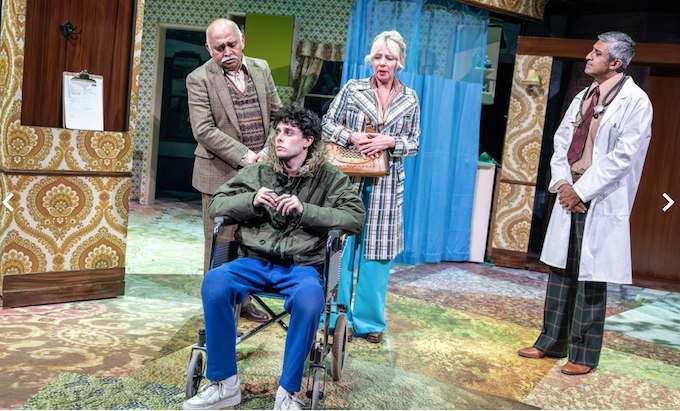
George and Ella. Sanjit in wheelchair post operation. The Indian doctor
Susil Chudasama plays the Indian doctor who does the circumcision. He then points out that Sajit might need some help with his mental issues.
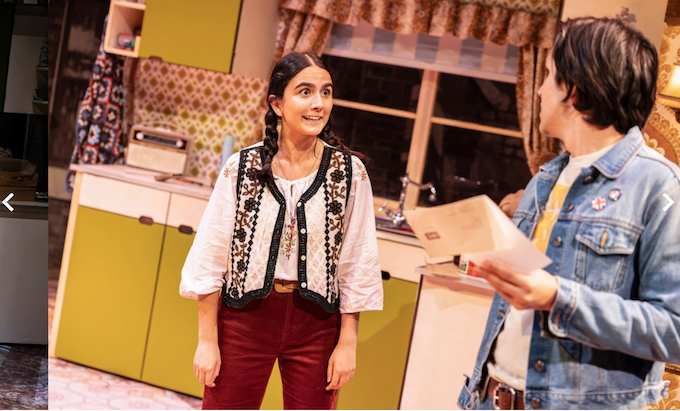
Meenha (Maya Dhokhia) is the daughter, and one of the most rebellious. She also says “fuck” more often than any of the brothers. Notably when Mr Khan arrives she’s been made to wear a sari and cover her head, and Mr Khan greets all her brothers and shakes hands but totally ignores her, except to tell Ella that the sari is not the right Pakistani style. Ella has had to put on a headscarf and trousers for the meeting. George wants them to look devout muslims.
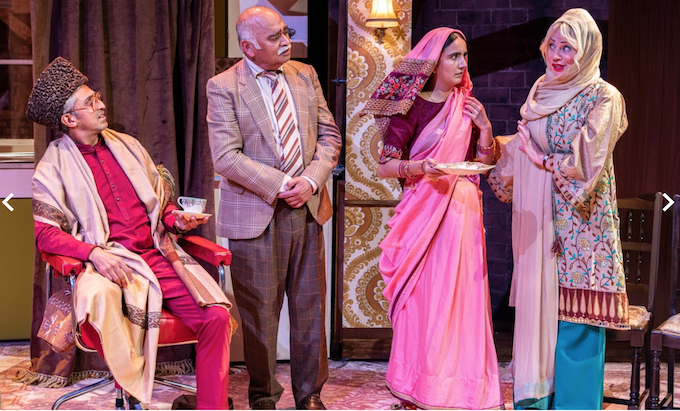
Susil Chudasama then plays Mr Khan hilariously as a pompous and superior total arsehole. He has gold framed photos of his daughters to show to the prospective husbands, which led to my favourite line. Ella looks at the photos and blurts out, ‘They’re very hefty!’ and quickly has to pretend she meant the gold frames.
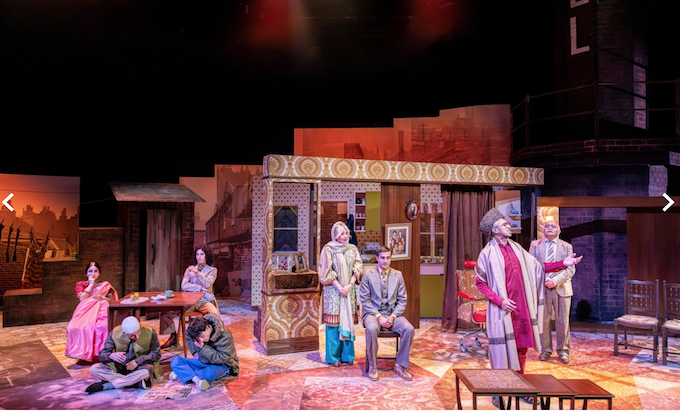
The scene is played with Khan in the living room. Some are with him, but the others are at the kitchen table in the other room, so we see simultaneous scenes (though one is non-speaking). Meenha, Maneer, Tariq and Sanjit are in the kitchen. Ella, Abdul, Mr Khan and George are in the living room.
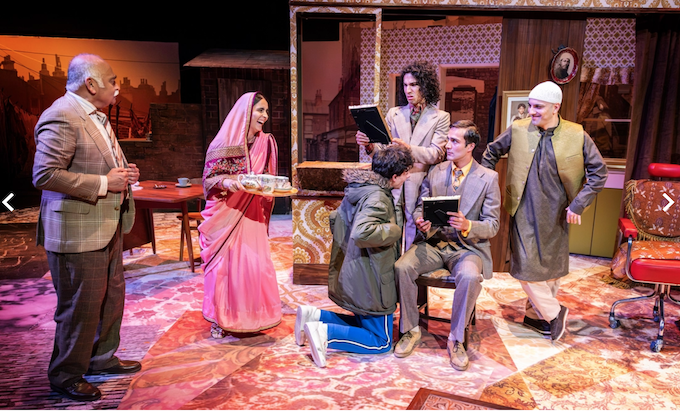
Mr Khan is wealthier and gradually disaster happens. Auntie Anne arrives and mentions the boys helping her with the banners at a Catholic parade. They escape that. Finally, Saleem turns up with his graphic female body part art project and drops it in Mr Khan’s lap.
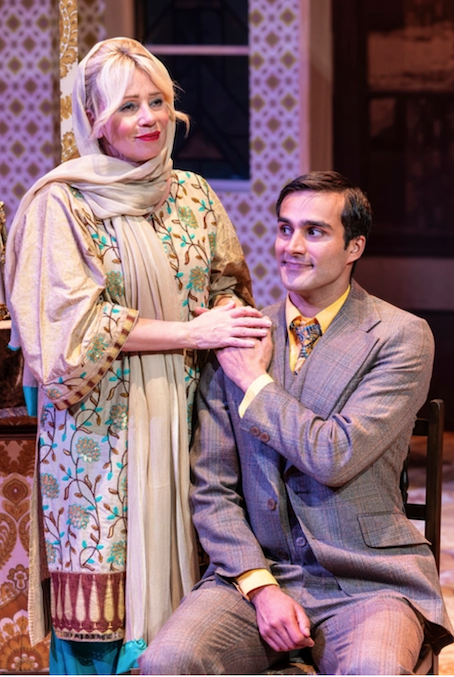
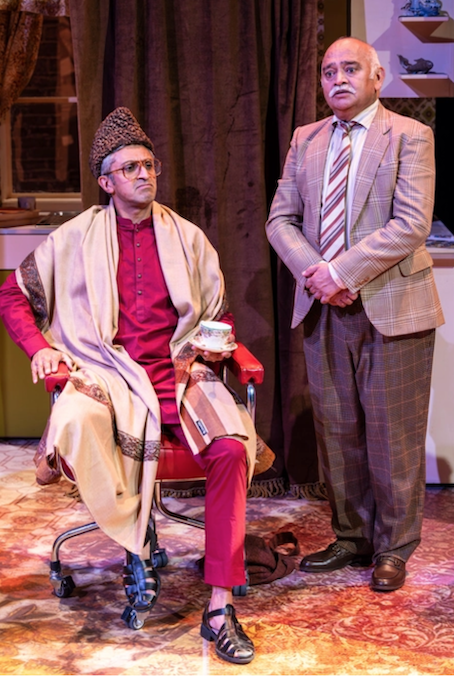
Ella with a trepidatious Abdul, Mr Khan and George
It’s a well known play, and I wouldn’t normally give away the best lines, but I loved at the end when the snooty Mr Khan dismisses the family as half-breeds. Ella comes straight back with, ‘Better than in-breds!’ An instant defence of the need to diversify DNA!
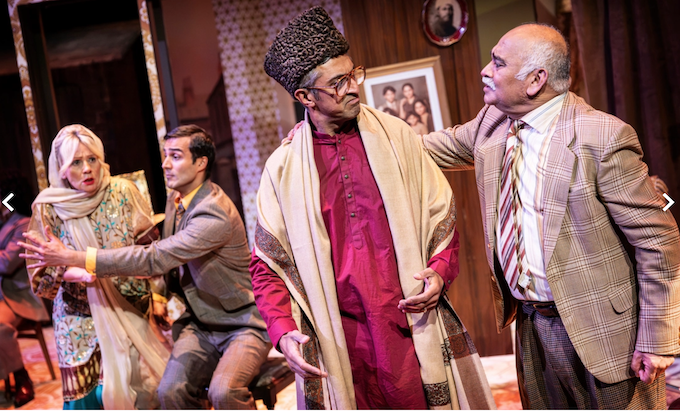
I noted comments from those who’d seen the film that Bhaskar Patel’s portrayal of George is more subtle. He blusters, he bullies, he’s a wife beater, but he still comes across as a human being not a caricature. And as so often when couples argue and fight, something is still there!
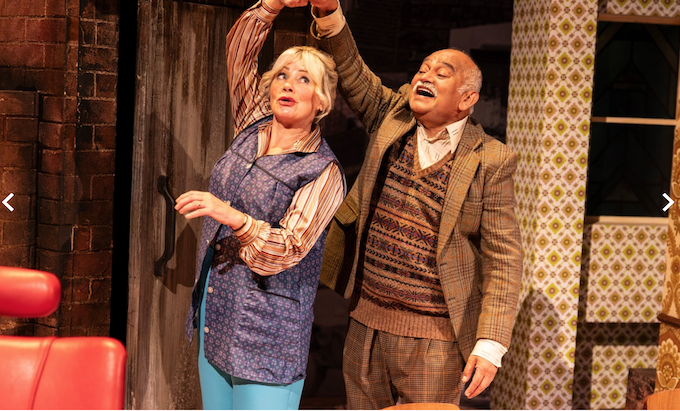
The play is very funny, the scene changes are well worked out. I’d have liked more of the scenes like the one where Meenah and Maneer cover the set change with a dance. The subtlety is her exuberance and the way Maneer watches to follow.
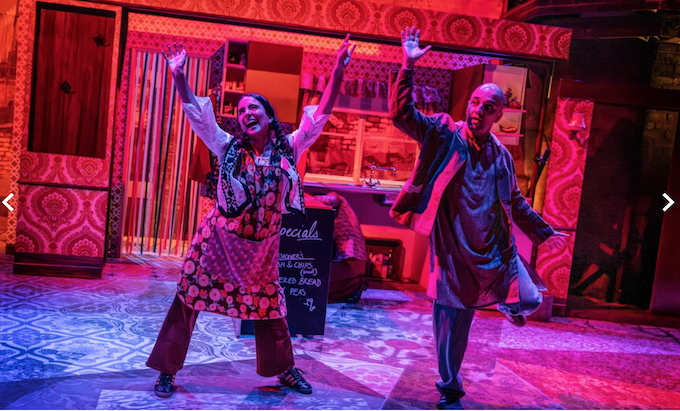
The play is wisely kept in the 1970s. Afterwards we discussed why you couldn’t change the date very much. Tariq and Abdul’s children would be late 70s / early 80s births (like my kids). So their kids would be George’s grandchildren. So much would depend on whether they married out of the Pakistani culture or not. If they married Mr Khan’s daughters, the rebellious grandchildren might well show it by adopting more devout Muslim stances. Sorry, actually not Muslim, but Saudi-influenced Muslim so far more extreme than the early 1970s. Saudi has spent a fortune exporting its extreme Wahabi version to traditionally tolerant countries. Maneer’s costume here might be the default in 2026.
We hadn’t booked in advance, as plenty of seats were available and builders were in the house, so we arrived about twenty minutes before the play started. Salisbury is about the most comfortable theatre we know, you can even get along the rows without people standing up. The rake is excellent. You can see. I think they’ve missed a trick. We were in row F, and the three rows in front of us were virtually empty. Behind us was better, and those seats were slightly cheaper. People were avoiding the premium seats. The trick at Chichester is not to make the balcony seats available (or here the back rows) until they’ve filled it at the front. For the actors looking out, they had very few people between A and Row E.
It was not very busy, in fact it was an old-fashioned midweek matinee audience. I say “old fashioned” because usually, at Chichester, Bath and Stratford, the matinees are the first to sell out. This was the old-fashioned elderly wet-afternoon audience that fails to inspire casts. There was a continuous horrible cougher right through the first act. It sounded like heavy Covid or flu. Still, she went in the lobby at the interval to have more heavy coughing so as to infect those who weren’t near her. It was loud enough to be off-putting to the actors. It was warm applause, but there were not enough of us.
I think that affects performance. If you’ve done evenings in (say) Bolton, where a play about Pakistanis is indeed still edgy given the large Muslim population, I suspect people will be roaring with laughter. I did myself, but felt isolated. I saw no South Asians at all in the audience. Bolton is just ten miles from Salford where it’s set. When I looked at online reviews, Bolton, where they started gets the 4 and 5 star reviews. Elsewhere tends to 3 star.
Perhaps the polite Salisbury audience were embarrassed about the run of “Paki” references. I’ve done talks which normally get a lot of laughter, then you go into a different town, different audience, and you don’t get as much, and it throws your timing. We both felt the performances were all great, but lacked an interactive “snap and crackle.”
This is intrinsically, as at Bolton, easily a four star production. I think the Salisbury matinee sparsely populated theatre reduced our experience to three star. I think the cast gave it their all, but the situation reduces the impact. I’d expect Friday or Saturday night to lift it to four.
***
WHAT THE CRITICS SAID
Five star
Karen Ryder, Manchester Theatres ****** (Bolton)
Ken Powell, Northern Arts, ***** (Bolton)
four star
Nick Ahad, The Guardian **** (Bolton)
Jack McCabe, All That Dazzles **** (Bolton)
David Cunningham, Reviews Hub **** (Bolton)
three star
Philip Lowe, East Midlands Theatre *** (Derby)
Kieran McMath, Reviews Hub *** (Glasgow)


Leave a Reply