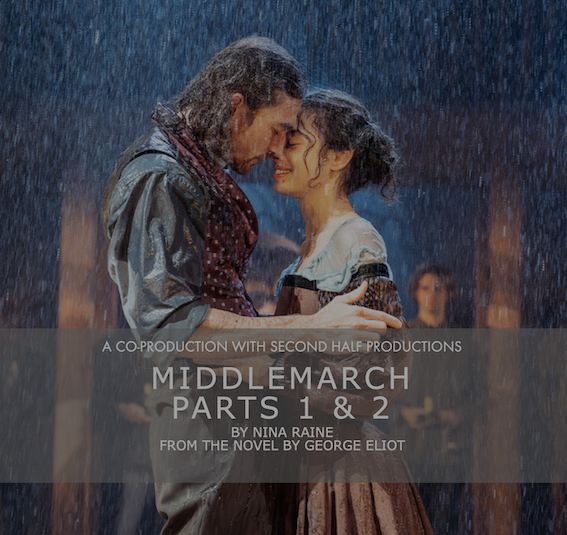
By Nina Raine
From the novel by George Eliot
Directed by Jeremy Herrin
Set and costume by Grace Smart
Composer Paul Englishby
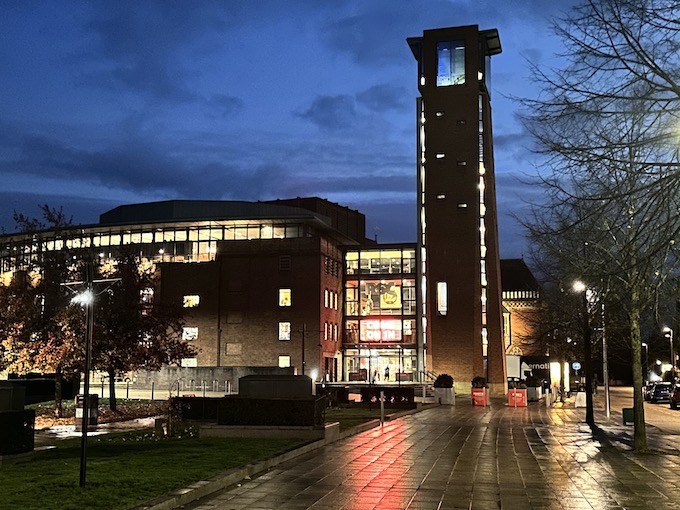
Royal Shakespeare Company
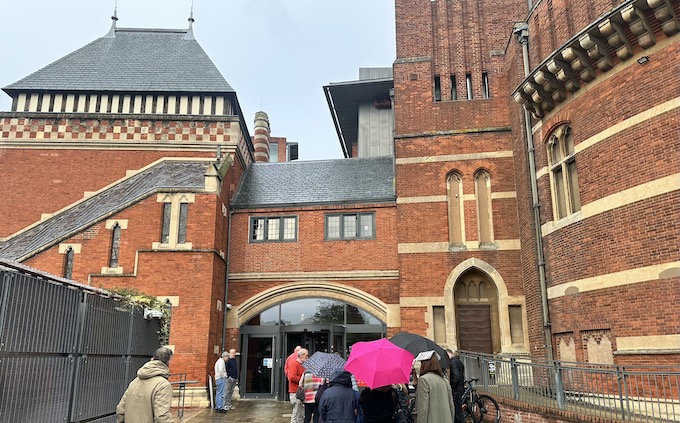
Swan Theatre
Stratford-upon Avon
Wednesday 11th November 2026
Part One 13.15
Part Two 19.15
CAST
Rory Alexander- Will Ladislaw
Lizzie Annis- Celia Brooke / Mary Garth
Emma Bown – Mrs Hackbutt / Clerk
Gunnar Cauthery- Mr Farebrother / Sir James Chettham
Ian Drysdale – Mr Causobon / Caleb Garth
Steven Dykes- Dr Wrench
Dave Fishley- Mayor Vincy / Bambridge / Thesinger
Peter Forbes – Mr Brooke / Featherstone / Raffles
Ebenezer Gyau- Fred Vincy
Mackenzie Heynes – Joshua Rigg / Mr Hawley
John Hodgkinson – Mr Bulstrode / Barthrop Trumbull
Penny Laydon – Mrs Bulstrode / Mrs Garth / Lady Chettham / Mrs Waule / Mrs Dollop / Tantripp
Emma McDonald- Rosamund Vincy
Anita Reynolds – Mrs Vincey / Mrs Mawmsey / Mrs Abel
Andrew Richardson- Tertius Lydgate
Amanda Root- George Eliot / Mrs Cadwallader
Nia Towle- Dorothea Brooke
Molly Watton-Williams – Martha / Jonas
Has the RSC started a tradition of two part versions of classics? Last year was The Forsyte Saga. Last year they scheduled it so you could watch Part One in the evening, stay overnight in a hotel, then watch Part Two at the matinee next day and drive home. They should have options to do that. We had the two plays in a day and so it required two overnight hotel stays. Grumble. I don’t fancy driving to arrive for a 1.15 pm start, nor a three hour plus night drive home starting after 10 pm. Six hours in a theatre seat is enough without six hours in a car.
The Guardian poll of the 100 Greatest Novels put Middlemarch as #1. It wouldn’t be my vote (Wuthering Heights might be). It wouldn’t be in my Top Ten. I had to read it before going to university. We were set the “four greatest novels” from four countries: Middlemarch, Moby Dick, Madame Bovary, Anna Karenina, I now think it a poor selection, completely 19th century biased, and Middlemarch was too long to impose as a pre-reading course. The excellent RSC programme enlightened me as to Eliot’s real life work as a translator of Feurbach and Spinoza and that she was putting some of their ideas on death, morality and religion into novel form. Hard stuff. No wonder critics voted it as number one.
We prepared for this production by watching the 1994 BBC TV series by Andrew Davies a couple of months ago- my memory of reading it aged 19 is sketchy. That’s six hours fifteen minutes on TV, no intervals. But it is also enhanced by great scenery, locations and costume. The novel comes in at around 900 pages even in the small print paperback. We have the impression that the TV version got a lot more plot and action in than the play, without being that much longer (25%?).
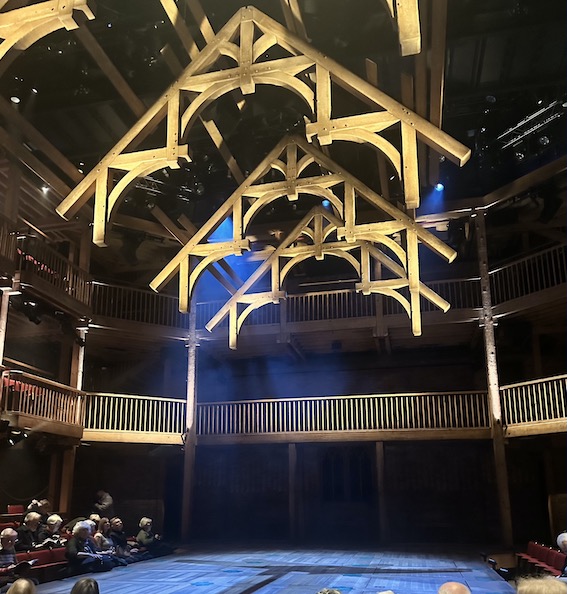
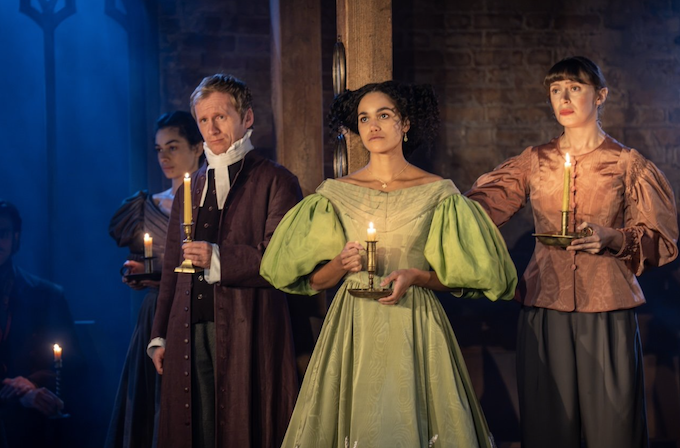
This RSC version goes for almost no set, just beams above and a projected Gothic window. Tables and beds (and a few people) emerge seamlessly from below. Minimalist set. A minimalist set is predicated because it is an array of very short scenes. Fifteen plus in each of the four acts. Lighting is used with subtle effect to highlight characters while losing the background. Candles appear a lot. It was like being in the Wanamaker Playhouse at times, though mercifully in comfortable seats at the RSC.
Minimalist costume too. The major actors get “19th century” then as extras they revert to green or brown trousers and top. Costumes are incomplete. Some have loose floppy trousers (e.g. Lizzie Annis as Mary Garth) below a 19th century top. Then as Celia, Lizzie Annis gets what Arifa Akbar calls a ‘shockingly unfashionable frock.’ It’s shiny turquoise nylon. Another review suggests her ballooning sleeves are so prominent they deserve a programme credit. When Amanda Root switches from George Eliot to Mrs Cadwallader, she just adds a blue cape that looks like a bed jacket. There are exceptions for the leading men, and for Dorothea and Rosamund, but we both thought the overall costume effect a mish-mash and quite often dreadful. This does not show in the production photos. Within the 19th century it’s non-specific. The story is set in 1830 to 1832 the time of the Reform Act, and George Eliot published it in 1871. George IV died and William IV became king in 1830, so costume would be late Regency for authenticity. Some of the men get that, such as Cheetham. The lead women’s frock length is more Edwardian, above the ankles. But no one is going for authenticity. My guess is that they didn’t it want to look like yet another Jane Austen 19th century adaptation in wispy Regency pastels. I see the point.
The date of the action, forty years before publication, supports my long held theory that many, many great novels are set 30 to 50 years in the past.
Middlemarch was a Midlands town, based probably on Coventry and we are watching it in Stratford, in the same county of Warwickshire and not far away. West Midlands accents are often used in the RSC for humour, and this time it’s appropriate. There is a clear RP v Midlands accent character divide.
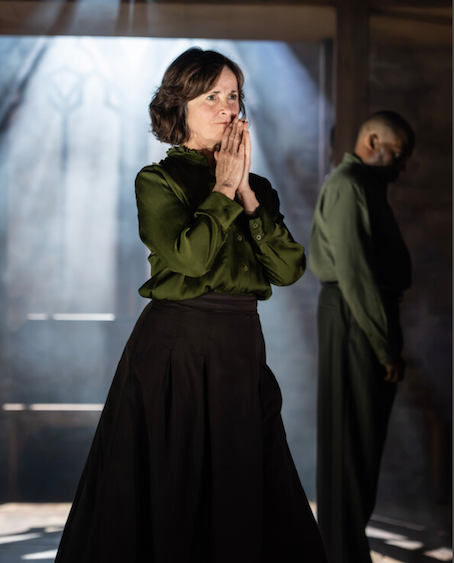
The big idea is that George Eliot becomes a major part of the production, played by Amanda Root. She narrates, but also listens to her characters, prompts characters to act, talks to characters.
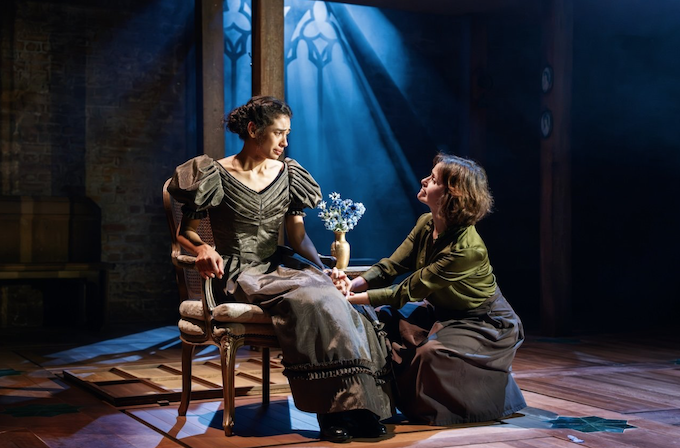
It’s a chance to put in some of Eliot’s non-dialogue lines from the novel too. At the very end, after the summing up of what happened AFTER the play, George Eliot adds her own autobiographical coda- I lived with a married man then I married someone twenty years younger. Her reactions to characters propel and predict plot. A tremendous performance. Superb as she was the opening speech at the back with a candle got lost. Too quiet.
Sum up the story in four words? Unrequited love. Unpaid debts.
Part one
13.15
Necessarily it’s in larger chunks than the TV series. That starts with the young Dr Lydgate (Andrew Richardson) arriving in the town. In the play it’s some time before we meet him.
Necessarily it’s in larger chunks because the amount of doubling and tripling between roles would make intercutting too hard. Peter Forbes for example plays three major roles: Mr Brooke, Dorothea’s vigorous and cheerful uncle; then Featherstone, Fred Vincy’s invalid uncle; and finally Raffles, the blackmailing figure from the respectable banker Mr Bulstrode’s past. He’s powerful in all three, and gets to die twice, as Featherstone and Raffles, in the same position in the same prop bed. His death as Featherstone is very funny clutching his black box and pile of money. Even better is when Fred needs money and he sneezes all over it before handing it over.
A further point on doubling: Dorothea, Rosamond, Will Ladislaw, Dr Tertius Lydgate and Fred Vincy are the five characters where the actor doesn’t have to double. Wisely, they also don’t get costume changes of any significance. With all the doubling, we need to be certain who these five actors are playing.
So the first chunk is the Brooke household, with the two wards, sisters Dorothea (Nia Towle) and Celia (Lizzie Annis) sharing out their mother’s jewellery box, indicating that Celia is a lively cheerful girl, but Dorothea is somewhat puritanical, even priggish. She is interested in the intellectual world. Nia Towle sustains this throughout the play, serious, wanting to be helpful, wanting to be “good” though not in a basic Christian sense. (A classic Libra, my companion said).
Peter Forbes is a comic creation as Mr Brooke (the lines are in the book) and it’s a dinner party with the wealthy and handsome neighbour, Sir James Chettham, and the dusty scholar Mr Causobon. Sir James fancies Dorothea, an unrequited love. This was rushed. The theme of Dorothea designing cottages to improve the lot of the poor flies past and would probably be missed if the book or TV series had slipped your memory. To me, Sir James (Gunnar Cauthery) needed more to time to establish his character. The cottages are important for establishing Dorothea’s intellect and need to help.
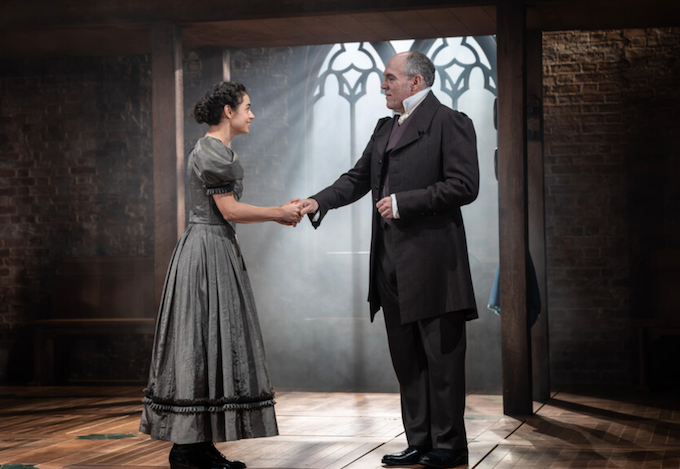
Ian Drysdale is a definitive Mr Causobon. He has been working for a lifetime on his theory that “all the mythical systems in the world are a corruption of a tradition originally revealed.” He is attracted to Dorothea’s youthful admiration for his work. Dorothea falls in love with his intellect only to find that he has a chronic problem with actually finishing his great work. He loves the scholarship process but doesn’t have the ability to shape it, or the courage to actually present it to the world.
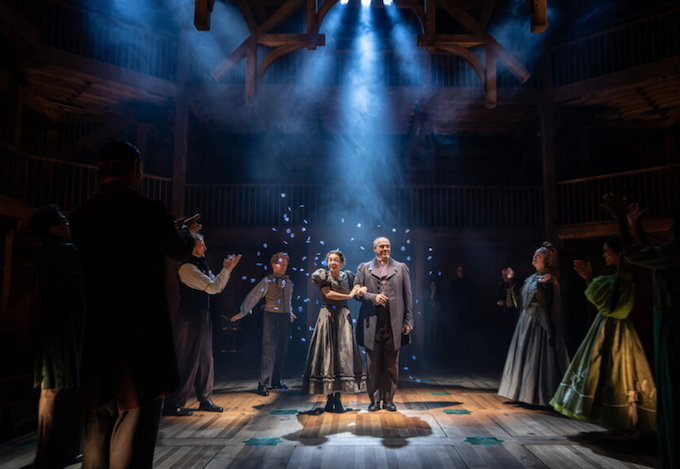
James Chettham is easily diverted to bestow his unrequited affections on Celia. Sir James Chettham and Celia get married a too, and Celia has a baby. This contrasts with the lack of any sexuality in Dorothea’s marriage.
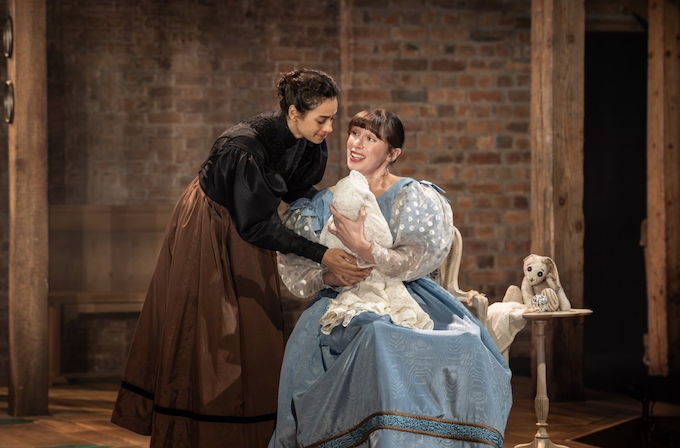
I’m not going to walk through the plot, but PART ONE, the first play, ends with Causobon’s death. It’s a good cut off point. So that’s the main story of the first part. We meet Will Ladislaw (Rory Alexander), Causobon’s artist second cousin early on.
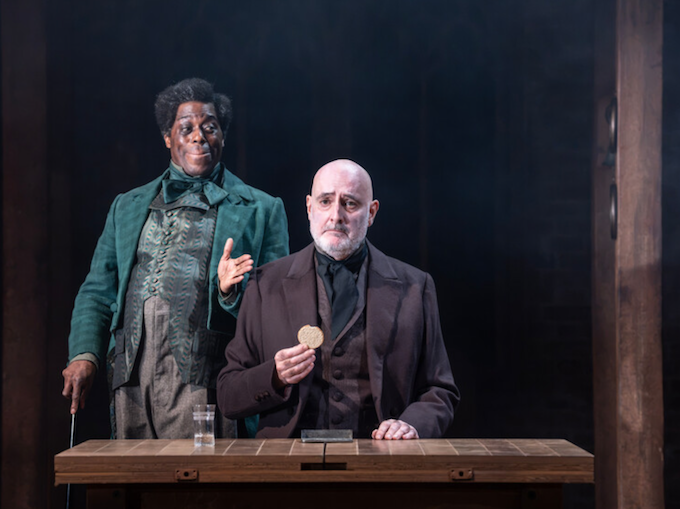
The next thread ot chunk is the Vincy family, led by Mayor Vincy (Dave Fishley) and Mrs Vincy (Anita Reynolds). They have two children, Fred Vincy (Ebenezer Gyau) and Rosamund (Emma McDonald).
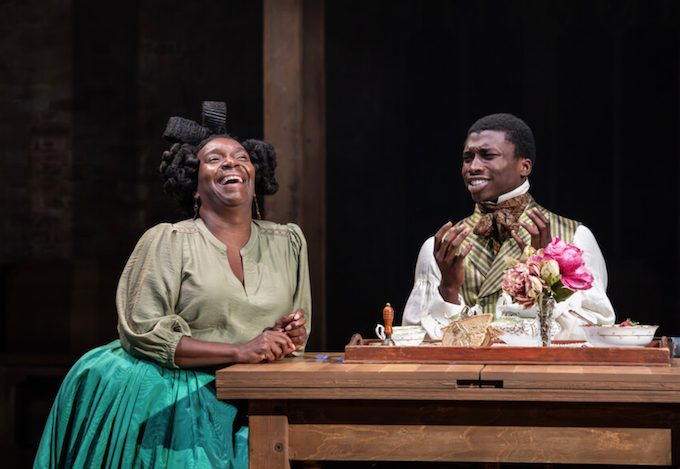
The actors in the family are Afro-Caribbean ethnicity, except that Emma McDonald is very light-skinned. At least the casting respects family relationships, though their rich uncle, Mr Featherstone (Peter Forbes again) is white. However, the relationship was via Mr Vincy’s first marriage and the programme family tree clears that up. Just about.
Featherstone employs Mary Garth (Lizzie Annis again) as a servant. Fred is a wastrel and gambler and owes money. His unrequited love is Mary Garth.
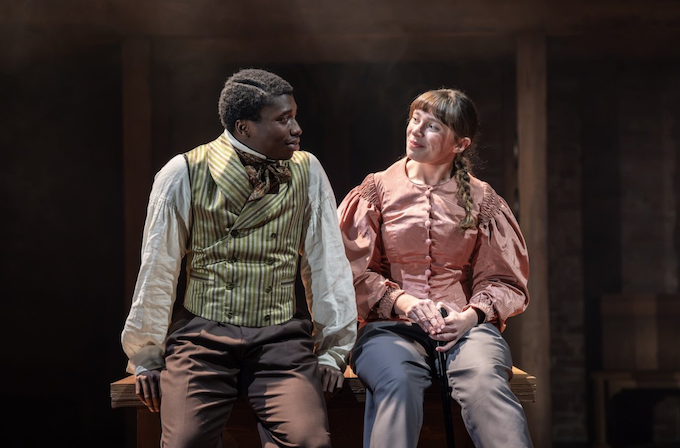
The Vincy thread… sorry, as my name is Viney, this name is really annoying to type … allows a lot of comedy with a set of grasping relatives waiting for the old man to die. John Hodgkinson with brummy accent is the outstanding relative, and is the one allowed audience interaction.
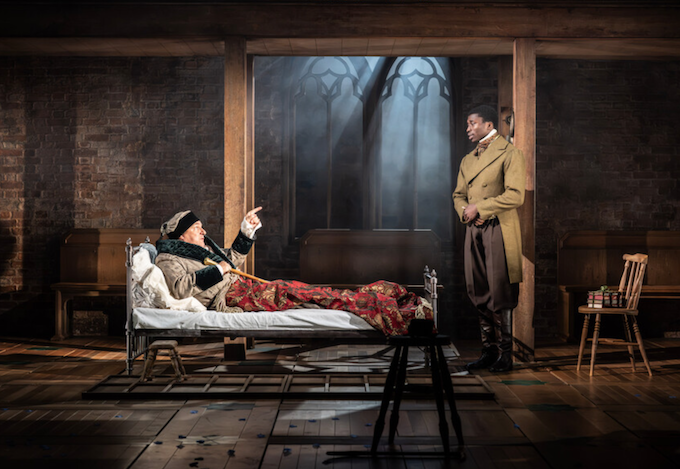
Fred has high hopes of being remembered in Featherstone’s will, as well as getting cash from him, cash which is insufficient and which he blows on a knackered horse.
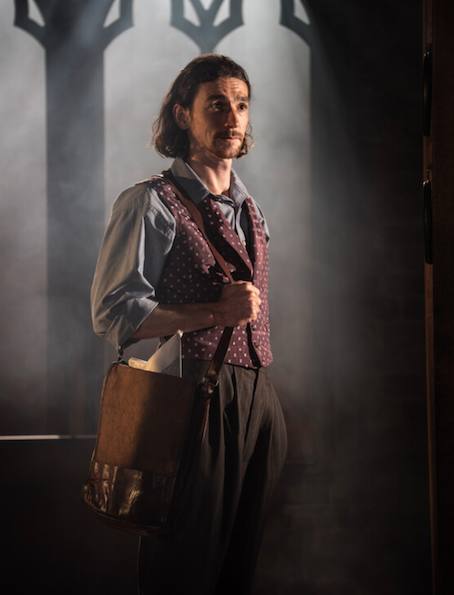
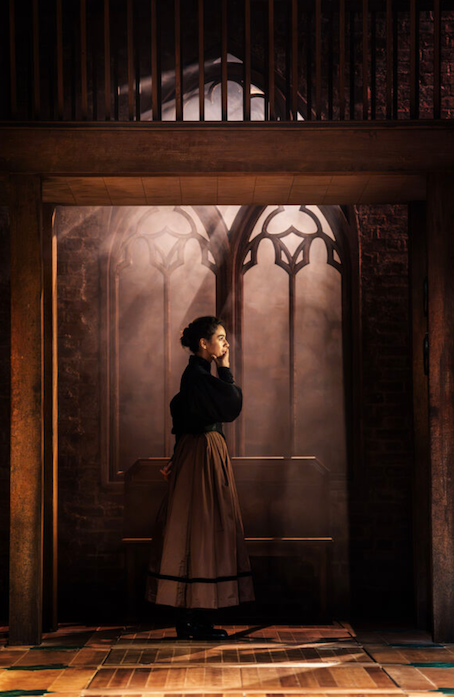
Rory Alexander as Will Ladislaw, Nia Towle as Dorothea
We can then switch back to the Causobon thread on their Roman honeymoon, where Dorothea runs into Will and his German friend. A statue rises to indicate Rome. Causobon is pre-occupied spending all day reading manuscripts. Dorothea is abandoned. The German friend is Naumann in book and play text, but uncredited in the programme.I believe it’s Mackenzie Heynes who also plays Joshua Rigg.
Will explains that Causobon’s theories have been surpassed by German philosophers, which is the original George Eliot, as German translator, needling her point in.
Ian Drysdale portrays the dusty scholar with much younger pretty wife, but to him she’s theoretical. Physical contact is distasteful to him. So Dorothea is another unrequited one.
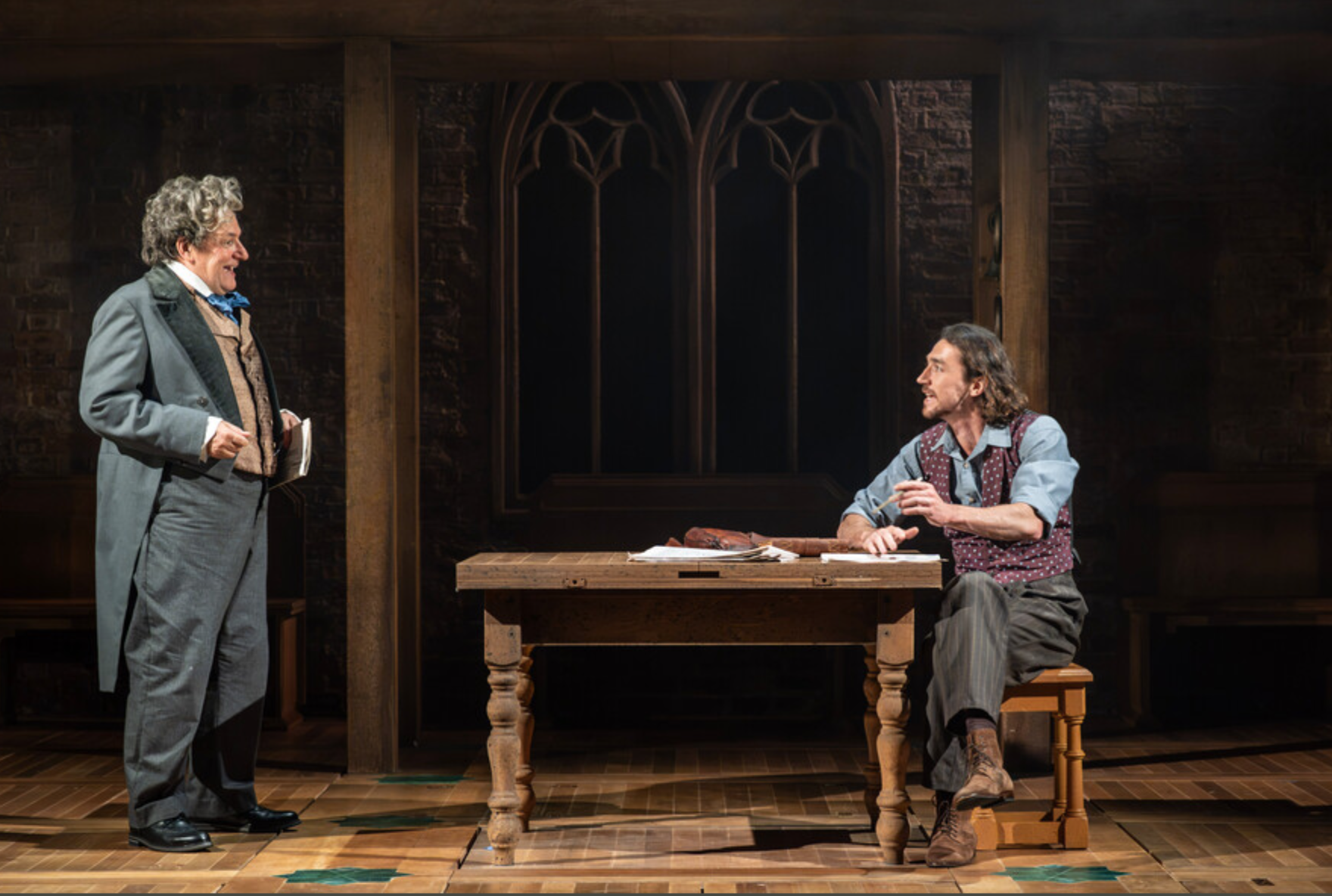
Will reappears in Middlemarch when Mr Brooke offers him a job on his newspaper, totally unaware that Will’s views are in a different political sphere to his own.
We do get to the Dr Lydgate thread, and Gunnar Cauthery switches from playing Chettham to playing the Reverend Farebrother. This was another point where we felt he didn”t have time to establish himself as the vicar keen on gambling on billiards (if at all), though he loses the elaborate coiffeur he had as Sir James Chettham. This is an issue, the whole Lydgate / Farebrother thread, with them beholden to banker Mr Bulstrode (John Hodgkinson) who establishes the charity hospital, is rushed too, though it has to be put in because of its dominance in Part Two.
The ending has a completeness, working as a play. We shall badly miss Mr Causobon in Part Two.
Part two
19.15
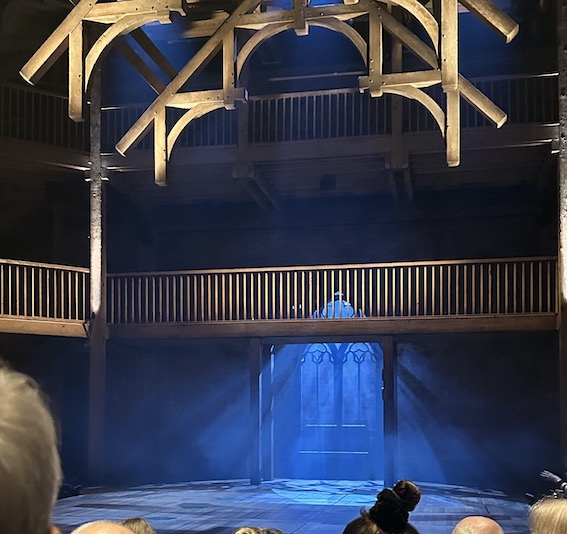
Would you choose to see just one of them? We had different people next to us (we retained the same seats) in Part Two, but then if I lived in Stratford or within 30 or 40 miles, so Birmingham or Oxford, I would have chosen to see the plays on successive days, not on one.
I won’t be too detailed, but I assume most, like me, have only a sketchy memory of the plot.
Dorothea has inherited the estate, but hasn’t been told (yet) that the will forbids her to ever marry Will Ladislaw. Causobon’s jealousy radiates from beyond the grave.
The unpaid debts theme emerges as Fred Vincy is deep in debt, and Mary Garth’s father, Caleb, has guaranteed his loans which must be paid back. This means Mary’s brother (who we don’t see) cannot have an apprenticeship. This was an area well done, but which I felt needed another couple of minutes of script to do it justice.
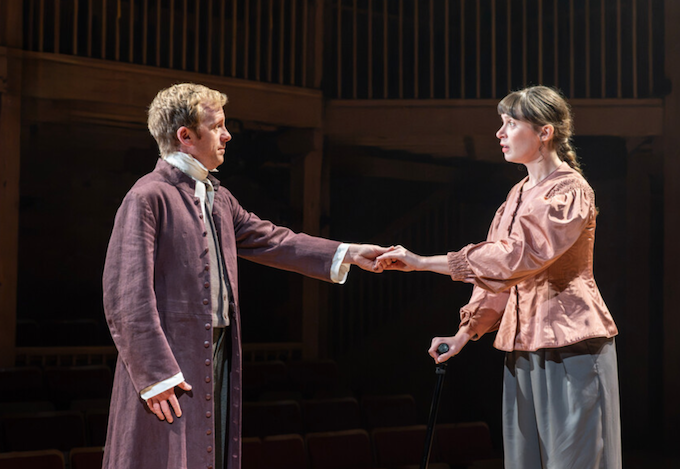
The unrequited love is double, because Fred asks Farebrother to intervene to persuade Mary of his affections, little knowing that Farebrother holds a torch for Mary himself.
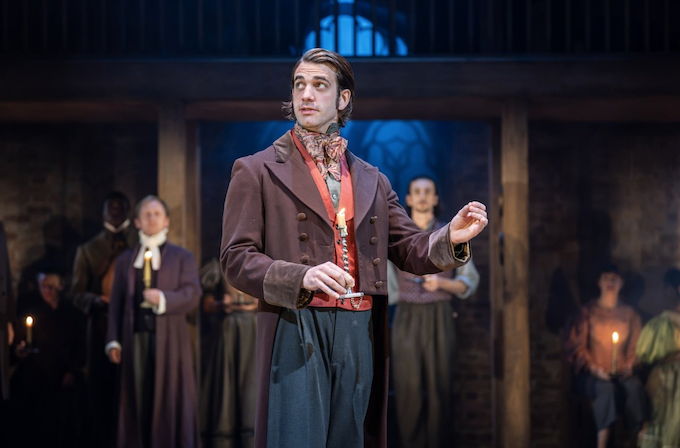
The focus in Part Two is on Dr Lydgate and Rosamond Vincy. He has been upsetting the other doctors (multiple doctors suggest Middlemarch is sizeable) by treating Fred Vincy’s typhoid and having radical medical ideas. Bulstrode makes it clear that he expects Lydgate to do his will in voting for his choice for the job of Hospital Chaplain, a post Lydgate’s friend Farebrother wants.
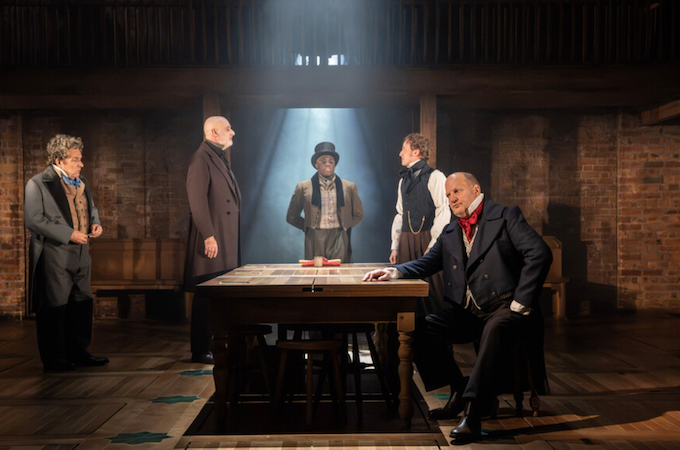
John Hodgkinson radiates piety as Bulstrode.
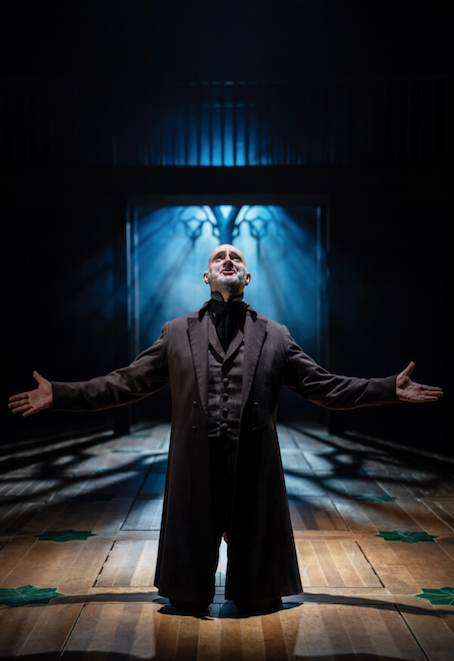
Rosamond is flighty and luxury loving, and a spendthrift. They are soon in debt. They can’t afford the fine house they are renting and all the new furniture will have to go. Lydgate is not a local man, but Rosamond has been brought up in the town and feels the potential shaming in front of her relatives, friends and neighbours.
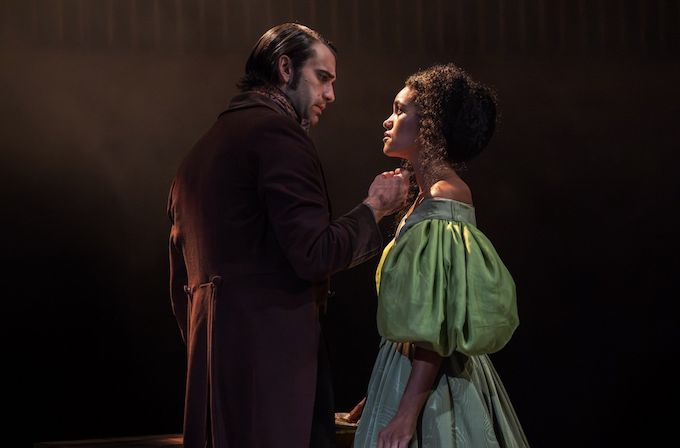
The arguments between the pair are high drama. Neither will compromise, though Tertius is defeated by the power of her will. Lydgate is desperate even resorting to gambling on billards to get some money.
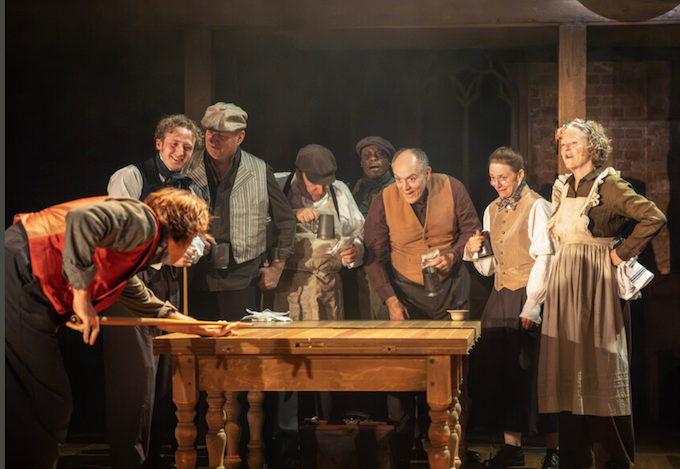
Lydgate has to ask Bulstrode for money and is refused. Will they have to move and sell off their furniture? It is not happy families as Rosamund goes behind Tertius’ back to appeal without success to his aristocratic relative.
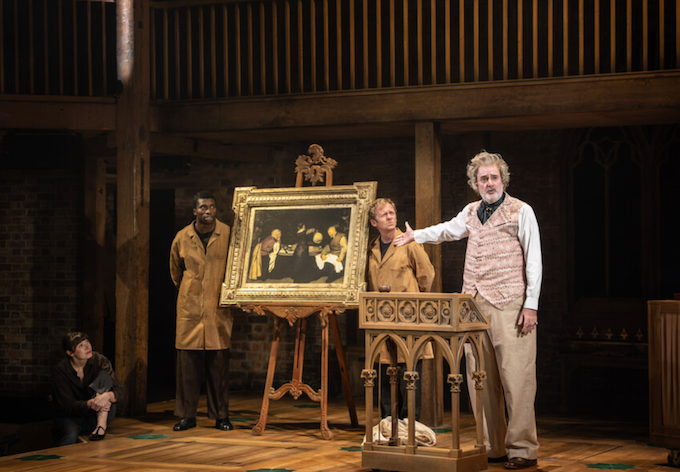
The highlight of the second play was the auction, with John Hodgkinson as Barthrop Trumbull, the auctioneer. He was freed to improvise and interact with the audience and have them bid (as one should always let major comedy roles do),
Will and Rosamund enjoy their mutual love of singing in the afternoons. A red herring, as Will is utterly devoted to Dorothea.
Then Raffles (Peter Forbes again) turns up. The blackmail element was confusing in the Davies version. it’s confusing here. I’m not going to check to see whether that’s Eliot’s fault. Suffice it that Raffles knows about Bulstrode’s dodgy dealings in the past and can shame him. It turns out that Bulstrode’s first wife was Will’s grandmother and that left Will and his mother, who went on the stage, in poverty. So he needed financial help from his second cousin Mr Causable … you can see it’s confusing. 19th century midland towns had a smaller DNA pool than one might expect.
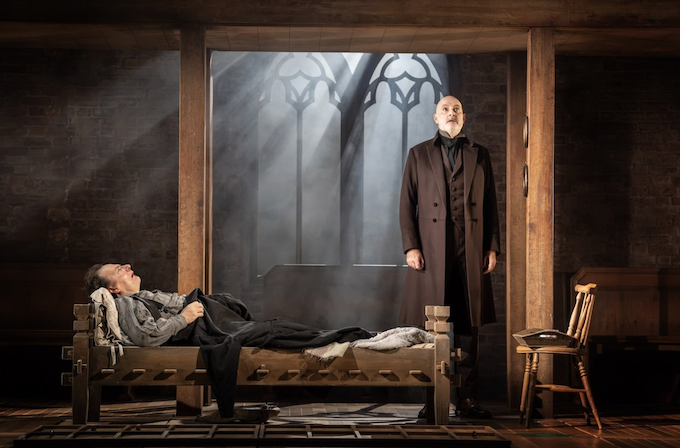
Rush to the end, Raffles becomes ill. Bulstrode takes advantage by ignoring Lydgate’s prescriptions and advice so Raffles dies, Peter Forbes’ second excellent demise. Bulstrode has decided to loan Lydgate the money. Ah ha! The town assume that Lydgate and Bulstrode are jointly responsible.
Rosamond and Dorothea make friends as Rosamond reveals that Will only loved Dorothea all the time. The plot sways perilously close to Mills & Boone.
Dorothea finds out about the will, renounces all her wealth to go with Will. Inexplicably the RSC turns on the rain machine as they embrace at the end and the assembled watching cast stand well back from the deluge. That rain machine has been over-used since it was installed.
Overall
There is a lot of comedy, some evokes a smile when Amanda Roots talks to characters, some a great big laugh as in Peter Forbes death scene or John Hodgkinson’s auctioneer. I had the impression that some of the humorous moments in the original had been marked with highlighter and at times it jumped between them.
Cutting classics is something I’ve done in English Language Teaching graded readers. I’ve written a few, edited a lot more. 900 pages is terrifying. I don’t think they included anything that Andrew Davies cut in 1994. Your choice is radical surgery, eliminate a whole sub plot, or make the thousand small cuts. Largely the politics, reform bill, changing-world themes go, but they have to keep Will being employed to edit the newspaper for Mr Brooke as a way of bringing him back to Middlemarch against Mr Causobon’s wishes. The story is Dorothea and Will in Part One, Dr Lydgate and Rosamund in Part Two. The radical surgery limb would be to lose Fred Vincy and Mary Garth and families (but then Rosamond Vincy is vital to the plot), but then the comic relief throughout involves Mr Featherstone and the Vincys, and the whole would suffer if it was cut to the two big romantic themes. The Bulstrode corruption theme is wound so far into the Dr Lydgate story that it’s essential. I’ve given it a lot of thought and they cut it well, in spite of some issues (the cottages, radical views) flitting by as a result.
Two long plays in a day is a marathon. Six hours (including intervals). For me, it was too much. I’d far rather see evening + matinee. Bad scheduling by the RSC is at fault. Concentration began to flag for both of us. Compared to The Forsythe Saga it covers a more limited timescale with fewer events. Middlemarch is unleavened with more than a few very short desultory waltzes and a couple of heavily truncated songs. There are excellent whole cast choral singing sections. It could have done with more of the variety John Hodgkinson brought. I know time was a problem with so much plot to get in, but more dance and a longer section of song (we know Emma McDonald as Rosamond is a first rate singer- we’ve seen her before) helps concentration on the wordy sections. The costume and minimalist set are also not in the same class as The Forsythe Saga.
The cast were universally marvellous. I reckon they largely got the cuts right, the device of having George Eliot worked, but overall there was a certain remoteness in the isolated scenes. The production photos lean towards the scenes with more people on stage, but we felt there were many more scenes with just two or three on stage. I’m afraid we agreed it was a three star. That means definitely worth seeing, but not one that is beyond improvement. See below. We were much in the minority and part of it was our own lack of stamina. Had we seen it over two days, I have a feeling it would have been four star though.
***
PROGRAMME
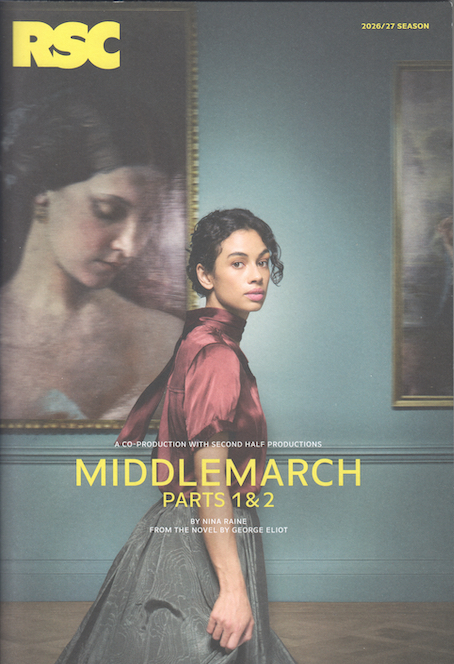
Excellent. Good background, good synopses, family trees and even a location map of houses in Middlemarch. It was excellent on Eliot, including a note on how Mary Ann Evans retained her George Eliot pseudonym, while the Brontë sisters all lost theirs early on. I often use the online inflation calculators to bring money to modern values and the programme has a chart of ones, such as debts, in the play.
The programme was £8, which is £2 to £3.50 over the going rate at other theatres. The sales desk said earlier in the year that £8 was for the Branagh Season. As it clearly didn’t affect sales, they’ve stayed with it. To me it’s probably the difference between losing money and breaking even, rather than profiteering. There’s only one non-RSC advert, and that’s on the back cover. With the cheaper ones you are buying lots of adverts. It was worth £8 in comparison. That’s fine as long as the advert-laden ones elsewhere don’t think they can do the same.
WHAT THE CRITICS SAID
five star
Mia, Theatre & Tonic *****
Stage Talk *****
four star
Arifa Akbar, Guardian ****
Georgina Brown, The Independent ****
Sarah Crompton, What’s On Stage ****
Debbie Gilpin, Broadway World ****
Gordon Parsons, Morning Star ****
The Stage ****
Rebecca Vines, Broadway Baby ****
three star
Domenic Cavendish, Telegraph ***
Nick Wayne, West End Best Friend ***
LINKS ON THIS SITE
JEREMY HERRIN (Director)
Grace Pervades by David Hare, Bath 2025
The Man In The Hat (film, actor, the priest)
Wolf Hall, RSC (director)
Bring Up The Bodies, RSC (director)
JOHN HODGKINSON
The Merry Wives of Windsor, RSC 2024 (Falstaff)
The Provoked Wife, RSC 2019 (Heartfree)
Venice Preserved, RSC 2019 (Senator Antonio)
The Country Wife, Minerva, Chichester 2018 (Pinchwife)
Twelfth Night, RSC 2017 (Sir Toby Belch)
Love’s Labour’s Lost– RSC 2014 (Don Armado)
Love’s Labour’s Won RSC 2014 (Don Pedro)
Hangmen, by Martin McDonagh, 2015 (Pierrepointe)
Love’s Labour’s Lost, RSC / Chichester 2016 (Don Armado)
Much Ado About Nothing, RSC / Chichester 2016 (Don Pedro)
The Ferryman, by Jez Butterworth, Royal Court, 2017 (Tom Kettle)
EMMA MCDONALD
The Constant Wife, RSC 2025
A Midsummer Night’s Dream, Watermill 2019 tour (Hippolyta / Titania)
Twelfth Night, Watermill, 2017 (Antonia)
A Midsummer Night’s Dream, Watermill 2018
Macbeth, Watermill, 2019
AMANDA ROOT
Richard II, The Bridge 2025
The Chalk Garden, Chichester 2018
Racing Demon, by David Hare, Bath 2017
Amanda Root was in my ELT video series Grapevine 3 with Jim Sweeney and Steve Steen
ANITA REYNOLDS
Romeo & Julie, National Theatre
Bartholomew Fair, Wanamaker 2019
The Merry Wives of Windsor, Globe 2019
Absolute Hell, National Theatre 2018
NIA TOWLE
Hamlet, RSC 2025 (Ophelia)
A View From The Bridge, Bath Ustinov / West End 2024 (Catherine)
ANDREW RICHARDSON
Guys & Dolls, Bridge Theatre 2023
IAN DRYSDALE
Ross, Terence Rattigan, Chichester 2016
Henry V, Grandage Season 2013
STEVEN DYKES
Sing Yer Heart Out For The Lads, Chichester 2022
DAVE FISHLEY
All’s Well That Ends Well, RSC 2013
As You Like It, RSC 2013
Hamlet, RSC 2013
PETER FORBES
Assassins, Chichester 2023
Jack Absolute Rides Again, National Theatre, 2022
Follies, National Theatre 2019


Leave a Reply