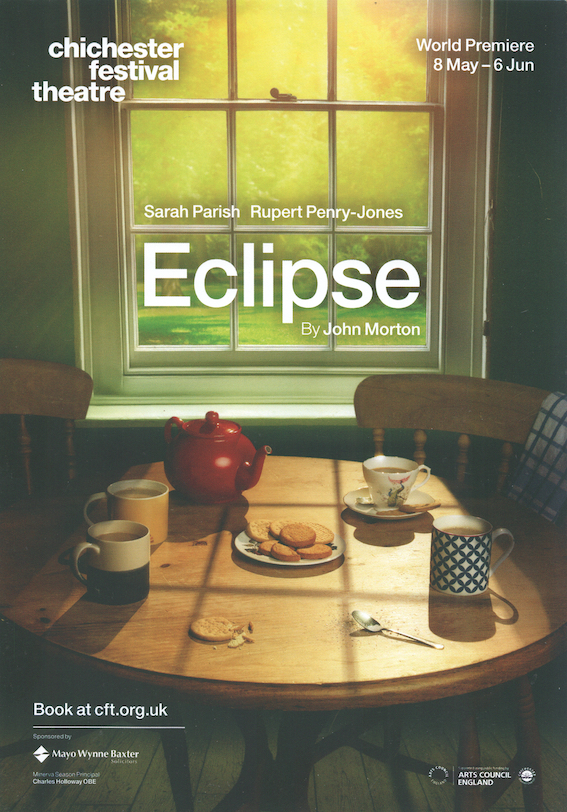
By John Morton
Directed by John Morton
Designed by Simon Higlett
Sound design and music by Ed Clarke
The Minerva Theatre
Chichester Festival Theatre
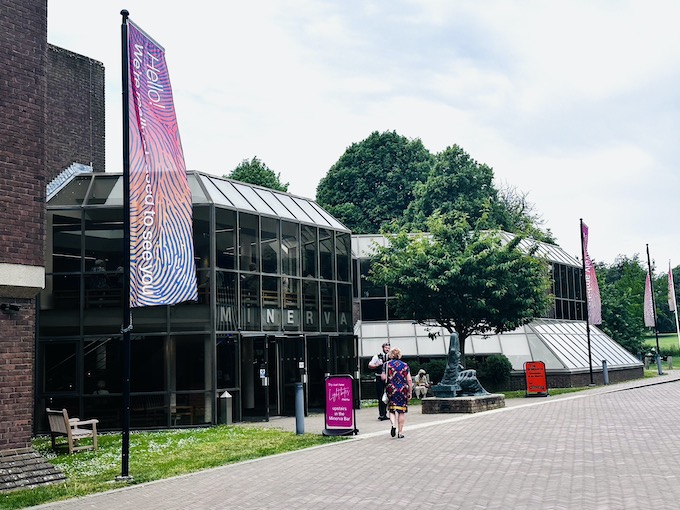
Thursday 28th May 2026 14.15
CAST
Sarah Parish – Sarah
Rupert Penry-Jones – Jonathan
Katherine Bennett-Fox- Julia, a nurse
Selina Cadell- Karen, a carer
Mariam Haque- Nell
Brendan Hooper- postmam
Lizzie Hopley- Linda, a carer
Julian Protheroe- Milkman
Maanuv Thiara – Doctor Parker
Paul Thornley – Graham
John Morton wrote and directed. He is the director of the TV series, People Like Us, Twenty Twelve and Twenty Twenty Six.
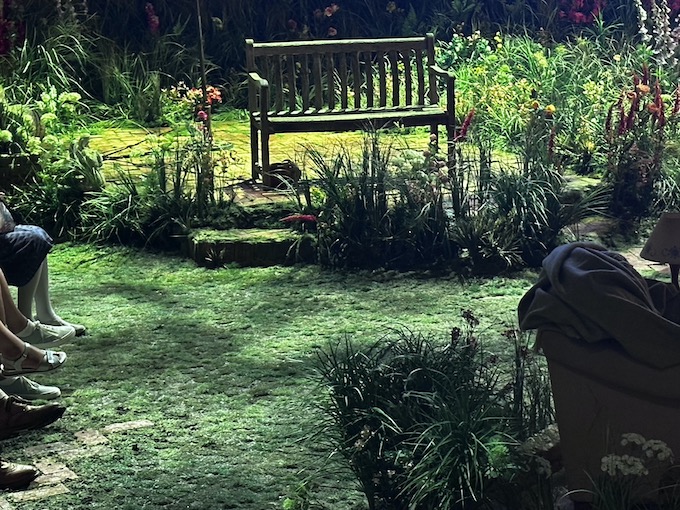
We walked into the Minerva Theatre and saw the realistic-looking grass that spilled off the stage and extended to the entrances and under the feet of the front row. ‘They must have kept the set from The Norman Conquests,‘ I said, ‘Or at least the blocks of grass.’ Indeed, Simon Higlett designed Chichester’s Alan Ayckbourn trilogy, and designed Enid Bagnold’s The Chalk Garden, both at Chichester with elaborate sets combining a house and garden. This was far from the only Ayckbourn reference of the day.
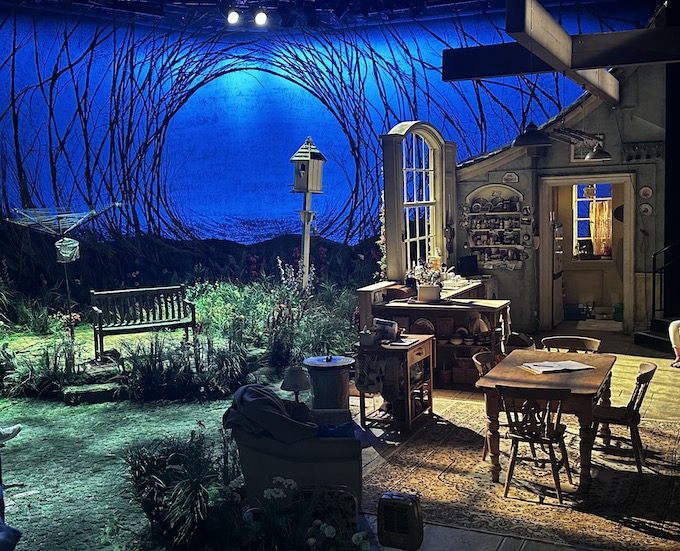
The set is incredibly detailed in the garden flowers and in the junk on the kitchen shelves, and I realised someone had thought about every item. I also thought it was tailored to the Minerva’s unusual stage shape, and Chichester productions so often go elsewhere. More later.
Several reviewers reference Ayckbourn. I was also referencing Harold Pinter. John Morton to me achieves the “poetry” of the realistically banal in dialogue. Lots of hesitations and monosyllabic responses. The dialogue is banal, because that’s what happens in times of crisis when people desperately avoid the central issue but need to fill the gaps. Every character talks about the hot weather, and how nice the garden looks. The carers talk about their driving route to work. Tea and coffee is constantly offered. Biscuits too. There’s so much on the errant toaster. Then there’s the long, long discussion on flavours of yoghurt and which one the patient might like.
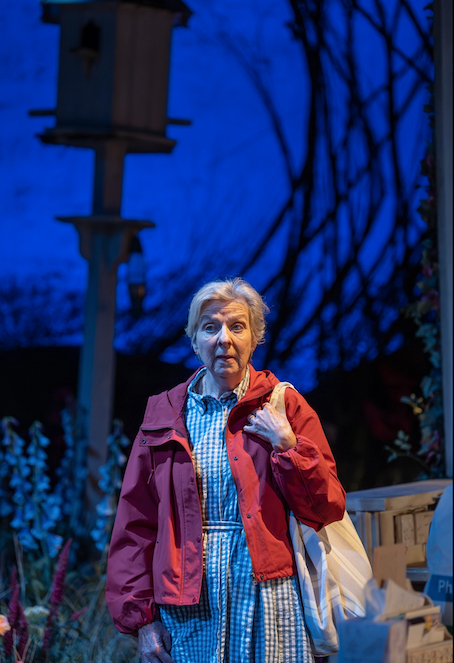
The story revolves around Edward, who is dying in the next room. We never see him. He was a successful children’s book author of a series based on Brian the Badger. As he got older he refused lucrative offers to write more, and instead focussed on the philosophy of gardens. His wife had died four years earlier.
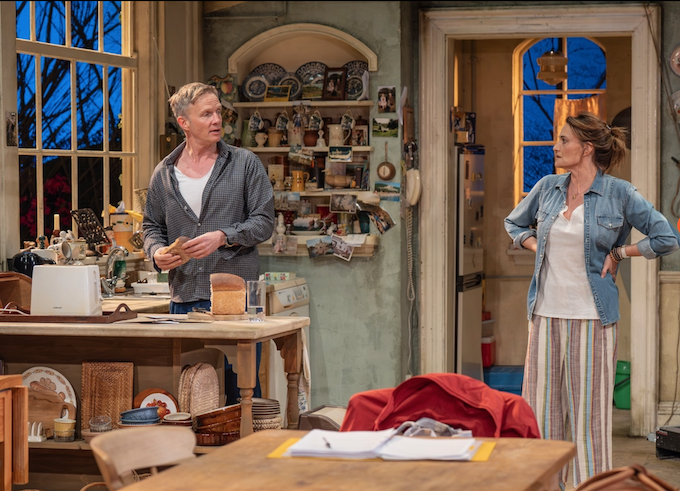
The two children are Sarah (Sarah Parish) aka ‘The daughter that stayed’ in the play text, and Jonathan (Rupert-Penry-Jones) aka ‘the son that moved away.’ It took me a while to work out they were siblings not spouses and that Graham (Paul Thornley) was married to Sarah rather than being the gardener / handyman. Jonathan is a TV producer and lives in London. Sarah lives locally. I do wonder about TV producers writing about TV producers as characters, but then I’ve written comedies about ELT authors (none of whom is me).
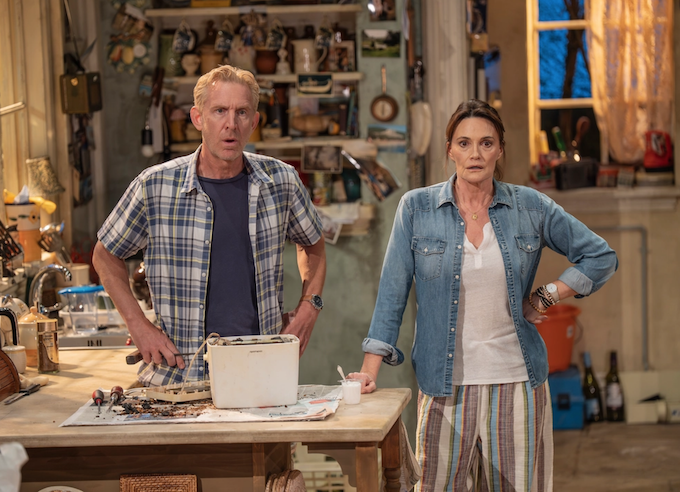
They know Edward is dying and it’s a matter of time. Sarah reacts to the situation by being sharp and snappy (especially to Graham) and sarcastic about the shapely nurse, Julia. Jonathan reacts to the situation by being confused and overwhelmed and then losing it and saying ‘fuck’ a lot. Graham is oafish, and too squeamish to go in and see Edward, and contents himself with trying to repair the toaster and eating biscuits. No plot spoilers, but that toaster deserves billing in the cast.
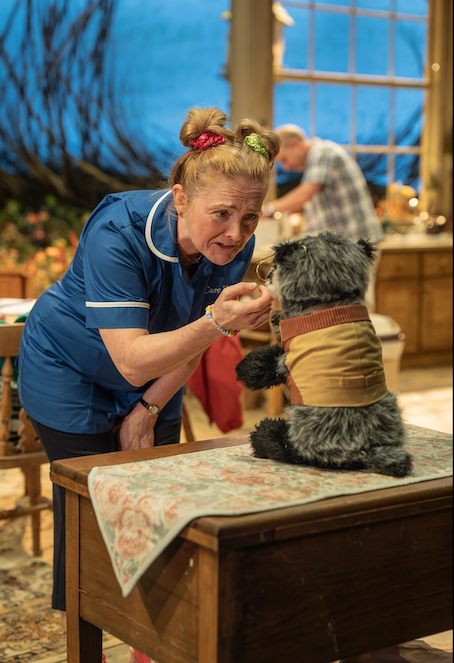
Selina Cadell as Karen, Lizzie Hopley as Linda. The stuffed toy is Brian the Badger.
There are visiting carers. Nell is the first to arrive in the play. This would most probably be an agency, not NHS, though the text says they’re an NHS care team. Mm, they might be lucky. Karen (Selina Cadell) is older, Devonian, and has seen the final curtain many times. Linda (Lizzie Hopley) is a lively, cheerful Lancastrian, and a prime offerer of tea. They both rang true but then both actors are ones we’ve seen before and always excel.
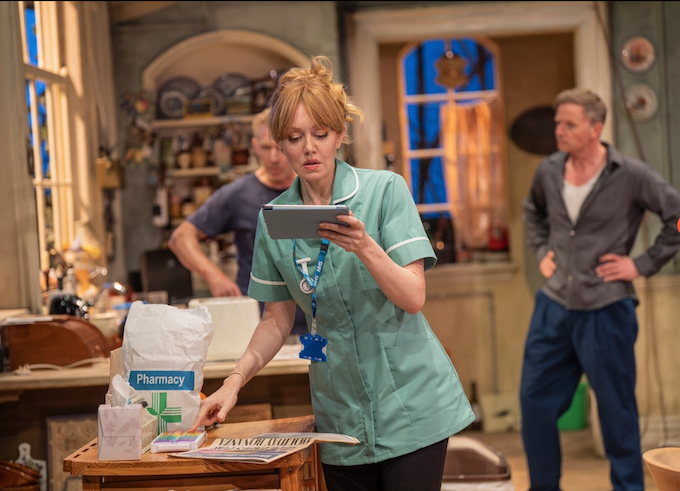
Julia (Katherine Bennett-Fox), is a qualified nurse with an NHS lanyard, who can be called in to notify the doctor. There are suggestions that old Edward was particularly friendly with Julia in the past, and they played tennis together. Sarah notes Graham’s interest. So do we as we watch his face as she bends over the table to write in the record book.
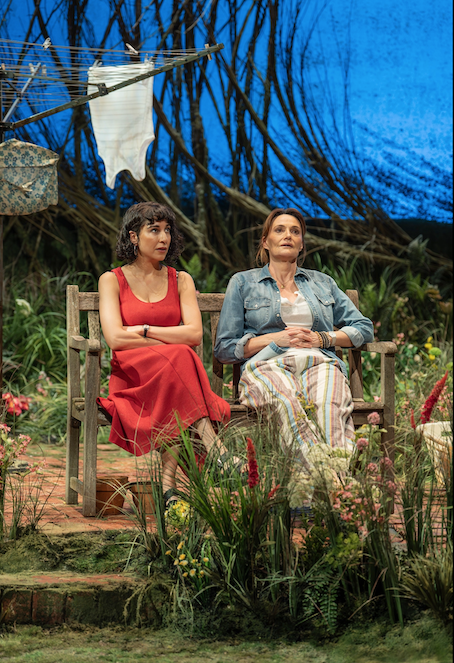
Nell (Mariam Haque) arrives. She is Jonathan’s ex-partner, and they separated after she caught Jonathan in a compromising position with Emma, his current (unseen) girlfriend. Nell was fond of Edward and has come to see him for the last time. She has travelled from Brighton to Devon and intends to return the same day. The drive took her five hours (I note these things, and that’s right!)
In the second part there is a glorious Chinese takeaway scene. Graham was sent out to collect it and has a pile of those foil containers with white card tops in white plastic bags to sort out. In this sort of situation, the takeaway is the solution for food (though we tended to pizza, but have done Chinese). No plot spoilers again, it’s a very good idea. A tip from me is you keep the menu because what is written on the lid will be “42” or “73” not Beef in black bean sauce or Chicken Chow Mien. They could have used that. The scene is interrupted by the arrival of the doctor.
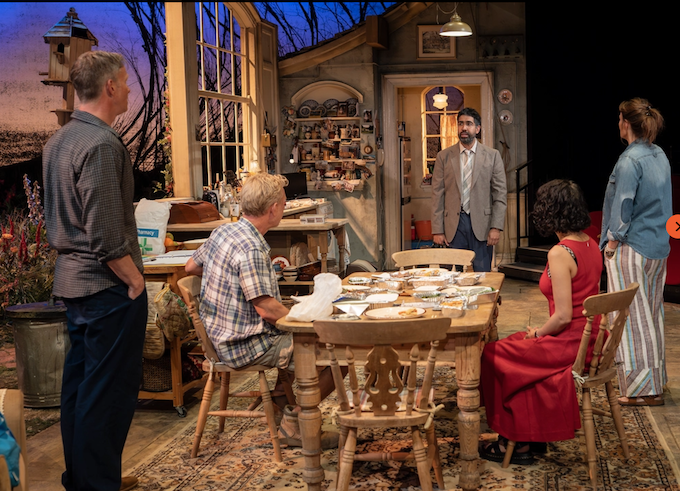
Dr Parker (Maanuv Thiara) arrives. He’s gentle and tired, and unlike the photo, his tie is half undone. He goes in to Edward diagnoses double pneumonia and he gives him a shot of Oxycodone to see him though the last hours without pain. The ending is inevitable. We know because Linda finishes her shift, and more or less says ‘goodbye.’
It’s going to be poignant, none more so than Sarah’s simple, ‘No parents.’ Then at the end of Act One, Rupert Penry-Jones just stands, totally overwhelmed by it all.
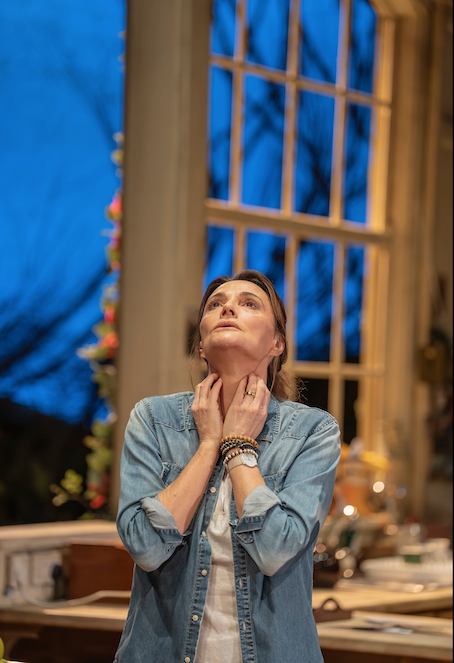
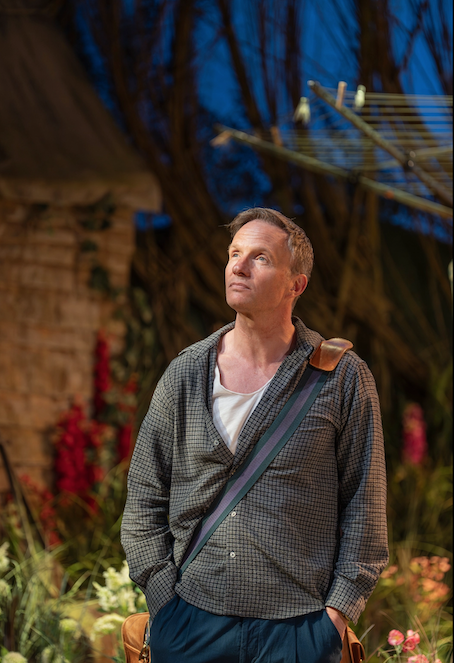
Judging by the age of the audience most would have seen something similar. For me, the major hit was when a blackbird started singing loudly in the garden just after the end. My mum died at half past midnight in a cold February. The care home phoned us and we sat up. It was not unexpected. A blackbird started singing loudly right outside the window. We opened the window to hear. Birdsong at one a.m? That’s an old belief about death. OK, in the play it was dawn. There are resolutions.
CASTING
It is unusual to see a cast of ten where eight are ethnically British. It’s something we try not to remark upon, but it does stand out nowadays. There is a mild sense of relief in not checking the spellings of African names. Actors don’t mind negative reviews, but they hate their names spelled wrongly.
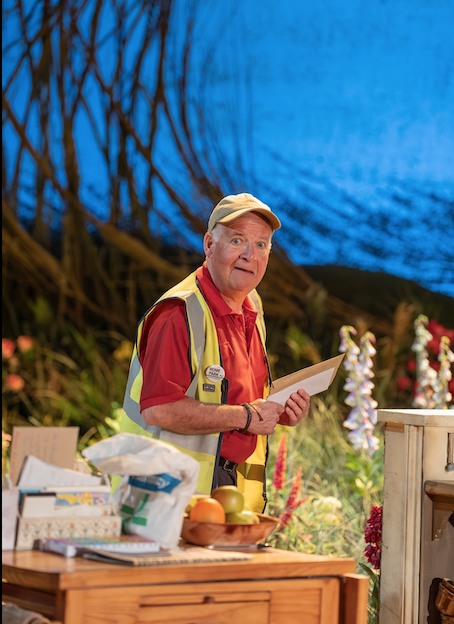
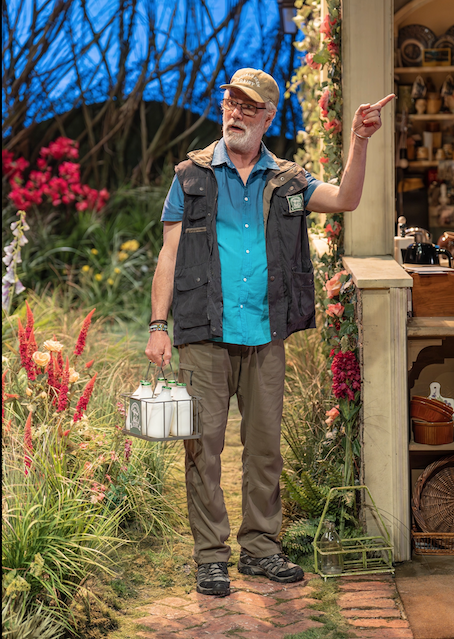
Brendan Hooper asthe postman, Julian Protheroe as The Milkman
Did they want to evoke an Ayckbourn England that has gone? A milkman? Who has a milkman nowadays? I was also surprised (and pleased for the actors) that they had two separate actors playing the postman (two lines?) and the milkman. The milkman had some important lines remembering Jonathan and Sarah as kids. With distinctive costumes those two could easily have been doubled by one actor. Or the doctor could have doubled as the milkman and the nurse as the post(wo)man. A good few producers would have suggested cutting them altogether. We’re used to heavy doubling in more ‘theatrical’ plays. They must have wanted to emphasize realism by eschewing it.
We have met a few carers. Some we’ve met at a friend’s home were cheerful Muslim girls with hijabs and broad Lancashire accents. Locally many were Polish or Portuguese. Others were Jamaican. So the setting did not dictate English ethnicity. But then Dr Parker was played by Maanuv Thiara. That looked likely, but why retain the English name? He didn’t look like a ‘Dr Parker.’
Like Ayckbourn, it is referencing an England that isn’t there any more. To a degree that’s a recipe for success. Ayckbourn (and Rattigan and Coward) sell theatre seats.
MILEAGE
Chichester productions often go on elsewhere. This has to be a promising candidate with its five and four star reviews, and the fact that it is now virtually ‘sold out’ right through to the end of its run. Can they recreate that stage set easily? Not for a tour, I think. Karen described the set as ‘over sumptuous’ and rather than cram every shelf with stuff, she would have gone for less, but made items look significant. Chichester’s usual next destination is the West End, but we felt that it’s potentially too Ayckbourn-esque for London. The theme would likely sell out in Bath, Guildford and Cheltenham too. It needs a provincial tour rather than a London run.
OVERALL
It’s short. We were out at 16.05 and there was a 20 minute interval. It could have squeezed into a performance with no interval, but I’m glad they had one and I enjoyed the ice cream. Also the age of the audience today indicated a large number who might have found a straight 90 to 100 minutes stressful.
We disagreed. Karen had accurately predicted the end of a couple of major funny sections. We did spend years analysing TV sitcoms. She found Graham’s boring on about the toaster was just that: boring, and thought he thoroughly deserved to be snapped at by Sarah. (I empathised with him, but then I’ve been snapped at for innocent things like describing a record turntable cartridge several times in a row myself). She thought the banality of repeated interchanges on the weather and the routes to work and tea and yoghurt was too much. Mainly she thought they skipped over the elephant in the room, euthanasia. For decades painkillers are increased as they have to be. A ‘final shot’ is avoided, or perhaps it was just never mentioned in the past. King George V’s death was timed to be announced on BBC Radio news.
I liked the dialogue writing. The comedy about dying worked for me. The acting, we both agreed was absolutely superb. I’m going for four star. Karen is three.
****
WHAT THE CRITICS SAID
five star
Dave Fargnoli, The Stage *****
Rosie, Theatre & Tonic *****
In Common *****
West End Best Friend *****
four star
Mark Lawson, The Guardian ****
The Times ****
Tim Bano, Financial Times ****
Gary Naylor, Arts Desk ****
three star
All That Dazzles ***
LINKS ON THIS SITE
SELINA CADELL
Endgame, Beckett, Bath 2025 (Nell)
The Dresser by Ronald Harewood, Chichester 2017
Love for Love, Congreve, RSC 2015 (DIRECTOR)
MARIAM HAQUE
Romeo & Juliet RSC 2018 (Lady Capulet)
Macbeth, RSC 2018, (Lady MacDuff)
LIZZIE HOPLEY
Taming of The Shrew 2024
The White Devil, RSC 2014
The Roaring Girl, RSC 2014
Arden of Faversham, RSC 2014
Princess Essex, Globe 2024
BRENDAN HOOPER
Ross, Chichester 2016
Importance of Being Earnest, w. David Suchet, 2015


Leave a Reply