
By Noël Coward
Directed by Philip Wilson
Set and costume by Colin Falconer
Theatre Royal Windsor Production, on tour

Yvonne Arnaud Theatre, Guildford
Thursday 25th June 2026, 14.30
CAST:
Juliet Aubrey – The Marquise Eloise de Kestournel
Simon Shepherd – Raoul de Vriaac
Tristan Gemmill- Esteban el Duco Santaguano
Albie Marber- Jacques Rijar
Eve O’Hara – Adrienne
Martin Carroll – Father Clement
Barnaby Tobias – Miguel
Lee Peck- Hubert

We could have seen it in Bath the week before, but we do that trip so often and the seats are uncomfortable, so we thought Guildford instead. Our daughter lived there for a couple of years. Our oldest grandson was born there. It’s slightly further than Bath but definitely quicker. We like the theatre too. Excellent feta and avocado salad for lunch. We’ll add the Yvonne Arnaud to our watch list.
Coward’s in vogue this year with major productions of Present Laughter, Hay Fever and Blithe Spirit. This hardly known play is the most intriguing. What’s fascinating is reviving such a rarely performed Noël Coward play for the first time in twenty-two years. He wrote it in 1927 and was not fond of it. He first saw it in the second night.
Noël Coward: It was for me obviously an enchanting evening, and it has made me forever incapable of judging the play on its merits. If, with intense concentration, I could detach myself for a moment from Marie Tempest’s personality and performance, I might perhaps see what a tenuous, frivolous little piece The Marquise is. I might, if only I could forget her in the last act eating an orange and watching Raoul and Esteban fighting a duel, realise how weak and meretricious the last act is. I might, bereft of her memory, read with disdain the whole play; sneer at its flippancy; laugh at its trivial love scenes and shudder at the impertinence of an author who, for no apparent reason except perhaps that pictorially the period is attractive, elects to place a brittle modern comedy in an eighteenth-century setting. But I am not and never shall be bereft of the memory of Marie Tempest.
Wikipedia
‘A brittle modern comedy in an 18th century setting.’ Fine. This production corrects that and shifts it two hundred years to the 1930s where it belongs. That was a really good idea. The programme note says it was easy; snuff box became cigarette case, carriage became car, coachman became chauffeur. That was about it.
Coward was in a Shakespeare mood. There are two quotes, and a joke about ‘coarse English drama.’ Not only that but the identical love letter that Eloise reads out to Raoul and Estoban (as having been written by them), is a plot nod to The Merry Wives of Windsor. This play was designed as a vehicle for a charismatic and sexy lead actress, Mary Tempest, marvellously replaced by Juliet Aubrey here. The role of The Marquise, or Eloise, also points strongly to the later Elvira in Blithe Spirit. Eloise is the apparently unwelcome ex-lover (or wife) who turns up from nowhere. As an in joke ‘Santaguano’ is a variation on Santiagueño, or someone from Santiago. In Coward’s spelling (Santa Guano) it could be read as ‘Saint Seabird shit.’ Perhaps Coward was, as rumoured, the writer of Eskimo Nell.
CONTAINS PLOT SPOILERS, if you have tickets you may prefer to read it later.
The play opens:

Shakespeare would have loved the basic plot hinges too. Raoul (Simon Shepherd) and Estoban (Tristan Gemmill) are old friends. They knew each other in a military past. Raoul has settled down. Estoban hasn’t.

They want their children to marry. Adrienne (Eve O’Hara) is Raoul’s daughter. Miguel (Barnaby Tobias) is Estoban’s son. The trouble is, they don’t love each other. Adrienne is in love with Jacques (Albie Marber), her father’s secretary. Miguel is in love with a dancer too. HE, the dancer, lives in Paris. Coward said he was surprised he got the play past the Lord Chamberlain’s censorship. I haven’t got the text. Was ‘he‘s a dancer’ in the original text? It’s not online but you can do a search. ‘She’s a dancer’ comes up. ‘He’s a dancer’ doesn’t. Actually it’s a good switch as Coward, Maugham and Rattigan had to disguise themselves, and often a secret female lover stands in for male, especially in the marriage of convenience that prominent gay men often had to enter. It reveals the original idea. Anyway, they are prepared to marry and ignore the other’s doings.
The dialogue where this is revealed made me sit up straight, as it is full of lines from my ELT book Streamline Departures, in the dialogue I Love You, Fiona. It’s all there. I like you, but I don’t love you / Do you love another man? / Yes, I do. I swear I never saw it, but I did see a lot of rep romantic comedies. Some were at Butlins.
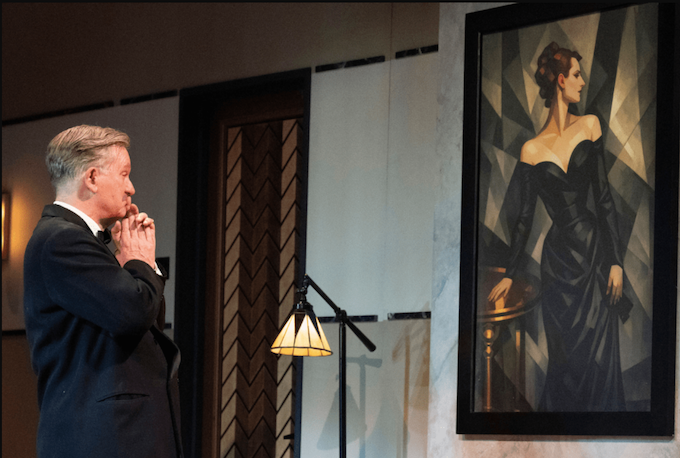
All is well, until Adrienne wakes up in the night and decides she’s going to tell her dad that she loves Jacques. Dad venerates his very Christian ex-wife, and is so religious that he employs his own confessor, Father Clement (Martin Carroll).
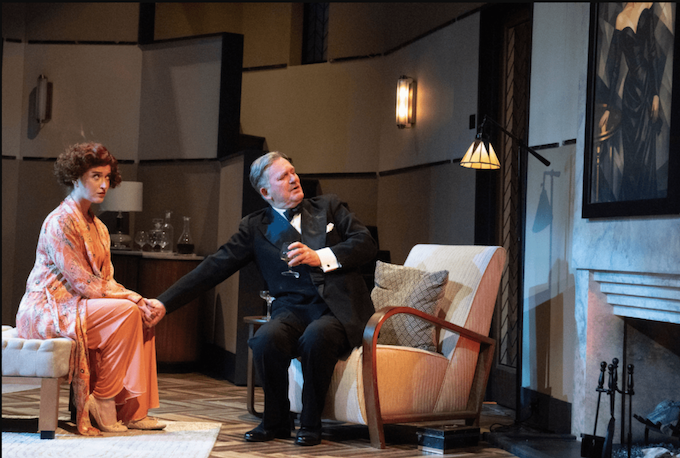
In earlier conversations, we learn that the bluff and wilder Estoban can’t believe how staid Raoul has become.
Raoul is appalled at Adrienne’s romance and decides to banish Jacques.

Then Eloise, the Marquise (Juliet Aubrey) turns up like a whirlwind, claiming her car has broken down. She confronts Raoul. They were once in love. She’s decided to renew the affair.

Raoul is horrified. Eloise is a full-on sexy, enticing ex-actress, and claims to be the widow of a Marquis.
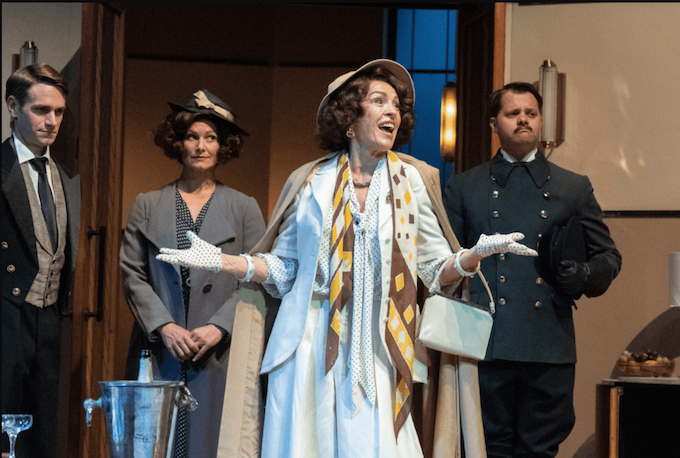
Once he gets rid of her, she soon returns with her maid and chauffeur, asking for shelter for the night. Raoul refuses but Adrienne intervenes and invites her to stay.
It turns out that she is Adrienne’s mother but Raoul and his deceased wife pretended the wife was the mother. Coward blithely ignored the mechanics of how that worked. But Adrienne must never know.
The production has the normal issue with three short acts. You can’t do two intervals, so they sensibly split Act two, freezing Eloise on the stage as the curtain drops, then reopening with her in the same place as the banished Jacques comes downstairs to go with his suitcase. She persuades him to stay. She persuades Adrienne that love is more important than duty.

Adrienne and Jacques run away to Paris.

BTW, all credit to Holly Smith as Eloise’s pert servant Alice, who is sent running up and down the stairs at breakneck speed.
Raoul gets drunk with his long time servant, Hubert, bemoaning his wilder youth until his strict Christian wife changed him.
Eloise runs into Estoban when he visits. They are also old lovers, and she reveals that she is the mother of his son. She hadn’t worked it out because Estoban’s deceased wife (exactly the same ploy) changed his name to Miguel. Eloise realises why Adrienne and Miguel can’t marry! They are sister and brother.

She says she’s going to stay with one or the other which ends up with Raoul and Estoban fighting a duel while she watches. This was the hardest part to get away with but it worked very well. Raoul orders Hubert to bring his case of rapiers which must date back to fencing as a sport on his early career.
It ends in classic Coward style with a song at the piano.
Yes, obviously it’s a lesser play. The set and costume design are first rate 1930 Coward. It is funny, and it is played “large” but that’s the right style for it.
It attracted a large older audience at the matinee. Even my age group is well post-Coward, but he still fills matinees, rightly so. It’s good entertainment. It is by no means a masterpiece, but in its 1930s guise works well as repertory romantic comedy. It was performed with gusto by a strong cast. If I give it four stars, I’m judging it in its own lights. In comparison to other Coward it would never get past three stars, whoever was in it. But as light relaxing theatre comedy? OK.
****
WHAT THE CRITICS SAID
They said not a lot because they didn’t go to see it. It’s a constant complaint. They can shift themselves to a tiny theatre in London, like the Menier Chocolate Factory or the Donmar Warehouse, but they won’t come out to see a touring play that left large happy audiences in Windsor, Bath, Oxford, Guildford, and next week, Cambridge. This is real theatre at your local playhouse, at prices normal people can afford. They’re also theatres where you can get a seat without being a ‘friend’ and buying tickets six or nine months before.
four star
AndrewWhiffen The Reviews Hub (at Oxford) ****
LINKS ON THIS BLOG
NOEL COWARD
Blithe Spirit by Noël Coward, Bath Theatre Royal 2010 (Alison Steadman)
Blithe Spirit, by Noël Coward, Bath Theatre Royal 2019 (Jennifer Saunders)
Blithe Spirit by Noël Coward, Salisbury Playhouse 2025 (Susan Wooldridge)
Blithe Spirit FILM 2021 (Judi Dench)
Noël Coward’s Brief Encounter, by Emma Rice, Salisbury Playhouse, 2023
Design for Living, by Noël Coward, BBC Play Of The Month, 1979
Fallen Angels, by Noël Coward, Salisbury Playhouse
Hay Fever by Noël Coward, Bath Theatre Royal 2016
Hay Fever, by Noël Coward, BBC TV Play 1984
Present Laughter, by Noël Coward, Bath Theatre Royal, 2003 Rik Mayall (retrospective)
Present Laughter by Noël Coward, Bath Theatre Royal 2106, Samuel West
Present Laughter by Noël Coward, Chichester 2018, Rufus Hound
Present Laughter by Noël Coward, Old Vic 2019, Andrew Scott
Present Laughter by Noël Coward, Bath Theatre Royal, 2026, Tracy-Ann Oberman
Private Lives by Noël Coward, BBC TV 1976
Private Lives by Noël Coward, Nigel Havers Theatre Company, 2021, Chichester
Private Lives, by Noël Coward, Donmar Warehouse, London 2023
Relative Values by Noël Coward, Bath Theatre Royal
The Marquise, by Noël Coward, Guildford & Tour 2026
The Vortex, by Noël Coward, Chichester Festival Theatre 2023
This Happy Breed by Noël Coward, Bath Theatre Royal
PHILIP WILSON (Director)
The Game of Love and Chance, Salisbury 2011
The Constant Wife, Salisbury 2011
SIMON SHEPHERD
Mrs Warren’s Profession, Bath 2022
Hay Fever, Bath 2014


Leave a Reply