This old fashioned education series has been popular:
Language Learning in Britain Past
Eng. Lit. in Britain Past
Music, Art & Divinity in Britain Past
Geography & History in Britain Past
Maths in Britain Past
Science in Britain Past
I’m not qualified to talk about science. Literally not qualified. I did not do well.
In our first year at grammar school (1958-59) we did three sciences, Physics, Chemistry and Biology. They were quite separate subjects with specialist teachers. Nowadays they seem more intertwined, and judging by recent kids textbooks, focus much more on ecology. That never came up in my day.
Biology
It was a boys school. So we only did Bugs / Biology in the first year. The would-be doctors could pick it up again at A level. Was it an option lower down? I don’t know but if so was never offered it. Girls schools did it for five years. It was a rigid divide. Females need to know all this stuff. Males only need to know a few basic initial bits.
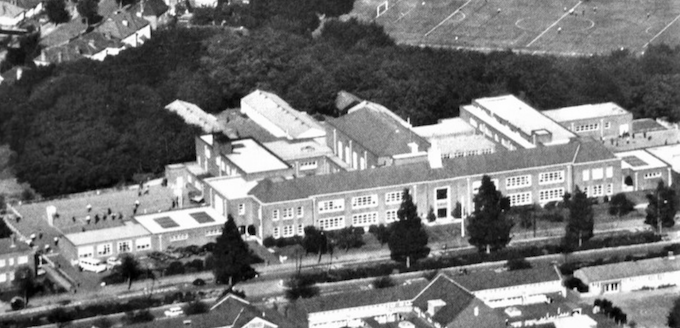
Biology was taught in the furthest prefab behind the school. You can then stretching at right angles behind the building. The sixth form A level labs were in the main building, but the pre-O level labs were all in prefabs well away from the building. A sound idea. Biology had a funny smell. Chemistry was liable to erupt in flame as well as having a funny smell. Physics could fuse the entire school. Also all three labs were places where kids were not allowed to be in between lessons. Even in torrential rain, we had to wait outside. This was a sensible policy given the dangerous material within. Being in prefabs meant we didn’t clog up the corridors while waiting.
Biology was taught by Mr Bruce-Mitford. Was he related to the Sutton Hoo archaeologist? Who knows? That one had three brothers, but if he were either Alaric or Vidal he was well advised to conceal his first name.
We only had two double-barrelled teachers, and the other, Mr Harcourt-Smith taught music. We boys were chippily suspect of double-barrelled names. This was 1958. There was no concept of parents appending both their surnames to a child, nor of footballers whose unmarried parents bequeathed both names to their sons. Nor of actors who needed a unique name to appear in the Spotlight casting directory. No, a hyphenated surname was seriously posh.
We didn’t have to cut up a frog, though I think there was an opportunity if you really wanted to. Those so inclined spent the hot days – that prefab was baking in the summer of 1959 – pulling wings off flies.
The main purpose was sex eduction. It started with molluscs and worms, then fish, then bees and flowers with stamens and pollen. Then birds and eggs. It moved on as the mystery deepened and we found out about rabbits. Finally they got to humans. A few photos would have helped and I’m sure one of the class would have loaned Mr Bruce-Mitford a dog-eared copy of Health & Efficiency. Instead diagrams in simple line drawings sufficed. Films were of the 70s.
The important lesson was introduced. ‘Today we are going to look at sex-you-all reproduction. If any one of you sniggers, you will leave the room. Therefore you will never learn how to do it.’ We didn’t snigger, except for one lad who was sent out. It obviously didn’t hamper him because he eventually had children. Some things come naturally.
Venereal disease was important and the result of even thinking about it. Masturbation made you go blind, but he didn’t tell us that as it wasn’t a Catholic school where such a warning was the main point of biology classes. Contraception was not discussed, nor were female cycles, nor homosexuality. Much too embarrassing for Mr Bruce Mitford. Then that was it.
Biology done and dusted by age twelve.
We were not given booklets, but improved our education in human reproduction in the Encylopaedia Britannica in the school library in later years.
Physics
I liked physics. Especially astronomy, electrics and magnets. The trouble was none of the teachers had personality or delivery. No personality at all. At least the maths teachers were violent psychopaths, some of the English department were poseurs with white hair and gold cufflinks, the French department wildly eccentric men with no talent whatsoever for languages. Geography teachers were of a nervous disposition. This is where we learned that all scientists were nerds.
Just having learned the basics of sex in biology, we worked out that being a nerd with thick specs and a leather patched tweedy jacket and a quiet monotonous voice meant you were highly unlikely ever to be able to employ what Mr Bruce-Mitford had gone puce in the face explaining to us with an actual female. We were proven right when we got to university. Physics was 99% plus male. There were two new blocks. The Arts block, and the Science block. They never mixed. None of the girls even glanced at the scientists. Being a Drama or Literature student, or even Sociology or Politics gave you a far better chance with women.
We learned a lot about famous people. Michael Faraday. Anders Celsius. Lord Kelvin. Daniel Fahrenheit. John Dalton. James Joule. You got a measurement named after you if you were a physicist. I can’t remember the first names of Mr Therm or Mr Amp though (was it Marshall Amp?). Thomas Edison may be the exception to unsexy physicists as he invented the Edison screw. I suspect knowing who invented a Faraday cage (the sort of history thing I am good at … he lived 1791 to 1867) is dwarfed in importance by understanding how one works. I keep my car keys in one. I don’t know how it works.
Our physics teachers were such a dull lot that I don’t remember their names, except for one, Mr Reynish. I don’t think he ever taught me physics, but he did take us for rugby in the third year. We were a football school in years one, two, four and five, but switched to rugby in year three. I have no idea why. He was a large heavy man and over-enthusiastic. One small rather spindly lad seemed afraid of the ball, and this teacher made him run with it and demonstrated a crunching tackle on him and broke the boy’s collarbone. The next week he was asked to demonstrate a scrum, which was deliberately collapsed on him by both teams, and with his face pushed well down in the mud, he got thoroughly trodden on and had to be carried off. That was revenge for an injured classmate who was watching, arm in sling. There were no repercussions. It’s a violent sport, so accidents happen – just as he had said the week before.
My comments on physicists seem cruel of me, especially as one son has a degree in Physics and my grandson is currently doing a degree in Physics. My son has explained to me that (a) it is the hardest degree of all, and the university guides support his statement (b) in his current role in computers, the physics graduates excel because they’re taught to think outside the box, while those who actually did computer programming only think within the box. I’ll add that both enjoy the more esoteric books on quantum physics, some of which I’ve managed to read, though I have never understood A Brief History of Time like most of those who bought copies. It is the world’s most unread bestseller. Those are the areas where physics and philosophy meet. I have read The Tao of Physics and The Dancing Wu Li Masters.
However, we didn’t get into much of that at all, if any. It was more fiddling around with dull experiments with magnets and electric circuits. I loved physics until we had to start employing algebraic formulas, then I was baffled. My lack of ability in algebra finished me. I suspect the ‘good at physics gene’ is Karen’s side of the family, not mine.
Chemistry
Chemistry was the domain of even more nerds as teachers, but you can tell the difference because chemistry teachers wore dustcoats and had no eyebrows and a hacking cough. I’ve never seen one with a beard, because I assume any chemist with a beard is dead. Bunsen burners caused the lack of facial hair. In the first year they made it interesting by setting fire to magnesium and dropping it in water. The magnesium fireballs had blackened the ceiling over the teacher’s long work table. Then they produced multi-coloured noxious gas fumes (hence the cough) and cleaned pennies in acids. I later discovered Coca-Cola does that just as well.
There was something called a fume chamber from memory and then there was the Lab Assistant / Technician, Mr Miller in white dustcoat and a little moustache. He had to race around between chemistry and physics preparing stuff – the teachers were after all, academics not technicians. This meant that they could hold forth on electricity in theory but needed Mr Miller to wire a plug. They bellowed at him, ‘Mr Miller! Prepare the fume chamber! Mr Miller! Bring the fire blanket! Mr Miller also had the task of projecting films in Geography, English or any other subject requiring his technical expertise.
I think all the atomic and sub-atomic stuff, and the periodic table, came in chemistry, rather than physics. It’s odd in that physicists conducted all the nuclear applications rather than chemists.
Karen’s girls’ school were taken to look at catalytic cracking at the Esso Fawley oil refinery. We didn’t get there but had endless films on the topic. It was considered of prime importance in the early 60s. I believe there’s jet fuel, petrol, diesel, engine oil and tar. That might be wrong.
We had six classes in the year. After the first year, the top two, 2X (express) and 2L (latin) continued with Latin. They were considered bright enough to cope with both Latin and Chemistry. The next two were divided into those who opted for Latin and those who opted for chemistry. I foolishly opted for chemistry, and failed to get an O level in it. My dad advised it.
Again, names don’t spring to mind, but I recall that one teacher committed suicide. I’m sure it was the year after I stopped doing it.
There was too much messing about in chemistry lessons. Discipline was not a strong area for the teachers. A particular prank was using the distilled water bottles to fill someone’s pocket. This worked best on CCF days because the army uniforms had some kind of waxed pocket, so the perpetrator could be well away before the water seeped through and ran down your leg. The most spectacular was when one lad’s pocket was filled with acid and that went through fast resulting in the screaming victim trying to beat the shit out of the perpetrator while the teacher desperately tried to dilute the steaming uniform with water.
This would be why I didn’t learn much. Wasn’t Dr Who’s dog fond of depositing K9P? (Is that H2O? No, it’s K9P)
The only chemistry teacher I can name is “Harry” Hawkins” because he was young and decades later was deputy head when my son was there, so spent forty years at the school. I chatted to him a few times when my son was a pupil. He was part of the new wave of younger teachers the head was trying to introduce. He was a pleasant, jovial and kindly man too and all the boys assumed he was gay (not a word we used in 1962), as they did with the physics teacher, Reynish, who started at the same time. Possibly that was because they strolled around the playing field together at lunch times. Now I’d just assume the new arrivals stuck together. I don’t think he taught me as I would have recalled a rare pleasant teacher. He became Head of Chemistry then Deputy-Head.
I failed mock O level, I think with 38%. The grammar school was highly competitive with its results, so I was not allowed to take O level. That annoyed me because I had decided it was low priority for mocks but I could well have revised better in the more spread out exams in the summer. Having sat through five years of it, I should have been allowed to attempt it and scrape a pass. But that’s what grammar schools did, and still do. It’s manipulating their pass rates.
I shared a bungalow at UEA with two chemists. Bill was doing Chemistry Education postgrad after teaching for ten years in Nigeria. Kevin was doing a doctorate in Spectroscopy, especially of methane. It’s studying the light from stars. We all got on well.


Leave a Reply