
By Martina Laird
Directed by Justin Audibert
Set & Costume by Sadeysa Greenaway-Bailey
Composer Christella Litras
Royal Shakespeare Company & Kiln Theatre
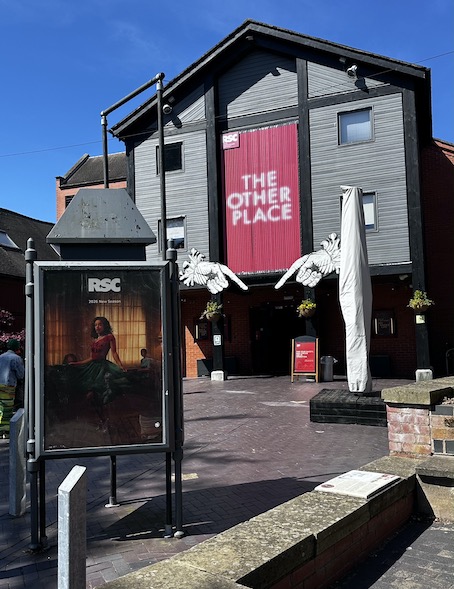
The Other Place
Stratford-Upon-Avon
Saturday 25th April 2026, 13.30
CAST
Shane David-Joseph – Seldom
Ziggy Heath- Tom
Marin Imhange – Diamond
Roger Ringrose- Mansion
Ellen Thomas – Pearl
Cat White- Ruby
The collaboration between the RSC and Chichester Festival Theatre continues, with Chichester’s Artistic Director, Justin Audibert, returning to direct at the RSC.
The Other Place has a different configuration every time. Here it’s a standard proscenium stage with conventional seating. Fortunately, the RSC have realised that numbered seats make sense. When the space was first re-opened after a long gap, they assigned seating areas but not seats, but everyone ignored it and it was chaos.
The play is based on Martina Laird’s Trinidadian roots and takes place in Trinidad in 1956, on the eve of the progress towards independence following the 1956 election. An independent Trinidad and Tobago finally appeared in 1962.
From her Guardian interview:
Laird’s play functions both as a drama about family and a metaphor for the toxic effects of colonial rule. Through each Trinidadian character you see the painful fight for self-determination in the face of British imperialists and American chancers. It captures a nation on the brink of change, too. Eric Williams, Trinidad’s first prime minister who hailed independence in 1962, is an important off-stage presence; his party was formed in 1956 – the year Laird’s play is set. “Anyone who was there at the time will tell you about the energy of optimism that was there. The second world war had blown things apart. Women had worked in factories and were then made to go back into their homes. Black people, the Commonwealth, had fought, and then were sent back with no thanks or rewards. This was now being fed back.”
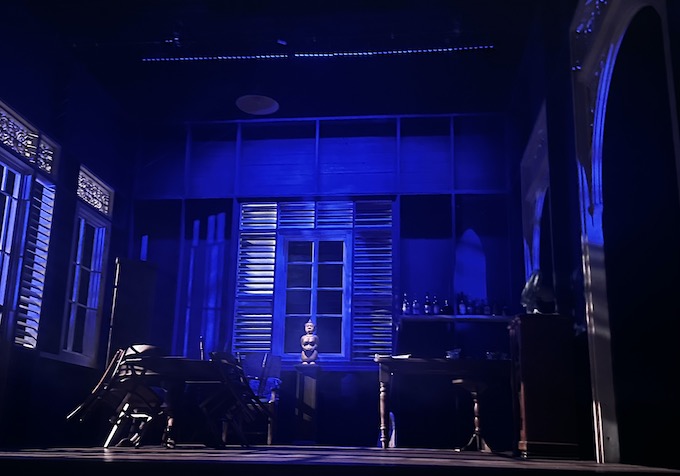
The setting is a ‘Gentlemen’s drinking club’ called Alma House, a leftover from colonial rule. It’s owned by an Englishman, Mansion (Roger Ringrose), but run by his long time manageress, Pearl (Ellen Thomas), who runs other establishments for him. Pearl is a fan of Eric Williams, the political figure who shaped Trinidad’s independent status.

The play opens with Ruby (Cat White), who is dancing to music on the new expensive radio that Mansion has given her. She’s young and gorgeous (as are her mid 50s costumes). Casting such a good-looking actor in the role is a major plus in the production. At one point she is referred to as looking like Carmen Jones, and that may have inspired the hair style, clothes and make up. Talking of musicals, I’d cast her as Maria in West Side Story tomorrow. A large man appears, delivering a new consignment of rum.

Seldom (Shane David-Joseph) is a policeman of Indian ethnicity … in East Africa and other British colonial areas, Indians often formed a “middle class” between the English and the local population. The sergeants, if you like, with the English as officers. So Seldom is a policeman. Ruby and Seldom have a business relationship, money changes hands from her to him. At this point we were struggling somewhat to understand the patois, but I think they had a ‘honeypot’ scam in which she started to seduce tourists, and he turned up in uniform as the outraged husband and they got paid off.

That rang bells. Years ago in 1973 I had to teach a group of Chinese students who were translators. When they arrived their English was all at Cambridge Proficiency level, and I was whisked away from my normal role of teaching ELT beginners to teaching them Life and Institutions. One brainwave I had was to take them to see a court case. That’s how I was threatened with being charged with contempt of court. I had told them everything about the English legal system EXCEPT the small detail of wigs on judge and counsel. The Chinese were in tears of laughter. The judge ordered the person in charge of them to stand up, and it was me. I was duly threatened that if one of them made another noise I would be held in contempt. Thank you to my Chinese students. They stifled any more. Then it transpired that the case involved a girl who lured men to the alley behind the Royal Ballrooms dance hall (now the O2 Academy) and just as they started to drop their trousers, the ‘husband’ turned up with two large mates and was about to beat up the bloke until she suggested he could pay them off instead. They had been doing it for months and few victims reported it. The Chinese wrote about it afterwards and all described them as ‘bandits.’
It looked like the same scam. They also discussed a girl Ruby knew who had a light-skinned baby. She was planning to borrow it and show it to a Canadian who had had a relationship with her six months earlier and ask him for maintenance. You begin to wonder about Mansion’s other ‘houses’. Are they more drinking clubs? Or the other kind of ‘house’?

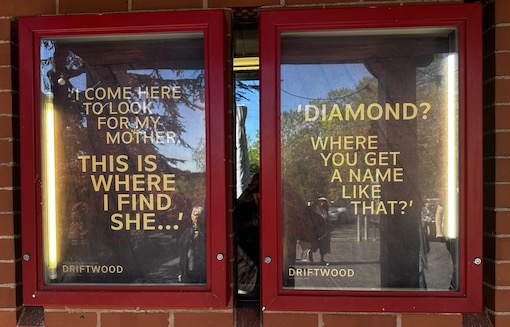
Anyway, Seldom has been posted away for a few weeks. End of business. As he leaves, the delivery man comes back. His name is Diamond (Martins Imhangbe). He is very taken with her, and she realises he could take the outraged husband role. But there’s more … the boards outside reveal some of it, so that’s not plot spoiling:
A scene between Mansion and Pearl shows the colonial v independent reference. Mansion owns Alma. Pearl thinks of it as her home. She lives there. He doesn’t. Around then we discover that Pearl is Ruby’s mother, and that Ruby was actually born in this room. Pearl thinks that Mansion should retire to England, and after years of working hard to keep the place running she deserves to own it. Mansion sees Ruby as a kind of cuddly pet. Ruby sees herself as the potential owner.
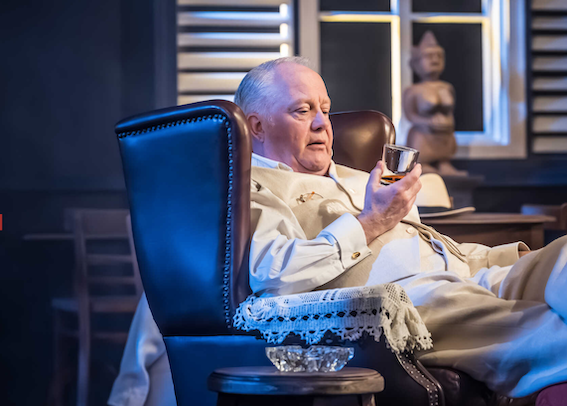
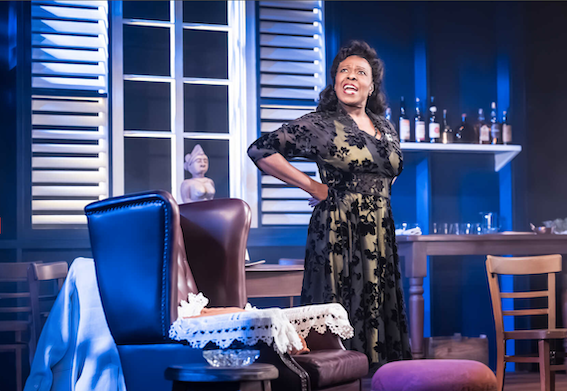
Mansion (Roger Ringrose) and Pearl (Ellen Thomas)
By sheer chance, some of the dialogue between the Englishman Mansion and the American Tom, relate to right what’s going on with Trump’s wild claims the very week we saw it. The American refers to the Caribbean and Latin America as ‘our back yard.’ There is some discussion about the roles of the USA and Britain in wartime too. They couldn’t have hit a better week, yet those appropriate and relevant lines were written long before.
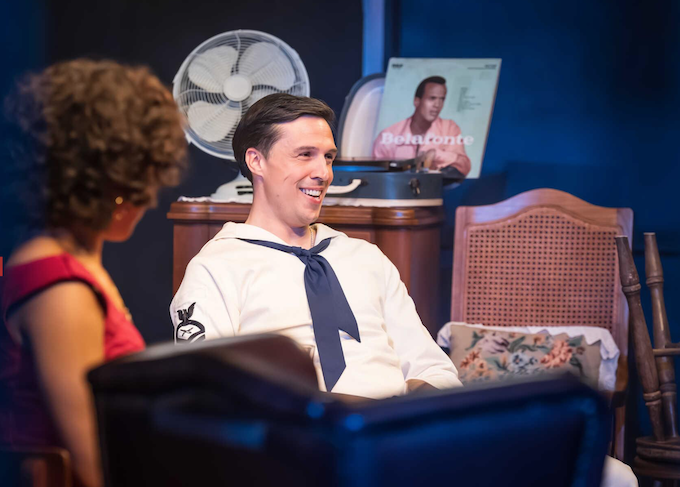
Plot spoilers? I’m going to have to be careful from this point and we’re not more than a third of the way through Act One. Suffice it to say there will be more scams, involving the American sailor, Tom (Ziggy Heath). It will not go well.
You may have guessed from the poster that Diamond is seeking the mother who abandoned him. Pearl, Diamond, Ruby. Think about it.

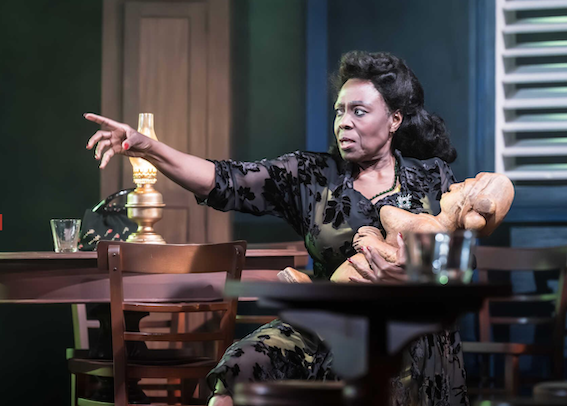
Diamond & Pearl
We have to balance the Ruby and Diamond strong mutual attraction against the attraction of the American money too.
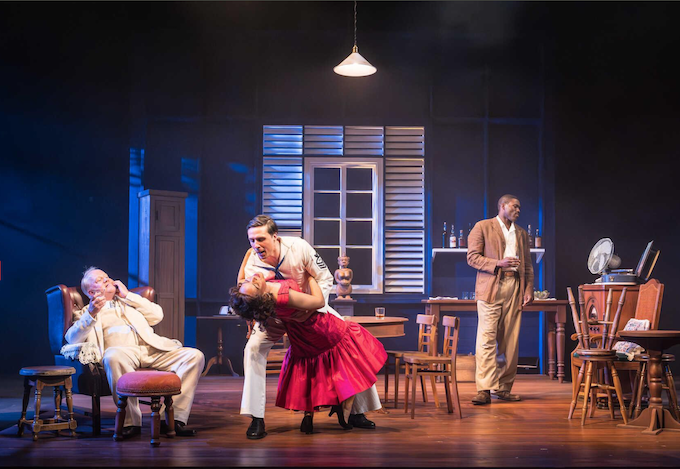
Seldom returns from his weeks away. He has some news about a police operation in the neighbourhood. Ruby starts to put two and two together,
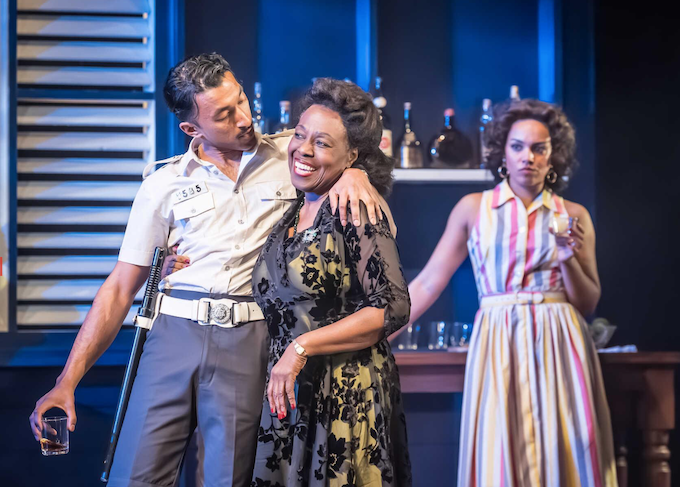
It becomes a moving family tragedy. It becomes an extremely complicated family tragedy, and Diamond suffers terribly at the hands of the American commander. The final fifteen minutes is truly searing.
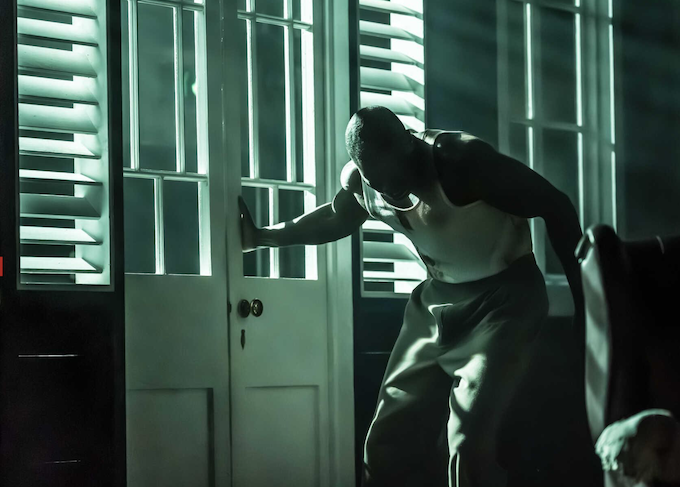
There is music. Some is specially written, some loud calypso is (I think) by the great ‘Kitch’ or Lord Kitchener (Aldwyn Roberts) from Trinidad, aka The King of Calypso. The Mighty Sparrow, another Trinidad hero, is mentioned too. I loved that. Later Tom, the American, calls Harry Belafonte ‘The King of Calypso’ to scoffing from the Trinidadians. There is a contrast with American popular music of the era, usually played very low on the radio.
Now I’m going to be critical, because I think the play as it stands is highly dramatic, exciting and moving BUT it needs a polish. Quite a lot of polish.
Martina Laird was interviewed in The Guardian. The Trinidadian patois or Creole is how she wrote it, and is a vital part to her of the concept.
From the Guardian article:
Strikingly, Driftwood is written in patois. Was that about capturing the authentic cadences of Trinidadian speech, or a statement on who it is written for? Laird reflects back on a seminal stage experience. “One of the first roles I got to play, of which I was very proud, was in ‘Moon On A Rainbow Shawl’ by Errol John, a Trinidadian playwright, at the National Theatre. When I’d read that play as a child at school, I’d thought, ‘That’s just how we talk, what’s so clever about that?’” But going back to it as an adult, she realised that was exactly the point. “You can’t not try to reflect a truth about the language if you want to capture people’s souls. Because in that language and its constructions is the history and the psyche.”
Did she have any apprehension about writing in patois for a UK audience, nonetheless? No, because she wasn’t writing it for the RSC at the beginning, all those years ago when she first put pen to paper. “At that point, I was writing it because I needed to. It was like a crossword puzzle. I needed to get it out and solve it.”
As it stands, I think it’s a mistake. The dialect is too broad which meant it took us some time before we could adjust to the accent and understand what people are saying. Even then I missed stuff. It needs turning down a few notches. They credit a dialect coach, and it went too far. After all, from what I can see the cast are mainly British born, but their parentage is from Sierra Leone, Nigeria and Jamaica, so no one is in their natural ‘family accent.’
A light Trinidadian accent is fine. Switching subject pronouns for object pronouns is fine, but here it’s too strong. I’ve worked with recording accents for decades. I just put on Dr Kitch on record. I can understand him. I just watched a Festival of Britain documentary where they interviewed a Trinidadian about steel bands. No problem following him at all. I’ll add that Pearl and Ruby have spent years serving expat Englishmen in the club and Ruby looks out for tourists. They would have modified their accents for communication, though possibly not when speaking among themselves.
I suspect the problem is exacerbated by the unusually high stage affecting the acoustic. Given that they can configure the space anyway they want, why is the stage set so high? We were in Row C, and our eye line was around actor ankle / lower leg level, and there was little rake to the rows. The poor people in Row A would have got severe neck ache looking straight up, which may be why three departed in the interval. Then the only one with a British accent, Mansion, was under-projecting. That’s a surprise because he is of a generation that knows how to fill a theatre and we’ve seen him before and he does. I wondered again about the stage height and acoustic.
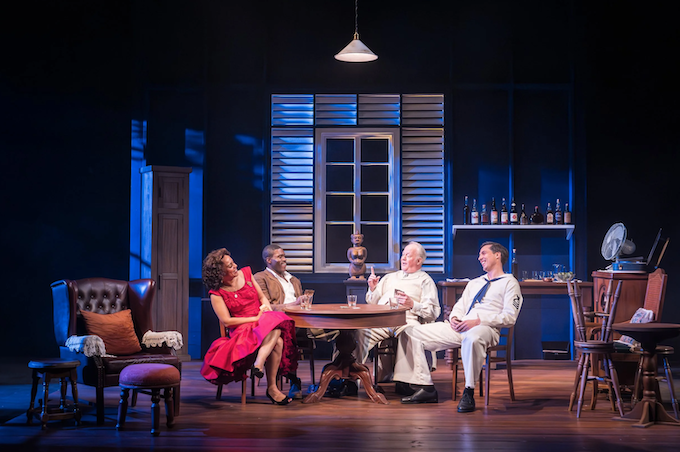
In Act Two, there is a game of bridge. I could hear Ruby and Tom clearly, but Mansion and Diamond, seated further back behind the table were blurred. That’s another thing. We have never played bridge. We have no idea of the rules, and that didn’t help us follow what was going on. As a producer, I might have suggested a plot change there, though we did get how Ruby won and that was good.
There is no programme, yet it’s at The Other Place for quite a long run. Instead there’s a free colour four page leaflet. It’s good but I’d have bought a programme. I’d definitely have bought a play text too. I checked Amazon and it is being published on 7th May (delivery 15th May), so it may be only days away. If you go and see it, it might be available. I ordered the Amazon copy – I may have to amend this article when I get to read it and get the story clear!
A minor point. They refer to India and Ghana as examples of aspiration. It’s 1956. They would still have said The Gold Coast, not Ghana, which is what it became a year later in 1957. (I was a young stamp collector and was given the first set of stamps. Long gone).
Overall? I think it needs some work to bring out the intriguing story. We struggled too much to work out what was going on. It would get a higher rating with a polish. I was three stars, Karen was two stars though.
***
WHAT THE CRITICS SAID
We saw it before the reviews came in, but at full price.
four star
Hollie, Theatre & Tonic ****
three star
David Jays, The Guardian ***
Alison Brinkworth, What’s On Stage ***
Dave Fargnoli, The Stage ***
LINKS ON THIS BLOG
MARTINA LAIRD (writer)
The New Real, RSC The Other Place 2024 (actor)
All’s Well That Ends Well, Wanamaker Playhouse 2018 (actor)
Coriolanus – RSC, 2017 (actor)
Romeo & Juliet, Globe 2017 (actor)
JUSTIN AUDIBERT (Director)
Hamlet, Chichester 2025
Redlands by Charlotte Jones, Chichester 2024
The Caretaker, by Harold Pinter, Chichester July 2024
The Taming of The Shrew, RSC 2019
Snow in Midsummer, RSC 2017
The Jew of Malta, by Christopher Marlowe, RSC 2015
Flare Path by Terence Rattigan, Salisbury Playhouse 2015
ZIGGY HEATH
The New Real, RSC The Other Place 2024
French Without Tears by Terence Rattigan, ETT, Poole 2016
ROGER RINGROSE
Birdsong, Salisbury Playhouse 2024
The Other Boleyn Girl, Chichester 2024 (Wolseley, Thomas Cromwell)

