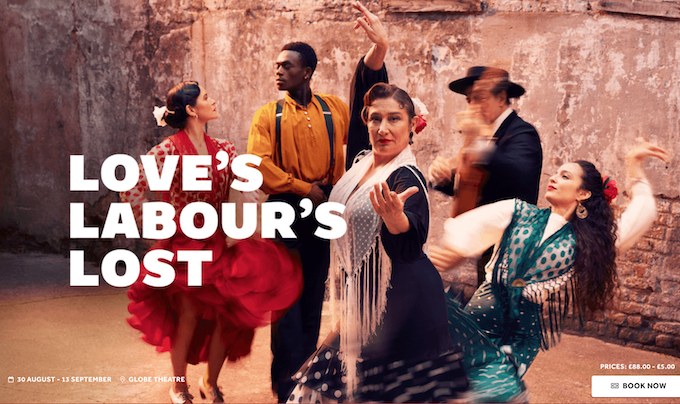
By William Shakespeare
Directed by Indiana Lown-Collins
Designed by Kate Lias
Choreographer – Carmen Ingarza
Composers Michael McMahon & Adrián Solá
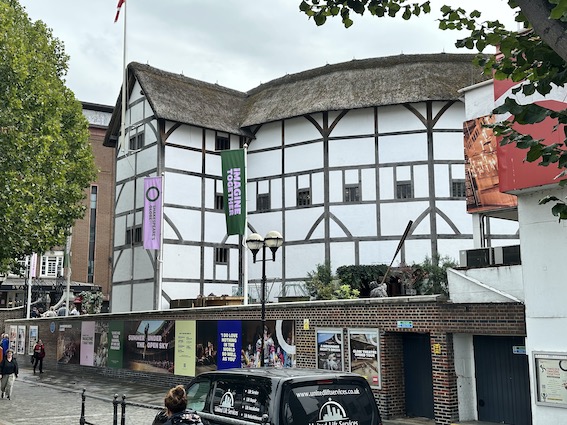
Shakespeare’s Globe, London
Wednesday 2nd September 2026
CAST
Daniel Abbott – Mozo de Espadas / cover
Suzanne Ahmet – Katharine / Nathaniela
Philippe Arditti- Berowne
Zannie Benfield – Marcade / cover
Ned Costello- King of Navarre
Adro Crespo – Don Adriano de Armado
Daniel Crossley – Boyet / Antony Dull
Jax Guerrero – Dumaine / Moth
Joshua Hill – Costard
Philip Labey- Longaville
Jimena Larraguivel- Jaquinetta
Norah Lopez Holden – Princess
Bea Segura- Rosaline
Katie Stephens – Maria / Holoferness
Pablo Egear- Flamenco artist (Bailaor)
Anita la Maltesa (Anita Reacher) – Flamenco artist (Bailaora)
Carlos Lobo Cordón – Flamenco artist (Cantaor)
MUSIC
Guitar – Michael McMahon
Guitar – Adrian Solá
Laúd – David Delarre
Percussion – Ayoze de Alejandro Lopez
I do like a bit of flamenco. Decades ago I was in Madrid on a lecture tour, exhausted on the last Saturday, when my publisher said ‘We managed to get tickets for Carmen tonight.’ I sighed, thinking it was the full opera, but it was Antonio Gardes original flamenco production, with Paco de Lucia playing guitar on stage. One of my all-time favourite theatre performances. Olé!
The play is one of Michael Billington’s six Shakespeare choices in his 101 best plays and others also love it for its language, but intrinsically it’s second rank among the comedies to me. I’ve never thought of the Spanish setting, probably because the most memorable ones I’ve seen have been set in 1914 Britain, and at the RSC in 2024, on a contemporary Pacific island. Navarre is in Spain, bordering France, and the Princess is originally the King of France’s daughter. Here she becomes the King of Spain’s daughter. To be picky, the people of Navarre wouldn’t identify with flamenco, which is from the opposite end of Spain in Andalusia.
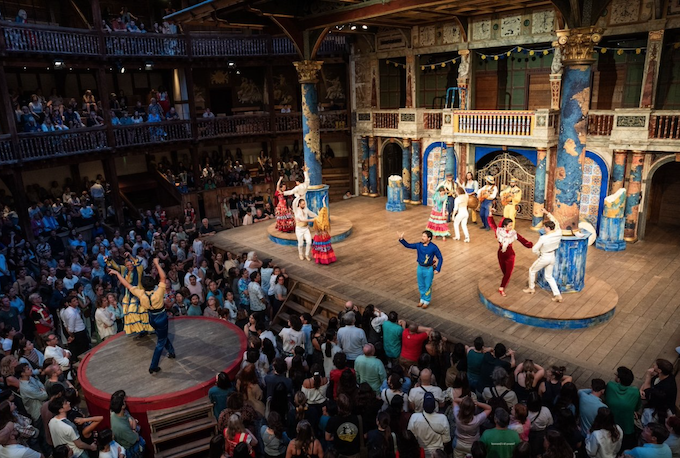
I was really irritated that the Globe had sold out of programmes. I like to read about concept, and here I wanted to know the backgrounds of the cast. There are some Spanish names in there, and the dancing is of high order.
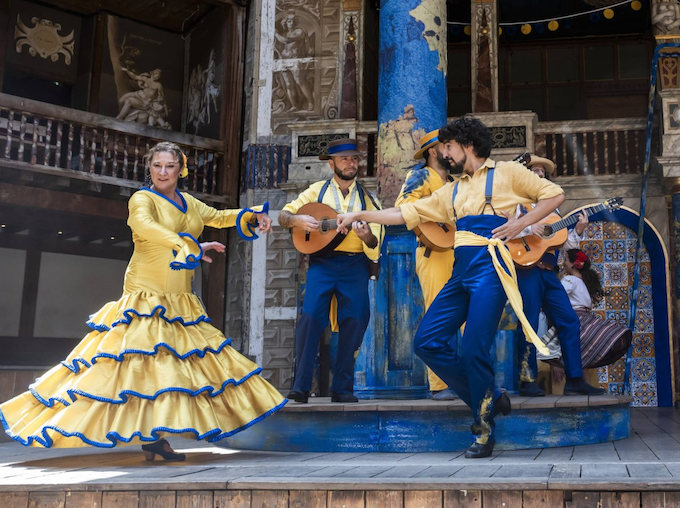
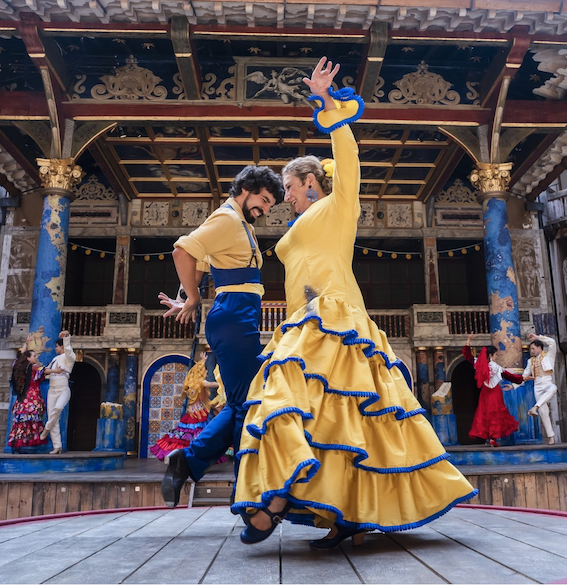
There are at least two, the Spanish singer and the dancer in yellow who don’t get to do any Shakespearean text.
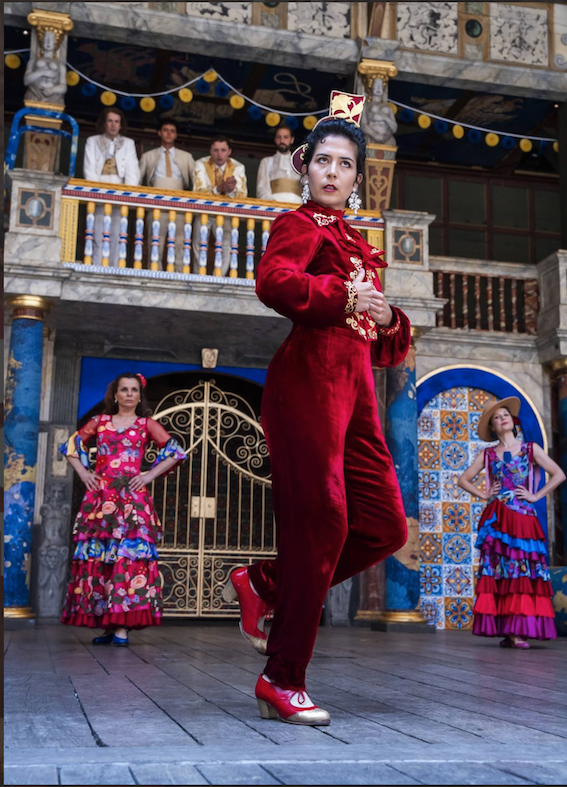
Most interesting is Norah Lopez Holden as the Princess. She was at top level as a flamenco dancer but also as an actor. It’s the first production I’ve seen where the Princess becomes the clear lead role in the play, rather than Berowne, or the King of Navarre or Rosaline. I just discovered that if you click on the picture in Cast & Creatives at the Globe online you get it all in the absence of a programme. I am reminded that she is ‘British-Spanish’ and was Ophelia in the YoungVic Hamlet. She lists her natural accents as Manchester / Lancashire and Spanish. Not only that, I have seen her as Perdita in The Winter’s Tale at The Globe and in Eyam. How did she get that good at flamenco?
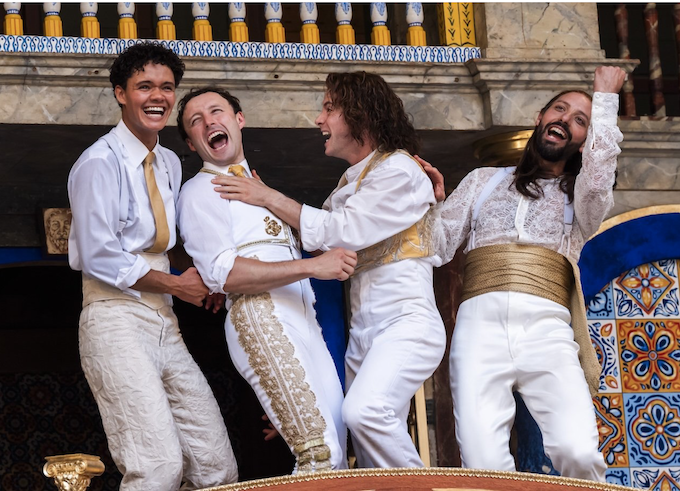
The plot is something you need to know in advance, because the production may not help much. The King of Navarre (Ned Costello) is a scholar and aesthete and requires three courtiers, Berowne (Phillippe Arditti), Dumaine (Jax Guerrero) and Longaville (Philip Labey), to join him on a three year studying binge, during which they must fast and most importantly, avoid any contact with women. Women are banned for a radius of one mile from the palace. Berowne ( is the most reluctant signer of the pledge.
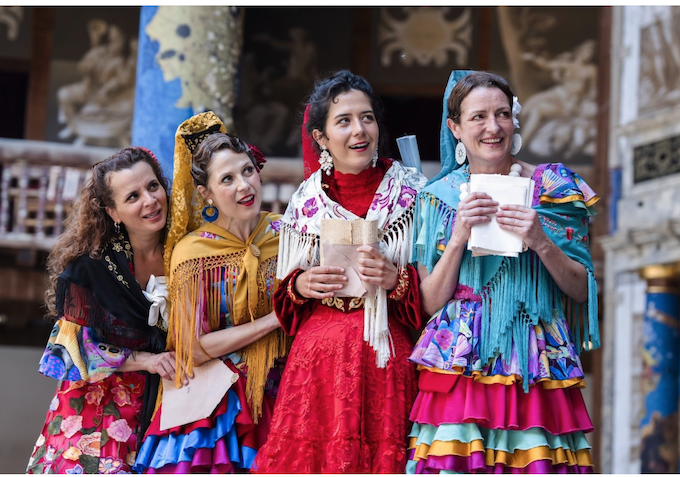
Katy Stephens (Maria), Suzanne Ahmet (Katharine), Norah Lopez Holden (The Princess) and Bea Segura (Rosaline).
The problem starts with a state visit from the Princess and her three companions, Rosaline, Maria and Katharine, along with her chamberlain, Boyet. As a princess from a powerful neighbour, she cannot be ignored. She is told to set up camp in the field, and not permitted to enter the palace.
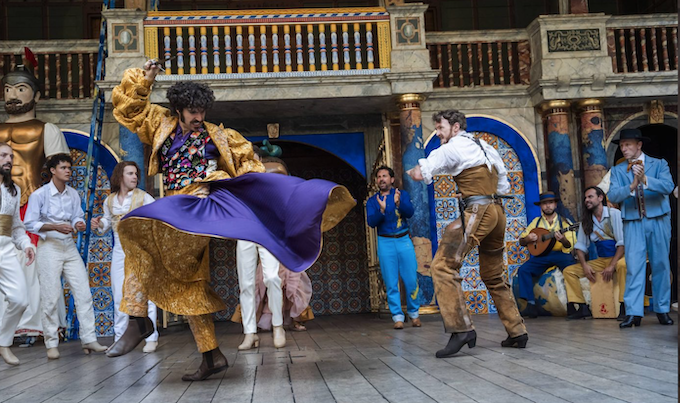
The sub plot involves Don Armado, originally a lone comic Spaniard, who is jealous of the rustic swain, Costard and his relationship with the rustic Jaquinetta. Don Armado is the cliché ‘Boasting soldier’ of classical drama. He complains to the king and the rustic pair are arrested by Dull, a constable.
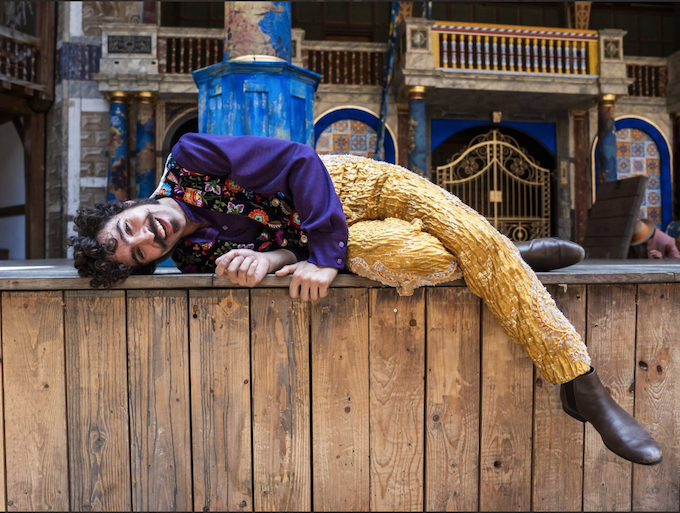
Don Armado is a comic creation, the play not being written long after the Spanish Armada. He’s the send up funny foreigner. When everyone’s Spanish, that loses a degree of impact. (I might have made him French!)
One by one the king and the three lords spy on the ladies of the royal party from above, and each falls in love with one of them. They try to hide their infatuation from the others. There is the classic giving two letters to a servant, Costard, who will mix them up. One is from Berowne to Rosaline, the other from Don Armado to Jaquenetta.
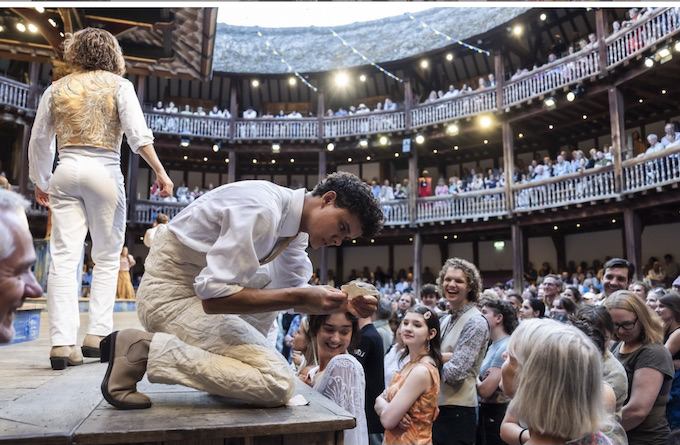
Shakespeare hadn’t finished with funny foreigners, as the four men decide to dress as Muscovites (Russians) and dance. The ladies are to watch, but swop the love tokens the men have given them and wear veils so each man will make his vows to the wrong women. The funny Russians here have enormous phallic codpieces and nipple shoulder pads. There must have been some incident in Shakespeare’s London involving crude, noisy Russians. Some things never change.
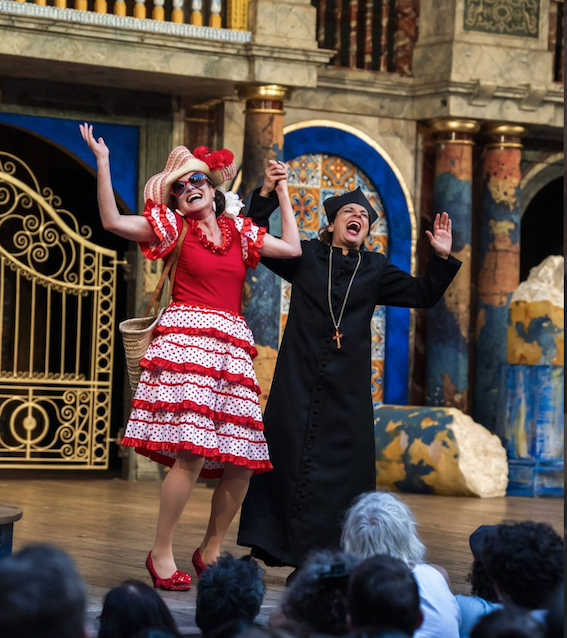
It’s really hard work for the cast. There is significant doubling with actors playing a straight role and a comic one. So Katie Stephens plays Maria, one of the Princess’s ladies, then Holoferness, or rather a completely different clown bearing the name. Suzanne Ahmet plays Katharine, in the princess’s party than Nathaniela, the priest.
Jax Guerreo is Dumaine, a courtier, then Moth, Don Armado’s boy servant. Daniel Crossley plays Dull, arresting Costard, and also Boyet, the chamberlain to the princess.
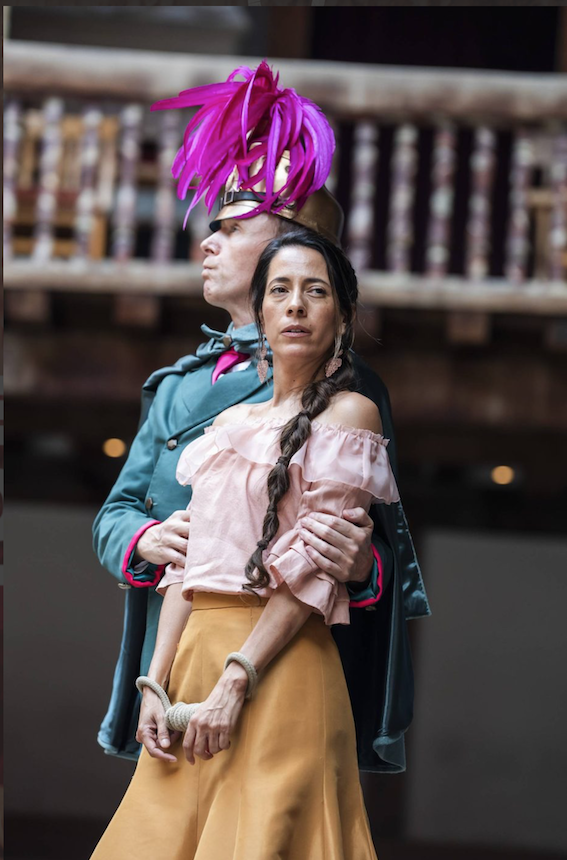
Daniel Crossley as dull, arresting Jaquinetta (Jimena Larraguivel)
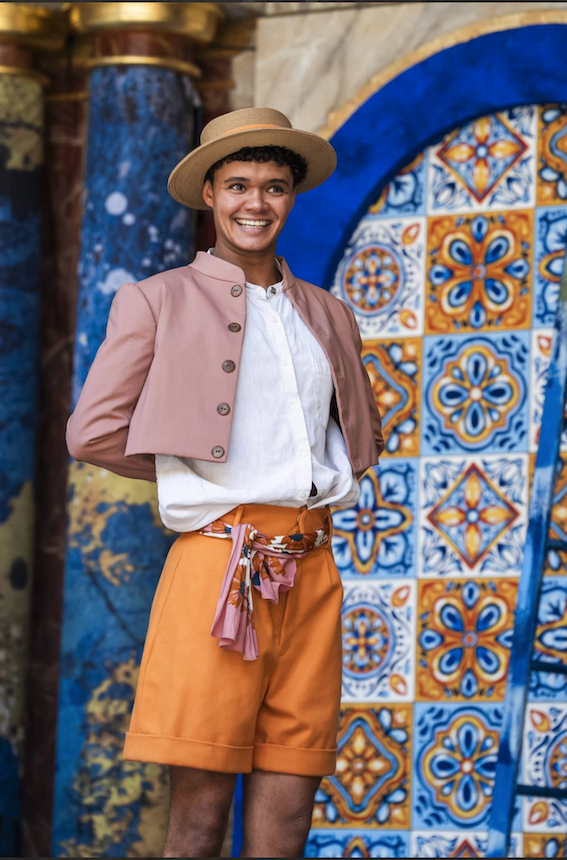
Jax Guerrero as Moth, Don Armado’s ‘boy’
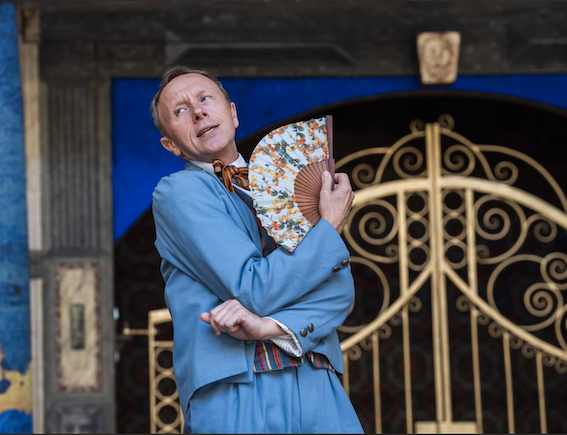
The non-aristocratic characters apart from Costard and Jaquinetta include Holofernes, originally a scholar (now changed to a women in red and white, hilariously played by Katie Stephens), Nathaniela, a priest, Costard, Don Armado and his ‘Boy’ Moth. The non-aristocratic characters decide to put on an entertainment, where Shakespeare is lampooning the masques popular in aristocratic houses, where the lords and ladies would dress up elaborately. Wilton House in Wiltshire has a statue and notes that Shakespeare’s company visited and performed there. This is the sort of place that would have had masques and spent a fortune on them. The shift is that the actors are NOT lords and ladies, so it is a direct line to Pyramus and Thisbe in A Midsummer Night’s Dream.
They shifted the worthies here to include Elizabeth I (who of course wasn’t known as ‘the first’ until there was a ‘second.’) The worthies have elaborate huge heads and peep through the stomach to speak.
The play has an odd ending. First there is an argument over who got Jaquinetta pregnant, Costard or Don Armado, then the fun and festivities are interrupted by a messenger to say the princess’s father is dead. She must leave at once. They all hope to meet again, but that’s it. Over. It’s why some scholars believe that Much Ado About Nothing was the same as the lost play Love’s Labour’s Won, so resolves tales of abandoned love. (I’m not convinced).
Wisely the photo gallery declines to show the Muscovites dancing, or the worthies. These are stand out visual scenes where they want to hold the impact for the show. But also there aren’t any solo photos of Phillipe Arditti as Berowne. He was superb, and the role is usually considered the lead.
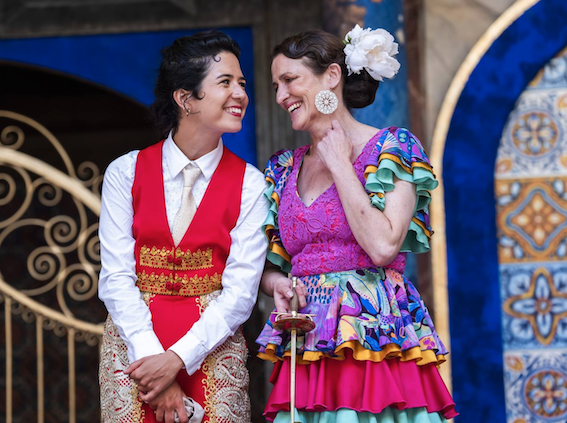
The play is peppered with Spanish. Should that be paprika-dashed with Spanish? Adios, paella, jalapenos, jokes with Castlian ‘th’ pronunciation.
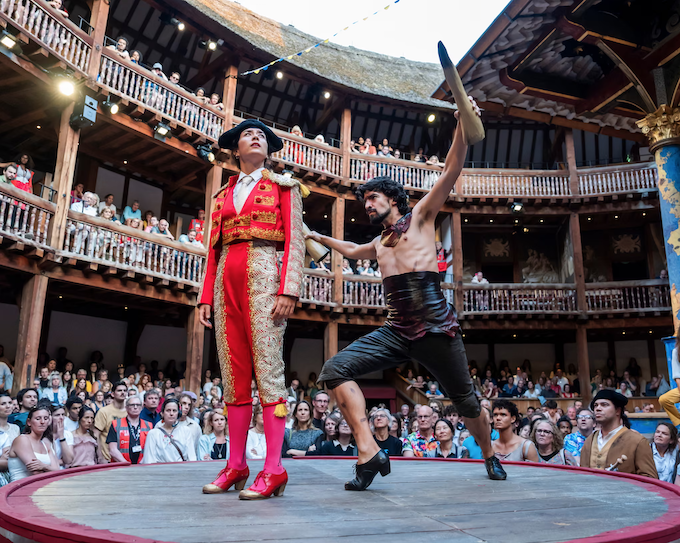
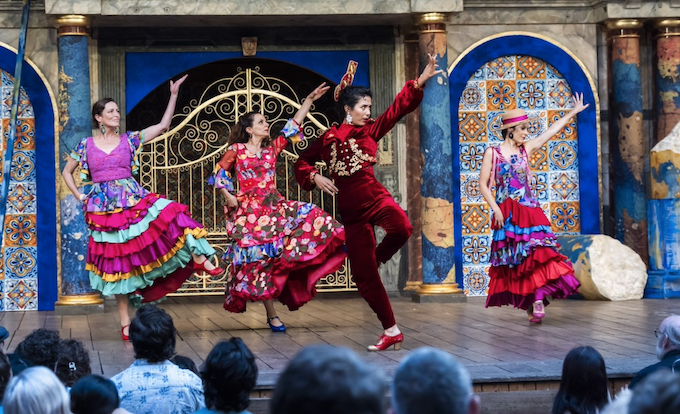
The deer hunt with arrows, is replaced by a spectacularly good flamenco bullfight with Spanish flamenco artist, Pablo Egear as the bull and Norah Lopez Holden as the toreador, matching the flamenco professional. That’s a very long way from the original text and any students studying the play for essays or exams should beware! It’s also a marvellous piece of theatrical dance. Flamenco radiates sex, and with it violence.
There are plenty of dirty jokes. Apart from the phallic Muscovites, we have jokes about Elizabeth Vagina and one lady when excited, fans between her legs. We did a video series for Spain, and after the pilot we were told not to stint on bawdier humour.
Kate Malby, in The Times wrote snottily: This is an evening of cheap laughs and lazy stereotypes — played for the least discerning of the Globe’s tourist crowd. She added ruined by puerile knob gags. She hadn’t finished: The result… is a crude cacophony of impenetrable Spanish accents, punctuated by groin thrusts and clumsy pratfalls, with nothing to say about love, learning or loss.”
No! The original play has stereotypes, you can’t start knocking Shakespeare for stereotyping. Also I guarantee the open air theatre would have had plenty of knob jokes in the late 1590s. Without tourists, the Globe wouldn’t exist.
There is a point about language. The puns are changed, the longer speeches are slashed, Spanish accents and Elizabethan English combine to be hard to pick up at times.
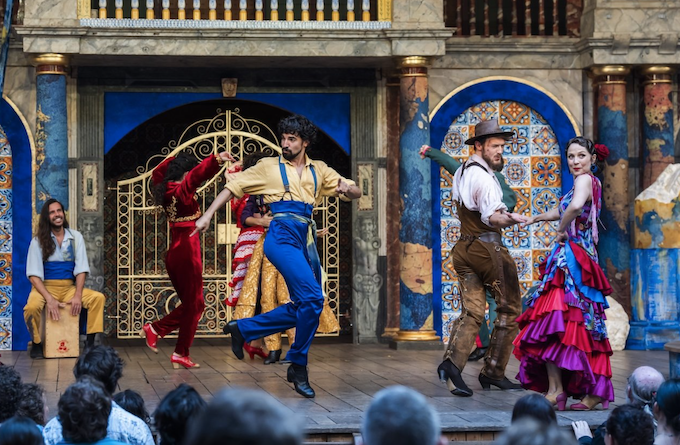
The flair and gusto comes from the flamenco punctuating the play. Most of the cast had to learn the dance steps too.
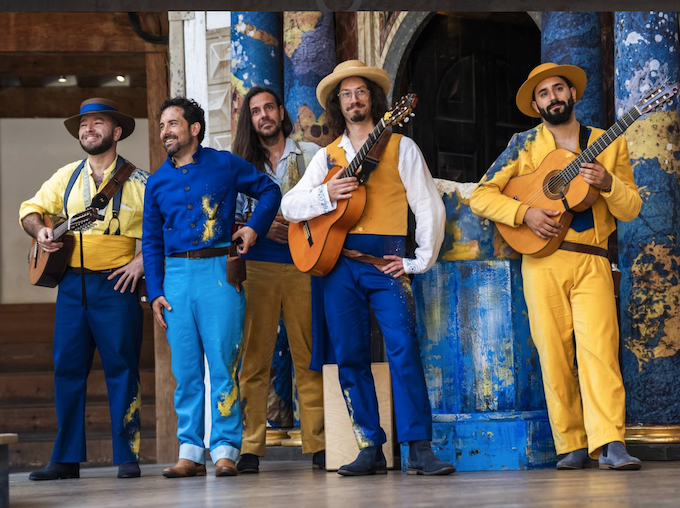
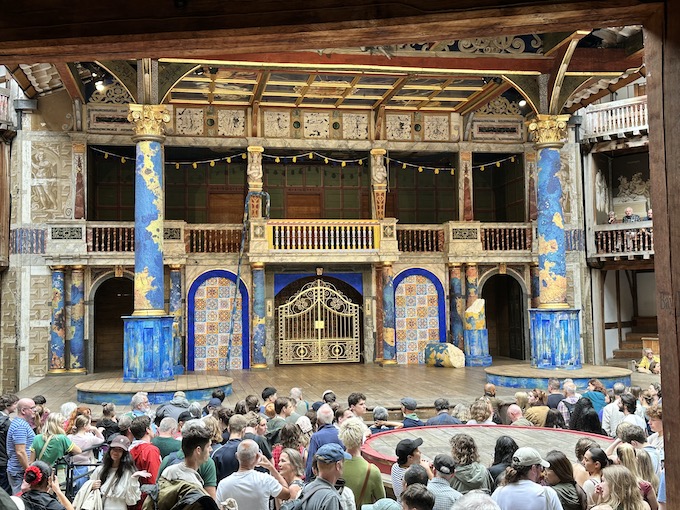
The musicians are on stage, not in the gallery, but often get drowned by the mass tapping stamping feet. They’re playing Spanish guitars, a laúd and a percussion box. They’re simply not loud enough. When I saw Carmen, the two guitarists got above the stomping feet and were much more energetic. It was a small theatre. Authenticity demands Spanish guitars but given the size of the open air space, and the fact thatThe Globe does not use amplification, I might have cheated with larger acoustic guitars and wire wound strings to get volume.
I’m trying to work out a rating. As a play seen at The Globe, it’s definitely four star, with 5 star choreography and lead roles from Norah Lopez Holden, Phillipe Arditti as Berowne and Ned Costello as the King of Navarre.
If you rate it as a production of Shakespeare’s Love’s Labour’s Lost and its language, it would drop to three or less.
I’m a visual learner though, so:
****
WHAT THE CRITICS SAID
four star
Mark Lawson, The Guardian ****
What’s On Stage, ****
Nick Curtis, The Standard ****
Debbie Gilpin, Broadway World ****
Neil Dowden, Plays International ****
Molly Gulvin All That Dazzles ****
Elizaveta Kolesnikova, Theatre Weekly ****
three star
Domenic Cavendish, Telegraph ***
Anya Ryan, Time Out ***
Dave Fargnoli, The Stage ***
one star
Kate Malby, The Times
LINKS ON THIS BLOG
- Love’s Labour’s Lost– RSC 2014
- Love’s Labour’s Lost– RSC 2016 revival, at Chichester
- Love’s Labour’s Lost, Wanamaker Playhouse, 2018
- Love’s Labour’s Lost, RSC 2024
- Love’s Labour’s Lost, Globe 2026
NORAH LOPEZ HOLDEN
The Winter’s Tale, Globe 2018 (Perdita)
Eyam, The Globe 2018
NED COSTELLO
Titus Andronicus, RSC 2025
JOSHUA HILL
Present Laughter, Old Vic 2019


Leave a Reply