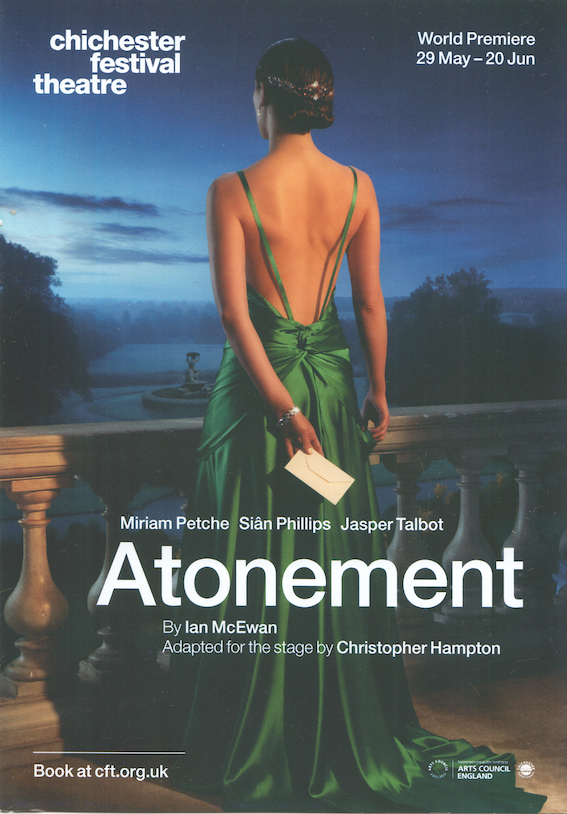
Based on the novel by Ian McEwan
Adapted for the stage by Christopher Hampton
World premiere
Directed by Adam Penford
Designed by Anthony Ward
Video Designer Andrzej Goulding
Composer / Sound designer Alexandra Faye Braithwaite
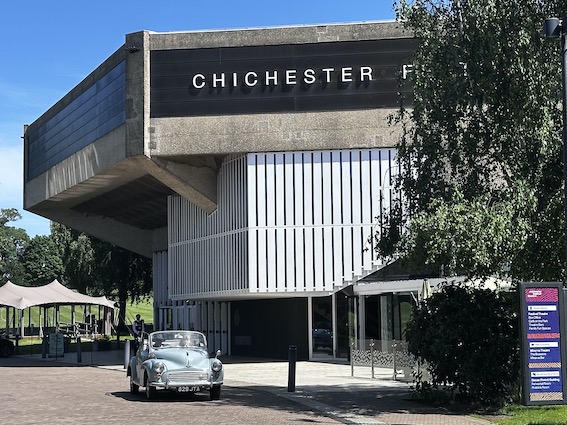
Chichester Festival Theatre
Saturday13th June 2026, 14.30
CAST
Miriam Petche – Cecilia Tallis
Jasper Talbot- Robbie Turner
James Backway- Leon Tallis / Airman Young
Nicholas Bailey – Dr McLaren / Mace
Tom Chapman – Paul Marshall / Corporal Tommy Nettle
Isabella Dempster- Young Briony Tallis
Yanexi Enriquez – Lola Quincey / Nurse Fiona Amery
Debra Gillis- Emily Tallis / Sister Margery Drummond
Gabin Kongolo – Danny Hardman / Henri / Luc Cornet
Natasha Magigi – GraceTurner / Mrs Jarvis / Tessa Scott
Jonathan Oliver – Police inspector / Jean-Marie / Older Pierrot Quincey
Jessica Turner- Briony Tallis
Jacob Isaacs / Ben Sparkes – Jackson Quincey
Felix Kennedy / Harry Sparkes – Pierrot Quincey
(Siân Phillips was replaced)
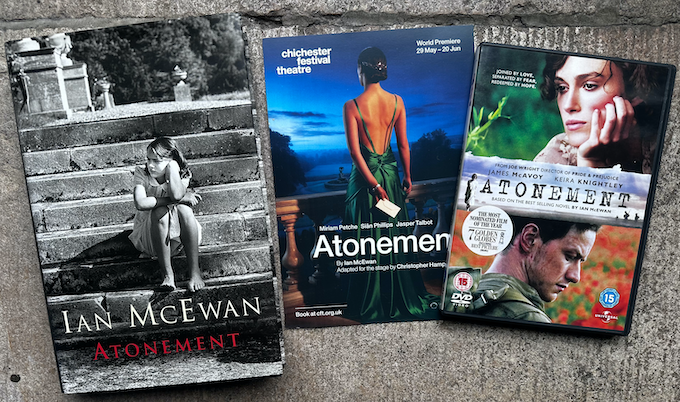
You’ve read the book (2001). You’ve seen the film (2007). The book was in a recent Guardian 100 Best Novels of All Time. It’s probably his best. I’ve read a few of McEwan’s, but not all. It’s very good whatever, and I’ve read it twice and seen the film around three times. It’s a film justly laden with awards. Christopher Hampton scripted the 2007 film as well as this stage play.
Before we start, I can see the country house in 1935 working. I worry about the beaches of Dunkirk.
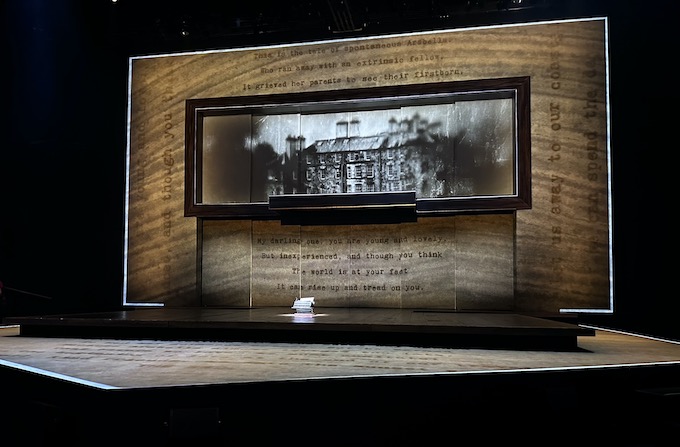
This is the set before the start. The typed and written word, projected are a running theme. The play opens to music and the characters moving around and criss crossing.
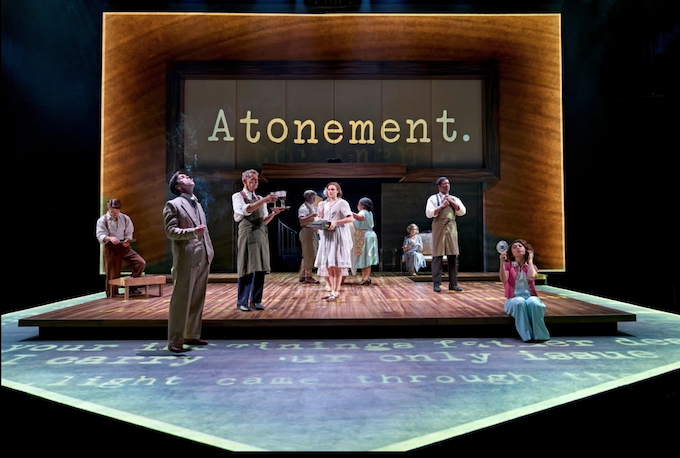
I’m assuming you recall the story. A fast recap. Basically country house 1935. The Tallises are posh, with two daughters, Cecilia and Briony, and a son Leon, who works in the City. Robbie is the housekeeper’s son, who the family have paid to go to Cambridge.
He has just finished and is helping in the garden. He has barely spoken to Cecilia in three years though both were at Cambridge. They argue, he breaks her vase by mistake, she dives into the fountain to retrieve it and emerges in wet T-shirt contest mode. Briony watches from the nursery window above.
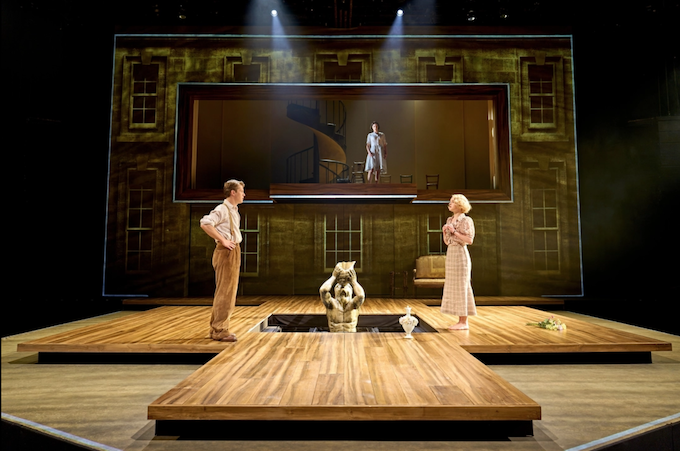
Briony (Isabella Dempster) watches from the nursery upstairs
Cecilia is about to strip off
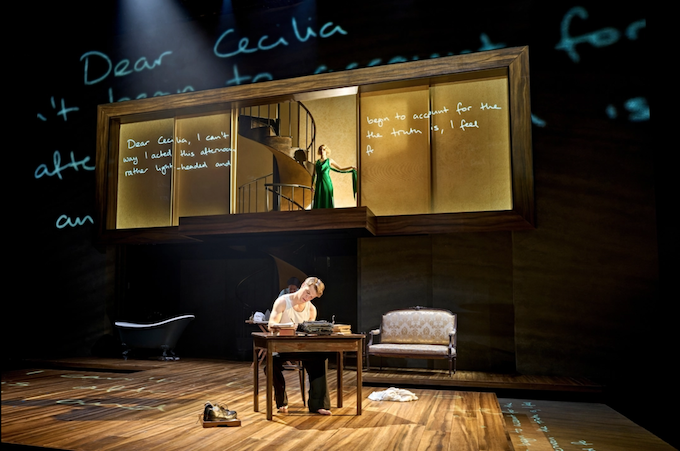
We see Robbie in the housekeeper’s cottage. Robbie types an imaginary sexual C-word letter to her, then hand writes a proper apology. In the play version, Cecilia is trying on different dresses above.
The letters get confused in Shakespearean style when Briony is asked to deliver the apology. Briony gets the wrong one, opens the envelope and reads the crude one. I was reminded of Jack Absolute Flies Again, where the servant complains that her role is a plot device delivering the wrong letters to people.
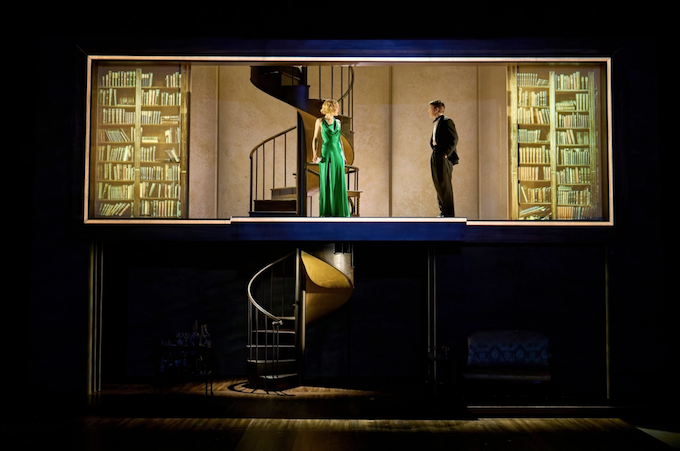
Three cousins arrive, Lola, and her two brothers, Jackson and Pierrot. Leon brings his pal, chocolate millionaire Paul Marshall to stay. Leon invites Robbie to dinner, and Robbie and Cecilia renew old interest (probably sparked by his suggestions in the crude one) and are in passionate sexual embrace in the library, and seen by 13 year old Briony.
We’ve seen Paul Marshall talking to Lola and the Twins. At dinner, Lola has heavy bruises on her wrists. She blames the twin boys, Jackson and Pierrot. The twins run away.
They all go looking for them. Briony sees someone raping Lola in the dark, and assumes it’s Robbie. Robbie arrives carrying the twins heroically. When the police move in, Cecilia defiantly kisses him.
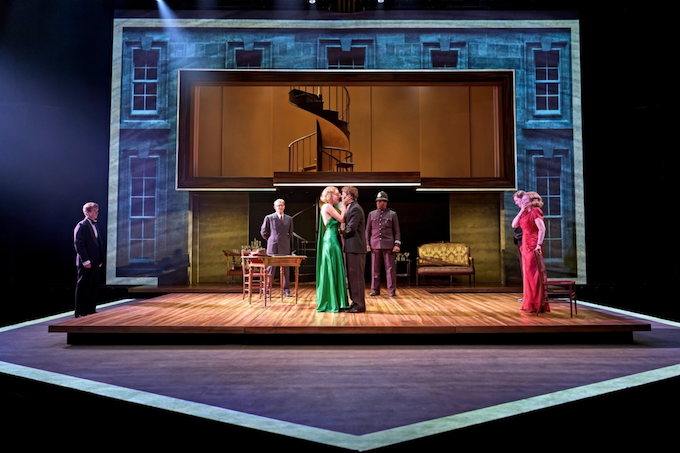
He’s arrested and sentenced to prison. The letter is part of the evidence. Cecilia can’t visit him because it would excite his ‘sexual morbidity.’ But she decides to have nothing to do with her family.
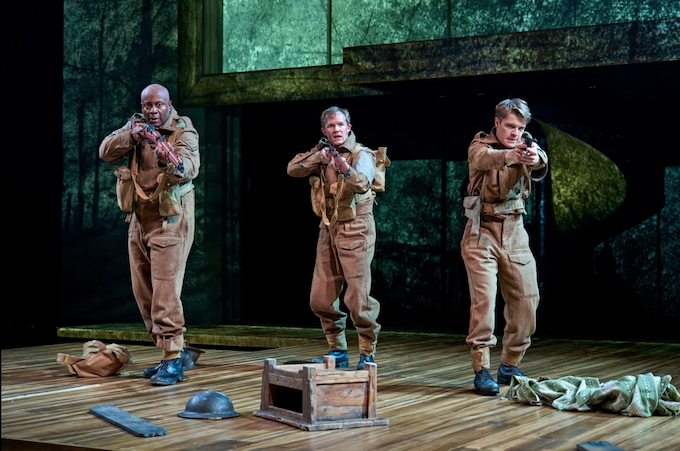
Part two cuts between Robbie and two other soldiers trying to escape through France to Dunkirk in 1940, and Briony and Cecilia working separately as nurses in London.
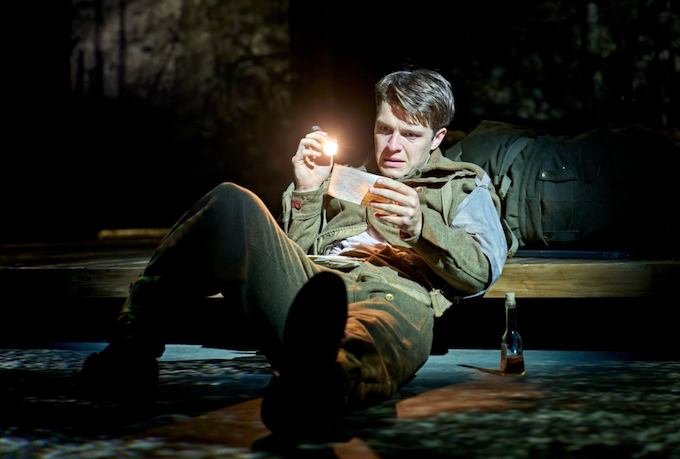
First, a very good idea is to show the letters projected as sur-titles as Robbie types. Then as he hand-writes the apology. Later we see a letter from Cecilia that he carries in France and each time he takes it out it gets more blurred and stained in the sur-titles.
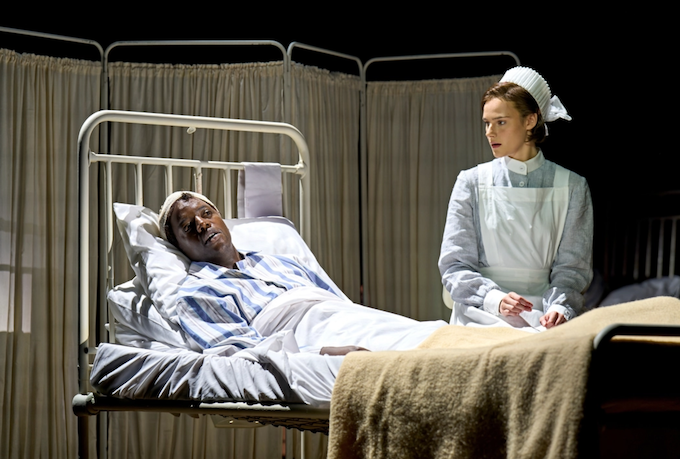
Then there are conversations in French in France, translated in sur-titles. The same idea is used when Briony is nursing a horribly wounded dying French soldier in London. It works very well.
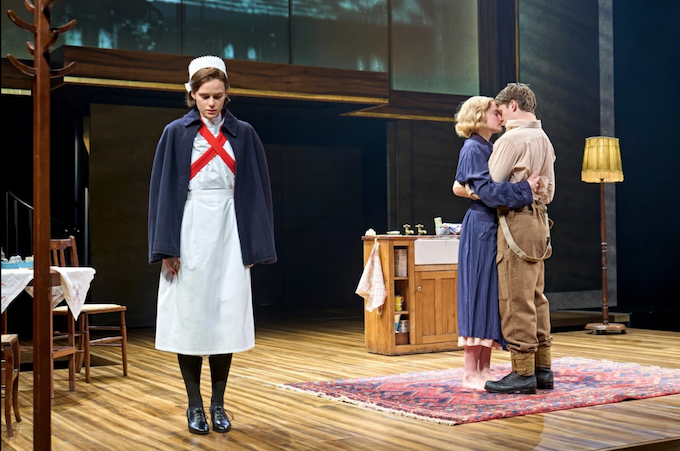
Then there’s the scene in Cecilia’s flat in Balham.
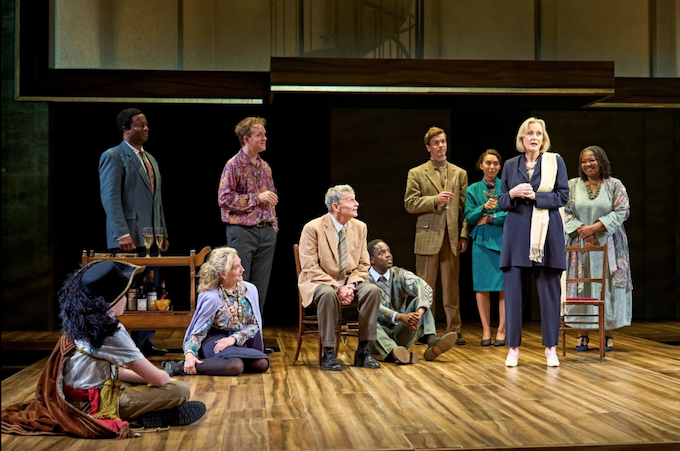
It ends “now” with an older Briony, who is a novelist and has written the story. Well, not “now” because Briony was born in 1922, so “about 2001.” The date of the novel. I won’t entirely plot spoil. As readers and viewers know, the twist at the end means it’s a fictional tale about fiction. Jessica Turner as older Briony, now a successful novelist, delivers it all beautifully and movingly.
There are some great theatrical moments. The first is when Cecilia strips to underwear and gets right into the pool below the fountain, submerges herself, and emerges dripping wet with sodden hair. That’s a moment of realisation for Robbie. About a minute later she walks back on dry with her hair properly dry. They must have had her natural hairstyle and a wig to replicate it, but it’s extremely fast.
It may be a bums on seats bum, that allows them to claim ‘contains nudity’ but in his mum’s cottage, Robbie is in the tin bath and has to get out revealing a bare bum to the world as he scurries off. To be fair, Hampton has taken it from the novel:
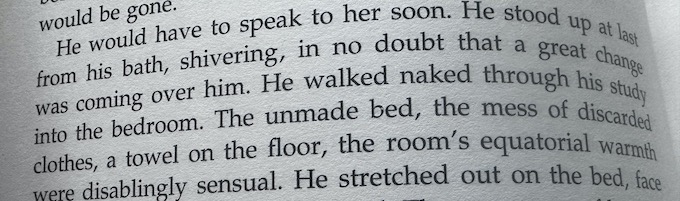
Gratuitous? Well, we don’t see him stretched out on the bed. Nothing problematic, but it is shoehorned in.
Then later there’s a flashback in Part Two, explaining Briony’s 13 year old crush on Robbie. She jumps into the river, he has to jump in and save her, How would you do that? They both jump off the platform which must be about ten feet above the stage into darkness, emerge in an “underwater ballet” with projection. I’m assuming there was a mattress of some kind pushed on. Even so, with no understudies listed, the possibility of a badly twisted ankle would worry me. The overall effect was very good indeed.
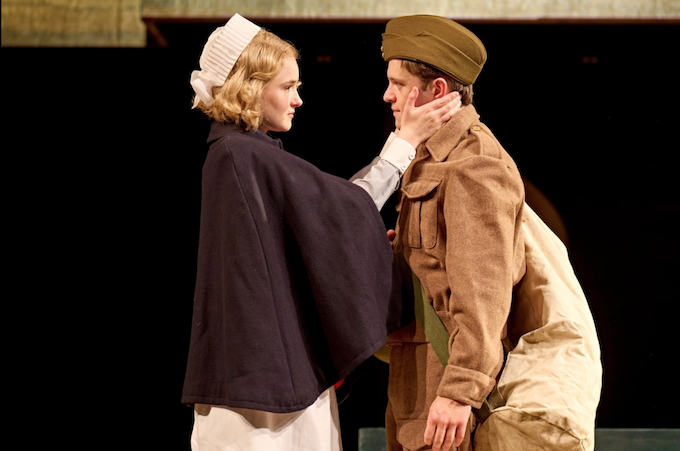
The music is anachronistic. Modern loud beats except for a little background when Robbie and Cecilia meet briefly in St James Park before he goes to France. It works well at covering the rapid set changes – even Cecilia and Robbie have to move furniture, but is a little jarring in ignoring a sense of the period.
There are things I question.
Visuals were important. Great care was taken over costume. The stunning visual note was that Isabella Dempster as Young Briony and Jessica Turner as Old Briony really do look like the same person. Jessica Turner replaced Siân Phillips, who is in the rehearsal photos too. They bothered to get at least one set of siblings to play the twins.
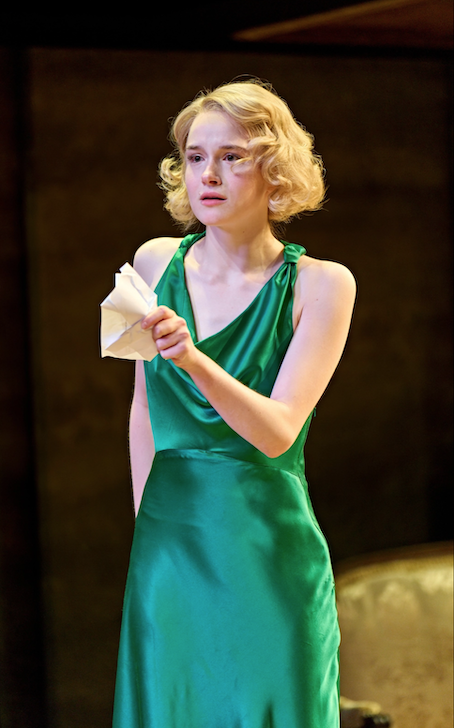
Then there was that stunning green dress, as noted in the book and film. It gets a whole programme article. Incidentally, they say they could only afford one. I don’t believe them for a minute. Even in educational video filming we would never have risked just one version of an essential costume. You always have a back up. Things get spilled, or ripped, or are hard to keep looking pristine. Stage is far riskier than film too. As so often the advance photo on publicity and programme was a different actor. Dark-hair not blonde.
On costume the play text describes Lola”
Lola sixteen, who wears a green check blouse, pink trousers and sandals which reveal her bright-red painted toenails and an ankle bracelet.
Of course the designer ignored the instruction. What led a writer as experienced as Hampton to put it in? On the ankle bracelet, in one of our video series, an actress was told by the producer to take hers off, because in several countries it signifies something between ‘available’ and in others, ‘for hire.’
I think the casting director has knocked a full star off, though let’s spread the blame, it’s a production decision. The acting is fine. Jasper Talbot is an obvious future major theatre star (Mick Jagger in Redlands, the son, Harry, in Inter Alia). Miriam Petche as Cecilia, and Isabella Dempster as Young Briony are perfect casting, and we hadn’t seen them before, both are brilliant. The rest of the cast are all excellent.
What’s gone wrong is the colour blindness. It rings out as quota casting. We are fully used to colour blind casting, and it works better in Shakespeare than in contemporary settings. You do have to check family relationships though. Robbie is white. Natasha Magigi is a very African lady in appearance. She is his mother. She says at one point, ‘You’re not a bit like your father.‘ Hmm, not a bit like your mother either. At least that line had to go. It’s unintentionally funny. There is no possible stretch that they are related. Yet in a play where great care has been taken over costume, this is still a visual matter. They could have cast Robbie as black. Colour blind for the story, but perfectly acceptable to the audience. We’re used to it. Not a problem. But you do have to consider close family relationships.
It goes further. The housekeeper, is black, Danny Hardman (Gabin Kongolo)who works there is black. It’s not ante-bellum Georgia or Alabama, but we have a house of rich white folk with black servants. Then the one the inspector initially, then Robbie and Cecilia suspect of rape is Danny, not Paul Marshall. That’s a touch ante-bellum Alabama too. Who’s the suspect? The black guy!
An injured black French soldier works (a fine performance too), the French army had African regiments, but I still don’t think he would have made croissants in a bakery in Millau.
Another casting decision struck me as misguided. Yanexi Enriquez is a perfect Lola, the sexually precocious (US English ‘jail bait’) victim of Paul Marshall. She has a wiggle and a look. Then she puts her hair up and doubles as Fiona, the nurse working with Briony in 1940. I think they needed to employ an extra actor to play Fiona because Yanexi Enriquez has a very distinctive face, and even knowing the story, you think ‘What’s Lola doing working with her?’ The hair up doesn’t do it, because nurses have to put their hair up anyway. The other reason I’d cast an additional actor as Fiona is that they list no understudies. That’s between brave, fingers crossed and foolhardy (especially with Briony doing that jump every show and Cecilia getting soaked in cold water). If they had another ‘younger female’ in the cast they could probably manage the understudy shuffle along if anyone was ill or injured.
OK, while I’m being extremely picky, Ian McEwan has previous on research, in On Chesil Beach where he has characters listening to Rolling Stones and Beatles covers of Chuck Berry in 1961. In the first edition anyway. The original novel and the Christopher Hampton play script has Cecilia announcing that while Robbie got a ‘first starred’ at Cambridge, she only managed a ‘third.’ 1935. While women were admitted to Cambridge, they received ‘certificates’ until 1948. That was the year degrees were finally awarded to women. I didn’t know the exact date, but I knew it was post-war. I have just double-checked and the certificates were in fact graded, first, second, third. (I do fact check). So, OK, I’ll let them have it!
Overall, they succeeded entirely in the France to Dunkirk and World War Two hospital sequences. They went light on the classic country house setting too, unexpectedly. It has tremendous pace, never slacking. It comes in at an unusually short two hours including the interval. It flies by. I reckon it’s a cert for a London run in spite of the weaker reviews, which are inevitable when a great novel is translated to a different medium.
We both found it genuinely moving, and I feel it deserves its place standing with the major novel and film. It’s a different medium. Accept that. This is why staging and set lean to theatrical rather than realistic. There’s no other choice. We both said instantly afterwards ‘four star.’ Without the niggling stuff it could have nudged a five.
****
WHAT THE CRITICS SAID
4 star
Hywel Farrow-Wilton, All That Dazzles ****
Theatre & Tonic ****
3 star
Arifa Akbar, Guardian ***
Dominic Cavendish, The Telegraph ***
2 star
Siobhan Murphy, The Stage **
Gareh Carr, What’s On Stage **
West End Best Friend **
LINKS ON THIS BLOG
CHRISTOPHER HAMPTON (Adaptor, Screenplay)
Sunset Boulevard, Savoy Theatre 2023
The Father, Florian Zeller 2020
God of Carnage by Yasmina Reza, also Bath 2018
The Lie, Florian Zeller, Menier Chocolate Factory 2017
The Truth, Florian Zeller, Menier Chocolate Factory 2016
The Height of The Storm, Bath, September 2018
An Enemy Of The People by Ibsen Chichester2016
ADAM PENFORD (Director)
The Sound of Music, Chichester 2023
Watership Down, Watermill, 2016
Deathtrap, by Ira Levin, Salisbury 2016
Stepping Out by Richard Harris, Salisbury 2012
JASPER TALBOT
Inter Alia, by Suzie Miller, NT 2025
Redlands, by Charlotte Jones, Chichester 2024 (Mick Jagger)
TOM CHAPMAN
Cymbeline, RSC 2023
King John, Rose Kingston 2016
JESSICA TURNER
The Fantastic Follies of Mrs Rich, RSC 2018
JAMES BACKWAY
Watership Down, Watermill 2016


Leave a Reply