Call me Scrooge, if you will. Christmas is coming.
This was occasioned by perusing the packet of sliced bread on the table before making toast. One needs an occupation at my age. So it says:
5p from the purchase of this bread will be donated to Youngminds.
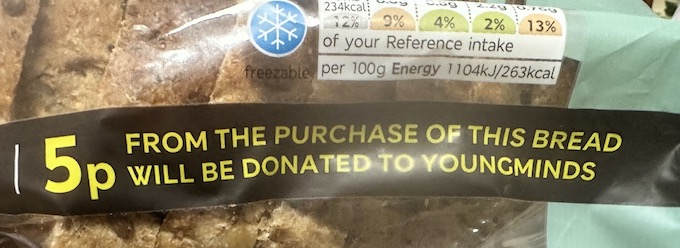
That’s fine, and it’s not like they’ve added 5p to the price and at £1.75, Marks & Spencer can afford to donate 5p. While one might argue that they could sell it for £1.70 instead, I’m not bothered and I’m sure it’s a worthwhile organization. However, this is really virtue signalling. Look at us. What a nice company we are.
It’s an epidemic. I blame a generation of thirty and forty somethings who grew up with the charity festivals. They’re the generation running things. They are the ones who dutifully took their 50p or £1 into school on Mufti Day, where they paid not to wear school uniform for a day. They paid 20p to throw wet sponges at the deputy head teacher in stocks to earn money for Comic Relief. They made papier mâche figures for Comic Relief and people paid 5p to look at them. They’re a generation who bought their Comic Relief red noses, and watched mum and dad send money to Comic Relief on Saturday night on their phones. £10 if sober. £20 if ‘tired and emotional.’ Mum and Dad had after all been through Live Aid and bought the Do They Know It’s Christmas single as well.
At my primary school we took in foil milk bottle tops which were collected. In my youth it was Bob A Job where Boy Scouts and Girl Guides tramped the streets offering to do minor tasks for a shilling. Not that washing a car or mowing the lawn was a minor task. Nowadays we’d consider that potentially dangerous, or exploitative, for children. Then at youth club we collected jumble for jumble sales two or three times a year. That was fun and we manned the stalls. Charity shops killed that.
Every theatre and concert hall does it. You pay for your tickets and are asked if you want to Add A Donation. Sometimes the suggested donation is eye-watering. We book the Royal Shakespeare Company for an entire season. That’s several hundred pounds and months in advance of the plays. Is that not sufficient support for the theatre? They will happily suggest a £25 donation. You can choose other amounts or press I do not want to donate. Add a Donation has been going on for years.
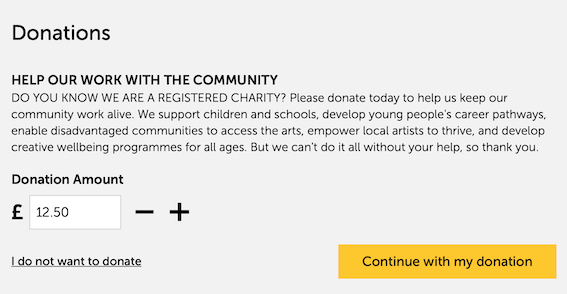
Note the yellow CONTINUE WITH MY DONATION box, exactly like the box which you have already pressed to move to the next page a few times already, versus the quiet ‘I do not want to donate.’ In this case a £12.50 donation on just under £80 worth of tickets seems excessive.
Now it’s spread to shops every day. The Garden Centre has ‘Do you want to add 10p for (our favourite charity)? Oxfam now has ‘Do you want to round up to the nearest pound?’ Oxfam have done that for years with everything priced at (something) and 99p. There was a box on the counter and everyone dutifully put the penny change in it. It changed to preferring cards during Covid. They lost all those pennies.
Restaurants have got in on the act. At so many transactions (Coffee shops are doing it too), you now have to press GREEN- Yes. I am a generous soul, or RED – No, I’m a mean tightfisted bastard. I pressed NO twice yesterday alone.
The point is, why should your favourite charity be my choice of charity? We already have direct debits to our favoured charities. So we ignore the teams of youths in hi-vis jackets in the street trying to sign people up for direct debits to a particular charity.
Yes, I’ll put money in the tin for Poppy day. My dad would have expected me to.
In the workplace, the sponsored walk / swim / marathon can be a nightmare. You’ll find someone turning up with a list asking you to sponsor them in aid of a relative or friend who has some heart-rending problem. You feel you can’t say no, even though you have only seen the person with the list once in the distance. The fact that you are a friend or colleague removes choice. My son’s teacher did spectacular marathon cycling to raise money, he had a child with cancer. We all sponsored, and while I’m glad we did, I have to say it wasn’t really free will.
I have said ‘no’ to a friend who wanted to be sponsored in a marathon in aid of an animal charity. She only wanted 10p a mile (though listed others who had given £1 a mile). I said that I never give to animal charities, but would give double what asked, so £7.20, to a local children’s hospice instead. She was deeply offended. Why? We all choose our charities. In a world with troubled and sick children, I cannot give money for dogs.
Then, what is a charity? I wrote for decades for Oxford University Press, which like Cambridge University Press is a charity. This enraged other publishers, who said it was not a level playing field because OUP and CUP were not taxed in the same way. In my presence OUP reps and editors have muttered as ever higher profits were announced, ‘So better claret at High Table in the colleges.’
I look at charity shops, and wonder how much of the money they collect has actually gone to shop-fitters and electricians. They mainly now have smart clean blonde wood cladding, professional rails and shelves. They are very fussy about the quality of donations too. They have a point, and we give clean quality clothes that no longer fit (or have never been worn but no longer fit) to the cancer charity, Tenovus. We took a friend’s deceased husband’s clothes there originally and not only did they get several hundred pounds, but they sent a note saying how much they’d got. So the blonde wood and smart shop paid off for them because they could sell expensive jackets and actually get £40 or £50 for one.
I sometimes look in at the rare shabby old-fashioned ones like the local Cats Protection League. Stuff is piled up everywhere. Prices are low. It’s much more fun for the browsing customer, though branches tend to reek strongly of cats. There will be one sitting on the counter.
Let’s continue the theme of what a charity is. I did a speaking tour of Switzerland one December. We planned to shift between cities after my early evening talk, and hadn’t anticipated thick fog on the roads. You could barely see the front of the car. On one night, only McDonalds was open when we finally arrived. On another nowhere was open. We were directed to the station buffet which was full of addicts escaping the cold with police on guard. The police advised us not to enter. We went to bed hungry. So on the last night, Friday, the OUP rep had a lot of his entertainment budget left. He suggested we go to an elite Geneva restaurant which was frighteningly expensive. We were the last customers and were joined by the Italian waiter and Mexican chef with complementary tequila as it closed (we’d been talking to them and mentioned that the OUP rep’s wife was Mexican). They said every table except ours was Red Cross or UNICEF executives on expenses. My co-author Bernie Hartley’s girlfriend was Swiss and was a trilingual Red Cross secretary. She earned three times what we did as teachers (Heads of Department on Burnham FE scale too). I always want to know what percentage is taken up in administration. I can also affirm from sitting next to them that Oxfam flew Business Class.
QUOTE: On average, the most well-known and largest charities in the UK will spend between 26% and 87% of their annual income on charitable activities– i.e. fulfilling the charitable services the charity exists to provide. The remaining income is usually divided across administrative and operational costs, which are crucial to ensuring that charities are successful in their cause.
So for some, 74% is on administration. For others it’s 13%. You need to know which end a charity is on. Obviously administrators with good ideas make money. Whoever persuaded Marks & Spencer to donate 5p a loaf was using their loaf.
Take charity Christmas cards. See how much they are actually donating to the named charity. It is a tiny amount. Sometimes 1p per card, or 5p per pack. I buy them if I like the cards (V &A are always good) but not because of their donation.
Oxfam Bookshops next. Salisbury used to have three good secondhand bookshops. The owner of one described what happened in The Bookseller. Oxfam opened, and recruited his assistant as manager. The manager went on a course and learned how Oxfam was targeting profitable secondhand bookshops and opening as close to them as they could. Just six months later Salisbury had no secondhand bookshops. That was three businesses which people ran as their living, and they employed others. Gone. Still, it’s all in a good cause. Oxfam run on a manager and unpaid volunteers. They get their stock free. They often get the shops rent and rates free. They have virtually wiped out secondhand bookshops, and the British Heart Foundation have joined the specialist Books & Music club. One volunteer said you should see the skip of rejected items behind charity shops.
Secondhand record shops have survived because charity shops get volunteers to (over) price records according to the highest eBay prices. No, a scratched and torn military band LP on a budget label is NOT worth £4. Nor £2. Nor 50p. A secondhand record shop puts them in the skip.
On records, SEE the article at Around and Around on CHARITY SHOPS
Finally, charities and wills. Lawyers will suggest leaving 10% to charities for a number of reasons, basically reducing the estate. My father-in-law designed and built his own modest house in 1960. It was 400 yards from the sea. You can guess that 60 years later it had appreciated in value. He left 4% to Cancer Research, 4% to his local church and 2% to injured jockeys (horse racing was his lifelong interest). The lawyer winced at Cancer Research. She said the big charities would go through the estate accounts with a fine-tooth comb, check every penny, and insist on seeing a valuation of the house contents as well. She said ‘Avoid the major charities.’ The major charities employ accountants to maximise their income from bequests. (All for a good cause … will be the mantra). Then the Church of England cost hundreds of pounds in legal fees because they didn’t bother to reply to any correspondence. The eventually did after several lawyer letters, and it took six months for a thank you on a piece of notebook lined paper. The jockeys were thankful, pleased and grateful.


Leave a Reply