Feeds:
Posts
Comments

The Boat Race

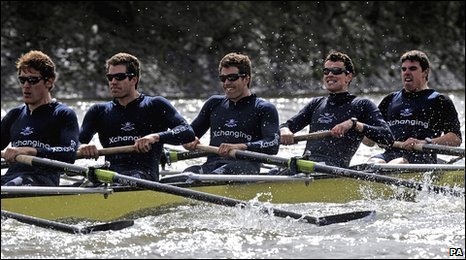
I was listening to the radio news about the Oxford and Cambridge annual boat race today. This is an event which has completely slipped beneath my radar, but it was brought into the news today by the presence of two burly identical twins in the Oxford team. Tyler and Cameron Winklevoss are Americans who as well as rowing at this high level, won a legal case over their role in the origins of Facebook.

It started me thinking about my childhood, when everyone in the country took sides in the boat race and everyone watched it on TV live. For no apparent reason, we all adopted sides and fervently supported one team or the other. The only reason for my choice of Cambridge all those years ago was a liking for light blue over dark blue, as we had no connections to either town and certainly not to either university. I liked light blue shirts and didn’t like dark blue pullovers.
Many years later, as an OUP author, I remember expressing a mild preference for an Oxford victory to one of my OUP editors, but as he’d attended Cambridge himself, he was rooting for the other side, as it turned out were most of his colleagues.

The boat race on TV has proven a minefield for sports reporters. The person who steers the boat is usually chosen because they’re small and light, and is called the cox. Private Eye regularly lists unfortunate sports commentaries, and with the boat race they’re along predictable lines (The race is over! They’ve won! Everyone in the crew is hugging their little cox …)

I haven’t watched it in years, except for re-runs on the main evening news, though after thirty years connection with Oxford, I’d extremely vaguely hope they’d win. That’s more to do with having filmed various videos in so many obscure parts of the university, especially English Channel III: Double Identity.

Barcoding mad

See a cut and pasted article  Barcodes under “Rants” on a disturbing new piece of legislation.

Shutter Island

Robbie Robertson and Martin Scorsese have been producing soundtracks together since Raging Bull and The Last Waltz. Robbie Robertson has been quoted as saying of Shutter Island that This may be the most outrageous and beautiful soundtrack I’ve ever heard. The choice of modern classical tracks is highly unusual, ranging from Penderecki and John Cage to Brian Eno, and I got the soundtrack CD a couple of weeks ago. In 1973, between recording Stage Fright and Moondog Matinee, Robertson was allegedly working on a version of Penderecki material, which never emerged.

The trouble is, that after seeing the film, the images they bring up are so chilling that I’m not sure I’ll listen that much. The film is gripping from start to finish, the locations are stunning as is the sense of period (1956). I’m not going to drop any plot spoilers, but the almighty twists left the audience somewhat irritated, I thought. definitely one to see, even if you come out wishing fervently that there’d been a more conventional ending.

Copyright and trademarks

I just read a New York Times articles about the Mardi Gras Indians in New Orleans, who are trying to copyright their elaborate costumes, so as to prevent photographers profiting from selling posters and photos of them.

The legal issue is interesting. We’ve had this for years  with publishers worried that a MacDonalds sign was visible in a street scene and might lead to problems. The general feeling is that if an image is the central subject of a picture, permission may be needed.

The legal trepidation reached a peak in the mid-90s when American editors started putting ™ or © signs after half the proper nouns in New American Streamline. I had a text about a car crash in Departures unit 55 and the first edit was  `The Ford™ crashed into the Chevrolet™.

I sent the editors  a couple of pages from the Grapes of Wrath where the name Ford appeared and said I don’t believe Ford could ever win a case against a publisher who failed to put “TM” after the word Ford, as anyone could find hundreds of examples without. They saw reason and the offending signs were removed, though one at least © was missed, so superstar Courtney Dallas still boasts in Unit 16 that I have a new Mercedes © and a lot of money …

This impacts on readability.

I also said I couldn’t believe Ford or Chevrolet would be dumb enough to sue, as they maintained their names were trademarked and a court might decide that their loss was nil in a work of literature, thus undermining the trademark. Anyone with any sense knows FORD is trademarked to stop the Central Asian Motor Corporation producing a range of “Fords” and more so, to stop spare parts manufacturers putting “FORD” on their goods. It’s not about describing a car in a book.  When we borrowed  a Ford for filming a video from the manufacturer I told the marketing guy about the TM issue and he fell about laughing at the very idea of sueing a writer for infringing their copyright. After all, his job was product placement, getting the Ford name into as many places as possible.

The moral of the story, as ever, is “Keep the lawyers in check.”


The latest issue of the EL Gazette (April 2010) has an article by me, Symbols Clash With Sounds, on the problems of students from Non-Roman Alphabet cultures. The accompanying photo is from the BELTE Conference in Brighton in October 2009. It may look enigmatic, but I’m teaching the sounds a / i / n / t with flashcards where symbols (square, circle, star, triangle) replace the letters. Teachers can try it themselves using the introduction to the Fast Track to Reading Teacher’s Book. There’s a page with the symbols replacing the letters, and if you play the accompanying tracks on the audio, you can see how the program works at a basic level.

The photos below were taken at the Garnet Education stand at the BELTE conference.

The first shows Olly Twist (Garnet) and Gordon Watts from Bellerby’s who organized the conference.

The second shows me with Gordon.

Invictus

I rarely use that Ned Flanders word “uplifting” but I’ll apply it to the Clint Eastwood directed, Morgan Freeman produced film Invictus. I saw it last night somewhat reluctantly fearing a worthy biopic that lacked tension because you knew the ending and that Nelson Mandela wasn’t going to get assassinated or die of a heart attack while jogging etc. Completely wrong. It’s a great movie and Morgan Freeman just becomes Mandela, or rather Mandela inhabits him. Matt Damon is excellent, even if he doesn’t look much like a rugby player. I can’t stand rugby as a game which enhanced the last twenty minutes because I didn’t know the result of the crucial match. But it’s genuinely uplifting. My only disappointment was to discover that it was named after the 19th century poem “Invictus” rather than the Holland-Dozier-Holland soul record label of the 1970s (OK, I know, that was named after the same poem).

New blog …

This blog replaces the guestbook on my website, http://www.viney.uk.com. The website remains active.