Feeds:
Posts
Comments

The experience of sales bullshit is repeated every time you buy something. I’ve been keeping my Xerox printer going for a year with horrible streaks, constant jams and the door falling off daily, hoping to use up the existing ink supplies, as the new bits I need cost more than a new printer. The ink in mine came in great big 11,000 page cartridges, and so I wanted to get the fullest use, but the cyan ran out (it continued to work for 8 weeks after it told me to replace it though), then this week the yellow ran out. The cyan reached a critical point and now it will only print in black and white. It’s also jamming three times a day. So off I set to buy a new one. A little research online told me that a similar specification new Xerox cost £349 + VAT (a fraction of what I paid for the old one).

So to Staples. I looked at the printers on show. High-gloss black is the colour of choice for 90% of models. 100 sheet capacity. 150 sheet capacity. Cartridge life 200 pages (or on one, just 65 pages).  It’s obvious that like early Kodak Brownie cameras with film, they sell the printers at cost, or a loss, in the hope of selling ink. The biggest they had was a Brother at 150 sheets storage and 2200 page ink capacity. The equivalent Xerox is 530 sheets storage and 6500 ink capacity from solid ink pellets. I thought my Xerox was flimsy (the door falling off constantly aids that impression) but compared to the Brother, it’s built like a tank. I was about to leave when the hovering salesman got to me.

Salesman:  Are you looking at printers?

Me:  Yes, but I’m not looking for a home one. I want an office one.

Salesman: These are office ones.

Me: Right, but 150 sheet capacity isn’t office size.

Salesman: It’s the biggest you can get.

Me: Office ones take a ream.

Salesman: What’s a ream?

Me: (and this place sells paper!) It’s a block of 500 sheets of paper. You’ve got lots of them over there.

Salesman: (sharp intake of breath) Two thousand pounds.

Me: What?

Salesman: That’s what it costs for a printer like that.

Me: £349 plus VAT for the Xerox.

Salesman: Does it fax?

Me: Fax?

Salesman: All these are fax machines too.

Me: I don’t want a fax machine.

Salesman: Very useful. Fax machines. You can send documents to people over the phone line, you know.

Me: I haven’t sent a fax in ten years. When I had a fax machine, I got twenty faxes a day trying to sell me fork-lift trucks.

Salesman: And scanners. They’ve all got built-in scanners.

Me: I’ve got a scanner. A proper scanner.

Salesman: This one’s got a telephone in it. With a two hundred number memory. And a little LED display so you can see what it’s printing.

Me: I can see that on the computer screen.

I didn’t wander away this time. He did.  So online you go. Next day delivery, and yet another retail business gets another nail in its coffin. I know why they don’t sell big Xerox or HP printers … if they did, their ink sales business would be seriously dented.
Review added under Film & Theatre reviews.

Review added of the film (see film and theatre reviews)

A Fishy Story

I’ve been a fan of Louis de Bernieres since his first book, The War of Don Emmanuel’s Nether Parts. I bought it new in hardback, and bought every book since. I bought Captain Corelli’s Mandolin on the day of publication, and foolishly failed to sell it when copies of the first edition were selling for £400. That figure plummeted when the film came out (and wasn’t very good).

So it’s with sadness that I say one short story in the latest short story collection, Notwithstanding, is unworthy of him. The story Colonel Barkwell, Troodos and the Fish is simply an ancient joke, elaborately written up. The story is well-known. There’s a dinner party. They’re going to serve fish (or chicken). The cat eats some. They serve the guests. They go in the kitchen and find the cat lying there dead. Everyone rushes to hospital and has their stomachs pumped. They return to find a note, ‘Sorry, I killed / ran over your cat …’ Let’s not even consider whether a hospital would think a stomach-pump effective for rapidly-multiplying salmonella bacteria, though de Bernieres does get around that question by making the Colonel in the story so obnoxious while insisting on a stomach-pump, that the doctor decides to let him have it.

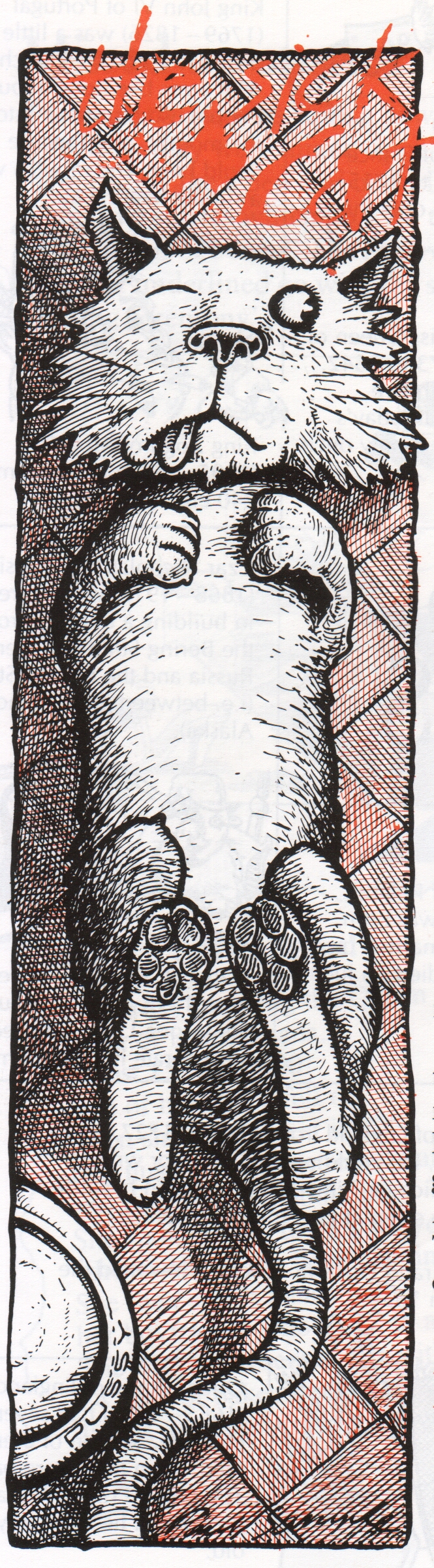
The Sick Cat: Illustration by Paul Sample from Connections in Reading A

I wrote a version of this story myself back in 1986, as The Sick Cat in Connections in Reading A. In my feline-friendly version, it’s chicken rather than fish, and the cat survives too. And I had an illustration from that great illustrator Paul Sample (above). I don’t accuse de Bernieres of plagiarism (though I believe he was an ELT teacher). I had heard the story when Tony Blackburn told it on the radio, and adapted it. It’s in several joke books. Richmal Crompton used similar in a William story in the 1930s. De Bernieres wrapped the old joke elaborately and did it far better than me, but please! For a major novelist this is shameful.

I would add that the excellent story The Happy Death of the General in the same Notwithstanding collection first appeared in a newspaper magazine in 2001. It’s customary to announce the earlier publication in the front matter. De Bernieres put all the previously published references in the back, hidden in a long Afterword. You don’t see them until you’ve finished, because who reads the last two pages of a new book first?

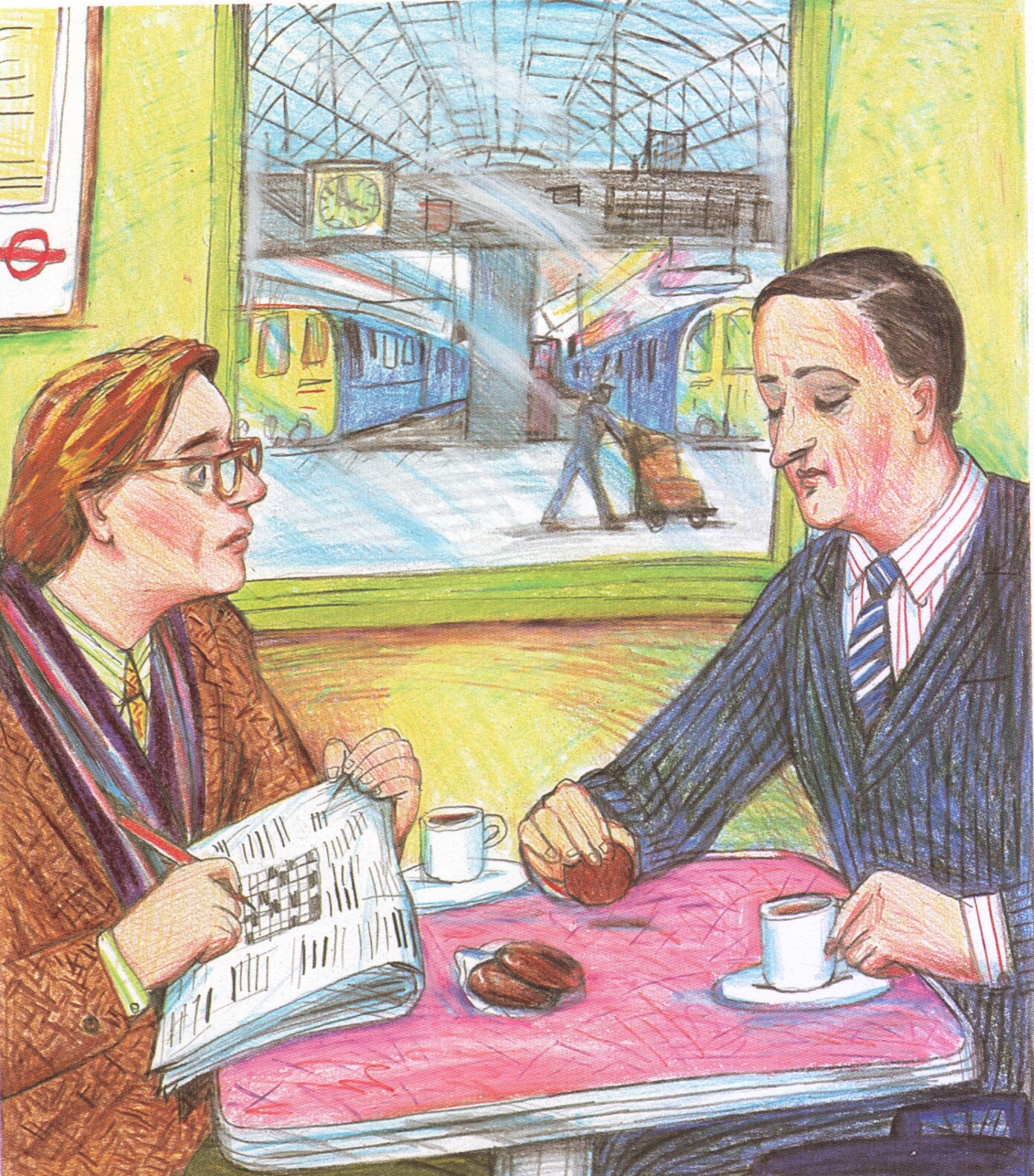
A Funny Thing Happened To Me: Streamline English Destinations, Unit 10

This reminds me of  A Funny Thing Happened To Me, a story I wrote with Bernie Hartley  in 1980 for Streamline Destinations. Five years later Jeffrey Archer used the same story in A Quiver Full of Arrows. Someone then accused us of lifting it, and we were appalled. Not so much at the idea of having lifted it, but from the idea of lifting it from Jeffrey Archer. In fact we all took the basic story from Woody Allen. Bernie and I changed Woody Allen’s ‘s mistakenly purloined cigarettes on a train to mistakenly purloined biscuits in a station café. Archer didn’t take as much trouble and wrote it just as Woody had told it.

Language viruses continued. After years being irritated by the previous government mantra of “Let’s move on …” (see below), we find that the Coalition has abandoned the catch phrase, but sadly replaced it with an equally irritating one. “End of story.”

It’s used to say, “You’ve been told my view. That’s it. I’m too important to answer further questions or to listen to any counter-argument whatsoever.”  One particularly arrogant twerp of a minister at the Conservative party conference managed to say it three times to the BBC interviewer within a couple of minutes. I’ve heard it three times since from ministers, most recently this morning.

It’s different to “Let’s move on.” That’s oily, and obnoxious, casting the questioner as someone who won’t let go of a point that has come to bore everyone else. “End of story” is just plain arrogant.

ADDITION:

Last night “Have I Got News For You” had a clip of the new Children’s Minister avoiding an interview in a corridor. This guy couldn’t even be bothered to complete the phrase. He just snapped “End of.” at the interviewer four times in thirty seconds.

Translations

R.I.P. Norman Wisdom, died aged 95. To his surprise, this comedian found himself an icon in Albania in his declining years. Apparently his movies were the only Western films shown during the communist era.

Anyway, on Radio Two, they told a story to mark his departure. A few years ago, the European parliament was debating regional food names, like Parmesan cheese, Brunswick ham,  Bakewell tart, Cornish pasties and so on. The debate turned to Normandy butter. The French delegate spoke at length, saying issues would be resolved by the natural common-sense of the farmers of Normandy. At this point, the British delegation were crying with laughter. The simultaneous translation through their headphones was “All problems will be solved by Norman Wisdom.”

As an author, greetings cards make me seethe with resentment. You can only get £7.99 retail for a 400 page paperback with a beautifully illustrated glossy cover. If you take out and discard the 400 pages of text, and print a few trite words on the inside of the remaining glossy cover, you have the equivalent of a greetings card and can charge £2.99 for it.

65% of greetings cards are bought by women. If I look at my birthday cards in any given year, nearly all are from female relatives and friends. The guys don’t send them. Fair enough, I don’t send them cards either. If you hear a cry of “Great! Look! A card shop!” in the High Street, the chances are it will be soprano rather than baritone. The behaviour of women and men in a card shop is different too. If you stand in one for any length of time, you observe that those quietly browsing are female, while the odd male darts in, looks, chooses, pays, and is out in two minutes. There is a serious discrepancy in communication here. You can bet that the woman who spends fifteen minutes agonizing over the right wording and picture for someone, will apply a similarly searching analysis on the cards she receives. A woman might say, ‘That’s the nicest card I’ve seen in years!’ Her male companion’s reply will be, ‘Great! Buy five. You can send one for the next five birthdays.’ Oh, dear. It doesn’t work like that.

Those silk padded A3 sized greetings cards in a box, with pink teddy bears, cute puppies, or hearts on them are bought by males, in the mistaken belief that high price will outweigh lack of appropriacy or forethought. Late-night petrol service stations do a good trade in them, as well as in those apology-gesture cut flowers, delivered daily from Holland in massive articulated trucks. Once I was looking for a CD for my sister’s birthday in a large record store, and selected her the new Norah Jones as well as a copy for myself. The sales assistant, who knew me, asked why I wanted two copies. I said one was a birthday present and he whistled in dismay, ‘You can’t give it as a birthday present. It’s in the top twenty!’ he said. He went on to explain that any CDs or DVDs that are in the Top Twenty, as gifts, look as if they’re a last minute panic buy, in a supermarket or motorway services shop. I bought a Windham Hill piano selection instead.

Man + Greetings Cards

Women buy cards for future possible use, and have a selection at home to choose from. Men buy them the day before they’re needed. I often spend time waiting in card shops, and like the other males, I gravitate to the humour section. I enjoy the ever changing selections. Just this week I laughed out loud at the retro painting of Goldilocks staring into her bowl of porridge with the speech bubble, ‘I hope it’s organic!’ Next to it was a truculent retro baby bear staring at his porridge bowl with ‘Oh, no! I wanted Shreddies!’I can cheerfully spend ten minutes looking at the jokes, surprising myself at the ever-increasing crudity. The F-word first appeared on displays several years ago. Recently, you can find both “Happy birthday, C***!’ and ‘Happy birthday, you c***!’ which would have had a shop owner arrested twenty years ago as obscene publications. (There’s an interesting little punctuation point in why the first has a capital C.)

I was in a small card shop with a superb and original collection recently, and asked how many cards in the humour selection actually sold. The shop owner smiled, ‘Oh, we sell quite a lot. The very crude ones are chosen for people in the same workplace most often, but really the purpose of the humour section is to keep men quietly occupied whilst their female companions browse and buy lots of cards.’

How confusing. As a music fan, I have records by The Glenn Miller Band, The Steve Miller Band and The Frankie Miller Band. Now we have The Ed Miller Band as leader of the Labour Party. Perhaps he was chosen in preference to his brother, The David Miller Band, because the media couldn’t take having David Cameron and David Miller Band having a debate where they cross-called each other David non-stop.

Language viruses

Language viruses, catch-phrases and set expressions, travel like lightning. In the last few days, listening to candidates for the leaders of the Labour party speaking on TV and radio, the one you hear again and again is “Let’s move on.”

This was used frequently during the Northern Ireland peace talks, and with good reason, but was appropriated by Tony Blair who turned it into a politician’s mantra. He must have said it so many times at cabinet meetings that Gordon Brown kept repeating it in the 2010 election, and now the Milliband brothers and Ed Balls are displaying the same addiction to the phrase. It has spread to business leaders in interviews too.

‘Let’s move on’ is not simply ‘Let’s change the subject’ (though that’s what it means). ‘Let’s move on’ has nuances. It’s used in this way. An interviewer has just presented an unanswerable piece of folly to the politician / business leader. e.g. What about the time you started a war based on fraudulent information / wrecked the economy / polluted the entire Gulf of Mexico /  were found in a compromising situation with a person (or creature) you should not have been with?

The politician pauses, then says in a very adult patronising tone, ‘Let’s move on!’ It has to be said in such a way that we see the questioner as irritating, flogging a dead horse, being like a dog with a bone, while the forward-thinking politician wishes to move us to the more positive future, casting aside all negativity.

Blair was the most annoying user, substituting ‘Let’s move on!’ for things he might have said like ‘Yes, I know. I’m truly sorry.’ Ed Balls used it on Radio Four this morning. Ed Balls is a man whose courage is undeniable., Anyone with the surname ‘Balls’ who takes on the job of minister for education, thus having himself announced to halls full of teenagers on a weekly basis as ‘Mr Balls’, needs bravery, or a very thick skin. There was a kid called ‘Balls’ in my class at school. From the first day he was known as ‘Bollocks’ even to the point where teachers used it too, having picked it up on the football field. ‘Bollocks! Over here, pass it to me …’ After seven years the boy had got used to it. Anyway, Mr Balls presented an economic argument. The interviewer picked holes in. He couldn’t think of a decent answer, so ‘Let’s move on.’ It collocates with ‘Well …’ or ‘Anyway …’

The signs are that the phrase has entered phase two of a language virus. I’ve heard it used ironically in the last few weeks. One example was a wife berating her husband at a dinner party (in a joking way) for always leaving the toilet seat up. His reply was, ‘Yes. (pause) Well, Let’s move on!’ We’ve started using it within the family as the response to any verbal criticism.

‘You didn’t put the butter in the fridge last night!’

‘Yes. Well, let’s move on!’

It replaces the old catch-phrase, ‘There’s no answer to that!’

POSTSCRIPT: Someone pointed out that the three male candidates, David Milliband, Ed Milliband and Ed Balls are on radio / TV all the time, while the fourth candidate, Diane Abbott is rarely seen. It was suggested that this was because she was black and female. The correct reason, according to the politically savvy, is that the other three all went to Oxford (just like David Cameron, William Hague, George Osborne, Tony Blair, Margaret Thatcher, Edward Heath, Harold Wilson, Harold Macmillan, Hugh Gaitskell, Clement Attlee …) and she went to Cambridge (like Nicholas Clegg).

Oxford’s domination of political leadership was illustrated in the sitcom “Yes, Minister.” The minister is in a car going to Oxford and says it’s curious that there are two motorways, the M4 and M40, going close to Oxford, but not one going to Cambridge (At the time the M11 hadn’t been built). The civil servant, Sir Humphrey, explains gently that the Ministry of Tansport has always been dominated by Oxford graduates.

In decorating a room, my adventures with Monty Pythonesque salesmen (I know I should say ‘salespersons’, but all the ones this week were indeed men) continue. Yesterday was the carpet store, or rather warehouse.

Salesman:  Can I help you?
Me:  No, thanks, just looking.
Salesman: (oblivious to brush off) What are you looking for?
Me:  A natural fibre carpet, probably wool.
Salesman:  You want polypropelene.
Me:  No, I’m looking for wool. Which section are they in?
Salesman:   All our polypropelene is natural.
Me:  Natural polypropelene?
Salesman:  Yes. It’s all natural.
Me:  It’s for a kids’ room. I don’t want the emissions from artificial fibres.
Salesman:  Ah, polypropelene’s better then. Wool emits a lot of noxious stuff.
Me:  I don’t like artificial fibres. There’s the static electricity too.
Salesmen:  Wool’s worse for static.
Me: (sarcastically)  Is it really?  OK, but I wanted wool.
Salesman:  You’d be better with polypropelene.
Me:  Do you actually sell wool carpets?
Salesman:  Well, we’ve got some. But polypropelene’s better.
Me:  Where are the wool carpets?
Salesman:  We actually haven’t got that many here at the moment, because everyone prefers polypropelene.

Exit me, stage left. Ah, well. Today will be the lighting shop.