
The Deep Blue Sea – BBC, 1994
By Terence Rattigan
Directed by Karel Reisz
‘Performance’ Series, Broadcast 12th November 1994
Based on an earlier Almeida Theatre production
CAST
Carmel McSharry- Mrs Elton
Stephen Tompkinson – Philip Welch
Geraldine Somerville – Ann Welch
Penelope Wilton – Hester Collyer
Wojchich Pszoniak – Mr Miller
Ian Holm – Sir William Collyer
Colin Firth – Freddie Page
Edward Tudor-Pole- Jackie Jackson
This is the fourth Deep Blue Sea review in a short time. When the National Theatre production was streamed during Covid, I did a long heavily illustrated step-by-step review, which I do for films rather than plays (being able to access screenshots). There is also a detailed review of Chichester 2019. It seems pointless to repeat that exercise, so if you really want to know about the play rather than this production of it, see:
The Deep Blue Sea by Terence Rattigan, Chichester Minerva, 2019
The Deep Blue Sea by Terence Rattigan, National 2016, NT Live 2020
Having done three recent reviews I’ve covered the background, Rattigan’s personal loss to a suicide, his instant thought that news of his ex-lover’s death was an inspiration to write a play, that the reality was homosexual, but he wrote it as heterosexual and so on.
We also have tickets to see it in Bath in 2024. I’m going to quote reviews here because the Almeida 1993 production which this grew out of, is regarded as so important that they have survived online. Karel Reisz directed both the Almeida and the BBC and they both centre on Penelope Wilton as Hester Collyer. Wojtek Pszoniak plays Mr Miller in both versions, and Edward Tudor-Pole plays Jackie Jackson. Otherwise the BBC production was recast, and as so often happens, with more famous actors. We used to go to Southampton’s Nuffield in its 1970s glory days, and several award-winning productions moved to the West End. Inevitably the ‘lead’ was replaced by a bigger name (which happened to my cousin David Tysall in The Hired Man.) On the other hand, the attraction of casting Ian Holm and Colin Firth is very large indeed.
The esteemed Michael Billington chooses it as one of his 101 Greatest Plays. It’s this production in its Almeida 1993 version that he cites:
It was Karel Reisz’s 1993 production at the Almeida, starring a luminous Penelope Wilton, that brought home to me two important factors: Rattigan’s ability to encapsulate the mood of post-war England and his capacity to generate overwhelming motion through verbal restraint … at the same time it reminded me that the emotional inarticulacy that Rattigan saw as the English vice was also his most powerful dramatic weapon.
Michael Billington 101 Greatest Plays
He added:
With its mix of sensuality and intelligence, (Penelope Wilton’s) portrayal of Hester Collyer at London’s Almeida in 1993 towers above all others … Great acting is always about exploring a character’s contradictions. Wilton’s Hester was painfully aware of the humiliating cost of her fixation with a lover who could never satisfy her emotional demands. At the same time, she readily succumbed to the delusion of a reciprocated passion. She had, of course, Rattigan to thank for writing one of 20th-century theatre’s best parts for a woman. But in Wilton, with her mix of sensuality and intelligence, the role found its ideal interpreter.
The Guardian 25 May 2015
Billington also points out the grey green transparent walls of the set showing the stairs to the other apartments with people moving up and down. Was this the first? They don’t use it in the TV version, but go for realistic, and cut to the corridor and stairs outside. It’s not just a filmed play. On the other hand, they insert Act numbers.
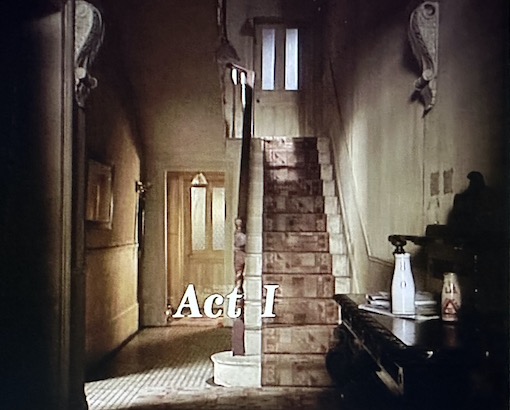
The main set is fixed. You need a shabby London flat. You need a prominent gas fire. It needs to light too. You need a display of unframed paintings on easels. You need a wardrobe and a sofa. Set designers since 1993 like to shove stairs in the background to show the way to the other flats, but you can do without that. ‘Grotty Ladbroke Grove flat 1952’ doesn’t leave a lot of room for variation.
Rattigan was deliberately ‘contemporary’ in most plays. That resonated when they were fresh-minted, but it also means they can’t be moved far out of their time setting. It was written in 1952. Deep Blue Sea has to be shortly after World War II with ex-aircrew who can’t settle to civilian life. They came of age flying Spitfires and Hurricanes. They were the young men of 1940, but it’s not 1940 anymore … inability to escape your heydays is a Rattigan theme if ever there was one, see After The Dance.
Hester Collyer was the role that women actors wanted to play at the right age, and still is. When you look back at productions, you think of “the Penelope Wilton or the Nancy Carroll or the Greta Saatchi.” Just as you think of the Schofield Lear or The McKellen Lear, or the Russell Beale Lear. That’s how important the role is.
Penelope Wilton is the perfect Hester Collyer. She is a vicar’s daughter, married to a judge and she has run off with a younger pilot. She has to be well brought up, polite, sensible, but reveals strong passion, and emotion that he can’t satisfy. It’s enough for her to attempt suicide. This TV play came after her sitcom run in Ever Decreasing Circles (1984 to 1989). Nowadays she is forever associated with Mrs Crawley in Downton Abbey. Billington wasn’t the only one impressed with her. Paul Taylor compares it to her then recent role in Andromache:
The emotion is much more clenched and ‘well- bred’ in the Rattigan, but in both roles Wilton excels at portraying a woman who can stare with appalled (almost comic) clarity at the humiliating cost of her fixation and then stubbornly snap back to deluding herself.
Paul Taylor, The Independent 14 January 1993
The young couple, the Welchs are both good. Stephen Tompkinson plays Philip, the junior civil servant offering unwanted romantic advice. Geraldine Somerville plays the nosey Ann. While I never met him, Stephen Tompkinson was the narrator in the three adaptations of Wallace and Gromit we did, so his voice is extremely familiar. (We needed a narrator to make it into an ELT teaching video.) They ply the discovery of the gas and Hester on the floor beautifully. I loved the way Ann speaks as if to a simpleton:
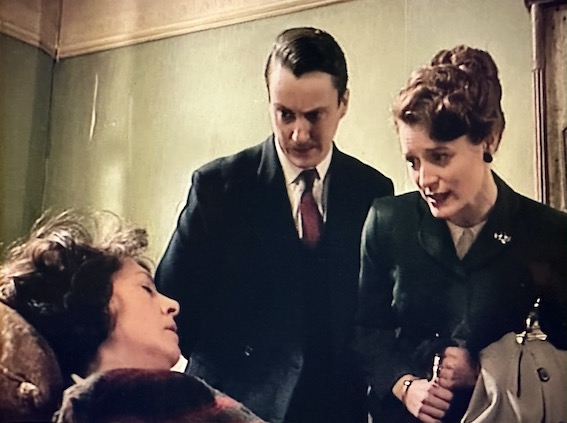
Anne: Don’t worry, Mrs Page. You mustn’t worry. You’re among friends …
Mrs Elton is a classic short rotund cheerful lovable landlady. Here she’s looking at Hester’s paintings and pointing out how long the rent is overdue.
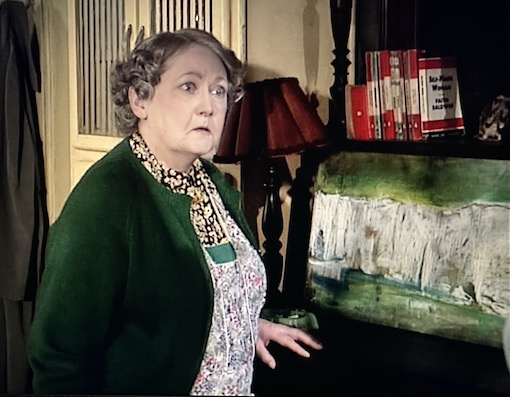
Mrs Elton: How much would you get for a thing like that?
Hester: Well- for the two, I’m asking twenty-five pounds.
Mrs Elton: Are you, really? Well, I never.
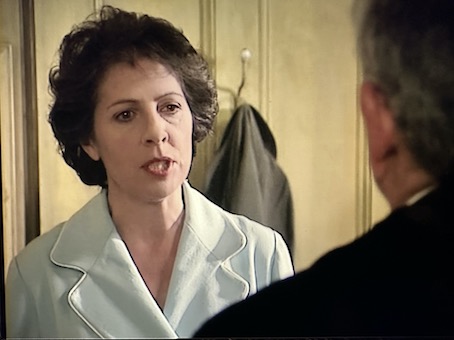
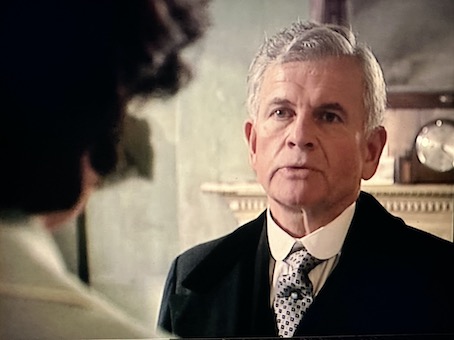
Hester Collyer and Sir William Collyer
Ian Holm, as Sir William Collyer had been the lead in in BBC’s The Browning Version in 1985. He is an addition after the Almeida version, replacing Nicholas Jones. He is a powerful presence in any play. Here he is shorter than Hester. He is also impeccably formally dressed, which a judge should be. He is fiercer than most in the part, absolutely furious in the first scene, with a clear impetus to bottle up the emotions while still letting steam escape.
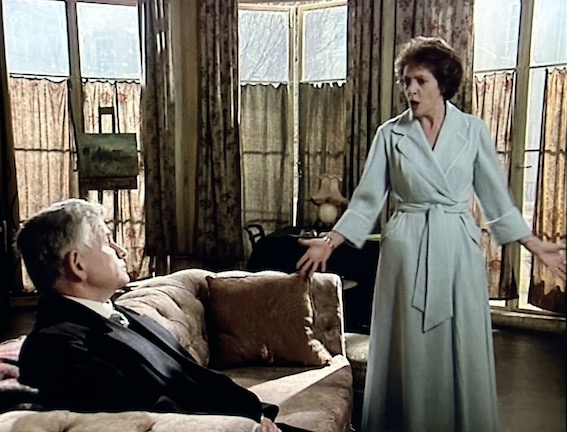
Hester: Bill, I am not in the witness box. You’ll never get me to confess!
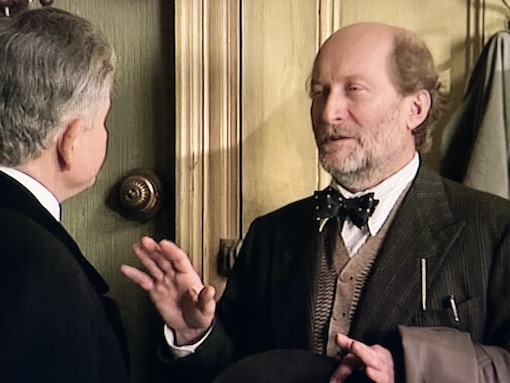
The puzzling one is Mr Miller, the struck off doctor. Part of the interest throughout is guessing what he did to be struck off. The first time you see it, you’re hoping it will be revealed. It isn’t. Rattigan hinted at homosexuality, but while illegal then, that would have been an offence, but have nothing to do with medicine (unless it were a patient, I guess). I always though abortion more likely. Then there were wartime hints. Well, they eradicated most of it here
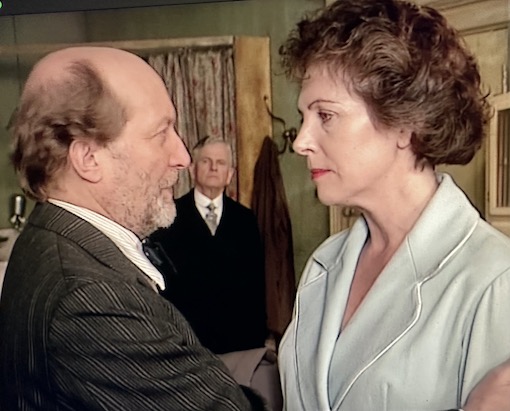
1) Miller: You should live to a ripe old age.
Hester: Barring accidents, of course.
2) Sir William: I only ask, because a qualified doctor,
in a case of this rather delicate kind, is strictly bound by a certain code.
Miller: You mean … No sneaking?
As elsewhere, Miller lose a lot of lines here, about the English schoolboy code and that he’s been in England since 1938 and spent a year on the Isle of Man. All cut. It’s a pity. You grow to like his manner.
More crucially, we lost Mrs Elton’s description of him working at a hospital for children in his free time. Then, what with being interned and called Müller, he’s meant to be German. Not here, and he has an odd accent. Without seeing the cast list, I’d guessed ‘something like Polish’ though I know a good few Poles and it’s not a standard Polish accent to me. His name is Polish. He brings a wry reflection to the proceedings. It’s an important part, and he gets the balance right. We have seen the character veer towards comedy too much, or potential horror film weirdo too much.
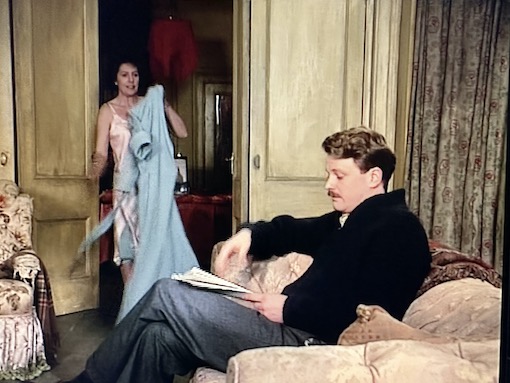
Colin Firth plays the ex-pilot, Freddie. He wasn’t a major star then, and wasn’t in the Almeida version the year before. He was cast for the TV play and it’s written in that he has to be extremely handsome, and a drunk, and immature, unable to let go of his war hero much-decorated glory days. He looks and sounds just right. This is was filmed the year before his Mr Darcy in Pride and Prejudice enlivened A level English for so many girls.
As I put the pictures in, and check the text, there are a lot of minor cuts. Jackie Jackson? A little too upper class twit for me, but I suppose that’s what RAF pilots were like. His role is reacting and it’s first rate reacting to Freddie’s narcissistic “It’s all about ME” speech.
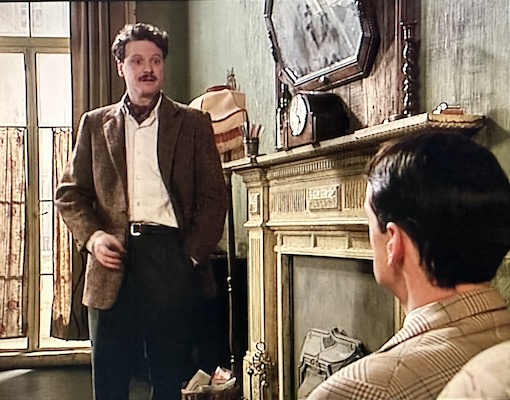
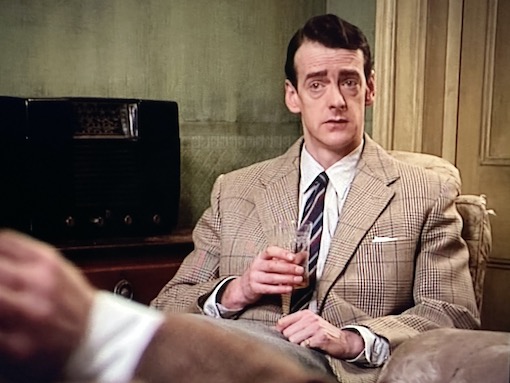
Freddie: After I read that letter … I just did a bunk. I had to have a drink quick.
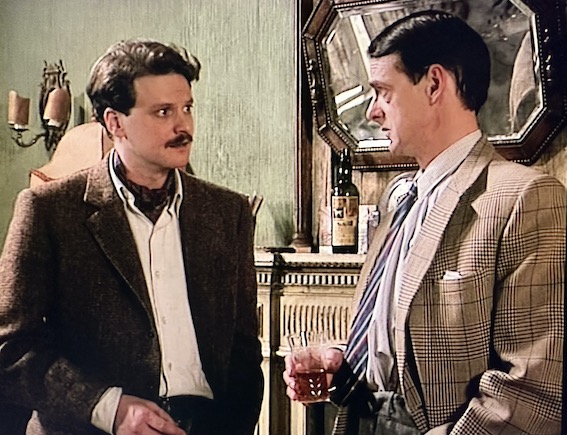
Freddie: This would have been front-page stuff. All over the News of The World.
And this ruddy letter read out in court!
The long scene in Act Two when Sir William arrives to collect the painting is marvellous from Ian Holm and Penelope Wilton. The facial expressions from both are a masterclass before you even consider the line delivery. This is where a filmed version scores, because we have tight close ups. You’re not going to notice the detail in the cheap seats in a West End theatre.

They are discussing how the affair with Freddie started at Sunningdale, and how Hester tried to avoid going back there, and kept away for two months. Then the loaded question:
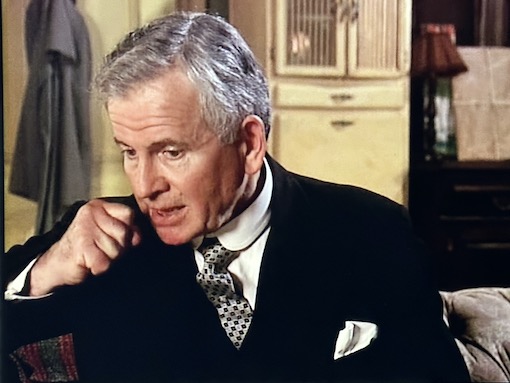
Sir William: When? Exactly …
Then you get Freddie’s return and another full-on impassioned scene:
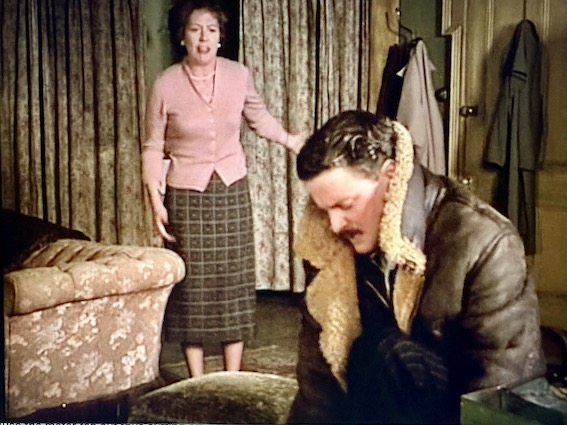
And Act III…
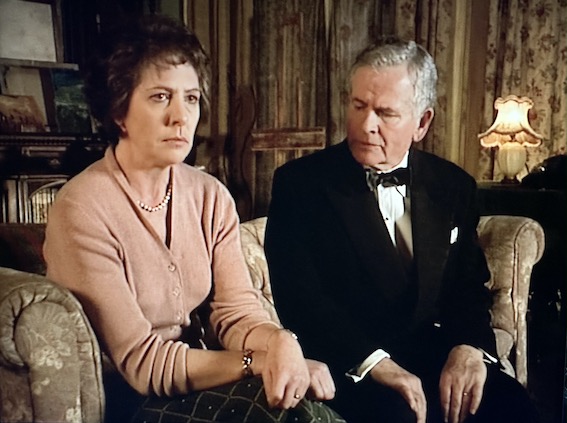
It’s a Rattigan trait to give lines that teeter on the edge between comedy and tragedy. as when Philip Welch returns to collect Freddie’s things. The clumsy attempt to show empathy is actually funny, yet she calmly listens to it.
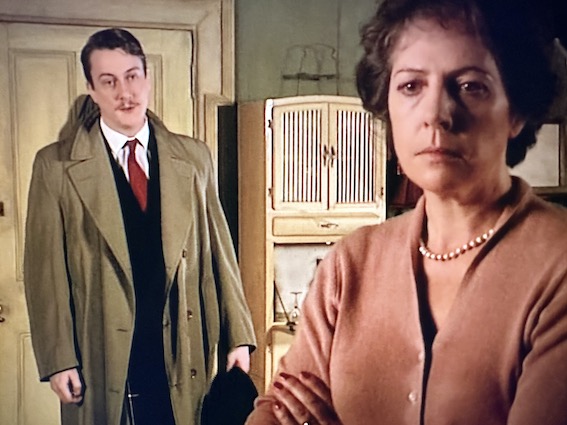
Philip: I’ve been in love too, you know. In fact about a year ago I nearly had a bust up in my marriage …
You note the angles on Hester. The camera loves her.
The star of the play is that shilling. Her suicide attempt failed because the meter ran out thus cutting off the gas. We had a meter in a bungalow in Norwich when I was a student. Musician friends were playing the university and stayed overnight on the living room floor. I warned them to switch off the gas fire. They didn’t which used up the shillings worth of gas. Fortunately I woke to the noise of my co-resident cooking his breakfast on the gas cooker with the radio on. The smell of gas was massive. He had put a shilling in the meter and fortunately I rushed in, switched off the gas and opened the windows, saving three future major careers. Had one woken and lit a cigarette the lot of us would have gone.
In the play when Freddie leaves the flat earlier he throws a shilling for the gas onto the hearth (here, sometimes the table) … implying she could do it properly next time. We see her put a rug under the door and pick up the tablets. This works well because we cut to him on the stairs seeing the light from under the door suddenly obscured so he knocks on the door. Miller is very good with his vehement and strong telling her that Freddie is never coming back to her.
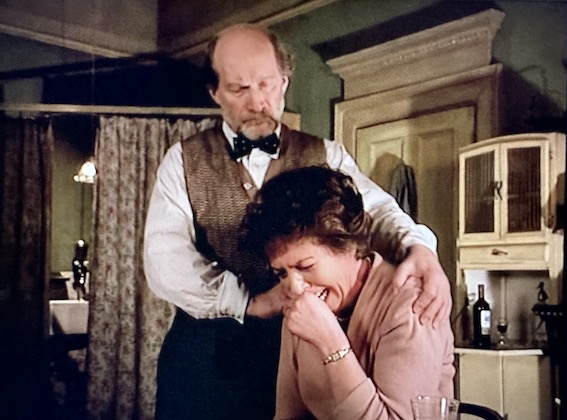
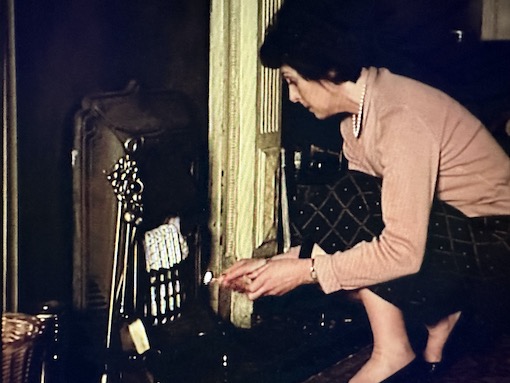
At the end she puts the shilling in the meter, turns it on. Pause. Then lights the fire… great ending, and we didn’t need to her to get up and start hugging and sniffing Freddie’s clothes to elongate it. I’m not sure I liked the sequence of her picking up the matches, pausing and bending to the fire. I’d reverse those two by having the matches on a low table.
Because the play is fixed in time and set, and because we’ve seen it several times (add Greta Saachi and Penelope Keith) there is a lack of tension. Still, it allows us to admire performance in detail. Is it the best? I can’t judge. I found Chichester 2019 more powerful (Nancy Carroll) but then that was live theatre on the Minerva’s intimate stage. A performance on DVD can’t compete, then that’s how it should be.
- TERENCE RATTIGAN
After The Dance by Terence Rattigan, BBC TV play 1992
All On Her Own by Terence Rattigan, Kenneth Branagh Company 2015
Flare Path, by Terence Rattigan, 2015 Tour, at Salisbury Playhouse
Harlequinade by Terence Rattigan, Kenneth Branagh Company 2015
Man & Boy, by Terence Rattigan,National Theatre 2026
Ross by Terence Rattigan, Chichester Festival Theatre 2016
Separate Tables by Terence Rattigan, Salisbury Playhouse 2014
Separate Tables, by Terence Rattigan, BBC TV version 1970
Separate Tables by Terence Rattigan (Table Number 7, Summer 1954) Bath 2024
Summer 1954 by Terence Rattigan (Table Number 7 / The Browning Version), Bath 2024
While The Sun Shines by Terence Rattigan, Bath, 2016
French Without Tears, by Terence Rattigan, English Touring Theatre 2016
French Without Tears, by Terence Rattigan, BBC Play of The Month 1976
The Deep Blue Sea by Terence Rattigan (FILM VERSION)
The Deep Blue Sea by Terence Rattigan, BBC TV Play, 1994
The Deep Blue Sea, by Terence Rattigan, Chichester Minerva, 2019
The Deep Blue Sea, by Terence Rattigan, National 2016, NT Live 2020
The Deep Blue Sea, by Terence Rattigan, Bath Ustinov 2024
The Winslow Boy, by Terence Rattigan, BBC Play of The Month, 1977
The Browning Version, by Terence Rattigan, BBC TV play 1985
The Browning Version by Terence Rattigan (as Summer 1954), Bath 2024
IAN HOLM
The Bofors Gun (film)
The Browning Version, by Terence Rattigan, BBC TV play 1985
PENELOPE WILTON
Operation Mincemeat (FILM)
Downton Abbey (film)
COLIN FIRTH
Operation Mincemeat (FILM)
Mothering Sunday (FILM)
The Secret Garden (FILM)
1917 (FILM)
The Railway Man (FILM)
Gambit (FILM)
Tinker, Tailor, Soldier, Spy (FILM)
 Peter Viney's Blog
I’d never seen any version of this play before tonight. Surely it has been noted before that Hester Collyer and her husband were childless (he brings this up with her), wondering if it would have made any difference. And when she’s with Page, it seems unmistakable to me that she mothers her younger lover, that she needs to be needed rather than being the recipient of the judge’s rescuing. The judge asks Hester what reason, other than love, could have prompted him to marry her in the first place.
LikeLike