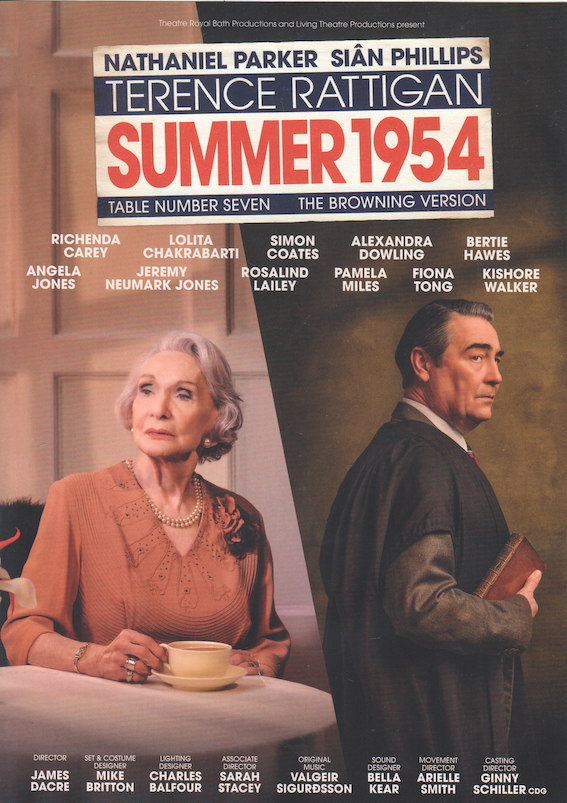
Table Number Seven / The Browning Version
By Terence Rattigan
Directed by James Dacre
Designed by Mike Britton
Music by Valgeir Sigurdsson
Bath Theatre Royal Production
Bath Theatre Royal
Saturday 26th October 2024 14.30
CAST
TABLE NUMBER SEVEN
Nathaniel Parker- Major Pollock
Siân Phillips- Mrs Railton-Bell
Alexandra Dowling- Sibyl Railton-Bell
Lolita Chakrabarti- Miss Cooper, hotel manager
Jeremy Neumark Jones – Charles StrattonAngela Jones – Jean Stratton UNDERSTUDY Rosalind Lailey
Simon Coates – Mr Fowler, retired teacher
Richenda Carey- Miss Meecham
Pamela Miles- Lady MathesonRosalind Lailey – Doreen, waitress UNDERSTUDYING
Fiona Tong- Mabel, waitress
ClaireCarpenter- diner
Hugh Osborne- diner
Bertie Hawes – Joe, servant
THE BROWNING VERSION
Nathaniel Parker- Andrew Crocker Harris
Lolita Chakrabarti – Millie Crocker Harris
Jeremy Neumark Jones – Frank Hunter
Simon Coates – Dr Frobisher, the headmaster
Kishore Walker – Peter Gilbert
Rosalind Lailey – Mrs Gilbert
Bertie Hawes – John Taplow, a pupil
Rattigan as usual filled our Saturday afternoon matinee at Bath. I used to think his appeal was to an older audience who remembered his heyday, but not so. His heyday was before my time, and in the 60s and 70s he was’t even mentioned on drama courses. So his enduring appeal is not just nostalgia.
Two Rattigan One Act Plays, both set in 1954, though Table Number Seven is properly twinned with Table By The Window in Separate Tables. Rattigan’s idea was that the same cast would be in both, or rather that the lead couple changed their roles but the hotel residents surrounding them remained the same.
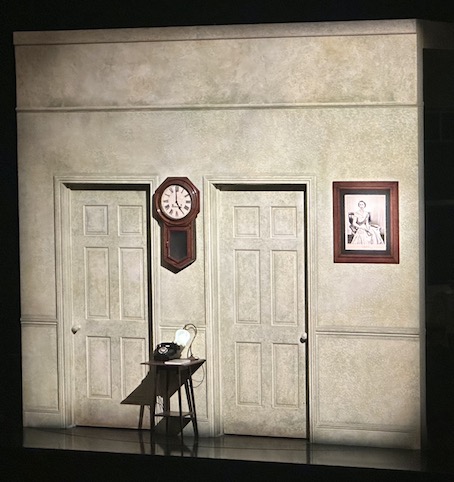
Table Number seven
Separate Tables is probably my favourite Rattigan play. It’s set at The Beauregard Hotel, Bournemouth. As in other reviews, Rattigan knew Bournemouth. He knew enough to know that the Norfolk Hotel used to be famed as a gay rendezvous. Studland Road, less than a mile from us is an in-joke. Studland beach is the nude beach across the bay (and it’s 90% plus male), and ‘Stud’ – Geddit? However in the play Bournemouth has ‘an esplanade’. No, it doesn’t. Along the beach, it has the Promenade. I wonder why he changed that?
The BBC TV version (1970) is the heterosexual one Rattigan was made to switch too. The Salisbury 2014 stage version was the banned homosexual original (and later revised) draft, which has been the default version since a 2006 Manchester production, and is followed here.
In the play, Major Pollock (Nathaniel Parker) has been living in the hotel for four years. In the 1950s, residential hotels often acted as a logical place of residence for single people. Housing was in short supply. Small flats were not common until the 1960s. It was cheaper to have bed and board in a small hotel. They were also fairly formal for the classes that could afford them. The play is about guilt and forgiveness, and what actually constituted a crime. Homosexuality was illegal until 1967. Major Pollock was caught between 11 pm and 1 am asking a series of young men for a light, and was found when arrested to have a working lighter. The play was 1954. In the autumn of 1953, John Gielgud had been arrested for the same offence of ‘persistently importuning men for immoral purposes.’ Rattigan and Gielgud knew each other well.
Major Pollock’s offence was reported in the weekly paper. He was also not a Major in the elite Black Watch infantry, but a lieutenant in the Royal Army Service Corps. He is terrified the other residents will find out. They do, and Mrs Railton-Bell starts a campaign to have him instantly evicted. The problem is that Sibyl, her daughter, has befriended the Major and is distraught at the news. The question is, the court has made its judgement (bound over to keep the peace) so do others have any right to add their own level of social punishment? Mrs Cooper (Lolita Chakrabarti) declines to expel him and persuades him to stay. One by one, the others come to defend him. From my review of the 1970 TV play:
As Rattigan has said, the play is about loneliness. They’re all alone. It’s a hotel full of single people. Mr Fowler hopes ex-pupils will visit him, invites them and waits for trains that never arrive. Pollock commits the offences because he is so alone he can only relate sexually to complete strangers in the dark (in both versions!) Sybil was home-schooled, only allowed to work for a very a short time and now is alone. No one to relate to. It is a great play.
There is a revolve stage starting in the dining room which revolves as characters walk into the sitting room, which a hotel in 1954 would call the lounge. This looks good, though initial lines are muffled as the moving revolve obscure faces. It’s not strictly necessary either. Rattigan’s original idea was that that the lead couple changed roles completely, but the hotel residents surrounding them remained the same. In Table By the Window, the lead roles are a politician (John) and his ex-wife (Anne). In Table Number Seven the lead roles are Major Pollock and Sybil, the put-upon and repressed daughter of Mrs Railton-Bell. The production here has a few bits from the first play to set the mood, but I felt it loses in not having set up the characters of the residents so clearly in the first play. Mrs Cooper as the hotel manager is enhanced by her role in the first play, and I missed that.
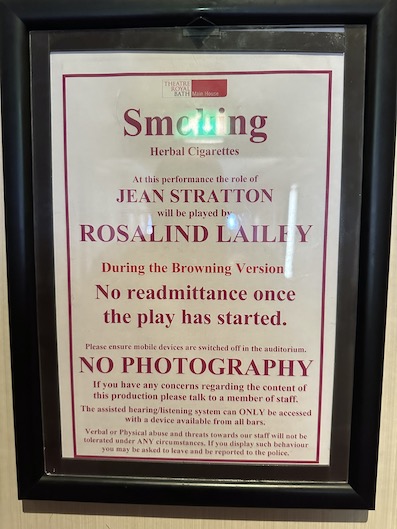
In the 1970 BBC TV play, and in 2014 at Salisbury, the waitress was Doreen (my mum’s name and she left Wales age fifteen to work in Bournemouth hotels as did her two sisters and her female cousins). Apparently the original 1954 production had Mabel, as here. Ah, but the cast list has Doreen and Mabel, and Rosalind Lailey (Doreen) was understudying and playing Jean Stratton, the young mother. The notice on the doors in confused and confusing. It looks as if it’s ‘during the Browning Version’ while they mean ‘No re-admittance once the play has started’ in The Browning Version. That certainly did not apply to Table Number Seven where the first ten minutes had at least three noisy interruptions as latecomers were shown to side seats.
I will add pedantically that Mabel’s Mummerset accent is unlikely. I was born in Bournemouth, so was my father. First, Bournemouth locals had a Hampshire accent, not a Dorset South-West one. You could tell Poole people (Dorset) from Bournemouth people (Hampshire until 1972) instantly by the accent. The road half a mile from my house marks the South-West / South Central and East accent boundary. A non-local accent is likely … hundreds of Welsh girls were sent there in the 1930s. At school, my friends’ parents were from all over the country, and second-generation Bournemouth (me) was rare.
I don’t have the text, infuriatingly, so can’t track the other names. In this, the police stooge who lures the Major and then reports him to the police, is called George Osborne. Was the 1954 Rattigan prescient that in 1956 John Osborne’s Look Back In Anger was going to take away his audience (well, until the 1980s)? Or was this a change when he revised it?
It’s hard to believe that Siân Phillips who commands the stage with beautiful projection is ninety-one. Alexandra Dowling who plays Sibyl is thirty-four and looks younger. In other words ‘daughter’ stretches our belief. Granddaughter perhaps. I reckon Rattigan intended mid-70s for Mrs Railton-Bell, and about forty for Sibyl.
I found it difficult to judge, as the 2014 version was so very good as was the TV play. This is not quite in the same class and I felt it slightly pedestrian.It wins because the acting is good and the lines say it all anyway, but the direction was unexciting to us.
***
The Browning Version

Siân Phillips is not in this one, so the theme of two actors playing different roles in one act plays is lost. They use the revolve as James Taplow, the Lower Fifth pupil, enters the set, but then the back half is redundant for the rest. There is one brief point where it revolves half way so Hunter and Millie can stand ‘outside’ for a cigarette. Both had to squeeze through the narrow gap between the desk and French window. I don’t think anyone would have placed a desk there. I thought the set dull and weak for a public school study, but you can’t erect the requisite crammed bookshelves in a twenty minute interval, so I thought the compromise of using the same basic sets with different moveable furniture undermined this second play.
BATH NOTE:
A long-serving Classics teacher is on the verge of retirement from his distinguished public school. Diminished by poor health, a crumbling marriage, the distain of his colleagues and the derision of his pupils, he is given cause to re-examine his life when a young student offers an unexpected gesture of kindness.
Mr Crocker-Harris is the classics master forced to leave the public school because of heart problems. He is due to go instead to a ‘crammer for backward boys’ in Dorset. I thought that would be a harder task. The play references Aesychlus’ Agamemnon in that the Greek play has the unfaithful wife and lover plotting to kill the hero. That doesn’t happen, but we have the unfaithful wife, Millie, and the younger lover, Frank Hunter, a science teacher. A science teacher who can’t read Greek. In Rattigan’s world of 1954 that indicates he did not attend public school. Millie is from Bradford and makes extravagant claims about her wealthy family. Casting Lolita Chakrabarti, an actor of Asian ethnicity, does make Bradford more likely than Rattigan would have intended.
The play is unbearably poignant around the outstanding performance by Nathaniel Parker. Crocker-Harris was never a popular teacher. The headmaster (Simon Coates) makes it clear that after eighteen years, Crocker-Harris will not qualify for a pension, though a pension was awarded to an injured sports master of much less service. The headmaster had assumed they had independent means, but Crocker-Harris admits his wife has £300 a year, and the new job will pay £200. In 2024 money, that’s £17,155 a year so below a living wage, though the job will provide board and lodging, but only for eight months a year.
Not only that, he must defer his retirement speech and speak before a more popular teacher who is much younger and who has been at the school for less time. Simon Coates presents the headmaster as a corporate slime. To rub salt in the wound, the Crocker-Harrises must show Mr and Mrs Gilbert, the incoming newly married teacher and his wife, around their flat. The key speech is in the scene where Crocker-Harris explains his teaching history to Peter Gilbert.
Taplow is having private lessons in Greek from Crocker-Harris, and presents him with a copy of the Browning Version of The Agamemnon. Hunter is touched by the inscription, but Millie dismisses it simply as a boy currying favour. This is incredibly hurtful, and her cruelty leads Hunter to break with her entirely. He discovers he’s in a long line of younger teachers who had affairs with her.
It’s beautifully performed. I will comment that Taplow projects loud and clear when mimicking his teacher, but doesn’t project enough as Taplow and goes too fast. This seems almost universally true of younger cast members compared to older ones. Speak up! Watch the others.
The set lets it down somewhat. The power of the text surmounts that. Nathaniel Parker is five star. We’re in the first week of a tour. Both plays should loosen up and the stiffness we detected should dissipate. However, when seats are full price, a production can’t ask for bedding-in time.
***
OVERALL, as a combination? Two great plays, but I don’t think they blend particularly well. Then originally The Browning Version was twinned with Harlequinade and they don’t blend at all.
***
LINKS ON THIS BLOG
TERENCE RATTIGAN
After The Dance by Terence Rattigan, BBC TV play 1992
All On Her Own by Terence Rattigan, Kenneth Branagh Company 2015
Flare Path, by Terence Rattigan, 2015 Tour, at Salisbury Playhouse
Harlequinade by Terence Rattigan, Kenneth Branagh Company 2015
Man & Boy, by Terence Rattigan,National Theatre 2026
Ross by Terence Rattigan, Chichester Festival Theatre 2016
Separate Tables by Terence Rattigan, Salisbury Playhouse 2014
Separate Tables, by Terence Rattigan, BBC TV version 1970
Separate Tables by Terence Rattigan (Table Number 7, Summer 1954) Bath 2024
Summer 1954 by Terence Rattigan (Table Number 7 / The Browning Version), Bath 2024
While The Sun Shines by Terence Rattigan, Bath, 2016
French Without Tears, by Terence Rattigan, English Touring Theatre 2016
French Without Tears, by Terence Rattigan, BBC Play of The Month 1976
The Deep Blue Sea by Terence Rattigan (FILM VERSION)
The Deep Blue Sea by Terence Rattigan, BBC TV Play, 1994
The Deep Blue Sea, by Terence Rattigan, Chichester Minerva, 2019
The Deep Blue Sea, by Terence Rattigan, National 2016, NT Live 2020
The Deep Blue Sea, by Terence Rattigan, Bath Ustinov 2024
The Winslow Boy, by Terence Rattigan, BBC Play of The Month, 1977
The Browning Version, by Terence Rattigan, BBC TV play 1985
The Browning Version by Terence Rattigan (as Summer 1954), Bath 2024
JAMES DACRE (Director)
King John, Globe 2015
DAME SIAN PHILLIPS
The Importance of Being Earnest, directed by Lucy Bailey, 2014
People, by Alan Bennett, Milton Keynes, 2014
NATHANIEL PARKER
An Ideal Husband, Classic Spring, 2018
Wolf Hall, RSC 2014 in London (Henry VIII)
Bring Up The Bodies, RSC 2014 in London (Henry VIII)
SIMON COATES
All’s Well That Ends Well, RSC 2022 (Lafew)
Richard III, RSC 2022 (Stanley)
Blithe Spirit, Bath 2019
Richard III, Almeida 2016 (Bishop of Ely)
King John, Globe (Philip of France)
Romeo & Juliet, Headlong (Friar Laurence)
LOLITA CHAKRABARTI (as adaptor / writer)
Hamnet, RSC 2023
ALEXANDRA DOWLING
Don Carlos, by Schiller, Southampton 2018
While The Sun Shines, Rattigan, Bath 2016 (Lady Elizabeth)
TOUR:
Summer 1954 – Tour Dates 2024/25:
5 – 9 November 2024 Malvern Theatre
12 – 16 November 2024 Cambridge Arts Theatre
21 – 25 January 2025 Chichester Festival Theatre
27 January – 1 February 2025 Richmond Theatre
3 – 8 February 2025 Cheltenham Everyman Theatre
11 – 15 February 2025 Oxford Playhouse
 Peter Viney's Blog
Thank you for your excellent review, Peter. I’m going to watch these plays in Chichester and I feel much better prepared after reading this.
Keep up the good work.
LikeLike