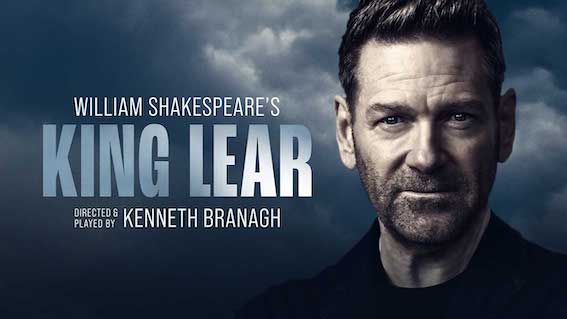
King Lear
William Shakespeare
Directed by Kenneth Branagh
Designed by John Bausor
Sound design / composition by Ben & Max Ringham
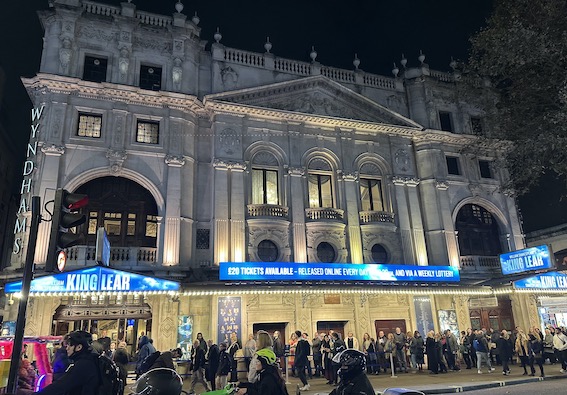
Wyndham’s Theatre, Charing Cross Road, London
Friday 16th November 2023, 19.30
CAST
Kenneth Branagh – Lear
Mara Allen – Curran
Deborah Alli- Goneril
Raymond Annum – Burgundy
Melanie-Joyce Bermudez – Regan
Doug Collins – Edgar
Dylan Corbett-Bader- King of France
Eleanor de Rohan – Kent
Chloe Fenwick-Brown – Oswald
Joseph Kloska – Gloucester
Corey Mylchreest – Edmund
Hughie O’Donnell – Cornwall
Caleb Obadiah – Albany
Jessica Revell- Cordelia / The Fool
The real new thing is playing King Lear straight in two hours with no interval. At first sight the cast of BAME actors with women playing both Kent and The Fool looks much more Globe or RSC than memories of the Branagh Company of a few years ago. However, he is good at working with newer actors.
Walking to the theatre before the play we were aware that London is different. People try and walk straight though we older people. We need to shift out of the way of other generations, step into the wet gutters to let them by. Then there are hordes of people walking along with earphones bellowing out a conversation with either unknown people or quite probably with their imaginary friends. They sound completely mad. That’s all excellent preparation for seeing Lear.
We were in middle price seats. OK, the banner outside says £20 seats available online, often as in London. Not many of them, there’s a lottery, and they’ll be in the upper circle at the back. Good luck with that. It’s a sop. Price is a major issue with assessing the play. £127.50 each for us. Best Seats in the stalls were £275. We could have gone to Chichester in the very best seats three times. We could have gone to the RSC twice in the very best seats for the same-price. The National Theatre and the Globe are also a fraction of the price. Expectations are fuelled. You can’t be just very good, you have to be totally amazing. It was very good. It wasn’t amazing. The prices were beyond ludicrous. Most Chichester productions are as good or even better. However, they can sell out in the West End fast at those prices, and that reinforced that we are the past generation. West End theatre has passed the ‘too expensive’ mark for us. We have the habit of coupling an evening play with a matinee with one overnight stay. Hotel prices have more than doubled since pre-pandemic. We are now joining the previous generation to us, and tutting, ‘That’s ever so dear. How much was that in old money? Lear is someone we can empathise with.
I had concentration issues. The neighbouring seat was occupied by a man who arrived as the lights went down and coughed solidly for the first 30 minutes. I had a mask in my pocket and put it on. After ten minutes his companion started talking to him at normal volume, not in a whisper. I was forced to say ‘Shhh’ strongly. At least they shut up. I have a school teacher’s authority in my Shh. The neighbouring one had to cover his eyes lean dramatically forward and shudder in the violent bits. Ah. Bless. However, that impacted on involvement.
Then Wyndham’s Theatre has appalling seats in the Royal Circle for six footers. We have been in the stalls before. Couldn’t get anywhere near affording the stalls this time. The circle seats have a very good rake, but the seats are beyond primary school low with no foot room under the seats in front. My knees were two inches higher than my base of spine. I had knee surgery four years ago. I was in agony. Never again. Either we can afford the stalls or we don’t go. We can’t afford this stalls price range. On the plus side, Karen used their hearing headphones and they were first rate and all the staff we spoke to were very nice. The programme was a fair price too. This is the review that checks these things. National newspaper reviewers with free tickets and a glass of bubbly don’t know.
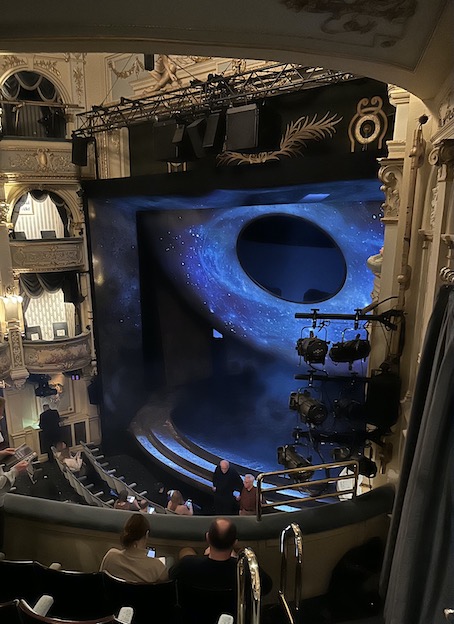
It is a strong concept. Pre-Roman Britain. The programme has a section on Stonehenge and the North Sea coastline of 4000 years ago. We know that Shakespeare had to start mining mythical monarchs for political expediency when the history plays got decidedly dodgy once he’d got as far as Richard III. Cymbeline was just shortly pre-Roman. Lear apparently equates with Josephus in his source from Holinshed, which gets us back to 800 BC. The monolithic stones in the set do channel Stonehenge. The programme notes that Stonehenge was built between 3000 BC and 1620 BC, so it was already ancient in 800 BC. (I was pleased that the programme used BC, not BCE, for a change). That presents the question of whether the society that built it had already disappeared.
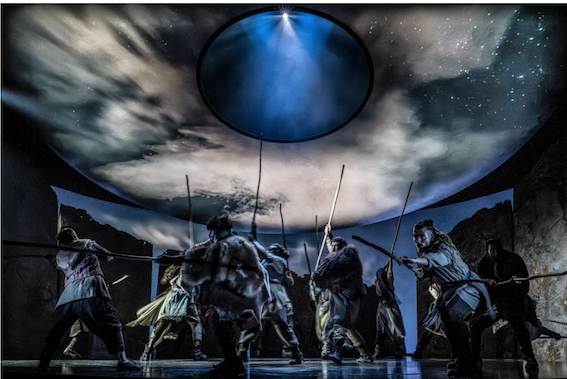
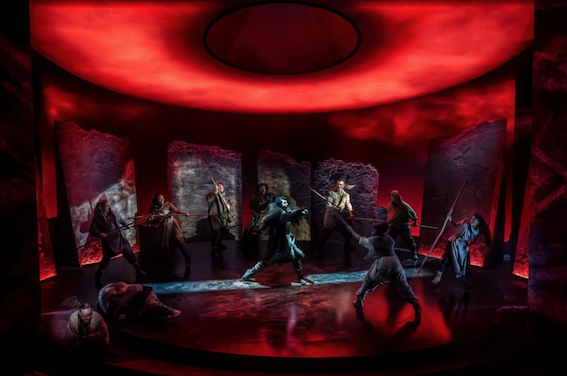
The set, lighting projection – a lot of projection, revolve stage, moving monolithic stones were superb stage design. I add the costumes. The colour palette was before strong dyes were invented. The stage as well as having a revolve, had a slowly lifting wedge for the cave. Lighting protection gave changing skies, and in the battle, close ups of angry distorted faces on those stones. The stones shifted considerably. It was a first rate and innovative set.
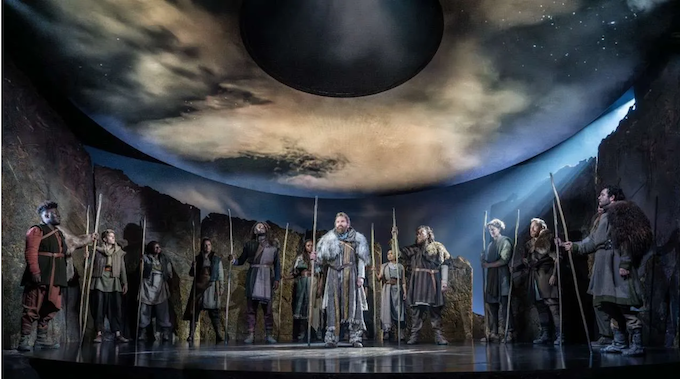
Branagh has gone for Ancient Briton Lear with wooden spears and animal skins. These multiples layers of dull cloth and fur bundled onto the cast must have been hot on stage, even though cold LED lights have generally made it a much more comfortable place for actors. Then while that sort of costume works for the hefty blokes, something more elegant is needed for the women. Of course, Shakespeare knew nothing of all this, and populated the play with early 17th century dukedoms – Cornwall, Albany, Kent, Gloucester plus Burgundy, and the King of France. It works in modern dress, as so many do. I doubt the Kings Men went beyond togas over normal clothes for Romans and breastplates and helmets for history plays.
Like most high concept Shakespeare the chosen period works well at the start, with everyone banging their staffs (staves?) or spears on the ground and grunting acclamation. When Lear divides his kingdom all references to maps and forests are deleted, and he waves with his stick as if to say ‘You can have that bit over there’ as if it were the next field or hill, rather than all of Britain north of Stratford. Like most high concept Shakespeare, the time period then later wilts in the face of the text.
The issue here is that Branagh looks too young and vital with nice hair. Ian McKellen at the Minerva in 2017 seemed a perfect Lear at seventy-eight. Paul Schofield’s famed Lear was performed when he was forty. Simon Russell-Beale was fifty-three when he did it at the National. David Haig’s Soho gangland Lear looked the youngest but worked as violently mad with early onset dementia. Branagh’s doing well physically, because at sixty-two he seems too young for the part. His wasn’t the only nice hair. Elaborate hair was a hallmark.
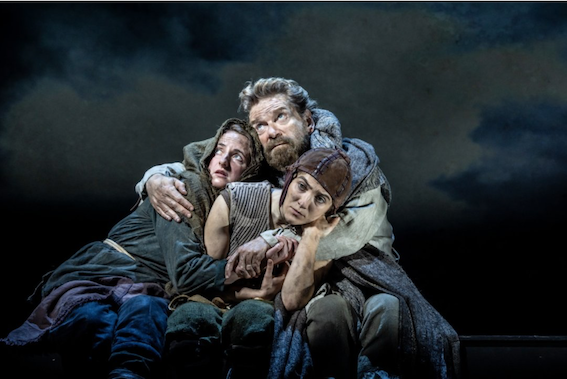
We liked it that Sir Kenneth Branagh interpreted it differently to the parade of ‘Great Thespians’ we have seen dominate the play – Frank Langella, Sir Ian McKellen, Sir Antony Sher, Sir Simon Russell-Beale. (Langella is the only unknighted one being American). It was more democratic, less Lear-centric, and this was fuelled by the pace of a two hour no interval production. The lack of an interval made sense UNLESS you were tall and sitting in those excruciating seats. I would have loved a stretch halfway. Branagh is better than most in drawing humour from lines. At the end when Lear speaks softly, his trademark ability to project effectively but quietly was to the fore. It enhances the range of what he can do. Most Lear productions run to 50% longer at around three hours. It was heavily cut with action being kept rather than long soliloquies. The blasted heath was way shorter than normal, and I have to say that the Great Actor emoting passionately in other productions has often seemed to have ‘gone on a bit’ which perhaps Branagh felt too.
It was different too because his Lear was not acted as an ageing arthritic man but someone up for grabbing early retirement (perhaps he got used to the idea while working from home during lockdown) and indulging in a bit of travelling around the country with his large retinue of pals, and leaving the boring running of the kingdom to someone else. Then he’s faced with the sheer callousness of his daughters’ generation.
For the audience of the early 17th century, abdication was not a choice, it was foisted upon you by jealous and aggressive siblings and cousins. Shakespeare had been there and done that. The concept of a king, anointed by God, resigning was radical.
Overall, there was a thinness to it. That’s the word. The near empty stage, no furniture at all, pushed that thought, It came particularly when Lear is being berated for his roistering train of one hundred knights. The National Theatre went way over the top last time in their loadsamoney production which filled the stage with nearly thirty (it was 26 or 28 on different counts) boozing knights and a dead stag for dinner, but it did make sense of Goneril’s distaste. Here with both Goneril and Regan’s confrontations with their dad, the near empty stage and no sign of a roistering retinue meant it was all reported so distant.
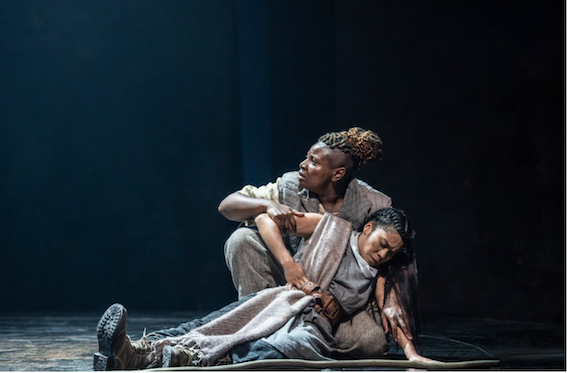
Edmund had the two sisters climbing all over him, but when Regan collapsed on stage, there was no sense that Goneril had poisoned her. Deborah Alli is an imposing Goneril, and her costume was mainly enticingly off-shoulder which stood out with everyone else bundled up.
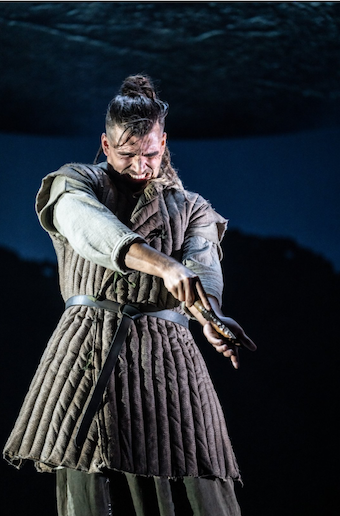
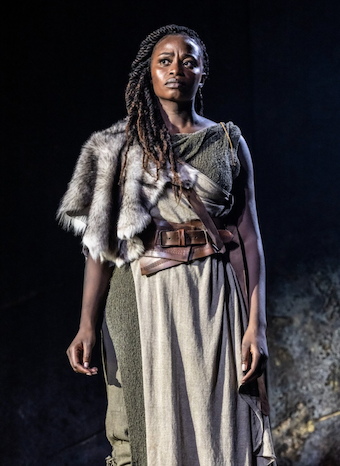
Left: Corey Mylchreest as Edmund self-harming to blame Edgar
Right: Deborah Alli as Goneril.
Edmund is a part for younger actors to go for. Corey Mylchreest carried it off, in spite of not being given enough room in the script to show how evil he is. Doug Collins’ Edgar / Tom also worked, even if I think every Tom we’ve seen smeared with dirt in filthy ancient underpants is much the same.
Doubling The Fool with Cordelia made a kind of sense. Kent needs two voices as aristocrat and servant but the cliché Mummerset as the servant grates on us West Country folk and no, it isn’t a female role. Simply changing him to her in the text doesn’t make it work either.

Joseph Kloska (the only other well-known actor on stage) was a really good Gloucester, though we did see David Troughton’s definitive Gloucester at the RSC. The photo above indicates what a marvellous-looking production this was, certainly the visually best Shakespeare play of 2023. At this point the cliffs have receded into perspective and the projection is watery.
The fight direction was outstanding. There was the choreographed France v Britain and then the Edmund / Edgar duel with spears
There was a lack of pathos. The cutting of speeches contributed, as did the brutal society continually bashing their spears on the ground as percussion. There was not much emotion. There was little sadness at Lear’s fate, we thought. However, it is a strong concept, and Branagh seems to have stripped it back, abandoned the sense that the play is a vehicle for actors emoting at the peak of their (ahem) maturity. He is the director, so the storyteller. He has focussed on the tale, and the thing about the play is that Lear is wandering around aimlessly while the real action of vying for power takes place, with all the focus on the related by marriage Cornwalls and Albanys (this sounds like the Daily Mail). Then there’s the double Gloucesters, Edmund and Edgar and their ill-fated dad. Lear is irrelevant to what’s happening now he’s renounced his authority. That comes across strongly.
The reviews are between disappointing (***) and downright vicious … (*) is really a rare rating for a major production. You may get one of them, but three x one star ratings is almost unprecedented. Look at the Lear / Gloucester picture above and consider. One star is plain nastiness.
So this is what we read before we’ve seen it. We are great Branagh fans since we saw him on stage in Ivanov. His Archie Rice in The Entertainer was better than Olivier’s. Harlequinade was comedy genius. His Leontes in The Winter’s Tale demonstrated his ability (shared with Gielgud) to whisper and be heard in the back row. Belfast is simply the best film of the last five years. We notice that the programme bio omits the Poirot films. But I would have predicted the day this King Lear was first announced that he was in for a critical kicking. He is a prime example of tall Poppy syndrome. They will go for him in a sneering mood at the superstar director / actor / producer / writer ‘new Olivier’. My opinion is that every critic knocks a star off for Branagh because he is Branagh. BUT … are they right (for a change)? It got very good applause. Some standing, but certainly not the simultaneous instant standing ovation that Sunset Boulevard got the next day. It’s off to New York where it will sell out instantly.
In this case we agreed with the consensus. Describing it as ‘King Lear: The Graphic Novel” is reasonable. A good-looking well-designed graphic novel, too. I believe that was the intent. Three stars.
***
FOOTNOTE:
I mentioned that the selfish bastard next to us (we were in P24 and P25) coughed continually through the play. He knew he had something because he kept popping cough sweets. So, a few days later we both just tested positive for Covid. So how many people did he give it to? There are two things. He could have worn a mask. He shouldn’t have been there at all. We’ve found all theatres will give credit notes if you cancel with Covid.
WHAT THE CRITICS SAID
three star
Arif Akbar, The Guardian ***
Dominic Maxwell, Sunday Times ***
Claire Allfree, The Telegraph ***
Clive Davis, The Times ***
Nick Curtis, Standard ***
Alice Saville, Independent ***
Andrezj Lukowski, Time Out ***
Sarah Crompton, What’s On Stage ***
two stars
Fiona Mountford, iNews **
one star
Susannah Clapp, Observer *
Patrick Marmion, Daily Mail *
Sam Marlowe, The Stage *
no ratings
Rachel Cooke, New Statesmen ‘camp and callow and utterly unmoving’
Matt Wolfe, New York Times, ‘short and shallow’
Kate Maltby, The Stage ‘Kenneth Branagh’s King Lear was preposterous, but Kate Maltby argues it also showcased Branagh’s greatest asset – his ability to nurture young talent‘
LINKS ON THIS SITE
KING LEAR
- King Lear – David Haig Bath Theatre Royal
- King Lear Frank Langella Chichester Minerva
- King Lear – Russell-Beale National Theatre
- King Lear- Barrie Rutter, Northern Broadsides tour, directed by Jonathan Miller, Bath Theatre Royal
- King Lear – Antony Sher, RSC 2016
- King Lear -Kevin R McNally, Globe 2017
- King Lear – Ian McKellen, Chichester Minerva, 2017
KENNETH BRANAGH
The Entertainer
The Winter’s Tale
All On Her Own & Harlequinade by Terence Rattigan
The Painkiller, by Francis Veber
Romeo & Juliet (director)
Death On The Nile
Belfast (FILM)(director, writer)
Dunkirk (FILM)
Fortunes of War (TV series)
JOSEPH KLOSKA
The Winter’s Tale, RSC 2021 Broadcast (Leontes)
Measure for Measure, RSC 2012
For Services Rendered, Somerset Maugham, Chichester Minerva Theatre
 Peter Viney's Blog
Rather than younthan me. Even at a 2 hour speedo, I cannot stomach Branagh;s diminution, nay, destruction of the complexities of The Man’s plays, See my article on what he did to Henry V.:
https://theartsdesk.com/theatre/king-lear-wyndhams-theatre-review-kenneth-branagh-helms-pared-down-tragedy
LikeLike
I’ve seen a few Lears over the years, starting with Schofield in Peter Brook’s production in 1962, when I was doing it for A Level. Diana Rigg played Cordelia that time. The Lear that touched me most was Michael Hordern’s in the BBC Shakespeare series.
LikeLike