See also:
Eng Lit in Britain Past
Language Learning in Britain Past
Here were three subjects which few took at O level at my school, though friends took Art to A level. In my life, my main sources of inspiration have been film / theatre, music and art. When we were writing text books, we spent more time on art and illustration than any other authors … OUP told us this … and were rewarded with helping choose artists from portfolios and attending all the art and photo meetings. We wrote very detailed art briefs. I used a lot of my own photography. Then as well as using real songs in our textbooks, I co-wrote several songs. My website AROUND AND AROUND is about music, with a particular emphasis on record design and illustration. So did Bournemouth School For Boys assist or inspire any of that? A resounding “no.” My interest in music and art is in spite of, NOT because of.
MUSIC
There was just the one music teacher and just the one music room, which had a piano and a record player, by which I mean a mono Dansette type not a hi-fi. His double-barrelled name, Mr Harcourt-Smith, was lampooned in the days long before half the professional football players in the country decided they needed a double surname. Actors are following fast because of the rule that you can’t have the same name as someone else listed in Spotlight and on IMDB.
He had to wear an unfortunate academic gown on speech days – lurid purple velvet with ermine trimming. This caused some mirth. We called him Liberace though he banged out the morning hymns daily in a considerably less florid manner. Music teachers always had the double task of accompanying assembly. School hymns leaned to the militaristic Stand Up For Jesus, Ye Children of The Cross, lift high his royal banner, it shall not suffer loss. I don’t believe they were to his taste from odd remarks in class.
He had a short list of the greatest composers. 18th century – Mozart and Bach. 19th century- Beethoven and Tchaikovsky. 20th century – Holst and Bernstein. At that point there were nearly forty years left for competitors to emerge (Dylan, Lennon & McCartney). Even if you stick to classical, Shostakovich was never mentioned.
He also thought choosing West Side Story as the greatest work of the 20th century (over The Planets) made him kinda cool, I suspect. He was a little short-tempered and I’m not surprised given my contemporaries who he had to teach, but unlike other staff, was never violent.
We were invited as an end of term treat to bring in a record we liked, which we could discuss in class. I pondered A White Sport Coat and A Pink Carnation and Little White Bull which my sister had borrowed from a friend, but decided against either.
One lad brought in Marty Robbins El Paso. This must have been 1960 when it was current. Our teacher had never heard it and was totally entranced by it. It occupied the whole lesson, was played many times and he asked if he could borrow it for the evening
.
Out in the West Texas town of El Paso
I fell in love with a Mexican girl
Night time would find me in Rosa’s cantina
Music would play and Feleena would whirl …
Did Marty Robbins join Holst and Bernstein for future years?
The thing is, our school produced several future professional rock musicians, even more who did well in semi-pro bands. We used to have an informal reunion in November at a tapas restaurant followed by a music quiz. We would seek out school reports. I compared mine with a late friend, who had gone on to have a #1 album in the USA, and a #1 single. He never came in the top half in music at school, though at that age he was already highly accomplished on piano, guitar and bass plus a stellar vocalist. I couldn’t read music but I was either second or third in Music exams. When I announced (admitted?) this it was met by incredulity all round. They had heard me fumble around on bass. They had heard my strangulated attempts at singing.
The answer was that Music exams at school were basically history. I’m good at history. J.S. Bach 1685-1750. Ludwig van Beethoven 1770-1827. Born in Bonn. He was deaf. Wrote the 5th Symphony and probably some others either side. Logic dictates there must have been four earlier. Tchaikovsky (1840-1893) wrote the 1812 Overture and Swan Lake and The Nutcracker. He was Russian but did not write War and Peace. Very good. I remember having to tap out time signatures on the desk, but quietly. He hadn’t heard of Take Five. That was as far as musical participation went. Our music education was mostly being bussed down to the Winter Gardens with all the other Bournemouth schools to watch Constantin Silvestri and the Bournemouth Symphony Orchestra do special schools educational concerts a couple of times a year. This is an oboe. Listen for the oboe in this piece. That was great.
So the conclusion of my more musical peers was that music was abysmal at my school, and had very little to do with music. I just kept my mouth shut.
ART
We had two teachers in the art department, and a north facing art room with studio windows above and a craft room on the top floor.
The art room was adorned with two types of art. Renaissance, and 1920s / 1930s advertising prints. I decided there were probably just the two types of art. It had been designed in 1939 when the school was built, as a dedicated art space with its natural north light. By the time my son got there in 1989, it had been commandeered as administration offices, and art shoved into an ordinary room … my son did A level Art.
Lieutenant Neame (his Combined Cadet Force rank, not his real rank) taught craft. Years later, I was told the headmaster, an ex senior officer, despised staff who used CCF ranks in the school. There were a few such as the woodwork teacher, Sub-Lieutenant Cutler, known to boys as Sub-Normal Cutler. The craft room stank of ever bubbling glue, no doubt rendered from old horses. I’d read Black Beauty. We did book binding the first year. We had to bring in some magazines to bind. All I could find at home were Tit-Bits and The Motor Trader. Tit-Bits was newsprint and unsuitable. My dad was in the IMI, Institute of the Motor Industry and Motor Trader was the bi-monthly magazine. He sold tyres for John Bull and then Dunlop, and did some motor maintenance teaching at evening classes too. The Motor Trader was at least on glossy paper, had few illustrations, and consisted mainly of lists of people who had attended functions. Mr and Mrs Jones of Jones Garage in Swanage were among those at the Wankel Rotary Engine presentation at The Bear Hotel in Wareham last week. It is said that the engine may appear in production cars within the next few years. Other lads had Punch (a lot had Punch), or part works. Lt. Neame was most sniffy about my magazines, asking ‘Why would anyone want to bind these?’ Why indeed. The thought had struck me. Bind them we did, then we did potato print covers. Then I took them home and we threw them away.
We had the same man for art in the second year. We had to carry our chairs down to the playground and draw a brick wall. Yes, a plain red brick wall. At home, I used to spend hours of my free time drawing and painting. By the second year of art, any creativity was being badly stifled. An hour drawing a brick wall in black and white? Maybe. But I recall this as a repeated chore over many lessons.
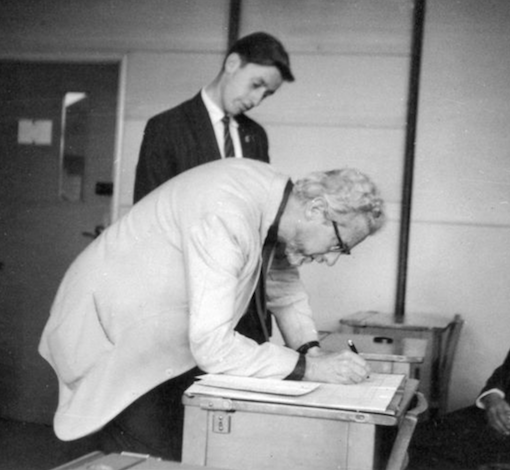
By the third year we were onto real art in the art room. The teacher was known as Bernie Walker. He had long (for those days) white hair and a trimmed white beard. He wore white linen jackets and bright waistcoats and cord trousers. He certainly looked the part.
This is a difficult one. Two friends at least cite him as a mentor, the very best and most inspiring teacher of their school career. They did A level.
It started well. The advertising art, London underground and so on, was great. We had talks on Renaissance Italy illustrated with his own slides, which I remembered much of, and on Italian book promotion tours, I ended up with free days in Florence more than once, and knew what to look for. I was fascinated while he was talking about art … which is of course history rather than art.
We got to draw one thing. A circle. The pope sent to Giotto asking for an example for his work. Giotto told the papal envoys to watch and drew a perfect circle in one movement. ‘Show the pope this and say how it was done.’ He got the job. That passed a lesson and it’s hard verging on impossible. Also the story has stuck.
Then we started drawing. Did we get to paint or use colour? Too messy. All I recall is interminable lessons drawing a dry stone wall in pencil from photos.
Then after many weeks of this, we would graduate to a road flanked by dry stone walls. He kept reading out G.K. Chesterton:
Before the Roman came to Rye or out to Severn strode,
The rolling English drunkard made the rolling English road.
A reeling road, a rolling road, that rambles round the shire,
The poem gets more interesting but we stuck to those three lines. The rolling road over hills would teach us perspective. Perspective was explained well enough with diagrams and slides. When do we get to colour? Can we make the grassy fields green? No. When do we get to draw from our imagination? Never.
I’ve spent enough time with illustration to know that not every artist can ‘draw’ accurately and I believe Mr Walker was right that drawing is a pre-requisite. My son looked at the local Art College for his gap year and dismissed it because it was all free-form painting, and he also knew that you had to be able to draw too. Those who went on to GCE O level and A level no doubt graduated to colour. Most of us stopped in the fourth year.
The reason I’m negative is simple. During the dry stone wall drawing I was in the back row of easels, with another Peter. We weren’t talking. Two lads in the row in front started whispering. Walker charged up, looked at Peter, easily the smallest boy in the class, decided against hitting him, and slapped my left ear with his full force instead. I protested that it wasn’t us who had been talking, and he said one more word and he’d hit the other ear, and added, ‘And I don’t care if your parents sue me.’ I was deaf in that ear for weeks. It still gives me trouble sixty plus years on. So to me he was a violent bastard. A mentor and friend to many? Yes. I don’t care. Such violence was illegal then. Only the head or deputy head could administer physical punishment, but it was widely ignored by his generation. Actually, he was not generally violent (most of the maths department were generally to always violent) but perhaps his artistic temperament gave him a short fuse. He’d have got away with it then even if my parents had complained. My dad, being an ex-staff sergeant, advised that it was the sort of thing you could complain about, but then revenge would be wreaked upon you weeks or months later.
DIVINITY
That’s what our school called it. Other schools called it RK for Religious Knowledge. Now it’s RE for Religious Education.
Our first form teacher was selected for first years because he was a benign, kindly and gentle man, Mr Knight. Because of his head shape everyone called him Eggo. He taught Latin and Divinity. He taught us both in the first year. I liked Latin, but at the end of the year we had to choose: Chemistry or Latin. My dad influenced me to choose Chemistry and drop Latin. A bad choice. I failed Chemistry O level, and had to do crash O level Latin at college.
In retrospect, I don’t know how good he was. He taught us helicoptorum a word newly coined by the pope when he got one. There was an awful lot of porto, portas, portat, portamus, portatis, portant chanting. Perhaps amo, amas, amat was considered too risqué. I have read since that 19th century Latin primers were full of rude double meanings for teachers of dubious inclinations towards schoolboys.
He was away for a week, and we had the Head of Latin, a Mr Petoello, who did two enthusiastic and memorable lessons on marching Roman armies setting up camps at night and the vocabulary with instant board pictures. It was clear why he was head.
Eggo had attended a public school, travelled to Germany in 1938 and had seen Hitler speak at a rally. He had a certain popularity because he was always seen with red rosette supporting Bournemouth football club on Saturdays. Like us, he stood on the terraces. So did Lieutenant Neame. We liked that.
Latin connects to Divinity. That was a doddle for me, because it’s like history, except that unlike history, a lot of it may never have happened or has been embroidered subsequently. It’s still remembering stories. Argue fact or fiction later. I remember the Jewish boys in our class had to attend the Old Testament bits but were sent out for the New Testament bits. Comparative religion? No.
We had Eggo most of the way through five years, except in the third year we had a Reverend Smith for History and Divinity. He was known as Holy Joe, unfairly perhaps as I don’t recall him preaching at us. He was a Baptist minister, and a jumpy, nervous and fervent fellow.
We didn’t do O level. I remember in my son’s era the careers teacher saying, ‘There are two university subjects which no employer counts: Theology and Social Studies.’
However, we were forced to do it in the Sixth Form. Was it a legal requirement? They didn’t do it at the local college in the A level years. We did. It was all based on Letters To Young Churches by J.B. Phillips with an introduction by C.S. Lewis. That’s probably why I never liked The Lion, The Witch & The Wardrobe. I have read on St. Paul (see The Kingdom), and no one mentioned that Paul can be said to have almost entirely invented Christianity as we now know it. Nor that he was a misogynist.
Leonard Cohen sussed St Paul in the ranting evil character he acts out in the Future:
Give me back the Berlin Wall
Give me Stalin and St. Paul …
That’s a good connection.
I got a detention in the sixth form for expressing the banal view that if God could forgive anyone their sins at any time, does that mean Stalin and Hitler could repent and go to heaven?
I got another one for selling tickets for my teen band’s youth club gig during the lesson. We were accused of gambling with cards as we were seen exchanging money, which would have meant a visit to the headmaster. It was reduced to a detention when I produced the tickets.
Many years later, probably late 1980s, I saw Eggo in Waitrose. He was elderly and frail. I introduced myself and he laughed and said he remembered me as an argumentative lad but ‘with a good heart.’ I don’t know if he really remembered me that well, but it was a nice thing to say. We had a ten minute chat, and I was able to thank him and say that his kindness had been a beacon of light in my first year at grammar school.
 Peter Viney's Blog
Lt Neame was usually ~”Nunkie” Neame as I recall. We saw with some pleasure that when the CCF Navy Section spent a couple of weeks away at HM bases, most regulars had little time for Sub-Lt Cutler, but they seemed to get on well with Nunkie.
I had Percy Cushion (“Persecution”) for Latin and was fascinated when he talked – at length – about the historical and social context of the Latin literature we studied.
LikeLike
Maybe Petoello wasn’t head of Latin, as Percy Cushion was so much older. Though the head was bringing in younger more dynamic teachers like McCabe and Bircher.
LikeLike
… had little time for Sub-Lt Cutler, I meant 🙂
LikeLike