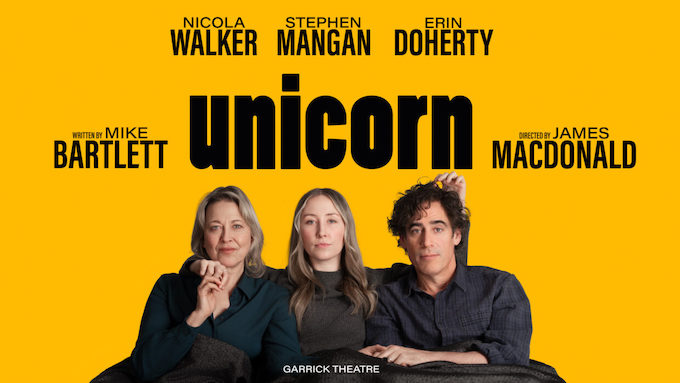
By Mike Bartlett
Directed by James Macdonald
Garrick Theatre, London
Thursday 20th February 2025
14.30
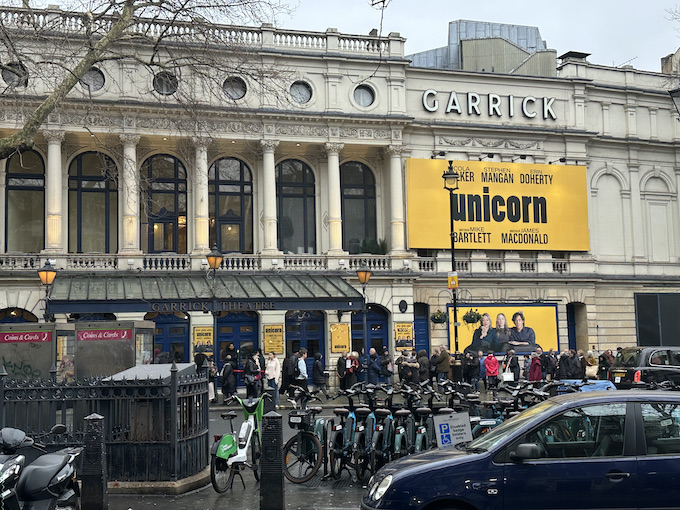
CAST
Nicola Walker – Polly
Stephen Mangan – Nick
Erin Doherty – Kate
The first attraction was the pairing of Stephen Mangan and Nicola Walker from the TV Series The Split, where they play a husband and wife who are lawyers. Add Eric Doherty, who was Princess Anne in The Crown and she was Abigail Williams in the National Theatre The Crucible. Stephen Mangan is a great favourite with us and Episodes is one of our favourite sit coms ever. Less attractive were such high ticket prices for a three parter with a minimal set in one of those uncomfortable well past-their-sell-by date West End theatres. The Broadway style, tiny cast, at least two major stars, talking taking precedence over action, is an unwelcome US import. Well, this month any US imports are unwelcome.
The programme points out it’s a rare new play in commercial (aka overpriced) West End Theatre and repeats three times that SUBSIDISED theatre normally breaks new plays. So ‘subsidised’ is a loaded word, a perjorative in the context. So SUBSIDISED means a cast of twenty four plus six musicians at the RSC, National Theatre or Globe (and I believe the Globe is self-financing) rather than three TV stars at a swingeing £150 for tickets (we paid £95 for the middle area)? They’re cashing in on the TV relationship.
The stage is a hemisphere (or rather half a hemisphere, like a band shell at outdoor concerts). It is surrounded by a front lighted bar.
The interior of the circle is fabric and can be rolled up at the back about halfway, which happens two or three times. It is lit differently in the different scenes. Props? Two bar stools. Next the sofa. Then in part two a bench seat from a coffee shop. Then a park bench. A bed (briefly and no frolicking). The sofa. The play is in two parts, though inexplicably the scenes are combined in the text as five acts, which is pretentiously Shakespearean. It’s a modern play, less than two hours running time. That means it has Act One and Act Two. Full stop.

I’ve seen these bars before, though square or rectangular rather than curved. They are used for rapid set changes. If you switch to a blackout, then the lighted bar is turned up brighter, you effectively can’t see what’s happening in the middle on stage. Then loud music obscures any noises. It works here where the set is simple. The ‘band shell’ shape may help to project sound forward too.
We had no idea what the title (Unicorn) meant. We’d never heard it before. It’s the third person joining a couple in a throuple (also a new word, but in several of the reviews), and the third or extra one is female. In this case, the married couple are Polly and Nick. Polly (Nicola Walker) is a university lecturer and published poet. Nick (Stephen Mangan) is a doctor and “ENT specialist.” ENT? Ear, Nose and Throat. That means he’s a consultant, and we have an ENT consultant neighbour, a surgeon. Later he just says ‘doctor.’ I checked the list of ten local ENT Specialists and nine were ‘Mr’ that is, surgeons. Only one was listed as ‘Dr.’
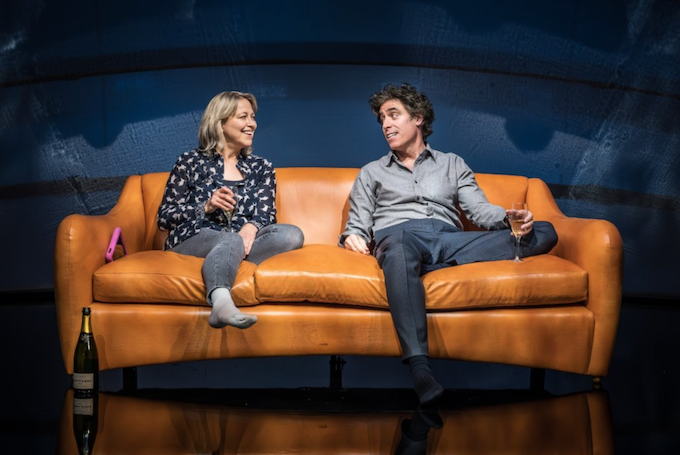
Nicola Walker and Stephen Mangan have worked together for years in The Split and have known each other since Cambridge University. There is an ease in them acting together. They always seem a credible couple. This is the core of the play’s appeal.
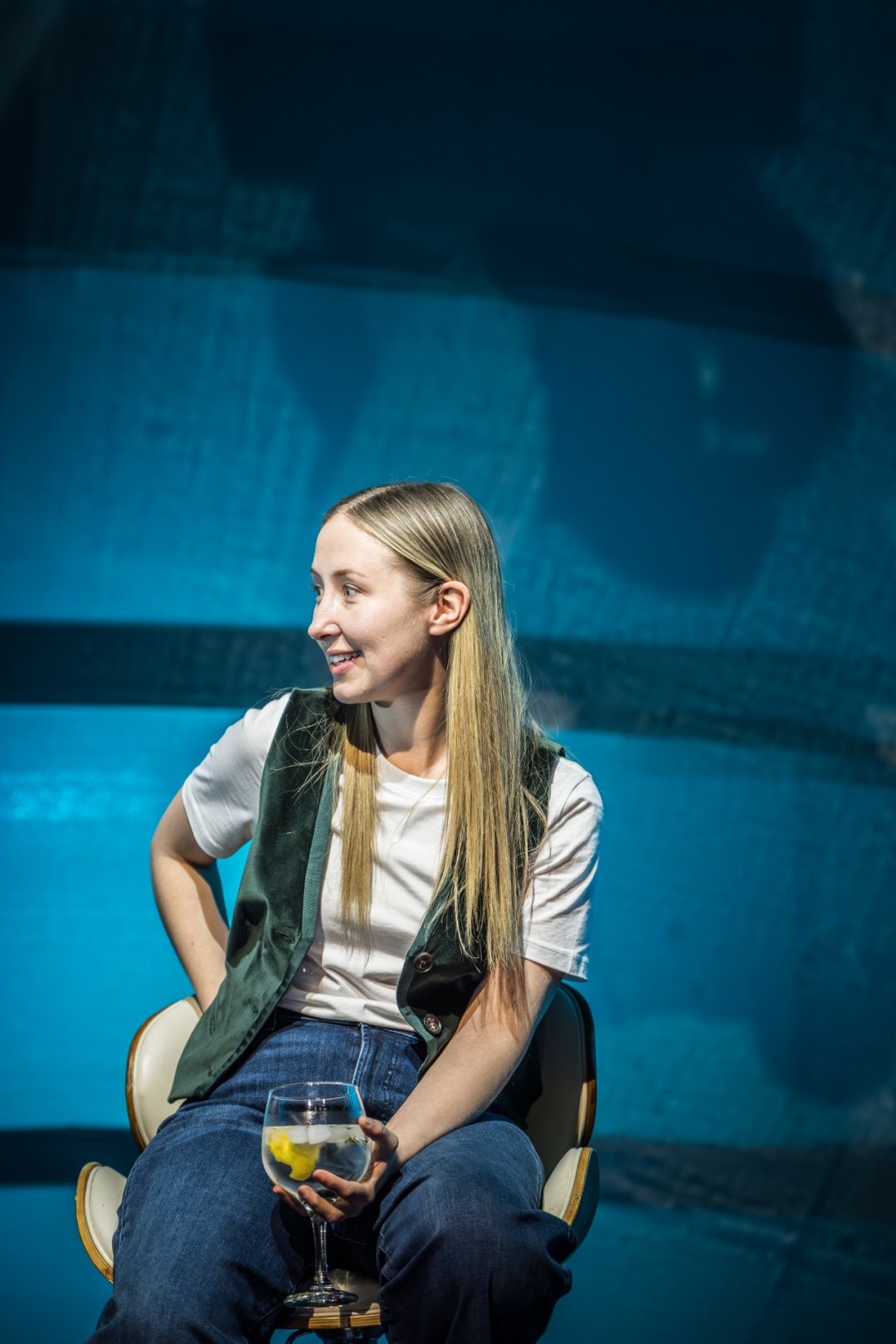
The mature student who is the third person is Kate (Erin Doherty). She is 28 at the start, 30 at the end. Polly is her teacher and we start with them having a drink on bar stools. Kate rates Polly’s poetry too. Polly realises she fancies Kate. Polly makes the moves to recruit her, Nick is diffident and reluctant. The play consists of talking about their potential then actual three way relationship. Though there is much explicit dialogue on sex, lubricants, positions, preferences and bodily fluids, there is absolutely no sex beyond kissing on stage. No one disrobes.
This is the text:
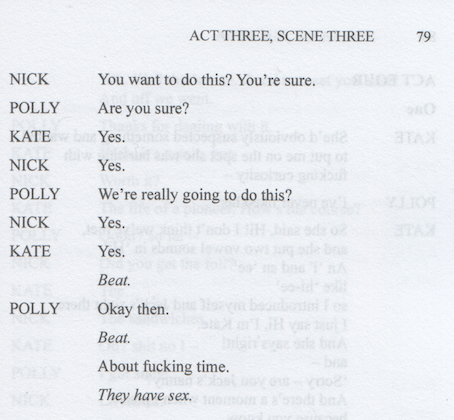
That last line is, They have sex.
Oh, no, they don’t. They stand up. There’s a blackout.
It’s all about the acting. It has to be, people came for the cast. It’s one of the most static plays I’ve seen in spite of the set and time changes. Mainly it’s simply two people sitting and talking. It’s quite an exciting change when one of them stands up, or crosses a leg.
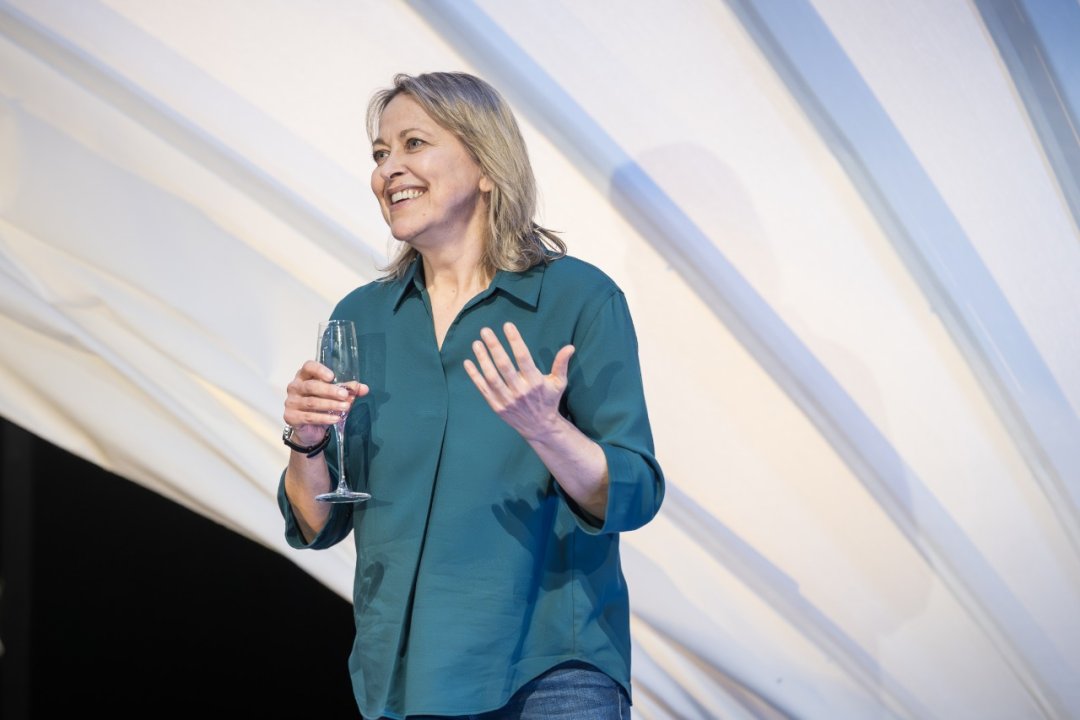
Nicola Walker was a surprise. We are so used to her as a dour, depressed, troubled detective or lawyer with personal issues, that it’s a shock to see her smiling, sparkly and playing comedy lines. The first few scenes have some very good comic lines and interchanges.
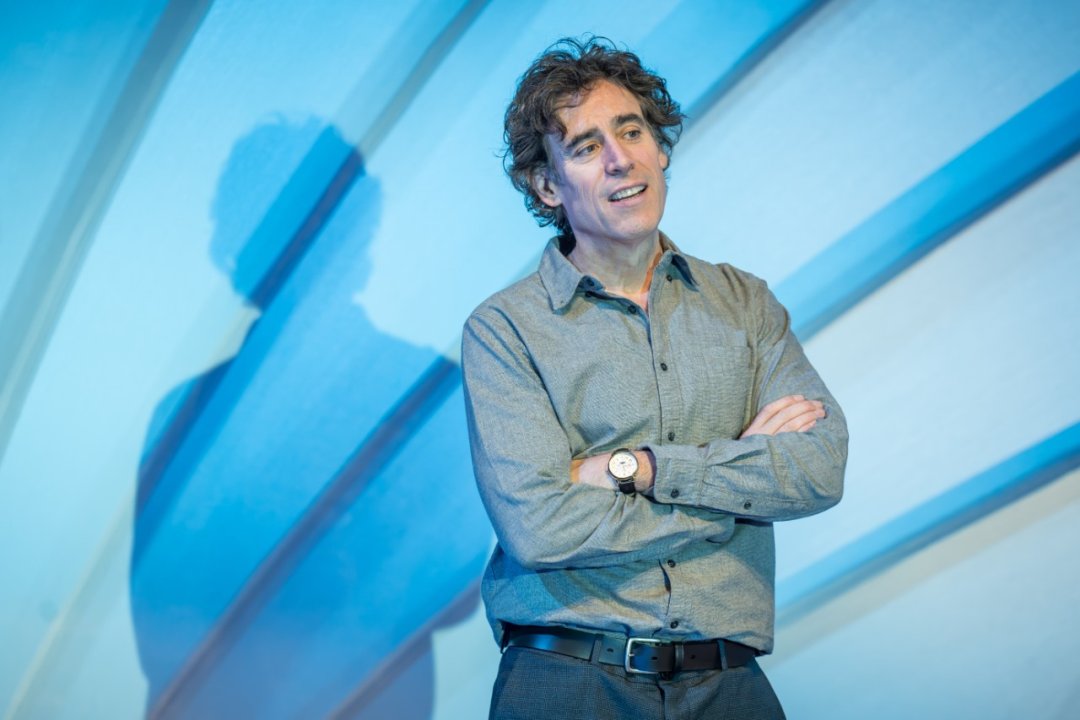
Stephen Mangan is always brilliant, here more diffident than usual. He does get to show his extremely long tongue. Is it in his contract? He definitely did it in The Birthday Party and Private Lives, though here it has context in a discussion on oral sex (show me your tongue). Erin Doherty is a third very fine actor. The facial expressions, timing, delivery are all superb. I liked the way Mike Bartlett sets out the play text, with separate lines to indicate pauses.
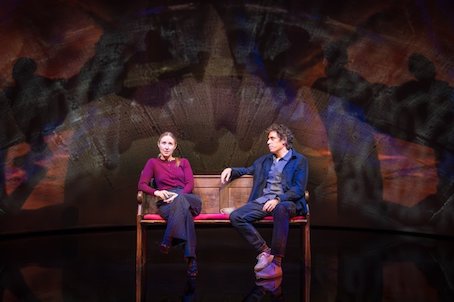
The trouble is the comedy starts to falter. It tries to shift to serious with portentous statements, and a touch of incipient tragedy, and we both thought it lost direction in the last twenty minutes. There are things that don’t gell. One was mentioned above. Nick is (probably) a consultant surgeon. By nature, surgeons are neither diffident or indecisive. I’d edit out the ENT Specialist earlier and make him a GP. In part two, he also reverts to jeans and denim shirts, rather than the casual clothes of part one. He looks a tad scruffy for a surgeon.
Then Kate seems to place them as working class / lower middle class.
Kate: (Polly) is about what’s simply and clearly what’s genuinely around her. The twenty-first century authentic working class stroke lower-middle-class experience …
What? A consultant, a university lecturer / published poet and a trainee barrister? Working class / Lower middle class? Only in London (Rod Liddle in the Sunday Times calls The Guardian ‘the North London local newspaper’).
Some of the polemic towards the end is dubious and the lightness of touch and humour in the writing in the early stages is replaced by leaden comments. I felt the writer was gasping (or grasping) for social relevance when the main theme is sexual boredom.
Kate: Maybe we’ll come through all this and build something in our country out of the fucking Conservative mud, that’s better.
or
Nick: (in fifty years) the world will be better and more open and our children will look back on us the way we are now as so …primitive.
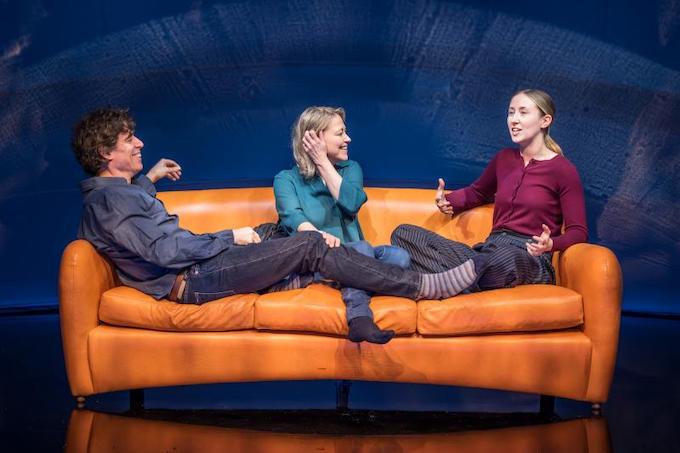
This scene is near the end
Arifa Akbar in The Guardian says it better than me:
What follows is just that: lots of talk and no action – in all senses of that word – and it is oddly atmosphere-less. Conversation spins and bounces from midlife doldrums to the terrible inexorability of ageing to mini critiques of capitalism, modern masculinity, coupledom and nuclear family values. The generation gap is shown up between the couple and Kate, and this services the comedy a little (gen X jokes about She-Ra and nostalgia about pre-digital dating), along with the hand-wringing about the pros and cons of being in a threesome. These are scattered nibblets of thought that undercut the drama’s spring loading and forward movement, especially in the first half. For all the radicalism of the idea, the couple look as if they are in a retro sitcom.
14 February 2025
There’s more to the plot. Nick has been diagnosed with cancer. The waiting list is long for treatment. Kate and Polly think they will have to work to get the money for faster treatment. Let’s clarify what they fail to. The NHS list is long. They want to pay for private treatment. It doesn’t ring true. An ELT consultant surgeon is of such value to the NHS that fast-tracking treatment would happen, even without allowing for colleagues in the right areas deciding on priority. If he was a highly-principled obsessive refusing to be fast-tracked by his colleagues, wouldn’t he decline private treatment? He’s been a doctor for 25 years. He’d know the system. I just checked, of 23,000 consultants in the UK, 16,000 also practise privately. Wouldn’t he have private insurance? Though a surgeon told me that they were advised on graduation to put the annual cost of BUPA medical insurance for the family into an investment fund instead. Then it would grow, and after around 25 years you would have enough to simply pay for a triple heart by-pass at a London private hospital. And if they were lucky enough not to use it, they still had the money. Then Nick tries to hide his hospital treatments by saying he’s going to the dentist. A word, Mr Bartlett, unlike writers, ENT Specialists don’t work from home nowadays. They work in hospitals. Why would they need to hide their hospital appointments from their two partners? Also if he was having treatment, would he not suffer from the side effects?
The music in the scene changes is odd. It’s A Bicycle Made for Two, aka Daisy Bell. The words include Daisy Daisy Give Me Your Answer, do. A very well known song in my childhood. My mum was christened Daisy, hated the name and used her middle name, Doreen. My dad would tease her by singing it. I can see why they chose it for the lyric:
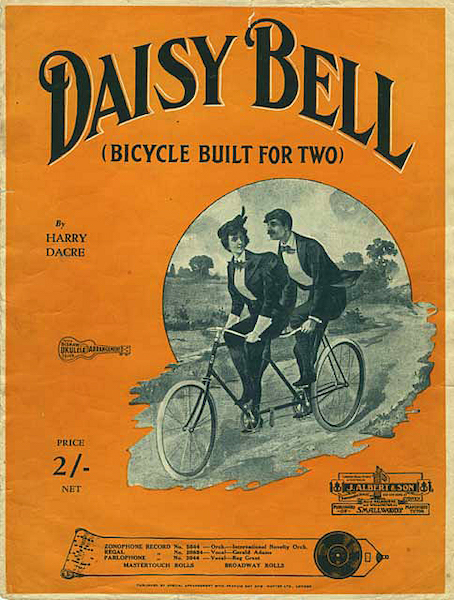
We will go “tandem” as man and wife,
Daisy, Daisy!
“pedalling” away down the road of life,
I and my Daisy Bell!
Musically? It’s an 1892 song, especially popular before 1939. Later it was the first computerised song and appears in 2001. They play various versions culminating in a thrash / punk version. It doesn’t reference the era – Polly and Nick are Eighties people. Kate is ‘now.’ The one I thought of was David Crosby’s Triad, as sung by Jefferson Airplane in the late 60s, except the triad is two men, one woman. Still some of the words fit and you only need 30 seconds.
You are afraid, embarrassed too
No one has ever
Said such a thing to you
Your mother’s ghost stands at your shoulder
Face like ice, just a little colder
Saying, “You cannot do that, it breaks all the rules
You learned in schools”
But I don’t really see, why can’t we go on as three
I thought Daisy Bell clashed anachronistically.
This three-parter is a studio play.
It’s natural setting is an intimate studio theatre with 120 seats.
Much as the cast protest that on seeing the script they were desperate to play it, they were not desperate enough tp play it where it belongs ; Bath Ustinov. At a stretch, Donmar Warehouse or The Menier Chocolate Factory. The Garrick at 732 seats is described as ‘relatively intimate.’ The ideal setting for this is far fewer. Wrong theatre … but as Walker and Mangan are cashing in on The Split (and good luck to them) the seat prices must be part of their reason.
Ratings? Before we saw it, we assumed the 4 star brigade would be the ones we’d identify with. We more often agree with Domenic Cavendish in The Telegraph, and disagree with Arif Akbar in The Guardian, Clive Davis in The Times and Dominic Maxwell in the Sunday Times. I discount Time Out‘s opinion because it is nearly always 3 stars. This time we thought Arif Akbar is the one who got it right. It is a static two star play enacted by superb actors. There is no theatricality. The last 10-15% of the play is clichéd writing. The play’s ending is a damp squib.
**
WHAT THE CRITICS SAID
four star
Dominic Cavendish The Telegraph ****
Susannah Clapp, Observer ****
Nick Curtis, The Standard ****
three star
Andrzej Lukowski, Time Out ***
Sarah Crompton, What’s On Stage ***
Tim Auld, Financial Times ***
Patrick Marmion, Daily Mail ***
two star
Arifa Akbar, The Guardian **
Clive Davis, The Times **
Dominic Maxwell, Sunday Times **
Sam Marlowe The Stage **
Aleks Sierz The Arts Desk **
LINKS ON THIS BLOG
MIKE BARTLETT
Albion
King Charles III (TV version)
King Charles III Almeida & West End
Love, Love, Love, Salisbury Playhouse 2011
JAMES MACDONALD
Bakkhai. Almeida 2015
STEPHEN MANGAN
Private Lives, by Noël Coward, Donmar Warehouse 2023
The Man in The White Suit, Bath Theatre Royal, 2019
The Birthday Party, by Harold Pinter, Harold Pinter Theatre, 2018
Birthday, by Joe Penhall, Royal Court, 2012 (Ed)
Jeeves & Wooster in Perfect Nonsense, Brighton (pre-London) 2013
Rules for Living by Sam Holcoft, Dorfman, National Theatre 2015
NICOLA WALKER
A View From The Bridge, by Arthur Miller, Young Vic 2015
ERIC DOHERTY
The Crucible, by Arthur Miller, National Theatre 2022
 Peter Viney's Blog
Leave a comment