
Music and Lyrics by Irving Berlin
Based on RKO’s motion picture
Adapted for the stage by Matthew White & Howard Jacques
Director and choreographer Kathleen Marshall
Set design by Peter McKintosh
Costume by Yvonne Milnes & Peter McKintosh
Orchestrator & dance arrangements by Chris Walker
Musical supervisor Gareth Valentine

Chichester Festival Theatre
Thursday 14th August 2025, 14.30
CAST
Phillip Atmore – Jerry Travers
Lucy St Louis – Dale Tremont
Clive Carter – Horace Hardwick
Sally Ann Triplett – Madge Hardwick
James Clyde- Bates
Alex Gibson-Giorgio – Alberto Beddini
Bethan Downing – Offstage Swing / Assistant Dance Captain
George Lyons – Offstage Swing / Dance captain
ENSEMBLE
Lindsay Atheron
Rhianna Bacchud
Jeremy Batt (hotel manager)
Freddie Clements
Pedro Donesco
Autumn Draper
Tilly Ducker
Laura Hills
Connor Hughes
James Hume
David McIntosh
Jordan Oliver
Emily Ann Potter
Molly Rees Howe
Kirsty Sparks
Toyan Thomas- Browne
After its debut at Chichester, this production starts on a long tour running to March 2026 and encompassing sixteen major cities in the British Isles, including Edinburgh, Glasgow, Cardiff and Dublin (British ISLES not Great Britain!). I like reviewing productions everyone has a chance of seeing.
It was a Fred Astaire (Jerry Travers) and Ginger Rogers (Dale Tremont) vehicle in its first incarnation with RKO Pictures. A 1935 musical is pushing back from the classic musicals (50s and 60s) to an earlier era. This is a NINETY years old musical. The Arts Desk review suggests the elderly Chichester audience might remember the original. Stop and think about it, of course they won’t; if they remember the original it’s on a tiny B&W TV late night on BBC in the late 60s or 70s. This stage version dates from 2011.
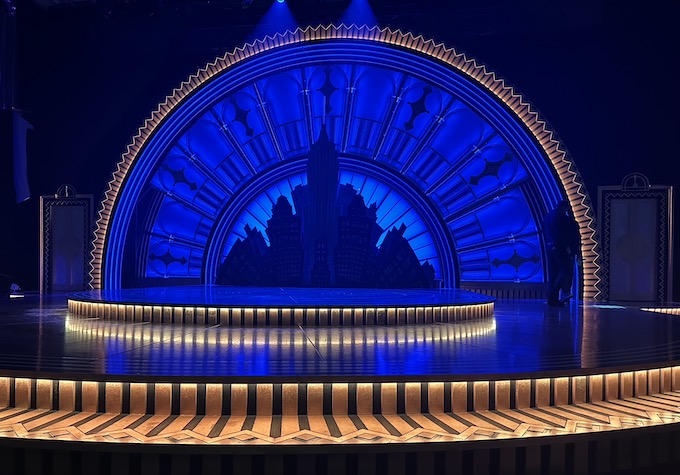
The art deco set looks glorious with an efficient rotating inner stage and two levels. During the overture there is a light show as the colours shift throughout. The first scene is New York, but then it shifts to London, and in Part Two, Venice. Projected skylines indicate the city.
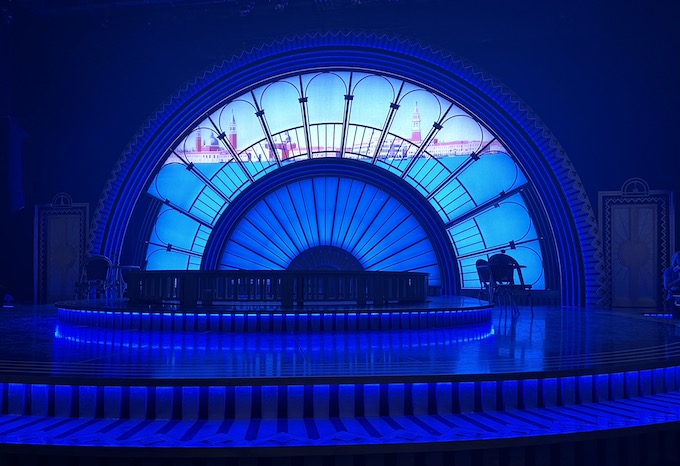
One review pointed out that it doesn’t use the full width possibility of Chichester’s stage, but it has to tour afterwards.
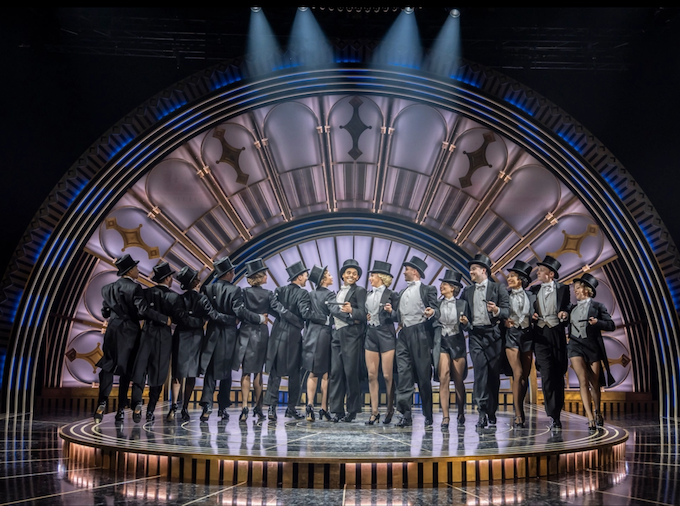
I hadn’t noticed, though Karen says she was disappointed there was no “Eric and Ernie” staircase to descend, which she says is a given for top hat, tails and cane movies and musicals. We had that for variety shows when I did lights in the late 60s too, and Frankie Vaughan did descend the stairs and wear the top hat for Cabaret.
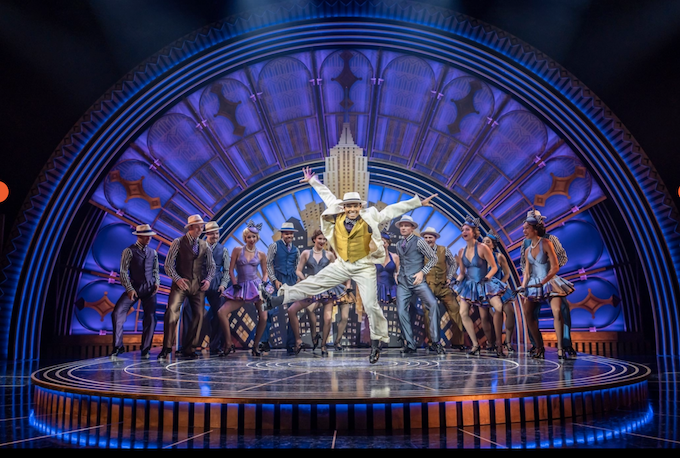
In 1935, it was logical for a musical film played by dancers to cast them as … wait for it … dancers. So Jerry Travers, the star of the show, is a Broadway leading man who is about to embark on a London production. Stick to the style, he is played by leading Broadway musical star Phillip Atmore. He is a fabulous dancer, of course, and tap is so much more an American tradition. Actors learn it. Jerry’s London show is produced by Horace Hardwick (Clive Carter). In London they meet at Horace’s club, and end up in Horace’s room (404?) for drinks. Jerry demonstrates some tap. The stage revolves and we are in Dale Tremont’s room, 304, directly below. Dale (Lucy St. Louis) is woken by the tap dancing and is furious. She phones the manager to complain, is told it is Mr Hardwick’s room, then goes to complain herself, meeting Jerry, who she assumes is Horace Hardwick. Horace has gone down to see the manager. Dale models clothes for top Italian designer Alberto Beddini (Alex Gibson-Giorgio ). It all takes off from there.

The dress echoes the one Ginger Rogers wore
Horace is married to Madge (Sally Ann Triplett) who will not appear until part two. Madge is friends with Dale, and invites her to Venice, intending to set her up with Jerry, but Dale thinks Jerry is her husband Horace and is understandably confused.
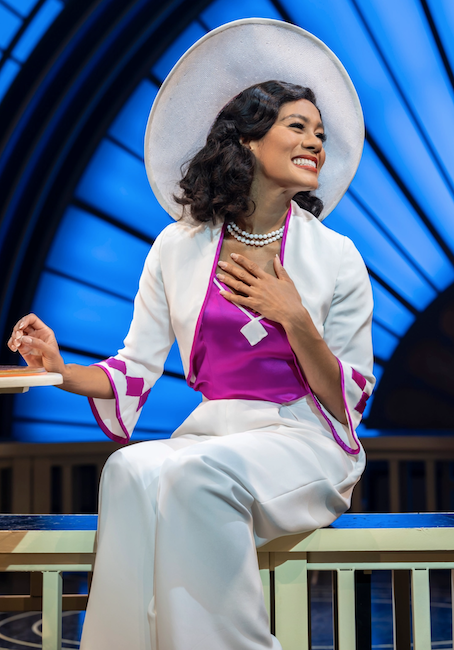
Lucy St Louis is English (and has played the lead in Phantom of The Opera, and Gilda in Wicked and Diana Ross). Sally Ann Triplett as Madge is also English, though you’d never believe it. She has great presence and her arrival on stage really lights up part two of the show.
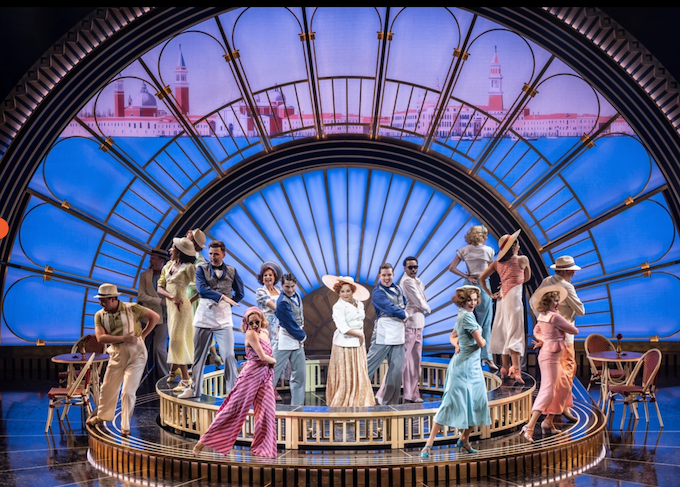
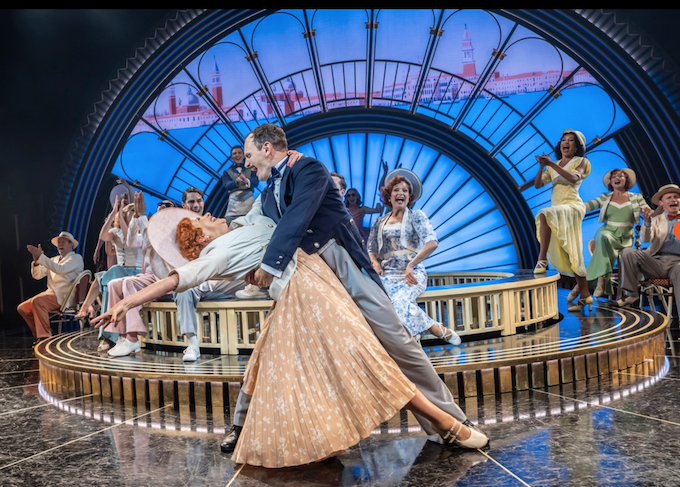
Jerry is so keen on his pursuit of Dale that he persuades Horace to hire a private plane to go to Venice. A short seven hour hop.
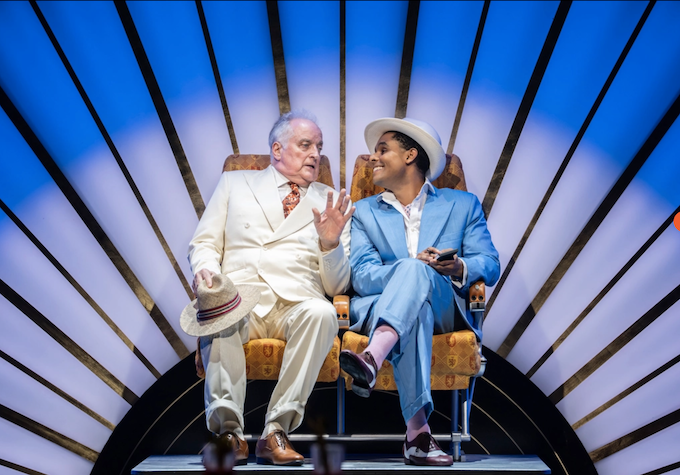
In Venice, Dale is still sure that the dancing star is Horace and goes to his hotel room to terrify him by coming onto him as a siren. However he laps it up. Horace is in the room and has to hide and we both thought the direction here needed to see some classic farces. More could be made of it, though the scene ender is a magic moment.

It is also a light comedy, with four comic acting roles, though they all have to sing and dance at some point. Horace and Madge are wonderful, though the show is stolen in comedy terms by James Clyde as Bates, the lugubrious valet, with an endless number of aunts and uncles to quote. He has to spy on Dale and goes through costumes including a dowager duchess and a gondolier.
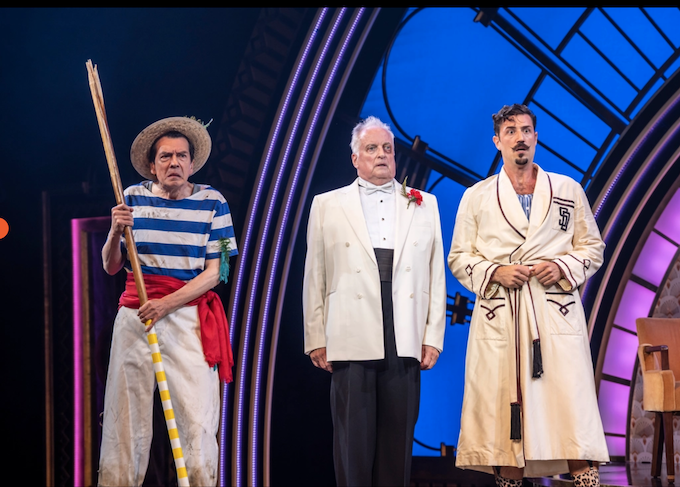
The quips and one liners are delivered with aplomb, and got plenty of laughs, but remember how old the story is. I don’t think there is a quip I hadn’t heard before, though Sally Ann Triplett as Madge delivers them so well she got gales of laughter and applause. BUT they are old and well-known. I don’t think the character of Alberto passes my ethnicity stereotyping theatre test. How would I feel if I were sitting next to an Italian friend? Answer: Bloody uncomfortable. So much so that I wouldn’t dare suggest an ice cream in the interval or a pizza afterwards. OK, the actor delivers the role superbly.
So marvellous dancing and singing is a given throughout. The athleticism is astonishing, they leap across barriers, dance on narrow platforms, leap up nearly three feet to platforms. Women dancers always say ‘And we have to do it in heels!’ and Lucy St. Louis has to do it riding boots at one point. (See below)
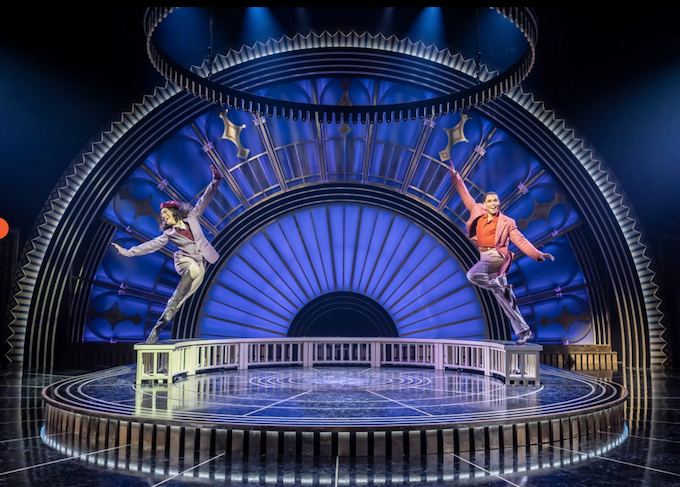
The main issue is that musicals changed in the 50s and 60s. A quantum leap? It was not enough to have dancers dancing as dancers or as people dancing in posh settings any longer. We had street gangs in West Side Story, rodeo cowboys in Oklahoma! Massed ukuleles in Half A Sixpence, tragic orphans, criminals and poverty in Oliver! Light comedy situations gave way to Nazis in Sound of Music, or military preparations in South Pacific. Top Hat is classic 30s musical, with classic choreography, expertly done, beautifully executed, but the word ‘innovation’ gets nowhere near it. This is a story about a dancer who dances in hotel locations where beautifully clad people also dance.
Karen disliked the mask-like standard one-size-fits-all ‘American’ make up on the ensemble dancers and thought costume unimaginative. She added that when the plot (I won’t spoil it) is resolved by Dale asking Alberto to make her a wedding dress, where is the wedding dress in the finale? Any provincial panto would have had that essential costume change. She also said that the dancers had brown tights in the scene with pink ostrich feathers and a few minutes later, fishnets in the top hat scene. She pointed out that changing tights fast on a hot day in a crowded area could have been avoided by using fishnets for both. I haven’t had to do that.
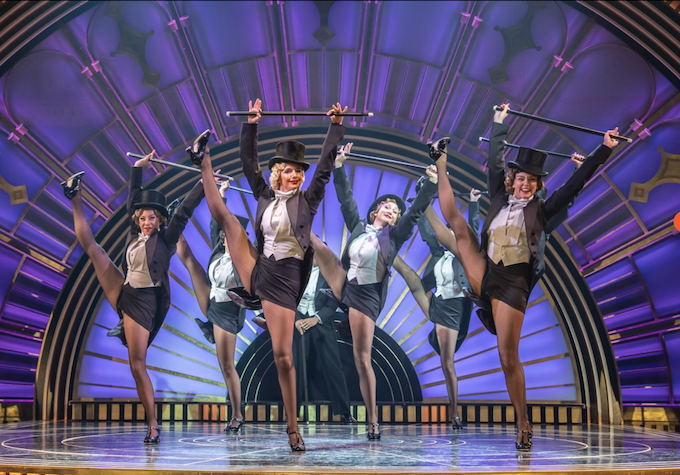
I liked the set with the revolve inner stage, but again Karen points out that the circular centre echoes the film, and Fred Astaire and Ginger Rogers do the same side-steps off the centre circle and back on. However good the choreography is, it gives us nothing new. Also, good as they are, neither lead quite ‘floats’ like Fred and Ginger. On the other hand, I’d say both sing better.
Five star performances and music, it looks superb in full colour rather than black and white. The live music is crisper, dare I say better? There are four of Irving Berlin’s Great American Songbook songs in here; Cheek to Cheek, Let’s Face the Music and Dance, Top Hat, White Tie and Tails, and Puttin’ on the Ritz. But not all the songs are that standard (or indeed, standards). Still four earworms is the most you expect from a musical and I woke humming putting on my top hat.
I’d go and see it again tomorrow with glee, and if it’s near you, I’m sure you’ll enjoy the show enormously, but I must compare it with Chichester’s magnificent run of five star summer musicals in recent years. This one, even if done as well as it possibly could be, betrays its earlier origins. There were better choices of musical: simply 50s and 60s musicals introduced more variety, in dance, in settings, in musical styles, so with regret, I’m going for three stars. Much is the fault of the original.
***
WHAT THE CRITICS SAID
five star
Patrick Marmion, Daily Mail *****
four star
Arifa Akbar, The Guardian ****
Clive Davis, The Times ****
Gary Naylor, The Arts Desk ****
three star
Dominic Cavendish, The Telegraph ***
Sarah Hemming, Financial Times ***
Paul Vale, The Stage ***
Alex Wood, What’s On Stage ***
LINKS
SALLY ANN TRIPLETT
Damsel in Distress, Gershwins, Chichester 2015
Alfred Hitchcock Presents: The Musical, Bath 2025
JAMES CLYDE
Timon of Athens, RSC 2018
Tamburlaine, RSC 2018
Tartuffe, RSC 2018
King Lear, RSC 2016 (Duke of Cornwall)
Cymbeline – RSC 2016 (The Duke, Cymbeline’s husband)
 Peter Viney's Blog
Leave a comment