
By Beth Steel
Directed by Bijan Shelbani
Set & Costume by Samal Blak
NT At Home
Broadcast 1 February 2024
Dorfman Theatre
National Theatre, London
January-March 2024
CAST
Lorraine Ashbourne – Auntie Carol
Lucy Black – Hazel
Lisa McGillis- Maggie
Sinead Matthews – Sylvie
Derek Riddell- John, Hazel’s husband
Ruby Stokes – Leanne, Hazel’s daughter
Philip Whitechurch – Uncle Pete, married to Carol, brother to Tony
Alan Williams – Tony, father of Hazel, Maggie, Sylvie
Marc Wooton – Marek
Bohdi Rae Breathnach, Maggie Livermore or Cadence Williams – Sarah, Hazel’s younger daughter
Many of the online photos are from a different production, with cast changes. I assume that’s the Theatre Royal Haymarket, because the surround stage looks like The Dorfman to me.
This is one we would have seen live five years ago, but by 2024 we started cutting right back on London theatres. Traffic, congestion and parking charges, totally unreliable trains, high seat prices, horrible cramped West End theatres (it went on to a West End run after the National) and ludicrously swinging hotel prices have made London theatre far less attractive, even at the National which has fairer pricing. Still it’s streaming in NT At Home, the greatest bargain of all if you love theatre. Reviewing NT At Home I’m conscious that it is accessible to all, and so readers can see it whenever. Plot spoilers become an issue. Clarification and comment are the thing.
It is takes place on one day, at a wedding. This is a ‘can’t fail’ option for comedy and drama. The elements are all in place, the preparations, the wedding dress, male v female difference in interest in the details, feuding families, excessive alcohol, sex, misdirected flirtations, the father’s speech. I recall ‘There’s always a punch up at a wedding’ as a line from the play.
What is different here is that it starts out as raucous, bawdy comedy, laden with laugh out loud lines, all from the women. It evolves, the sub texts start rising to the surface, and it ends up as full on impassioned drama. That’s a very hard trajectory to maintain, and it does so brilliantly.
It’s set in Mansfield, say the reviews. It was probably in the programme. I’d guessed Nottinghamshire correctly, and a run down ex-mining town. The mines are long gone, and now jobs, if there any, are stacking shelves in the warehouse.
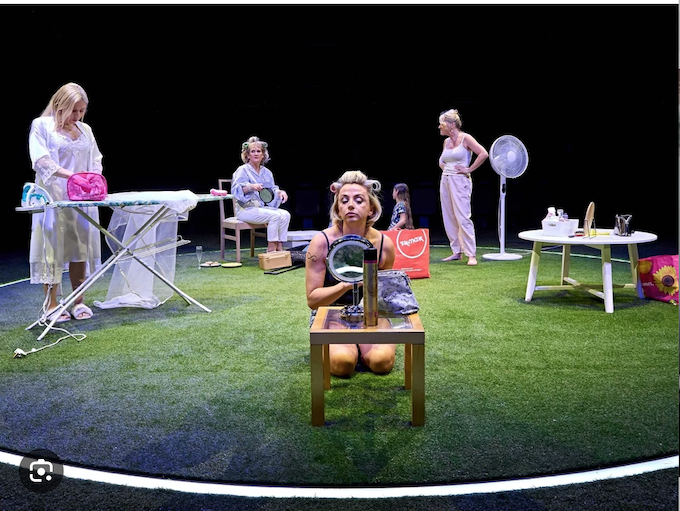
It opens with the women getting dressed and ready. Curlers, make up, ironing, getting into clothes. Hazel (Lucy Black) is the oldest. Maggie (Lisa McGillis) is the raunchy one who left town six months ago. Sylvie (Sinead Matthews) is the bride to be. Add Hazel’s daughters, phone addicted teenager Leanne (Ruby Stokes) age 14, and Sarah, about 8. Sarah is a child part so changes, but she can go into full screaming tantrum mode. Soon Auntie Carol (Lorraine Ashbourne ) will sail in and take over.
Sylvie is marrying Marek (Marc Wooton), a Pole. Casting makes her tiny and him huge and bearded. None of his family have come for the wedding, so he is a lone figure. The play centres on attitudes. At the dinner (I find wedding breakfast hard to type for an afternoon event) this comes out. Marek is a successful businessman, after arriving with sixty quid and doing shit jobs. He can’t eat pork, one job was an abattoir. Hazel’s husband, John (Derek Liddell), is unemployed and has little prospect of finding a job. Marek offers him one which Hazel rejects in fury. The house seems to be their dad’s. Tony (Alan Williams) is a widower. The girls mother died a few years earlier. It must be his house because their mum’s wedding dress is still upstairs.
Prejudice against immigrants is a theme. I would say Marek is a soft option, but then I’m a Southerner. There is very little or no anti-Polish feeling among the middle classes here at least. We benefitted hugely from Central European immigration. Maybe Central Europe didn’t, they lost many of their best. I was in Hungary in 1988, Poland in 1990. Their education systems were the thing that really worked in their systems. I’ve been in Hungarian and Polish secondary schools where the facilities then put ours to shame. We got the best-educated and most ambitious. When I say Marek is a soft option, I mean that in the 2020s, the immigration issue is Middle Eastern and African immigrants. Poles fit in Britain culturally. They’re European, Christian or agnostic. They generally speak excellent English. The tradition of Polish pilots in the Battle of Britain was remembered, I have friends whose dads were Polish aircrew. If Sylvie’s husband had been Afghani or Sudanese, you’d have a far edgier and more dangerous play, and wisely they didn’t go there. At a neighbourhood party, a Reform voter was railing against Muslim immigration, but stopped to say, ‘We need immigrants. But ones like Poles, Portuguese and Rumanians.’ Even the far right like them. So I think the play chickened out. However, it’s a run down town. Jobs are an issue. The working class get the impact of immigrants taking jobs. After Hazel insults Marek, Sylvie and him have a ding-dong argument. (It ends with a sex scene ion stage which is wildly realistic AND hilarious- try doing that!) He’s fed up with Hazel’s prejudice. Sylvie’s angry that his Catholic family didn’t attend the wedding. Marek has his say. I’ve heard that conversation many times. He worked hard, some English people are too lazy.
An aside. In 2024 we had our bathroom replaced. The company was Polish. The English plumber who had to certify work told me their work rate made him ashamed to be English. The Polish foreman (with an English wife, had been here nearly twenty years) said the reason they got work is they started at 8, finished at 6. They had frequent coffee (and came and asked us for it), ate a sandwich while working, went out for a cigarette three times a day. He compared the British. Arrive 8. Sit in van till 8.30 reading The Sun and having a sandwich. Break 10 to 10.30. Lunch 12-1. Break 2.30 to 3.00. Pack up at 4. Unfortunately, that’s accurate. He finished, ‘And they wonder why we get more building work.’ That’s Marek’s point. It should have been expanded. Our foreman also added that his kids, brought up here would have a much lesser work ethic. His grandkids one day would just be British.
The next theme is the family feud. Tony, father of the three sisters, has not spoken to his brother Pete for forty years. Pete is married to Auntie Carol, who is the centrepiece of much of the play. The wedding theme of precedence is universal. It goes back to the Bible. Pete and Carol have not been placed on the top table because of the feud, and Carol is not going to let that go. She moves their chairs to the top table. Carol is stroppy. She’s furious at the price and late arrival of the vegetarian option (for Leanne) and wants their money back.
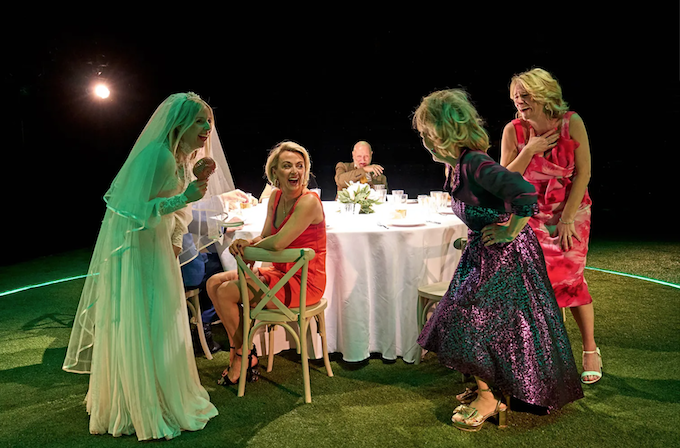
At the meal, Pete recites the long list of closed coal mines. Forty years feud? We realise that the feud begins in the miners’ strikes of the 80s which split families and communities. That strike was the halfway point between the end of World War Two and now. Pete was on the picket line. Tony crossed it. A scab. The miners versus Margaret Thatcher. In retrospect, the miners were on the wrong side of history. North Sea Gas was cheaper and cleaner. The miners had held the country to ransom several times. You have to have lived through the three day week of 1973 and constant power cuts. Thatcher was set on stopping it. Thatcher destroyed the miners union and mining, but forty years on, it turns out to have been an environmental necessity. But then it destroyed communities. She was, like it or not, on the right side of green history.
I often tell the tale of my mum and her sisters sent from depression South Wales to work in Bournemouth at age fifteen to send their wages back. The boys stayed. At my mum’s funeral, my uncle, an ex-miner listened to that story and told me, ‘But you know, the girls were the lucky ones. They got out. The boys got stuck. Believe me there is nothing nice, or good, or romantic about coal mining.’ That’s a feud that ends with elderly blokes fighting on the floor.
The third and most powerful theme is love. Maggie, married four times (but only to three men, she married one twice) left town six months earlier and hasn’t been back? Why? I can’t spoil the plot for you, but she fell in love with the wrong person. It was mutual. She left to eradicate it, but the wedding throws them back together. That is the extraordinarily powerful finale. I wondered why so many of the cast seemed hoarse. I know why. Extended shouting.
The characters are on the bigger side of large, but it works. Leanne, the fourteen year old, sets off the chain of events that leads to the end. We were so taken with these people that Beth Steel should consider.Leanne is fourteen? She could be married at eighteen. That begs a sequel set four years later.
****
WHAT THE CRITICS SAID

5 star
Arifa Akbar, Guardian *****
Sarah Crompton, What’s On Stage *****
Telegraph *****
 Peter Viney's Blog