
By William Shakespeare
Directed by Yael Farber
Set & Costume by Soutra Gilmour
Composer Max Perryment

Royal Shakespeare Company
Royal Shakespeare Theatre, Stratford Upon Avon
Thursday 24th July 2025, 13.15
CAST
Leontes, King of Sicily – Bertie Carvel
Hermione – Madeline Appiah
Polixenes, King of Bohemia- John Light
Antigonus- Matthew Flynn
Paulina – Aicha Kossoko
Emilia – Hilda Cronje
Camillo – Raphael Sowole
Time / Autocylus – Trevor Fox
Perdita – Leah Haile
Florizel- Lewis Bowes
Shepherdess – Amelda Brown
Clown (Young Shepherd) – Ryan Duval
Jailer / ensemble – Richard Sutton
Mover / ensemble- Mkiyah Page-Gordon
Ensemble – Gavin Dunn
Songstress of Bohemia / Dancer / ensemble – Rhianna Compton
Dancer / ensemble – Rakhee Sharma
Dancer / ensemble – Chihro Kawasaki
MUSIC
Lindsey Miller- keyboard, accordion, vocal
Violin, vocal- Tonny Shin
Cello / vocal – Ailsa Mair Fox
Guitar- Nick Lee
Percussion – Kev Waterman
We bought the programme the night before. I wish I hadn’t read it. There is an essay by dramaturg Drew Lichtenberg which is the sort of complicated background stuff that puts kids off Shakespeare. It links all of it to Greek myths – which I assume you are supposed to know. So we must remember that Autoclycus, the trickster was a legendary thief and the son of Hermes and a mortal, and of course it is Hermes that leads Demeter to Persephone. Pygmalion invented a living statue. Then they have deleted Shakespeare’s Time speech which opens the Bohemia sequence in act 4, and replaced it with a choral ode from Bertolt Brecht’s The Antigone of Sophocles. Replacing Shakespeare with Brecht? WTF? It’s like moving a Division 2 player into a Premier League team for me.
Then although Shakespeare references Sicily / Sicilia in three plays, he would not have known it was an arid but fertile waste, nor what Mount Etna did, nor that you can cross Lake Peruvia on foot. Remember, this is after all a man who thought Bohemia had a coastline in this play. I read that pretentious programme article and wondered if we could cash in our tickets. After his notes, I had no desire to see it. Then I read that it was a sci fi dystopia in the next article. BUT …
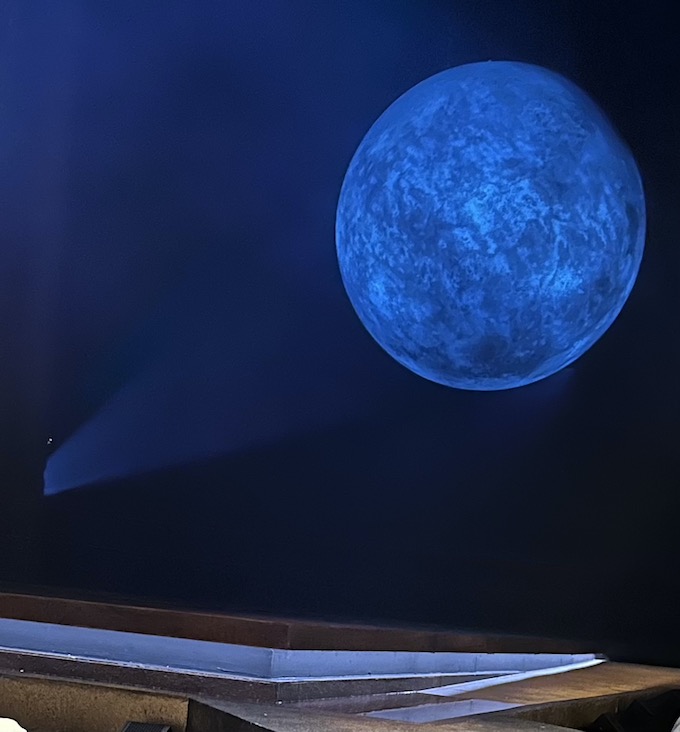
For the first few minutes, my negativity was reinforced. A great big globe dominated the set which had water around the outside. The costumes were aggressively boring nondescript grey. People wafted about portentously. Time trudged dolefully around the paddling pool surround. Pretentious, μου? I thought. (Sorry, I have no idea whether it’s μου or με. It’s all Greek to me.) The globe will be blue or black for Sicilia, then red for Bohemia (Act IV), then black for the return to Sicilia (Act V), where costumes switch from grey to black too. Right at the end, the projection starts to revolve and reveals the Earth- Australia and New Zealand. There are two separate revolve stages, constantly turning in some scenes.
Then I realised that this production was extremely hard to review or rate. My thoughts swung from one star to five star and back again. I was thinking, this is the heavy, serious Almeida style (where the director Yaël Farber really made her name) rather than the more populist RSC style. They solved the play’s major problem: how do you move from the tragedy in Sicilia to the rustic comedy in Bohemia? Is it a tragicomedy? They solved that by eliminating virtually all the comedy – they had to keep Autolycus picking pockets, but the shepherds weren’t funny. Autocylus doubling as Time wasn’t funny. The rustics weren’t comic at all.
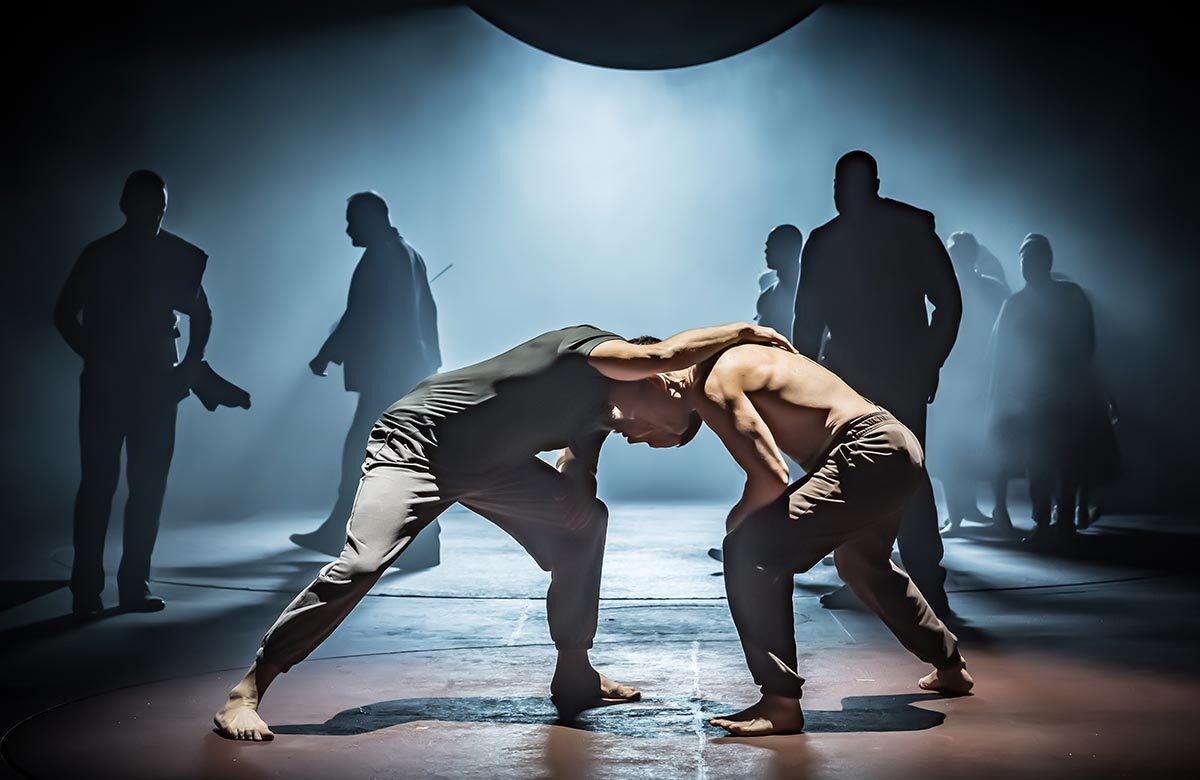
They open dramatically with Leontes, King of Sicilia, wrestling with his sweaty bare chested friend, Polixenes, King of Bohemia. It’s all slightly homoerotic in their relationship.

Some negatives came in. John Light as Polixenes seemed to be making up for the several minutes delayed start by speaking at breakneck speed. He had a head mic, so there was no problem hearing, and diction was clear, but he was much too fast. There is a point in learning a script where speed assists you, then as you get used to it, you can put ‘air’ back in. Was it that? He looked great in face and gesture. Let’s say he was channeling the greats of the past – if you watch old Olivier films he was much faster than modern actors. Gabbling, I call it. Clipped RP enables speed too.
It’s heavily cut- you need extra time for “Time” to trudge about lighting cigarettes. One result is that Leontes’ unfounded suspicion that Polixenes had been the one who impregnated the heavily pregnant Hermione comes very soon. Leontes escalates to full on fury very quickly and stays at that extreme level. Again I was lost, was Bertie Carvel the angriest Leontes ever, or was he over-acting wildly? I’m still not sure, but I’ll go for ‘angriest ever.’ Certainly a stunning performance either way.

I wasn’t too happy with blocking (there’s a pedestrian thought about such an artistic enterprise). We were stalls, stage-left and there were several dialogues there where Hermione or Polixenes had their backs square to us while speaking. I decided that the trudging Time was a Brechtian character with a touch of Tom Waits.
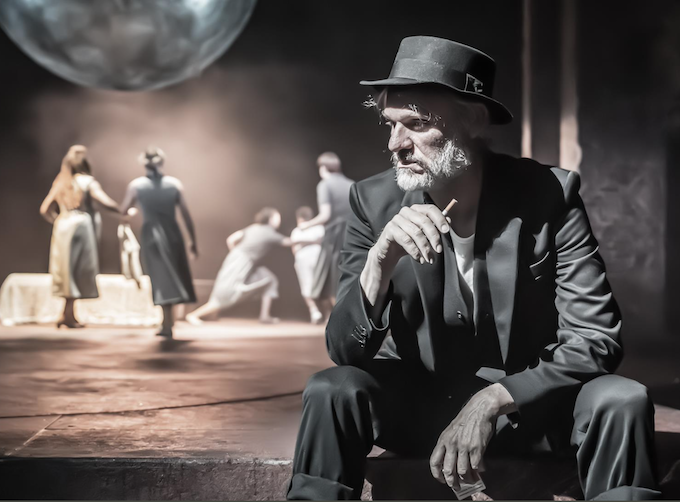
Trevor Fox (as Time) ended up sitting on the stage-left corner for some time, totally obscuring our view. In the background, many of the cast stay on, either wafting about, freezing, or forming tableaux. The amount of people standing stock still freezing rather points to that final statue scene. Did they have freezing workshops?

Leontes is getting more angry and vengeful, and tells Camillo to murder Polixenes. Camillo declines, and instead warns Polixenes and they flee together, with Camillo now in Polixenes’ employ.

As you get to the trial of Hermione, you realise why you need a large ensemble as a chorus. They sit hands clasped, heads bowed watching (or trying not to watch), in uniform grey clothes, very much The Handmaid’s Tale.
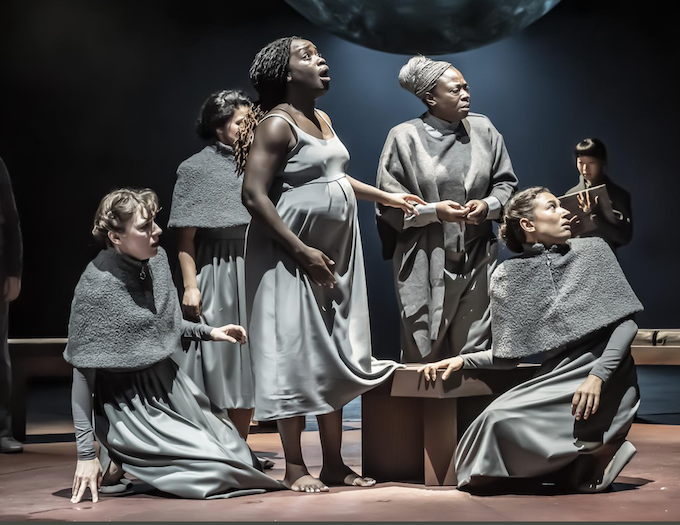
Women are powerless before the King’s fury. The King is the all powerful dictator, ready to believe and act on his own wild fantasies. There’s a lot of that about politically in 2025. I was warming to the production quite quickly by now.
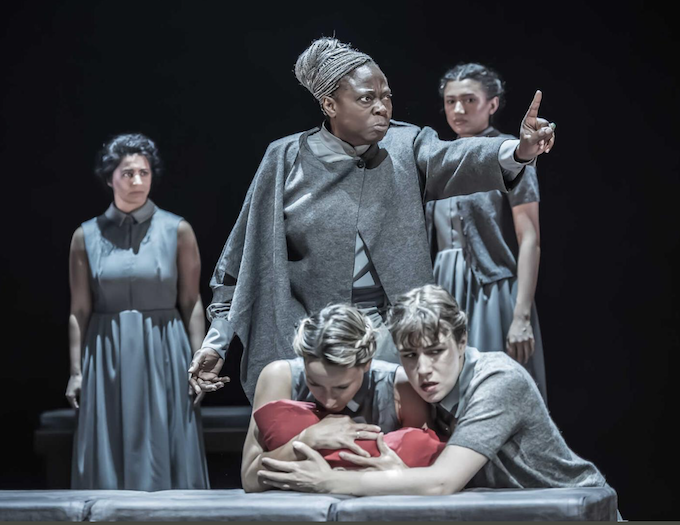
After the trial, we get the powerful scene where Leontes tosses the baby around, then Paulina tells Leontes what she thinks. Aicha Kossoko as Paulina is not someone you would dare mess with. She gives a towering performance in spite of Leontes’ threats. It’s at this point another thought comes. Many productions nowadays are colour blind. This isn’t. (Can I just use white and black for a change?) Leontes is white. Hermione is black,. Mamillius and Perdita, their children, are both mixed ethnicity. That leads to another point, remembering that the director, Yaël Farber, is South African. The “good” characters: Hermione, Paulina, Camillo are played by particularly strong black actors. Is this deliberate? It works. We both noted it.

But there is another good one, Antigonus, charged with disposing of the baby. He arrives in Bohemia (on its beach) crawling through the water in a sou-wester. It starts snowing (shades of Kenneth Branagh’s production). Both take the ‘winter’ a little too literally.
I keep hoping for a real bear for ‘exit pursued by a bear’ having seen projections and bear suits. We’re not going to get it though I am sure Shakespeare used a real bear. This is a new one. In the far background, Hermione stands in shadow, and puts on a bear’s head. There is no production photo, but it is the programme cover:
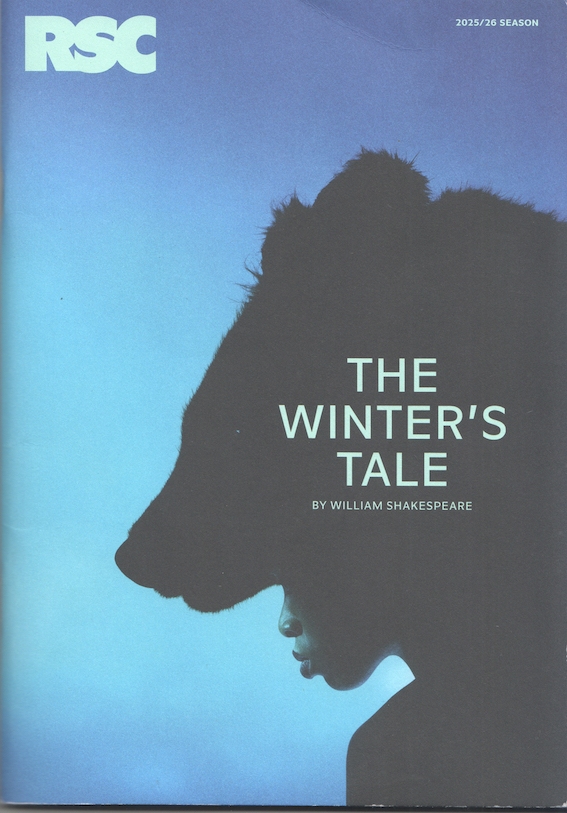
She never moves, practising her later statue perhaps. Just stands at the back. Protecting the baby? Dunno.

The shepherds arrive, but there is not the usual comic bit. Or if there was, it wasn’t funny.
The interval, and we are wondering what they will make of Bohemia. After all, we’ve gone through 75 minutes with nary a titter. We had been aware of music trembling under lines. Violin and cello walked around as part of scenes, often plucking as a quiet accompaniment to lines. In the second part, the music really came into its own as a powerful and integral part of the play.
The second part begins with a full on and tremendous drum solo. They’re going for dance – not the bucolic Morris dance style either. Sixteen years have passed.
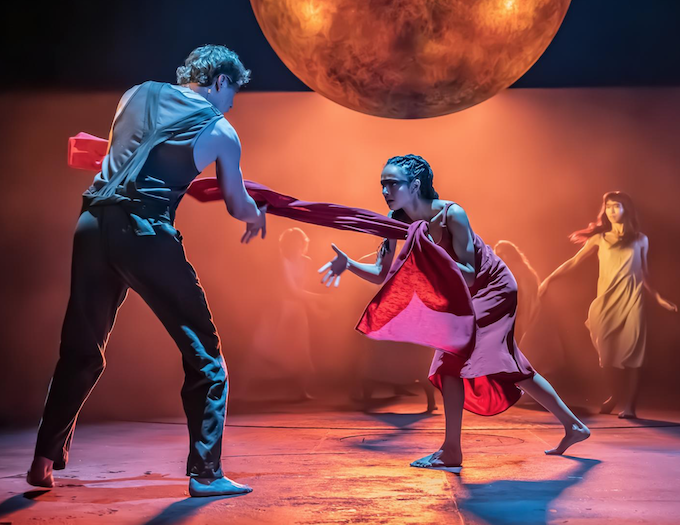
Florizel and Perdita are covered by a red blanket and emerge in a state of undress. Well, that happened in rural areas. They go into dance. Music and dance will replace comedy. I’m up for that. The globe is red, the lighting is brighter. All the women are in thin shifts with odd red stains here and there.
As with so many of Shakespeare’s clown parts, they are best seriously updated. Jokes were current at the time and can fall as flat as a pancake. Two years ago, the Wanamaker (Sicilia) / Globe (Bohemia) production almost totally abandoned the script in favour of impro. Trevor Fox as Thief of Time / Autolycus is one of the most experienced Shakespeare clowns of recent years, with his Geordie accent enhancing it. We have seen him as Jacques in As You Like It, Stephano in The Tempest, Pompey in Measure for Measure, The Porter in Macbeth, Pisano in Cymbeline. He gets to pick pockets for the only laughs of the night and then does a turn selling ballads.

He gets to deliver a speech which I can only describe as Tom Waits does Rap to percussion. Five star moment. There is also a very good song from Rihanna Compton. Linguistically, I wondered why, as the word ‘actress’ causes such furore, why we had a Shepherdess, and why Rihanna was a ‘Songstress of Bohemia’ in the programme rather than a non gender-marked ‘Singer of Bohemia.’
Polixines and Camillo (in disguise) come on early in the revels to cast a suspicious father’s eye on what (Prince) Florizel is doing with the supposed daughter of a shepherdess.
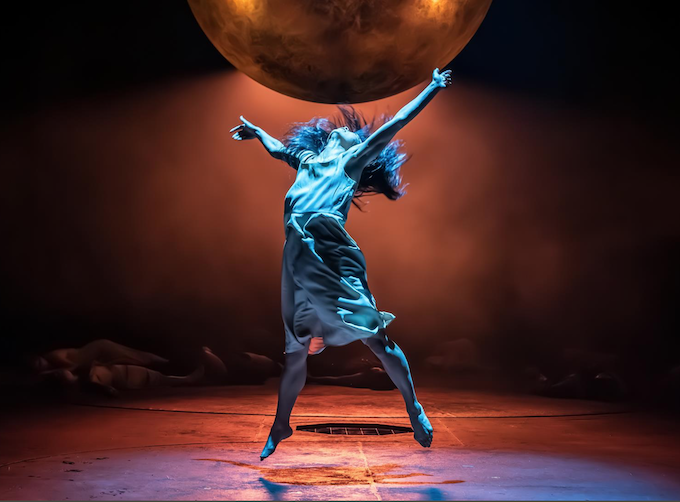
The absolute highlight of the play is during the Bohemian revels when Chihro Kawasaki, cast as a dancer, does a ‘fire dance’ to the band plus plumes of fire leaping from the stage.
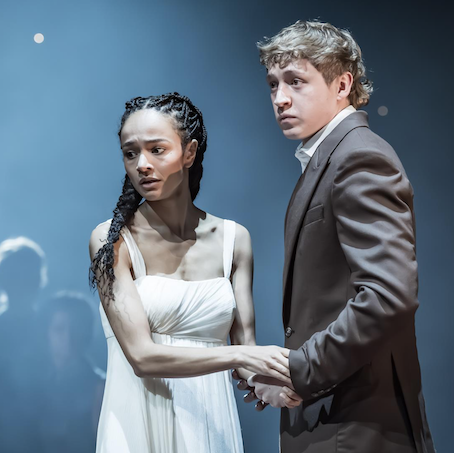
We have a very young looking Perdita and Florizel, which helps the plot. When they return to Sicilia, Autocylus / Time narrates the story of how it was all worked out, sitting on a bench with our omnipresent violinist and cellist accompanying him.
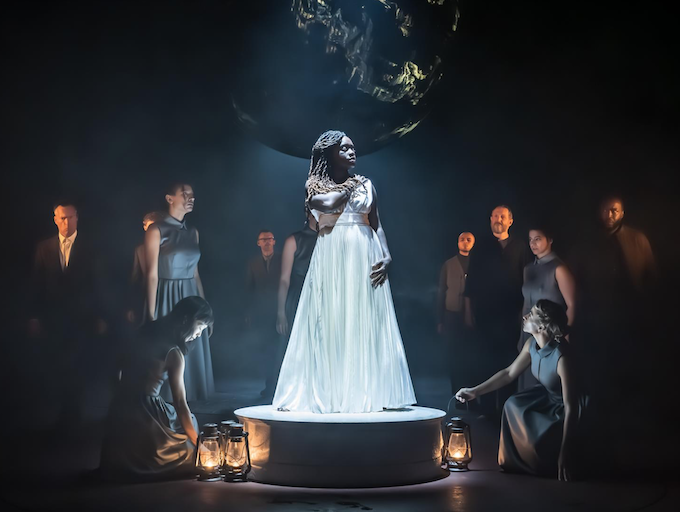
The “statue” of Hermione scene is played at full length (I think). She ascends in a swift black out on a stage lift and then does a perfect statue, on a platform at the front of the thrust stage in full light. No lurking at the back in half light for this one.
Karen’s instant response was four stars. She found it raw and violent, reflecting today’s world situation, and that the mythic comparison was apposite, especially the air of hope in the ending. (She also thought the programme essay pretentious). I said I could see some giving it five and others two. It kept our attention, threw a new light on the story and had us discussing it at length. In the end, they won me over and I think four stars is about right.
****
WHAT THE CRITICS SAID
They hadn’t when we saw it. They had the night before but none had been published.
4 star
Dfiza Benson, The Telegraph ****
Libby Purves, Theatre Cat ****
3 star
Arifa Akbar, The Guardian ***
There is a fuzziness to the storytelling. This modern-dress production is all smoke and shadows, unmoored from a specific time or place, so it is harder to contextualise its themes. More specifically, some scenes are vague, such as Antigonus’s pursuit by a bear which is dealt with symbolically – a static figure takes off the mask to reveal herself as Hermione. It is beautiful but unclear.
Michael Davies, What’s On Stage ***
Graham Wyles, Stage Talk ***
Dave Fargnoli, The Stage ***
LINKS ON THIS BLOG
THE WINTER’S TALE
The Winter’s Tale – RSC 2013
The Winter’s Tale – Branagh, Kenneth Branagh Company, 2015
The Winter’s Tale – Wanamaker Playhouse, 2016
The Winter’s Tale – Cheek by Jowl on tour, Bath 2017
The Winter’s Tale – Globe 2018
The Winter’s Tale, RSC on BBC4, 2021
The Winter’s Tale, Wanamaker & Globe 2023
The Winter’s Tale, RSC 2025
YAEL FARBER
The Crucible, Old Vic 2014
BERTIE CARVEL
Strife, by John Galsworthy, Chichester Minerva 2016 (DIRECTOR)
Bakkhai, Almeida 2015 (ACTOR)
MADELEINE APPIAH
The Duchess of Malfi, Old Vic 2012
Macbeth, RSC 2011
TREVOR FOX
As You Like It, RSC 2024 (Jacques)
Macbeth, National Theatre, 2018 (porter)
The Tempest, Wanamaker Playhouse 2016 (Stephano)
Cymbeline, Wanamaker Playhouse, 2015 (Pisano)
Measure for Measure, Globe 2015 (Pompey)
LEAH HAILE
Pericles, RSC 2024
AMELDA BROWN
First Light, Chichester 2016
AICHA KOSSOKO
Private Lives, Nigel Havers Company 2021
RAPHAEL SOWOLE
Romeo & Juliet RSC 2018 (Tybalt)
Macbeth, RSC 2018 (Banquo)
Pygmalion, Nuffield Southampton 2016
Measure For Measure, Young Vic 2015
 Peter Viney's Blog