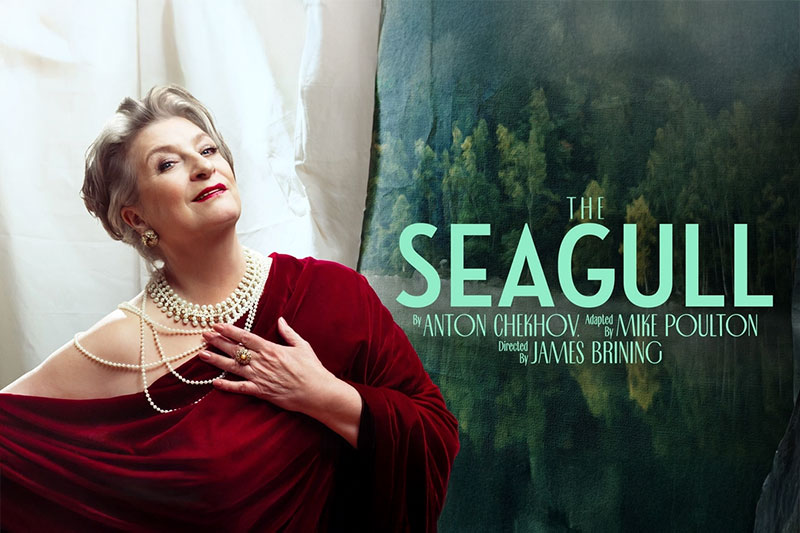
By Anton Chekhov
Adapted by Mike Poulton
Directed by James Brining
Set design by Colin Richmond
Composer & sound design Michael John McCarthy
A Royal Lyceum Theatre Edinburgh production
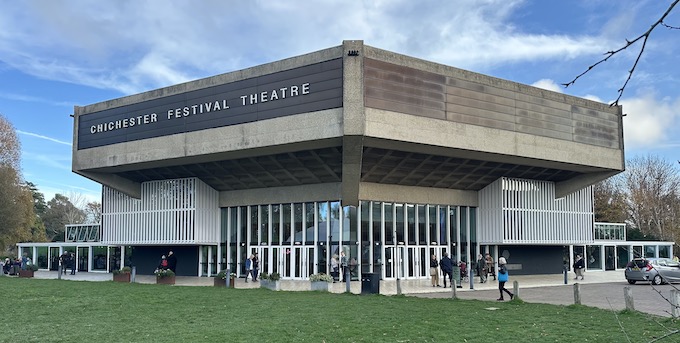
at
Chichester Festival Theatre
Saturday 15th November 2025, 14.30
CAST
Caroline Quentin – Irina Arkadina, famous actress. Age 43
Lorn Macdonald- Konstantin, her son. Age 25
Harmony Rose-Bremner – Nina, Konstantin’s girlfriend
Dyfan Dwyfor- Trigorin, famous novelist, her lover
John Bett- Sorin, her brother, owner of the estate, Age 60
Irene Allan – Polina
Tallulah Greive- Masha – daughter of Polina, Age 22
Steven McNicoll- Shamrayev, estate manager, second husband of Polina
Michael Dylan – Medvendenko, a school teacher
Forbes Masson – Dr Dorn
Krisatian Lustre – Yakov, the servant
This production started at the Royal Lyceum in Edinburgh, then moved 450 miles to Chichester for just a week. There doesn’t seem to be an extended tour and you have to wonder how worthwhile it was designing a set to fit both of the theatres then transporting it that far, though Chichester is a large theatre and was full downstairs. Still, perhaps it marks an era of co-operation between the two. The Royal Shakespeare Company The Constant Wife is also coming to Chichester soon.
The trouble with reviewing The Seagull is you never see the same version twice. The list of adaptors is long. Even by 2004, twenty-five had appeared. The list of adaptors include Tennessee Williams (who retitled it), Michael Frayn, Tom Stoppard, Christopher Hampton, David Hare and now Mike Poulton. I assume most work from a literal translation by a Russian, and to be frank, Chekhov is out of copyright. A new adaptation has copyright so royalties. So re-adapt every time you put it on. I’ve had to put ‘Poulton’ in brackets because it’s one of FOUR different UK productions in 2025.
Ornithologists get worked up over the title. It was Cháyka which means ‘gull’ and covers seabirds and fresh water gulls. In Russia, it would have been a bird that returned to Masha’s inland freshwater lake and flew high and free. So not a seagull. Gull is too short for a title, and you have to gull meaning to cheat or deceive. Duck! sounds like Mind your head! and while geese are majestic flyers, in the singular goose is a rude grope. So it’s The Seagull. Live with it. In this version, the dead bird is huge which made me think of an albatross, and killing one is bad luck.
This one is set in 1890s Russia, as Chekhov imagined it. It’s a play that people love to update, so that’s unusual.
Mike Poulton: My own approach is to trust Chekhov and make no unwise attempt to ‘modernise’ his settings in a pointless and fatuous attempt to make his plays ‘relevant.’
The enduring appeal of The Seagull is the blend of comedy, romance and tragedy, together with its comments on theatricality. Add the parallel Hamlet theme. The tortured Konstantin as Hamlet, Irina as Gertrude, Trigorin as Claudius. Then add Shakespeare quotes. In true Russian tradition the play flopped on its original stage performance, was revived (by Stanislavski) and was a huge success. Compare The Rite of Spring, The Bath House.
Do you need a very brief outline? If you must: Irena the actress is visiting her brother’s estate, where her son, Konstantin is putting on an avant garde play in the garden with Nina playing the single role. , Irina, arrives with Trigorin, a famed novelist and her lover. He is the same age as her son. The play is lampooned. Konstantin is distraught.
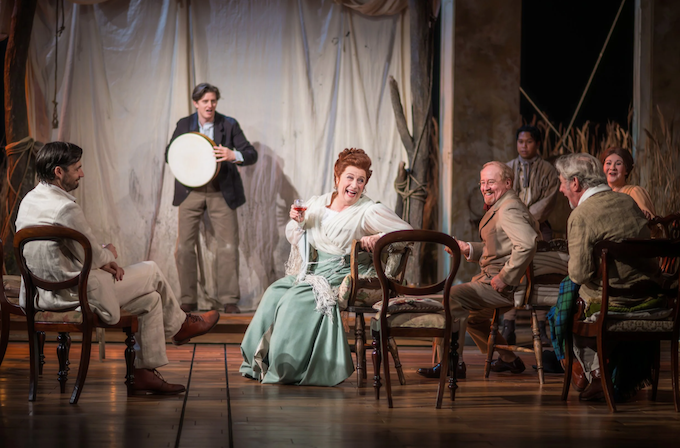
OK, deep breath. The schoolteacher Medvendenko loves Masha , who loves Konstantin, who loves Nina. Irina loves Trigorin, who it will turn out loves Nina. Polina loves Dr Dorn. Dr Dorn loves anyone available.
Masha has lived by the lake. Her mother Polina, has remarried, to the estate manager. Konstantin shoots a highly symbolic seagull, which is later stuffed at Trigorin’s request. Unlike the noble Dane, Konstantin is decisive on the issue of being or not being, and tries to shoot himself, but only cuts a groove in his temple.
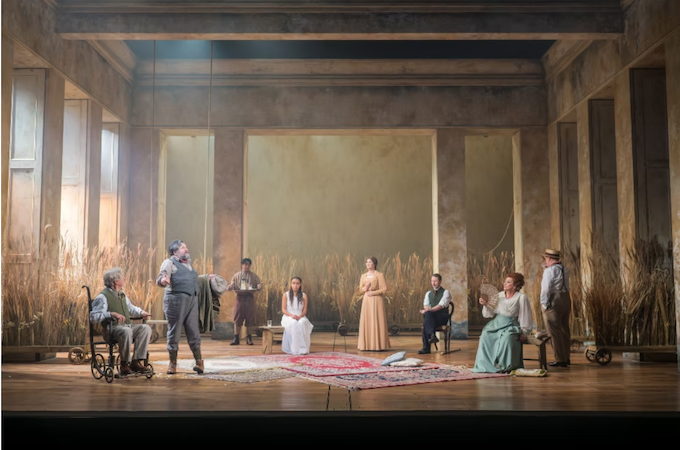
The comic highlight is that Irina is furious at Trigorin’s interest in Nina, and decides to go back to Moscow, only to find all the estate horses are working in the harvest, including the fine carriage horses. That’s a row with Shamrayev, the estate manager.
Part two changes the scene from exterior to interior. Trigorin is making his play for Nina. Impassioned dialogue scenes abound.
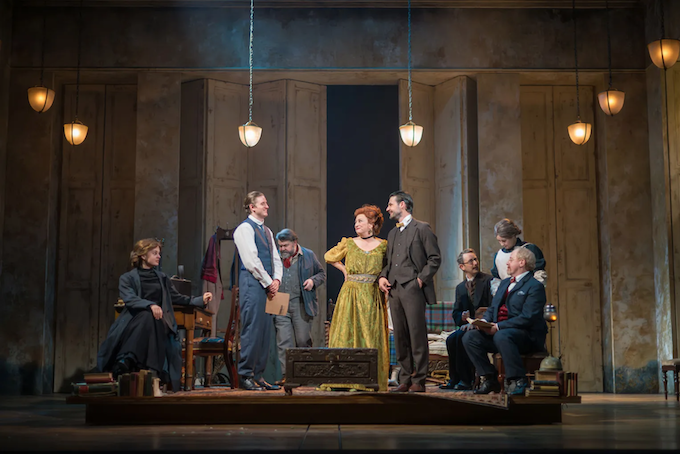
We move to the final act, two years later. We hear in report that Trigorin and Nina escaped Irina and ran away, where Nina had a baby that died. Trigorin returned to Irina. They are all at the estate. Nina turns up, battered by life as an actress touring provincial theatres. There is a long scene with Konstantin and Nina. Konstantin has to pretend to be friendly to Trigorin. Konstantin goes off and … this is a Russian play … so obviously there is a gunshot. The end.
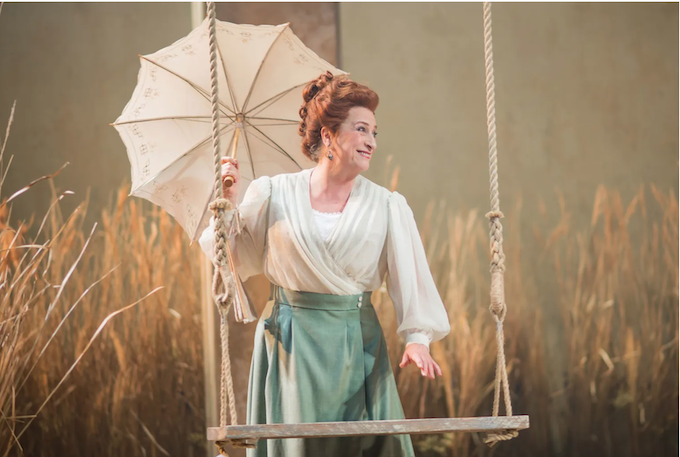
Mike Poulton says in the programme that his inspiration was to write for Caroline Quentin as Irina Arkadina, and John Brining as director. He got it. Caroline Quentin’s interpretation is the key to the production. No one does aside facial expressions and grimaces like Caroline Quentin. I see his point. I think she is the perfect Arkadina. Other productions have had her as operatically superior, a prima donna. Not Caroline. She plays it as self-absorbed but above all, a very popular ‘salt of the Earth’ showbiz star. It brings out the comedy better this way.
Most of the cast have light and mild Scottish accents. Lorn Macdonald does the tortured artistic soulful Konstantin just as I imagine him too.
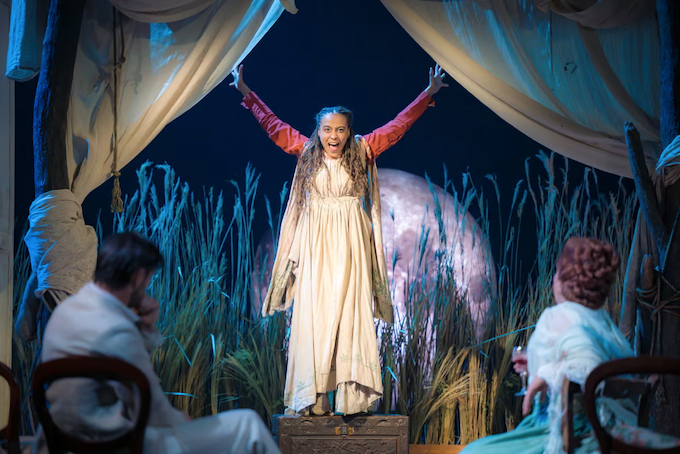
The play within the play is truly dire, set 200,000 years in the future. Harmony Rose-Bremner again does it beautifully. I’d quote some lines, but I only have two texts, one ancient and one David Hare (though in my memory her monologue isn’t much different). The pleasure for me is that Chekhov, writing in the mid 1890s and lampooning avant-garde theatre, predicted Mayakovsky’s The Bathhouse over thirty years later. That has the Phosphorescent Woman arriving from 100 years in the future. I have seen it. It is utterly dire. At least, at the end, the lead character doesn’t commit suicide for a change. Though four days after it flopped, Mayakovsky did.
My one question is the character of Trigorin. Dyfan Dwyfor gives a fine performance, but it’s the interpretation within the whole. This is traditionally the male star part. Stanislavski played him, as did John Gielgud, Bill Nighy, Gerald Kyd, Tom Burke. When you have the operatic diva as Irina Arkadina, then Trigorin is the exploiter, and as a writer a cross between Jeffrey Archer and Gyles Brandreth. In other words, you can get some comedy from the preening and pompous nature of the role. Here Trigorin is a straight part. In the balance, I see why. You can’t have Trigorin competing with Irina for the laughs.
John Bett was Sorin, the owner of the estate. He is elderly and infirm – after all he’s sixty. Dr Dorn wonders what he expects at such an advanced age. John Bett plays it to the hilt, stumbling and being caught a few times. Stressing that ‘sixty’ caused much laughter at a Chichester matinee, where being sixty would place someone in the younger third of the audience.
It all worked well. Tallulah Greive as Masha was outstanding, dressed in black, very 21st century too. Steven McNicoll as Shamrayev the estate manage was a shambling thug, and very funny. The first part ended with Forbes Masson as Dr Dorn and Masha duetting on a folk song. A well-known one too, and it’s on the tip of my tongue, so I’ll repeat my old cry. If a song takes up stage time, why is it not credited?
It’s Russian, so names are an issue. The full names are to be avoided, there is no need: Irina Nikolayevna Arkadina, Ilya Afanasyevich Shamrayev, Yevgeny Sergeyevich Dorn, Semyon Semyonovich Medvedenko, Nina Mikhailovna Zarechnaya. The Headlong version may have shortened them too much: Boris, Irena. Poulton and David Hare get it about right, though Hare does have the odd ‘Konstantin Gavrilovich’ and then Boris Alexeyevich for Trigorin.
The mood changes in Act 4 to tragedy, and it’s depressing. As I said in previous reviews, one welcomes the final gunshot. The gunshot itself was a disappointment. The text has Dr Dorn explain it away by saying a bottle exploded in his medicine chest and goes to check. So it’s realistic, but basically you get a plop rather than a dramatic gunshot.
Overall: ****
WHAT THE CRITICS SAID (Edinburgh)
5 star
The Herald *****
Arts Review Edinburgh *****
4 star
Mark Fisher, The Guardian ****
Simon Thompson, What’s On Stage ****
The Scotsman ****
3 star
Fergus Morgan, The Stage ***
Kerry, Theatre & Tonic ***
LINKS ON THIS BLOG
CHEKHOV
The Seagull by Anton Chekhov, Headlong / Nuffield Theatre, Southampton
Young Chekhov Season, Chichester 2015
* The Seagull (adapted by David Hare)
* Platonov (adapted by David Hare)
* Ivanov (adapted by David Hare)
Uncle Vanya (adapted by David Hare), Bath Theatre Royal 2019
Uncle Vanya (adapted by Conor McPherson) 2021 and streaming
MIKE POULTON adaptor / dramatist
The Other Boleyn Girl, Chichester 2024
Wolf Hall, by Hilary Mantel, RSC West End 2014
Bring Up The Bodies, by Hilary Mantel, RSC West End 2014
Fortune’s Fool by Ivan Turgenev, Old Vic 2014
The Syndicate by Eduardo de Filippo, Bath 2011
CAROLINE QUENTIN
Mrs Warren’s Profession, by Shaw, Bath 2022
Jack Absolute Rides Again, Richard Bean Oliver Chris, National Theatre 2022
The Provoked Wife, RSC2019
The Hypocrite by Richard Bean, RSC 2017
Relative Values by Noel Coward, Bath Theatre Royal 2013
Me & My Girl, Chichester, 2018
FORBES MASSON
Much Ado About Nothing, Jamie Lloyd Company 2025
The Taxidermist’s Daughter, Chichester 2022
Bartholomew Fair, Ben Jonson, Wanamaker Playhouse 2019
The Merry Wives of Windsor, Globe 2019
Boudica, Globe 2017
Travesties, Menier, 2016
A Midsummer Night’s Dream, Bath 2016
The Ruling Class, Trafalgar Studio, 2015
Richard III, Trafalgar Studio, 2014
 Peter Viney's Blog
Leave a comment