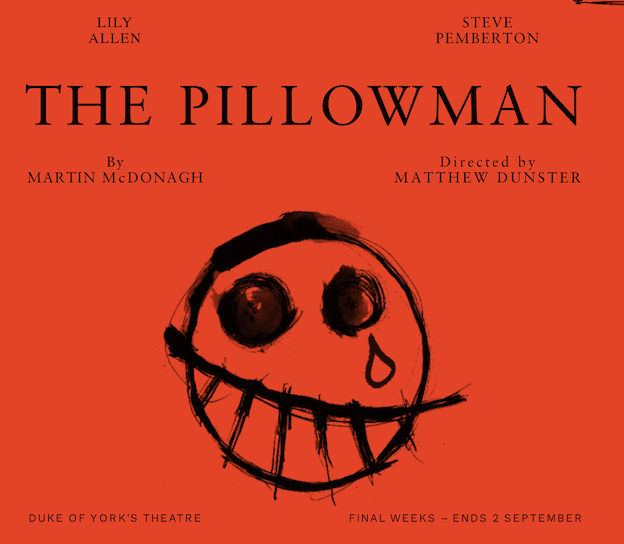
By Martin McDonagh
Directed by Matthew Dunster
Production Design by Anna Fleischle
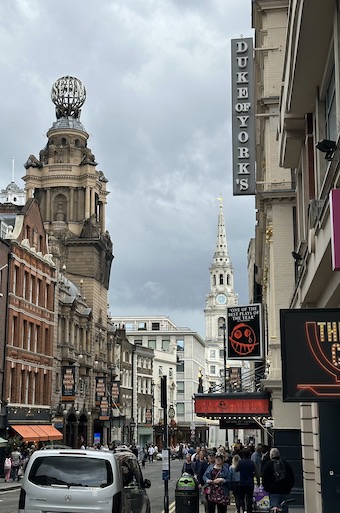
The Duke Of York’s Theatre, London
Saturday 26th August, 14.30
CAST
Lily Allen – Katurian
Steve Pemberton – Tupolski
Paul Kaye – Ariel
Matthew Tennyson – Michal
Rebecca Lee- mother
Daniel Millar- father
David Angland- blind man
Various children depending on the day.
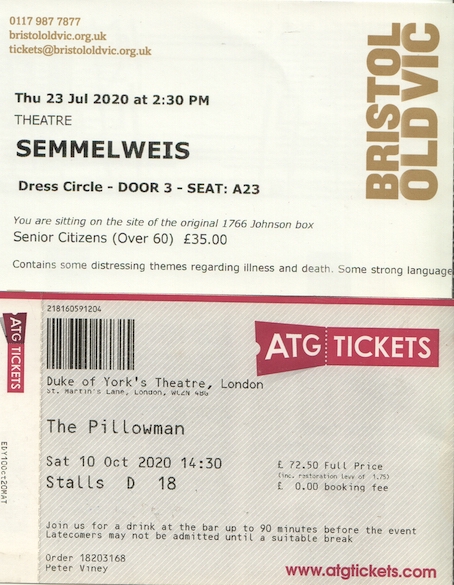
This is another play this weekend for which we had pre-Lockdown tickets, the other being Dr Semmelweis. After months of hearing nothing, ATG assigned us the same seats for The Pillowman on a Saturday afternoon, just as before. We probably wouldn’t have chosen late August for London, but there you go. Or there we went, and booked Semmelweis for the evening before.
This is a 2003 play which starred David Tennant twenty years ago, when it was hailed as a modern classic.
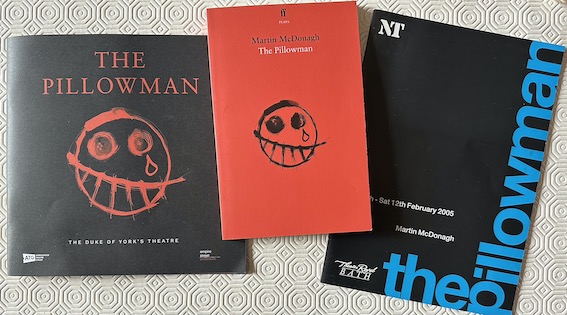
We have seen it before, and it’s one of the reasons why I started this theatre review section. We were sorting out our programmes before a previous McDonagh play, and there it was. It was the 2005 National Theatre tour, which we saw at Bath, probably selected after seeing the original Lieutenant of Inishmore at The Other Place in Stratford. It was a National Theatre tour, but they had a new cast. Jim Norton was Tupolski, Lee Ingleby was Katurion and Ewan Stewart was Ariel. I have almost zero recall of that production though Karen said in the interval, ‘It’s all coming back.’ It wasn’t to me. I’m like Ani de Franco’s goldfish swimming in circles around the bowl with no memory so the little plastic underwater castle is a surprise every time. Yet I can remember every play that I’ve reviewed. So that’s why I review.
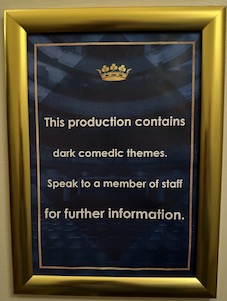
It may surprise some people that a ‘black comedy’ contains ‘dark comedic themes’ though we spoke to a couple of people who were there as Lily Allen fans rather than Martin McDonagh devotees.
The black comedy of Joseph Heller’s Catch-22 is referenced in calling the writer / prisoner Katurian Katurian Katurian, just as a character in Catch-22 is Major Major Major.
The role of Katurian is switched to female as Lily Allen takes over the role. In a way that’s an improvement. She doesn’t get an easy critical ride, most unfairly. We thought she was brilliant. It’s Martin McDonagh. A range of critical views is expected and it certainly got it. It’s violent with disturbing stories told within it plus a great deal of effing and blinding.
Katurian is a writer, with just one published story out of hundreds she has written. Some of these stories are about abused children and are extremely nasty. They apparently date back to McDonagh re-writing grimmer Grimm’s fairy tales for amusement, as did Angela Carter. We will see some of the stories acted out in mime in a different set. The ‘alternative pied piper’ story is highly memorable in its own right. However, the Three Gibbets is derived. Is it a Nasreddin story rewritten?
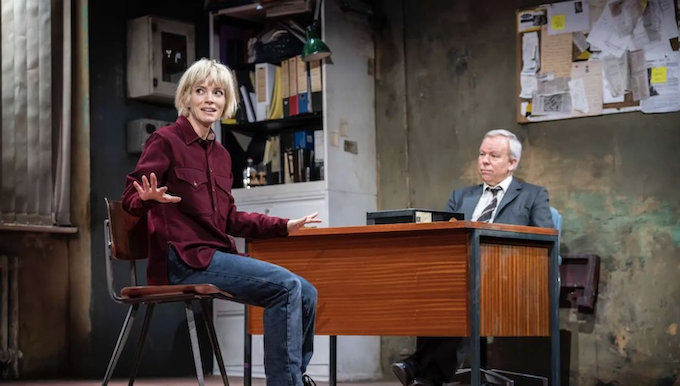
The play opens with her in an interrogation room with Tupolski (Steve Pemberton), the chief detective, and the extremely violent Ariel (Paul Kaye) as interrogators. Katurian’s brother, the retarded Michal (Matthew Tennyson) is in a room next door.
Ariel is a torturer. Katurian does not know what she is accused of, but they have her stories and quote them. She hears Michal screaming after Ariel goes to the room next door.
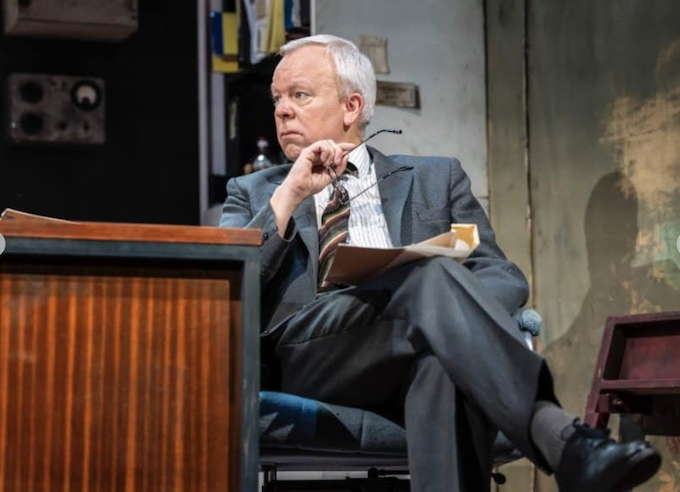
Katurian: You said he would be fine. You gave me your word.
Tupolski: Katurian, I am a high-ranking police officer in a totalitarian fucking dictatorship What are you doing taking my word about anything?
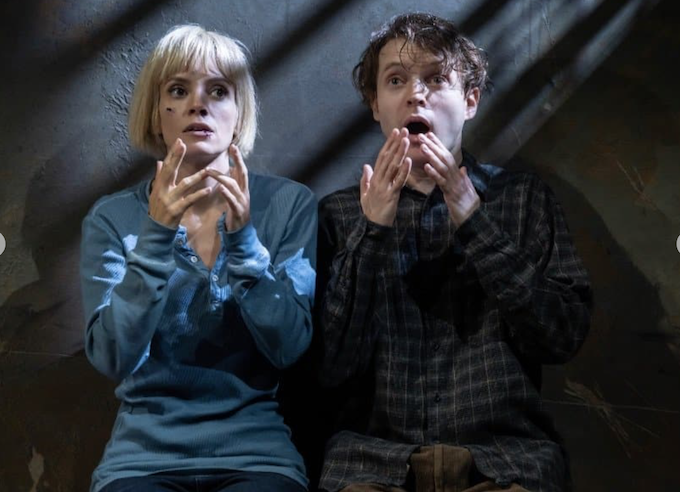
In Act Two, in Michal’s cell, we discover that three children have gone missing and then two of them have been found dead, killed in ways which appear in her short stories. Or at least they’ve been told that. Only Katurian and Michal are in this long scene. No plot spoilers.
The set slides forwards and backward, showing the interrogation room in act one and three, and Michal’s cell in act two. It’s slid backwards for the mimed sequences illustrating Katurian’s short stories with the father, mother and children. The room sets for these slide on from the sides as the main set slides back. It’s complicated and also seamless. Projection is added to create forest, or wallpaper. In the play text the interval is marked after Michal’s scene, with ‘Scene two’ of act two opening the second part. This scene has Katurian recounting her most controversial tale, The Little Jesus, while the mother, father and daughter act it out. Why it’s Act 2 Scene 2 rather than Act 3 Scene 1 will remain a mystery.
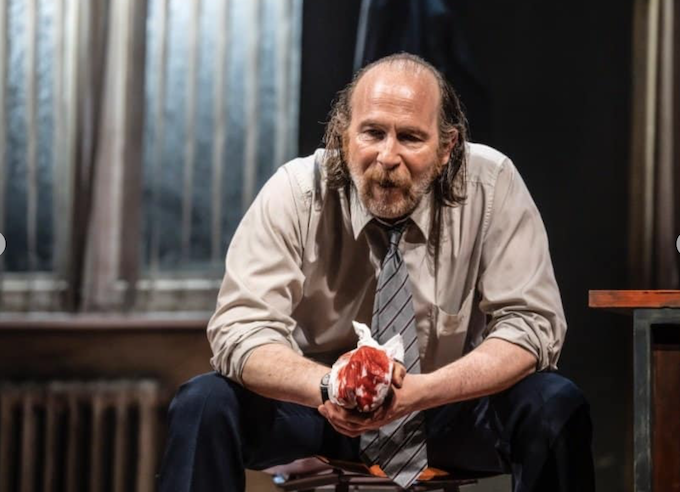
Act 3 is the resolution. The interrogators begin to fall out. We get Ariel’s back story too. We have started seeing her as a tortured writer in a totalitarian state, but then there are questions. Given the alleged crimes, do her interrogators have some degree of justification in forcing the truth? You might call this the 24 justification for torture after the several 24 TV series. Then Katurian tries to explain to Michal the difference between the report of an event, and an event. The final twist in the story is pure McDonagh (see the Lieutenant of Inishmore.)
The four main actors are not ones with a conventional theatre history. We have a singer, a comic TV and film actor, and two who have been seen more on TV and film. They give an acting master class. Paul Kaye’s gangling, twitchy Ariel bursting into violence is such a memorable performance. Steve Pemberton really draws the laughs. A couple of reviewers thought Lilly Allen ‘flat’ – not so at all.
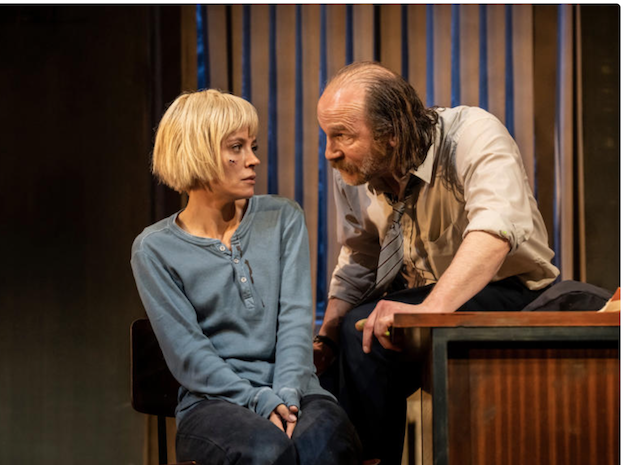
Arifa Akbar (The Guardian): Allen’s Katurian is too indistinct, quivering with fear or blank-faced, though she delivers her lines efficiently. In the play’s original staging the part was played by David Tennant, and the character’s gender reversal brings nothing new. **
I totally disagree. We both felt she was giving a female reaction to the situation in contrast to previous men in the role. In fact, looking at the text, some of Katurian’s retorts are fairly aggressive, and that would be emphasized by a male in the role. We thought female worked better, and also was better with the relationship with the brother. Matthew Tennyson’s Michal was convincingly away with the fairies, as they’d say in one of McDonagh’s Irish excursions.
There is a deal of undercurrent on the nature of writing and reality. Is your legacy as a writer more important than your actual life? Are terrible experiences an inspiration to be treasured by a writer? How much of any writing is concealed autobiography? Is a writer (musician / actor / director) responsible for evil acts that the perpetrator’s claim were inspired by him or her? To extrapolate, does the fact that Charles Manson was obsessed with The Beatles’ Helter Skelter and Piggies mean Lennon & McCartney were at fault for writing the songs?
Tupolski tells his story about a deaf Chinese boy (it would be hard to get that one through a modern theatre producer with Tupolski’s imitation) and Katurian points out a flaw. How do we know the boy’s deaf? We see his hearing aid, says Tupolski. But the point of the story is he can’t hear a train behind him, so you would have to explain the batteries were dead. He doesn’t. Katurian doesn’t pick it up. It’s deliberate. We both noticed it. There’s also a reference that shows McDonagh had A Very, Very, Very Dark Matter, in his head back that at the beginning of his career.
Michal: The Shakespeare Room? Old Shakespeare with the little black pygmy lady in the box, gives her a stab with a stick every time he wants a new play wrote?
That’s in the Hans Christian Anderson (rather than Brothers Grimm) McDonagh play: A Very, Very, Very Dark Matter, also directed by Matthew Dunster.
The programme had the idea of essays by three writers from PEN International, the organisation for threatened authors worldwide. Sadly they are unenlightening on the play … one has no connection at all. They contrast to the superb Dr Semmelweis programme the day before with its insightful notes from director, designer and choreographer. That was a first class programme. This is a poor one. Good idea. Weak execution.
The play was acclaimed in 2003. I think McDonagh went on to write better.
****
WHAT THE CRITICS SAID
four star
Jessie Thompson, Independent ****
Nick Curtis, Standard ****
Marianka Swain, London Theatre, ****
three star
Susannah Clapp, The Observer ***
Claire Allfree, The Telegraph, ***
Andrzej Lukowski, Time Out ***
Sam Marlowe, The Stage ***
Fiona Mountford, iNews ***
Sarah Hemming, Financial Times ***
two star
Arifa Akbar, The Guardian **
Clive Davis, The Times **
one star
Quentin Letts, Sunday Times *
LINKS ON THIS BLOG
MARTIN McDONAGH
The Banshees of Inisherin (film) 2023
The Lieutenant of Inishmore, RSC 2001
The Lieutenant of Inishmore, Grandage Company 2018
The Cripple of Inishmaan by Martin McDonagh, Grandage Season, West End 2013
Hangmen, by Martin McDonagh, Royal Court, London 2015
The Beauty Queen of Leenane by Martin McDonagh, Arena Theatre, 2018
The Beauty Queen of Leenane, by Martin McDonagh, Chichester Festival Theatre, 2021
Three Billboards Outside Ebbing, Missouri (FILM)
A Very, Very, Very Dark Matter, Bridge Theatre 2018
The Pillowman, West End, 2023
MATTHEW DUNSTER
Shirley Valentine, Duke of York’s 2023
True West, by Sam Shephard, West End, 2018
A Very Very Very Dark Matter, Martin McDonagh, Bridge Theatre 2018
Much Ado About Nothing, Globe, 2017
Plastic, by Marius von Mayenberg, Bath, 2017
Imogen (Cymbeline Renamed and Reclaimed) – Globe 2016
Hangmen, by Martin McDonagh, Royal Court 2015
Love’s Sacrifice by John Ford, RSC 2015
MATTHEW TENNYSON
Salome by Oscar Wilde, ESC 2013 (Salome)
A Midsummer Night’s Dream, BBC TV 2016 (Lysander)
A Midsummer Night’s Dream, Globe, 2013, (Puck)
PAUL KAYE
Bank of Dave (film) 2023
 Peter Viney's Blog
Leave a comment