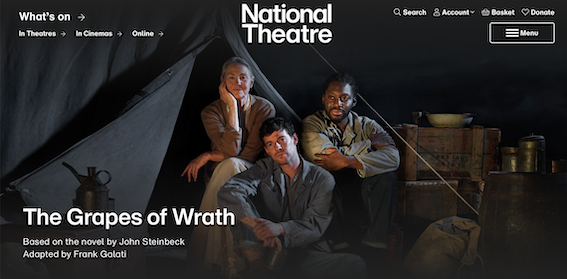
Based on the Novel by John Steinbeck
Adapted by Frank Galati
Directed by Carrie Cracknell
Set Designer – Alex Eales
Costume- Evie Gurney
Composer- Stuart Earl
Original songs – Maimuma Memon
The Lyttelton Theatre
The National Theatre,
South Bank, London
Saturday 10th August 2024, 13.00
CAST
Harry Treadaway- Tom Joad
Natey Jones – Jim Casy
Greg Hicks- Pa Joad
Cherry Jones – Ma Joad
Lin Blakley- Grandma Joad
Mirren Mack- Rose of Sharon
Christopher Godwin – Grampa Joad, contractor
Tucker St Ivany- Al Joad
Rhys Bailey – Winfield Joad
Tom Bulpett- Noah Joad
Emma Tracey- Ruthie Joad
Anish Roy – Connie Rivers
Michael Shaeffer – Uncle John
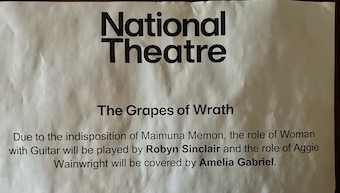
Zoe Aldrich – Elizabeth Sandry, Agricultural Officer
Afolabi Ali- Muley Graves, Floyd Knowles, Ensemble
Rachael Barnes – Band vocal, accordion
Brandon Bassir- Camp proprietor, First officer, second man, first man with club
Morgan Burgess – band vocal, guitar, second officer, Hooperranch guard
Ryan Ellsworth – Willy, Mayor of Hooversville, man going back, man in barn
Amelia Gabriel- Ensemble, UNDERSTUDY Agnes Wainwright here.
Valentine Hanson – first agricultural officer, Weedpatch camp director, camp guard, Mr Wainwright
Harey Johnson – gas staton attendant, second man with club, Willy’s accomplice
William Lawlor- Man in Barn’s sonMaimuma Memon– band vocal, banjo, woman with guitar Robyn Sinclair understudy
Matthew Romain – band vocal, fiddle, deputy sheriffRobyn Sinclair – Mrs Knowles, Agnes Wainwright, ensemble Amelia Gabriel- understudy
Cath Whitfield – gas station owner, book keeper, Mrs Wainwright, ensemble
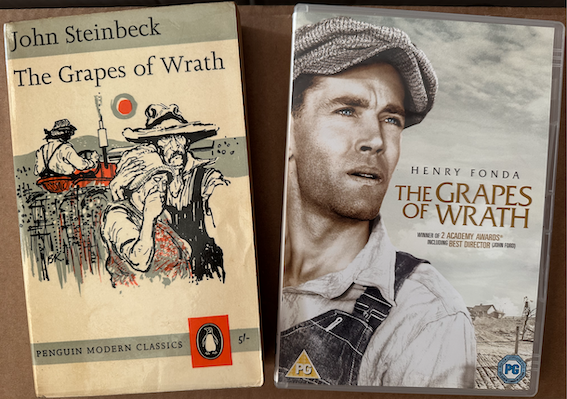
Our sixth form General Studies teacher introduced us to Cannery Row, and I became obsessed with John Steinbeck. Over the next two years I read everything – The Cup of Gold, In Dubious Battle, The Short Reign of Pippin IV, The Log from ‘The Sea of Cortez’ the lot. I thought The Grapes of Wrath was a masterpiece. I would say though that its fame is based on the John Ford film as much as the novel, or more so. My dad, not a man of literary persuasion, was afflicted with piles, which he referred to as the grapes of wrath. That would be inspired by the film. We once detoured to Monterey and sought out the original Cannery Row.
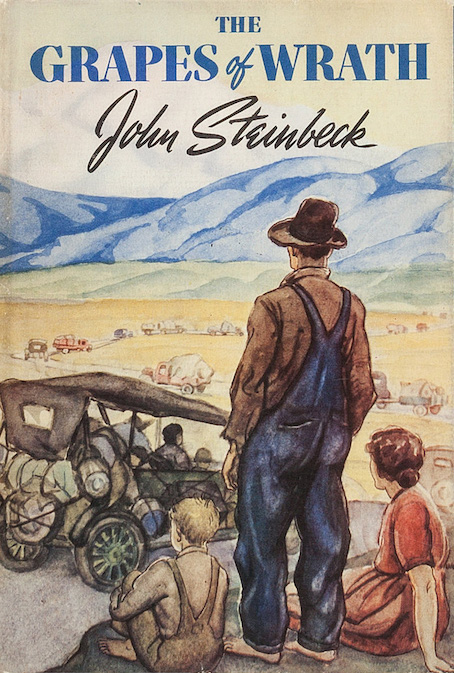
I was surprised in my third year of American Studies, that John Steinbeck was looked down upon by the literary elite. That was due to some right wing later views and writing America and The Americans style coffee table books for the likes of Readers Digest. I defended the Grapes of Wrath with some passion in a seminar where I found myself the only fan. Still Bruce Springsteen with The Ghost of Tom Joad is a fellow fan.
The title comes from Battle Hymn of The Republic, a poem before it was a song.
Mine eyes have seen the glory of the coming of the Lord:
He is trampling out the vintage where the grapes of wrath are stored;
He hath loosed the fateful lightning of His terrible swift sword:
His truth is marching on.
I have seen Him in the watch-fires of a hundred circling camps,
They have builded Him an altar in the evening dews and damps;
I can read His righteous sentence by the dim and flaring lamps:
His day is marching on.
Verse two is significant. The camps in the open air.
The history
How well do you know the story? The 1920s dustbowl devastated poor farm land in Oklahoma and Arkansas. Oklahoma was settled late because it was reserved as ‘Indian Territory’ and Native Americans had been forcibly sent there in ‘The Trail of Tears.’ When they decided to clear the Native-Americans to even worse land, there was a land grab centred around 1889, which brought in vast numbers of white settlers. What no one knew was that the area was going through an unusually wet few decades. They ended in the late 1920s with little rain, high temperatures and strong winds, and a drought took over. Historically, it was merely a return to normal. Monoculture had stripped the topsoil and it just blew away in dust storms, creating the dust bowl. The banks foreclosed on the farms. They sent in tractors to demolish the homes to make sure no one hung around. 7% of the population of Oklahoma left, joined by others from Arkansas and Texas. 100,000 to 300,000 people emigrated.
They were lured to fruit picking in California. Drive down the Central Valley. Even now It’s miles of almonds, then miles of peaches, then miles of apricots to miles of tomatoes. Even now you see long lines of fruit pickers moving through them. They migrate north with the harvest. The experience of the farmers or ‘Okies’ trekking West with their scanty possessions to near slave labour in California is the basis of the novel. Steinbeck was from Salinas, right in the fruit picking area. He toured the workers’ camps. The novel was published in 1939 and focussed on one family, The Joads. The John Ford film followed fast in 1940 with Henry Fonda as Tom Joad. Their lot was resolved by the need for workers for re-arming before and during World War II, centred in California.
There is a fine modern novel The Tortilla Curtain by T. Coraghessan Boyle on Mexican immigrants, who took over the roles of the exploited, which was hailed as the ‘new Grapes of Wrath’ and quotes Steinbeck on the title page.
They ain’t human. A human being wouldn’t live like they do. A human being couldn’t stand to be so dirty and miserable.
John Steinbeck, The Grapes of Wrath
The adaptation
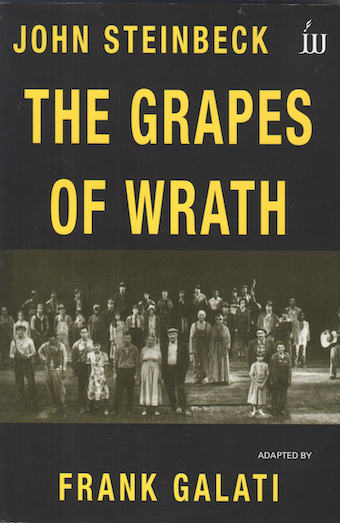
This adaption by Frank Galati debuted in the USA in 1990, with a cast of thirty-six judging by the cover photo. The National Theatre was never known for economy, but easily gets it to twenty-four with doubling and tripling. We came home by train and I read the text cover-to-cover on the way back. You can easily do this when you’ve just seen a play. There should be an added credit for cutting. A whole scene with five automobile salesmen was junked. The original songs have been dropped and replaced. There are cuttings within lines. So:
Tom She always seen that gate was shut. Ever since the pig got in over to Jacobs and ‘et the baby.
I think they lost ‘over to Jacobs.’ It jumps at you more without it. I will comment on Galati’s use of apostrophes, because they should show missing letters. ‘et for ate makes no sense. Maybe it means ‘unkonvenshional spellin’ follers.’ I’m not sure whether a writer should write forgit somepin or leave it to the actor to do an Oklahoma accent.
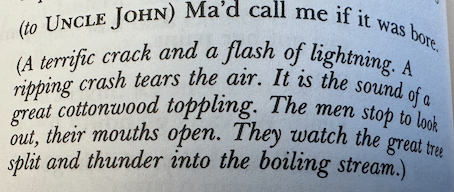
It’s a weird play text. It has stage directions which are impossible even with the National’s near unlimited budgets:
The first and second and third and fourth narrators have all been deleted. Why did they need four different ones? Now there are none. They served as walking Sat Navs in the New York production:
Second narrator Holbrook, Joseph City, Wimslow. They drove all night and came to the mountains at night.
Right choice. Means nothing in the UK. Lose it.
The play text runs to 115 pages, followed by FORTY-FIVE pages of detailed description of props and costumes. Does it really matter that Winfield in the Hooverville scene has ‘maroon braces’ or that ‘Ensemble #15’ has a brown and gold plaid gaberdine shirt? Of course the costume designer ignores this and starts from scratch, and very good the costumes are. Ma Joad’s green and white frock serves just as well as the black and white frock specified by the playwright. In many ways Galati got lucky. A lot of directors would have read all the guff, shaken their heads, and moved to another script.
The thing is the construction and dialogue interaction are winners. Full marks to Carrie Cracknell (I assume) for seeing the potential, and cutting freely and ignoring freely.
The play
The scale is epic. The Lyttelton stage often feels too wide for its contents, but this seems tailor made for the Lyttelton with proscenium arch and safety curtain. This is staging to match the scale of the novel. Sets descend. The essential truck can be moved anywhere in any direction … the wheels don’t turn, but it’s on a platform with small rotating castors. Water is needed for the Colorado River and for the creek that floods at the end. There is a swimming pool sized tank with a sliding cover to return it to an acting area. I haven’t seen a pool utilised like this in a play (I’ll ignore the Cirque du Soleil’s Las Vegas show O) since John Barton’s ten act, all day play Tantalus at Milton Keynes, one of the four theatres big enough and equipped enough to stage it.
There is a black curtain, it lifts and we see people bent over trying to walk into clouds of dust, under a darkened sky.
The four strolling musicians make their first appearance joined by the cast. They are guitar / banjo, steel guitar, accordion, fiddle. The four are interspersed with the action throughout the play. Maimuna Memon usually leads them and plays guitar or banjo, and sings (she also did the original songs) but this afternoon she was under-studied by Robyn Sinclair. If we hadn’t been told, we wouldn’t have known.
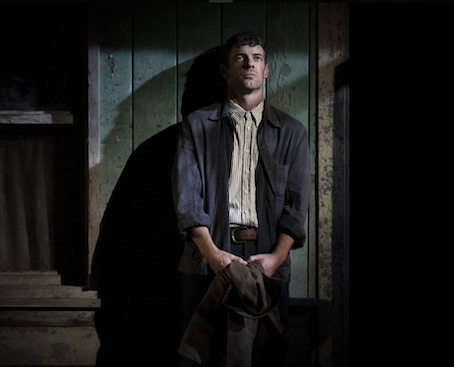
Then a broken wall of a shack descends – the Joad homestead, and we meet Tom Joad (Harry Treadaway), on parole from jail for killing a man in a fight. The family has gone. Jim Casy (Natey Jones) is there. He was a randy gospel preacher in Elmer Gantry style, but has lost his faith, and now believes in a kind of humanism. He will join the Joad family on their travels as their thirteenth member. They evade the uniformed men sent out by the banks to make sure no one is around, and go to Uncle John’s place, to find the family.
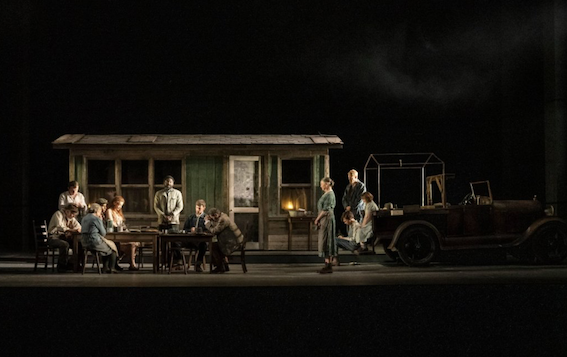
A new set descends. The Hudson truck is on stage. It’s Uncle John (Michael Shaeffer)’s house. Greg Hicks is Pa Joad and Cherry Jones is Ma Joad. Both look perfect.
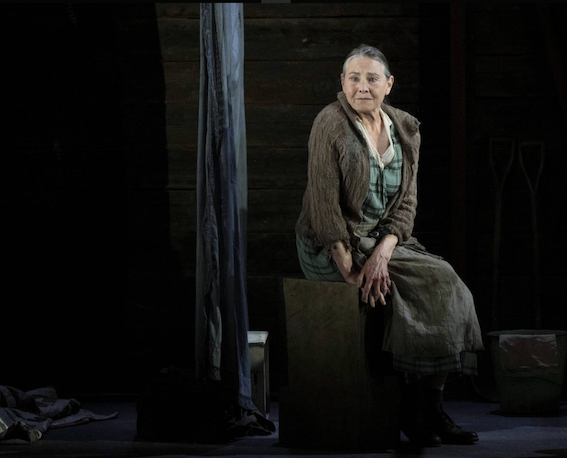
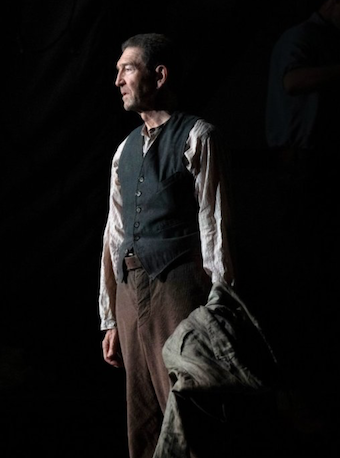
We are used to seeing Greg Hicks in kingly roles but he convinces totally as a worn, rangy ‘ornery farmer.
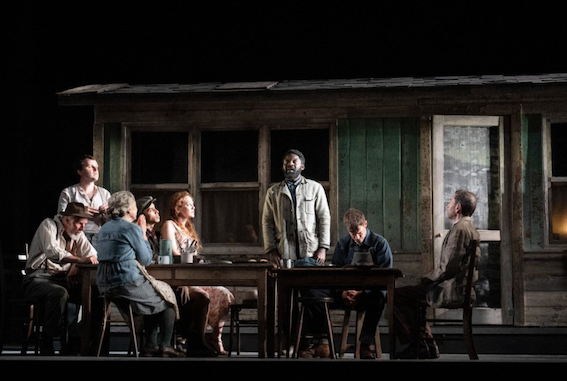
Tom introduces Jim Casy (they all remember him) and meets Grandpa and Granma, and finds his sister, Rose of Sharon (Mirren Mack) is married to Connie (Anish Roy), and pregnant. Connie is good with vehicles and has ambitions. His brother Noah Joad is ‘slow’ as they would have said at the time. Al Joad (Tucker St. Ivany) is permanently off and about ‘tom catting.’ Jim Casy is persuaded to say grace, but it’s his kind of grace,
So the 2000 mile journey starts. They have to get thirteen of them on the truck (the family members help wheel it around). I’m not going to lead you through the plot in too much detail. Grandpa, who never wanted to leave, dies. No one wants migrants on the edge of towns. They’re moved along. They reach the Colorado River and the pool appears and they jump in to swim or wash feet. We felt sorry for Harry Treadaway as Tom – he gets out of the pool soaked, and immediately has to put on his jeans and socks with no towel to dry himself. Still, it’s near the interval. Noah decides he’s going to stay by the river and fish. Another one gone.
They drive into California and are stopped for an Agricultural Inspection (that still exists) though in those days you didn’t have the lines of cars buying gas at Arizona prices before crossing into more heavily taxed California. They get through, then Ma reveals that Grandma died several hours ago, but she didn’t want to stop them before they’d crossed the border.
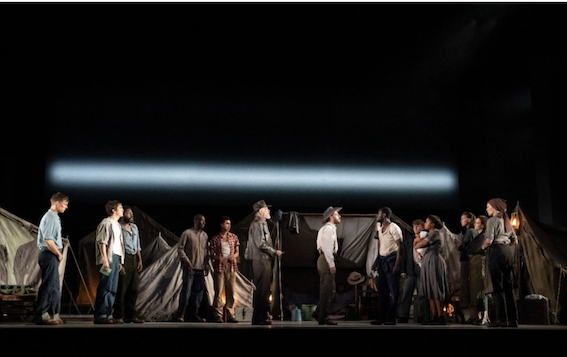
In Act two, they begin to realise that the California Dreaming has a deep downside. There are way too many people for the work. Pay is below the barest subsistence level. Anyone who argues gets beaten – possibly killed and dumped in a ditch as yet another ‘dead vagrant.’
They finally get to Weedpatch, a self-administered site rather than one run by local profiteers. There is an unpleasant encounter with a Born-Again Christian Elizabeth Sandry (Zoe Aldrich) which contrasts with the Reverend Casy’s humanism.
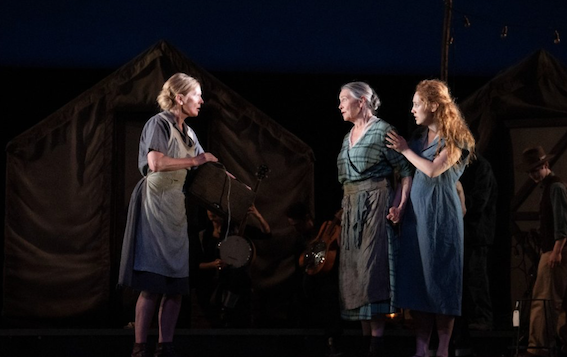
She upsets Rose of Sharon with her vile talk of sin and babies born dead after ‘Hug dancing’ by their mothers. We then get a marvellous square dance scene, followed by a slow hug dance tune.
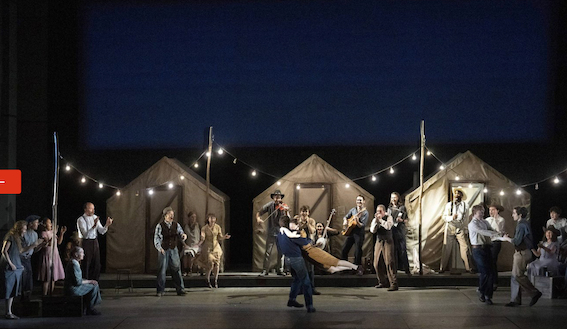
Jim Casy saves Tom from arrest after a bad fight by offering himself up instead of Tom. Their discussions are keys to the plot.
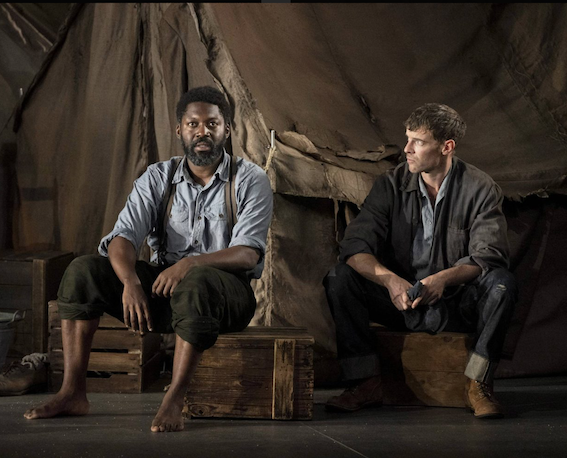
The departures go on. Connie deserts the heavily pregnant Rose of Sharon and heads for the city hoping to use his mechanical skills to get work.
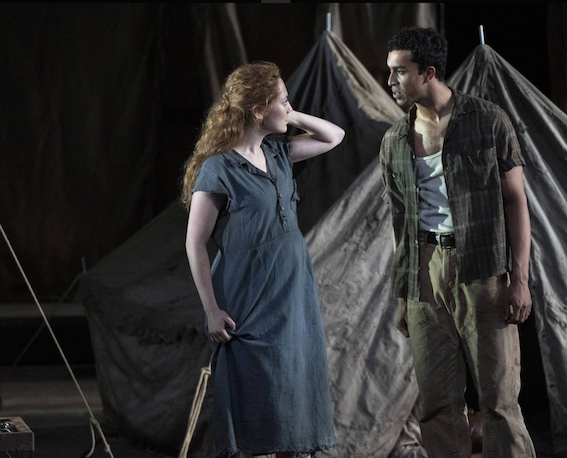
Tom finally gets into real trouble, saving a man by attacking a deputy sheriff who’s poleaxed the guy with a pick handle. Tom is battered and bloody. He will have to leave too. After all, he’s still on parole.
Tom Then I’ll be all aroun’ in the dark. I’ll be evr’where – wherever you look. Wherever they’s a fight, so hungry people can eat. I’ll be there. Wherever there’s a cop, beatin’ up a guy,I’ll be there. An’ when our folks eat the stuff they raise and live in houses they build, I’ll be there.
This is why Bruce Springsteen wrote The Ghost of Tom Joad, based on the same passage.
Now Tom said, 'Mom, wherever there's a cop beating a guy
Whenever a hungry newborn baby cries
Where there's a fight against the blood and hatred in the air
Look for me, Mom. I'll be there.
Bruce Springsteen

The end
Rose is about to give birth. Al announces he’s going off with the Wainwright girl in the next tent (Robyn Sinclair had to move to replace the singer, so she was understudied. Again you wouldn’t notice). Another Joad gone. The creek starts to rise and rise. Pa and Uncle John lead the efforts to sandbag it.
They did the novel, not the film. Hollywood would not allow the novel ending in 1940. The lighting on Rose of Sharon and the dying old man was absolute state of the art. It narrowed to them, then the blackout. What a strange blackout it was. Utter silence. No one moved. We just all sat there stunned and speechless for several seconds, until they put the house lights partly up. Then there was no explosion of applause, just building clapping. Only a few stood. It was a contrast to the instant jumping up (and about) the night before. The play does not leave one in the mood for punching the air and shouting’Yo! Way to go!’
The programme, in spite of the NT’s economy utility brown soft cover, has very good historical and political background.
Overall
The production necessarily runs straight into the ‘The book’s better’ syndrome. You have a 410 page classic novel. A film rated in many ‘Best movies lists’ and you have to put it on stage. I’ve trained myself to clear my mind as far as possible from that ‘not as good as the novel’ attitude and take a play or film of a book on its own merits. It afflicted the critics badly.
The sheer scale gives it a Brechtian edge (without monologues fortunately). It moves faster in Act two than in the longer Act one, naturally. The sets are denser in Act Two which pulls the viewer in- it’s hard to do open prairie and desert by just showing a huge pink rectangle as sky in Act one. When projection has become SO ubiquitous nowadays, I’m surprised they didn’t project the land but then for long distance there is little to see. A starry sky wouldn’t have gone amiss. There is a LOT of sky when you’re out in the South-Western USA. The lighting plot leaves much of it semi-dark, half lit throughout. It worked for me, but it is gloomy and dark, as you will see from the photos.
Those criticizing it tend to like the music. The opening full cast gospel was brilliant, as was the square dance music. We had an understudy, but she sang very well. The instrumentation was right for the square dance. To me, it was too bluesy at several other times. Oklahoma was settled by people from the Appalachians. The Oklahoma Ozark sound is country. Arkies from Arkansas had a stronger blues influence though … the Mississippi rolls past the east end of the state. You could add (if brave) that the African-Americans would be more likely to integrate with po’ whites in Arkansas than Oklahoma too.
It is long, but NOT the three hours that Dominic Maxwell complains about in The Times. We were outside and walking away in less than two hours fifty. It was never dull either. The first half suffers from somewhat choppy shifts between scenes. Too much is happening to get involved closely with the character, which is why it feels ‘epic.’
The thing is that it builds. The tragedies pile up, and we move into more action and get to know the characters. I thought the strobe lit slow motion violence worked. I like the fact that the emotion piles on steadily and increasingly to the utterly stunning ending.
Of course it’s at least four stars. Acting, set, lights, direction. I’m tossing up whether it’s four or five. Not quite five.
**** 1/2
WHAT THE CRITICS SAID
This bunch increasingly focus on tiny theatres in Hampstead, Camden and Islington, or Southwark (NOT the big South Bank ones). I begin to think the RSC, Chichester and NT lose a star before the reviewer has finished quaffing their press night champagne. I see little point in reviewing a tiny London theatre that sold out weeks ago.
4 stars
Claire Allfree, Telegraph ****
The Stage ****
iNews ****
3 star
Andrzej Lukowski, Time Out ***
Arifa Akbar The Guardian ***
Nick Curtis Evening Standard ***
What’s On Stage ***
Stephen Bates, Reviews Hub***
All That Dazzles ***
2 star
Susannah Clapp, The Observer **
LINKS ON THIS BLOG
CARRIE CRACKNELL (Director)
Macbeth, Young Vic 2015
The Deep Blue Sea, 2016 NT Live streaming
Medea by Euripides, National Theatre Live 2014
GREG HICKS
All’s Well That Ends Well, RSC 2013 (King of France)
Hamlet, RSC 2013 (Claudius)
Fortunes of War (TV Series)
NATEY JONES
Dr Faustus, RSC 2016
Don Quixote, RSC 2016
CHRISTOPHER GODWIN
The Crucible, Old Vic, 2014
Candida, Bath 2013
A Midsummer Night’s Dream, RSC 2011
The City Madam, RSC 2011
Cardenio, RSC 2011
 Peter Viney's Blog
Leave a comment