
By Nikolai Gogol
Adapted by Phil Porter
Directed By Gregory Doran
Designed by Francis O’Connor
Composer Paul Englishby
Chichester Festival Theatre
22 May 2025, 14.30
CAST
Lloyd Hutchinson – the Mayor
Joe Dixon – The Judge
Oscar Pearce – Charity Commissioner
Christopher Middleton – Head of Schools
Reuben Johnston – the Postmaster
Paul Rider – Pyotr Ivanovich Dobchinsky
Miltos Yerolemou – Pyotr Ivanovich Bobchinsky
Mark Oliver- Chief of Police
Scott Bowden – Constable Svitsumov
John Rogers – Constable Derzhmorda
Tom Rosenthal – Khlestakov
Nick Haverson – Osip, his servant
Joe Eyre – waiter at the inn
Sylvestra le Touzel – Anna, the mayor’s wife
Laurie Ogden – Marya the mayor’s daughter
Leigh Quinn – Avdotya, the maid
Moshsen Ghaffari – Mishka, the manservant
Shereener Browne- Fevronya / Charity Commisioner’s wife
Shereener Browne- locksmith’s wife
Leigh Quinn – Head of Schools Wife
Leigh Quinn – The sergeant’s widow
John Rogers – a petitioner
Moshsen Ghaffari – Abdullin, a merchant
Joe Eyre- gendarme
Mopira Hartley- accordion
Corey Wickens – violin
Benedict Wood- guitar

We were pleased to see the return of the pre-show. We get five or six tunes from the trio. Most of us sat in rapt attention, and they were extremely good, though the two ‘chaps’ with loud RP voices continued to speak at normal volume (i.e. bloody loud) throughout.

The Government Inspector was written by Nikolai Gogol and dates from 1836. No, it’s not ‘Russian’ drama. Not anymore. Gogol was Ukrainian. The programme has an essay on it by director Gregory Doran too. It’s slightly specious, and compare that Wikipedia notes Oscar Wilde as an ‘Irish writer.’ I would class W.B. Yeats as an Irish writer, but Wilde lived and wrote in London in standard English. Gogol wrote in Russian. He was definitely Ukrainian whatever, and the world loathes Russia appropriating anything Ukrainian.
On the original language, this is an adaptation by Phil Porter. Was it adapted from a particular translation? Was it from a new word by word translation? Did Porter translate it himself? The credits do not clarify this.
This is Gregory Doran’s first production outside Stratford after his illustrious and highly productive decade as artistic director of the Royal Shakespeare Company. This is a plus for Chichester, and there are close connections, almost an exchange as Chichester’s artistic director, Daniel Evans, became his RSC successor, and Justin Audibert, Chichesters current incumbent worked with Doran at the RSC. The other connection being that the RSC and CFT are the two best producing theatres in the country.
The play features in The Telegraph’s fifteen best plays of all time, as well as Michael Billington’s 101 Greatest Plays. I hadn’t seen it before though it did feature in ‘production history’ in Drama as it has been played variously as farce, satire, surrealistic, and realistic. That is a sign of a great play, though here it’s ‘comedy.’ The production I want to see is the 1958 BBC TV with Tony Hancock in the starring role.
The play centres on a small remote Russian town where all the officials are corrupt. It’s an unusual play in that the supposed Government Inspector, Khlestakov, is seen as the lead role, but only appears in Acts two, three and four. I’d say the Mayor has the most lines and appears throughout.
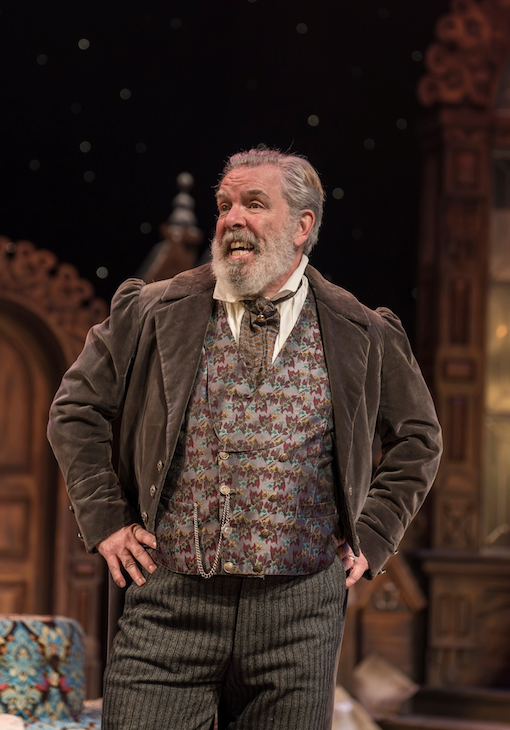
The mayor fleeces the merchants, flogs an innocent widow. The judge takes bribes, and prefers them as puppies. The Charity Commissioner runs the hospital where patients never complain because the German doctor doesn’t speak Russian. The Head of Schools presides over mad teachers.
Mayor Whip your staff into shape! I know they’re educated men, I make allowances for that, but bugger me if teachers aren’t the weirdest bunch of bastards!
That’s for my many teacher friends. Was this in the original?
Head of Schools God help anyone that goes in for teaching. I shouldn’t wish it on my worst enemy. Everyone complains, everyone thinks they know best.
Mayor Well, get used to it because that’s exactly the crap that’s coming our way.
And that’s for the last twenty years of Ministers of Education.
The postmaster reads all the letters passing through his hands. They are in consternation after it is reported that a government inspector is to arrive.
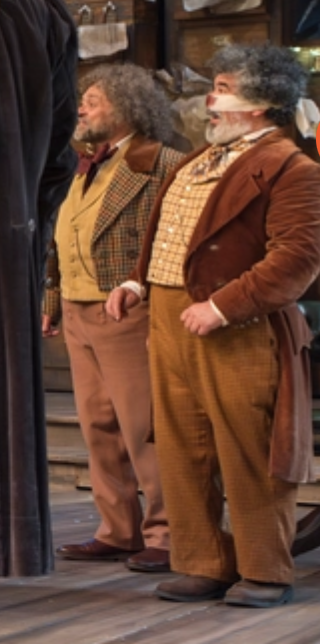
Miltos Yerolemou – Pyotr Ivanovich Bobchinsky
Two people with near identical names, Piotr Ivanovich Dobinsky and Piotr Ivanovich Bobinsky report that a stranger has been staying at the inn for two weeks already. The town officials are all terrified that they have been investigated already. But why has the government sent an inspector?
Judge Perhaps the motherland wants to go to war so they’ve sent a spy to crush the traitors within.
Mayor Don’t be ridiculous. Russia would never do a thing like that!
Yes, that got the second biggest laugh of the evening plus applause.
In this Dobinsky and Bobinsky are a visually hilarious pair, and few reviewers could resist comparing them to Tweedledum and Tweedledee. As written, they are a double act, interrupting each other constantly.

The stranger is a civil service clerk Khlestakov who is with his servant Osip. He hasn’t paid his bills for two weeks and is on short rations. He complains about the appalling food to the waiter, but his credit has run out.
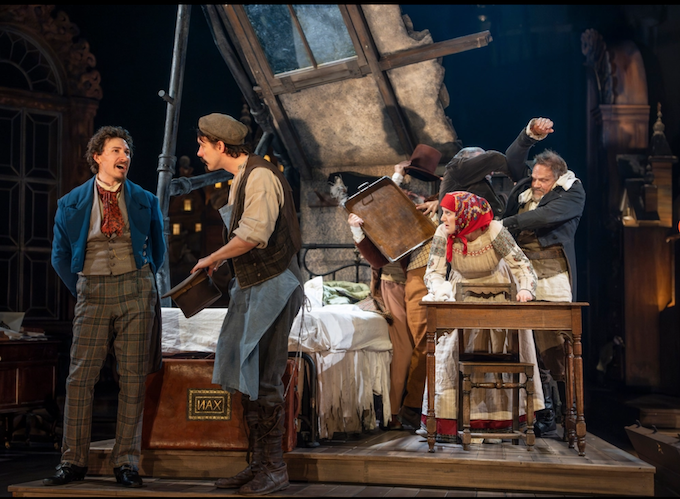
The skylight is where Bobchinsky will fall
By far the best moment in the production is in Act two at the inn. While everyone is gathered in Khlestakov’s tiny grubby room, Bobchinsky (Miltos Yerolemou ) climbs on the roof to eavesdrop through the skylight. He falls through landing on the bed which collapses. Brilliantly done, and it is a definite Play That Goes Wrong piece of set manipulation and acrobatics. It is easily the biggest laugh in the play.
The town worthies invite Khlestakov to see the hospital. The mayor invites him to stay at his house.

They wait anxiously for him to wake from his drunken slumbers.
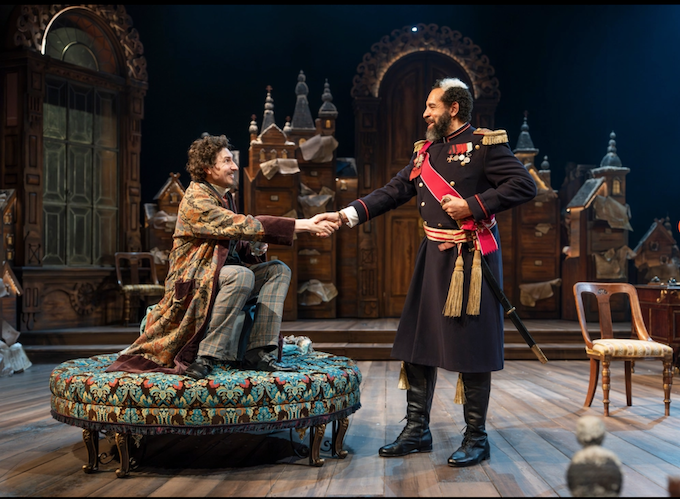
Khlestakov is a drunk and fantasist and accepts allhospitality and praise, then proceeds to con all the worthies for large “loans” which they happily give, seeing them as bribes.
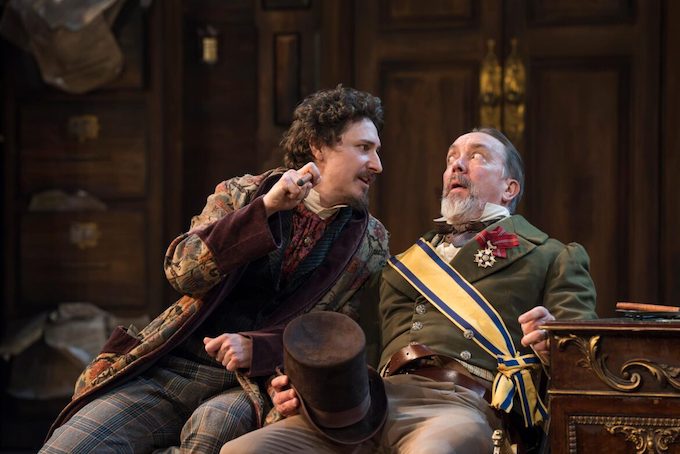
Khlestakov is trying to decide whether to seduce the mayor’s wife or her daughter. Both are fascinated by his spiel. He tells tales of his exploits in St Petersburg and lists his achievements as a writer.
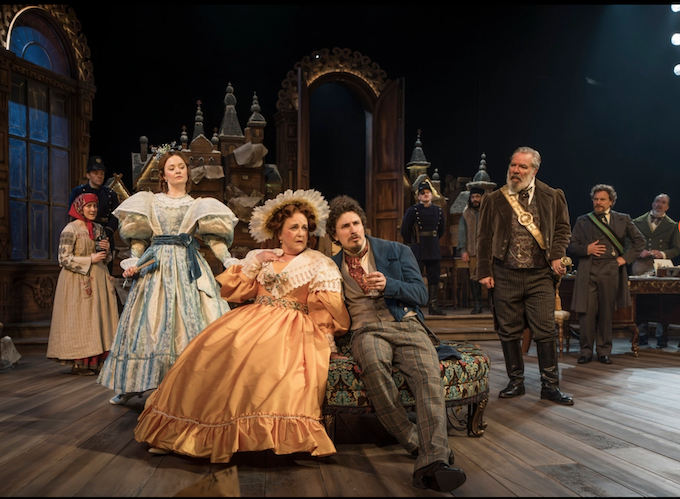
Khlestakov decides to propose to the daughter.
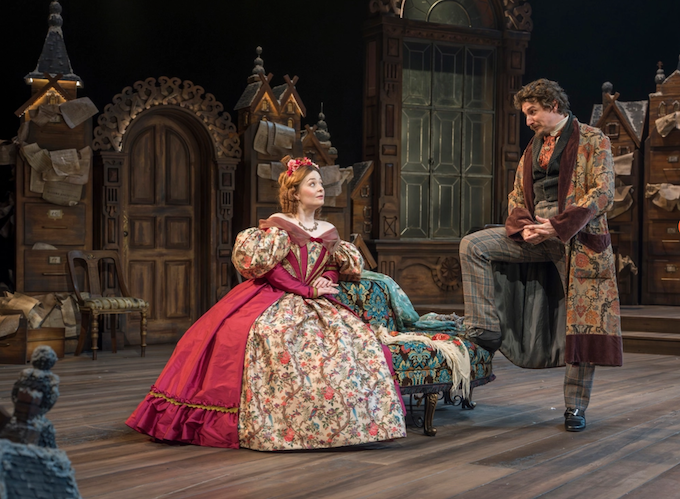
The mayor is delighted. He will be favoured and go to St Petersburg and become a general. Khlestakov takes the carriage and the best horses in the town and disappears.
The postmaster arrives having opened Khlestakov’s letter to a friend.

The letter reveals how he duped them all and describes each in most unflattering terms. The mayor raves at the audience (well modernized here to lampoon theatre patrons). In theatre history, it is noted that he breaks the fourth wall and shouts ‘What are you laughing at? You’re laughing at yourselves!’ Then the messenger arrives to announce the arrival of the real government inspector.
Tom Rosenthal is a memorable Khlestakov as drunk and as seducer. The trickster, cheating everyone in turn is excellent. Nick Haverson (probably the best Dogberry I’ve seen) was the servant, Osip. All the worthies were notable and distinct.
OVERALL
As we walked out a woman next to us was saying, ‘Yes, it was of its time, but it just wasn’t that funny.’ She was right. It’s hard to define it. There was tremendous detail work on comic business with every actor. Physical casting was perfect, actors gave their all in marvellous costumes on a richly detailed and striking set. It is a comedy, and the comic line stretches back to Plautus’s stock characters. Our trickster, Khlestakov, is ‘the boasting soldier’ and his servant Osip is ‘the cunning slave.’ Even the Mayor’s wife is the willing older ‘courtesan.’ The thing is, I’d have expected gales of laughter from the audience throughout, but it wasn’t happening. There is a point at the end where the mayor lists the stupidity of theatre audiences, and points at someone and says ‘What are you laughing at?’ (as in the original) We were in the front row, and it was me he pointed at, because I was laughing heartily, so throughout I laughed more than most.
We spent the journey home trying to analyse why the laughs weren’t coming in gales – except for some moments. (Our years of writing ELT video comedy means we have spent hours analysing the laugh points in sitcoms.) Was it simply a midweek matinee audience? Older and more jaded? Did it play better in the evening? We have noticed Saturday matinee audiences are far livelier than midweek. The reviewers were there in the evening, and both The Guardian and The Telegraph rated it at three stars, and they’re the normal benchmarks. Good applause, but no standing ovations on our Thursday afternoon.
I’d conclude that it’s the play itself. It is one of Michael Billington’s 101 Greatest Plays, and it comes at a time, 1836, when nothing was happening in British drama. Interestingly, there is a point where a drunken Khlestakov claims to be the writer of great works from the Marriage of Figaro, through Don Quixote, Faust, Candide to the Merry Wives of Windsor. (A good adaptation from the originals, which are now obscure apart from The Marriage of Figaro), The Merry Wives is not one of Billington’s 101 Greatest Plays, but it’s way funnier than this one, and when we saw it at the RSC in 2012, Sylvestra le Touzel, the mayor’s wife here, was a great Mistress Page. The Merry Wives has characters. The Government Inspector instead has STOCK characters, cardboard cut outs. In spite of great efforts to give visual characteristics and differentiation, a very funny walk for the judge, a Tweedledum & Tweedledee duo in Dobchinsky and Bobchinsky, an over enthusiastic police constable, accents, lots of clever business, the characters are two dimensional.
In the end, five stars in so many areas, but overall:
***
TONY HANCOCK
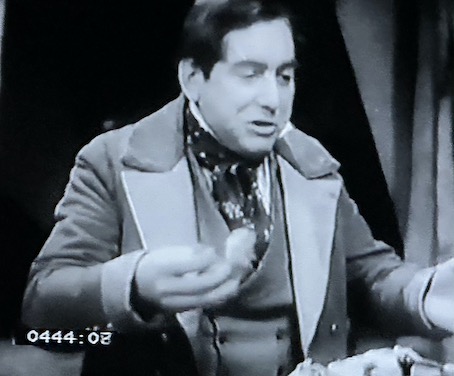
The next evening we watched Acts 1 and 2 of the 1958 BBC TV play, filmed live, with Tony Hancock in the trickster role. It’s on YouTube and Wilfred Brambell is the Postmaster. It showed that those modernised lines on education and Russia were close to the original with a very good small tweak to modernise them.
WHAT THE CRITICS SAID
5 star
Simon Topping, Reviews Hub *****
4 star
The Times ****
Holly O’Mahoney, The Stage ****
Soy in The Stalls ****
3 star
Mark Lawson, The Guardian ***
Domenic Cavendish, The Telegraph ***
Gareth Carr, What’s On Stage ***
Rosie, Theatre & Tonic ***
LINKS ON THIS BLOG
PHIL PORTER (Adaptation)
Vice Versa, RSC 2017, writer
The Miser, by Moliére, adapted by Sean Foley & Phil Porter, 2017
A Mad World My Masters, RSC 2013 Edited by Sean Foley & Phil Porter
GREGORY DORAN (Director)
Henry IV Parts 1 & 2 RSC
Henry V – Alex Hassell, RSC, 2015
Julius Caesar – RSC 2012
Richard II – RSC 2013, David Tennant as Richard II
The Witch of Edmonton by Rowley, Dekker & Ford, RSC
Death of A Salesman, by Arthur Miller, RSC 2015
King Lear – RSC 2016
The Tempest, RSC 2016
Troilus & Cressida, RSC 2018
Measure for Measure, RSC 2019
Richard III – RSC 2022
Cymbeline, RSC 2023
LLOYD HUTCHINSON
Romeo & Juliet, National Theatre 2021 (Lord Capulet)
Absolute Hell, by Rodney Ackland, NT 2018
A Midsummer Night’s Dream Young Vic 2017 (Puck, Egeus)
PAUL RIDER
The Comedy of Errors, RSC 2023
A Woman of No Importance – Classic Spring, 2017
The Tempest, Sam Wanamaker Playhouse, 2016
Measure for Measure, Globe
Julius Caesar, Globe
Knight of The Burning Pestle, Globe.
The Duchess of Malfi, Wanamaker
SYLVESTRA LE TOUZEL
Hogarth’s Progress, Rose Kingston 2018 (Mrs Needham)
Merry Wives of Windsor, RSC 2012 (Mistress Page)
Mr Turner (film)
JOE DIXON
The Tempest, RSC 2016 (Caliban)
CHRISTOPHER MIDDLETON
Coriolanus, RSC 2017
Salome, RSC 2017
The Witch of Edmonton by Rowley, Dekker & Ford, RSC 2014
The Roaring Girl, RSC 2014
Arden of Faversham, RSC 2014
NICK HAVERSON
The Cat & The Canary, Chichester 2024
Love’s Labour’s Lost, RSC 2014, Chichester 2016 (Costard)
Love’s Labour’s Won, RSC 2014, Chichester 2016 (Dogberry)
Much Ado About Nothing, RSC at Chichester 2016
 Peter Viney's Blog
Leave a comment