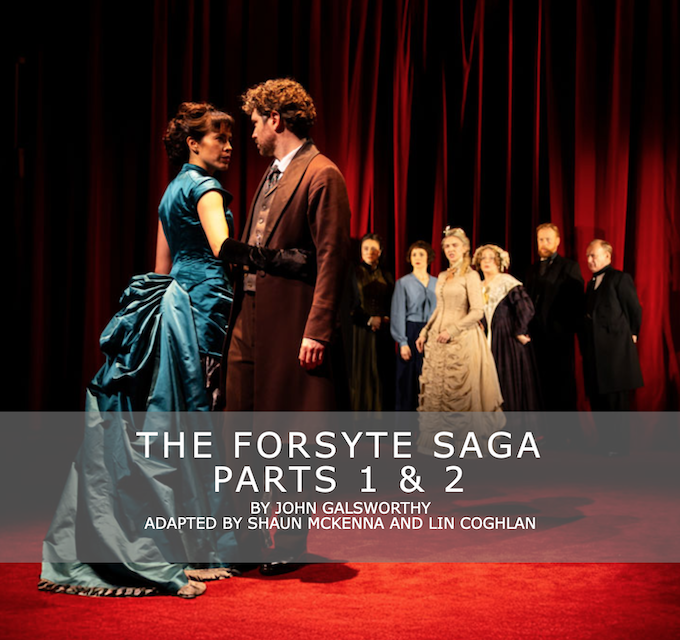
Based on the novels by John Galsworthy
Adapting Playwrights Shaun McKenna & Lin Coughlan
Directed by Josh Roche
Set & Costumes by Anna Yates
Composer & sound design Max Pappenheim
Royal Shakespeare Company
The Swan Theatre
Stratford-upon-Avon
PART ONE: IRENE
Wednesday 7th January 2026, 19.30
PART TWO: FLEUR
Thursday 8th January 13.30
CAST
| actor | Part one | Part two |
|---|---|---|
| Emma Amos | Emily Forsyte / Juley Fortsyte | Juley Fortsyte/ Holly Forsyte |
| Paul Carroll | ensemble | ensemble |
| Fiona Hampton | Irene Forsyte | Irene Forsyte |
| Nigel Hastings | James Forsyte | Jo Forsyte / Harold Blade |
| Michael Lumsden | Jolyon Forsyte / Swithin / Doctor | Prosper Profond / Riggs |
| Abigail Mahoney | ensemble | ensemble |
| Joseph Millson | Soames Forsyte | Soames Forsyte |
| Florence Roberts | June Forsyte / Annette Forsyte | Annette Forsyte / Anne Forsyte |
| Andy Rush | Philip Bossiney / Mr Polteed | Jon Forsyte |
| Flora Spencer-Longhurst | Fleur Forsyte | Fleur Forsyte |
| Jamie Wilkes | Jo Forsyte / Policeman | Michael Mont |
When my mother died, I took her complete set of nine Forsyte novels to a charity shop. I regret it now. She dearly loved the original 1967-68 TV series. I never saw a single episode. In retrospect I think that was undergrad snotty assumed cultural superiority and totally wrong. Karen remembered it, being two years younger and stuck at home watching. When we saw the RSC was going to do it we looked for the original TV series but it’s not easily found on DVD. She explained I’d never follow the plot without pre-knowledge. All I knew was that The Forsyte Saga started off the rich Victorian / Edwardian / 1920s family sagas, so begat Upstairs Downstairs and The Duchess of Duke Street, which begat the comedy parallel You Rang M’Lord, and it all leads to Downton Abbey.
So we watched the 2002 TV series, which starred Damian Lewis as Soames, Gina McKee as Irene, Barbara Flynn as Emily, Amanda Root as Winifred, Rupert Graves as young Jolyon, Corin Redgrave as Old Jolyon. I was transfixed. Then we barely got past episode 1 of the 2025 Channel 5 series which was totally confusing. I suspect any version needs outline notes.

There is piano and clarinet in the lobby playing tunes of the era. I do like a pre-show. The music during the play is low level and pre-recorded, not usually an RSC thing, nor a good precedent.
The programme notes in one place that there are 105 scenes, and in another place, 120 scenes. Maybe that was per part. They use the words epic and Brecht to explain that there is no set, just curtains and a red carpet. The curtains are removed entirely for Part Two (see later).
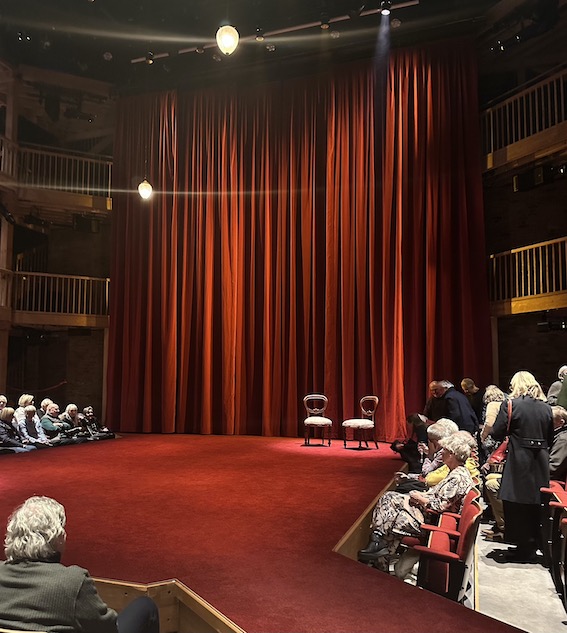
The scenes run fluidly into each other and sometimes characters stay on stage when not active. Fleur, not born until the last moments of part one, is the narrator. She is in 1920s trousers and hair cut, a visitor from the future explaining her past.
Costumes are elaborate late Victorian. How on Earth did bustles become popular? How did they sit down? When Florence Roberts switches from June Forsyte to French waitress Annette, there is a full costume change. Yet when Jamie Wilkes doubles as Jolyon and policeman, the policeman merely is sans jacket and tie. One would have thought a blue overcoat over the costume very easy, but no.
We did Part One in the evening, Part Two in the next day’s matinee. There were days when you could see both parts in order on the same day. We found it hard to find our preferred ‘Evening + Matinee’ combination. There were very few, and the RSC should build that into its planning for multi-part plays. Like many, we travel 150 miles to Stratford. Two plays in a day means two nights in a hotel, before and after, especially in winter when travel may be disrupted. Evening + matinee means one night. Time to drive there. Time to drive home after the matinee.
The programme could list the sources more clearly. The original Forsyte Saga was a trilogy (with interludes): A Man of Property (1906), In Chancery (1920), To Let (1921). He added two short ‘interludes.’ That’s what the 2002 series covered, ending with the birth of Fleur. Then Galsworthy did two more trilogies due to public demand. The second trilogy was A Modern Comedy, consisting of three novels The White Monkey (1924), The Silver Spoon (1926) and Swan Song (1928).
This is how it relates to the plays:
PART ONE “IRENE”, ACT ONE: A Man of Property (Book 1)
PART ONE “IRENE:, ACT TWO: Indian Summer of Forsyte (interlude) / In Chancery (Book 2)
PART TWO “Fleur” ACT ONE: To Let (Book 3)
PART TWO “Fleur” ACT TWO: Swan Song. (Book 6)
So they skipped books 4 and 5, and went straight to Swan Song, because it brings the story full circle, and ends with the death of Soames Forsyte. We knew the first three. Swan Song was unfamiliar.
Usefully, the programmes (separate ones for each Part) include a Family Tree.
PART ONE: IRENE

Fleur (Flora Spencer-Longhurst) is the narrator throughout, distinct from the 1886 generation by her 1920’s clothes, though she sits in on scenes and observes and makes asides to the audience. Here she is 1920s modern dress, sitting directly in front of Soames.
We have our Soames Forsyte of the imagination. Karen is imprinted with Eric Porter in the first TV series, I’m imprinted with Damian Lewis in 2002. Joseph Millson’s Soames almost instantly got us over that. While other cast members update their clothes, Soames remains resolutely in full 1886 formal plus top hat.
The financial wheelings and dealings have been stripped out of the story, and the play starts five years after Soames Forsyte’s marriage to Irene (Fiona Hampton). She had been eighteen when they married. Soames is a collector for value, so buys art, not because he loves it, but he sees value. We don’t get to see his cruelty in financial matters.
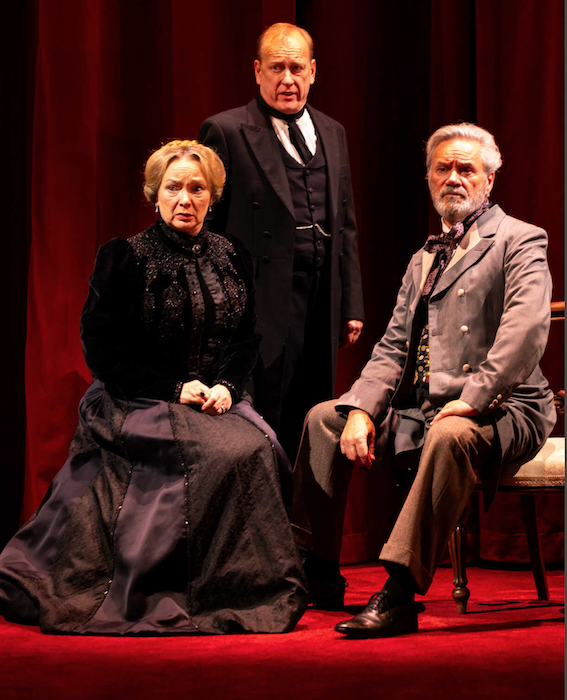
The Forsytes are a formidable lot of wealthy financiers, lawyers and bankers. The older group are far less clearly delineated than in the TV series simply due to lack of space and lines. James and Emily are Soames Forsyte’s parents. Swithin is the same generation.
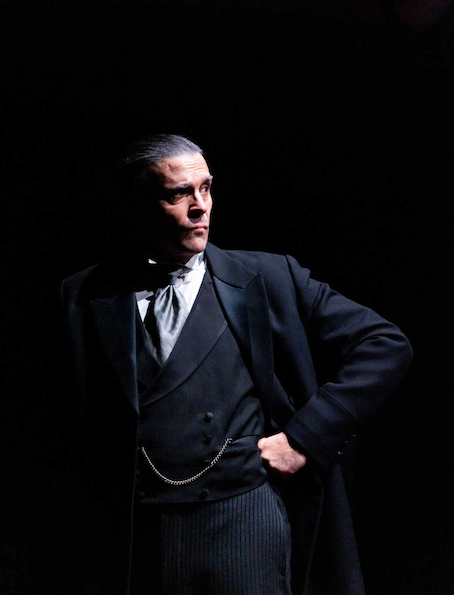
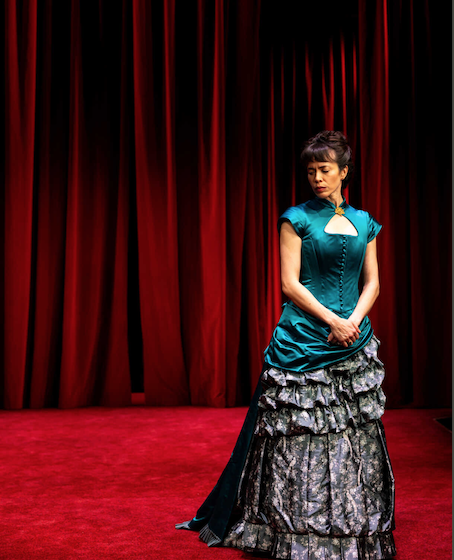
Joseph Millson as Soames Forsyte. Fiona Hampton as Irene Forsyte.
Soames is becoming aware of Irene’s remoteness from him. He is persuaded to build a new house, Robin Hill, away from London, so as to isolate her.

He employs a young architect, Phillip Bosinney (Andy Rush). Bossiney is the fiancé of June Forsyte (Florence Roberts). June is the daughter of Jolyon, who is Soames’ cousin. June is trying to get him the work so that he’ll be earning enough to get married.
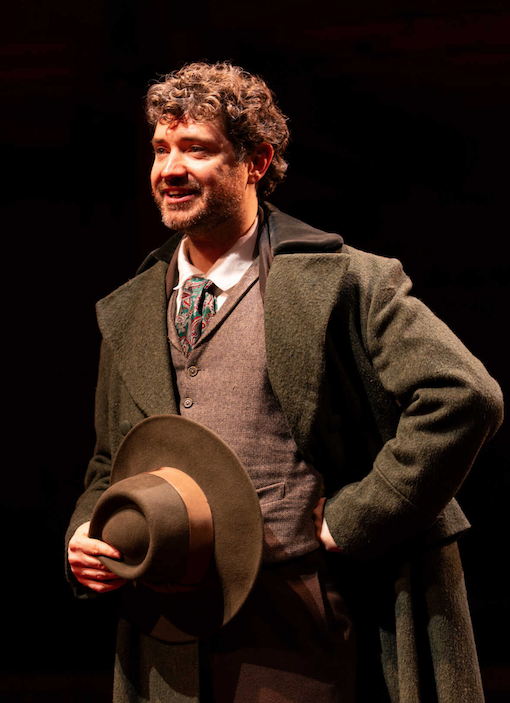
OK, this is really tricky. Jolyon (Soames generation) is known as Young Jolyon, because his grandfather was Old Jolyon. Here it helps to keep calling Young Jolyon “Jo.” Jolyon’s branch of the family is estranged from the rest. While the doubling is generally done expertly, we found it complicated by Michael Lumsden playing the judgemental Swithin and his brother Old Jolyon. His distinctive beard made it more difficult.

The thing is that Phillip, the architect, falls in love with Irene, and vice versa, meaning June is unceremoniously dumped. Irene tells Soames he makes her skin crawl, and she can’t bear to be in a room with him. They have separate bedrooms. Joseph Millson does fabulous finger acting behind his back, while outwardly formal, his writhing hands betray that he is seething with emotion. Rage? Jealousy? Sexual passion?
Soames finds out about Phillip, and asserts his marital rights and “forces Irene against her will” i.e. rapes her, though in the 1890s it would not be legally classified as rape. This is the genuine shocker in every version of the play, here done brilliantly. It was Galsworthy’s dedication to exposing the lack of women’s rights that propelled the success of the original novel.
Phillip is told of the rape, and goes off into the fog (the whole cast dressed in coats hurrying around) and is run over by a horse drawn bus. Accident? Suicide? We will never know.
ACT TWO

It opens with Soames reading a letter, discovering Irene has left him.
This takes off with Galsworthy’s linking 1918 interlude, Indian Summer of Forsyte. Old Jolyon (Michael Lumsden) has bought Robin Hill from Soames. He has made it up with Young Jolyon, or Jo (Jamie Wilkes), who had scandalously left his wife, run off with the nanny and become an artist. Irene had left Soames and lives in Chelsea in a small flat, but was drawn to visit Robin Hill where she and Phillip had made love. She is spotted in the garden by Old Jolyon, who insists she stays for dinner. They become good friends. Jo is away, and so Irene is persuaded to visit twice weekly to give Old Jolyon’s granddaughter Holly piano lessons. Old Jolyon dies under the oak tree (a theatre wooden upright revealed between curtains). He leaves Irene £15,000 with his son, Jo, as her trustee. Jo has supported her against his cousin, Soames.
Don’t mention the war, or do so very briefly. Apart from a few lines they skip the Boer War (where Jo’s son Jolly dies in the book). Soames confronts Jo, and believes wrongly that Jo and Irene are having an affair. He also stalks Irene, and so Irene retreats to Paris.
Soames is desperate for a son and heir, and is taken by Annette (Florence Roberts), a young French girl working in a restaurant. Again there is much plot skipping. Her mother owns it. Annette is invited to come and see Soames’ valuable painting collection … including a Goya and a Corot.
Soames is humming and haa-ing about Annette. He’d rather have Irene back. Failing that he wants evidence to divorce Irene so he can marry Annette. He employs a private detective, Mr Polteed (Andy Rush returning from death as Phillip in Act One). They try for comedy here. I don’t think it was as funny as they had hoped. It’s also an area where the 2002 TV series excelled visually with Parisian streets and restaurants. Jo visits Irene in Paris to check she’s OK, and they’re stalked by the detective, and eventually accused of adultery by Soames. It’s not true, but they agree to pretend it is. This brings Jo and Irene together and they marry.
Soames marries Annette who has a difficult labour and nearly dies … Soames has instructed that if only one can be saved, it should be the baby. Both survive, and it’s a girl, but Soames has to rush to his father’s deathbed. He pretends it was a boy. But when he gets back, and holds the baby Fleur, he is immediately struck by her. She will be the greatest love of his life.
PART TWO: FLEUR
For us, the next afternoon. We have moved on to 1920.
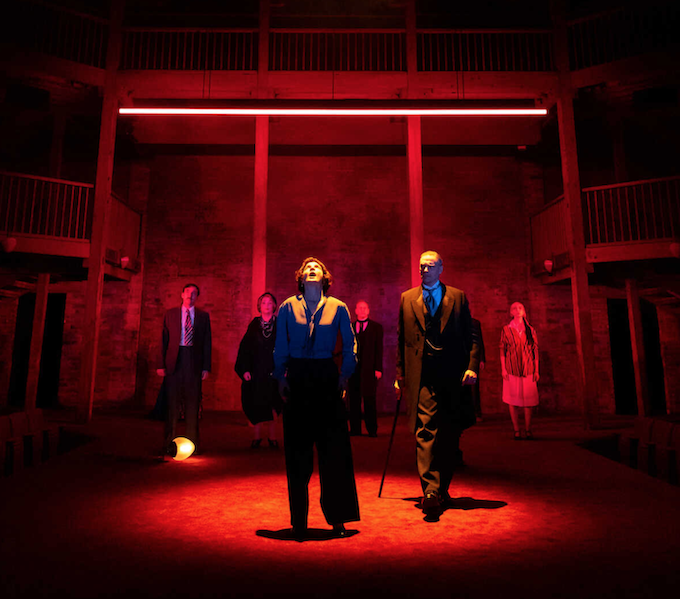
Act one
To Let, the third book, set twenty years after the events of the first two.
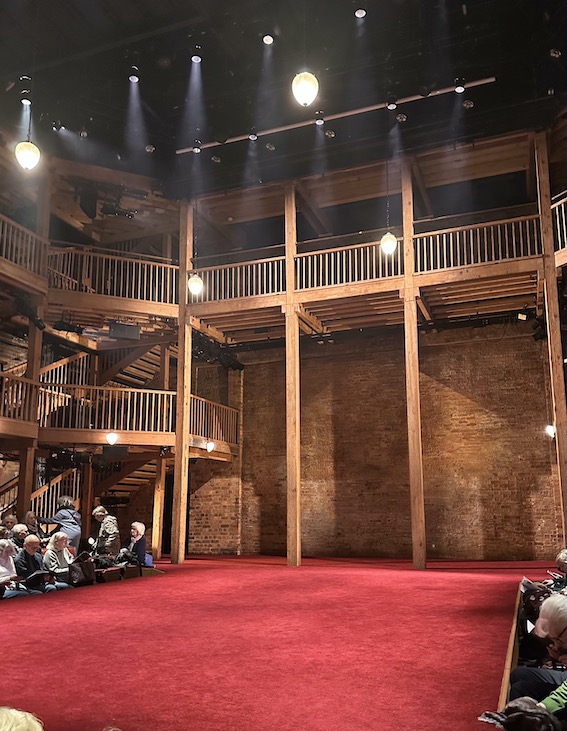
The curtains have gone. The bare brick wall will serve as Robin Hill.
Fleur remains as narrator. There is an excellent handover scene, where the actors dressed in their roles in Part One, hand over their roles to those playing the roles in Part Two. So 1886 June (Florence Roberts) appears and hands over her role to her older self (Emma Amos). Young Jo (Jamie Wilkes) appears and hands over his role to old Jo (Nigel Hastings). That really helped! Irene and Soames remain as Fiona Hampton and Joseph Millson.

June owns an art gallery. She has invited Irene, and her 19 year old son Jon (Andy Rush) to view it. Then Soames turns up with his 19 year old daughter, Fleur. The two young ones are immediately attracted to each other. Fleur engineers more meetings.
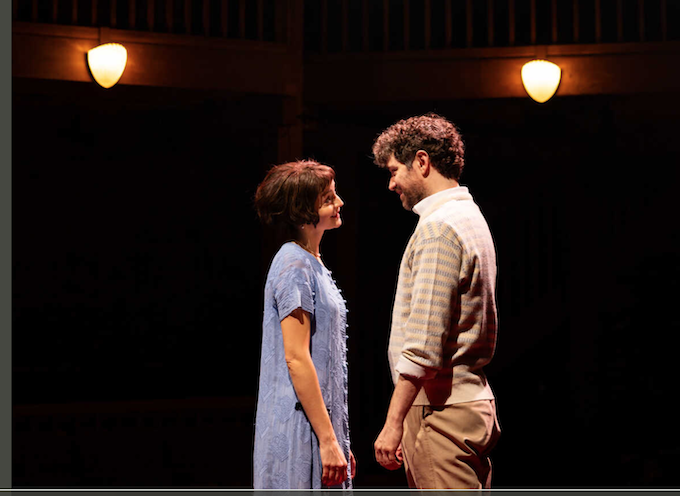
Both Irene and Soames are horrified at their children’s attraction. The point now is that just like her father, Fleur is obsessed with possession. ‘He’s mine.’ There is a lovely scene where she has engineered a meeting, and apparently innocently holds Jon’s hand. His amazement was something to remember.
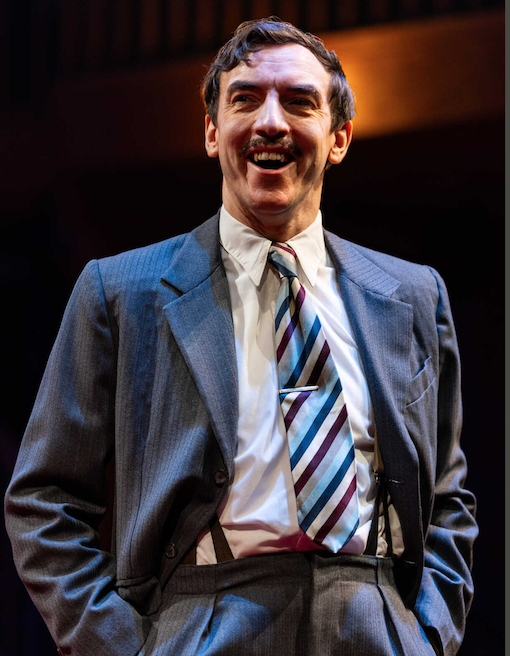
Another meeting at the gallery is Soames with Michael Mont (Jamie Wilkes). Mont fought in the war, is from landed gentry and sets his eyes on Fleur, being most careful to approach via Soames. There is a punting scene, done with two chairs plus a paddle with Michael and Fleur which will be one of the best comedy cameos we’ll see in a year.
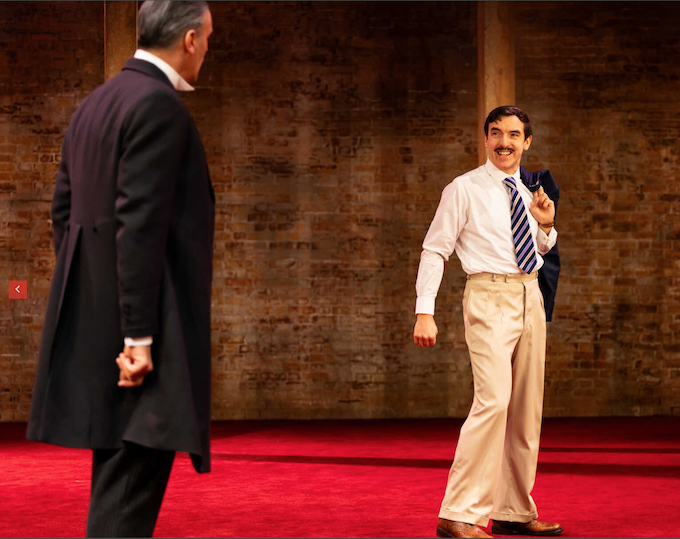
There is also an arranged meeting at a railway station between Fleur and Jon where the rest of the cast rush through and between them dressed as commuters. The fluidity between scenes and timing reaches a peak in this act.
The sub plot is that Annette, bored with the older Soames is having a twice weekly affair with a French man, Prosper Profond (Michael Lumsden) and Soames is aware.
Jo realises he needs to make the young couple, Fleur and Jon, aware of the history and the rape of Irene by Soames. He then dies. Jon decides he must leave and go to Canada for his mother’s sake. (Going to Canada was what you did after thwarted romance or marriage in 1920. We have family history!)
Fleur marries Michael Mont (done with superb economy).
We both said in the interval, that this was easily the best of the three acts to that point. It soared. I don’t know whether it was the plot, comedy that worked, or we were getting used to the style. A definite five stars at the interval.
Act two
We were on unfamiliar territory, as they skipped books four and five and went straight to Book 6, Swan Song. I can only go by the Wikipedia summary, but they have lost a great deal of the story. The focus is on Fleur becoming ever more like Soames.
This starts with the General Strike of 1926. Michael Mont is now a Liberal MP. Michael and Fleur have a son. Fleur has no interest in politics, but the family will volunteer to keep services like bus driving going through the strike and Fleur is to set up a canteen to feed them.

Jon has returned from North America with his American wife, Anne. Jon is among the overall clad volunteers and Fleur sees him. Jon is happily married and intent on buying a farm in Sussex.
Michael is focussed on helping slum dwellers, and Fleur sets up a home, scheming to be near Michael.
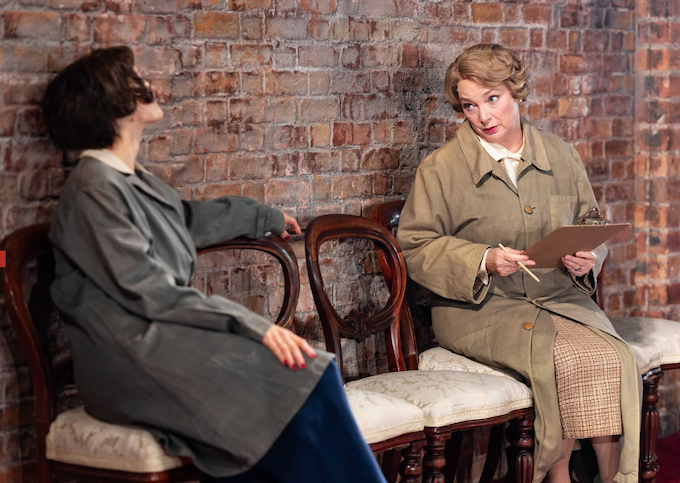
Aunt Holly tries to fend off Fleur’s pursuit of Jon. Fleur arranges to stay with her sick son in a cottage near Jon and Anne.
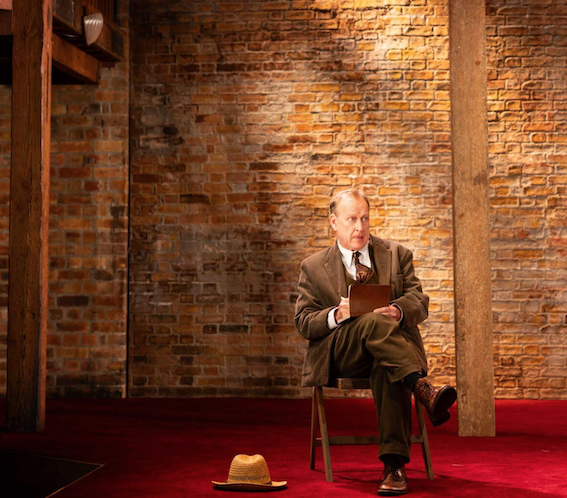
Then via Aunt June, both Fleur and Jon are to have their portraits painted by June’s gruff artist discovery, Blade (Nigel Hastings). She is warned to make sure they don’t meet but Fleur sets it up. She offers to give Jon a lift eventually, and detours to look at Robin Hill. She seduces him in the gardens.
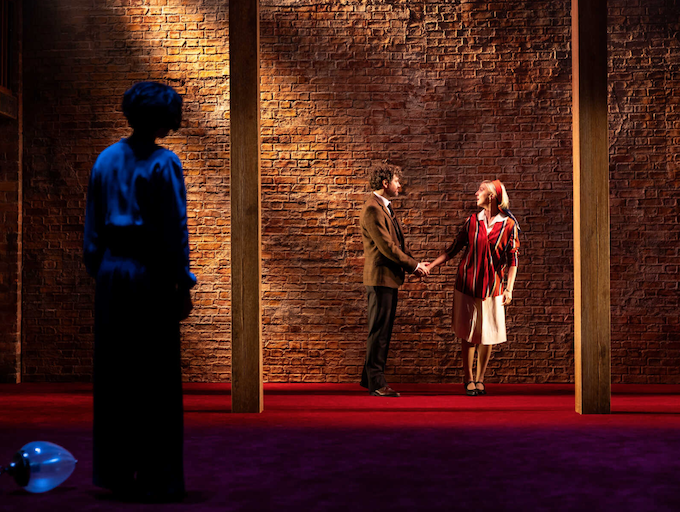
He rushes back to own up to Anne to confess, and she announces she is pregnant. He will stay with her.
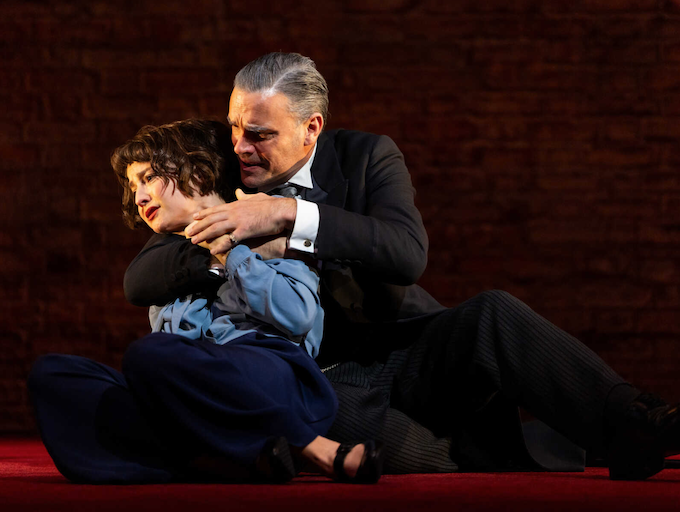
At Soames house, Fleur’s cigarette starts a fire. They try to rescue his paintings, but as he goes to save Fleur, one of his old masterpieces (prized possession again) falls and brains him. He dies.
We thought this easily the weakest of the four acts. Was it unfamiliarity? Or did he lean too far into Mills & Boone Romance?
Overall
It’s hard. It is really four stories, four novels.
If we look at the four acts, Part Two Act One was probably five star for us. Part One Acts 1 and 2? Veering between three star and four star. Act 2 Part 2? Barely a three star, probably two.
We were both aware that the last RSC trip involved Cyrano de Bergerac. Five star. Live music and singing, elaborate sets, sword fights, dance, acrobatics, complex lighting, surround sound effects. Our one word summary after part one of this was’ ‘underwhelmed’. I have never been into Brechtian style. Text and extremely fine acting? Yes, but I want a bit more pizzazz as well.
****
WHAT THE CRITICS SAID
5 Star
Domenic Cavendish, Telegraph *****
4 star
Philip Gooden, Stage Talk ****
Dave Fargnoli, THe Stage ****
Gordon Parsons, Morning Star Part 1 ****
Reviews Gate ****
3 star
Arifa Akbar, Guardian ***
Gordon Parsons, Morning Star Part 2 ***
LINKS ON THIS BLOG
JOHN GALSWORTHY
Strife, Chichester Minerva, 2016
JOSH ROCHE (DIRECTOR)
Home, by David Storey, Chichester Minerva, 2021
JOSEPH MILLSON
The Rover, RSC 2016 (Best Actor award)
EMMA AMOS
Sweet Bird of Youth, Chichester 2017
Ivanov, (David Hare version) Chichester 2015
FIONA HAMPTON
Ralegh, The Treason Trial, Winchester Great Hall, 2018
NIGEL HASTINGS
Henry VI: Three Plays, Globe on tour 2013
FLORA SPENCER-LONGHURST
Love’s Labour’s Won (Much Ado), RSC 2014 (Hero)
Love’s Labour’s Lost, RSC 2014 (Katherine)
Titus Andronicus, Globe 2014 (Lavinia)
JAMIE WILKES
Cymbeline, RSC 2023
Richard III – RSC 2022
The Rover by Aphra Behn, RSC 2016
The Two Noble Kinsmen, RSC, Swan Theatre, 2016
The Comedy of Errors, Globe 2014 (Dromio)
Titus Andronicus Globe 2014
The Shoemaker’s Holiday, RSC, 2015 (Hammon)
 Peter Viney's Blog
Leave a comment