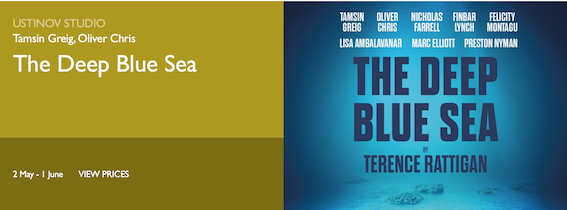
By Terence Rattigan
Directed by Lindsay Posner
Set & Costume by Peter McIntosh
Composer Will Stuart
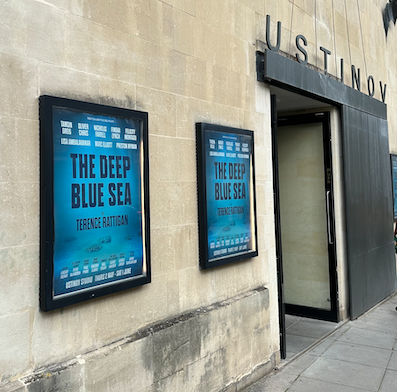
Bath Ustinov Studio
Thursday 30th May 2024
14.30
CAST
Tamsin Grieg – Hester Collyer
Oliver Chris- Freddie
Finbar Lynch – Miller
Nicholas Farrell – Sir William Collyer
Felicity Montagu- Mrs Elton
Preston Nyman – Philip Welch
Lisa Ambalavanar – Ann Welch
Marc Elliot- Jackie Jackson
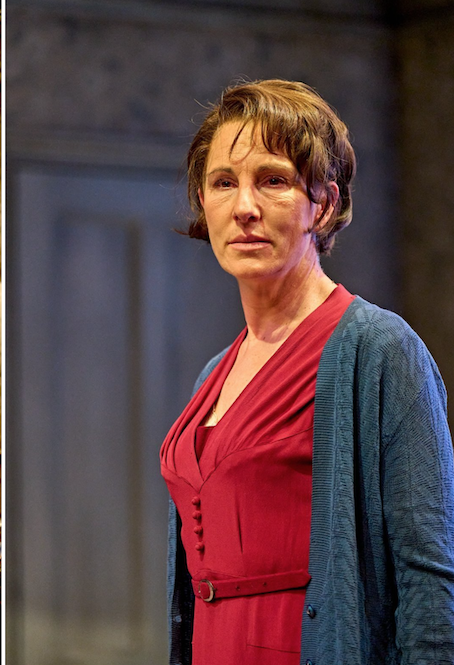
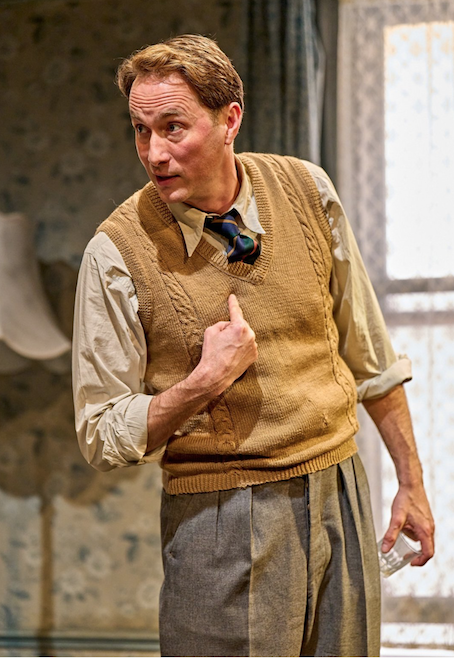
We booked this because Tamsin Grieg was in it … Episodes being one of my all-time favourite sitcoms. Then it was delayed, and we got exchange tickets at the end of the run instead. Then we saw that the wonderful Oliver Chris was in it too. They’ve worked together before in The National Theatre’s Twelfth Night. There was a sense of disbelief that such a cast was in the tiny Ustinov. Then Dominic West was there recently too. How do they do it? Oliver Chris co-wrote Jack Absolute Flies Again, a tale of Battle of Britain pilots. Here he is playing Freddie, the pilot who can’t get beyond 1940, the central time of his life, and it’s 1952, twelve years later. Rattigan was in the RAF. He could do the slang.
The Ustinov is tiny. We were in Row C, a few yards from the actors. The set is simply the grey room in Ladbroke Grove. Friends had a flat in Ladbroke Grove in 1970. It was painted grey because the landlord had bought a job lot of ex-Royal Navy ship paint. This was an instant reminder. Most productions have a more elaborate set, showing the stairs and flats above. It works perfectly without any of that. Given the dimensions of the Ustinov, it fits the play so well- and we have seen plays with an upstairs at the Ustinov, so it is deliberate choice.
Peter McKintosh designs a room of gloom: peeling wallpaper, faded rugs, grey light sighing through the curtains. Even the landscape on the wall shows Weymouth Pier under washed-out skies. People smoke nervy cigs or gulp at corner shop claret. Quiet despair lurks in the silences.
David Jays, The Guardian 14 May 2024
The costumes are carefully vintage. I would think they sourced genuine clothes mainly … Hester’s dress has a darn. It is a proper red dress. The name Hester is in Nathanial Hawthorne’s The Scarlet Letter, where in Puritan New England, an adulteress had to wear a scarlet A. The detail on shirt sleeves and collars, ties, suits is perfect. When Freddie has to take off his shoes for Hester to clean, he has grey woollen socks, just as we wore at school.
Every review just about mentions that it’s Rattigan’s masterpiece. It is the one selected as one of Michael Billington’s 101 Greatest Plays. We’ve seen it often. Simply, this is the best ever version we have seen. That goes for eery character too, and the set, costume and direction. Karen said she’d place it as one of her most memorable productions ever (and she is consistently a harsher judge than me). Before we went, she felt she’d seen the play too many times. This changed that feeling. I would be very surprised if there is a better actress than Tamsin Grieg in 2024, or a better actor than Oliver Chris. Finbar Lynch and Nicholas Farrell can compete for best actor in a supporting role.
It finishes tomorrow. We had tickets for early in the run, it was delayed a week and we could only substitute at the end. I wouldn’t worry, like Dominic West’s A View From The Bridge, I’d say this was a shoe-in for a West End transfer.
Its different in several ways. Tamsin Grieg brings out the normal, middle class clergyman’s daughter, and that she could never play the part of the loyal wife of an older, wealthy High Court Judge in Eaton Place. She is never histrionic, and this is a part where other actresses have decided to go for it. Her interpretation is subtle, real. She brings out her normal-ness. She is genuinely very fond of ‘Bill’ (Justice Sir William Collyer)but he doesn’t make her feel passion, or in his words, lust. She declines the offer to go back to life with him. She had other dreams. She had more to give.
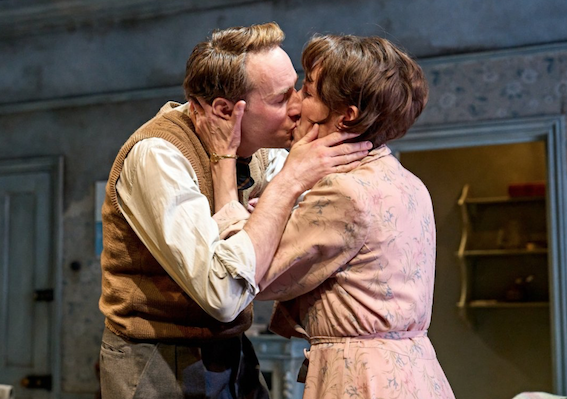
It took huge courage for a woman to leave a marriage under the divorce laws as they were in 1952. It took more courage to say straight out that sexual passion made her do it. Freddie was the key, but the door needed opening anyway.

After her ‘rescue’ by Dr Miller, Mrs Elton and the Welch couple, she tries to pass it all on and be calm and collected, but you can see the strain right through it. No one is convinced, but she is trying so hard.

Oliver Chris’s Freddie is different too. He doesn’t get as embedded in RAF slang as usual, but just spins it off. His Freddie is much less of an arse. It is very rare to have any sympathy for Freddie and his self-centred narcissism invoked in this play. He does it. Freddie was fragile, and wanted and needed her. He is genuinely distraught at the idea that he drove her to suicide. He knows he can’t stay with her. He is beginning to recognise his own irresponsibility.
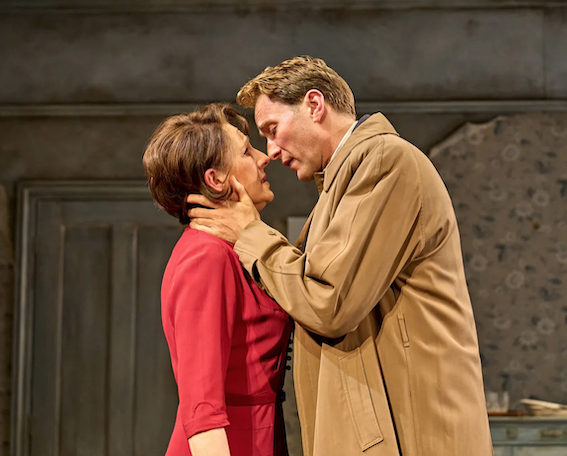
Yes, Freddie is an arse, but he still makes us realise that with his background he hadn’t much choice. Seeing the facial expressions that close up is amazing.
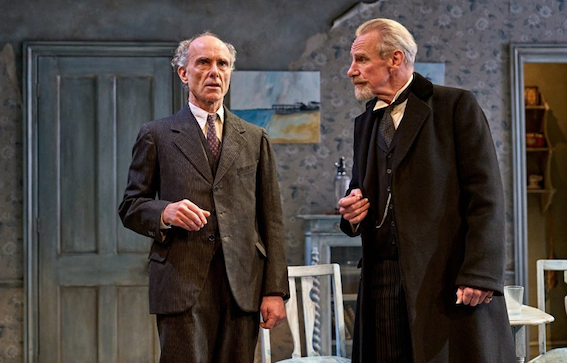
Then Finbar Lynch is Mr Miller, the struck off doctor who is now a bookmaker’s clerk. An accent, but not a comedy one for a change. Miller arrived in England in 1938 and was interned in the Isle of Man. Mr / Dr Miller is the play’s enigma. Why was he struck off and sent to prison? Rattigan never said. The current edition has a detailed essay, and in an early draft of the play (there were six drafts, which is how you change a well-made play into a perfectly-made play) Miller had been seduced by a female patient who was a “dope fiend” and persuaded to give her morphine and she died. Rattigan rightly abandoned that path as too over-dramatic. The consensus, because Mrs Elton talks of renting to a “couple” who “were like that,” is he was struck off for homosexuality. It was illegal in 1952, but widely known and tolerated in theatrical circles. We couldn’t believe that a doctor could be struck off for completely non-medical reasons, but apparently he could. Perhaps a relationship with a patient crossed a line, as it would with a female patient? But would it have been worthy of the attention of The News of The World and major public notoriety? We, in common with early reviewers, always thought it was abortion. He has sympathy for women, seen in his comments to Hester. However, reading the points on Mrs Elton’s couple, I’m persuaded it was meant to be homosexuality. It seems impossible now, but so much of 1952 seems impossible now.

We felt the key moment when he recognises that Hester was a talented painter at 17 came out better here than ever before. The contrast of the freshness of the early picture with the gloomy recent Weymouth pier painting on the wall is the line between her young potential and what she is now.
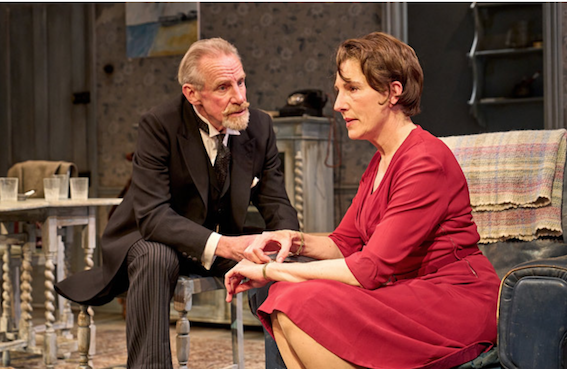
Nicholas Farrell convinces totally as the husband, Sir William. It is yet another nuanced portrayal. More so he looks the part in morning dress. His beard is stately … kingly even.
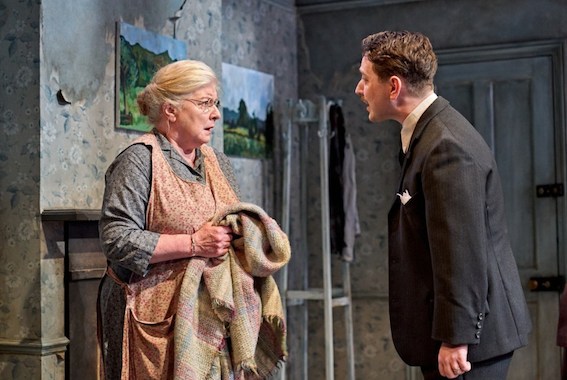
Preston Nyman as Philip Welch
Then we have Felicity Montagu as Mrs Elton, the nosey landlady who gets confidences from her tenants and lets them slip. Too often she’s a cheerful loveable Cockney born to the sound of Bow Bells. Cor luv a duck, guv’nor, ain’t that the truth? Not here. Yes, she has the accent (and a perfect older lady’s 1952 dress and apron and stockings) but she can go to really fierce. Yes, some of the lines are meant to draw laughs and they do, but usually she’s a caricature. Here she’s a character.
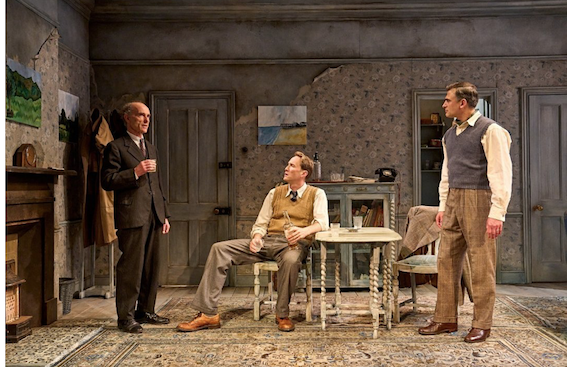
There are no small parts. Marc Elliot’s Jackie Jackson makes us feel his ‘Don’t tell me! Don’t show me! Don’t get me involved in this stuff!’ without the usual Over The Top RAF chap.
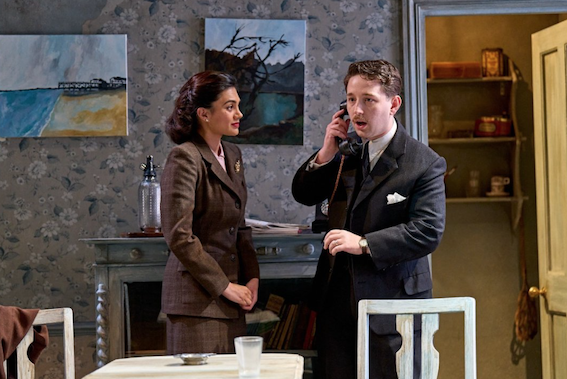
Preston Nyman – Philip Welch
Weymouth Pier painting top left
The Welch’s are great too as the civil servants embodying the “respectability” that Hester has deserted. You are reminded of how good the lines are, as when Ann Welch says in panic ‘Don’t tell him you work at the Home Office!’ as Philip starts to phone Sir William with news of his wife’s attempted suicide. Then the way Tamsin Grieg bustles her out of the room after Anne says she doesn’t like being alone in Act 3 is so well executed it drew a major laugh. Hester’s reaction as Philip priggishly tells her about how he nearly wrecked his own marriage is lovely. It took us right to Tamsin Grieg’s character in Episodes, responding so politely to utter bullshit from the American producers, while conveying what she thought of their opinions straight to the audience without a word.
We couldn’t really fault it. We tried hard to think of one on the drive home too. Then we thought of one! In Act 3 it’s between 11 pm and 12 pm. The light outside the windows is unchanged grey sky. It should be either dark, or weak yellow street light!
We were into discussing what happened to these people next. We decided that Hester WOULD go off to art school after the play and at the end of her course, be one of the early beatniks. Poor Freddie, judgment still impaired, would meet his death as a test pilot in a crash in Brazil.
FIVE STAR *****
But, better than other 5 star versions!
WHAT THE CRITICS SAID
I just can’t see what any of the four star reviews are knocking a star off for!
5 star
Holly O’Mahoney, The Stage *****
4 star
Domenic Cavendish, The Telegraph ****
Chris Hallett, What’s On Stage ****
David Jays, The Guardian ****
Broadway World, ****
The Times ****
LINKS ON THIS BLOG:
TERENCE RATTIGAN
After The Dance by Terence Rattigan, BBC TV play 1992
All On Her Own by Terence Rattigan, Kenneth Branagh Company 2015
Flare Path, by Terence Rattigan, 2015 Tour, at Salisbury Playhouse
Harlequinade by Terence Rattigan, Kenneth Branagh Company 2015
Man & Boy, by Terence Rattigan,National Theatre 2026
Ross by Terence Rattigan, Chichester Festival Theatre 2016
Separate Tables by Terence Rattigan, Salisbury Playhouse 2014
Separate Tables, by Terence Rattigan, BBC TV version 1970
Separate Tables by Terence Rattigan (Table Number 7, Summer 1954) Bath 2024
Summer 1954 by Terence Rattigan (Table Number 7 / The Browning Version), Bath 2024
While The Sun Shines by Terence Rattigan, Bath, 2016
French Without Tears, by Terence Rattigan, English Touring Theatre 2016
French Without Tears, by Terence Rattigan, BBC Play of The Month 1976
The Deep Blue Sea by Terence Rattigan (FILM VERSION)
The Deep Blue Sea by Terence Rattigan, BBC TV Play, 1994
The Deep Blue Sea, by Terence Rattigan, Chichester Minerva, 2019
The Deep Blue Sea, by Terence Rattigan, National 2016, NT Live 2020
The Deep Blue Sea, by Terence Rattigan, Bath Ustinov 2024
The Winslow Boy, by Terence Rattigan, BBC Play of The Month, 1977
The Browning Version, by Terence Rattigan, BBC TV play 1985
The Browning Version by Terence Rattigan (as Summer 1954), Bath 2024
LINDSAY POSNER (Director)
The Lover / The Collection by Harold Pinter, Bath Ustinov 2024
Farewell Mr Haffman By Jean-Philippe Gaguerre, Bath Ustinov 2023
God of Carnage by Yasmina Reza, Bath Theatre Royal 2018
The Lie by Florian Zeller, Menier Chocolate Factory, 2017
The Truth by Florian Zeller, Menier Chocolate Factory 2016
Communicating Doors by Alan Ayckbourn, Menier Chocolate Factory 2015
Dinner With Saddam by Anthony Horowitz, Menier Chocolate Factory 2015
The Hypochondriac by Moliere, adapted Richard Bean, Bath Theatre Royal, 2014
A Little Hotel On The Side By Feydau, Bath Theatre Royal 2013
She Stoops To Conquer by Goldsmith, Bath Theatre Royal 2014
Hay Fever by Noel Coward, Bath Theatre Royal 2014
Abigail’s Party by Mike Leigh, Poole Lighthouse 2013
TAMSIN GRIEG
Romeo & Juliet, NT Film 2021 (Lady Capulet)
Twelfth Night, National Theatre 2017
Women on The Verge of A Nervous Breakdown, Playhouse, London, 2015
PLAYS BY OLIVER CHRIS
Jack Absolute Flies Again, NT 2022 (Co-writer)
Ralegh – The Treason Trial, Winchester Great Hall, 2018
OLIVER CHRIS AS ACTOR:
A Midsummer Night’s Dream, Bridge Theatre 2019 (Oberon / Theseus)
Young Marx, by Richard Bean & Clive Coleman, Bridge Theatre 2017
King Charles III, TV version, 2017
Twelfth Night, National Theatre 2017
Fracked! Or Please Don’t Use The F-Word, Chichester 2016
King Charles III, 2014
One Man Two Guv’nors 2013
FINBAR LYNCH
The Tempest, Bath Ustinov 2023 (Antonio)
Richard III, Almeida 2016
NICHOLAS FARRELL
Munich: The Edge of War (film 2022)
Sex, Chips & Rock & Roll (TV Series 1999)
A Damsel in Distress, Chichester 2015
FELICITY MONTAGU
A Midsummer Night’s Dream, Bridge Theatre 2019 (Quince)
Dad’s Army (film 2016)
Quatermaine’s Terms, by Simon Gray, 2013
MARC ELLIOT
Women in Mind, Alan Ayckbourn, Chichester 2022
Macbeth, Wanamaker Playhouse 2018
 Peter Viney's Blog