
By Joe Penhall
Directed by Matthew Warchus
Set & Costume by Rob Howells
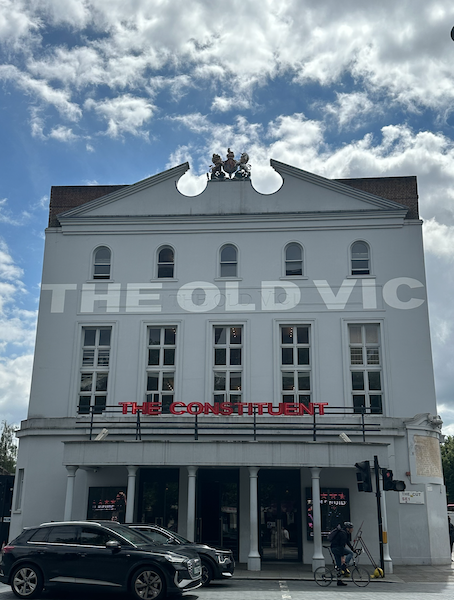
The Old Vic, London
Tuesday 16th July 2024, 19.30
CAST
James Corden – Alec
Anna Maxwell Martin – Monica
Zachary Hart- Mellor
It’s always good to be at the Old Vic. I saw my first top rate professional Shakespeare there on a school trip. It was The Merchant of Venice, which was I believe the last National Theatre Old Vic play before they moved to the South Bank. The actor who did the burglar in the TV advert ‘Watch out there’s a thief about’ played Lancelot Gobbo, in much the same character. From then I was hooked on live Shakespeare.

It’s not in the round, but there are seats banked on the stage. A traverse stage. I call it tennis court, or sandwich, playing to two opposite directions. It’s an unhappy medium compared to playing to three sides like the RSC or Chichester, or totally in the round. With three sides you have to encompass, but there is nothing directly behind you. Front and back is hard for actors, but I guess it gets more punters in the high priced seats. However, they knew everyone was there to see James Corden, so he had decent spells stage left and stage right to share out the view.
The play is classic ‘Broadway’ style. One location, a cast of three (or four), two of whom will be major famous name actors. This is James Corden! Car pool karaoke with Paul McCartney and Stevie Wonder (my two favourites). In the UK, it’s perfect studio theatre material (the script is good enough to withstand lesser actors), and the ‘sandwich’ staging is a ploy to increase proceeds to me.
It is short, played without interval. The programme gives it as 1 hour 40 minutes. The notice in the ‘8 Urinals + 1 Cubical loo’ (the Old Vic is very PC so doesn’t have gents. The alternative is the 12 cubicles loo, which apparently was full of women) says it’s 1 hour 25 minutes. I’d say 1 hour 30.

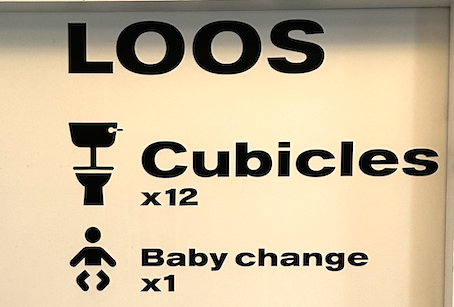
I point out that for non-English speakers, neither cubicle nor urinal is in the top 2000 frequency words, but I guess they wouldn’t go to see wordy plays. I suppose a notice stating length is useful in the loos. The Old Vic doesn’t have toilets, WCs, Restrooms, Washrooms or Lavatories. Just Urinals and cubicles classed as loos. As they also have an added and clearly labelled Gender Neutral loo between other the two, they might as well have stuck with Men and Women for the basic ones. PC gone mad.

As expected, Corden proved the old adage that actors known for comedy can switch to serious. It is not a given that actors known for serious roles can switch to comedy. This role is not a comic one.
Corden plays Alec, an army Afghanistan veteran now working to install security cameras and alarms. He is working at his local MPs office or ‘surgery’ and reminds her they were in the same class at primary school, and their mothers were teaching assistants for her and dinner ladies for him.
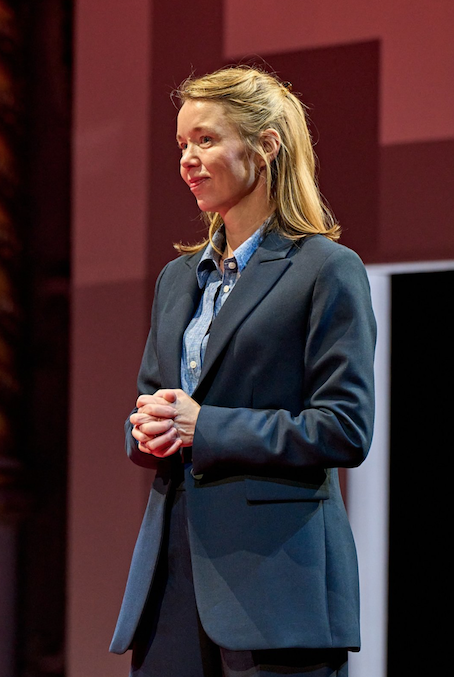
When there were 40 in a class you don’t remember everyone, The MP, Monica, is listed in the play text as an opposition MP. She is clearly Labour, so they failed to predict that Rishi Sunak would call a surprise election, so by three weeks into the run she was a government MP. Anna Maxwell Martin is so convincing and so clearly Labour. It doesn’t matter. She’s a backbencher not a minister whatever. Alec thinks Monica could bring the case of men who’ve been refused access to their children to Parliament. She can’t. Actually, while sincere, she’s not a lot of use to him.
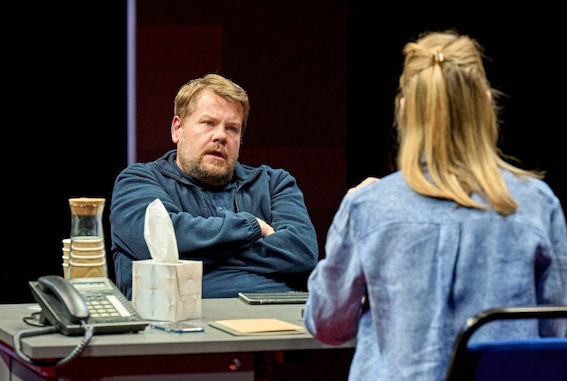
Alec has issues. His wife and kids are with another man. Alec uses threatening language. The other man is an undercover police officer and even has an offensive retired police dog – this is the really funny section of a serious play and Corden goes with it.
Monica, the MP, is naturally wary of an angry male in her office. We know that female MPs have been threatened and in Jo Cox’s case in 2016, murdered. Jess Phillips MP had 600 rape threats in a day. Joe Penhall, who wrote this, interviewed her. We’re seeing this the day after Trump’s ear was hit by a bullet.
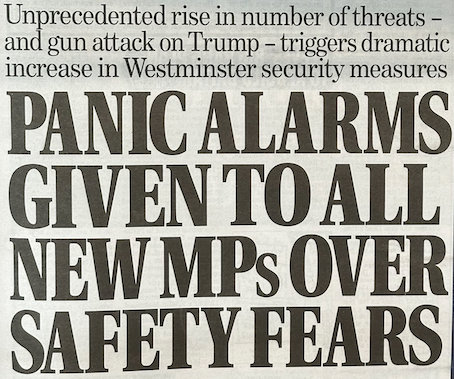
That was Tuesday. This was the headline in The Daily Mail the following Sunday. Yet again, fiction predicts reality. Alec was installing a panic alarm.
So abusive language and a threatening tone are not acceptable, though he’s talking about his family rather than threatening Monica. There are two worlds colliding here. Tesco, the Post Office, British Airways, the NHS, your doctor and dentist receptionist areas have signs telling you that abuse of employees is not tolerated. South Western Railway, whose employees I predict have had more abuse than most during the endless strikes, have signs reminding us that abuse is indeed taken as personal, and is hurtful and traumatic. Last year we were in Accident and Emergency. A man came in, wearing chef’s garb. He had cut off the end of his finger and had it wrapped in ice. He was told he was twentieth in the queue. He said he needed to see a doctor now while it could still be re-attached. We were right next to him. He was told if he raised his voice again, it would be considered abuse and he would be refused treatment. His English was near bilingual. His accent was Spanish. There are studies of volume in different languages. Native Spanish speakers generally use a higher volume than English speakers. He was definitely not ‘shouting’ was perfectly polite and in some pain, just slightly above normal volume. I was furious but daren’t intervene lest we we were then refused treatment.
As an army veteran, Alec has a different definition of ‘threat’ and ‘abuse.’ So do I. When I worked backstage in the late 1960s my stage manager’s normal form of address was ‘you, you useless c*nt.’ That indicated he was in a good mood. It could be much stronger. We are on that interface and I expect sergeant majors on the front line in Afghanistan were not worried about hurting one’s feelings and that dire threats were normal. Alec recounts how incredibly violent his staff sergeant was to local Afghans, elderly, women and children, and to him as well. However, Alec cannot say he’d cheerfully kill his wife’s lover. I wouldn’t assume he was literal. In Belfast, ‘You’re daid (dead)!’ is mild abuse. I had it said to me for making notes for a review at a Van Morrison concert. I’ve had it jaywalking in Belfast from an angry driver. I never thought I was really about to be killed. Monica and the police protection officer have to assume that threatening language is literal. It develops from there. Monica arranges counselling for him. The counsellor ‘has to’ report him to Social Services for comments about his wife’s new lover.
Monica: So you didn’t say you know, you wanted to murder him, or strangle him with your bare hands, or anything like that, did you? (Pause) Did you?
Alec: I was a soldier. That’s how we talk. What’s the point of therapy, if I don’t say what I’m thinking?

The police officer, Mellor, is played by Zachary Hart with a mild Brummy accent. We first meet him giving Monica advice via FaceTime. Alec has had words about the police, in particular The Mets, the Metropolitan Police. These are commonly held views. Mellor speaks in strangulated, legalistic bureaucratese:
Mellor: My name is Detective Constable Mark Mellor and I have been asked to facilitate a process of Restorative Justice here today following a guilty verdict of making threats and causing criminal damage.
There will be a violent confrontation proving the nasty things Alec has had to say about the police. No plot spoilers.

The events sparked off by his confrontation have ruined Alec’s life in every aspect as we see in the final scene.
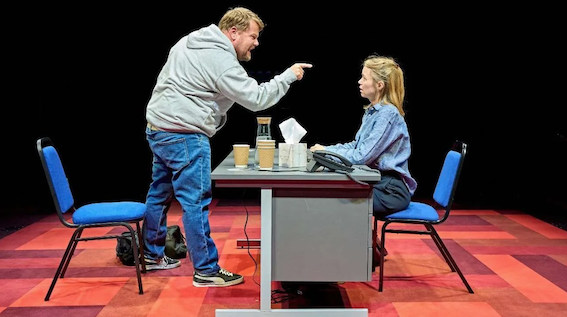
It was a standing ovation, oddly to the rear stage as they bowed, then to the auditorium as they turned. The acting from all three deserved it. I thought the play’s last few lines rather trite, though the final scene was moving, with an incredible performance by James Corden.
The long scene changes are somewhat intrusive. A blue neon square surrounds the stage from the front (Does it from the other direction?) and you can see people moving around in the semi-darkness and there is music. There is only one really big absolutely necessary set change, which has to be changed back.
What no credit? There are snatches of songs or music in the 8 or 9 blue neon / blackout demarcated set changes. Towards the end we hear most of a song that I couldn’t quite place. It has to be over 1% of the run time and prominent. Why no credit? They can credit the bar manager and a parental leave facilitator, but not the singer songwriter we listened to for nearly two minutes. The Time Out review mentions the music:
Staged on a narrow traverse, with its scenes delineated by increasingly mangled shards of The Smiths’ ‘Last Night I Dreamt That Somebody Loved Me’
OK, that should have been credited too (it was mangled too much for me to get it), but that’s not the one I want to know.

Not only does the programme lack song credits, but it lacks a cover designer too. It’s a cover in current dull National Theatre minimal style. Then they have colour rehearsal photos inside so they’re not saving the environment by avoiding full colour printing. It’s sparse on reading matter.
In spite of five star acting acting the intrinsic play lacks the theatricality or variety for more than four stars.
****
WHAT THE CRITICS SAID
5 star
The Sun, *****
4 star
Arifa Akbar, The Guardian ****
Sarah Hemming, Financial Times ****
Patrick Marmion, Daily Mail ****
The i ****
Daily Express ****
3 Star
Domenic Cavendish, The Telegraph, ***
Susannah Clapp, The Observer ***
Natasha Tripney, The Standard ***
Sam Marlowe, The Stage ***
Tim Bano, The Independent ***
Andrzej Lukowski, Time Out ***
2 star
Clive Davis, TheTimes **
LINKS ON THIS BLOG
MATTHEW WARCHUS
Future Conditional, The Old Vic 2015
JAMES CORDEN
One Man Two Guv’nors, West End 2012
ANNA MAXWELL-MARTIN
King Lear, National Theatre 2014 (Regan)
The Duke (film)
 Peter Viney's Blog
Leave a comment