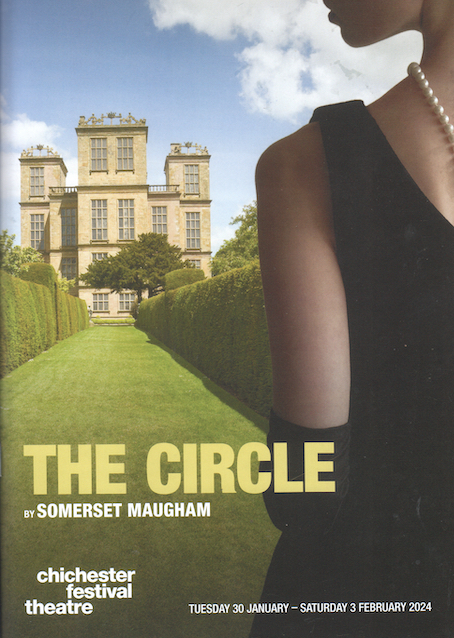
The Circle
By W. Somerset Maugham
Directed by Tom Littler
A Bath Theatre Royal Production 2024 presenting the Orange Tree production 2023
Chichester Festival Theatre
Thursday 1st February 2024, 14.30
CAST
Jane Asher- Lady Catherine Champion-Cheney (Kitty)
Clive Francis – Clive Champion-Cheney
Nicholas Le Prevost – Lord Hughie Porteous
Olivia Vinall – Elizabeth Champion-Cheney
Peter Ashmore – Arnold Champion-Cheney
Daniel Burke- Teddy Luton
Robert Maskell- Murray
The Circle was first produced in 1921 and was controversial at the time because it’s about a woman seeking advice on leaving her husband. There are parallels with Maugham’s The Constant Wife. As the programme notes, Maugham was in a triangle with his wife Syrie, and his male lover Gerald Haxton, which is perhaps why triangle relationships feature so often in his work. The director, Tom Littler, also mentions that the four classic playwrights of the era … Wilde, Maugham, Coward and Rattigan were all homosexual, yet the other three were too aware of Wilde’s fate to be explicit. Maugham was married and had a daughter. However, you have a socially acceptable married relationship on one hand, and an illegal and then socially unacceptable one on the other. In this play, it has to be a woman leaving her husband to be with another man, not for the first or the last time, it’s a cover.
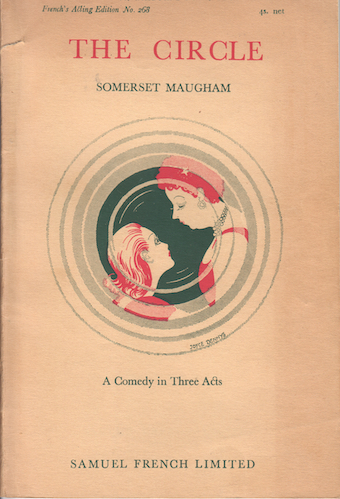
I remember being told that it was Maugham’s best play. My possession of French’s Acting Edition bears this out. We had to do a play a month at Anglo-Continental, a tradition that stretched back to the 1950s. I inherited the complete sets of plays, and was told I could keep them when I left. I kept one of each, and donated the sets to a school drama department. The Circle was in there alongside Private Lives, The Deep Blue Sea and The Importance of Being Earnest. Elite company indeed. Any production must have pre-dated us by years.
The story in brief
Arnold Champion-Cheney is an MP, and has been married for three years to Elizabeth. Elizabeth lost her mother at an early age, as did Arnold. In Arnold’s case, his mother deserted him at five to run away with his father’s best friend, Lord Hughie Porteous. Arnold’s father, Clive Champion-Cheney was parliamentary private secretary to Porteous, and Porteous was tipped as a future Prime Minister. The scandal finished both their careers, and Arnold’s mother, Kitty, was the subject of bawdy songs in pubs.
Clive refused to divorce Kitty. Puzzlingly while Clive does not appear to have a title, Kitty is ‘Lady Catherine Champion-Cheney’ though I’m sure at one point she is addressed as ‘Lady Porteous.’
Elizabeth seeks a mother figure and has persuaded Arnold to invite Kitty and Hughie to stay – they are visiting England from Florence. Arnold has not seen her in the thirty years since she left. Problem! Clive gave the estate to Arnold, but retains a cottage. Everyone thought he was in Paris, but he turns up. He decides to stay around (and stir it).
The house guest is Arnold’s pal Teddy Luton, a planter from Malaya. Elizabeth has fallen love with Teddy. She wants to leave Arnold and seeks Elizabeth’s advice on ‘life after scandal.’
That’s it. There’s a butler (obviously) and in the play text, a woman called Anna who only appears at the beginning to allow some plot to be set in dialogue – like the charlady at the start of The Real Inspector Hound. This production has cut her and distributed the important lines between Elizabeth and Teddy. A very sound idea.
The production
The production started at the Orange Tree in Richmond, Surrey last year. Same director, same cast except for Teddy (now Daniel Burke). The Orange Tree is a small 200 seat theatre in the round. Chichester Festival Theatre seats 1206 with a semi-circular thrust stage. It was nearly full. Theatre Royal Bath seats 900 with a traditional proscenium arch stage. It goes on to Oxford, Malvern, and then Richmond. That means a different stage every time, so there is a platform area sitting on top of the stage. In Chichester (as so often) it’s surrounded by acres of black unused stage. Blocking has to alter in spite of the platform area. In Bath the audience is entirely fourth wall, but goes up a long way into galleries. At Chichester you have to embrace the curved sides. We were central and it was fine BUT I really don’t think they were fully embracing the sides (until the final bows).
Tom Littler: The Circle was originally written for a proscenium arch staging which does allow for greater stillness; a chance for the picture to tell the story. (programme)
Indeed it becomes a framed picture, but too often with Maugham, a still life!
Maugham’s main fault is that you tend to get one actor spouting and the rest listening and watching. On this set, large sections of the romantic Elizabeth and Teddy scenes were at extreme sides, with the actors at least 24 to 30 feet apart, facing in. Square. In the Elizabeth-Arnold row, Kitty and Hughie have to stand watching passively from the side with nothing to do for ages. They need to be somewhere else rather than stuck like a pair of lemons. It’s a Maugham fault. He had story, he had lines, but he did not have stagecraft. There’s nothing for a director to do with it.
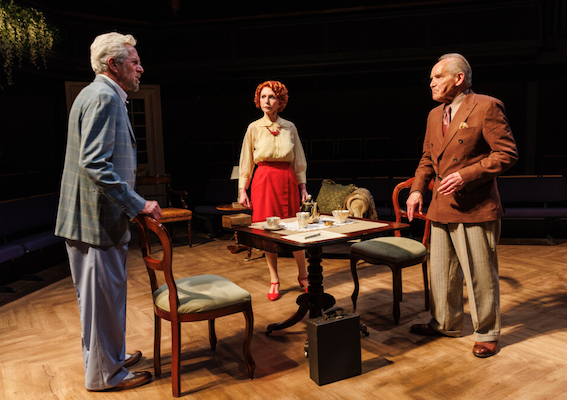
For obvious reasons the online photos are all from those (rarer) moments when the cast get close to each other.
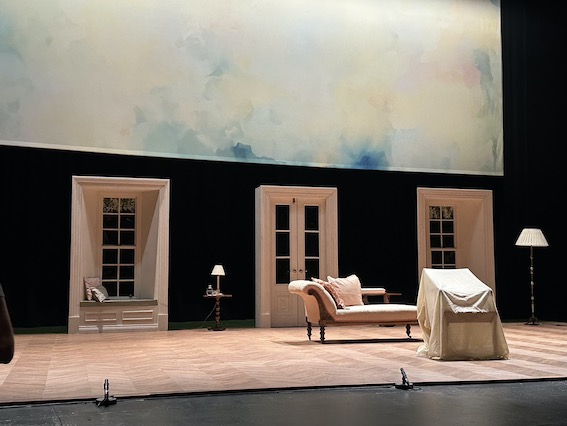
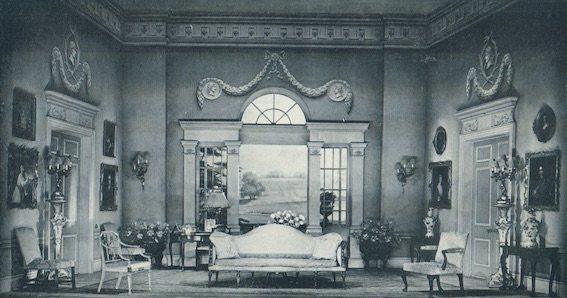
The travelling set is bare and unimaginative. The text says that Arnold is an interior decorator, and is obsessed with furniture. Elizabeth talks about over-stuffed interiors. Every time I see Somerset Maugham, there are three windows at the back, and the central one is a French window – it’s 1921. Every theatre had a French window set. Compare the 1921 set:
There is an attempt to enliven it with a silent statuette swap from table to table as a pre-show- Arnold thinks it should be on one table, the butler on another. This was a great Two Ronnies sketch, but works better with a man in a restaurant who wants the bunch of flowers which is only on one table and the waiter doesn’t want him to have it (we did our own version for years). It’s not in the script, but comes from a line. OK, I like silent starts, but it’s tagged on. Also if I’d done it, I’d have had a larger brighter statuette or a vase of flowers.
There’s interminable and intrusive background soundtrack birdsong. I guess it reminds us of how much avian life has been lost over a century. Too much of it.
They cut smoking. Good. You wouldn’t notice. It’s near impossible with Coward.
The cast
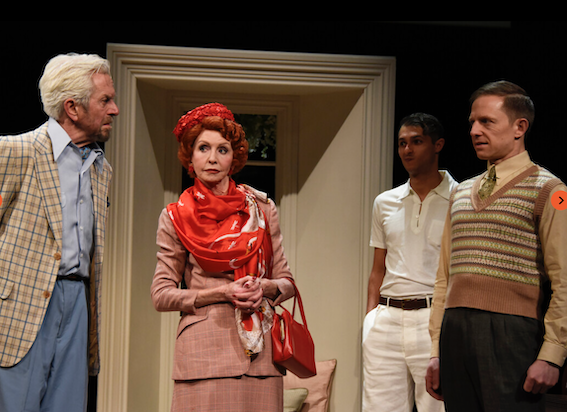
The photos on line are darker. Chichester seemed more brightly lit in my memory. These pictures are not from Chichester.
The cast is the thing here. That’s why it got 5 star reviews in Richmond. I wouldn’t go to five because whoever you put in it (and I can’t see you could get better actors than these), Maugham didn’t have the theatrical nous to write a five star play. It is a very good play though.
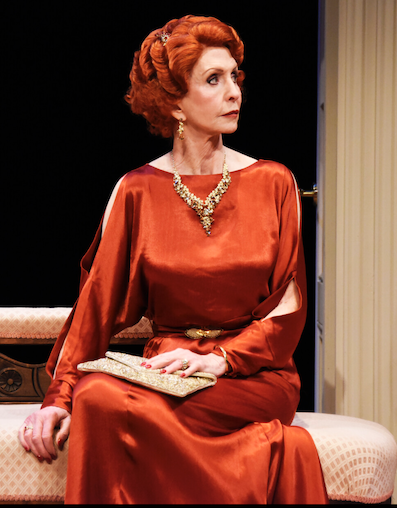
Jane Asher plays Lady Kitty. Perfection. Asher was a famous beauty in the 1960s. As the text dictates, she was also a famous redhead. Charisma? Paul McCartney’s girlfriend! All that is brought into the part with her. She’s a older than the text envisages (she’s a year older than me), but she looks younger. If we take the text – married at 22. Left when Arnold was 5. Been away 30 years, you’d get to just under sixty. BUT hang on, the 60 year old of 1921 would probably look much older than the 75 year old today. When my grandad was my age he was bent double with a stick, hobbled about and found it very hard to hear or see much.
The description in the play text:

OK, Maugham has the over-description common to all writers in the era and Shaw was vastly worse. Nicholas Le Prevost is not ‘very bald’ but has thick white hair. The effect is the same. Both work. I had an aunt who acted twenty when she was fifty and dressed the part of mutton dressed as lamb. Jane Asher gets it right, and is very funny indeed delivering the lines.
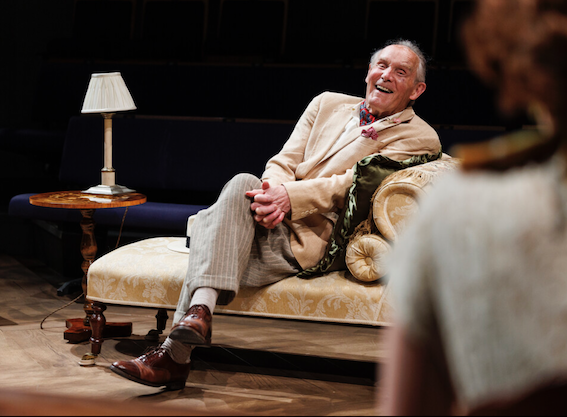
Clive Francis as the father, Clive, and Nicholas Le Prevost as Lord Porteous, demonstrate why mature actors continue excel on stage. Perfect timing, reactive acting, clarity of articulation. Both are marvellous. Clive is wry, urbane, mischievous. Hughie is snappy, curt, irritable.
-isms? While Maugham is trying to show that women have equal desires (possibly a surprise to some in 1921 audiences), there are classist asides.
Arnold: Twenty four hours after you leave this house I shall go down to Brighton with a chorus-girl. And neither you nor I will be able to get a divorce.
I suppose that in the law of the time, if both committed adultery then it ruled out divorce on the grounds of it. The text says the house is in Dorset … if so you ‘go along’ to Brighton, not ‘down’. It indicates that Maugham’s mind was set in the Home Counties.
‘taking a chorus girl to Brighton.’ Having worked on late 60s variety shows, I will take exception on the chorus girls’ professional dancers’ behalf.
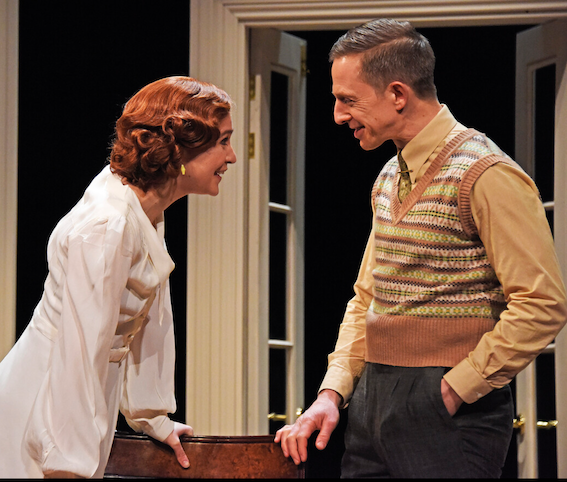
Peter Ashmore as Arnold was outstanding. His fury was terrific. The programme points out that ‘interior designer’ may have been a coded reference in those days. Maybe not deeply coded:
Arnold: I’ve worked like a dog to make this house a thing of beauty. After all, a man marries to have a home, but also because he doesn’t want to be bothered with sex and all that sort of thing.
The way Peter Ashmore delivers the line is superb, dropping his voice to a whisper on ‘sex.’ Elizabeth is asked why they haven’t had a child in three years. Now we know. Yes, the play is very funny at times. As an interior design fanatic, Arnold’s taste runs to Sheraton chairs circa 1750. A Noel Coward interior designer would have given us some interesting art deco furnishings.
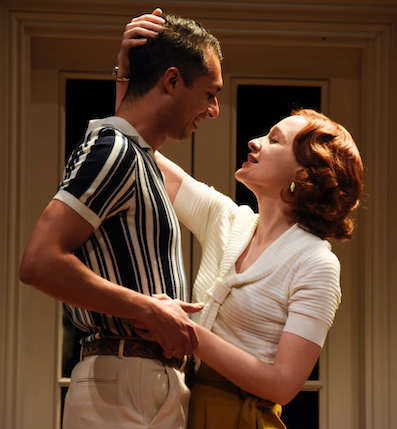
Teddy is a planter in Malaya, which he refers to repeatedly as ‘The FMS.’ (Federated Malay States). That is an acronym (or rather initialism) unknown to a modern audience. I mentioned it to someone who lived in Singapore for a year and he’d never heard of it. I would have changed it from FMS to Malaya.
Olivia Vinall is Elizabeth, fresh-faced, enthusiastic, only to be drawn into arguments she had hoped to avoid. One of the advantages of poor memory, is that I had no recall of the ending and her eventual decision, so the ‘Will she? Won’t she?’ aspect remained a mystery right to the end. That enhanced our enjoyment.
****
W. SOMERSET MAUGHAM ON THIS BLOG:
The Constant Wife by W. Somerset Maugham, Salisbury Playhouse
For Services Rendered, by W. Somerset Maugham, Chichester Minerva Theatre, 2015
The Circle, Chichester 2024
also
Before The Party by Rodney Ackland, based on Maugham’s short story, Salisbury 2017
LINKS ON THIS BLOG
NICHOLAS PREVOST
Love for Love by William Congreve, RSC 2015
Man & Superman, by Shaw, National Theatre 2014
OLIVIA VINALL
The Seagull, Chekhov, Chichester 2015
Platanov, Chekhov, Chichester 2015
Ivanov, Chekhov, Chichester 2015
King Lear, National Theatre 2014 (Cordelia)
Othello National Theatre 2013 (Desdemona)
PETER ASHMORE
The Provoked Wife, Vanbrugh, RSC 2019
Venice Preserved, Otway, RSC 2019
DANIEL BURKE
Troilus & Cressida, RSC 2018
 Peter Viney's Blog
Leave a comment