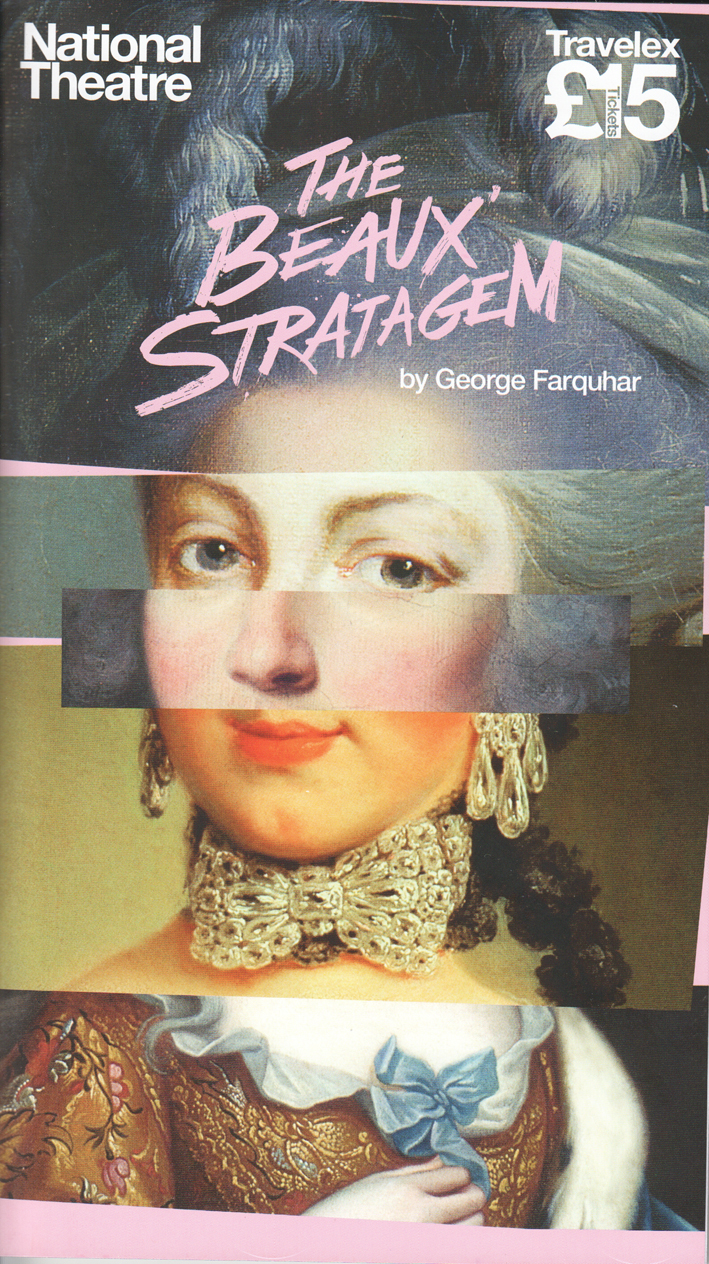
The Beaux’ Stratagem
by George Farquhar
Additional Dramaturgy by Patrick Marber & Simon Godwin
Directed by Simon Godwin
Designer Lizzie Clachan
Music by Michael Bruce
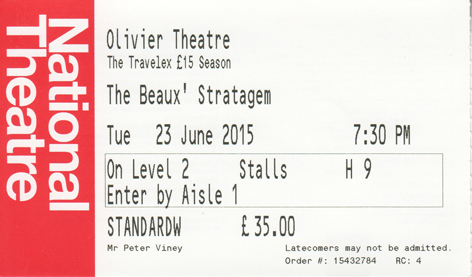
The Olivier Theatre, National Theatre
Tuesday 23rd June 2015, 19.30
Now on NT At Home streaming
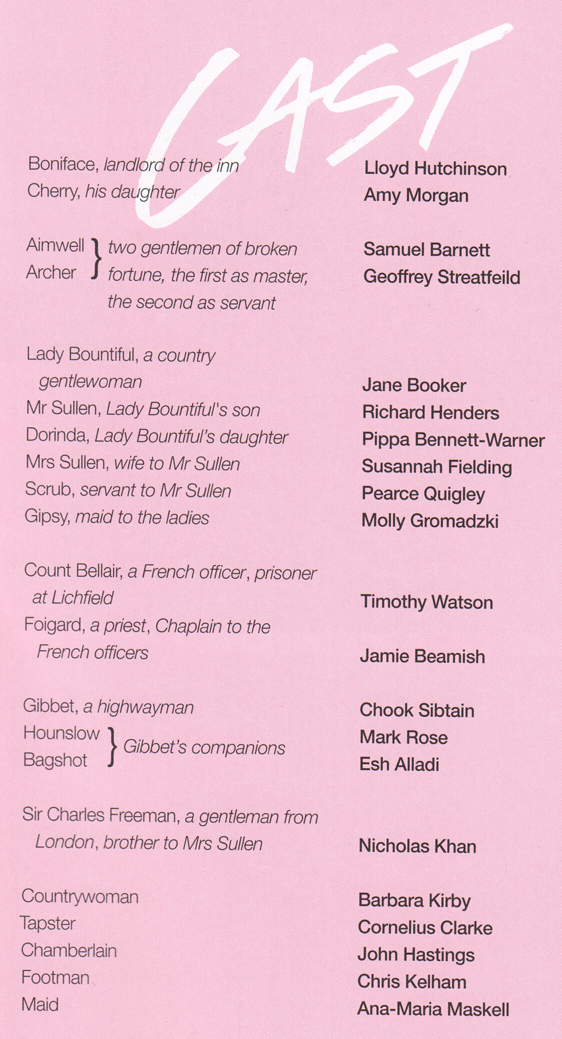
CAST
Lloyd Hutchinson – Boniface, landlord of the inn
Amy Morgan – Cherry, his daughter
Jane Booker- Lady Bountiful
Richard Henders – Mr Sullen, her son
Pippa Bennett-Warner- Dorinda, Lady Bountiful’s daughter
Susannah Fielding – Mrs Sullen
Pearce Quigley- Scrub, servantto Mrs Sullen
Molly Gromaszki- Gipsy, servant to the ladies
Timothy Watson – Count Bellair, French prisoner
Jamie Beagard – Foigard a priest
Chook Siblain – Gibbett, a highwayman
Mark Rose- Hounslow
Eash Aladi – Bagshot
Nicholas Khan – Sir Charles Freeman
Barbara Kirby – Countrywoman
Cornelius Clarke- Tapster
John Hastings – Chamberlain
Chris Kelham – Footman
Ana-Maria Maskell- Maid
The play is one of the last restoration comedies, written in 1707, and already pointing towards the more sophisticated comedies of the18th century. It was also Farquhar’s last play.
Aimwell and Archer are a pair of London beaus, who have run out of money and are in the provinces seeking rich wives. They turn up in Lichfield at the local inn. The inn, run by Boniface and his daughter, Cherry, is a den of highwaymen, and the landlord is in league with them. He suspects Aimwell and Archer of being highwaymen too because they pretend to have a box full of cash. The lads are taking it in turns to act out master and servant, and it’s Archer’s turn to pretend to be the servant.
Squire Sullen
Squire Sullen is the local drunk and a very drunken drunk at that. He has recently married Mrs Sullen, a beautiful and sophisticated London lady. They loathe each other. They reside with his mum, Lady Bountiful, a purveyor of herbal medicines. Sullen’s sister Dorinda is the eligible heiress. They are served by their butler, Scrub, who gets involved in most of the plots, being in love with the ladies’ maid, Gypsy.
The inn also has a French count and his chaplain staying there, though the chaplain is an Irishman pretending to be French. The count, Bellair, is a prisoner-of-war hoping to be ransomed. The count is intent on wooing Mrs Sullen, as is Archer. Mrs Sullen is willingly wooed. Aimwell has his sights set on Dorinda.
The highwaymen are planning to rob the house. Mayhem ensues at night. Lots of running up and down, tying up bandits, hugs and stolen kisses. Happy ending, very surprisingly with Mrs Sullen divorcing her oafish husband. Just about possible in 1707, though there had only been one successful case.
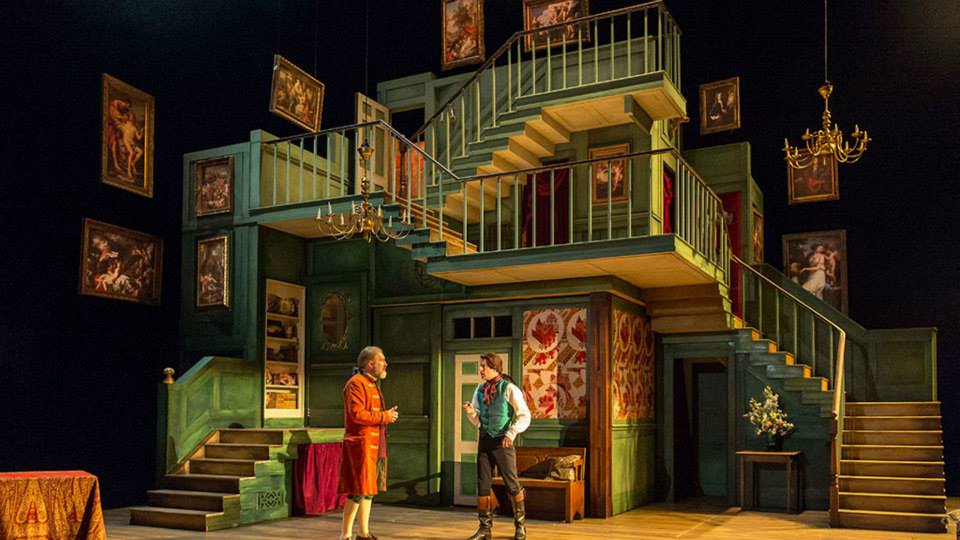
The set: we never saw any of this from our position facing the side of the stairs on the right. I didn’t even know it was green.
I have always said every seat at the Olivier has good vision and sound. Wrong today. We were in Row H, at the side on Aisle 1 … though the furthest to the centre in the side section, by the concrete section edge. The set design was weird. OK, just wrong. Instead of being squared to the centre of the auditorium, it is squared to Stage right and the stage right half. From extreme Stage Left you are looking at the side of the set. We also lost a lot of lines where actors had their backs to us. Fortunately, the star of the show (and she really is) is Susannah Fielding and she delivered most speeches in our direction and she also has crystal clear delivery. We both thought the set positioning in relation to the audience totally wrong-headed. It accentuated another issue. This is a 1707 play. The huge Olivier Theatre dwarfs it, which means a directorial tendency to have extras running around to little purpose to fill it. Having seen so much recently at the Wanamaker Playhouse, the contrast becomes massive. You don’t need that huge space, when the comedy is often two way or three way dialogue. In fact, the stage size is a barrier, pulling the actors apart. The set itself has the advantage of levels, and without a revolve transforms very easily from inn to Lady Bountiful’s house (with everyone going on and off doing a little bit). That aspect was good, but we only saw the side, which was the stairs side. One review complains the set is unlucky green. We couldn’t even see the colour.
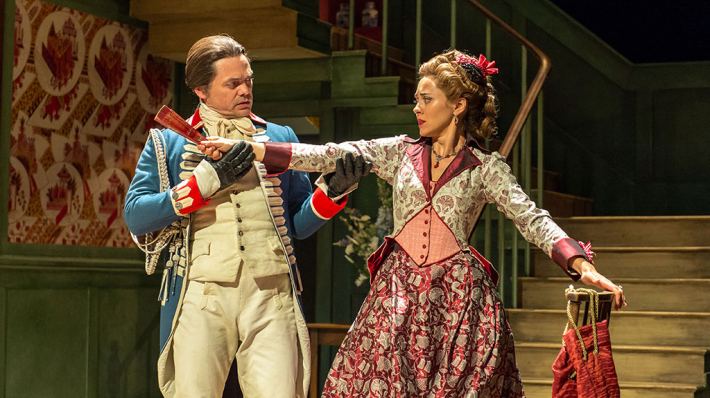
Count Bellair & Mrs Sullen
Mrs Sullen is a part so good and so “modern” that it must be the reason for reviving the play. Her lines are vibrant on the page, and take off with an actress as accomplished and lovely as Susannah Fielding. My companion remembers once doing Mrs Sullen as an audition piece, which is why I suppose we have a copy. One of the funniest scenes in the play is when a countrywoman turns up, seeking a remedy from Lady Bountiful for her husband’s sore leg. She meets Mrs Sullen first, who reveals her loathing of husbands as a breed, and her suggested remedies are very funny. Lady Bountiful looked wonderful with her sculpted hair, and we’d have liked rather more of her than the script gave us. The herbalist / amateur physician (powdered sugar for a bleeding arm) is interesting for 1707. It was only a few decades earlier that women proffering herbal remedies were seen as witches. Clearly no longer in Farquhar’s England.
The bigger a part was played the better. Gibbet the Highwayman’s first appearance was memorable because he produced booty from all over himself like a magician. Really well done. Naming his assistants in crime Hounslow and Bagshot is so intrinsically funny now that I had to check the script: it was funny in 1707 too.
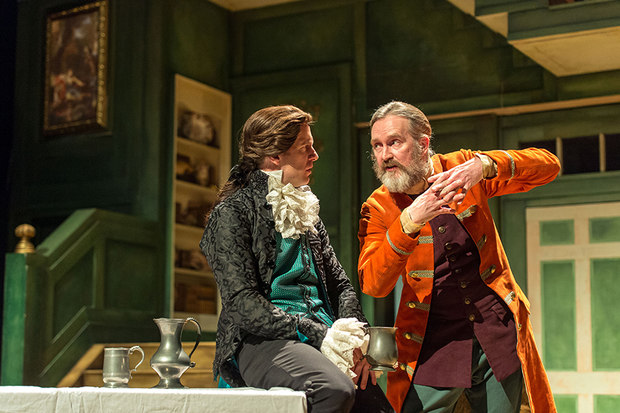
Archer and Scrub the Butler (in red)
Pearce Quigley as Scrub, the Sullens’ butler, is simply the best comic servant you can put on a stage. His laconic delivery makes every line funny. It’s an important role in the play too, culminating in taking Mrs Sullen’s place hiding under the covers in bed when the highwayman arrives.
Count Bellair was delightfully and forcefully Gallic every time he appeared. On accents, we never really got why his chaplain was comic French veering into comic Irish. Hard to pull off, harder to comprehend at the angle, to the point where Farquhar’s plot reason was unclear for having an Irishman posing as French – though I guess the discovery of his Irish origin, so treachery, allowed Aimwell to blackmail him into marrying him to Dorinda.
On accents, the lower classes have ‘Birmingham area light’ as a default, because it’s Lichfield in Staffordshire. Using Brummy-lite is often an RSC ploy at Stratford too.
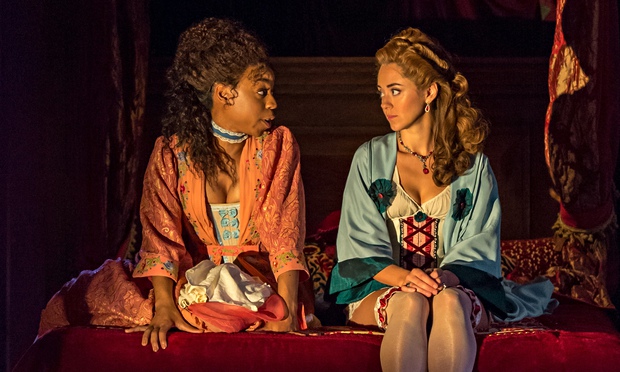
Dorinda and Mrs Sullen
The Beaus, Aimwell and Archer, are classic roles, and both were well taken. Archer, posing as Aimwell’s servant, is the bigger role and done with force and clarity. They worked superbly as a double act.
Music was notable, with an Irish air, and at several points musicians appeared on high on the set and thus “forced” a character to sing. Archer got a guitarist. Count Bellair got an accordionist dressed in striped jersey and beret and got instant applause at the end of his song. Archer got the ‘Trifle Song’. Mrs Sullen closes the play with a song.
Reviews tend to four star, though The Telegraph gave a three, saying a romp needs to be “rompier.” We felt just the same. With such a first-rate cast, all performing so well, you’d expect an easy four star. But it wasn’t for either of us. There was a click, a pace, an interactive buzz that just wasn’t quite there. Partly it’s the play … Farquhar creaks a tad, and indeed seems forced, as we found with The Recruiting Officer. It is also partly direction … the director’s Two Gentlemen of Verona at the RSC also failed to click for us in just the same way. There were five minutes here and there where I was actually bored. I wish I could define it, but with comedy, you’ve either got the directorial timing, or you haven’t. Which is why the play shone in the bits where Mrs Sullen, Scrub, Count Bellair, Archer, Gibbet were given space to do their thing, because all the actors are totally capable and have natural comic timing. But it’s not enough. It has to run through the whole and all the parts all the time. The highs were solo pieces, not interaction.
We both felt extremely short changed by the way the set was angled. It was simply incompetent set design. Don’t directors and designers ever walk around and watch from different angles?
Four stars for acting, and for costume design.
Three stars for direction.
One star for set design.
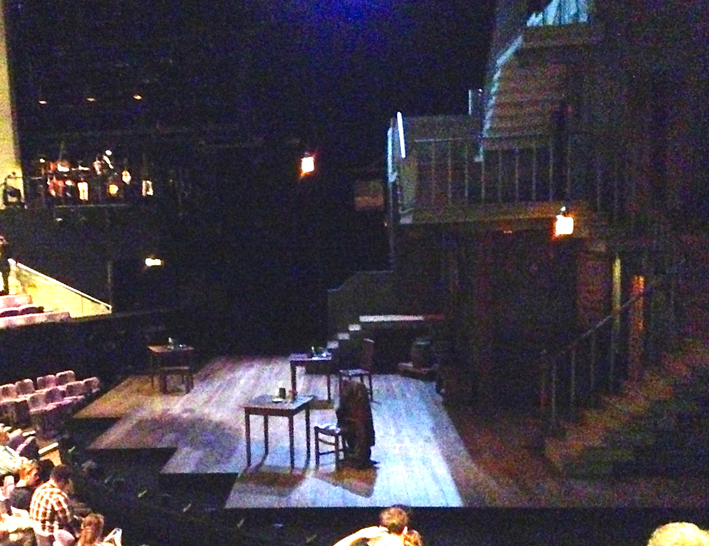
Our angle on the set (phone image before the start)
AMBIENCE
In a new low for audience etiquette the man in the row behind took off his shoes and put his smelly feet up on the concrete side, inches from my companion’s head. He’d whacked me heavily on the head with his backpack on the way in too, without apology.
PROGRAMME
The National Theatre’s boast that it has the best programmes in London is repeated all over the theatre. No. Not at all. You do not print in tiny text on pink and mauve paper when one of the most common reading places is in the dim theatre before it starts. Also it has a high guff count around the essays. Nowhere near Globe / Wanamaker standards.
NT AT HOME: Added note in January 2026
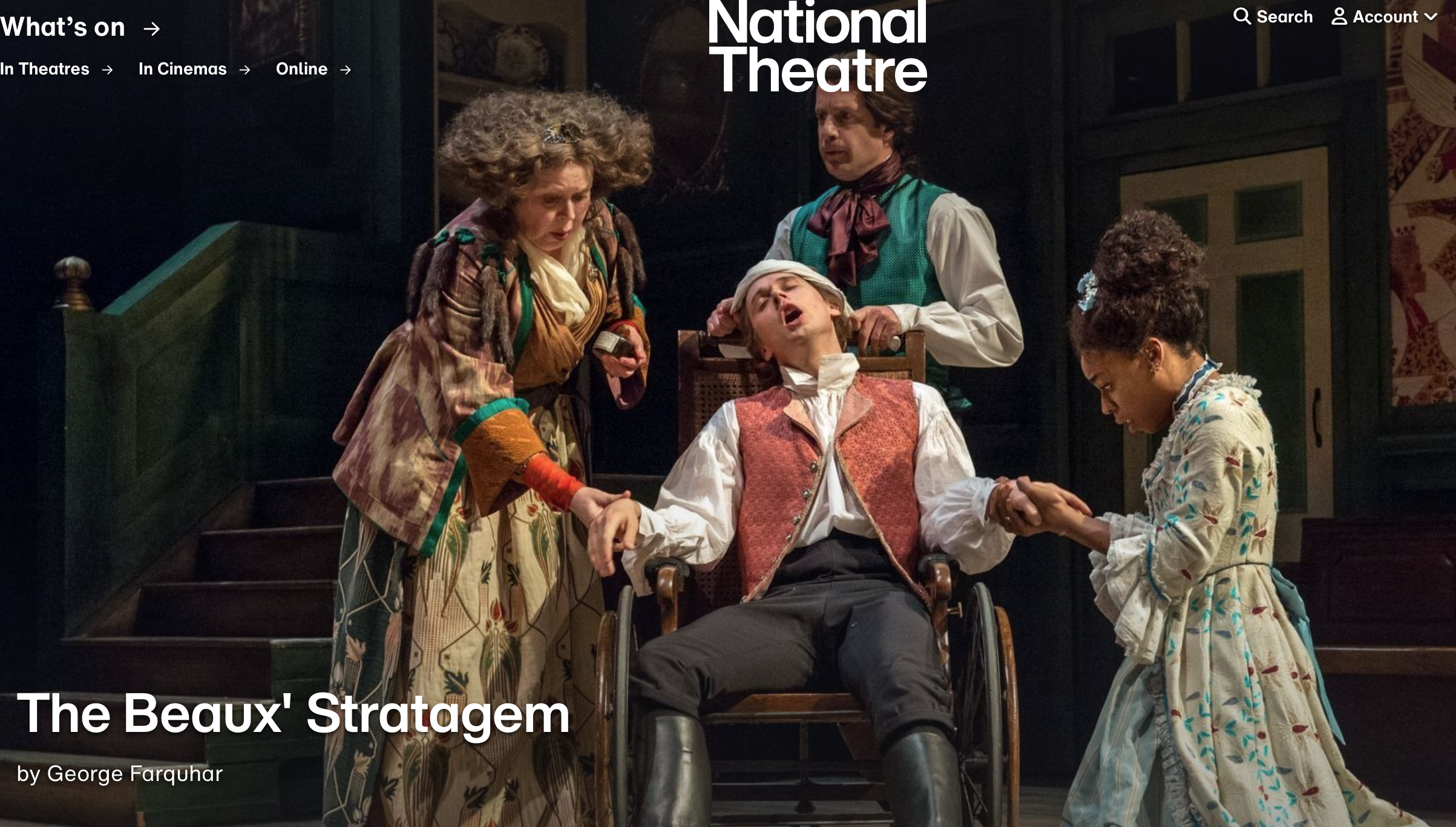
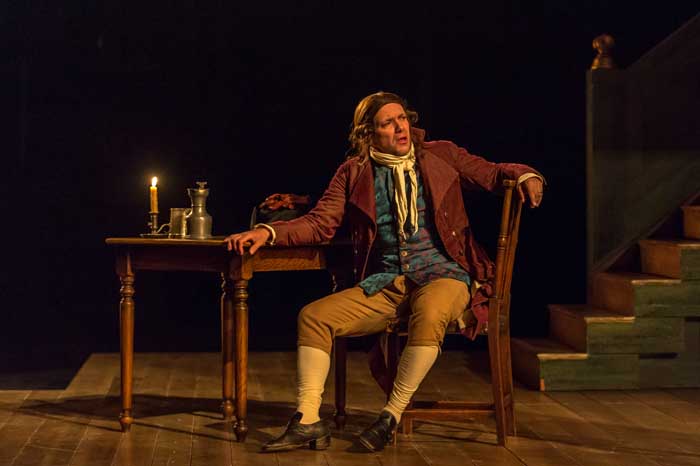
L to R: Lady Bountiful, Aimwell (seated), Archer (standing), Dorinda
We rewatched this on NT At Home, after an eleven year interval. I hadn’t re-read my review in the meantime. However, reading it now, the points still persist. It’s Susannah Fielding as Mrs Sullen and Pearce Quigley as Scrub that we remembered best. A lot was a revelation. We knew we had missed much of the action from our terrible seats in the Olivier Theatre, but we had no idea how much we had missed. The outstanding one was Scrub taking over Mrs Sullen’s place in bed. Pearce Quigley’s little waves from below the blanket are hilarious. We totally missed them in the actual theatre. Dorinda and Mrs Sullen chatting in bed? Hardly saw any of it live.
We had forgotten the brilliant performance by Samuel Barnett as Aimwell, when he is pretending to have a fit so as to gain admission to Lady Bountiful’s house and get up close to Dorinda. It’s illustrated above. I fear it would be too un-PC (don’t mock the afflicted) for a 2026 production.
Geoffrey Streatfield as Archer is more central to the impact than we remembered, with some fine dancing, singing and jumping to add to his performance. We saw him last year in the RSC’s School for Scandal, as Sir Peter Teazel.
I criticised the set, because we only saw the side. On TV, I still agree, while adding that the switch from ‘The Inn’ to ‘Lady Bountiful’s house’ needs to be clearer and the murky TV lighting doesn’t help.
It’s the sort of play where seeing it live should be far better, with so much action, but in fact it was probably not given the extreme side seats we had on the night. I did think on the recorded version lighting was too dark, which we hadn’t noted on the night. Also the over-riding complaint was that it just failed to click and snap as much as good comedy should, in spite of a great cast.
LINKS TO REVIEWS ON THIS BLOG (UPDATED JANUARY 2026)
George Farquhar
The Recruiting Officer
Simon Godwin
Much Ado About Nothing, NT 2022
Two Gentlemen of Verona, RSC, 2014
The Beaux Stratagem, National Theatre, 2015
Man & Superman, National Theatre, 2014
Candida, Theatre Royal, Bath, 2013
Romeo & Juliet (filmed), NT 2021
Timon of Athens, RSC 2018
Twelfth Night, National Theatre 2017
Hamlet, RSC 2016
Richard II, The Globe 2015
Susannah Fielding
All New People
The School for Scandal
The Merchant of Venice – Almeida
Death On The Nile (film) 2022
The Country Wife, William Wycherly, Chichester 2018
Pearce Quigley
A Midsummer Night’s Dream – Globe 2013
The Changeling Wanamaker Playhouse, 2015
The Merry Wives of Windsor – Globe 2019
As You Like It, Globe 2018
Bank of Dave II (film)
Jamie Beamish
Macbeth, RSC 2011
The Merchant of Venice – Almeida
Geoffrey Streatfeild
The School for Scandal, RSC 2024
Blithe Spirit, Bath 2019 (Charles Condamine)
My Night With Reg, 2015
Samuel Barnett
Ben & Imo, RSC 2024 (Benjamin Britten)
Rock Follies, Chichester 2023 (Harry)
Richard III, Globe / West End 2012 (Queen Elizabeth)
Twelfth Night, Globe / West End 2012 (Sebastian)
Lloyd Hutchinson
The Government Inspector, Chichester 2025
Romeo & Juliet, National Theatre 2021 (Lord Capulet)
Absolute Hell, by Rodney Ackland, NT 2018
A Midsummer Night’s Dream Young Vic 2017 (Puck, Egeus)
Amy Morgan
Dear Octopus, NT 2024
The Constant Wife, RSC 2025
Travesties, Menier 2016
The Beaux Stratagem, National Theatre (Cherry)
The Broken Heart by John Ford, Wanamaker Playhouse
An Ideal Husband, Chichester 2014
Jane Booker
The Watsons, Chichester 2018
Richard Henders
Fortune’s Fool 2014
 Peter Viney's Blog
[…] of The Beaux Stratagem by George Farquhar (1707) at The National Theatre in London. Two of our favorite actors, Susannah Fielding as Mrs […]
LikeLike