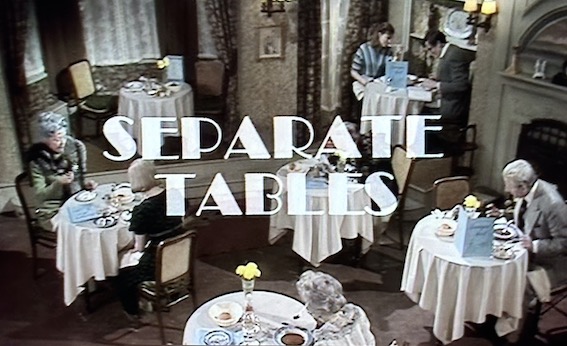
Separate Tables
By Terence Rattigan
Adapted for television by Hugh Whitemore
Directed by Alan Cooke
Produced by Cedric Messina
BBC ‘Play of The Month’ broadcast March 1970
Now in “The Terence Rattigan BBC Collection” box set (2011)
CAST:
Geraldine McEwan – Anne Shankland / Sybil Railton-Bell
Eric Porter – John Malcolm / Major Pollock
Anette Crosbie – Miss Cooper, the hotel manager
Robert Harris – Mr Fowler
Hazel Hughes – Miss Meacham
Pauline Jameson – Mrs Railton-Bell
Cathleen Nesbitt – Lady Marcheson
Laurence Carter – Charles Stratton
Loanna Wake – Jean Stratton
Annette Robertson – Doreen, waitress
Peter Bathurst – Sir Roger
Beatrice Greeke- cook
I’d had the BBC Terence Rattigan Collection Box Set in my hands at The National Theatre Bookshop and the BFI Bookshop a few times. It’s a five DVD set too. I’ve seen it at £39.95 and also discounted to £29.95. It’s currently a mere £15.97 on Amazon (and a bargain). I was tempted but didn’t succumb. Then I saw it in a charity shop for £4 a couple of weeks ago. I won’t do them all, but Rattigan appears a lot here, and I thought it worth joining the others.

I decided to start watching with Separate Tables. See my review of SALISBURY PLAYHOUSE 2014 for more details on the play and on its Bournemouth setting.
There are two film versions, 1958 and 1983, and this from 1970. I didn’t have a TV in 1970. I’d never seen it. In 1970, I’d been conditioned to ignore Rattigan too. It’s taken me years to appreciate him.
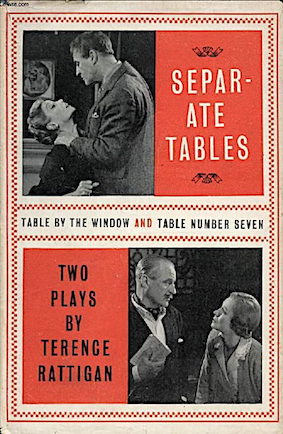
It was designed to be two one act plays, Table By The Window and Table Number Seven, both set in the Hotel Beauregard in Bournemouth, and the plays were set eighteen months apart. The point was to create a star vehicle for the two leads, who would play vastly different characters in each play, while the support cast of long term residents and staff remained the same. This casting is always adhered to. These leads are as good as you’ll get and both major actors of the era. Geraldine McEwan was in a run of major National Theatre lead roles. Eric Porter was the star of The Forsythe Saga.

So the male lead (Eric Porter here) plays John Malcolm in the first play. He is a disgraced Labour ex-cabinet minister (1945 cabinet), imprisoned for striking his wife and causing her Grievous Bodily Harm. He was a Hull docker. Rattigan had a crystal ball about Labour cabinet ministers called John from Hull who cause a scandal by hitting out with fists. Now eight years on, he’s a left-wing journalist living in the hotel. The female lead (Geraldine McEwan here) is Anne, the ex-wife, a glamorous model, now terrified of being alone and terrified of being forty.
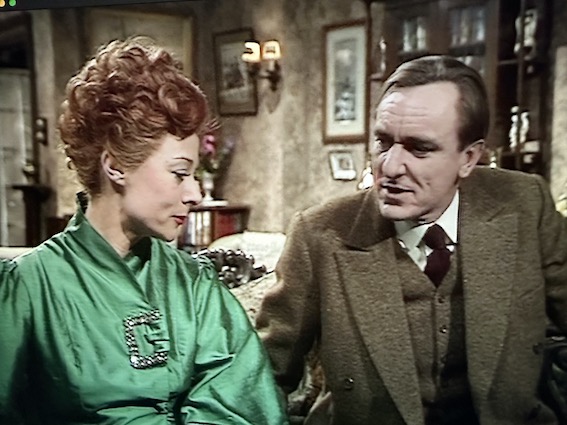
She turns up at the hotel where he has been conducting a quiet, secretive affair with the hotel manager, Miss Cooper. (Annette Crosbie … Mrs Meldrew in One Foot In The Grave, the housekeeper in Dr Finlays Casebook among many others.) Miss Cooper is the calm, kind voice of reason throughout.
So what makes the BBC play adaptation different? The eighteen month gap has been removed, so the two plays run as one, with an evening sequence for the first, and a morning sequence for the second. In the second, for much of it, the “tables” are also in the conservatory. Therefore, the young couple with a baby from the second play, can now appear at a table in the first and have a couple of lines. More, our leads appear in both halves … though due to 1970 technology, never appear together. So the end sections of the first play are cut into the second play. Geraldine McEwan appears as Sybil in the first play at a table, goes out and soon arrives as Anne.
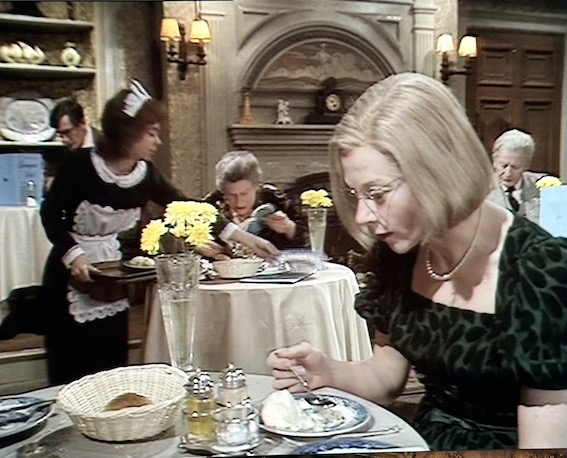
This could never have been done on stage. The female lead could never remove the glamorous and flawless make of the gorgeous forty year old, change elaborate wigs, and become the nervous dowdy unmade-up 33 year old with crows feet, in time. The interval must be a stretch in stage versions. Every minute must be in make-up for both. They needed the interval. I assume Rattigan decided on ’18 months later’ to stress how long the permanent residents had been there and that nothing had changed.
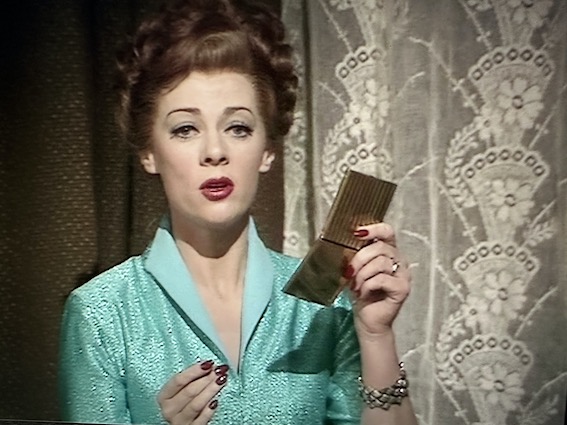
So both actors have a major jump. The glamorous role is plain Anne, while the dowdy role is exotically Sybil (named for the Delphic divine oracles).
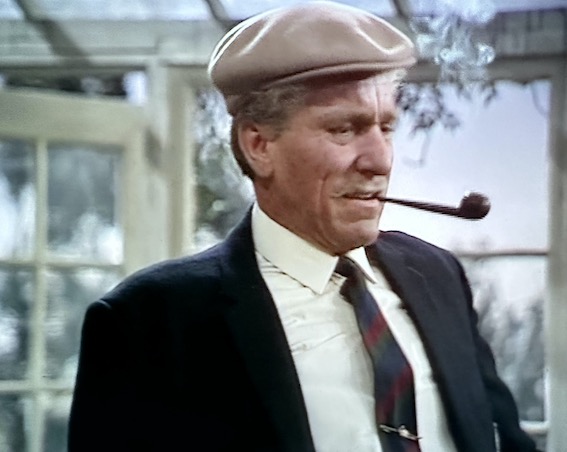
In the second play, the male lead plays Major Pollock, a fantasist who lives at the hotel. He claims to be a public school educated Black Watch officer with a fruity upper class accent. The female lead is now Sybil, the nervous, unattractive and put upon daughter of the bullying Mrs Railton-Bell. Pollock is trying to stop anyone reading the West Hampshire Weekly News where his court case is reported. Mrs Railton-Bell finds it. He was caught ‘nudging’ women in a cinema.
‘Major’ is the normal choice for bounders pretending to be officers. I wonder if John Cleese and Connie Booth were inspired by this TV production? We have permanent hotel residents plus visitors in a South Coast resort. Hazel Hughes as Mrs Meacham, plays a similar (identical?) hard-of-hearing fierce lady interested in horse-racing, Mrs Richards, in Fawlty Towers. That has the pompous Major in a blazer, and then the smartly-dressed efficient hotel manager played by Prunella Scales in Fawlty Towers is Sybil Fawlty. Connie Booth, like Doreen here, is Polly, the waitress who is too honest in her comments. Cleese apparently thought of the idea after staying at a Torquay hotel in May 1970, so a few weeks only after the broadcast.
There are cuts, all my beloved Bournemouth hotels references have gone, though we still retain ‘Studland Road.’ Why? Well, this is the BBC. In 1970, the Branksome Towers Hotel, The Royal Bath Hotel and The Norfolk Hotel were all still trading. The Branksome Towers closed in 1973. We live at the furthest end of what used to be its extensive estate. The other two are still trading today. No advertising and they are described as the best luxury hotels.
Moreover, it’s the original 1955 script. Rattigan’s draft was instantly rejected by producers. In that version, the Major’s offence was importuning young men on Bournemouth beach, and being arrested by an undercover police officer. Rattigan had to rewrite it with the Major’s offence being touching women strangers in the cinema … six in one five hour session. The 2006 Manchester and 2014 Salisbury productions go back to Rattigan’s “banned” version, which is a stronger text. The censorious producers also toned down, I think, the schoolmaster’s wistful memories of young boys at the school where he was Housemaster. That takes away his hidden sympathy for the Major, and Sybil’s unrequited friendship is therefore played up.
I had expected a blurry black and white version, but it’s actually crisp bright colour, very good for 1970 TV. Was it done on film rather than video tape, I wonder? It has a superb cast, and looks just as you might imagine. Costume and set are perfect.

The hotel food close ups, slopped on the plates, evoke the school dinners of my youth. They’ve added a cook to slop the food on (and added a few lines).
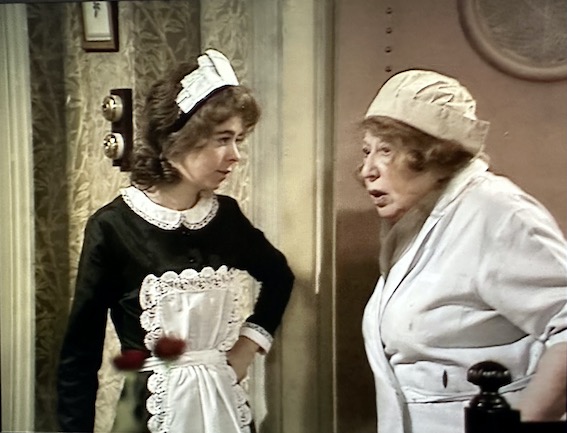
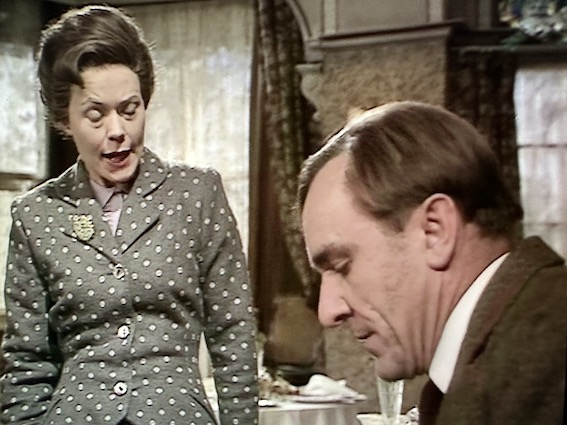
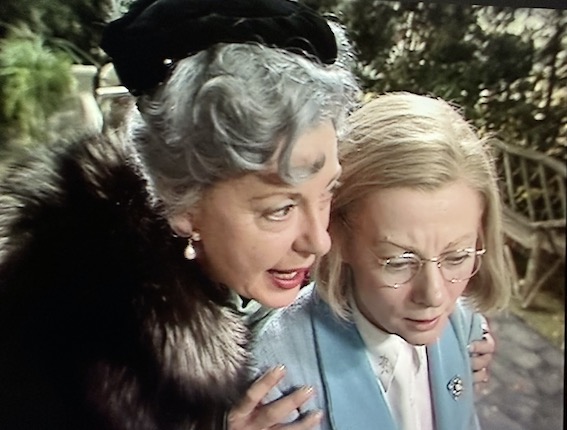
The thing that comes across most strongly is the Major’s punishment. He was bound over to keep the peace. Mrs Railton-Bell (Pauline Jameson) demands that he be expelled from the hotel and tries to work the other residents up.
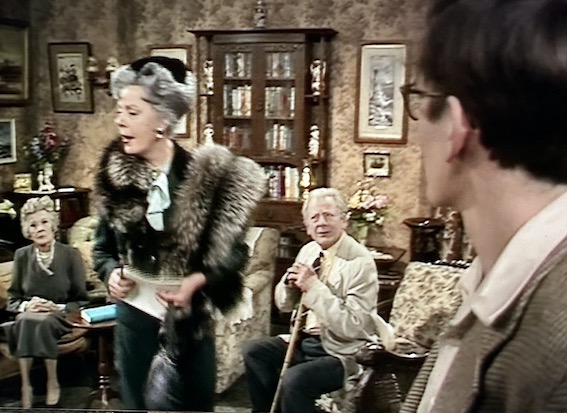
Pauline Jameson as Mrs Railton-Bell, Laurence Carter as Charles Stratton
While she spouts how difficult it is for her to do this she relishes every second of it. The character is a beautiful example of the holier-than-thou bullying hypocrite. Sybil is devastated and will defy her mother in the end and stand up to her. In the end, all rally to be pleasant to the disgraced Mr (as he now is) Pollock.
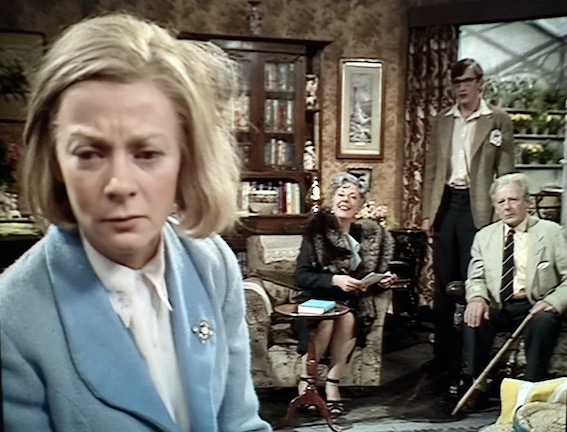
This resonated much more watching it again. The point is the Court has punished Pollock. Is it up to the residents to pile further punishment on him? The meeting with other residents is a kind of 12 Angry Men, with the young Charles Stratton, there with wife and baby, the counsel for the defence.
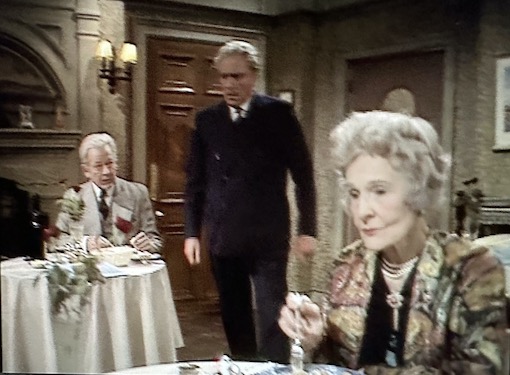
What it reminds me of. In the mid and late 1970s, I was Head of Elementary studies at Anglo-Continental School of English (ACSE) in Bournemouth. At that point the group (Anglo Continental Educational Group) had several branches, about nine in total. My Director of Studies was on holiday and it was the quartely group Director of Studies meeting, and I was there in his place. I note that ACSE was also the largest and senior member of the group. So a case came up. An Algerian student had been convicted of shoplifting. Our task was to expel him, and recommend deportation (his visa was dependent on studying with us). I had taught this young man for three months in Elementary Studies, and he had moved on to Intermediate Studies. I knew the case. After months in England preparing for Air Traffic Training, his wife was allowed to come and visit him. He had no money- these lads were paid a pittance by their government and as we noted could not afford winter coats. He went to Marks and Spencer and stole a piece of lingerie as a gift for her arrival. I had written to the court explaining the circumstances, praising his attitude to his studies and hoping for leniency. The court agreed and he got a tap on the wrist fine. As the (all older) directors spoke, agreeing on expulsion, my hackles rose. I wasn’t having it. I asked what right they had to impose a far, far greater sentence than the court of law? I asked what did they think the career chances would be for a Muslim convicted of theft?
Of course they gave the counter-argument that society and employers always add a further layer of ‘punishment.’ It got nasty. The right-wing director of studies of the smallest school pointed out that I wasn’t a Director of Studies. I pointed out that just my department was several times the size of his entire school. I wouldn’t let go. Alan McInnes, the Director of Studies who had appointed me, and then promoted me, before moving from ACSE to a mid-sized school as a step towards retiring had been silent. He really was the senior one there and everyone there had worked under him. He let me speak, then announced that I was quite right. There would be no double punishment. I was right. The others should be ashamed of themselves. He added that prurient references to ‘stealing panties’ were completely inappropriate. Agreed? Yes, good. Move on. On the way out, he said, ‘I’m very pleased with you. Read Separate Tables.’He had appeared in it, of course as the lead.
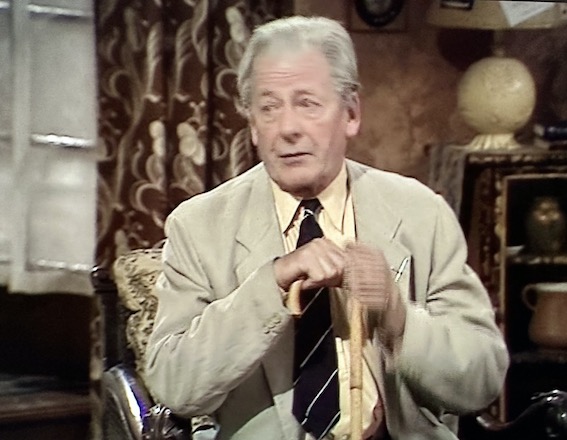
As Rattigan has said, the play is about loneliness. They’re all alone. Mr Fowler hopes ex-pupils will visit him, invites them and waits for trains that never arrive. Anne is after her ex-husband, John Malcolm, because she can’t stand being alone. Pollock commits the offences because he is so alone he can only relate sexually to complete strangers in the dark (in both versions!) Sybil was home-schooled, only allowed to work a sort time and now is alone. No one to relate to. It is a great play.
- TERENCE RATTIGAN
After The Dance by Terence Rattigan, BBC TV play 1992
All On Her Own by Terence Rattigan, Kenneth Branagh Company 2015
Flare Path, by Terence Rattigan, 2015 Tour, at Salisbury Playhouse
Harlequinade by Terence Rattigan, Kenneth Branagh Company 2015
Man & Boy, by Terence Rattigan,National Theatre 2026
Ross by Terence Rattigan, Chichester Festival Theatre 2016
Separate Tables by Terence Rattigan, Salisbury Playhouse 2014
Separate Tables, by Terence Rattigan, BBC TV version 1970
Separate Tables by Terence Rattigan (Table Number 7, Summer 1954) Bath 2024
Summer 1954 by Terence Rattigan (Table Number 7 / The Browning Version), Bath 2024
While The Sun Shines by Terence Rattigan, Bath, 2016
French Without Tears, by Terence Rattigan, English Touring Theatre 2016
French Without Tears, by Terence Rattigan, BBC Play of The Month 1976
The Deep Blue Sea by Terence Rattigan (FILM VERSION)
The Deep Blue Sea by Terence Rattigan, BBC TV Play, 1994
The Deep Blue Sea, by Terence Rattigan, Chichester Minerva, 2019
The Deep Blue Sea, by Terence Rattigan, National 2016, NT Live 2020
The Deep Blue Sea, by Terence Rattigan, Bath Ustinov 2024
The Winslow Boy, by Terence Rattigan, BBC Play of The Month, 1977
The Browning Version, by Terence Rattigan, BBC TV play 1985
The Browning Version by Terence Rattigan (as Summer 1954), Bath 2024
 Peter Viney's Blog
Leave a comment