
By Jamie Boygo
Directed by Roy Alexander Weise
Designer Khadija Raza
Composer / Sound designer Giles Thomas
World premiere
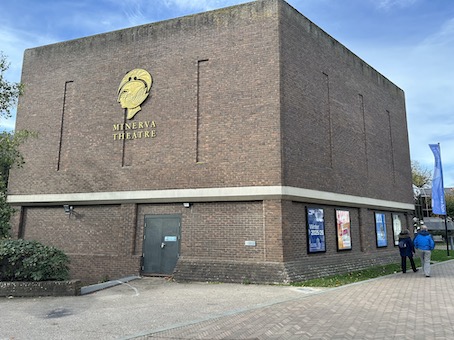
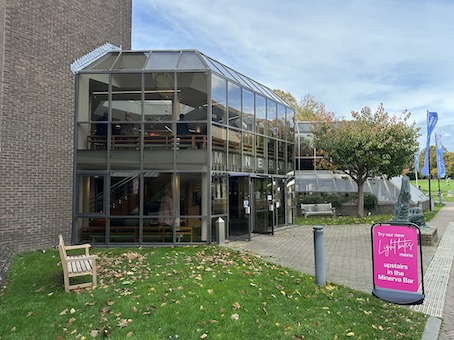
Chichester Festival Theatre
Minerva Theatre
Thursday 23rd October 2025, 14.15
CAST
Bola Akeju – Stacy
Jamie Boygo – Connor
Céline Buckens – Annabelle
Ernest Kingsley Jr- Isaiah
Ivan Oyik – Omar
The first point is that the playwright also acts in his own play AND that he is a Yale graduate. It’s set in the American university, with a debate about statues and slavery. The play is inspired by real events at Yale in 2016 and 2017 when students protested about the name of their college. Calhoun College was named after Vice-President John C. Calhoun (in office 1825-1832). Calhoun was senator for South Carolina and served under John Quincy Adams until 1829 and Andrew Jackson 1829-1832. He was not just a slaveholder, but a vigorous and extreme defender of slavery, which he believed to be a positive good.
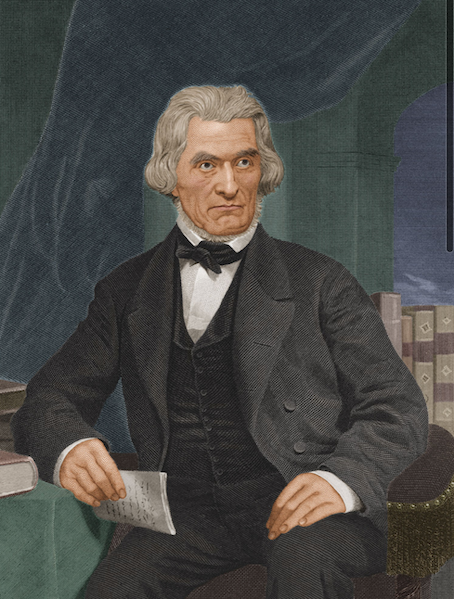
The play is not actually greatly interested in Calhoun, you could have slotted any slaveholder into it. Calhoun and renaming the college is just one of many actual examples of rewriting history. They’re vague about him too, mentioning the 1860s a couple of times. Calhoun died in 1850. The vagueness is probably deliberate as 1850 is in the programme notes. I know a bit about Calhoun though, so I’ll show off my knowledge. This is from the anthology Slavery Defended – The Views of the Old South (1963) which is NOT a defence, but quotes 19th century writers before 1865:

So we are not looking at a Robert E. Lee who believed slavery was an evil that would wither away. This would be a good extract to add to the programme if it moves on.
I did a long article on the other theme of statues of slaveholders: SEE: CIVIL WARS & STATUES (linked) It is an emotive issue but highly selective. Both Washington (317) and Jefferson (600) had more slaves than Confederate General Robert E. Lee did. Lee freed his too.

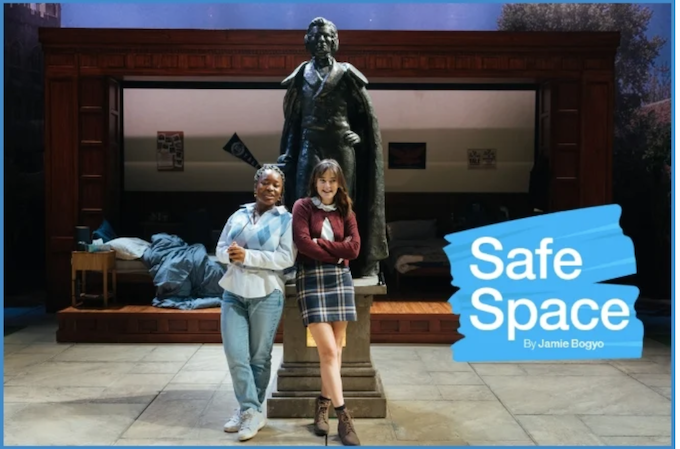
The set is extremely good. We have an inner stage which serves as Connor and Isaiah’s room, then a corridor in the university, and then Omar’s room. It slides in and out. For Omar’s room, a further platform slides out to show his larger single room with more furniture. Changes of scene in the inner stage are elaborate and must require rapid and silent work froim the stage crew. The statue is in the foreground. Note that grass surrounds the patio (astroturf), and the photographic backdrop with trees and doors. For the patio scenes, a cloth with trees covers the inner stage. When the initial blackout starts the play, we were amazed when the lights went up to reveal the statue had gone. It will come and go during the play. (It’s on a silent track).
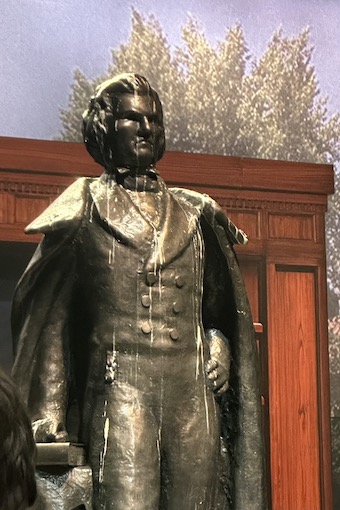
On detail, like the grass surrounding the paving stones, note that Calhoun’s statue is a pigeon toilet.
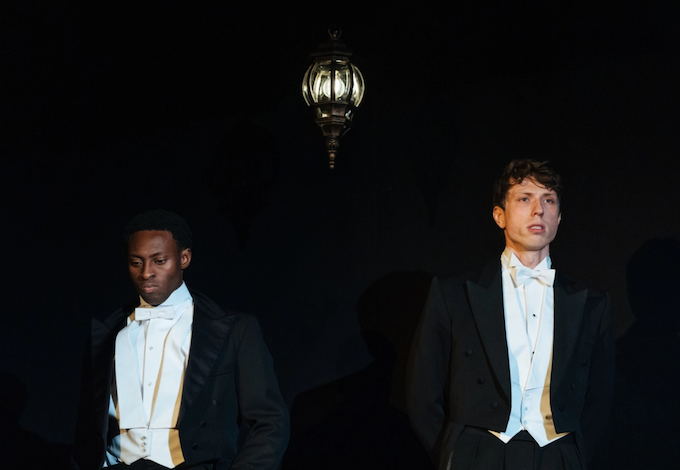
The programme has an extensive and erudite note on a cappella singing groups in American universities. Yale’s Whiffenpoofs are still going. Cole Porter was a member of the 1913 version. The play is bookended with a cappella. It starts with a spotlit song with lead vocal by Isaiah (Ernest Kingsley Jr) in full white tie and tails, accompanied by the other four on high platforms either side of the stage, backs to us. This runs through. As he stares at the white gloves, my mind went to minstrelsy, or the Black & White Minstrels.
A theme is university clubs with the room mates, Connor (Jamie Boygo) and Isaiah sharing the desire to be Whiffenpoofs. Then the two girls, Annabelle (Céline Bucken) and Stacey (Bola Akeju) are in competition for the Women Leaders Society (? Memory- there was no play text on sale) not that Annabelle who thinks her election will be a shoe-in, knows that Stacey is applying too. Stacey is only a freshman. This is an American theme with leadership of clubs and societies being a major c.v. point. I’m somewhat surprised that they don’t bring in fraternities and sororities too as that’s an Ivy League institution, and students have to be voted in like Freemasons and can be ‘blackballed’ so refused admission. I can relate to it in British terms. I was elected President of the Drama Society and my defeated opposition was a mature student, who though ten years older, was immature enough to plaster graffiti about me around the campus. There can be a lot of angst about these society posts, as in the play.
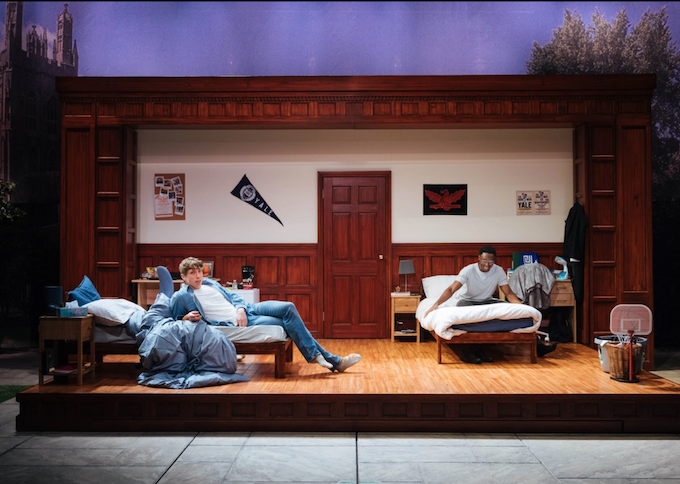
My son went to NorthWestern University. He opted for a single room, but many preferred a two bed or four bed room as ‘These will be your buddies for life.’
The play is about the relationships more than politics or political correctness. It’s a very real American issue. Black and white. Connor is white, proudly voted for Obama, but feels that Yale is full of tradition, and that the name should not be changed in a PC surge. For this he is seen as conservative, right wing. His room mate Isaiah, is black. He didn’t vote for Obama, giving up when he saw three hour lines … an aside on deliberate efforts to obstruct voting in African-American districts perhaps. Isaiah is the voice of reason, at least to me. While the campus, as personified by Annabelle, Stacey and Omar (Ivan Oyik) are intent on changing the college name, Isaiah reckons you can’t change history. You can’t pretend it never happened, though you can annotate, you can give it context. I’d rate Isaiah as the most sympathetic character. Connor describes Isaiah as his best friend, but throughout the play there is edginess from Connor and Annabelle. Is their friendship with black classmates tinged with desperation to show no prejudice, thus inadvertently patronizing?
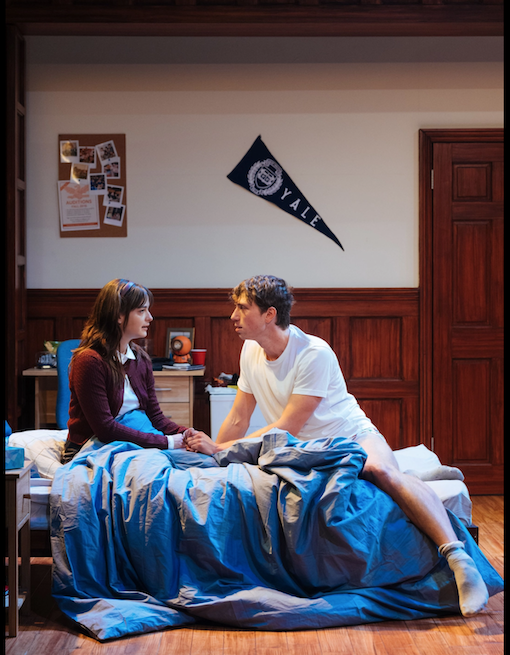
Annabelle is Connor’s girlfriend. A long sex scene (under the covers, or at least Connor is) is interrupted by her fake squeaks while checking her phone constantly over the election. She does not know that her friend, Stacey, has also applied.

Then there’s Omar, whose name Connor forgets and agonizes that people will think that’s because “they” all look alike. Which is exactly the tale Omar tells about a Greek Classics class where the tutor confused the two black class members. Omar arrives and can’t understand why Isaiah is not committed to the cause.
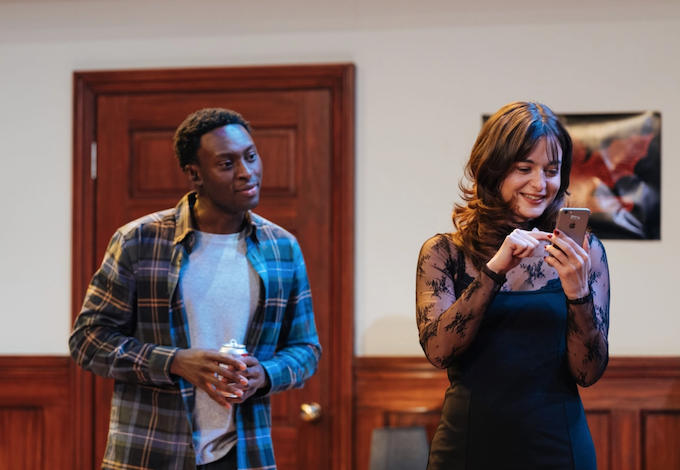
Annabelle comes to look for Connor to apologise for some frankly ball-breaking comments the day before. She finds him gone and shares a beer, then three beers with Isaiah. They get on. They’re both good listeners. She persuades him to sing. They dance, and she dances very sexily.
At the interval, I was wondering about an English audience v American audience. American campuses ban alcohol under 21. Students have beer parties, but wine or vodka (shared by Annabelle & Stacey earlier) is less frequent. Even three beers might be significant. There are subtleties throughout in the text. This is Act Two, but Omar is an elite student with a grander room, and leading the protests. He is from Westchester. Stacey (“I always win.”) is hard line. She is from Chicago. Westchester County is like commuter Surrey to New York. Some of my American editors lived there. The Managing Director did too. I doubt that Omar encountered much if any overt prejudice there. Chicago is different. I remember when my son arrived in his hall at NorthWestern. There were two African-American girls on his corridor. They walked away from any attempt by white students to start any conversation whatsoever without deigning to answer. You can feel an edge if as a white person you walk into a soul food restaurant in Chicago, and I include the tourist attraction that is Michael Jordan’s especially. People are polite but they have no wish to be friends or friendly. Interactions are curt, which is NOT an American server thing (I will admit this was twenty years ago, and it may be different). In contrast, in the West Coast, New York, Boston or the South I’ve had many friendly conversations with African-Americans with no sense of “side.” I think Americans would pick up Westchester v Chicago at once. Then Isaiah is from Bridgeport, Connecticut. It’s a port, industrial, and for New England a 23% African-American population is high. I wonder if some of it was going past an older British audience, and unusually the Minerva was little more than half full.
On the theme of attitudes in different situations, I remember a dinner conversation with an Afro-Caribbean actor in one of our videos. She said that she could work in the theatre, go on a TV or film set, and racial prejudice didn’t enter her mind. She said as an attractive black female in the media, it just didn’t happen, though she sometimes felt the ‘over-compensation’ friendliness. Then she would go home and go out with her male cousins and it came back with a bang. That’s what this play reflects.

The interval has a long a cappella version of Got To Get You Into My Life (Lennon-McCartney) before Act two starts. At the interval, the statue, which has been vandalised in covered with plastic sheeting.
Act two opens with a superb solo rendition of Down By The Salley Gardens (lyrics by William Butler Yeats) by Jamie Boygo as Connor. I note W.B. Yeats. It’s a favourite song of mine. He did it credit. More later.

The statue has been vandalised. The students are waiting in some trepidation in a corridor, waiting to be called into the investigation. They had rooms overlooking the quadrangle. What are their alibis? Where did teach of them spend the night? No plot spoilers. I want people to go and see it.

The election results are out. Stacey beat Annabelle. They skirt round the question of whether it’s because she’s black, so tokenism. Annabelle is terrified that people will think that she might think that, but then, does she?
At Omar’s rooms Stacey and Omar are locked in debate over a new name for the college.
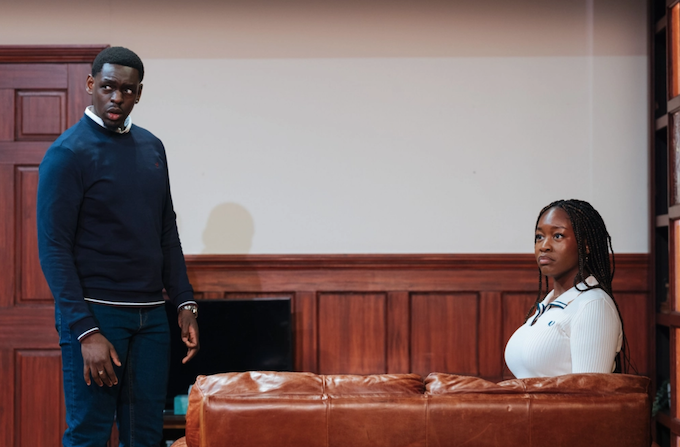
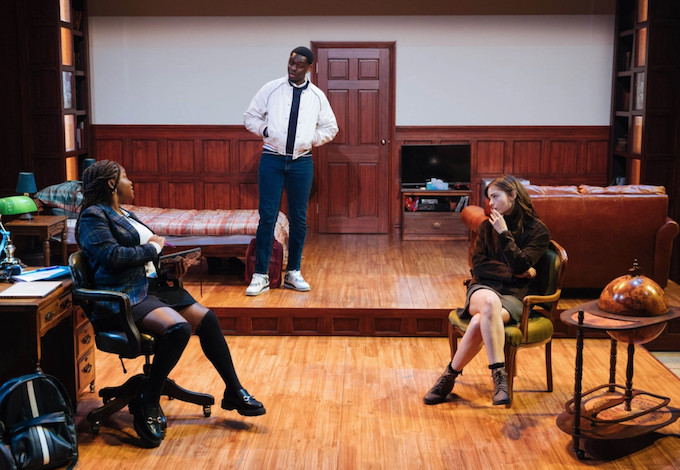
Annabelle turns up and joins in. Omar wants African-Americans. Annabelle wants women. Stacey wants African-American women. The photo is not from an actual show. Omar has oil paintings on the wall that came with the room. Stage right (and out of view) he says there is a picture of Calhoun with two slaves picking cotton, and he has had to look at it every day. That’s what has inspired him.
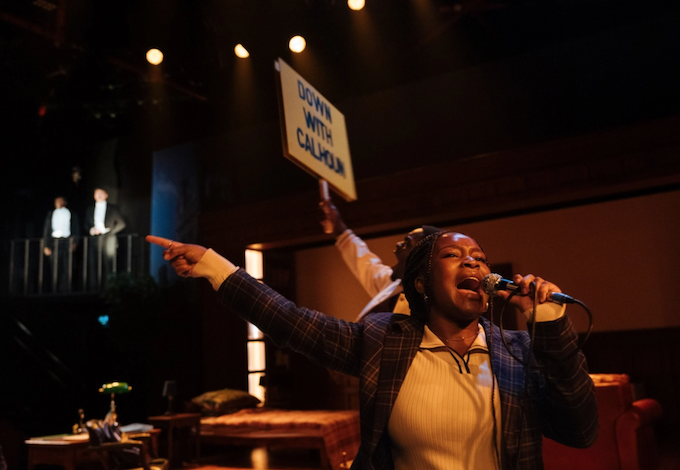
They do the protest very well given a small cast and a well-designed soundtrack.
I will give a plot spoiler, Calhoun College is now Grace Hopper College and she was a white Yale graduate mathematician, one of the very first computer programmers.
The play finishes, after some differences of opinion, with Connor starting to sing The Boxer (by Paul Simon) a cappella. Then Isaiah arrives and joins in, and they take us out on the chorus.
Tut tut. On songs, I will make my usual complaint. A lot of impact was gained by the writing of W.B. Years, and of Paul Simon and of Lennon & McCartney (though Beatles experts agree it’s Paul’s song). Heart Be Still sung by Isaiah was an outstanding moment. I am guessing it’s the one Lorraine Ellison recorded (Bert Berns & Jerry Ragovoy) though I’m not sure. Nor am I sure what the first song was that Isaiah opened the play with. I really want to know. I finfd it appalling that the songwriters are not listed in the programme, yet they can list multiple box office assistants. I hope this play goes on, as it deserves to, but I hope they correct that in future productions.
It’s running till 8th November. Judging by the matinee, you would get in and get reasonable seats. Highly recommended. The acting and singing are superb, we were engaged. It’s an excellent set. I feel sorry for the cast with the sex scenes and references, and the dance, playing to an elderly afternoon audience rather than their peer group. I mean. I’m old, but at least half were older than me. That’s a matinee given. I don’t notice it with Coward or Rattigan, but i do with young actors in a play about being young.
Overall. Four stars.
****
WHAT THE CRITICS SAID
5 star
Theatre & Tonic *****
View From The Gods *****
4 star
The Latest ****
West End Best Friend ****
London Theatre1 ****
3 star
Arifa Akbar, The Guardian ***
Gareth Carr, What’s On Stage ***
Dave Fargnoli, The Stage ***
Stephen Gilchrist All That Dazzles ***
LINKS ON THIS BLOG
It’s rare to have a cast I’ve never seen before. All five were first rate.
ROY ALEXANDER WEISE (Director)
The Hot Wing Chicken King, National Theatre 2024
Much Ado About Nothing, RSC 2022
 Peter Viney's Blog
Leave a comment