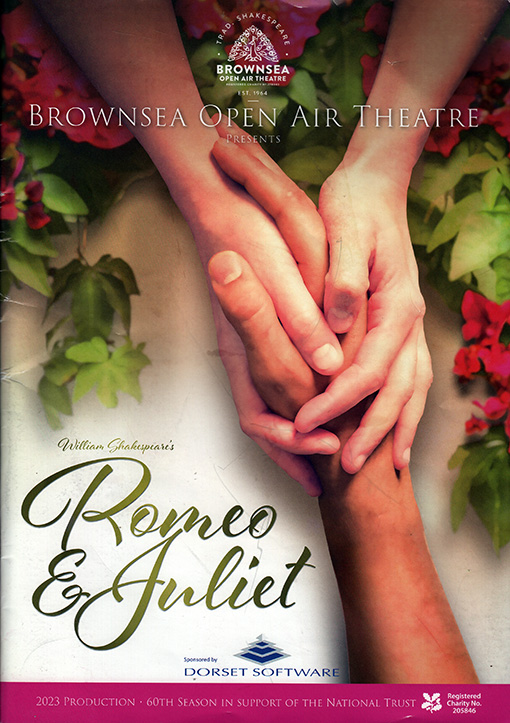
BOAT -Brownsea Open Air Theatre
Brownsea Island, Poole Harbour
Directed by Silvia Coates
Set design by Sylvia Coates, Bob Nother
Lighting design by Chris Caton
Monday 31st July 2023 19.30

MAJOR ROLES:
Dylan Havard- Romeo
Jessica Allen – Juliet
Lucy Palmer- Nurse
Stuart Glossop- Friar Laurence
Chaz Davenport- Capulet
Joanne Owen – Lady Capulet
Barry Gray- Montague
Martha Jenkins- Lady Montague
Brian Walton – Mercutio / Brother James
William Lent – Count Paris
Beau Gater – Balthasar
Sam Goodman – Benvolio
James Riley- Tybalt
Belinda Harward – The Prince
Joe Burgess – Sampson
David Vintner- Peter / Apothecary
It’s the 60th Anniversary. It looks as if the entire run is sold out, and there is no return ticket service. Many theatres in the country would be thrilled to fill 500 plus seats on a Monday night, or any night. It’s way beyond the ‘relatives and friends’ of many amateur shows. It’s a longish run in a large space. It’s a local cultural event. Something many people put on their calendar in Poole in the summer. You can go from 5 pm and picnic if you wish.
This is AmDram at its very most elaborate, with the added logistics of transporting the audience there and back by boat (or rather five boats). A vast number of people are involved backstage, and there were at least twenty-four in the cast. The set with its three sides of bleacher seating and two lighting towers as well as lighting above the central seating area is almost on a technical par with the RSC’s Covid year Garden Theatre at Stratford.
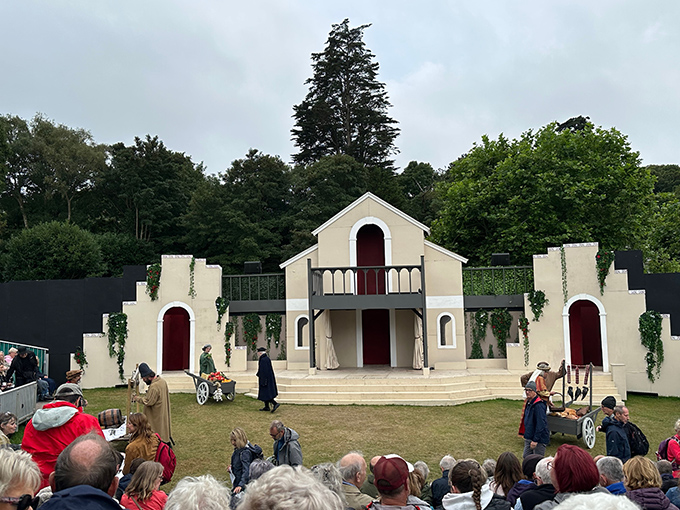
The acting area is Globe like- with the audience on three sides. Two side entrances, a central entrance with a balcony above. Two diagonal entrances between the seating areas. A wide grassy area in front. There is an elaborate pre-entertainment.
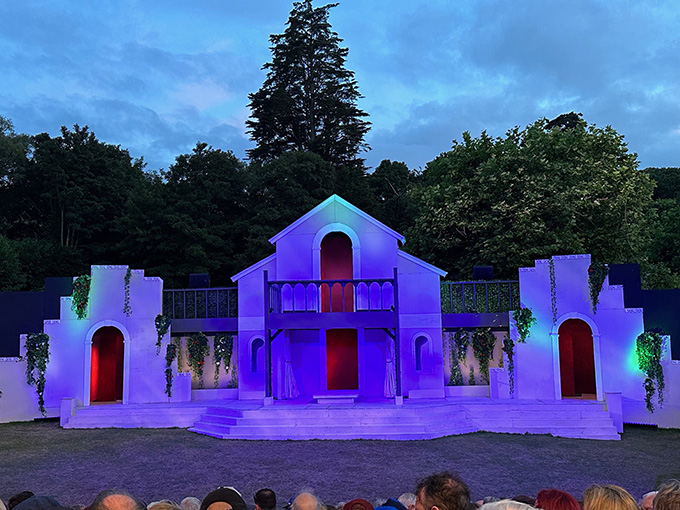
Lighting has been carefully thought out. Daylight until the interval (with boosting) then a dynamic lighting design for the second part after the interval with full black outs – impossible in the first half.
I believe in seeing at least one amateur production and one open air production a year, though it’s many years since I went to one at Brownsea. My drama supervisor at Hull dismissed all open air Shakespeare as “Whimsy-cult in the wet” and yes, he had been to Brownsea. Karen was in the 1970 company as Nerissa in The Merchant of Venice. The experience has made her avoid it ever since. She remembers trying to speak her lines while hungry mosquitos landed one after the other on an actor’s nose and she watched it visibly swelling at an extraordinary pace. I went with my daughter and son-in-law. I was well covered with an organic environmentally friendly spray. The mosquitos and midges descend when darkness falls. We watched one buzzing the woman in front of us. As she swatted at it, I wondered whether to offer to spray her. Worse a couple of rows in front, an older lady with a grey perm ended up with four of the things entangled in there. The background atmospherics out there include peacocks, pigeons and owls.
One thing about AmDram is that cast size is never an issue. The more the merrier, which means a cast of National Theatre proportions. Few professional companies use twenty-four or more people on stage. That meant that when Juliet apparently dies, they have six cowled monks coming on from each side to pay their respects. Most professional productions lose Sampson and Gregory from the cast. They lose Gregory here (though Peter does the Gregory lines in Act One Scene One of the text) but add Mala, Valentio, Marzia, Martino, Mina, Calenta, Carlotta, Lucentio, Watch 1, Watch 2, Innkeeper, Innkeeper’s wife. I feel everyone wants a named part, and names have to be invented. They doubled the Apothecary and Friar James. They didn’t need to.
Costume was Elizabethan and elaborate. They also colour-coded, maroon for Montagues, always a good idea. Personally, I would not have shifted Romeo’s and Mercutio’s costumes. There’s no need and it helps identification in large scenes. I noted that in the professional productions since I started this, twelve years ago, Romeo And Juliet defaults to modern dress. I blame West Side Story. It was a pleasure to see it in an imagined Verona.
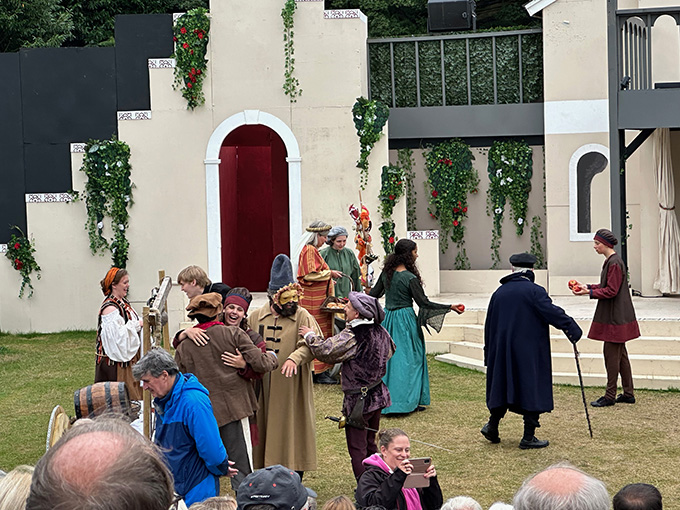
They did an elaborate pre-show with people milling around, juggling, stick twirling, and very good market cart props too. The Globe and RSC used to do that but stopped.
Direction and acting were praiseworthy. It’s open air. You have to project, and apart from the too quiet prologue, who was there because she had been in the original first Brownsea production, everyone did. You also need to act ‘larger’ for open air, as The Globe always does, which was fine. It’s easier to get good amateurs to go larger than more subtle. I was critical about the amount of bawdy gesturing every time one of the many double entendres in the text (maiden’s head, prick, draw, under a man etc) appeared. Yes, a clown part (like Peter) should point them. The nurse too. Not everyone should. We do understand the ‘maidenhead’ pun. Some of the pricks are genuine sword references. It was definitely unnecessary to flap arms on the word ‘swan.’ If you’re doing a signed performance, that’s someone’s job.
I admired the general fight choreography and also the Mercutio-Tybalt duel. I’m not too sure about under the under armpit sword stabbing but it’s hard to do it any other way. I thought the Romeo- Paris duel was weaker. I recalled how fencing classes were part of the basic drama course in my day. You can’t go from zero to adept in rehearsals. We did a Robin Hood – Sheriff of Nottingham sword fight in one of our ELT videos. Jim Sweeney, playing Robin, had never fenced and had eye problems. So they cast a fight director from feature films as the Sheriff. He said, ‘Just attack me full force. Try and hit me as hard as you can. You really won’t be able to hurt me, so don’t worry about that.’ It worked and that was large heavy swords, not rapiers as here. But you needed one participant who was a top level swordsman. I wouldn’t expect it even at the RSC.
They used no stage blood. When you’re hiring in very good costumes it’s an expense because of doubling (or on matinees, quadrupling) costumes while they’re cleaned, though given the chance of rain in a performance, double costumes are an insurance.
The phone weather apps said no rain, but the skies were very murky, and I’ve sat staring at my phone in disbelief while torrential rain fell at least twice in my life – the phone was showing ‘sunny.’ For that reason, the thunder rumbling sound effects in the fight were a bad idea. I wasn’t the only one who thought it real thunder (i.e. it was good and was not the classic BBC effect most use). When you’re sitting on metal seats on a metal stand with lighting towers above, real thunder is a frightening prospect. Use drums or music.

The acting standards were high. I was most impressed by Romeo (Dylan Havard), who is genuinely seventeen, which is perfect for the role. He is at LeAF performing arts school, which is a very hard one to get into. He was matched by a young Juliet (Jessica Allen) who is off to drama school next year. You wouldn’t see their ages in a professional production. Obviously, Juliet can’t be ‘nearly fourteen’ but eighteen is a lot closer. Incidentally, they didn’t update her age to sixteen, which happens often. Good amateur companies (which this is) can make use of age range and avoid the issue of ‘senior members’ in their middle-age taking the plum parts. In this case, both leads are in their first BOAT production. Lucy Palmer, playing the nurse is also new to the company. It’s an intrinsically good funny role and she makes the most of it.
Others are regulars. Stuart Glossop is in his 15th production here and is a strong Friar Laurence. Loud, clear and vigorous. Chaz Davenport as Capulet is another regular (and next year’s director for Macbeth). A good imposing paternalistic performance. Mercutio (Brian Woolton), a tough Tybalt (James Riley), Benvolio (Sam Goodman), Balthasar (Beau Gater) all impressed me, as did David Vintner as a funny Peter, the servant. I was mildly surprised at a female Escalus, the Prince (Belinda Harward). It would be a given at the RSC or Globe, less so here. She made it work well anyway. There was nothing anywhere that dropped the performance level. Not being a local newspaper, I won’t list everyone.
There are some logistical issues. The interval queue for the men’s toilet (two urinals and a cubicle) was ridiculous. The women’s far worse. We, and several other men, walked on a hundred yards into the woods and peed under a tree. A male advantage – though we saw some women disappearing into the woods too. They need Portaloos! Several women’s and a urinal block.
The other was length. This is a criticism. Karen, far more experienced in AmDram than me, says it’s a universal fault. I remember it too from an amateur Richard III. You can’t cut any minor parts as people are desperate to do them. Then the principals don’t like cutting their lines either. Then you add in long extra scenes like the monks paying respect. It started at 7.30 and finished at 10.40, with a 25 minute interval. That’s 2 hours 45 minutes. Romeo & Juliet is one of the shorter plays. The last RSC one was 2 hours 20 minutes. This may be the longest version I’ve seen. There was no problem with losing interest, I never did. It’s also normal length for most Shakespeare plays, though not this one. However, then you have to get several hundred people onto boats. It was like the Dunkirk evacuation there at the quay with thirty at a time marshalled forward by the stewards to board (they need a lot of stewards). (Which reminds me. The old, small, abandoned Brownsea ferries all had brass Dunkirk plaques on them).
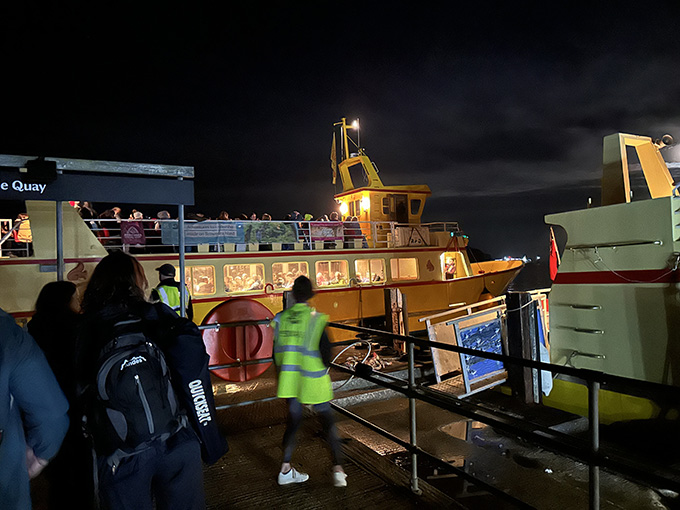
Our boat left at just after eleven. (Juliet was on board). We landed at Poole Quay at 11.40. Five minute walk to the car. Back at my daughter’s (where Karen was babysitting) at exactly midnight. That’s late for a play that ended at 10.40 a couple of miles away as the crow flies. I think it’s too late. If I were directing, I’d move the start to 7 p.m. I’d shave five minutes off the interval by having portaloos nearer- it’s a few hundred yards to the inadequate loos. I would understand keeping every possible role, and utilising crowd scenes, but I would then cut elsewhere (sorry main actor monologues). I’d want to be finished by ten, given the more than an hour exit.
The programme is good value for a fiver. Better than many.
I don’t think it fair or possible to rate even the best Am Dram with the Royal Shakespeare Company or National Theatre on the same star system so I won’t. I thoroughly enjoyed the evening, more than some of the professional ones.
ROMEO & JULIET
Romeo & Juliet, Headlong 2012, Nuffield, Southampton
Romeo & Juliet 2014 – Box Clever
Romeo & Juliet 2015 – Globe Touring Production
Romeo & Juliet – Tobacco Factory, 2015, at Winchester Theatre Royal
Romeo and Juliet – Branagh Company, 2016
Romeo & Juliet, Globe 2017
Romeo & Juliet, RSC 2018
Romeo & Juliet, TV film, NT 2021
Romeo & Juliet, Brownsea Open Air Theatre, 2023
Romeo & Juliet Globe 2025
 Peter Viney's Blog
Thank you Peter, for spelling my surname correctly. Most people default, incorrectly, to Harwood. Your attention to detail is appreciated. All the best, Belinda.
LikeLike
I understand. I was once in Richard III and was away when the programme went to press, and ended up as ‘Peter Smith.’
LikeLike
Steward counting to 30 appreciates your recognition!
LikeLike