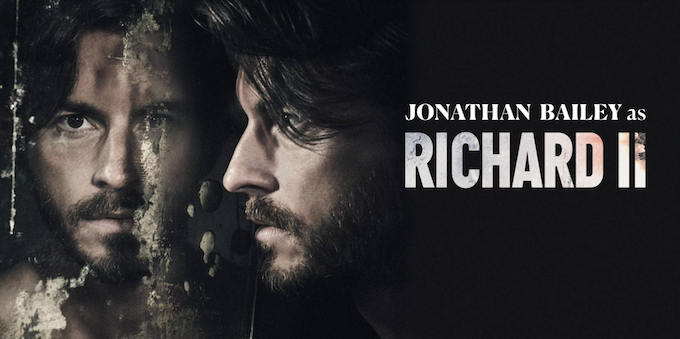
By William Shakespeare
Directed by Nicholas Hytner
Designed by Bob Crowley
Composer Grant Olding
Bridge Theatre, London
Thursday 27th February 2025, 14.30
CAST
Jonathan Bailey- Richard II
Nick Sampson- John of Gaunt- Duke of Lancaster, Uncle of Richard II
Royce Pierreson – Henry Bullingbroke, Duke of Hereford, son of John of Gaunt
Michael Simkins – Duke of York, Uncle of Richard II
Amanda Root – Duchess of York / Green
Christopher Osikanlu Colquhoun – Earl of Northumberland
Vinnie Heaven – Duke of Aumerle, son of Duke of York
Phoenix di Sebastiani- Thomas Mowbray, Duke of Norfolk
Seamus Dillane – Duke of Surrey
Jordan Kouame – Bushy / Percy
Adam Best- Bagot
Gerard Monaco-Scroop / innkeeper
Olivia Popicsa – Queen Isabel
George Taylor – Lord Fitzwater
Badria Timimi – Bishop of Carlisle
ENSEMBLE:
Emma Brown, Stephen Boyce, Martin Carroll
Nick Sampson has replaced Clive Wood during the run, with a full size programme insert. The production photos show Clive Wood as John of Gaunt.
The Bridge Theatre blew its rising position as London’s best and most innovative theatre. It did the best A Midsummer Night’s Dream I’ve seen (I saw it twice), then the best produced musical I’ve seen, Guys and Dolls. But Guys and Dolls was just too successful. It just kept selling and selling seats. It ran on and on, like a West End musical, extended and extended. I began to wonder if it was going to do a Mousetrap. So, anyone who became Friends / Members would have been mightily annoyed at one production running for two years. Richard II is the return to a manageable run, and it’s not going to just take over the theatre for months or years. But I’d still be wary of joining a Friends scheme, much as I love this theatre and its location. However, never sit in row J, the front row of the ‘upper’ stalls when the “ground” is used as in the Globe. The wooden barrier is agonizing. There is zero leg room. Much was said on the theatre’s design. That row is as bad as it gets.
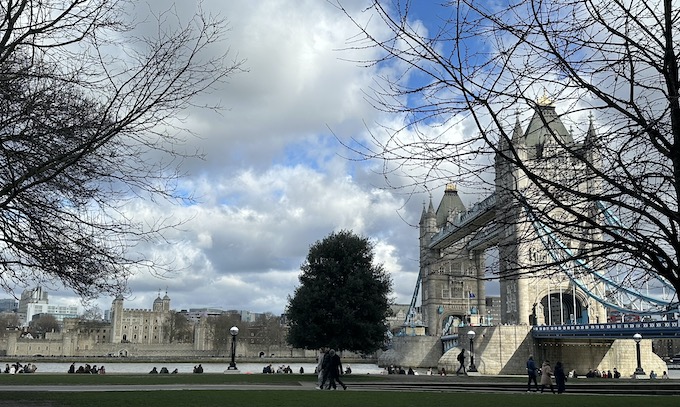
However, buy the programme. It is superb, and at £5 half the price of the inferior Theatre Royal Drury Lane programme the day before. With the history plays, you need a family tree to work out how all the cousins and uncles are related, and the Bridge goes one better in putting photos of the actors in this production on the family tree. This is especially helpful as Shakespeare never attended the creative writing seminar where you’re told to push the names of the characters into dialogue as soon as possible. You need to sort out your county cricket leagues: Lancasters, Herefords, Yorks, Norfolks, Northumberlands, Surreys, Suffolks etc. The programme also has essays on the real Richard II, and how the original play fitted politically in an Elizabethan context. Then The Bridge Theatre has the edge in that when a character is threatened with being sent to ‘The Tower’ we remember that we can see the Tower of London itself directly across the river from the front doors.
Everyone of importance in the play is related to King Edward III. Richard is king because he’s the son of the oldest son of Edward III, the deceased Black Prince. Richard became king at age ten, and Shakespeare has compacted his messy and complex reign into its last year or so, twenty-two years later. The other three sons of Edward III are Gloucester (dead before it starts), Lancaster and York. The three uncles acted as regents until Richard was old enough. Henry Bolingbroke is the son of John of Gaunt, Duke of Lancaster, who was Edward’s second son.
Nicholas Hytner is rightly renowned for Shakespeare in modern guise: the aforesaid A Midsummer Night’s Dream, Timon of Athens with stock exchange dealers, the ‘West Wing’ Hamlet, the Gulf war Othello. Does it run for the histories? Richard III always works well in modern guise. The others? Not so. They’re too tied to their time frame. In Richard II, when Richard is an autistic narcissist, kicking away John of Gaunt’s Zimmer frame to propel him to the floor, scoffing his bedside grapes after his death, just before seizing his lands, you think this is going somewhere with reference to narcissistic and grasping dictators like Putin and Trump, but it then ceases to work. OK, the trial scene replacing courtly discussion in Part Two is excellent, the Duke and Duchess of York in rural welly boot and Barbour mode, very fine. They look like aristocrats in their country seat.
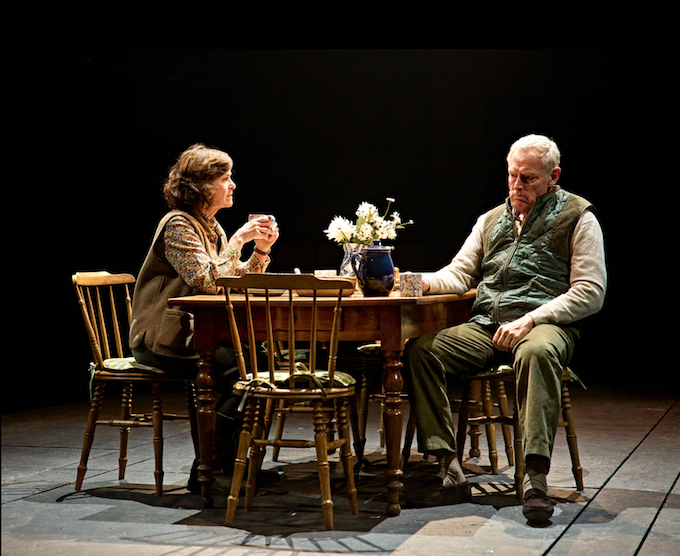
This late scene is one where modern dress resonated and worked
But crucially it doesn’t work with Richard’s character as it develops. Then we have too many men in boring grey suits. Costume is dull. Suits, then hoodies for battle gear. Suit sales have plummeted. Bring back some 14th century colour. Given the complexity of the plot, a touch of subliminal colour coding to indicate allegiances would help (such as shades of green for Richard’s allies, shades of red for Bolingbroke’s.) The modern dress theme didn’t run well this time.
The most memorable actor on the stage is Royce Pierreson as Henry Bullingbroke. “Bullingbroke” is a pretentious First Folio spelling of ‘Bolingbroke.’ I will stick to modern spelling. Michael Simpkins excels as the Duke of York, Amanda Root as the Duchess of York, Christopher Osikanlu Colquhoun as the Earl of Northumberland, Nick Sampson as John of Gaunt, The trouble is projection. That previously listed group all had it without having to shout. Those mainly older actors can do it with ease. Jonathan Bailey? No, unless he’s shouting. Vinnie Heaven as Aumerle? Inaudible unless he’s having a shouting fit. Both lacked projection, and they weren’t alone. Phoenix di Sebastiani as Thomas Mowbray was about half the volume of Bolingbroke in their heated row. Though it’s NOT just volume. Why? Michael Simkins as York could speak very quietly and fill the theatre. That’s training and technique. Royce Pierreson has it too, though far less experienced.
Part of it is the stage. It doesn’t help the actors, because inevitably they have their backs to large sections of the audience. It’s a thrust stage with an entrance at the narrow end opposite the entry doors, so like the Royal Shakespeare Theatre or Swan Theatre in Stratford, BUT they have audience behind the entrance, so it’s “in the round” (or rather long rectangle) playing to four sides. So how do the audience behind the entrance to the stage see the boat gangways for the banished exiles, the military vehicle headlights? The prison bars? Mainly, how do they see the group of watching nobles standing still in the entrance. Do they have access to a TV monitor? That was used for a Richard II speech which took place above us, opposite the entrance. The monitors were far too small and had time lag so speech didn’t match mouth movement. At the start, Richard II is seated at a table, facing the entrance, so has his back to us. It was very hard to hear Jonathan Bailey as Richard when you can only see the back of his head. In part two, Bolingbroke was seated in the same position, but Royce Pierreson had far better projection and was clear. In the prison cell scene we missed much of what Bailey was saying. We thought overall blocking for a play to four sides was ineffective. That’s why ‘in the round’ was actually round, not a long rectangle playing to four directions. The Bridge boasts its many potential configurations from proscenium to all sided. This one didn’t fit the play. It looked as if it would, because it looked so much like the RSC until you noticed all those faces behind the stage entrance.
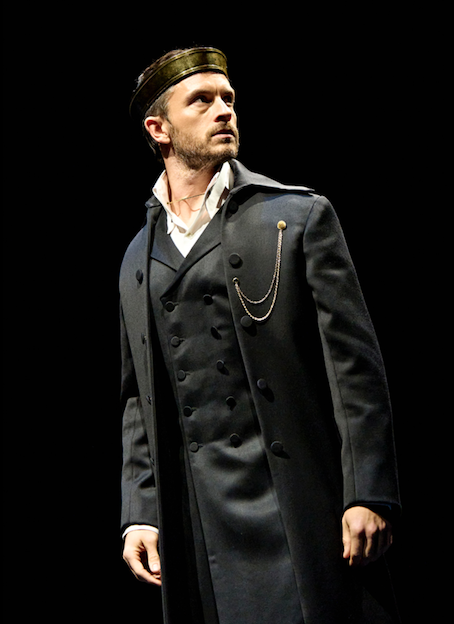
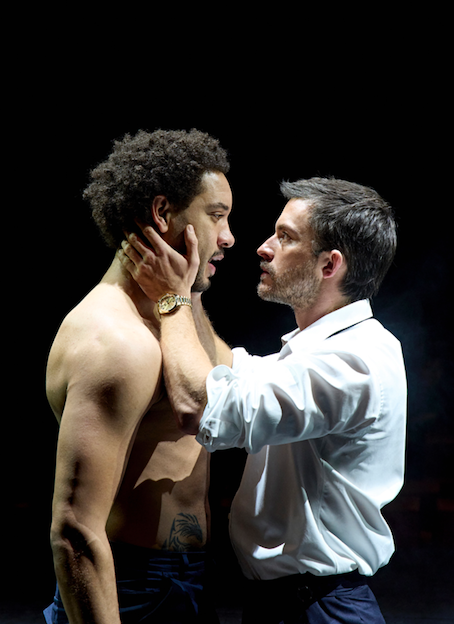
Jonathan Bailey as Richard III. Richard at the duel with Bolingbroke (Royce Pierreson)
As a reminder, Mowbray the Duke of Norfolk says that he murdered one of the uncles, Gloucester, on Richard’s orders. Bolingbroke challenges him to a duel. At this point Richard has to be slimily Putinesque, sending off assassins. The fight scene, the Bolingbroke / Mowbray duel with knives in a pit worked. It’s interrupted by Richard, but is that a whim? Or sadism? Both are banished, Mowbray for life, Bolingbroke for ten tears, reduced to six.

The reflection is a loo roll. We have it in the downstairs loo (throne?)
Then there was the famous speech. The big one. The John of Gaunt one. The speech that the RSC has printed on posters and maybe tea towels, but it’s the one they always show the patriotic first part of, but not the reversal in the rest of the speech. It was done in a wheelchair by a sick and dying man, and we didn’t get the feel of that at all. It lost its power.
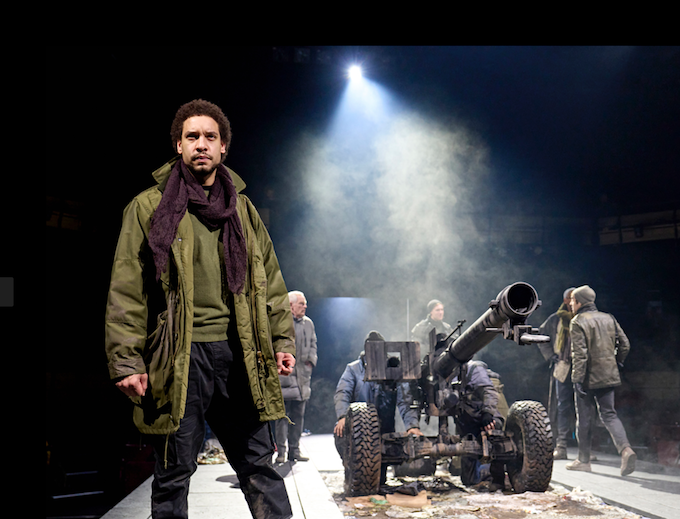
This scene looked great. The gun is pointed at Richard’s castle.
Richard confiscates John of Gaunt’s lands and wealth on his death. Bolingbroke will return to claim back his inheritance and then to topple Richard II.
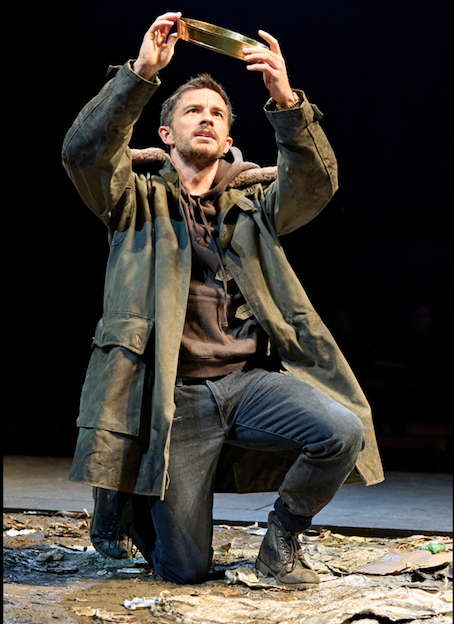
The second part is way better than the first. That’s because it has three outstanding scenes. First the discussions in court become a legal trial. Then there’s the marvellous scene of handing over the crown … Aye, nay (here Yes, no). Then there’s the Duke and Duchess begging pardon from Bolingbroke for their son, Aumerle, who has been plotting against his cousin, who has become Henry IV.
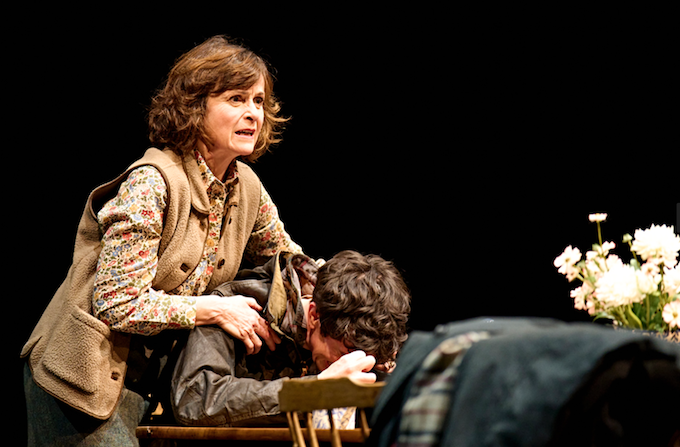
The music, often cinematic, was excellent. Jonathan Bailey played the character well but the promisingly nasty narcissist in the early stages doesn’t have the lines in the text to continue that mode, so switches to a very good handover of the crown to Henry IV, but it’s almost a different character. OK, he plays all the characters with aplomb.
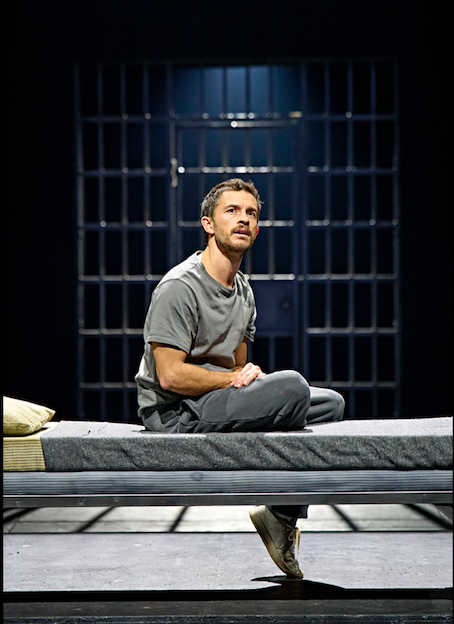
It’s hard to get sufficient pathos when we all know you’re an utter bastard. The issue of the role is carrying through the changes.
Overall? Three. (Karen is *** for part Two, ** for Part One). I’ll go for ***
PROGRAMME
5 star
WHAT THE PAPERS SAID
I suspect the Bridge invites more reviewers on Press Night than the average.
4 star
Nick Curtis, The Standard ****
Domenic Maxwell, Sunday Times ****
Sarah Crompton, What’s On Stage ****
Olivia Rook, London Theatre ****
Phoebe Taplin, Review Hub, **** 1/2
Cindy Marcilioni, Broadway Word ****
Annie, Theatre & Tonic ****
Jim Keaveny, The Arts Dispatch ****
3 star
Arifa Akbar, The Guardian ***
Domenic Cavendish, The Telegraph ***
Clive Davis, The Times ***
Sam Marlowe, The Stage ***
Andrzej Lukowski, Time Out ***
Matt Woolf, The Arts Desk ***
Daz Gale, All That Dazzles ***
Chris Omaweng, London Theatre ***
LINKS ON THIS BLOG
RICHARD II
Richard II – RSC 2013, David Tennant as Richard II
Richard II – Globe, 2015, Charles Edwards as Richard II
Richard II – Bridge Theatre 2025, Jonathan Bailey as Richard II
NICHOLAS HYTNER
John Gabriel Borkman by Ibsen, Bridge 2022
The Southbury Child, by Stephen Beresford, Chichester 2022
A Midsummer Night’s Dream, Bridge Theatre, 2019
Young Marx, by Richard Bean & Clive Coleman, Bridge Theatre 2017
Othello, National Theatre, 2013
Timon of Athens, National Theatre, 2012
Hamlet, National Theatre, 2010
People, by Alan Bennett, National Theatre on tour 2013
JONATHAN BAILEY
Bridgerton, TV series
King Lear, Chichester Minerva 2017 (Edgar)
Testament of Youth (film)
Othello, National Theatre, 2013 (Cassio)
MICHAEL SIMKINS
John Gabriel Borkman by Ibsen, Bridge 2022
The Unfriend, Chichester Minerva 2022
Greed (film)
The Fantastic Follies of Mrs Rich, by Mary Pix, RSC 2018 (Mr Rich)
Fracked! Chichester Minerva 2016
Hay Fever, Bath, 2014
NICK SAMPSON (replacing the originally cast Clive Wood)
Plenty by David Hare, Chichester 2019
Ross by Terence Rattigan, Chichester 2016
Othello, National Theatre, 2013
Timon of Athens, National Theatre, 2012
Hamlet, National Theatre, 2010
VINNIE HEAVEN
A Midsummer Night’s Dream, Globe 2023 (Demetrius)
Malory Towers, Wise Children, Exeter 2019
 Peter Viney's Blog
Leave a comment