
By Charlotte Jones
Directed by Justin Audibert
Designed by Joanna Scotcher
Composer / Orchestrator Benjamin Kwasi Burrell
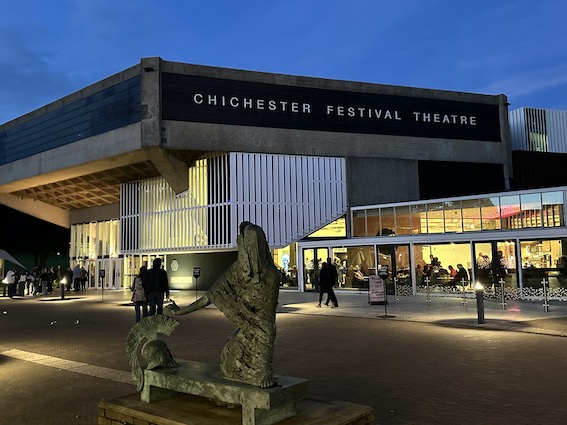
Chichester Festival Theatre
Thursday 10th October 2024
14.30

CAST
Jasper Talbot- Mick Jagger
Brenock O’Connor – Keith Richards
Emer McDaid- Marianne Faithfull
Louis Landau- Nigel Havers
Anthony Calf- Michael Havers, Q.C.
Olivia Poulet- Carol Havers
Clive Francis – Cecil Havers
Ben Kaplan – Allen Klein / English teacher / newscaster / radio announcer
Sam Pay- Inspector Bramley / Judge Block / RADA principal
Melody Chikakane Brown – Constable Flint / Daphne / News reporter
Akshay Sharan – PC Willis / Vivek Chakrabarti
Adam Young- Sniderman / Derek Carter / Terry / Philip Havers / cricket commentator
Riley Woodford- George Harrison / dancer / hawker / policeman / newspaper seller / appeal clerk
Ella Tekere- Patti Boyd / Sheila / shop assistant / female fan / journalist / drama student
MUSICIANS
Alan Berry – MD, keyboard
Joshua Griffith – keyboard 2
Iestyn Griffith – deputy keyboard 2
Isobella Burnham – bass guitar,
Matt Isaac – guitars
Zach Okonkwo- drums, percussion
I’ve really been looking forward to this one. First it’s advertised as Justin Audibert’s debut directing at Chichester where he is now Artistic Director. Though he was credited as director of The Caretaker in July, which may have been a change of plan after the season was announced.
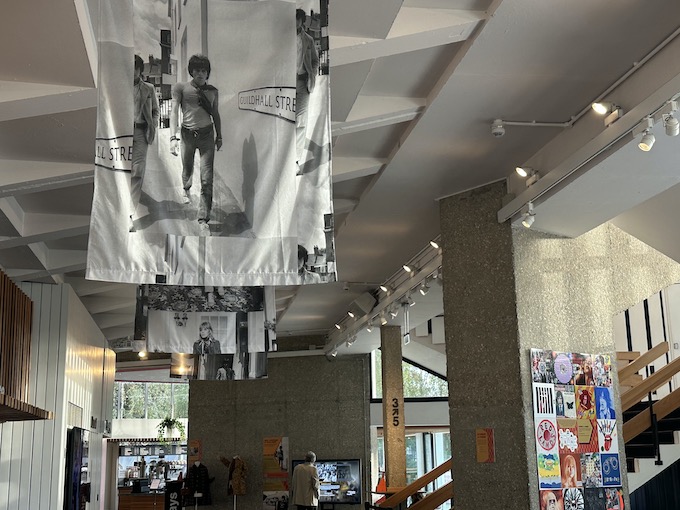
It is the story of the February 1967 police raid on Redlands, home of Keith Richards, where a house party with Mick Jagger, Marianne Faithful, George Harrison and Patti Boyd was winding down. The police waited until George Harrison and Patti Boyd left before moving in. They wanted a Rolling Stone, not a Beatle. The subsequent trial and conviction became a major cause in 1967. This is Chichester Festival Theatre. As with major productions, the lobby is devoted to displays with background information. No other theatre I know of can do this. Go early, I spent 45 minutes reading them all.
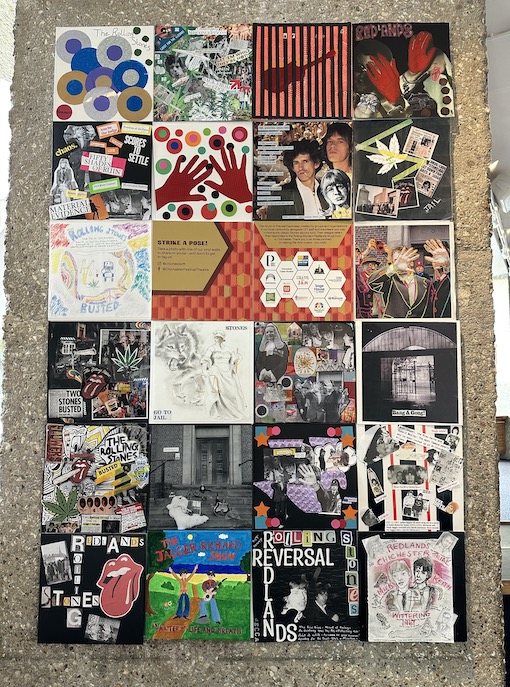


The famous Times editorial at the time rightly accused the courts of ‘breaking a butterfly on the wheel.’ You are invited to add your responses to the play on paper butterflies.
West Wittering, where Redlands is situated, is just six miles from the theatre. The case was held in Chichester. Every knowing reference got a chuckle from the audience. I was reading the reports at the time. I’ve read the major books on the Rolling Stones. I’ve read Keith Richards’ and Marianne Faithfull’s autobiographies. I’ve read Mick Jagger biographies. It’s incredible that this took place fifty-seven years ago. It still resonates now. The music sounds fresh now. The Rolling Stones are still recording and touring. Marianne Faithfull has matured into a much-praised mature female singer.
It’s not just the story of the Stones bust. The defence of Keith Richards and Mick Jagger was undertaken by Michael Havers QC, regarded as one of the best barristers of the era. He later became Attorney-General. The Rolling Stones story is interwoven with the story of the Havers family, and how Nigel Havers avoided his father’s strictures and became an actor instead of a lawyer (with some assistance from Mick Jagger’s advice to his father). The 17-year old Nigel Havers acts as narrator, directly addressing the audience. We begin with a school production where he is Puck in A Midsumer Night’s Dream. His father barges through the audience, late for the performance, stealing all the limelight. (On press night, the actual Nigel Havers was in the audience).
The bust was a News of the World set up, and the main drug dealer was cited as ‘Mr X’ (David Schneiderman) aka Acid King. Missing? Art dealer Robert Fraser. Stones photographer Michael Cooper. Antique dealer Christopher Gibbs. One Nicky Karmer. Most of all, I do not see the name of Detective Sergeant Pilcher of the Mets whose personal crusade it was, though Sussex Police did all the dirty work on the night. He left the police in 1972 after being charged with conspiracy to pervert the course of justice. The News of The World was popularly known as The News of The Screws, specializing in stories of naughty vicars and ladies of the night. It’s now The Sun on Sunday.
Charlotte Jones has made a decision to simplify the base story of the bust. In retrospect, as drama, she’s right, even though I knew the larger tale and wanted to see it. Is Redlands a musical, or a play with music and a live band? I’d say the latter as nothing was written especially for it. For entertainment value, the songs and dancing are vital. The real drama will be the trial, so she sets up the bust fast. Yes, and with dancing police officers.
The bust: background
Robert Fraser, the art dealer, was there and convicted of possessing heroin. That’s gone. It muddies the water. They had all taken LSD, but some time earlier and were coming down. They’d been wandering the countryside and were dirty. Marianne Faithfull had gone for a bath, and having no change of clothes had come back down swathed in a fur rug. It was said to be 6 foot by 8 foot, or ‘enough to cover three women.’ When the police arrived, Keith Richard says:
There was a knock on the door. I look through the window, and there’s this whole lot of dwarves outside, but they’re all wearing the same clothes. They were policemen, but I didn’t know it. They just looked like very small people wearing dark blue with shiny bits and helmets.
From Life by Keith Richards, 2010
I assume that’s like the Father Ted TV series, where Ted shows the thick Father Dougal a toy cow. Look. Small, but very near. Then he points at the cows in a field through the window. Look. Big but very far away. In the play, ‘dwarves’ has been PC’d to fairies.
It’s easy to research. Among the groaning shelf I have of books about The Rolling Stones is Life by Keith Richards, and Faithfull by Marianne Faithfull. We can hear the tale directly from the participants.
Keith Richards: He (Schneiderman) was at every party for about two weeks then mysteriously disappeared and was never seen again … The bust was a collusion between the News of The World and the cops, but the shocking extent of the stitch-up, which reached to the judiciary, didn’t become apparent until the case came to court months later. Mick had threatened to sue the scandal rag for mixing him up with Brian Jones and describing him taking drugs in a nightclub. In return they wanted evidence against Mick, to defend themselves in court. It was Patrick, my Belgian chauffeur, who sold us out to the News of The World, who in turn tipped off the cops, who used Schneiderman … didn’t do him any good. As I heard it, he never walked the same again.
From Life by Keith Richards, 2010
Keith Richards points out that the story that Marianne was clothed only in a fur rug was reported in the very first story, so could only have come directly from the police. Remember, that Richards answered the door, after prolonged knocking, all of them knowing it was the police.
How the Mars bar got into the story, I don’t know. There was one on the table- there were a couple, because on acid you suddenly get sugar lack and you’re munching away. And so she’s stuck forever with the story of where the police found the Mars bar … the evening paper headlines are “Naked Girl at Stones Party.” Info directly from the police. But the Mars Bar as a dildo? That’s a rather large leap. The weird thing about these myths is that they stick when they’re so obviously false.
From Life by Keith Richards, 2010
Marianne Faithfull has often discussed the Mars bar story. It was invented and whispered and spread by the police, and she says that if it were true, she wouldn’t mind saying so, but it’s not. I believe her.
The first time I heard about the Mars bar was from Mick shortly after the trial. Mick said, ‘You know what they’re saying about us in Wormwood Scrubs? They’re saying that when the cops arrived they caught me eating a Mars bar out of your pussy.’ I was amused at first, but my amusement began to wane when the damn thing refused to go away and established itself as a piece of folk lore. The Mars bar was a very effective way of demonizing that was so overdone, with such a malicious twisting of the facts. Mick retrieving a Mars bar from my vagina? It was far to jaded for even any of us to have conceived. It’s a dirty old man’s fantasy, some old fart who goes to a dominatrix every Thursday afternoon to lick her shoes and get spanked. A cop’s idea of what people do on acid.
Faithfull by Marianne Faithfull & David Dalton, 1994
Charlotte Jones should have had the character saying that!
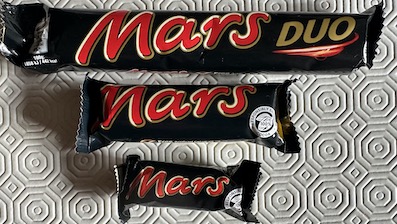
In the play, a Mars bar appears twice. One is chucked on the table, and one during the trial is shown by a newspaper vendor. They’re both ‘fun size’ snack versions. A production note. “Fun size” Mars bars were not on sale in 1967. This is an error. A 1967 bar was 62.5 grams. They shrink continually, allegedly ‘to help us reduce calories’ but in reality to raise the price without changing the numbers on the price ticket. Marianne was not allowed to testify in court, a Michael Havers decision, so was called ‘Miss X.’ She never got a chance to squash the story and it stayed for decades along with the ‘Marijuana Faithfull’ nickname, which I strongly suspect was Private Eye.
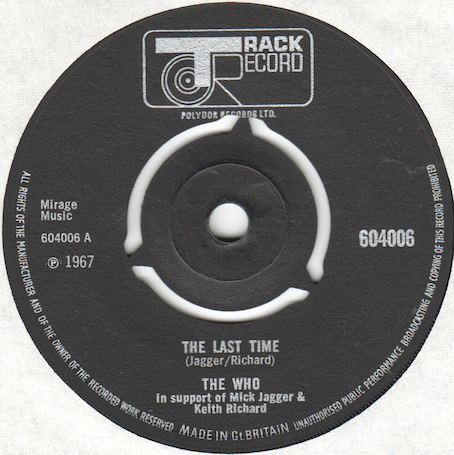
An aside is that everyone assumed Jagger and Richards would serve their full sentence. The Who rush-recorded and rush-released two Jagger / Richards songs, The Last Time and Under My Thumb in an effort to ensure their royalty stream would continue. Note ‘The Who in support of Mick Jagger and Keith Richard (sic).’
There’s another story that is ignored in the play. There is a claim that they bribed the police to drop the case, and that the police took the money and didn’t drop it.
According to Spanish Tony (Sanchez)’s memoirs, published in 1979, the bribe demanded was $12,000. According to Robert Fraser it was £7000 … of which Mick and Keith were to pay £2500 each, while he, with considerable hardship scraped up the remaining £2000. Keith has always believed the money was handed over by Spanish Tony to his Met contact in a Kilburn pub and that the subsequent unimpeded analysis of the substances proved how doubly ‘bent’ some British coppers could be.
Mick Jagger by Philip Norman, 2012
£7000 in 1967 would be £108,000 now. Marianne Faithfull disagrees, says it was £5000 in 1967 (that figures just Mick and Keith’s share) but that Allen Klein persuaded them it was a bad idea and it didn’t happen. Bill Wyman, however, repeats exactly the same figures. He was an obsessive chronicler and kept the paperwork too.
Next day, Mick cabled Klein: ‘Please cable by Saturday morning (18th) £5000 * and credit Rolling Stones No. 3 account at Westminster Bank.
* This was the bribe money for Tony Sanchez.
Stone Alone, by Bill Wyman, 1990
The stage
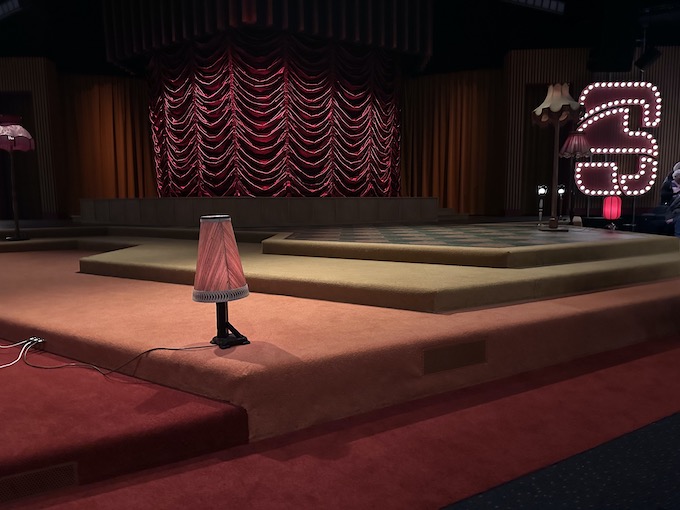
We were in the front row. When the Chichester Season booking came up, I went straight to Redlands, and booked it first, then went back to other plays.
Several scenes had characters … commentators, police inspectors, witnesses, as well as Mick and Keith at times, on platforms in the auditorium so three or four rows behind us, which was annoying as we couldn’t twist round far enough to see them. So don’t worry if you can’t get front seats.
Mick and Keith

Jasper Talbot as Mick Jagger and Brenock O’Connor as Keith Richards. This is Jasper Talbot’s professional debut. Brenock O’Connor is a seasoned performer in musical theatre. They are both superb, acting, singing and dancing. They have studied the real ones meticulously.
Justin Talbot has perfected all the Mick moves. I don’t think Brenack is actually playing guitar (on a radio link) but he mimes well. Justin Talbot can do Jagger’s mock cockney and Jagger’s RP switch whenever Havers asks him to.

You expect them to be the central characters, and reviewers complained that we never get to explore Mick or Keith. They are cut outs, the versions we expect, but that was a writer’s choice. It would be a different play if it examined the dynamics of ‘The Glimmer Twins’ relationship or if it examined the Mick / Marianne relationship in any detail. We get the comedy of the versions of them the world is allowed to see. A recurring problem is how much background the audience is expected to know. We hear that it was Brian Jones the press saw taking drugs, not Mick. The suggestion is also made that the News of The World may have not mistaken identity, but gone for the better known one deliberately. The background knowledge problem comes up with a brief comment, ‘We’ll have to do something about Brian.’ Indeed and they did, but those are other stories.
The Havers story
Charlotte Jones: “When I realised Michael Havers’ son was Nigel Havers – everybody knows who he is! – I thought: there’s a father-son story, a domestic rebellion story that an audience can really get hold of, even if they’re alienated by the bigger political or global story of the Rolling Stones. They were such a symbol of rebellion but I wanted to mirror it and see how the smaller, personal rebellion is influenced by what the Stones are doing.”
Interview, The Guardian, 17 September 2024
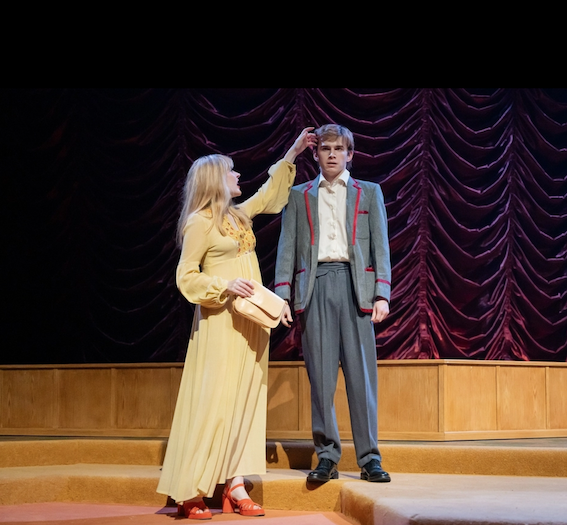
The parallel story. As well as wanting to be an actor, the young Nigel is infatuated with Marianne Faithfull, who takes an interest in helping him. He goes to see her as Nina in Chekhov’s The Seagull.
Nigel doesn’t get a mention in her biography, but nor do The Seagull or Hamlet. Then she actually appeared in Three Sisters (which she does mention), sharing a dressing room with Glenda Jackson, in April 1967, and while he is seen helping her with Hamlet, she was in that two years later with Nicol Williamson, in 1969. (see below)
The young Nigel gets to go to see her doing a photo session in bra and French knickers, which channels another 60s theme- the celebrity London photographer (as in Blow Up.)
The scenes together where she takes him shopping and gets him some hip clothes, and where he helps her learn her Ophelia part in Hamlet are strong because we have two such fine actors. It’s hard to believe that this is Louis Landau’s professional debut (Guildhall and Bristol Old Vic training). He will sing Ruby Tuesday with her later. Whether it’s true in detail or not, it is the story link holding the threads together.
Anthony Calf as Michael Havers QC is the ‘man of the match’ award in reviews. It is a powerful performance.
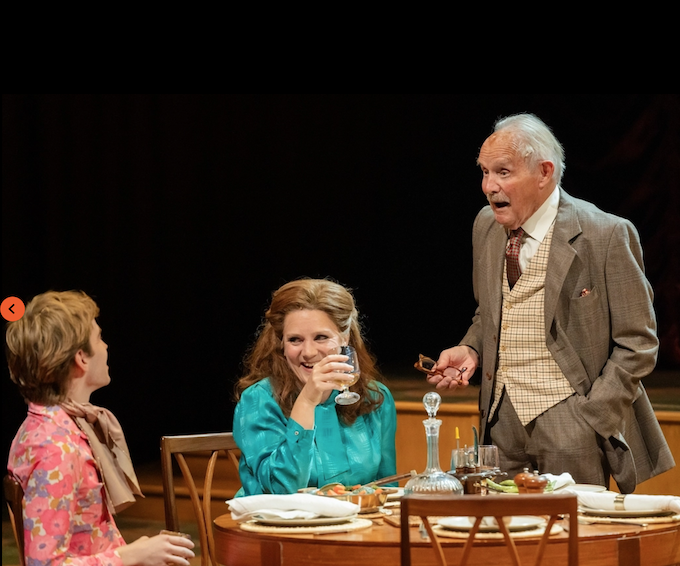
The big scene is Sunday lunch with Bongo (Clive Francis), the family pet name for Cecil Havers, Nigel’s grandad, a judge. Cecil met The Beatles, as he tells us twice. Olivia Poulet plays Nigel’s mum, Carol. Nigel appears in his new hip finery. Michael orders him to go and change.
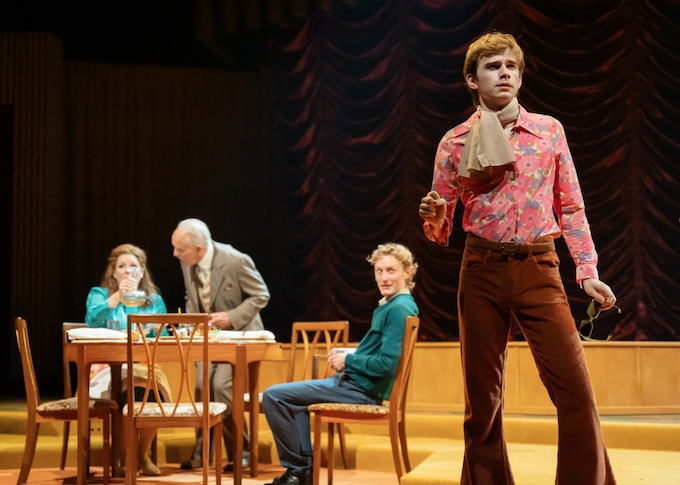
Grandad is on Nigel’s side, and first asks if he’s a ‘pretty boy‘ now then tries to smooth things by saying ‘I was mistaken for a queer once. I was holding a tambourine at the time.’ Anyone who had long hair and was in a band was used to wolf whistles and comments from building sites.
It’s Bongo, the grandad, and Carol Havers who persuade Michael to take the case. Later, Marianne arrives distraught, and is invited to stay by Carol, much to Michael’s horror. (That’s definitely not in Marianne’s book. In reality she retreated to Steve Marriott’s house). Part of the theme is that Michael comes to like Mick and Keith.
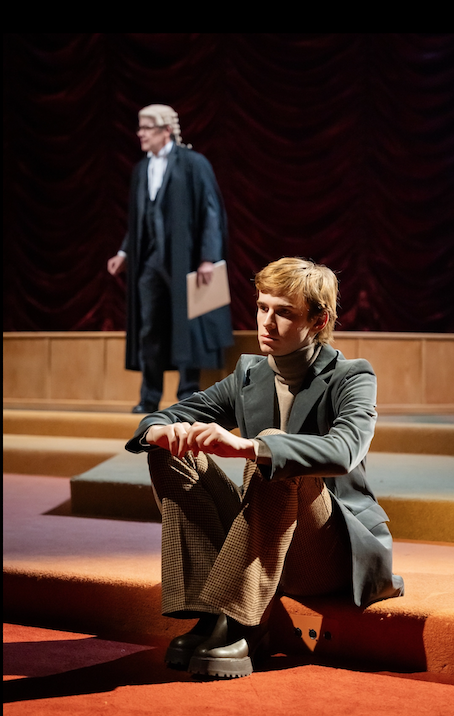
Nigel gets his audition for RADA, and does the Portia quality of mercy speech from The Merchant of Venice, and Michael joins in and they do it in unison.
I noticed that when Nigel was rehearsing Marianne’s lines in Hamlet he had an old Signet Classics edition, which is accurate. It’s what everyone used for Shakespeare in the mid to late 60s.
Marianne Faithfull
Possibly she is the major character in Charlotte Jones’ play.
Alex Petridis: To Charlotte Jones’ delight, she discovered that not only had Nigel Havers been around the trial, he had become close to Faithfull, who – as Jones notes – was in some ways the biggest victim of the Redlands controversy, despite not actually being on trial nor even giving evidence. “I went to visit Marianne in Paris a few years ago, and she was really angry about Redlands. She felt it ruined her life. I really empathised with this woman who wasn’t allowed to speak at the time, but at the same time, the tabloids were writing about as Miss X. She was really, really delighted that someone would tell her side of the story. She told me Nigel was ‘like my little brother’. There’s such a touching, beautiful unknown celebrity story in the middle of this. She helped Nigel out on his journey, but she’s kind of trodden on by the court case and shut out – the 1970s were terrible for her” – Faithfull ended up an anorexic heroin addict, at one point living on the streets of Soho – “and she traces it all back to Redlands.”
The Guardian, 17 September 2024
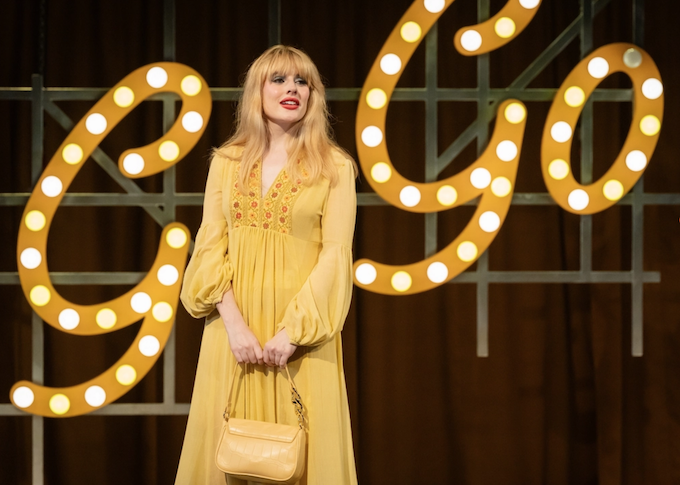
Emer McDaid is almost a lookalike. She is as stunningly beautiful as the original too, and a fine vocalist. The story is Marianne’s tragedy. The fall out, the Mars bar myth, the drugs, naturally fell hardest on a woman. As (the real) Marianne says in her autobiography, Keith created his bad boy image at the trial, and has lived on it ever after. For him it was a great career boost.
Keith Richards: The judge managed to turn me into some folk hero overnight. I’ve been playing up to it ever since.
Keith Richards, Life
For her it was a prelude to years in the wilderness and a descent into addiction. Then fortunately we get her late blooming renaissance.
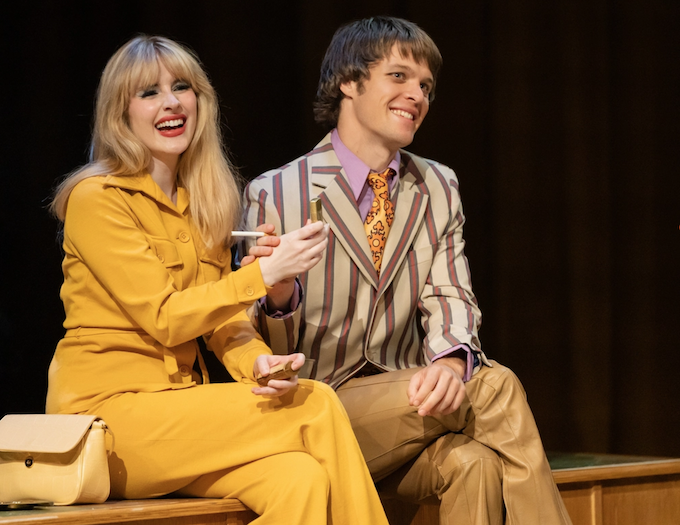
When she first appears, I thought her lines explaining her mother was a baroness, one of the Sacher-Masoch family, came in a little clumsily, but then she was posh.
We don’t get to explore the Mick / Marianne story far either. Here she comments that Mick must be ‘so scared’ in a cell. In her book, real Marianne describes him in tears on the point of total breakdown.
The Chambers
I wondered if they needed the lighted signs up on high above the set saying CHAMBERS and COURT etc.
There is a typing pool sitting in a line on the revolve inner stage. Michael’s assistant is Vivek Chakrabarti (Akshay Sharan), a young man who is as excited by the arrival of the Stones (one typist faints) as the girls. Mick knows his attraction, and gently touches his face. Daphne is the head of the office. There was always someone in charge of the typing pool.
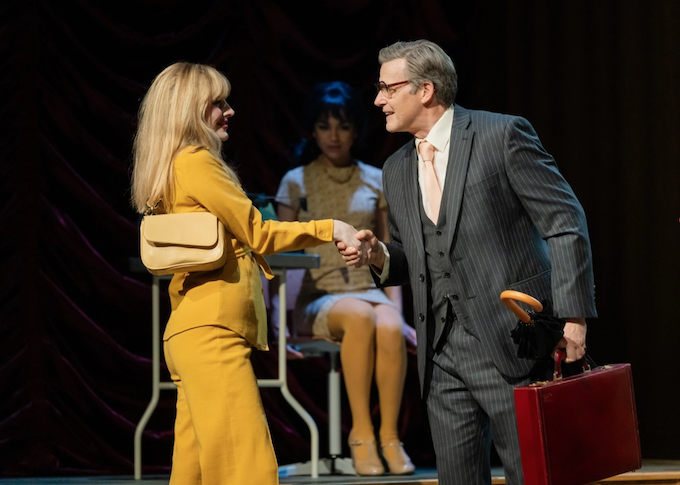
Marianne wants to testify. in the court case. Is Havers old-world in declining to allow her, or is he just toweringly sexist? The family scenes indicate the latter. He was a famed barrister, but not as a campaigning one.
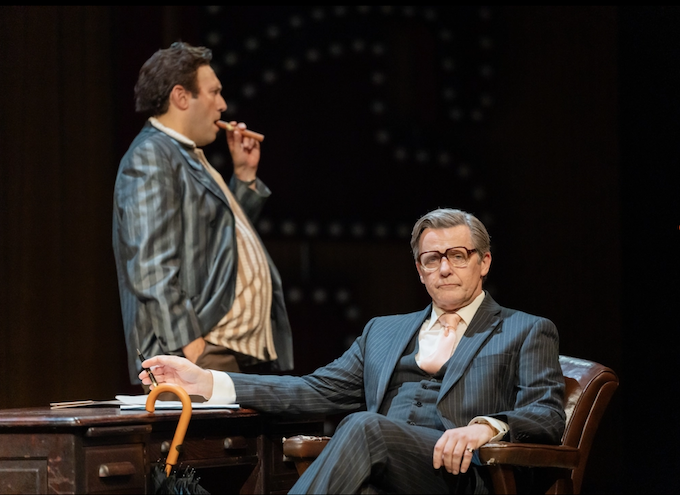
This is where we meet Allen Klein (Ben Kaplan)as the pushy, aggressive American manager. He was in real life too. The scene where Havers sees him injecting himself with insulin is precious. Klein was an expert in forensic accounting, and brought the Stones loads of unpaid back royalties. He was recommended by them to The Beatles and became the villain of that story. Klein has been described as always carrying a gun, and swigging whisky from the bottle.
Court

Sam Pay is Judge Block. I loved the idea of shining a light on a section of the audience stage left and talking about them (rudely) as ‘the jury in Chichester.’
The prosecution counsel, Malcolm Morris, is not a character in the play. A pity. I’d like to have heard him. Note the shocked racism on ‘Moroccan’.
Morris: Would you agree that in the ordinary course of events, that you would expect a young woman to be embarrassed if she had nothing on but a rug in the presence of eight men, two of whom were hangers-on, and the third a Moroccan servant?
Transcript quoted in Jagger-Unauthorized, 1993
In the first case in Chichester, the jury found them guilty separately. They took five minutes for Jagger. Judges shamelessly directed juries. Keith Richards quotes him calling them scum and filth. He finished ‘People like this shouldn’t be allowed to walk free.’
Jagger got three months for possessing four Benzedrine tablets, purchased across the counter in Italy, and actually belonging to Marianne (who wanted to testify to that). He had checked with his UK doctor who testified he would have prescribed them. They were then legal nearly everywhere in Europe, but illegal in Britain. In 1970, there were slot machines in German autobahn cafes dispensing pills to keep you awake on the road. I can testify that they worked too. I don’t know what was in them. In the UK, doctors freely prescribed Benzedrine to long-distance drivers in those days (such as bands driving back from gigs at night).
Keith’s charge was allowing the use of his premises for drug taking. The play uses (almost) his actual line in court, ‘We are not old men. We are not worried about petty morals.’ They extended it and milked it by gazing at the Chichester audience of old men and women at the matinee.
Keith got a year. They were both escorted off to prison. The Times article by William Rees-Mogg pointed out that two anonymous young men would have been slapped on the wrists – a fine, possibly probation. Keith Richards reckons kids in the same situation got a £25 fine then. Havers got them released on bail pending their appeal.

Witnesses are out on the auditorium platforms in this (Chichester court). Later in the Court of Appeal, we have no judge and Havers’ speech is straight to the front (as if the judge were out there).
The witness is the News of The World photographer, and Havers ties him knots. Not that we could see him testifying behind us.
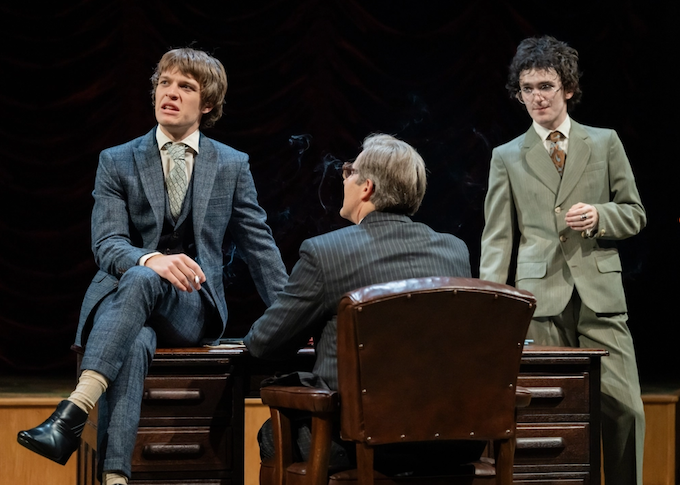
Mick and Keith have taken Havers’ sartorial advice for the court appearance at the court of appeal.
The songs
The songs are not listed in the programme. They are with credits in the play text (though incomplete) but the Jagger / Richards songs are credited wrongly to ‘The Rolling Stones’ while others are to songwriters. Incidentally, I’ve never seen that many play texts being sold. There is a reason sometimes given, that the director wants the songs to come as a surprise in the show, but The Watermill Theatre always credits, and you don’t read all the small print between buying the programme and curtain up. If you can list all the theatre staff in tiny text in three columns, including the finance department, Building and Site Services department, and front of house, then why not credit Messrs Jagger and Richards for their songs, or (e.g.) Don Covay for an apposite Mercy, Mercy?
Interestingly, the actual Jagger / Richards compositions are in a minority. The sound is ‘modern’ in that a current audience would not understand how quiet and jangly actual mid-60s bands sounded. There are tiny amps on stage here. They could be mic’d into the PA, but I suspect they’re for show.
These are the songs and composers from memory. I was talking about them and Karen said, ‘A lot of people won’t know them. Describe them.’ Here you go.
You Can’t Always Get What You Want (Jagger / Richards) – sung by the female members of the ensemble and brilliantly too. From Let It Bleed LP, 1969. Ella Tekere was singing near us and was tremedous.
You Can Make It If You Try (Ted Jarrett / Gene Allison). A 1957 song, covered by The Stones on their first LP in 1964.
Not Fade Away (Buddy Holly / Norman Petty). The Rolling Stones third single, February 1964, and their first Top Ten hit (UK #3). The first full on rocker by Mick & Keith with the curtains open to show the band (or rather bass, drums, guitar).
Going To A Go-Go (Smokey Robinson) A 1965 single by Smokey Robinson & The Miracles that every discotheque had on constant rotation in the mid-60s. The Rolling Stones covered it, but years later in 1982 on Still Life. This version is by the ensemble.

This Little Bird (John D. Loudermilk) a 1965 UK #6 hit for Marianne Faithfull. Emer McDaid sings it in her role as Marianne, and it is a stunning vocal performance.
Can I Get A Witness (Holland, Dozier, Holland). A 1963 song by Marvin Gaye, which the Stones covered on their first album. This closes Act one, because the lyrics fit. The riff is the most classic R&B riff of all and my teen band played it. The version here is the best I’ve heard it live (and I’ve see Marvin Gaye do it). It sounds modern rather than the mood of the original, but in a huge theatre, we accept that. Maybe the dancing is what lifts the excitement. The original had Gene Pitney, Phil Spector and some of The Hollies guesting in the studio.
ACT TWO
Soul Limbo (Booker T and the MGs), aka Test Match Special, and the act begins with Nigel and his grandad watching a Test Match at Lords.
Mercy Mercy (Don Covay). An appropriate lyric in the court case. Have mercy on me … Don Covay recorded it in 1964 with Jimi Hendrix playing on the session. The Stones recorded their version in Chicago in 1965 and it’s on Out of Our Heads.

As Tears Go By (Jagger / Richards / Loog-Oldham). Marianne’s first UK hit in 1964. Her version pre-dated the Stones own version. Here is (again) the best I’ve heard it, sung as a trio by Emer McDaid and two of the dancers / singers. Extraordinarily well done.
Satisfaction (Jagger / Richards). Mick and Keith doing The Stones signature song from August 1965.
Ruby Tuesday (Jagger / Richards) It was a double A-side with Let’s Spend The Night Together, and I played this side most. It would be in my Stones’ Top Ten. It was the current Stones single at the time of the bust. Mick Jagger cheerfully admits that lyrics and music were all by Keith Richards. Marianne Faithfull says Brian Jones collaborated as well as playing recorder, and it was his favourite song. Here, Marianne (sorry, Emer McDaid) starts singing it, and when she goes off stage, Louis Landau as Nigel Havers completes it. To great applause, too.
Jumping Jack Flash (Jagger / Richards) wasn’t recorded until 1968, but who cares? It personifies Jagger’s image. It becomes the ultimate closer with the whole ensemble on and dancing, then it segues into Satisfaction. This was the best few ending minutes of a play in years.
Wow. Surely the greatest-ever final ten minutes of anything that has ever been on the CFT stage. Brilliantly, blisteringly delivered
Sussex World review
In the end?
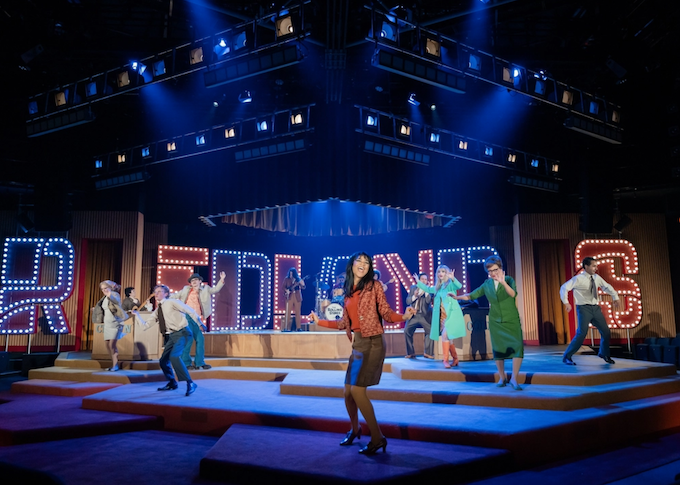
There is a mention of the three hour run time in reviews. Really? We were at a matinee. Started 14.30. Twenty minute interval. Finished 17.15. We were driving out of the car park at 17.20. I spoke to someone who saw it twice, both at evening shows and loved both. I saw mention of the audience dancing at the end. At the matinee, we were on our feet but there were a lot who were (even) older than us who much as they loved it, couldn’t do that. I could see with the audience up and shimmying, they could have kept playing Jumping Jack Flash and Satisfaction for ages. You wouldn’t want to with a second performance later the same day.
Overall? A definitive five star play.
We both agreed it was the best thing we have seen this year.
*****
THE BAND
Three of the backing band appear in the Jagger Richards performances as ‘The Rolling Stones.’ There is no tribute band attempt to be lookalikes, and with a female bass guitarist with a fuzzball, it would be hard. Playing with the neck upright as Bill Wyman did, is not to many bassists’ taste. I’d still have given the guitarist a blonde Brian Jones wig. I might have tried to use a Vox bass like Bill Wyman, but they’re rare probably because they weren’t very good. Very few played them. I expect The Stones were paid to do so.
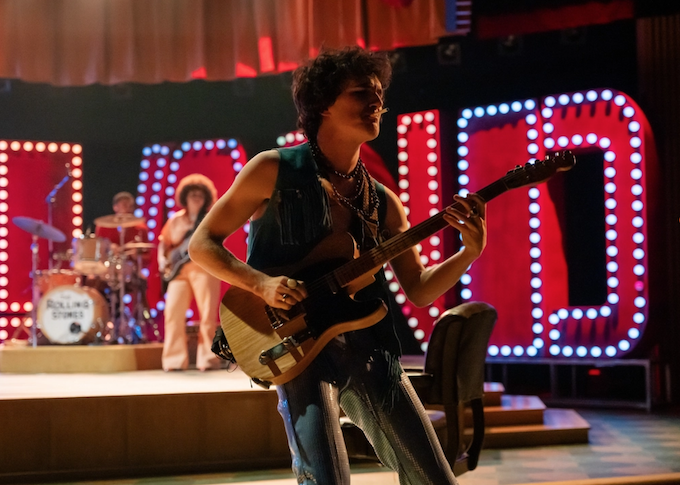
I wondered about instruments. In the programme, Brenock O’Connor as Keith Richards is shown with a red Gibson SG. On stage it’s a Fender Telecaster, which is what he had bought at the end of 1966, and seems his current guitar of choice. Younger photos show Keith with a Gibson 335 or Epiphone. A tribute band like the Bootleg Beatles would get the guitars exactly right for every song. BUT as Keith has to run around (allegedly) playing, a Telecaster is lighter and smaller than most. Also it would be too easy to damage a semi-acoustic guitar like a Gibson 335. Also, not many people know that much about guitars.
WHAT THE CRITICS SAID
I look at those three star reviews. One said he’d never read anything about The Rolling Stones. Ah, I see.
five star
Theatre Vibe, *****
four star
Debbie Gilpin, Broadway World ****
Rosie, Theatre & Tonic ****
Daily Mail, ****
three star
Dominic Maxwell, Sunday Times ***
Arifa Akbar, The Guardian ***
Claire Allfree, The Telegraph ***
Dave Fargnoli, The Stage ***
Gareth Carr, What’s On Stage ***
LINKS ON THIS BLOG
JUSTIN AUDIBERT (Director)
The Caretaker, by Harold Pinter, Chichester July 2024
The Taming of The Shrew, RSC 2019
Snow in Midsummer, RSC 2017
The Jew of Malta, by Christopher Marlowe, RSC 2015
Flare Path by Terence Rattigan, Salisbury Playhouse 2015
ANTHONY CALF
Hedda Tesman, Chichester Minerva 2019
Plenty, Chichester 2019
Racing Demon, Bath 2017
For Services Rendered, Somerset Maugham, Chichester Minerva
CLIVE FRANCIS
The Circle, by Somerset Maugham, Bath & Chichester 2024
SAM PAY
Timon of Athens, RSC 2018
Tamburlaine, RSC 2018
Tartuffe, RSC 2018
BEN CAPLAN / KAPLAN
Hedda Gabler, Salisbury 2016
Macbeth, Globe 2023
 Peter Viney's Blog
Leave a comment