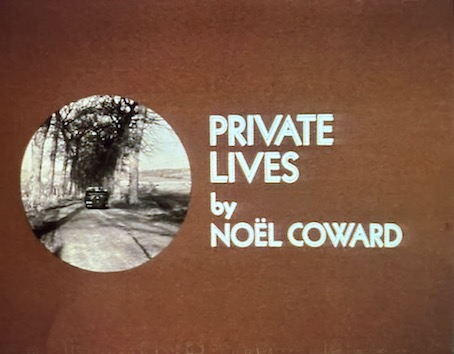
Private Lives
By Noël Coward
BBC Television
Broadcast 28th December 1976
Produced by Cedric Messina
Directed by John Gorrie
Designed by Stuart Walker
On DVD: The Noël Coward Collection (BBC)
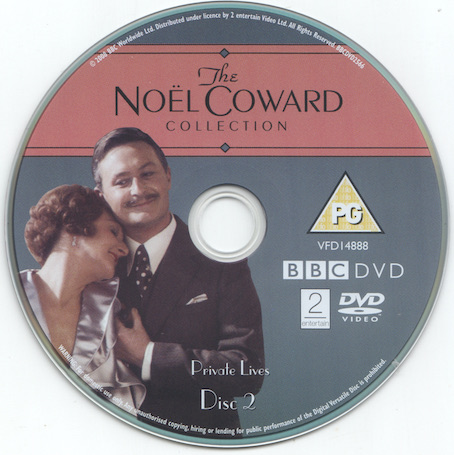
CAST
Penelope Keith- Amanda
Alec McCowen – Elyot
Polly Adams- Sybil
Donald Pickering – Victor
Françoise Pascal – Louise
A lavish BBC Christmas week production from 1976. They were moving away from ‘TV plays’ where they filmed it on one set, and adding more film elements. The DVD is sharp, bright and clear, even though it’s in 4:3 TV shape. See the previous reviews of Private Lives (link to 2021 production) for more on the play and our experiences of it. As I mention, there are only two other reviews (2021, 2023) on this site, though we saw it many times before starting reviews here in 2012. It’s relaxed and comfortable viewing for us. Not a line holds a surprise for us, so we can focus on delivery. Karen’s done Sibyl. I’ve done lights and sound. If you don’t know the outline story, the other reviews have it. Like The Importance of Being Earnest the play is a perfect construct. It self propels. There are better versions and lesser versions, but the core will entertain.
The basics for those who can’t be bothered to look at the other reviews and need a memory jog. Also, the extracting of stills from screenshots inevitably leads into ‘picture stories.’
Act one

Elyot and Sibyl have arrived at a hotel in Deauville for the first night of their honeymoon. They go out onto the balcony. They talk about his first wife, Amanda.
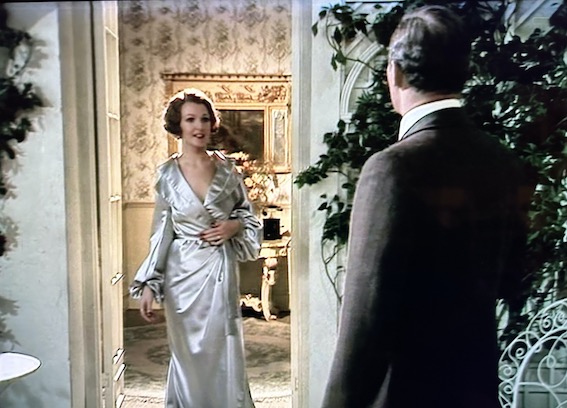
Once they’ve gone back into the room, we switch to the neighbouring balcony. Then we find Amanda and Victor have arrived at the same hotel for the first night of their honeymoon, and they discuss her first husband Elyot. While Sibyl is sweet, Amanda is toweringly glamorous. Sibyl’s primrose yellow going away outfit contrasts with Amanda’s silver, silken and revealing dressing gown.

Victor: Do you love me more than you loved Elyot?
Amanda: I don’t remember. it was such a long time ago.
Victor: I’d like to break his damned neck.
The hotels have those adjoining balconies. Sibyl is getting ready(changing from primrose yellow to baby blue). Unlike the play we can go into the hotel room where she’s looking for her lipstick. Elyot goes to sit on the balcony to wait and hums a song … their song. Elyot and Amanda’s song. Amanda has gone to her balcony while Victor gets ready. She finishes the song …

Both try to persuade the new spouses to leave the hotel at once. Elyot claims he has second sight and predicts an imminent disaster. He gets nasty and she bursts into tears.
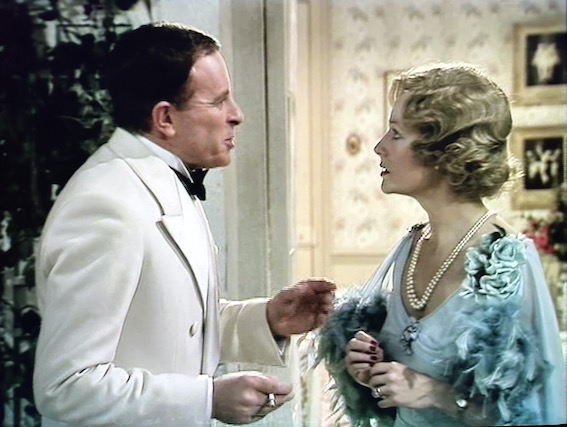
Amanda makes up a story about her sister dying in this hotel (she forgot) then admits that it’s because Elyot is at the hotel. In both cases, the camera goes into the hotel room for the arguments, which makes more sense than the balconies, I suppose.
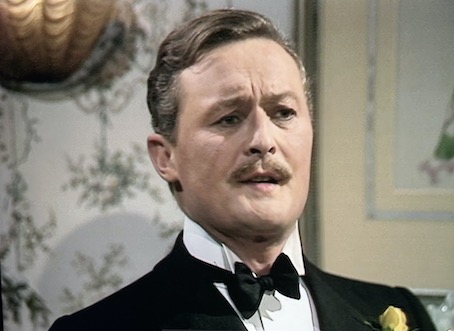
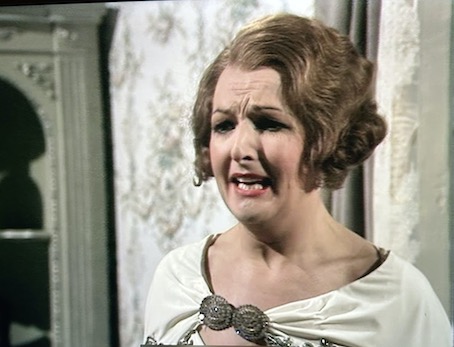
Both couples argue, and the new spouses Sibyl and Victor, depart for the casino (him) and restaurant (her). (Incidentally an episode of Frasier set in Hawaii replicates the scene).

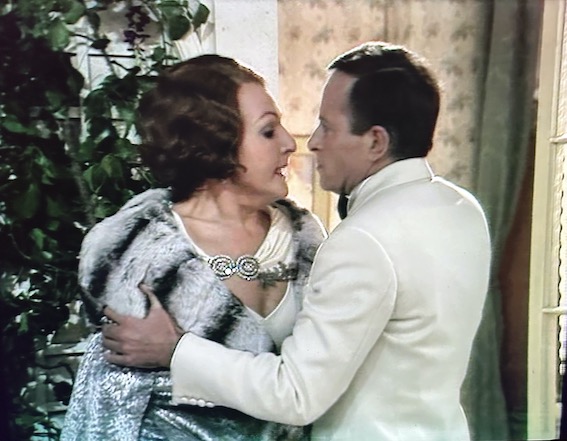
Elyot and Amanda go to their respective balconies and meet with the cocktails they had ordered earlier. Not for the first or last time in a Coward play, he lights her cigarette. Their passionate romance is rekindled and they decide to flee the hotel to Paris and Amanda’s apartment.
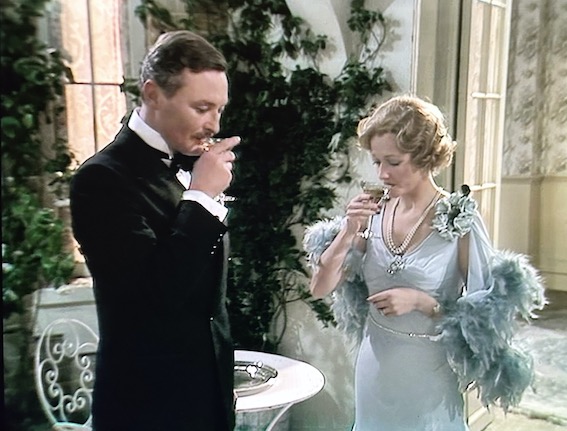
Victor and Sibyl return looking for them. They introduce themselves and share a sad and wistful cocktail.
Act two
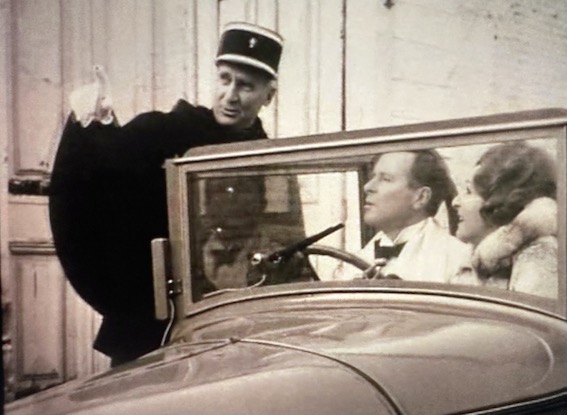
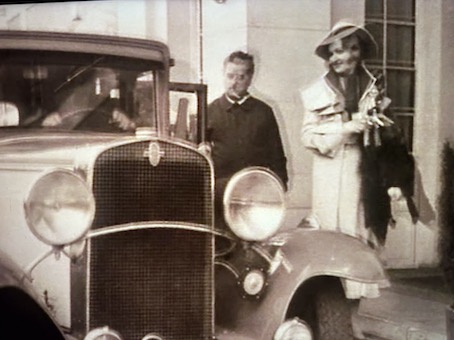
They use linking black and white film for the journey to Paris.
Act two is Elyot and Amanda’s act. It’s why they’re always the star names in productions. It’s a great piece for two actors to run through a gamut of high emotions. Elyot and Amanda are in her apartment, after three days of unmarried / divorced / reconciled bliss. This is the set designer’s dream Art Deco festival in most productions (and you feel the lack when it’s not there).

They dance while having a wonderfully absurd conversation. We warm to them. Amanda brings up their guilt about poor Sibyl and Victor. Elyot is not concerned.
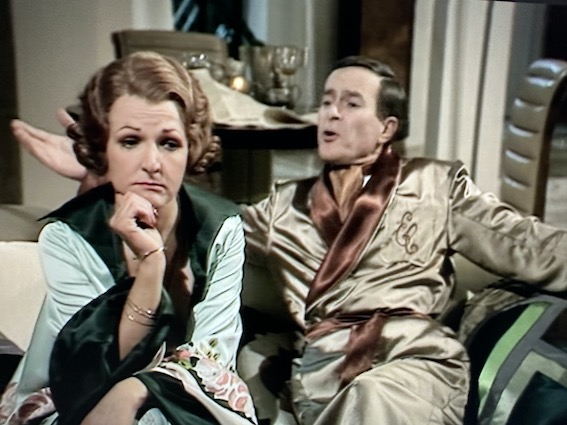
Elyot has EC (Elyot Chase) on his dressing gown. Some may think he was a fan of EC (Eric Clapton).
It’s Coward. The smoking is incessant. It’s very hard indeed to reduce it let alone eliminate it (as you might try in 2024). It’s built into the script.

They canoodle on the sofa, they’re going in and out of passion and argument throughout the Act.
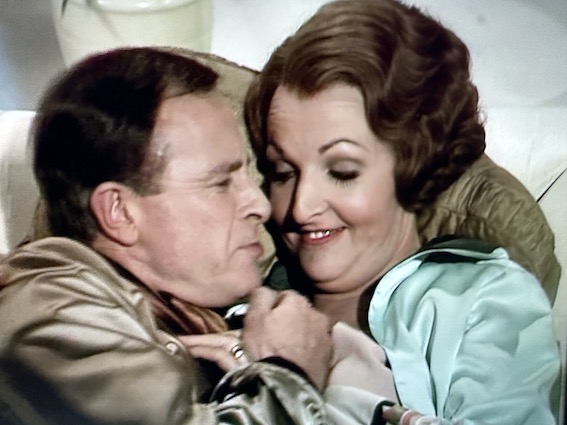
Their old arguments resurface, especially on forensics on what each was up to during their years of separation. On stage, Amanda’s horror at Elyot’s ‘it’s different for men’ attitude never fails to get the laughs. We get the line which more modern productions cut:
Victor: I was madly in love with a woman in South Africa.
Amanda: Did she have a ring through her nose?
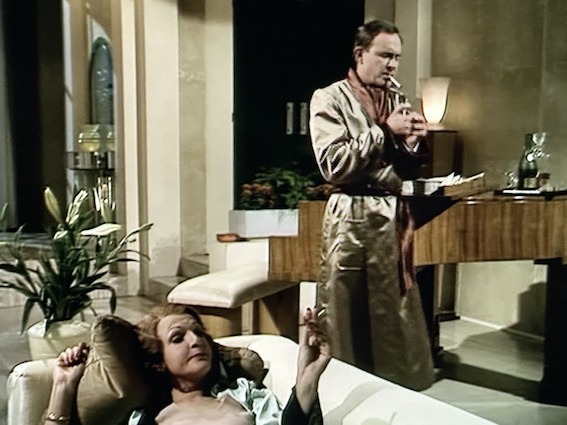
One of the lines that breaks up audiences is when Elyot gets amorous and Amanda, recumbent on the sofa, declares that it’s too soon after dinner. He finds this remark ‘rather common.’ To make it up with her, we get the song repeated, sung by Elyot at the piano (Coward’s speciality when he played Elyot in 1930).

Again, TV allows another room, the bedroom. These BBC TV productions love the mirror shot, here where Elyot does Coward’s trademark ‘we are different to (i.e. better / cooler / more sophisticated than) normal people’ speech. I guess it’s the camera operator’s signature shot.
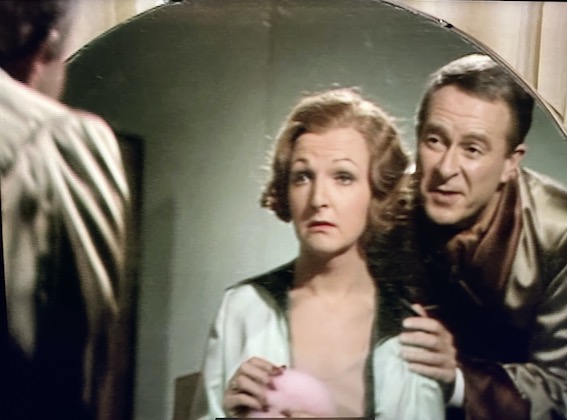
Then the row starts. Elyot’s hitting the brandy.
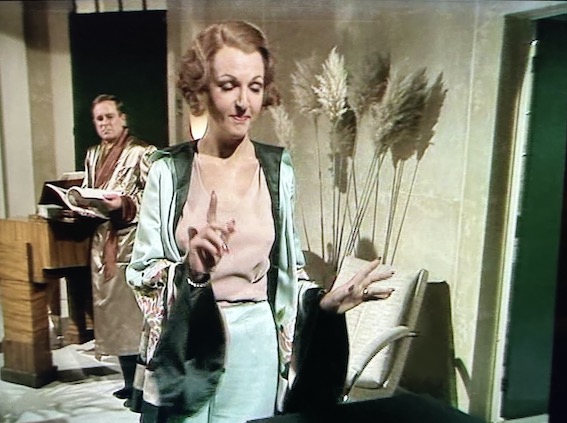
She puts on a record and dances which annoys him, so he grabs the record to stop it ,scratching it, and she breaks it over his head.
Right, that’s what’s happened in recent productions. Great moment. On the 2023 Donmar Warehouse review I commented that The Guardian was wrong about shards of ‘vinyl’ flying, because vinyl is unbreakable in that situation. It’s a 78 rpm shellac record. They break readily, though I wouldn’t guarantee every time on a blow to the head at all. Also, on Elf and Safe Tea, it’s a bit close to the eye for shards of shellac to fly. I would guess it’s a doctored / fake disc on modern stage productions, which means the record playing is sound over, not the actual record. I thought back to doing Private Lives regularly for ELT students in the 70s. We never broke a record. Too risky? Too unreliable with a standard shellac 78? It led me to the Acting Edition. We kept one copy from each set we had, and I note we kept Amanda’s copy.
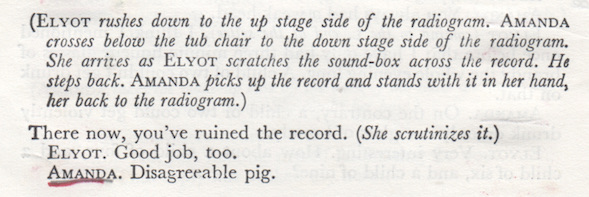
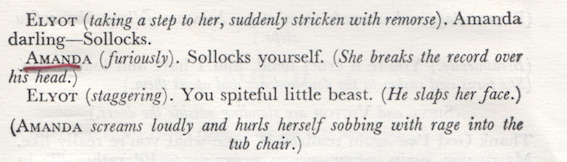
I reckon in 1930 they would have actually played the record on stage and broke one every night. The scratch of the needle on the disc wouldn’t matter because they changed new needles every play or two anyway.
Incidentally, it’s almost impossible to get still shots of fast action from DVD. You can from VHS tape, because it has each frame of the original film separately. DVD samples across several frames.

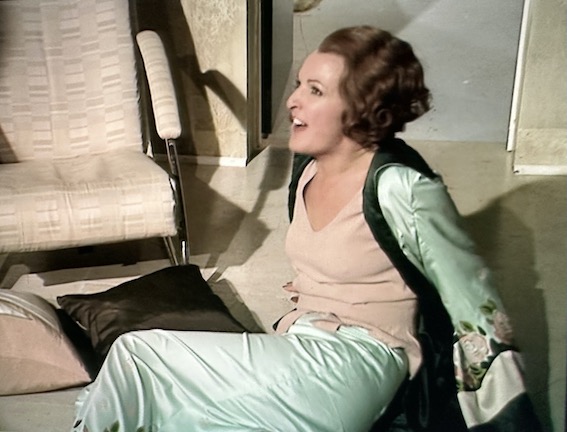
It erupts into a full on physical fight – slapping, bottom smacking, dragging across the floor … which is when Victor and Sibyl walk in through the door.
Reviewers in 2023 seemed shocked by the level of violence. While the Acting Edition is out, I’ll scan the text. It’s all there:


The TV production gives Victor and Sibyl more time to come in and gaze around.
Act three
The morning after. The maid, Louise (Françoise Pascal ), comes into the dark room, tripping over the light the fight had knocked over. Her opening word is Merde! which Noël Coward couldn’t have got away with in English, and she continues in French. She tidies up, then sees Sibyl who wakes. Note the effectiveness of tight close ups:

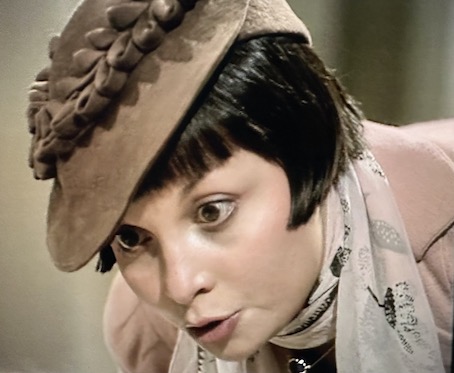
Sibyl and Victor have been asleep in chairs having spent the night in the living room. There’s no sign of Elyot and Amanda.

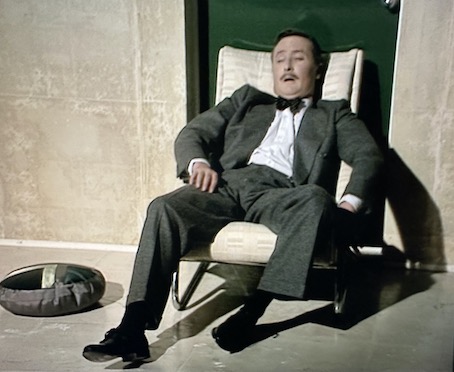
Amanda and Elyot emerge from different bedrooms. Both have packed cases to go. Amanda is blithe and ultra-polite, apologising for the state of the room and ordering coffee for them. When Elyot emerges and retreats again, Sibyl breaks down in tears. Amanda ignores her.


Amanda chats merrily about Paris.
Elyot: What manner. What poise. How I envy it.
Amanda takes offence and we are back to the previous evening. This is another exchange that shocked reviewers in the 2020s.
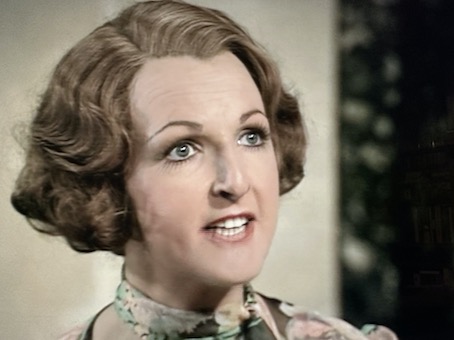
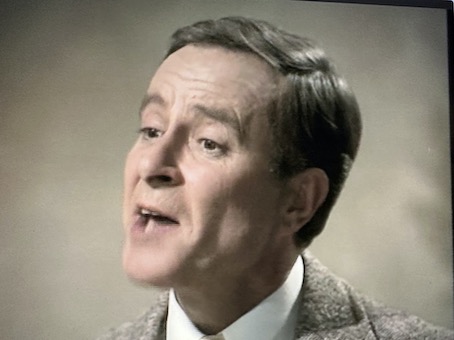
Amanda: I’ve been brought up to believe that it’s beyond the pale for a man to strike a woman.
Elyot: A very poor tradition. Certain women should be struck regularly, like gongs.
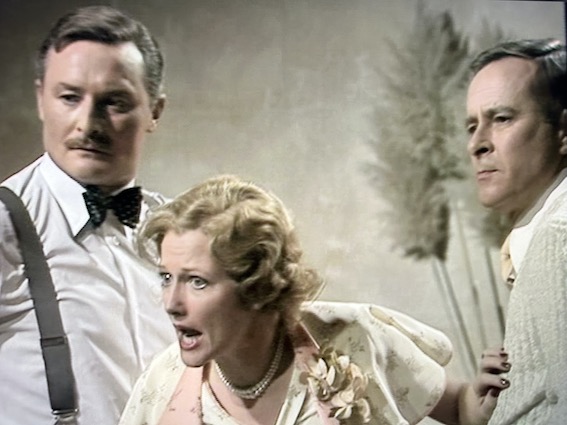
Victor takes exception and wants to fight and Sibyl tries to intervene.
Sibyl: Stop! Stop, it’s no use going on like this . Stop, please. Help me, help me, do help me –
Amanda: I’m not going to interfere. Let them fight if they want to. It will probably clear the air.

Amanda leads the distraught Sibyl away to wash her face. The Victor belligerence versus Elyot calm insouciance is one which must have been a joy when Coward was Elyot and a young Laurence Olivier was Victor. It’s marvellous here too.
Amanda gets to speak to Victor, and Sibyl follows Elyot into his room to speak. The issue here centres on the laws of who would divorce whom and the social consequences, a 1930 play obsession.


The confrontation centres around the coffee and brioche for breakfast scene, which rivals the Cecily / Gwendolen tea scene in The Importance of Being Earnest for best tea / coffee scene. Noël Coward may have consciously rivalled it.
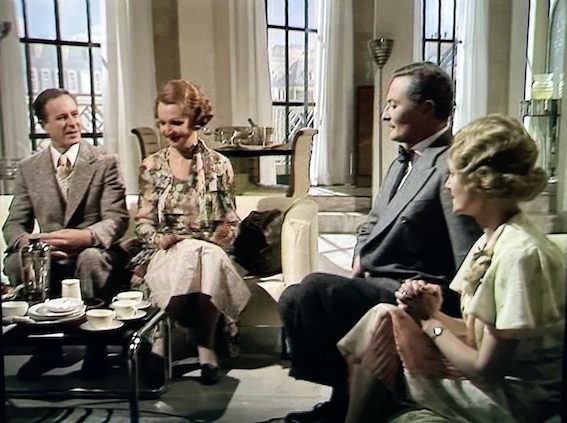
So Victor and Sibyl get into an argument. As it gets nastier, Elyot and Amanda watch.
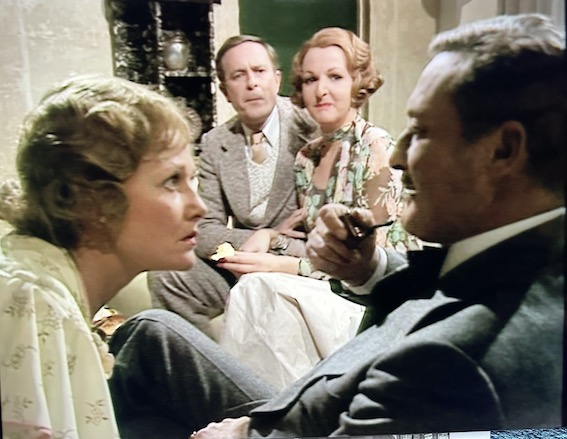
The angle here is one you couldn’t do on stage with the argument foreground and the watchers behind. The kiss is an addition in this version:

Amanda and Elyot watch, then carefully creep away together leaving them to it. Sibyl and Victor are now in a slapping physical fight.

The End.
They use sepia jerky (so faux silent film) link pieces at the start and between acts, with added comedy … arriving at the hotel, getting lost on the way from Deauville to Paris, asking a policeman. Appropriate ‘silent film’ music accompanies. Hmm. A 1920s mood. The play dates from 1930 and Noël Coward was always up to date. Jerky film dates back to hand cranking and then projection years later at 24 frames per second instead of 16 frames. Noël would have expected up to date filming.

Penelope Keith defines Amanda. Her make-up and costume are perfection. She does do ‘Margo’ at virtually all times, but for Private Lives her style could not be bettered – this was not true of her Lady Bracknell where she channeled Edith Evans too much. Amanda caught her at just the right time. It’s as if Coward wrote the role with her in mind.
Donald Pickering’s Victor is also the Victor of my imagination, moustache bristling. Upright. Thick.
Alec McCowen delivers Elyot’s lines with aplomb too, but we both agreed that he doesn’t look quite right physically. He can do the Coward singing and piano playing, the Coward flippancy, the Coward timing all so well. Is it his face? His teeth? I don’t know. I would say though that the two most memorable actors in roles Coward performed himself are ‘off the template’ … Rik Mayall in Present Laughter and Stephen Mangan in Private Lives … and that’s because, like Coward, they let their own personality / style come over into the part, rather than simply ‘doing Coward.’
Polly Adams is a very good Sibyl, doing it as Coward intended without veering into shrillness or silliness.
All in all, very good casting. Even the walk on maid, Louise (Françoise Pascal) looks just suitably Gallic.
The TV allows a little set extension … Amanda’s flat has a separate bedroom for example. We get views down from the balcony on the yachts (not real, but the camera shows us their angle looking downward).
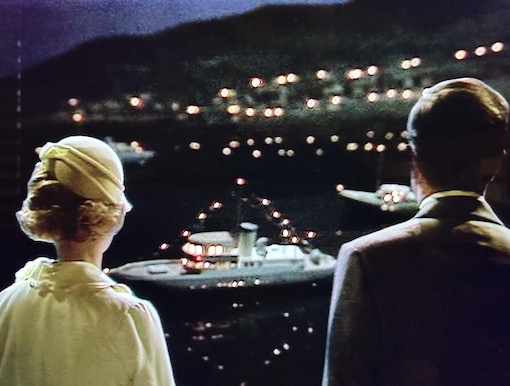
They made the right decision to go for filmic close-ups and use them as much as possible. That enhances the play compared to stage versions. It allows subtlety too, in all the interactions and reactive acting.
The one point where film suffers is the big fight scene at the end of Act 2 between Amanda and Elyot. Yes, it’s all well performed, but we expect that on film. On stage, it can be amazing as the actors roll around, fall over sofas, crash into things in one continuous move. You often feel, ‘How did they do that?’ when you see it on stage. On film, well, you know they can.
In Act 3, we are surprised that Victor refers to Elyot by surname as ‘Chase.’ Yes, that’s the text and what a 1930 Victor would have done, but as his discussion with Amanda in Act 1 always calls him ‘Elyot,’ it’s perplexing. Who remembered his surname? Was it mentioned? Our French’s Acting edition has ‘Chase’ crossed out and ‘Elyot’ written in. We were not alone in changing it for clarity.
You can’t compere TV film and stage in the same rating system. Suffice it that it looks sumptuous and that Penelope Keith is the best Amanda I’ve ever seen.
NOËL COWARD ON THIS BLOG:
- PLAYS BY NÖEL COWARD
- Blithe Spirit by Noël Coward, Bath Theatre Royal 2010 (Alison Steadman)
- Blithe Spirit, by Noël Coward, Bath Theatre Royal 2019 (Jennifer Saunders)
- Blithe Spirit by Noël Coward, Salisbury Playhouse 2025 (Susan Wooldridge)
- Blithe Spirit FILM 2021 (Judi Dench)
- Noël Coward’s Brief Encounter, by Emma Rice, Salisbury Playhouse, 2023
- Design for Living, by Noël Coward, BBC Play Of The Month, 1979
- Fallen Angels, by Noël Coward, Salisbury Playhouse
- Hay Fever by Noël Coward, Bath Theatre Royal 2016
Hay Fever, by Noël Coward, BBC TV Play 1984 - Present Laughter, by Noël Coward, Bath Theatre Royal, 2003 Rik Mayall (retrospective)
- Present Laughter by Noël Coward, Bath Theatre Royal 2106, Samuel West
- Present Laughter by Noël Coward, Chichester 2018, Rufus Hound
- Present Laughter by Noël Coward, Old Vic 2019, Andrew Scott
- Private Lives by Noël Coward, BBC TV 1976
- Private Lives by Noël Coward, Nigel Havers Theatre Company, 2021, Chichester
- Private Lives, by Noël Coward, Donmar Warehouse, London 2023
Relative Values by Noël Coward, Bath Theatre Royal
This Happy Breed by Noël Coward, Bath Theatre Royal - The Vortex, by Noël Coward, Chichester Festival Theatre 2023
 Peter Viney's Blog
Leave a comment