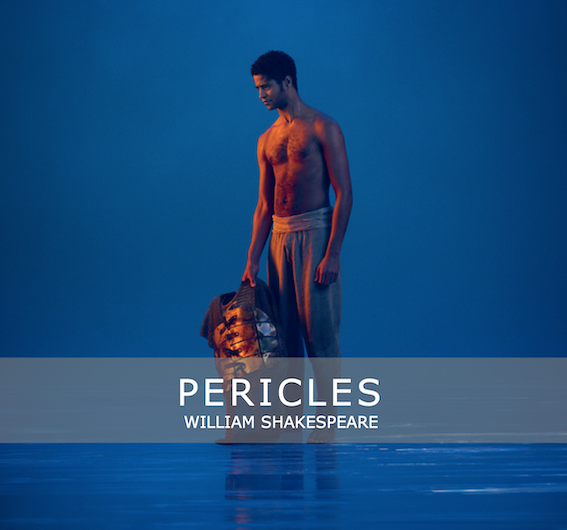
Pericles, Prince of Tyre
By William Shakespeare & George Wilkins
Directed by Tamara Harvey
Set designer Jonathan Fensom
Costume Kinnetia Isodore
Composer Claire van Kampen
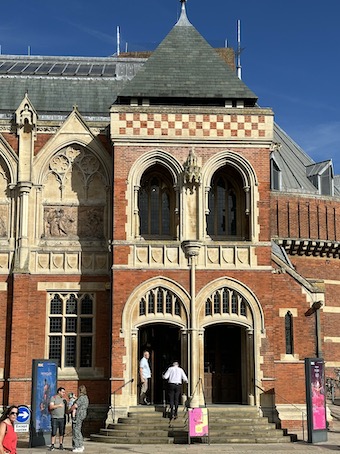
Royal Shakespeare Company
Swan Theatre
Stratford-upon-Avon
Tuesday 13th August 2024, 19.30
CAST
Miles Barrow- Thalliard / Boult
Philip Bird – Helicanus
Jaqueline Boatswain – Cerimon / Bawd
Cassie Bradley- ensemble UNDERSTUDY Lady of Ephesus
Rachelle Diedericks- Gower / Marina
Alfred Enoch – Pericles
Chyna-Rose Frederick – Antiochus’ daughter / Lychorida / Diana
Sasga Ghoshal- Ensemble
Leah Haile – Thaisa
Felix Hayes- Antiochus / Pander
Kel Matsena – Lysinachus
Miriam O’Brien – ensemble
Emmanuel Olusanya – ensemble
Chukwuma Omambala- Cleon
Sam Parks – Escanes / Leonine
Christian Patterson – SimonidesGabby Wong – Dionyza UNDERSTUDY Miriam O’Brien

This is the first RSC production by new co-artistic director, Tamara Harvey. It was one waiting to be done. When the RSC announced they were going to do the whole canon over five years, they skipped Pericles and Henry VIII. The presence of another co-author was no reason as they did other collaborative plays. They also announced the three Henry VI plays pre-Covid, and condensed them to two post-Covid. The argument would be that Pericles was not in the First Folio, though it was very popular at the time and published in a shoddy quarto version. It was Third Folio in 1635 before an official version. I consider it a possibility that actually no one at the RSC then wanted to take it on. So Pericles was overdue, it’s eighteen years since the last RSC version. Even so, it gets the smaller Swan Theatre rather than the main stage.
Interestingly, it has the same designer, Jonathan Fensom, and the same composer, Claire van Kampen, as last time we saw the play at the Wanamaker Playhouse in 2015. More later.
On authorship, the RSC has an article on its site, THE PIMP AND THE PLAYWRIGHT. (linked). Textual analysis attributes Acts I and II to George Wilkins, Acts III to V to Shakspeare.
From the RSC site:
Wilkins had written a play, The Miseries of Enforced Marriage (1607), which was performed by The King’s Men …. While most dramatic collaborations of the time alternated between two authors, based on textual analysis, it appears that the first two acts of Pericles were written by Wilkins, while the last three were written by Shakespeare. This suggests Wilkins may have started writing the play and then abandoned it halfway through, leaving Shakespeare to finish it. Popular consensus places the play as being written in 1608. Its entry in the Stationer’s Register is dated as 20 May 1608 as The booke of Pericles prynce of Tyre under the publisher Edward Blount. It was first published as a Quarto in 1609 …
… Following the short-lived collaboration on Pericles, Wilkins wrote a prose romance called The Painfull Adventures of Pericles Prince of Tyre (Being the true History of the Play of Pericles, as it was lately presented by the worthy and ancient Poet John Gower), which is textually very close to the play. Some editors have used Wilkins’ romance to correct the 1609 printed text of the play, which, even for the notoriously error-filled playbooks of the time, contains an unusually high number of mistakes. These include an estimated 452 lines of verse printed as prose, and 51 lines of prose printed as verse, and many corruptions, inconsistencies and incomprehensible sequences.
The 1976 Penguin Shakespeare suggests that Wilkins did the prose version, but not necessarily Acts I and II. The quarto is so messed around that it’s impossible to tell. Though Acts I and II are not by Shakespeare, there are other candidates. I guess we’re nearly fifty years on in textual analysis by computer which is why the Wilkins attribution may now be solid.
The programme describes how it was recut and there is a whole scene and a song which were always omitted. They are restored here.
For more on the sequence of events and characters, see my review of Pericles, in the 2015 Wanamaker Playhouse production.

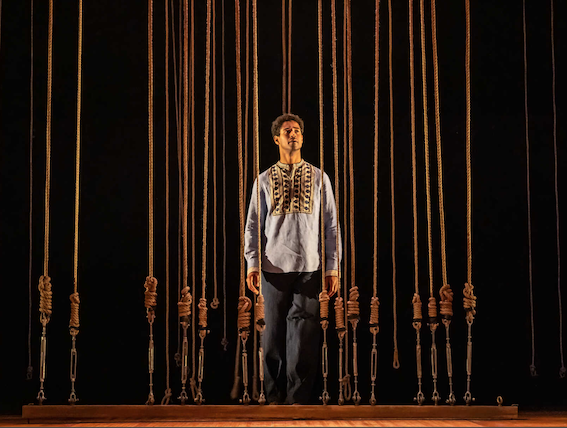
The set is minimalist. It would have fitted the Wanamaker Playhouse with ropes as the basic decoration, just as the Wanamaker version by the same designer had ships rigging rope . Single ropes here. I think the square rigging worked better, being climbable and you could get stuck in them. They even came on with a candle at the start, hoisted it on high, then lowered it at the end. Very Wanamaker, though there was only the one and it was lifted out of sight lines (thank goodness) and left out to the end.
Costumes are elaborate and vaguely Arabian Nights as befits the locations. There are a lot of all cast static tableaux, and much sinuous arm movement. I thought it was Indian but Karen pointed out we saw real Indian dance in the BSO version of The Rite of Spring and they were a hybrid here.
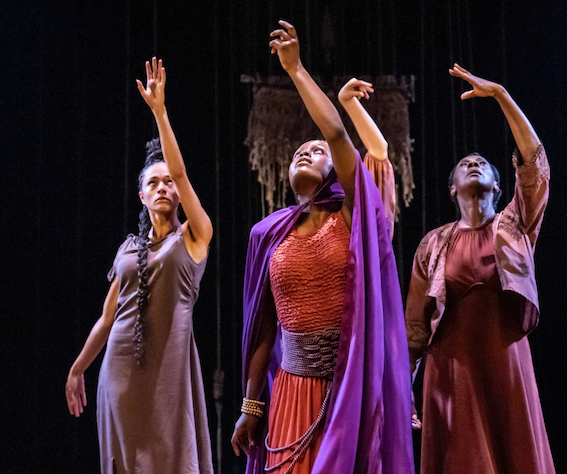
I wonder what the concept was? It was purist in a way. It reminded me of the costume designs in the 1950s and 1960s Folio Shakespeare single plays. Were they saying we can do a very modern Merry Wives in one theatre, and a traditional old-fashioned production in the other? The focus was on style, definitely not on character. It’s not a play with significant ‘character’ anyway. Praise we heard in the interval crowd was extravagant and at that point we’d mainly seen the George Wilkins bits. I have to admit that the magic experience others were describing so keenly hadn’t hit me and I was slightly bored.
Susannah Clapp in The Observer said:
Its plot skitters all over the place: death at sea, incest, tyranny, pirates, jerky motion with disconcerting gaps. Which would matter less if it were fully dramatised. As it is there is more description of action than real development. There is no central pulse.
She sums the play up better than I can. They were one cast member short, and understudying was seamless, but the cast are very distinctive physically and have strong hair styles. They double and triple up at speed, and costume changes are minimal. Too minimal. Crown on / crown off. Outer robe on / outer robe off. Wigs would help. I notice they did try to colour code the rulers though, which always helps subliminally. The play intrinsically suffers from far too many characters in too many locations. This period, 1608, sees Shakespeare avoiding classical unity altogether. We leap about in time and pop up all over the Eastern Mediterranean.
The play revived the old poet Gower as narrator and link. That’s deliberate distancing from 1608 to an older style. It worked well here switching the role to Marina, who is not born for the first few years and so is telling the story as she later heard it, though the play has too much narration instead of events. With the narration added to the later scenes, Marina becomes the co-lead of the play. Rachelle Diedericks is a rising star. She is listed as Gower / Marina but it is all played as Marina narrating her own story.
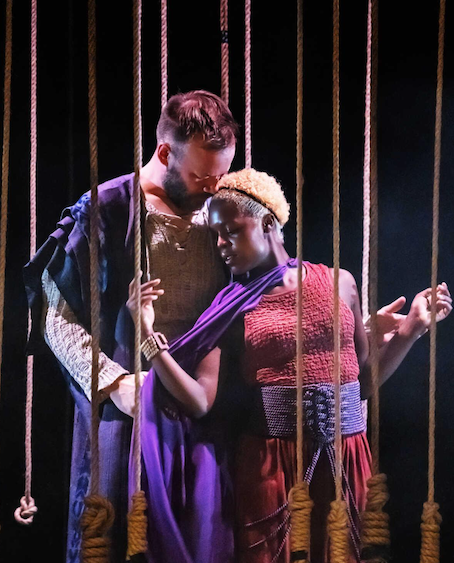
Another oddity is that it begins with Pericles being presented with an Arabian Nights riddle by King Antiochus, which, in the way of royal riddles, means death if he gets it wrong. He works out that it’s describing father / daughter incest. He decides escape is the best answer. Exit, pursued by assassin. Then the end reunites him with his own long lost daughter in fond embrace.
We could add that confining lost mothers who were assumed dead to temples or nunneries was overdone and there would be more. Then there is seeming dead, but emerging from a coma alive. So were fourteen /fifteen year ‘growing up’ time gaps and father /daughter stories – King Lear, The Winters Tale, The Tempest for starters. They were young too- Juliet 13, Marina 14 (though they missed the narrative line), Miranda 15.
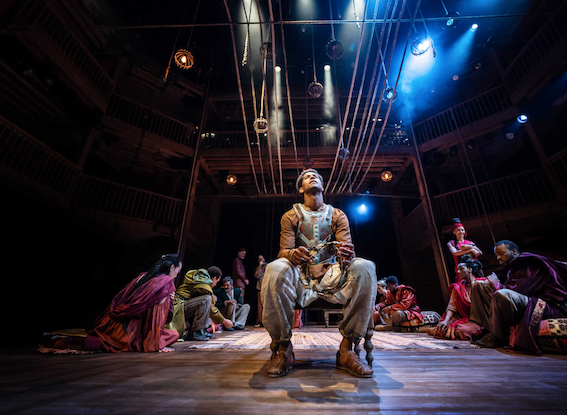
One of the best set pieces is the tournament. The recently shipwrecked Pericles has to don rusty armour and fight with four knights. It’s done as a formal dance routine. It looks glorious.
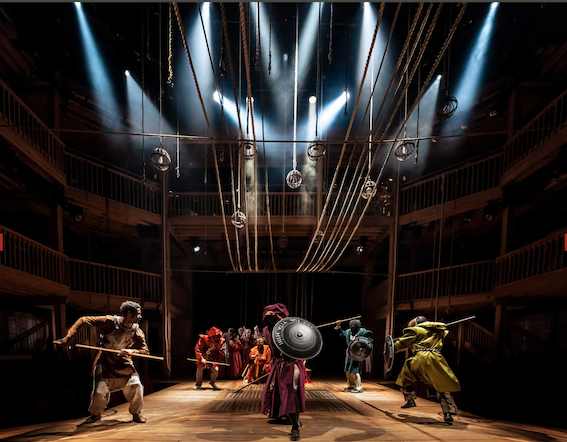
The play lacks comedy. We’re some bits lost? The quarto was an incomplete text. The brothel scene should be funny, and wasn’t really. It was funnier at the Wanamaker.
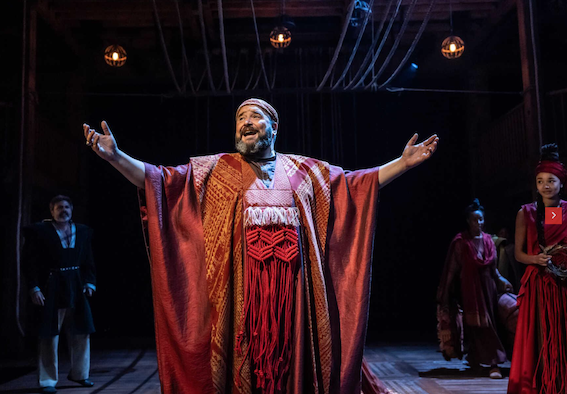
Full marks to Christian Patterson for squeezing lots of humour from the role of Simonides, the father of Pericles’ bride, Thasia. It’s not obvious in the lines, but he gets the looks and gestures to make it work.
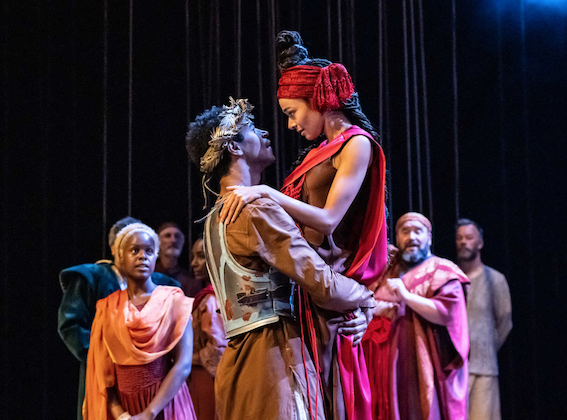
Pericles marries Thasia, two years pass and Pericles and the pregnant Thasia set off again. He should be called Jonah, because there is a mighty storm, Thasia dies giving birth to Marina, and the sailors insist on burial at sea.
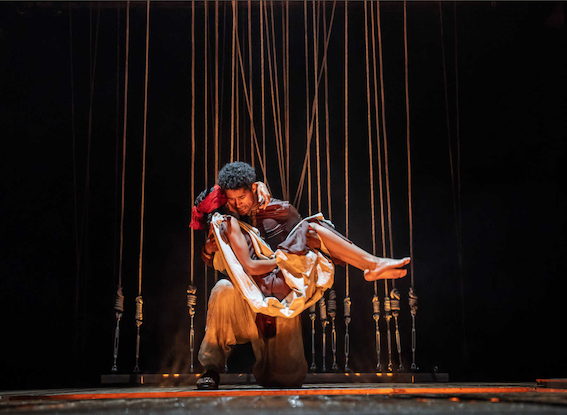
The casket washes up in Ephesus, where they discover she’s not dead, but only sleeping. These things happen at sea. Looks dead? Over the side with her.
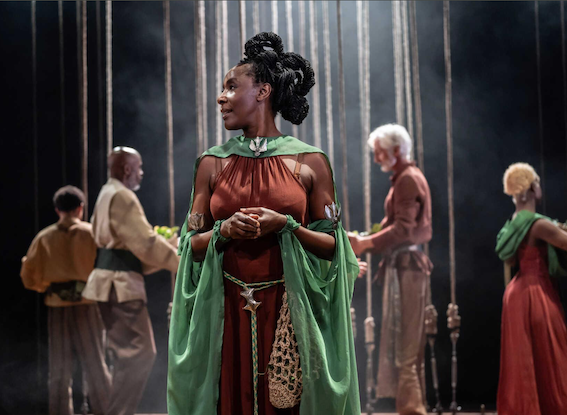
Cerimon of Ephesus (Jaqueline Boatswain) saves her and she’s off to serve in the Temple of Diana, assuming Pericles and her child are lost at sea.
Pericles stops off at Tarsus and asks the rulers, Cleon and Dionyza, to foster the baby daughter Marina, and Pericles goes off on his wandering way.
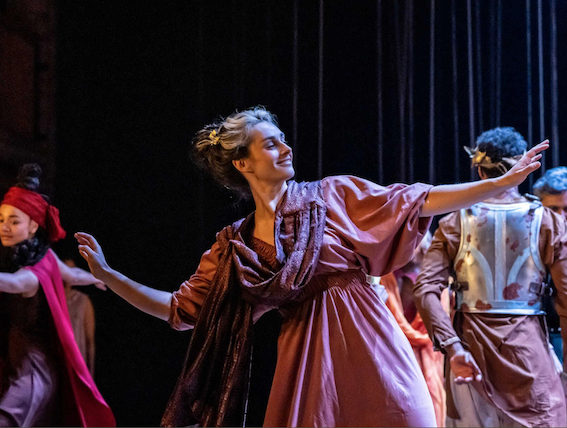
Miriam O’Brien, understudying the wicked foster mother, Dionyza, also got lots of humour into her nastiness. She was outstanding, especially as a minute or so later she had to drop the crown and switch to a languid whore. Alfred Enoch as Pericles probably got the best laugh for a sudden astonished and very modern, ‘Who are you?’
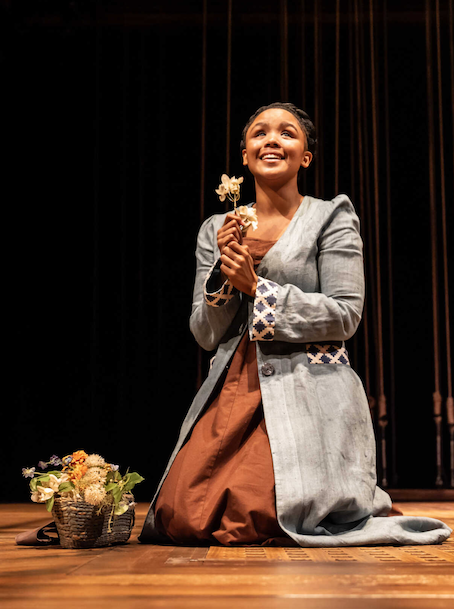
Fourteen years pass by. Dionyza is jealous that Marina’s beauty and sweetness exceeds that of her own daughter, and as absolute monarchs do, instructs a kindly assassin (a role which appears in other plays) to put her to death. Before he can kill her, on rush the pirates and whisk her away to sell. Marina is packed off to a brothel in Mytilene.
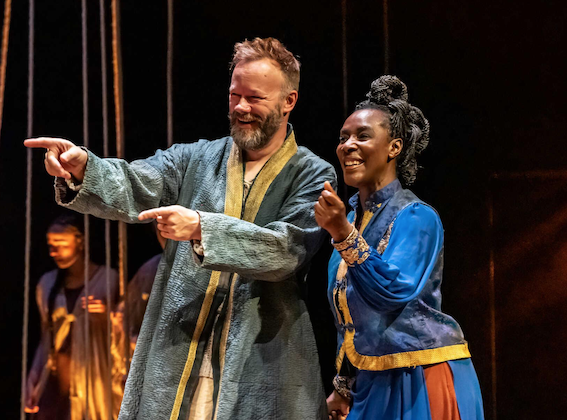
Felix Hayes as Pander, Jacqueline Boatswain as Bawd,
There her natural goodness persuades the customers to lead a good life instead of debauchery. Lysimachus, the Governor of Mytilene, is particularly struck with her. Later they will marry. She conveniently forgets that he frequents brothels.
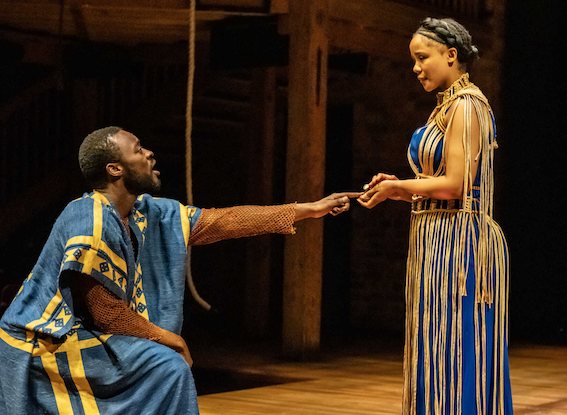
Eventually and inevitably, Pericles will wander into Mytilene, sad, bedraggled and shell-shocked. They decide that the sweet Marina can sing to him and revive him. This is the care home alleged phenomenon where a visiting entertainer starts singing (e.g.) A Whiter Shade of Pale, and an aged hippy who has been mute for a decade suddenly starts singing along in a loud voice. They realize they are father and daughter. They go off to the Temple of Diana to give thanks. Thasia emerges … etcetera.
Cross cutting two scenes was done several times with actors from both scenes on stage. It doesn’t help an already confusing plot with too many characters, but it does up the pace which is positive.
It was brave to choose the play. It was significant to make style, tableaux and mime a key feature. It looks beautiful.
As at the Wanamaker, they decided not to draw any parallels with people travelling around between Lebanon (Tyre), Syria (Antioch is on the border), Turkey (Tarsus, Ephesus), Lesbos (the modern name for Mytilene) and Libya (Pentapolis). Then getting shipwrecked and losing relatives for years. It’s an obvious possibility. Too obvious perhaps.
If I were doing the programme, I’d put a map with the route.
In the end, it is an atypical play, and definitely a lesser one, especially in George Wilkins’ first two acts.
three stars
***
WHAT THE CRITICS SAID
4 star
Mark Lawson, The Guardian ****
Fiona Mountford, The Telegraph ****
Shakespeare’s obscure picaresque pantomime is a bold choice, but it’s one that has paid off with this triumphant production
Sarah Crompton, What’s On Stage ****
3 star
Clive Davis, The Times ***
Susannah Clapp, The Observer ***
Holly Williams, The Stage ***
Suzy Feay, Financial Times ***
LINKS ON THIS BLOG
PERICLES
Pericles, Sam Wanamaker Playhouse, 2015
TAMARA HARVEY
The Famous Five: A New Musical, Chichester 2022
Home I’m Darling by Laura Wade, National Theatre 2018
FELIX HAYES
Semmelweis by Tom Stoppard, London 2023
The Tempest, RSC 2012 (Trinculo)
Twelfth Night, RSC 2012 (Fabian)
Comedy of Errors, RSC 2012 (Dromio of Ephesus)
A Midsummer Night’s Dream, RSC 2011 (Snug)
The City Madam, RSC 2011 (Mr Plenty)
Cardenio, RSC 2011 (Shepherd)
Vice Versa, RSC 2017 (General Braggadacio)
RACHELLE DIEDERICKS
The House Party by Lara Lomas, Chichester Minerva 2024
A View From The Bridge, Chichester 2023 (Catherine)
The Crucible, National Theatre 2022 (Mary Warren)
SAM PARKS
An Ideal Husband, Classic Spring, 2018
GABBY WONG
Macbeth, Globe 2023
Troilus & Cressida, RSC 2018
Volpone, RSC 2015
Love’s Sacrifice, RSC 2015
The Jew of Malta, RSC 2015
CHRISTIAN PATTERSON
Cymbeline, RSC 2023
 Peter Viney's Blog
Leave a comment