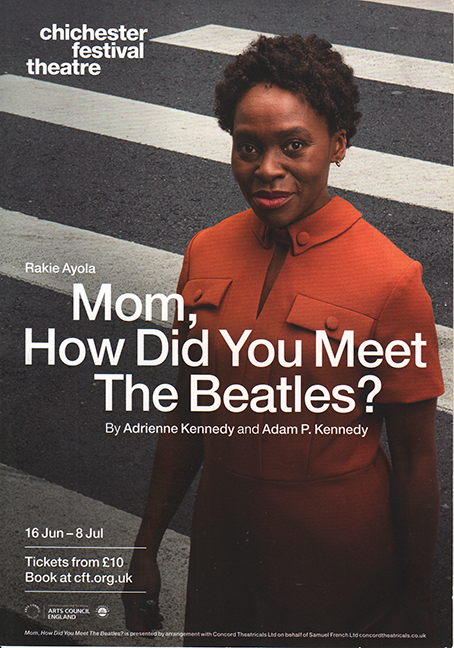
Adrienne Kennedy & Adam P. Kennedy
Directed by Diyan Zora
Designed by Anisha Fields
Composer Robert Sword
Lighting design by Joshua Gadsby
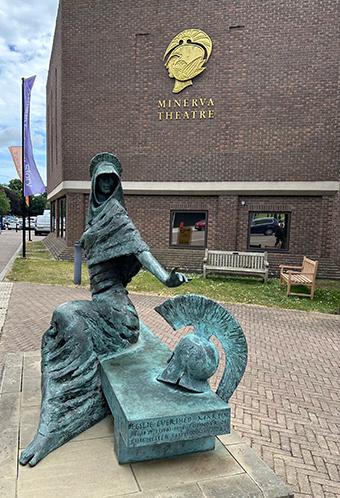
Minerva Theatre at Chichester Festival Theatre
Wednesday 5 July 2023 14.15
Cast:
Rakie Avola – Adrienne Kennedy
Jack Benjamin – Adam Kennedy

It’s an autobiographical story, based on Adrienne Kennedy’s journey to London in 1966, where she stayed until 1969. Kennedy was already an acclaimed off-Broadway playwright, and the recipient of a Rockefeller grant, and soon to get a Guggenheim grant. That is, she was highly rated in the US, though Off-Broadway was her area.
She wanted to adapt John Lennon’s In My Own Write (1964) for the stage. I’d say this was an impossible task. The book, and the subsequent A Spaniard in The Works (1965) which was part of the project, is dire in retrospect. It’s sub-Stanley Unwin nonsense punning and word mangling with a nod to Lewis Carroll’s Mock Turtle and Spike Milligan. To me it reads most like Professor Stanley Unwin, a chap who used to appear on TV spouting mangled words that strangely you could understand. The loftier critics at the time saw James Joyce’s Finnegan’s Wake as the inspiration. John Lennon cheerfully admitted that he’d never read it, but then bought a copy and liked it, but said the only similarity was word-mangling. In 1966 the two books, published by Tom Maschler at Jonathan Cape, were combined as The Penguin John Lennon. This had different coloured text for different pieces, most innovative (and expensive) at the time.

The illustrations by Lennon are the best part of the book. I suspect it was only ever published because of Lennon’s name. It’s hard to see any theatrical possibility in it.
Adrienne Kennedy went to London. Via Victor Spinetti, who was in A Hard Day’s Night and Help! she met John Lennon, and then Laurence Olivier and Kenneth Tynan from the National Theatre who promised to produce it, with Tynan as ‘dramaturg’. Victor Spinetti offered to co-write and direct it. They did a single National Theatre performance on 3rd December 1967, then reprised it in Triple Bill with two other one act plays in June 1968.
It did not end well.
This play dates from 2008, and is based on a discussion she had with her son Adam forty years after the events.
It’s only 75 minutes, with the addition of a 20 minute film after the interval on the origins of the story.
Rakie Avola is so totally convincing that we forgot we were watching someone acting as Adrienne Kennedy. It felt straight from the original mouth. Then when we saw the documentary film afterwards, we were amazed to discover she was British. We had been absolutely convinced by her American accent.
It relies on a narrator as skilled as Rakie Avola. She brought it to life and held us transfixed for the length of the play. As the following film points out, a lot is down to Adrienne Kennedy’s naturalistic writing which sounds as if it’s being created on the spot. Part is her repetition of key names and places with such delight. Basil Street! The Old Vic, Edward Bond, Alex Hailey, Edward Fox, Ringo, Paul McCartney, George Martin.In any other hands it would be excessive name-dropping, but not here. It works. The National Theatre was still at The Old Vic at the time. I feel her enthusiasm. I remember a day in Kings Road where I saw P.P. Arnold, Dudley Moore and Jean Shrimpton all within an hour. You feel you’re at the centre of the universe.
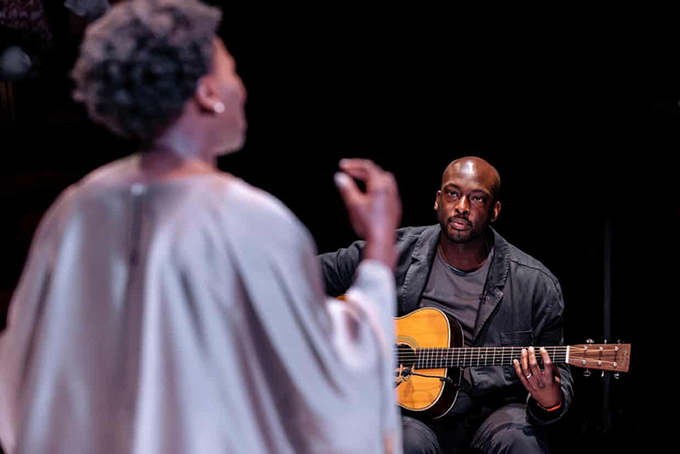
Rakie Avola makes use of the thrust stage area with the audience on three sides, and does so as well as I’ve seen any actor do it. Jack Benjamin as her son Adam, adds subtle guitar accents as well as interjections. Chichester have added projected (but blurry) film – which gives her a chance to sip water, and added a subtle shifting lighting plot. For such a simple play – one person speaking – an awful lot of thought and work went into lighting.
Basically, the split for the one-off pilot was Lennon 60%, Kennedy 20%, Spinetti 20%. Then she found herself pushed right out of the project before the run the next year. So was it a plot? Was it all misogynist? Or Racist? Or because she was American? As Adrienne says in the play, The Beatles loved black music. I’d say her skin colour was between neutral and an advantage.
Karen suggests that when you’re five foot tall, it happens every time you’re waiting for service. Taller people just step in front of you. Servers automatically address them first. I have noted that to be true for her. So she reckons being short was major. I don’t think it’s gender or race based or height based. It’s about not being a member of “the club” of theatrical grandees. The same would have happened to a twenty-something white male who was not part of the theatrical establishment. Yet she was an award-winning playwright, though not on their turf. They disregarded her American experience. Did they deliberately con her? The contract she signed for just the one pilot performance suggests that Olivier, Tynan and Spinnetti set it up so they could dump her later and did so deliberately. That wasn’t personal, nor would have been stealing her ideas and credits. From their theatrical Mount Olympus they just felt so entitled they could do that. Just as in my MA year, I was sent off to research and write a report on slave shipments from Africa. In the subsequent hardback publication by my tutor, I received no credit for the chapter I researched. No acknowledgment in the long list of acknowledgments to my betters. That’s how elites behaved and they had no idea what bastards they were. In the accompanying film, Adam Kennedy says she felt no bitterness, but adds knowingly, if it had been a success, she might have felt bitter. It wasn’t. So were Olivier and Tynan appalling snobby shits? I’ve always been inclined to think so. Lennon was only half-interested I suspect, but naturally (having written the words and it selling on his name) expected the lion’s share. The play text in 1968 is entitled The Lennon Play.

I looked at the books of the play and credits online and she was properly credited, though neither allowed to be involved past the initial stage, nor involved, nor paid. It strikes me she was terribly naive. When you “co-write” with someone you don’t do it at a distance unchecked and undiscussed.
The issue is the setting. The Minerva is a four hundred plus seat theatre. It was much less than half full on this matinee. Less than half of them returned for the film. You’d think the older matinee audience would be up for a Beatle-related play, but I guess there were many in their 80s, rather than 60s and 70s. Just as the National Theatre used the Beatle connection to shift seats in 1967 and 1968, so does this play this year.
The natural setting for the play is an intimate 100-150 seat studio theatre. Bath Ustinov would be ideal. The Sherling Studio at Poole Lighthouse. The Salberg Studio at Salisbury Playhouse. I’d far rather play to 140 people in a 150 seater than to 150 people in a 430 seat theatre. Having said that, Chichester did everything they could to enrich it, but you were left thinking the intrinsic material didn’t need the size of theatre.
Negatives? They played mid-60s music before the play to set the mood. I Want To See The Bright Lights Tonight by Richard and Linda Thompson is 1974. Another sad case of “It’s all old.”
The play text is a very short pamphlet, not a book. The Samuel French edition was £10.99 in the lobby. I didn’t buy it. I would have at even £7.99, though it was far shorter than the £4 theatre programme.
The performance is magnificent. The material is fascinating, and the film adds to it.
****
WHAT THE CRITICS SAID
4 star
Claire Brennan, The Observer ****
3 stars
David Jays, The Guardian ***
Sam Jays, The Stage ***
 Peter Viney's Blog
“Flower’s keggy bit. For the best pickit of the inner brewflade . . . “
LikeLike