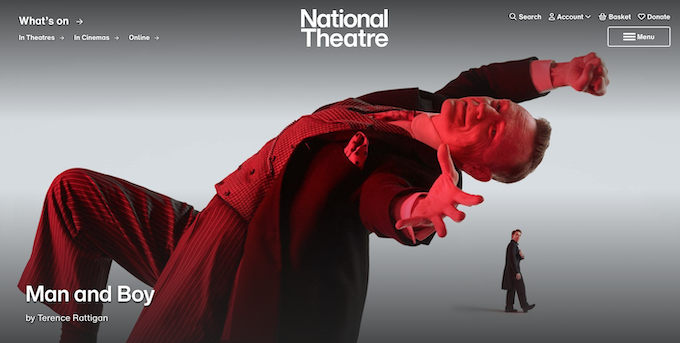
By Terence Rattigan
Directed by Anthony Lau
Set & Costume by Georgia Lowe
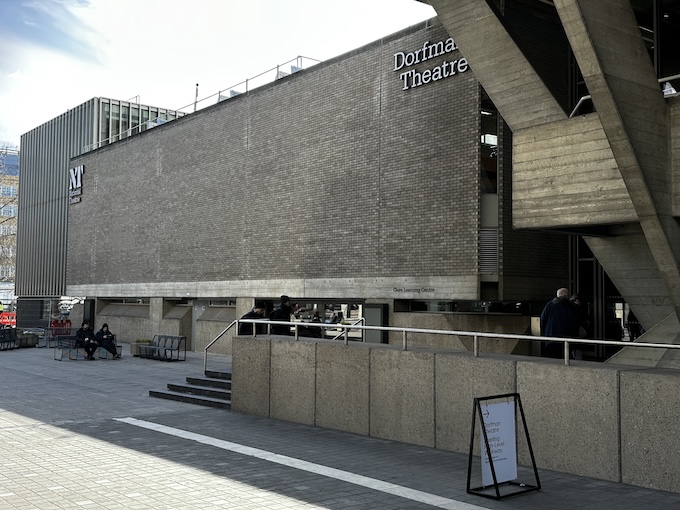
Dorfman Theatre
at the National Theatre
Saturday 14th March 13.30
CAST
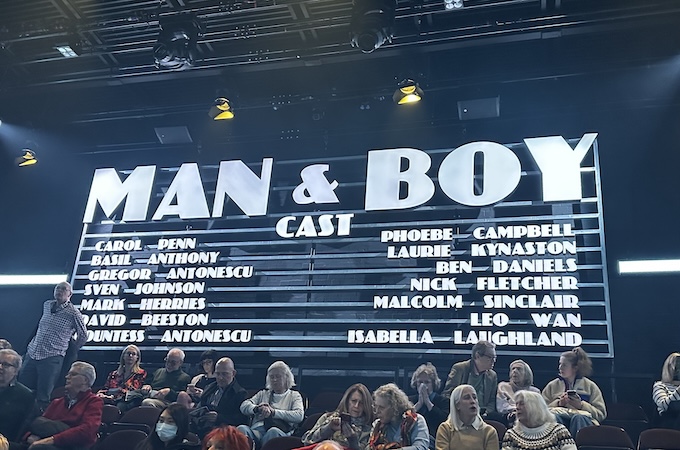
Phoebe Campbell- Carol Penn
Ben Daniels – Gregor Antonescu
Nick Fletcher- Sven Johnson
Laurie Kynaston – Basil Anthony
Isabella Laughland – Countess Antonescu
Malcolm Sinclair – Mark Herries
Leo Wan – David Beeston
It’s a little-known Rattigan play. It was first performed in 1963, and was not well-received, but then Rattigan was already approaching the bottom of his popularity arc. Rattigan once said he thought it his best play. The play text explains the different versions and drafts of the play, some in three acts, some in two. Rattigan revised it again for his Collected Plays.
Anthony Lau (director): I believe we have arrived at a version of the text that amplifies the tone and nature of Rattigan’s published play whilst sharpening elements of the storytelling We have prioritised showing over telling and pared back some of the intricacies of the economics in the pursuit of clarity.
Afterword to 2026 Play Text
A BIT OF BACK STORY
Michael Billington: I would suggest that Man & Boy reveals a surprising amount about its author. The first thing to hit one is how much the play’s success or failure mattered to Rattigan himself. It was sparked by a book about the swindling Swedish financier Ivar Kreuger, whose business empire collapsed at the height of the Great Depression. Setting the action in 1934, Rattigan shows his hero, Gregor Antonescu, hiding out in his estranged son’s Greenwich Village apartment to which he lures the chair of American Electric in the hope of securing a life-saving merger. What is shocking is the ruthlessness with which Gregor exploits his son’s sexual charms. Equally astonishing is the normally diplomatic Rattigan’s belief that the play should be performed on his own terms or not at all. To him Gregor is “as evil as Iago” and when the play’s intended star, Rex Harrison, and director, Glen Byam Shaw, sought to soften the text and Laurence Olivier rejected the play for his opening Chichester season, Rattigan dug his heels in. The play mattered hugely to Rattigan because, with his theatrical reputation at its lowest ebb thanks to the rise of a new Royal Court generation, he felt it was his last chance to prove he was a serious dramatist.
The Guardian 2 January 2026 (before production started)
Billington goes on to point out that the financier Antonescu in the play is Romanian, and Rattigan’s own father was forced to resign as a diplomat after an affair with a Romanian princess.
The play text has two long introductory essays, one on Rattigan, another on the play. Rex Harrison was set to star in the first version, but wanted the title changed as he thought it sounded homosexual, and wanted the role of the son toughened to avoid suggestions of effeminacy. He also objected to the crucial scene where Gregor pretends to be gay, Harrison refused to act being in ‘the brotherhood of buggers’ even though it is clear that Gregor, the swindler and con-artist is pretending to be gay, and is a womaniser with mistresses in every port. Much is made of Rattigan’s wish to show an overt gay character (Mark Herries) trying to pick up a younger man. I’m not sure that it makes it a “glad to be gay” play as Basil, the son, is revolted by the subterfuge. I would say the original version of Separate Tables was clearer, although Rattigan was forced to change it from trying to pick up a man on the promenade at Bournemouth, to groping a woman in the cinema. Both recent versions I’ve seen revert to Rattigan’s original intent and text. If I had to list this play’s main themes it would be financial crime (a current theme) and a distorted and once broken father / son relationship. If anything the”gay”scene is an example of trickery mixed with covert blackmail.
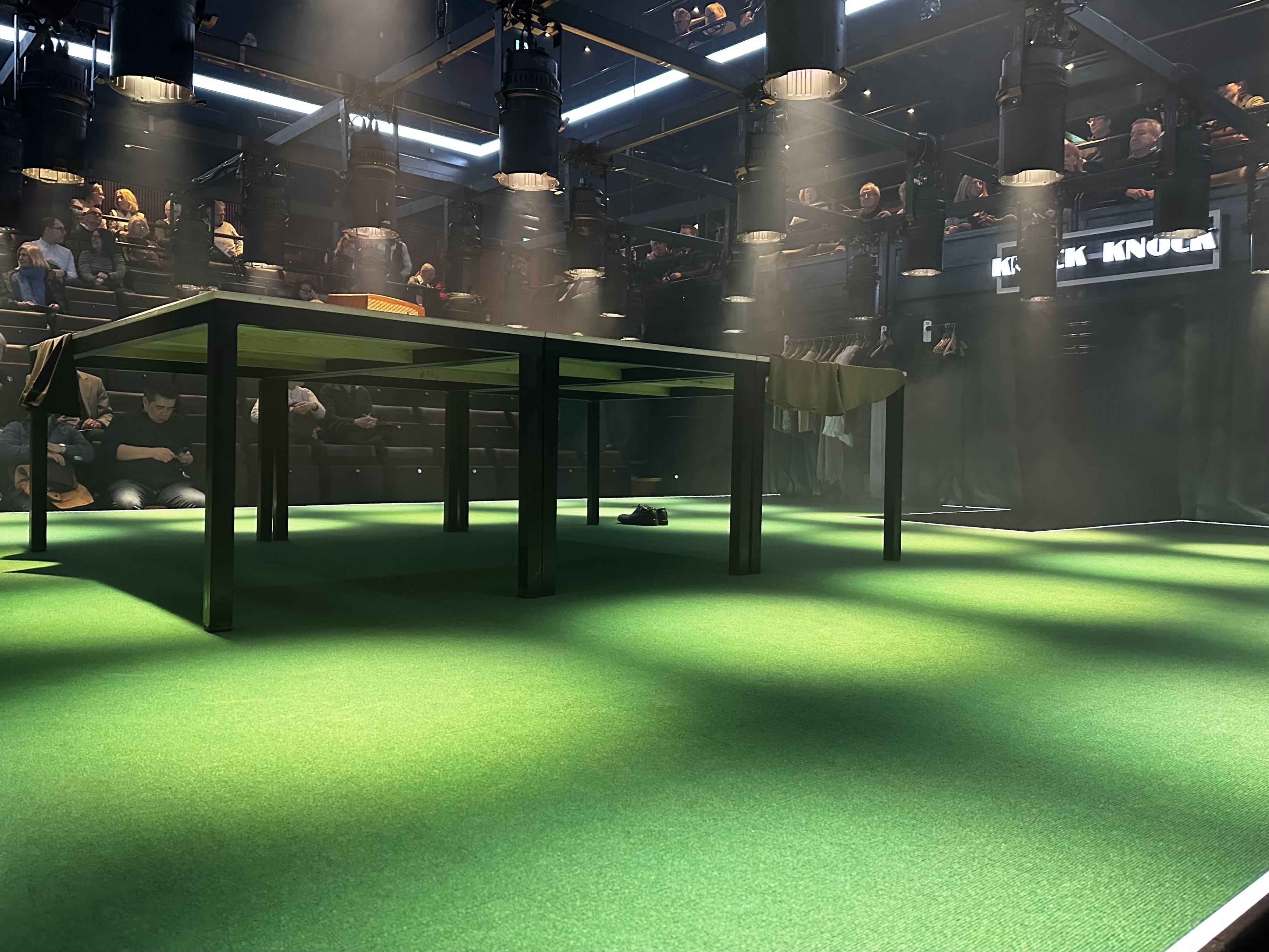
The production is in the round at balcony level, though a tennis court (two sides facing each other) at stalls level where we were. It was virtually fully booked, fully booked most evenings, but but we found the last two separate single seats, both in the front row. There were no two together seats left on sale, though it turned out I had two empty seats next to me. A no show.
Plain tables form platforms which are moved around at great speed. There’s a piano, some bottles, a phone. Actors leap from floor to table level in a bound, An athletic feat.
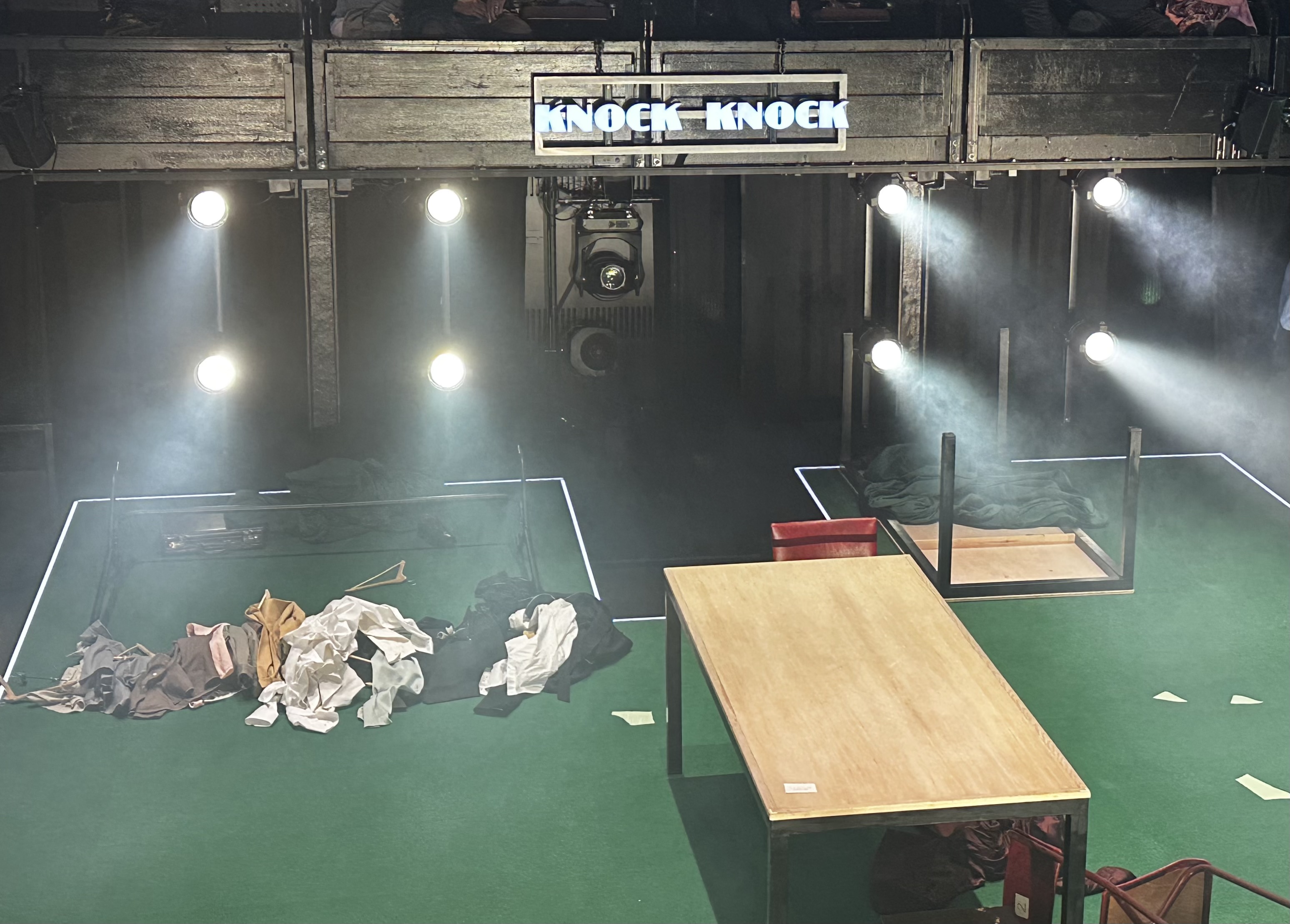
By the interval, the upturned table is now Basil’s bedroom. At the start, the central tables were the bedroom. It’s fluid.
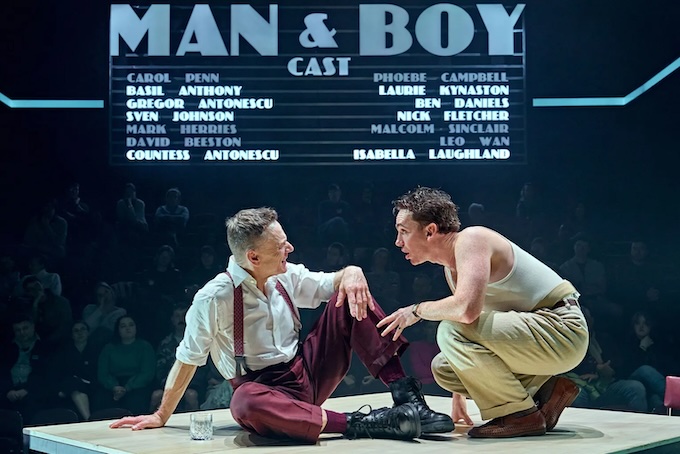
We find the production photos disconcerting because of that huge cast list forming the end of one side. Fortunately it was directly behind us and all the better for not seeing it all the time.
The play begins with Basil Anthony (Laurie Kynaston), a night club pianist, in post-coital bliss with Broadway actress, Carol Penn (Phoebe Campbell).
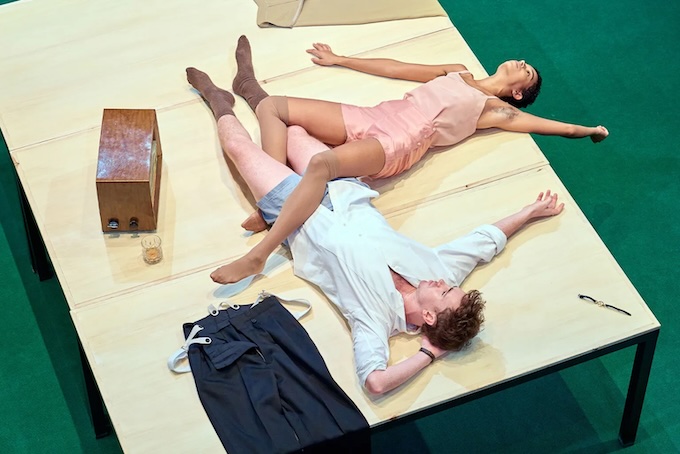
They live in a Greenwich Village basement. She is fascinated by his British accent, even though he is a new American citizen. They listen to the radio announcing the worldshaking financial crash of the Antonescu conglomerate, after a failed deal with American Electric. Basil is admitting nothing.
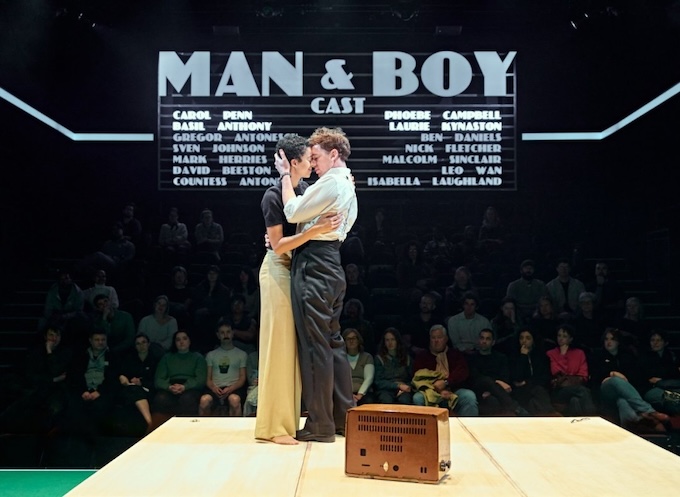
Basil and Carol. The radio is important, because not only does it update the crisis, but is made by Gregor Antonescu’s company, Manson Radios. In the photo we see that the two on stage’s names are lit. I’m so glad it was behind us! A weird idea.
Then his father, Gregor Antonescu (Ben Daniels) turns up, speaking in French. Basil Anthony (real name Vasily Antonescu) has not seen his father for five years. On their last meeting, Basil Anthony/ Vassily Antonescu tried to kill Gregor.
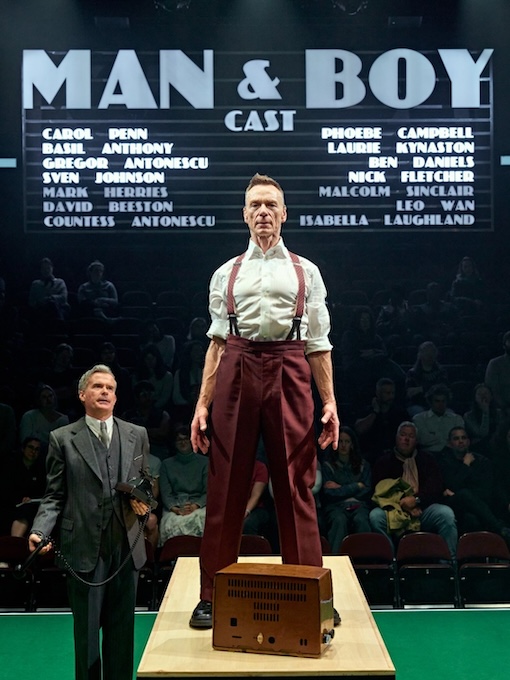
Ben Daniels as Gregor has enormous charisma as he takes control of the room, charming Carol, a completely dominating presence as both actor and character he is playing. (Going out, we said, if I were casting Macbeth tomorrow, he’d be the first choice). It is clear that Gregor’s private information has told him all about Carol and Basil. This is a man of power. He admires Stalin, does loans to Mussolini, is on a board of directors with Goering, though he thinks Hitler ‘a guttersnipe.’
Gregor’s right hand man Sven (Nick Fletcher) arrives, Smart, grey suited, authoritative, taking orders aside. We can switch conversations between Gregor and Sven, and Basil and Carol and accept they’re in different rooms. Gregor wants Carol out of the way. We’ve heard she’s an “actress” and Rattigan slips in a theatrical in joke: she’ll be going soon. Understudies have to report half an hour before the play starts,
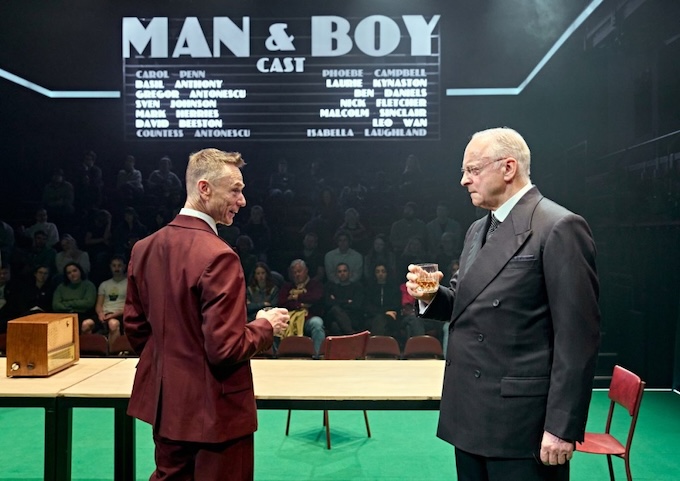
Gregor is planning a meeting with Mark Herries (Malcolm Sinclair). The deal that fell through and started the financial meltdown was between one of Gregor’s companies, Manson Radio, and Mark Herries’ American Electric, He needs to revive the merger to solve the crisis. Gregor has discovered that Herries is gay, and that his ‘kept boy” committed suicide the year before. He tells Basil to change into more relaxed clothes, and tells him not to say he is Gregor’s son. He plans to use Basil as bait to get Herries on his side. Gregor implies to Herries that he too is gay and that he keeps Basil in the apartment, but only visits him infrequently, and basically, Herries can have a go too. He claims to have visited Herries’ kept boy with ‘another young man.’
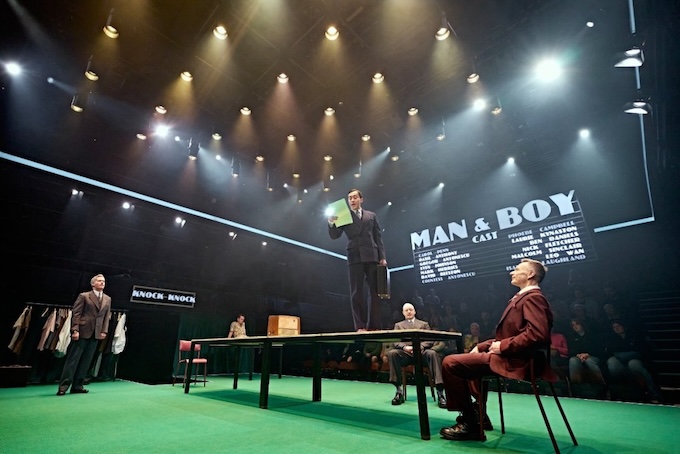
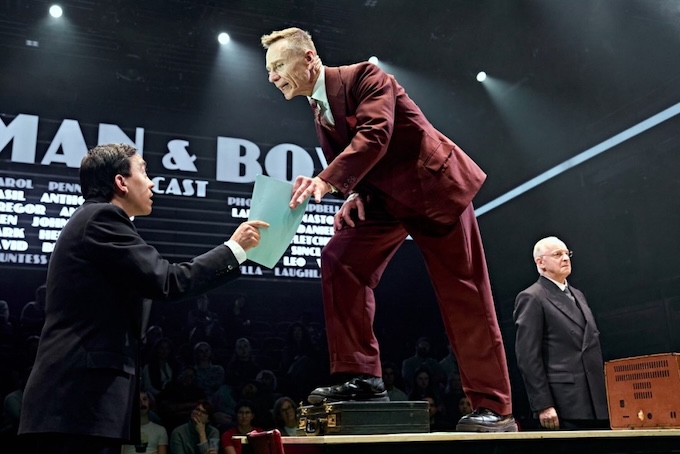
The trouble is that Herries’ accountant, David Beeston (Lee Wan), has been to Bucharest, looked at the books and found that Gregor’s dealings are extremely dodgy. The accountancy argument with Beeston is high comedy, and Lee Wan should get a supporting actor award for his portrayal this year. The intricacy with which Gregor persuades Herries to ignore Beeston and bring in ‘more friendly’ accountants is a memorable scene.
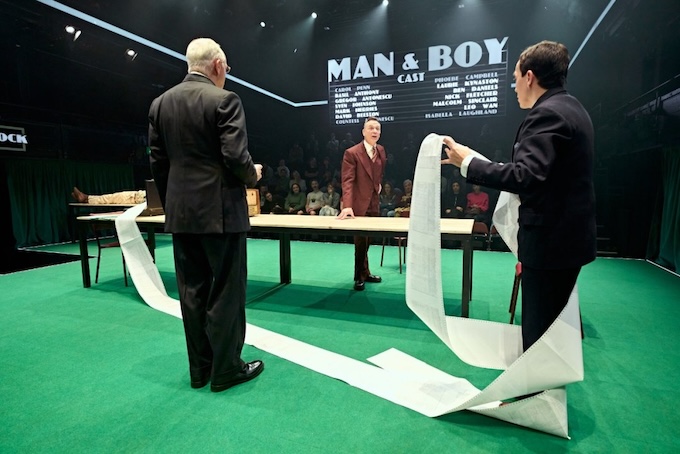
Mark Herries takes Basil’s number and says he will see him soon. When he leaves, Basil is revolted, and trashes the flat.
Part two shows the scandal in finances closing in. Gregor’s wife (Isabella Laughland), who he bought a countess title for turns up. She and Sven have to sign some fake cheques, and she says her role is ‘sex and signatures.’
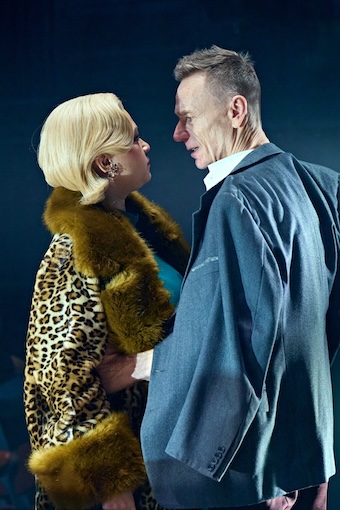
Her complaints about Gregor’s mistresses underline the pretence of being gay. It’s a reversal, because of course the early 20th century playwrights and actors devoted time pretending to be straight. It closes in. Father and son are reunited emotionally. A warrant is out for Gregor’s arrest and Basil plans to drive him to Mexico. Gregor has decided there is only one way out and sends Sven to get a gun from his bodyguards,
Another piece of comedy at the point of tragedy is Sven dictating a careful suicide note to exonerate himself from the years of fraud and swindling he participated in. The essay on Rattigan in the play text notes his love of Chekhov. Ah, that explains the ending.
The jazz background music is almost subliminal. It works.
It is not typical Rattigan. Rattigan thought Osborne’s Look Back in Anger had finished his career. He claimed that he could ‘write angry’ and here that’s just what he did. This production sets out to honour that. The performances are large. This is not the quiet subtlety of The Browning Version or The Winslow Boy, but it does have some of the sheer passion of The Deep Blue Sea. “writ large” rattled some critics – a snotty two stars from The Guardian. Take it on its own terms. Rattigan had no crystal ball. He is much produced in the 21st century. John Osborne isn’t at all (except for Branagh’s The Entertainer).
Ben Daniels gives an acting masterclass with fine support from the rest. The production is fluid, well-costumed but minimal in set. The text retains Rattigan’s suggestion that there be two rooms, but ignores it. Karen’s comment was extremely good performances and production. Not sure about the play itself. There are parallels with current mega moguls, but the play is firmly set in 1934.
Overall: four star ****
WHAT THE CRITICS SAID
five star
Andrzej Lukowski, Time Out *****
As he only ever gives two or three stars, it’s interesting to find a play he rates!
four star
Sarah Crompton, What’s On Stage ****
three star
Domenic Cavendish, The Telegraph ***
Nick Curtis, The Standard ***
Alice Saville, The Independent ***
Sam Marlowe, The Stage ***
Tim Bano, Financial Times ***
two star
Arifa Akbar, The Guardian **
Clive Davis, The Times **
LINKS ON THIS BLOG
TERENCE RATTIGAN
After The Dance by Terence Rattigan, BBC TV play 1992
All On Her Own by Terence Rattigan, Kenneth Branagh Company 2015
Flare Path, by Terence Rattigan, 2015 Tour, at Salisbury Playhouse
Harlequinade by Terence Rattigan, Kenneth Branagh Company 2015
Man & Boy, by Terence Rattigan,National Theatre 2026
Ross by Terence Rattigan, Chichester Festival Theatre 2016
Separate Tables by Terence Rattigan, Salisbury Playhouse 2014
Separate Tables, by Terence Rattigan, BBC TV version 1970
Separate Tables by Terence Rattigan (Table Number 7, Summer 1954) Bath 2024
Summer 1954 by Terence Rattigan (Table Number 7 / The Browning Version), Bath 2024
While The Sun Shines by Terence Rattigan, Bath, 2016
French Without Tears, by Terence Rattigan, English Touring Theatre 2016
French Without Tears, by Terence Rattigan, BBC Play of The Month 1976
The Deep Blue Sea by Terence Rattigan (FILM VERSION)
The Deep Blue Sea by Terence Rattigan, BBC TV Play, 1994
The Deep Blue Sea, by Terence Rattigan, Chichester Minerva, 2019
The Deep Blue Sea, by Terence Rattigan, National 2016, NT Live 2020
The Deep Blue Sea, by Terence Rattigan, Bath Ustinov 2024
The Winslow Boy, by Terence Rattigan, BBC Play of The Month, 1977
The Browning Version, by Terence Rattigan, BBC TV play 1985
The Browning Version by Terence Rattigan (as Summer 1954), Bath 2024
LAURIE KYNASTON
How To Build A Girl (film)
NICK FLETCHER
The Crucible, NT 2022
The Deep Blue Sea, National 2016, streamed 2020
For Services Rendered, Somerset Maugham, Chichester Minerva
MALCOLM SINCLAIR
Dear Octopus, National 20234
As You Like It, RSC 2023 (Orlando)
Pressure by David Haig, 2018 (Eisenhower)
Quartermaine’s Terms, Brighton 2013 (Eddie Loomis)
ISABELLA LAUGHLAND
The Vortex, Chichester 2023
King Lear, Chichester 2013
Good Luck To You Leo Grande (film)
 Peter Viney's Blog