By Joe Murphy and Joe Robertson
Directed by Stephen Daldry & Justin Martin
Set by Miriam Buether
Costume by Natalie Price
Royal Shakespeare Company
Swan Theatre
Stratford Upon Avon
Friday 12th July 2024. 19.30
CAST
Jude Akuwudike – Tanzania / Mwandosya
Jenna Augen – Shirley
Olivia Barrowclough – Secretariat
Jorge Bosch – Raul Estrada-Oyuela
Nancy Crane – USA
Vincent Franklin – Fred Singer
Andrea Gatchalian- AOSIS / Kiribati
Togo Igawa – Japan / Ohki
Stephen Kunken – Don Pearlman
Kwong Loke- China / Zhung
Ingrid Oliver- Germany / Merkel
Dale Ropley- Bolin / Santer / Al Gore
Raad Rawi- Saudi Arabia / Al Sabban
Ferdy Roberts- UK / Prescott / Houghton
It’s set on 11 December 1997 at the Kyoto Conference.
From the RSC website:
The Kyoto Conference Centre. 5am.
The nations of the world are in deadlock. 11 hours have passed since the UN’s landmark climate conference should have ended. Time is running out. And agreement feels a world away… The greatest obstacle: American oil lobbyist and master strategist, Don Pearlman.
It’s an award winning play. We booked it on our trust of the RSC, though I feel dubious about completely modern plays there. OK, things like Wolf Hall and Hamnet feel connected. I enjoyed Miss Littlewood, but there’s a feeling that the wooden setting wasn’t designed for this. Now The Other Place is back and running, it feels a more appropriate location for the RSC exploring new drama.
First, it went down extremely well. At the interval, I heard people declaring, ‘amazing’ and ‘incredible.’, At the end it got a standing ovation, rare at the RSC, but we felt we had to join in from where we were sitting. On our part it was not sincere on the play itself, but ovations are for actors, so always deserved.
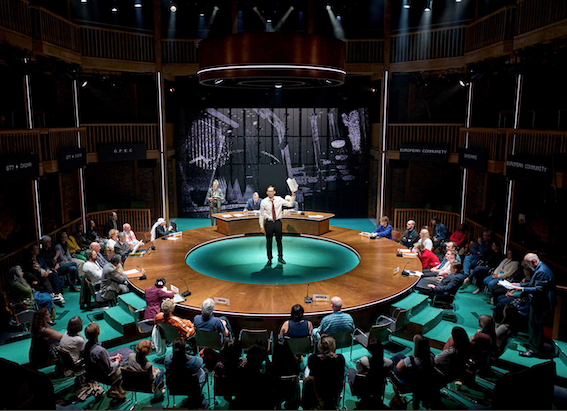
They created a circular delegate conference table on the thrust stage, with the audience on three sides, and then interspersed audience members around the circular table as delegates to fill in between the actors – you had to choose a delegate seat. I wish we had. Our booking got moved when they decided on that plan, we were offered, declined and we were in row C on the flat. No rake, nor behind us, The row In front on ordinary chairs looked an inch at least higher, and we had very burly people in front of us. I qualify as very burly myself and the elderly man behind me moved. Quite rightly. He wouldn’t have seen anything through me.
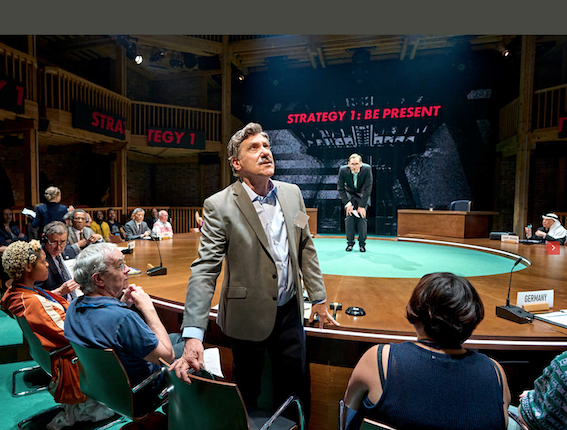
The staging looked great on the RSC photo gallery, but from where we were sitting it was awful. The ‘real’ delegates shifted between the empty seats at various points of the circle. Very often we couldn’t see them. Karen has top grade hearing aids and the multiple directions of speech were beyond their capability. This is highly unusual. She said it sounded confusing throughout, and the accents from several delegates didn’t help. Not all the delegates looked nationals of the countries they represented. Japan was easily the most real. I taught Saudis for years. I never met one who looked or sounded like that, but I never met one of the Western educated ones in extreme positions of power. If you are going, definitely try to switch your tickets to seats upstairs in the gallery. The best seats are the worst. Screw what it looks like, in effect it was dreadful set design for audience members from where we were sitting. Maybe it was OK further back where the rake started.
The outstanding one of the delegates is Kiribati. She is the one who makes the impassioned speech about what will happen to her Pacific Island home, then organizes the other low lying islands and states into a cohesive group, AOSIS. Kiribati looks just about the dead centre of the Pacific and consists of thirty-two atolls.
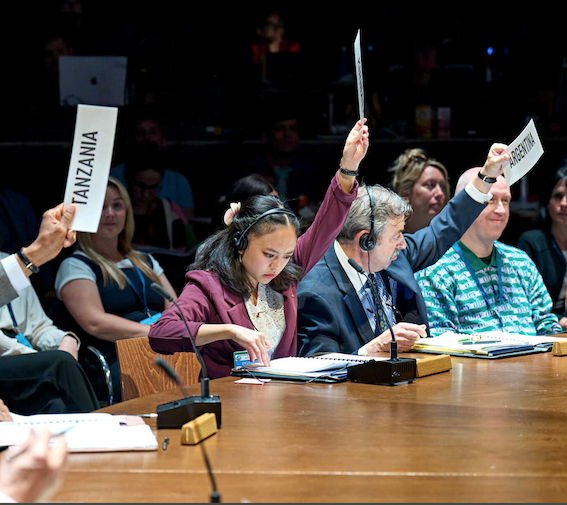
After the first half, with hearing the enthusiastic interval chatter outside in the lobby, I was worried about my judgement. I thought the play so far messy, badly structured, obvious and worst of all boring. I never liked Brecht, any Brecht. I don’t do didactic theatre, unless it’s well combined with other attractions, Thematically, it is all preaching to the choir. I am a member of that choir. That is not the issue, We did the Alaska cruise in 1994 and we have photos of huge glaciers and icebergs. Friends were at the same spot a few years ago and there’s not enough ice in that valley left to make a Martini. Al Gore’s TV documentary examined Greenland ice cores going back hundreds of thousands of years. No, it’s not ‘just weather’ – global warming is climate change and it is permanent. I don’t know why Al Gore is presented as an duplicitous trickster in Act two, but then I haven’t studied the conference, but then virtually all, or more likely all, professional politicians are duplicitous, so I accept it.
The problem in Act One is we never get as far as Kyoto. We run through one ineffective climate conference after another with everyone racing round and going on and off. Not more! We groan. Delegates are constantly shifting places. We don’t work out until Act two that when everyone is wearing a dark grey coat and scarf, they are the ‘seven sisters’ or the major oil companies, giving their instructions to Pearlman. Stephen Kunken as Pearlman, narrates and holds everything together. He is the creature of both the US government and Big Oil, which might be the same entity. It is the central role of the play:
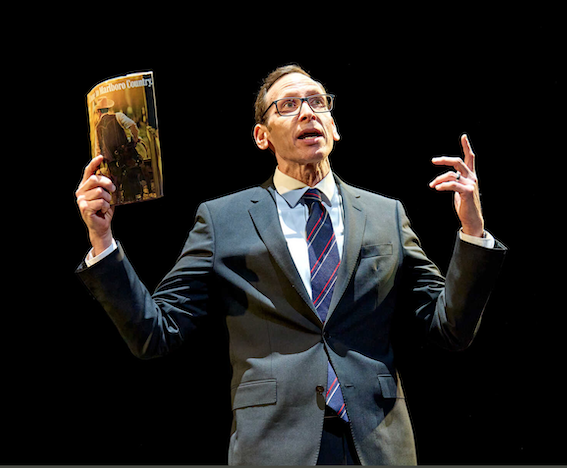
Act two is Kyoto. We both felt that after 75 minutes of such extreme repetition, the thought of Act Two was daunting. We thought that if it had been our local theatre, three miles from home, we might have jumped ship at the interval. It gets much better, though the accolades on the RSC site describing it as ‘thrilling’ and ‘darkly funny’ never got to us.
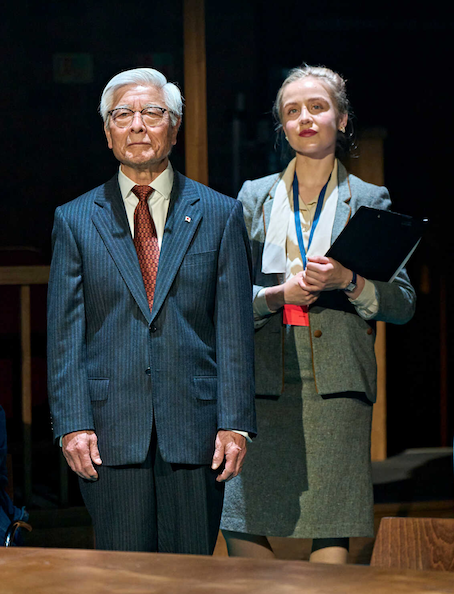
This is the conference, opened by the Japanese delegate describing the seventy plus five-day long micro seasons of Japan. We love Kyoto too, possibly my favourite city of all. The story of why it was not the 1945 atom bomb target is slightly garbled though true in essence. However, Hiroshima was an alternative weather target rather than a choice.
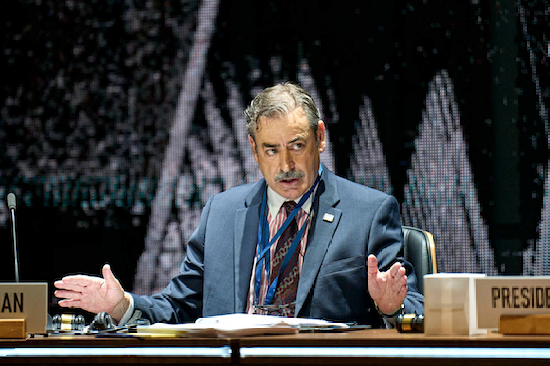
Raoul Estrada is the antithesis of Pearlman. He’s the Argentinian delegate and conference chairman, who by sheer will eventually makes the conference succeed. When the carbon footprints are listed for the conference, Estrada is the one who flew to Japan in Economy. Guess which countries came on private jets.
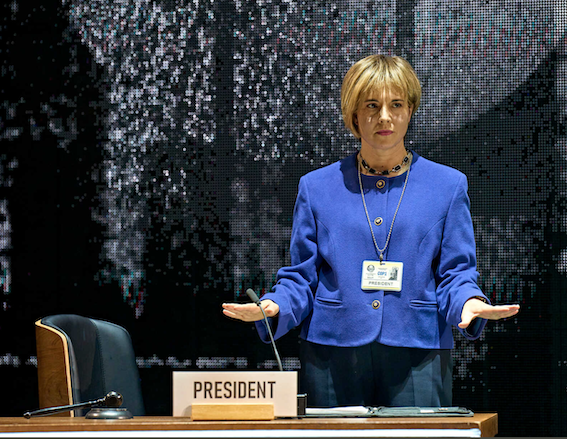
The dastardly alliance is the USA and Saudi Arabia. Pearlman is pushed away from the centre as the obvious Big Oil representative but the official delegation from the USA remains the reluctant player. Nancy Crane’s USA (with no name) looks perfect – I think Hilary Clinton. The role combines being a serious and convincing stateswoman, while saying ‘fuck’ a lot in asides.
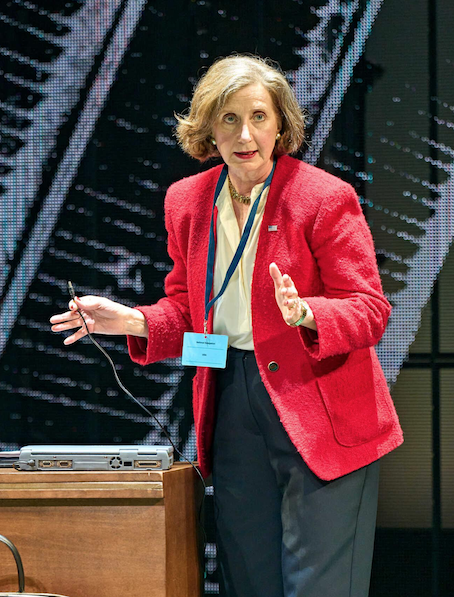
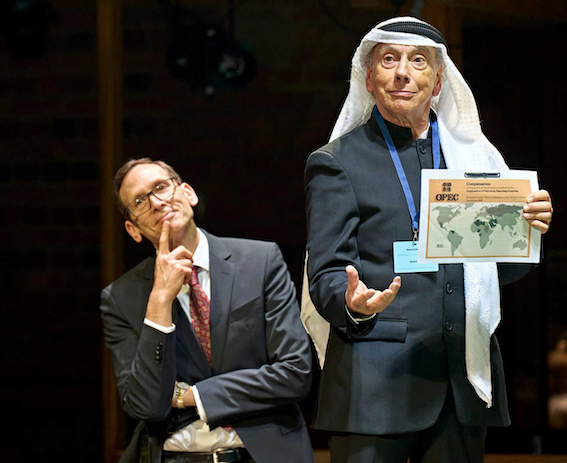
Saudi Arabia, in cahoots with the USA, then throws in a surprise. If everyone cuts emissions, they and the rest of OPEC want compensation for the loss of trade.
Ferdy Roberts plays the UK representative John Prescott, and in the play he is hailed as from the West Riding. He was born in Wales though then moved to the West Riding, but in popular lore he is forever identified with the East Riding: Hull. This is an important distinction in Yorkshire. Prescott has a one page note in the programme. It’s good, but too articulate to be actually by him in my opinion. Mark Lawson in the Guardian felt this:
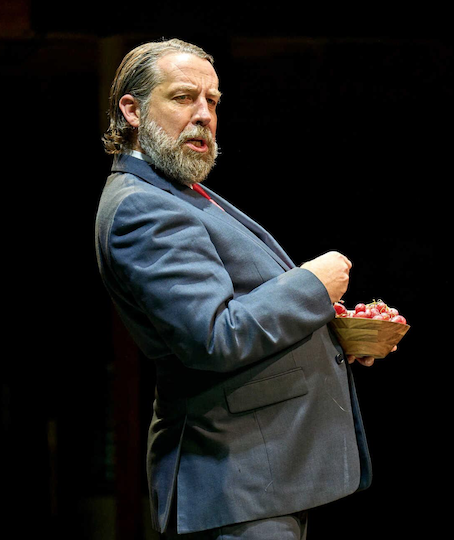
Ferdy Roberts is very funny as the UK’s hungry and punchy representative, John Prescott, although this characterisation seems unfairly more buffoonish than the others.
No, no. Did he mean ‘paunchy?’ He reveals a large tum, but Prescott was famed for being free with his fists, so punchy. Buffoonish? Labour leaders have always tried to employ a stroppy trades union buffoon as Deputy PM to keep the unions on board. I was at a meeting in Hull where George Brown, Wilson’s deputy, was paralytically drunk and pawing at young female students. “Two Jags” John Prescott was allegedly at Hull at the same time as me on a union scholarship. We discussed him in 2018 at the 50th Anniversary of the 1968 sit in, and not one person remembered him ever being there, either in that highly political event, or anywhere at all at Hull University. Is it too early to comment on Angela Rayner?
Actually, I never thought Ferdy Robert’s portrayal ‘buffoonish,’ if this was what Prescott actually did at Kyoto, I have misjudged him for years. His ploy was all too familiar. I was an ELT teachers union rep as was Karen. We were affiliated to MATSA a branch of the GMWU, We went on a training day, and it was on how to fix the agenda of meetings. You make finicky points of order on the minutes for ages and keep arguing them until the moderates are tired out and bored and leave. But the meeting is quorate because it was at the start, so you wait till the moderates leave and push the radical agenda through. It’s victory by exhausting everyone and that’s exactly what Prescott and Merkel do in collaboration in the play, arguing minor and confusing punctuation points until people just give up. Been there in meetings, seen it. It’s in John Prescott and Angela Merkel’s DNA. It’s accurate and well presented. Did it happen that way? We wondered if the writers had access to transcripts. It’s perfectly credible to me.
There was indeed a slightly unfair reference to Prescott. They list the air miles of each delegate to Kyoto. When they get to Prescott, they ask whether he had chicken or beef on the flight. ‘Beef,’ he says emphatically. ‘Another fifty kilos’ of carbon ‘ they say. Well, they have associated him with food, but do you think the Americans or Argentinians opted for the vegan tofu option? Yes, beef monoculture drives global warming and deforestation, but within Europe, beef is a necessary by product of having dairy cattle. Bad luck for the males. Sorry, I hate to upset the squeamish but if meat were banned tomorrow, farms would not change into petting zoos. On which, I last ate beef in 1989. That was because of BSE. Once you stop eating it, it is indigestible. Too heavy. But I don’t want to stop anyone else eating it.
The important information comes in Act Two. The oil companies understood back in 1959 that fossil fuels were definitely causing global warming and they sat on the studies. They did their own research, which confirmed it by 1979. They still sat on it.
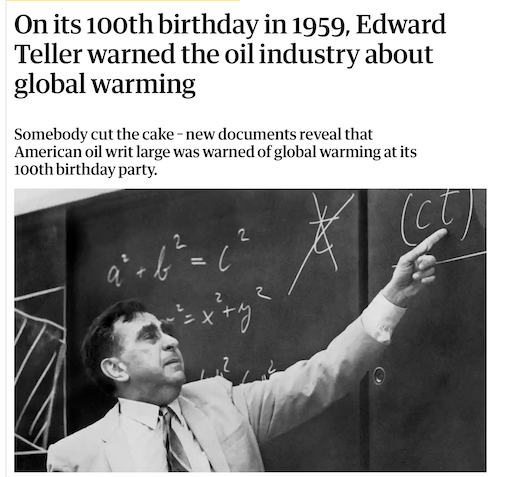
The whole article is there with quotes from his speech
The play sent us to look up what Teller actually said in 1959. Here it is:
At present the carbon dioxide in the atmosphere has risen by 2 per cent over normal. By 1970, it will be perhaps 4 per cent, by 1980, 8 per cent, by 1990, 16 per cent, if we keep on with our exponential rise in the use of purely conventional fuels. By that time, there will be a serious additional impediment for the radiation leaving the earth. Our planet will get a little warmer. It is hard to say whether it will be 2 degrees Fahrenheit or only one or 5. But when the temperature does rise by a few degrees over the whole globe, there is a possibility that the icecaps will start melting and the level of the oceans will begin to rise. Well, I don’t know whether they will cover the Empire State Building or not, but anyone can calculate it by looking at the map and noting that the icecaps over Greenland and over Antarctica are perhaps five thousand feet thick.
Repeat 1959. The car industry confirmed that in 1968 and sat on it too.
They realise in the conferences that they need to split developed countries emissions targets from developing countries targets. The crux of much of the arguments are presented by Tanzania and China.
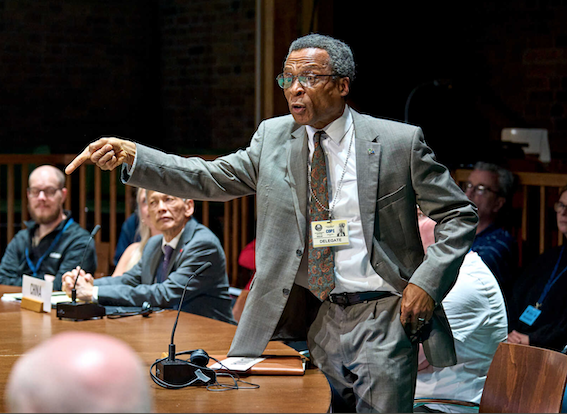
Developed countries have had their couple of hundred years of burning fossil fuels and becoming wealthy. Can they deny all that to developing countries who want homes, hospitals and schools too? They want fridges and air conditioning also, which drives climate change – though not from fossil fuels.
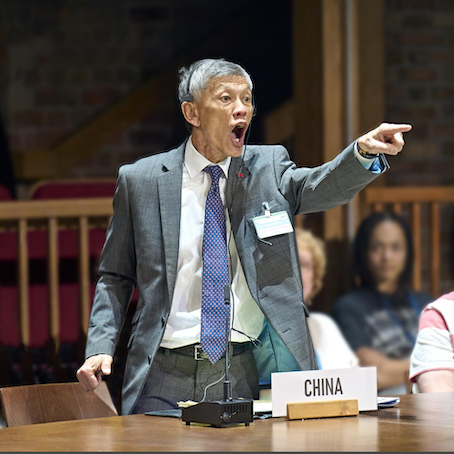
There is nothing in the play on the 25 years since. China, India and others have developed at extremely high speed and now not only join the problem, but have also become the main drivers of the problem. The play’s aim is to pinpoint one moment when the world agreed.
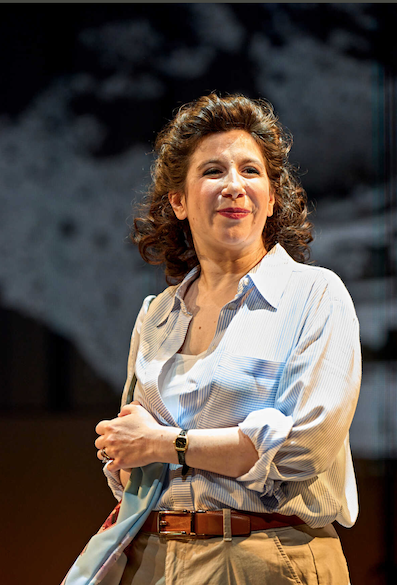
There is a long coda speech by Pearlman’s wife, Shirley, who appears throughout in a different costume every time. It is an attempt to humanize or personalize. Pearlman is dead. Throughout he is a heavy smoker, so they equate blindness on big Tobacco with blindness on Big Oil. Cherry blossoms rain down at the end. I muse that I would like to have seen a play about the city of Kyoto.
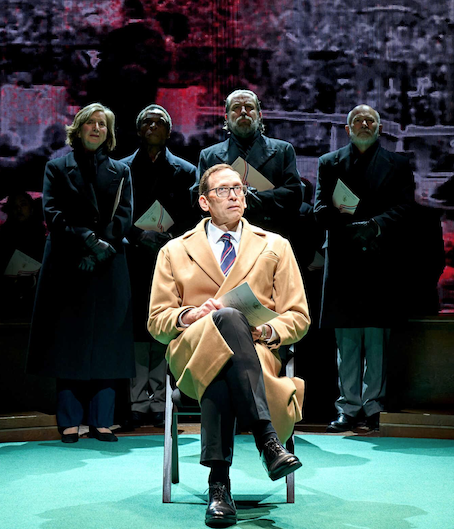
The best bit for me and I laughed out loud was post Kyoto where the seven sisters, or Big Oil, declaim their post Kyoto strategy.
– Times change. And we’ve got to change with the times. Beyond Petroleum.
– A few of us are thinking of shifting the conversation. Some light sponsorship.
– Museums.
– Yeah!
– The Arts.
-Yeah!
– Theatre!
The stage direction reads ‘confused silence.’ There was a knowing laugh from the regulars. Only a few years ago the Royal Shakespeare Company had protests at plays because of accepting sponsorship from BP, aka Beyond Petroleum. We were at a disrupted one. In the play, when Ferdy Roberts is a dark-overcoat wearing oil company rep, it’s suggested he must be BP because of his British accent.
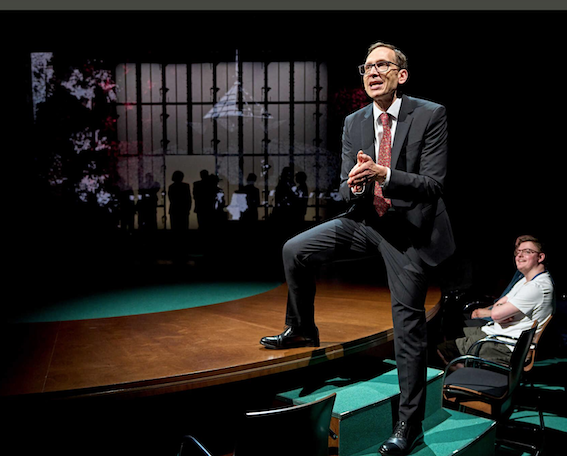
The subject matter is part of the audience acclaim. The actors, especially Pearlman, his wife Shirley, Prescott, ‘USA’ the American representative, and Al Gore are superb. I’ve met people like Pearlman (working for US Information Services for ESL, which locals in most countries just call CIA) and “USA” is like people I’ve had edit me. So given they’re only seen in their dimension as delegates (Estrada is the exception) it was good writing to make them exist and seem alive. Nancy Crane is USA, and like Kiribata, doesn’t even get given a name! Well, I suppose the original, being American, is likely to sue.
I thought the play itself confusing and at times preachy. The problem is that ‘not liking it’ is like saying ‘I’m a climate denier’ and no one I know would want to say that. Are we applauding the play, or are we applauding the sentiment?
Also it pinpoints a time, but there is no suggestion that we took some wrong turns as a result. Electric cars mainly shift the pollution elsewhere. Being heavier, they also create more tyre scrub particulates. Hydrogen combustion is where the research should have gone. I have a plug in hybrid. I like the fact that it cleans my local air, but that I can still drive distances – such as the 300 miles return trip to Stratford on Avon – without range anxiety. My supplier, Octopus, claims to be all renewables. Maybe it is. Prescott led the anti-car argument after Kyoto, in spite of being filmed in a chauffeur driven car for a 250 yard journey and getting done for speeding four times. That leads to roads being widened to add dual bike lanes. You find that coming into Stratford on the A439. Months of disruption, traffic jams with cars engines idling, miles of diversions, diggers belching out pollution, new tarmac made from oil. Then a cyclist uses it every ten minutes or so, at the most, and that’s for personal leisure, not useful alternative transport to work. That cyclist has a massive carbon footprint.
Then the forest fires wipe out all the West is doing. Huge fires in Indonesia and South America cause more pollution than electric cars save, and that turning down the thermostat can save. In 2023, my son’s home in New York State had yellow skies and thick smog for days from a fire hundreds of miles away in Quebec. An estimate was that it wiped out more than a year’s North American efforts. Fires in Australia and North America are often started by lightning but spread so far and so fast because of global warming drought. Fires in Brazil and Indonesia are deliberate. How does the World deal with that? We still have to do what we are doing, but it will be ineffective unless they are stopped.
Overall? Act one two star. Act two three star. Karen’s rating was lower.
WHAT THE CRITICS SAID
5 star
Michael Davies, What’s On Stage *****
Raphael Kane, All That Dazzles *****
4 star
Mark Lawson, The Guardian ****
Susannah Clapp, The Observer ****
Fiona Mountford, iNews ****
Suzy Feay, Financial Times ****
Mia, Theatre & Tonic ****
3 star
Domenic Cavendish, The Telegraph ***
LINKS ON THIS BLOG
FERDY ROBERTS
A Midsummer Nights Dream, Filter on tour 2011
Macbeth, Globe 2023
NANCY CRANE
A View From The Bridge, Chichester 2023 (Alfieri)
A Week By The Sea, by us. Peter Viney & Karen Viney. A small part in two episodes in 1987!
 Peter Viney's Blog