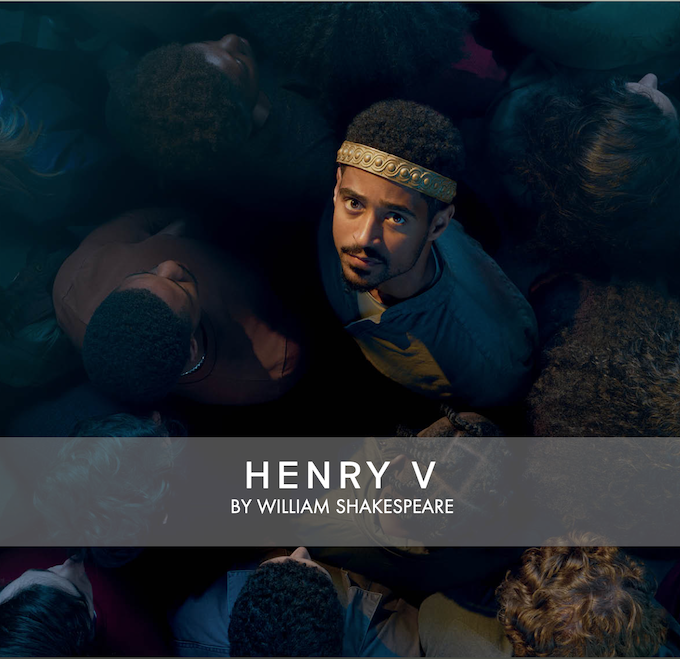
By William Shakespeare
Directed by Tamara Harvey
Set & costume by Lucy Osborne
Composer Jamie Salisbury
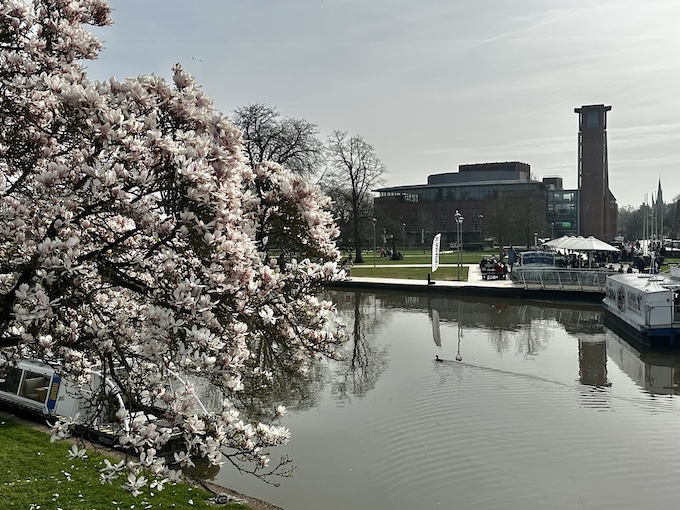
Royal Shakespeare Company
Royal Shakespeare Theatre, Stratford upon Avon
Friday 20th March 2026, 19.30
CAST
I like those old fashioned cast lists which ranked the noble status of the characters, but I can’t wok it out.
Alfred Enoch – King Henry V
Catrin Aaaron – Hostess / Queen Isabel / Governor of Harfleur
Micah Balfour- Exeter
Jamie Ballard – Canterbury / King of France / Williams
Michael Elcock – The Dauphin
Owain Gwynn – Cambridge / Orleans
Valentine Hanson – King Henry IV / Grey / Erpingham
Paul Hunter- Pistol
Hanora Kamen – Ely / Gower
Natalie Kimmerling- Katherine of France
Sophie McIntosh – Gloucester
Emmanuel Olusanya- Bardolph / Count
Sam Parks – Westmoreland / Bates
Sion Pritchard – Fluellen
Diany Samba-Bandza – Scroop / Alice / Rambures
Sarah Slimni- Mountojoy
Tanvi Virmni- The Girl
Ewan Wardrop – Nym / Constable
Imogen Wilde- Swing
Henry V should be a play for today in March 2026, with war looming over the world. There are themes, not least Henry threatening the civilian citizens at the gates of besieged Harfleur. This is what unleashing the dogs of war (OK, different play) means:
The gates of mercy shall be all shut up
And the fleshed soldiers rough and hard of heart
In liberty of bloody hand shall range
With conscience wide as hell, mowing like grass
Your fresh fair virgins and your flow’ring infants
What is it to me if impious war
Arrayed in flames like to the prince of fiends
Do with his smirched complexion all fell feats
Enlinked to waste and desolation?
and later, if the French decline to surrender:
If not- why in a moment look to see
The blind and bloody soldier with foul hand
Defile the locks of your shrill shrieking daughters,
Your fathers taken by the silver beards
And their most reverent heads dashed to the walls
Your naked infants spitted upon pikes …
Which world leader has a besmirched complexion? The orange one, I guess?
Then we have an army with low tech but effective weapons (Welsh longbows) facing the high-tech French with armour so complex they have to be lifted onto their horses by a crane. Drones v missiles?
Then we have specious reasons for starting the war. This is done amusingly here with complex charts to explain Henry’s convoluted right of succession to rule France, rather than Tony Blair’s alleged but mythical weapons of mass destruction. Then we have to admit that “our side” is the aggressor here and starts it. Yes, these things are “us” and “them” however much you want to mix up the sides and show we’re all victims together (as in this production).
Then we have the theme the English and Welsh love. We are outnumbered. We are the underdogs. We are David facing Goliath. We are Zelensky facing Putin. That’s why Laurence Olivier turned it into a celebration of patriotism in 1943. He even adjusted the killing of the English train of boys and women to justify Henry’s order to ‘kill all your prisoners.’ Kenneth Branagh’s film continued that.
However you feel about the play, it has become patriotic and heroic. When those great speeches were done by Olivier, or Branagh or Jude Law, they were genuinely stirring. That’s how the play works. It’s Last Night At The Proms stuff.
I have a constant rule. If you really don’t like, or “get” a play, don’t do it. I’ve applied this to several productions. It applies here.
Is it just me? My heart sinks seeing so many females in Shakespeare’s most male and warlike play. You can’t do 50 / 50 casting with Shakespeare. You can balance it over the season, but not in every play. While Chichester or the National Theatre have no problem getting the balance, the RSC and Globe probably should stop trying. There are exceptions, A Midsummer Night’s Dream obviously where recently Puck, Quince plus another rude mechanical have become female. I don’t mind the odd Duchess replacing a Duke here and there in royal councils in history plays, but then they end up running around in the battle scenes. Still Henry V was an A level set book for me (Karen said unkindly, ‘Well, at least you’ll understand all the words this time.’)
My other problem in reviewing it is that the Michael Grandage 2013 production starring Jude Law and Jessie Buckley so defined the roles that nothing since since lives up to it. Nothing before lives up to it either, and I must have seen the Olivier five times or more. The silly haircut, based on genuine pictures of Henry, doesn’t help. It’s my next favourite history play (after Richard III).
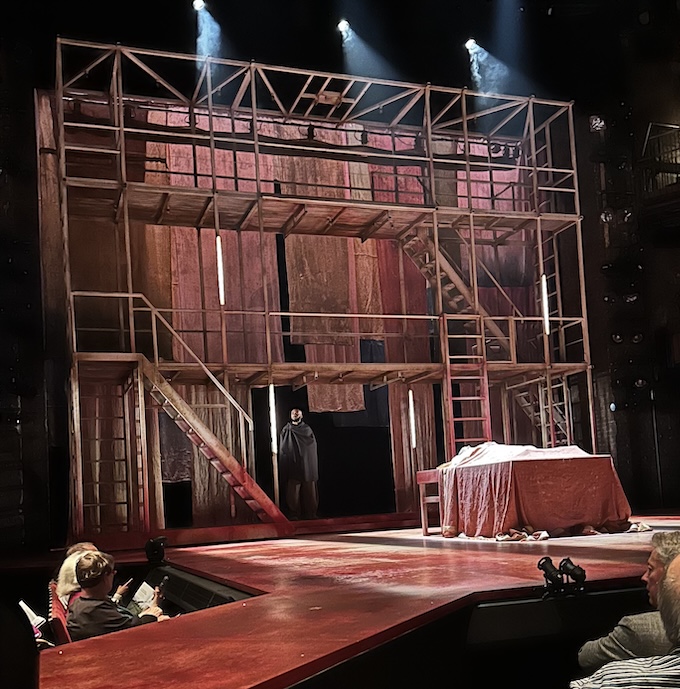
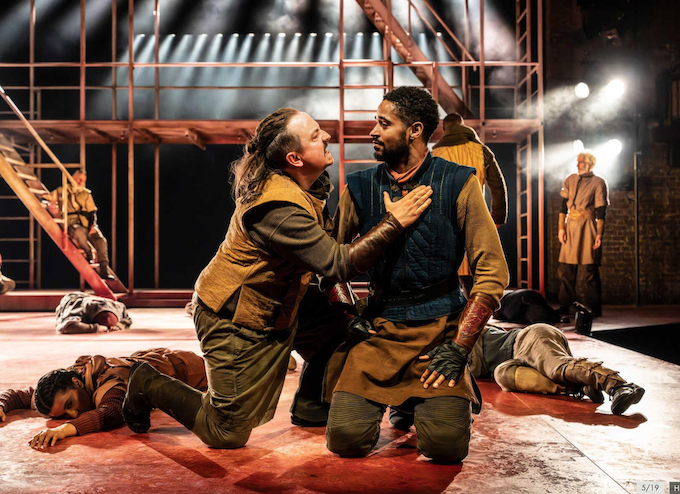
The set has three tiers (like The Rose, Kingston) but this set can revolve. The stage is painted as blood-spattered. The set is the strongest point. The tiers and stairs are effective for running up and down, and serve as the city walls of Harfleur.
It’s not the text I know. It starts off with Henry IV lying on the stage for 15 minutes while the audience come in, wander about and chat, and finally shocking us all by sitting up and conversing with Henry V.
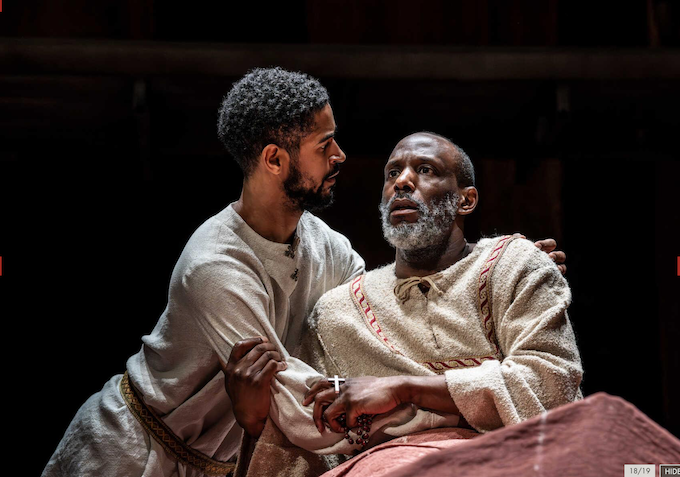
That’s not in my copy. It’s imported from Henry IV- Part Two. First, bodies on platforms which are on lifts are becoming a cliche the last couple of years at the RSC. Second, is it worth it? It’s the TV intro In the previous series … but that has a SKIP button usually. If you’re not doing the four, Richard II, Henry IV – Parts One & Two, Henry V, you don’t need it. Henry V stands well on its own, even if the references to Falstaff’s death become cuttable.
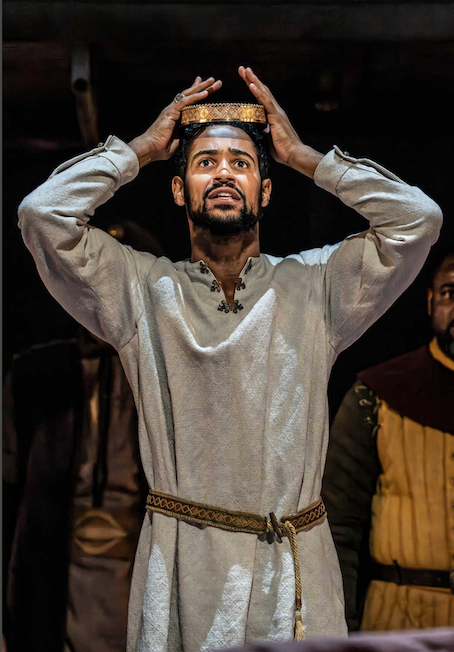
Then the ‘Oh, for a muse of fire’ speech omits the Wooden O and replaces it with ‘this coronet.’ The last speech of the play is switched from ‘chorus’ to Katherine.
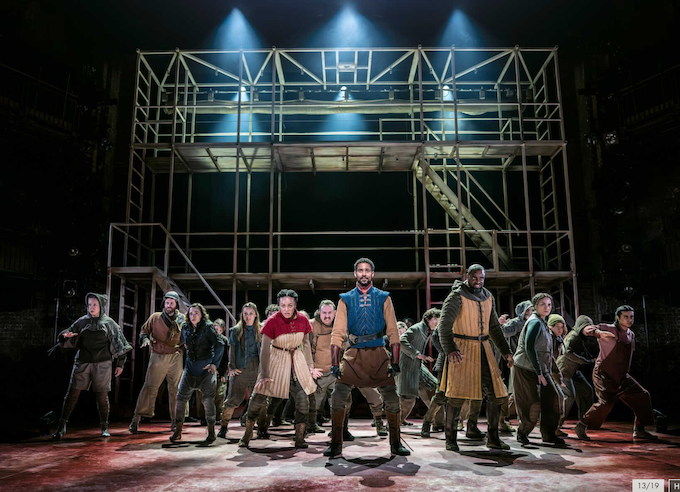
The costumes are a weird choice, we both thought a bad choice. It’s Mother Courage cast offs in some sort of indeterminate Central Asian guise. No attempt is made to distinguish the English and French as everyone plays both. The only costume I’d keep is Exeter.
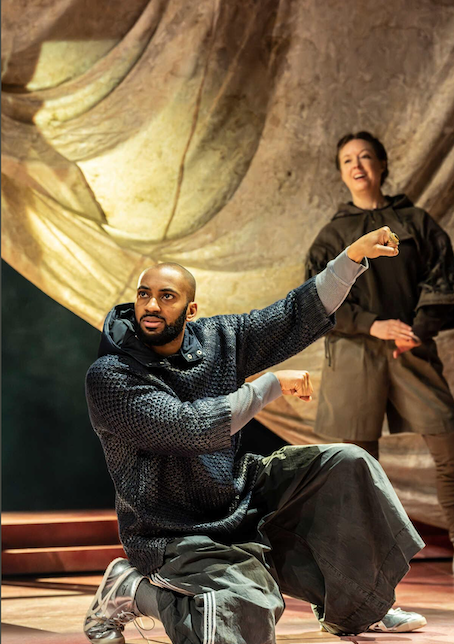
The Dauphin (Michael Elcock) is the worst offender. The wide silly trousers make him look like Ali G, and they lose all the humour that can be put in the role. We like our dauphins foppish. Elcock tries hard, but that costume is a trial.
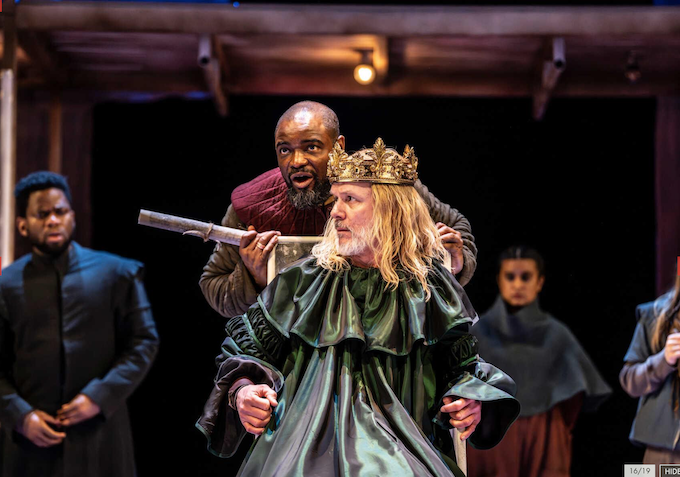
The King of France looked daft in contrast to the others too. Then everyone has quilted costumes. I think the concept might be that we can’t distinguish the sides as everyone keeps dying en masse. Vaguely, the French have more black / grey. A wise production uses velcro tabards in contrasting colours for battle scenes. Yes, medieval armies didn’t wear uniforms, but the nobles did. That’s why their designs were called coats of ARMS.
Much is made of the choreography in the programme, and it is easily the most enjoyable part of the play, but choreography should be plural. Here it’s pretty much singular. Rather repetitious. There are high points, like the siege of Harfleur utilising the levels and steps and the revolving set with lots of action.
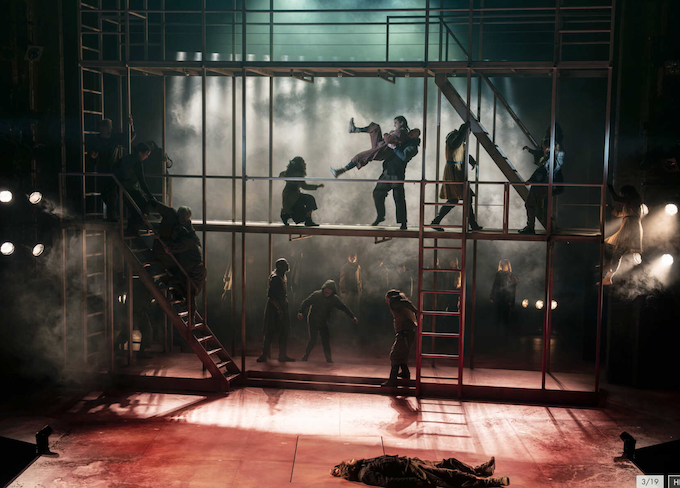
The programme note says:
Very early on, we decided not to have weapons, because a 20-person battle with broadswords, is not that interesting to watch.
I beg to differ. Well, you never saw Richard III at Bournemouth College in the late 60s. Real broadswords in a 20 person battle. Real action with metal sparking. Real blood. By which I mean most of us got cuts. Real cuts. Bad cuts. One was hospitalized. The girls didn’t dress up and participate in the battle. They just declined to bandage the wounds in the dressing room afterwards and made scathing remarks on our martial prowess. I digress. But it was interesting. OK, at least here we didn’t have the cast running about with guns and battledress or trying to heft swords.
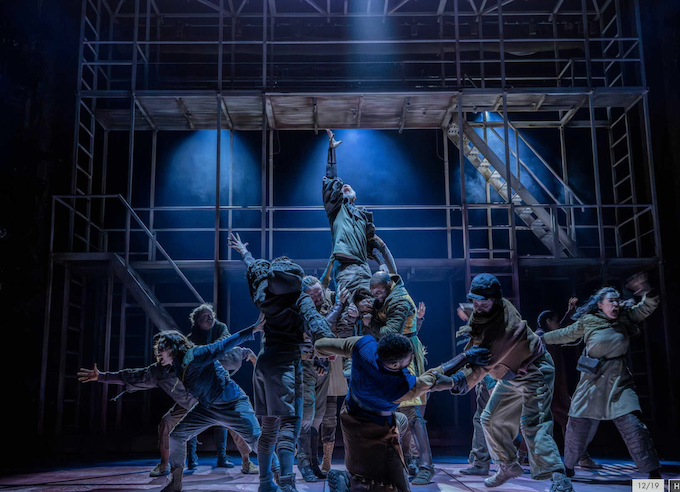
I agree that in general, a dance battle is the better choice, that is, unless like the National Theatre’s Othello a decade or more ago, they bring in military experts to train the actors how to fight effectively.
It was confusing. People were French then British without changes of costume or position. A major point was people dropping dead, one at a time around the stage, replacing a battle. They will all be expert at dropping dead. It looked very good … the first time. Each actor seemed to have an individual dropping dead style. But which side were they? Were we supposed to think they’re all the same?
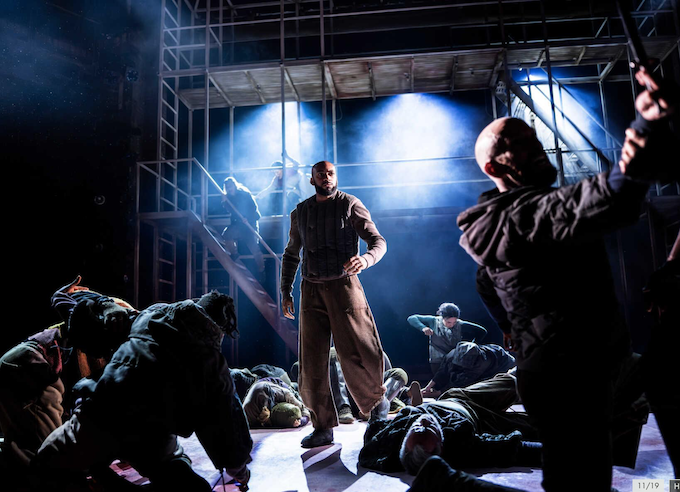
An unusual addition was hanging the three traitors, Scroop, Cambridge and Grey, very graphically. Well done too.
Not many of the cast came off well. The females looked female, or as I have said in the past, thesping about, so they never looked like soldiers. Henry flirted with the traitor Scroop (why?) and one of the English female nobles later.
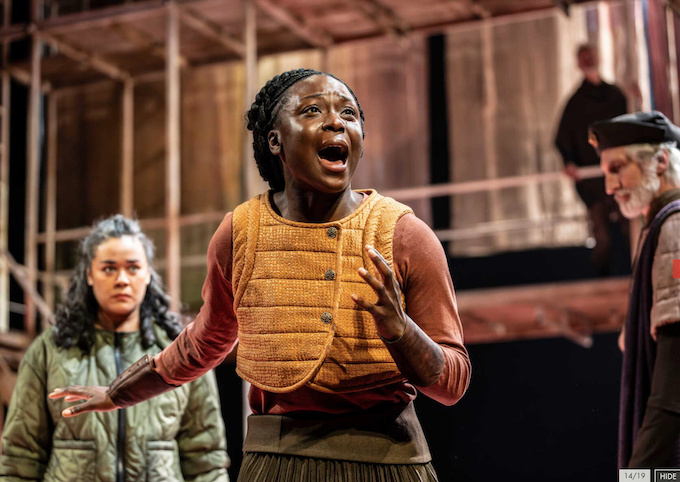
Then Gloucester is addressed as ‘sister’ but is dressed the same as the men. The boy who narrates is a girl (Tanvi Virmni). Not a problem at all, possibly an improvement as she is graphically thrown about in the French attack on the train of boys. Girls suffer especially as Henry’s speeches at the start of this show. She also does the part particularly well. But why then call her ‘Girl’ in the programme, but address her as ‘Boy’? Why not dress her as a girl?
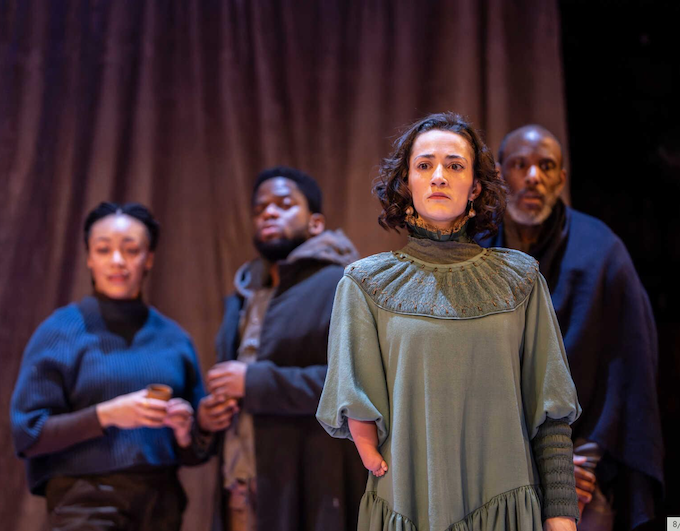
The Katherine / Alice English lesson was I think unique. They did it walking among the injured soldiers lying on the battlefield (there is so much lying on the stage I’m surprised the cast don’t have splinters and bed sores), explaining the vocabulary by touching the injured men. It got laughs (there were few throughout) especially the soldier yelling when his elbow was touched to demonstrate, but I’m not sure that it worked, though by then I was already responding negatively. The bit my A level English teacher glossed over (le foot et le count) can be much funnier.
Williams (Jamie Ballard) the soldier who argues with Henry and exchanges gloves came across powerfully. He has the lines to do it. Ballard was also a decent dithering King of France. Micah Balfour as Exeter actually looked like a powerful noble soldier, more than anyone else.
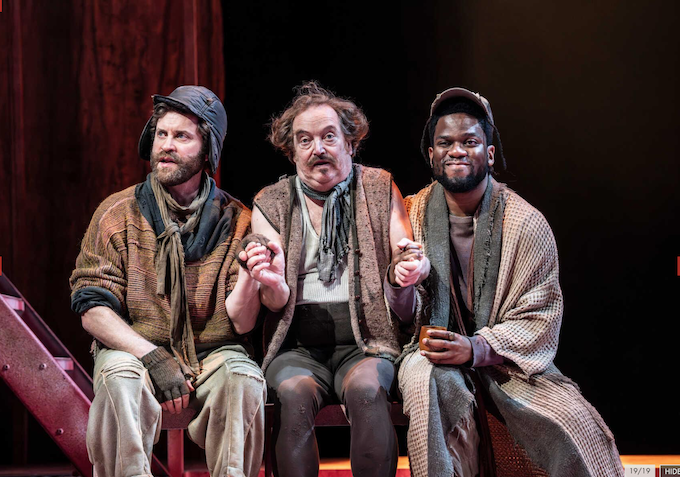
Pistol? (Paul Hunter) he worked hard mincing about. He got plenty of laughs, which was his task/ It’s a clown part so hard to do. Possibly overdone. Pistol’s looting of the dead and the ransoming of prisoners is another important point in the story.
I think Nym and Bardolph lost a lot of lines to cutting so had insufficent stage time.
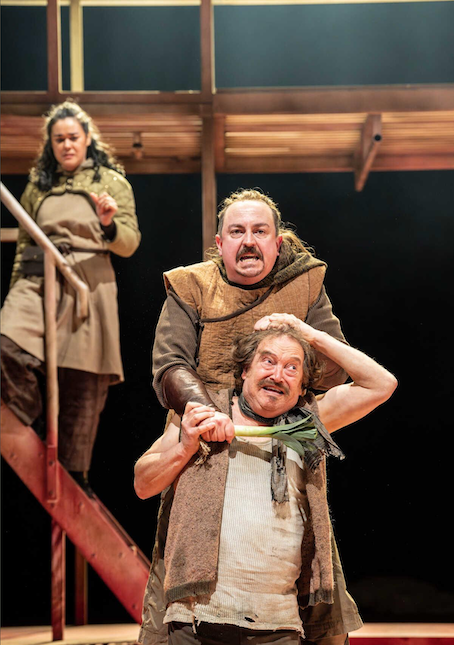
Then Sion Pritchard was Fluellen? Yes, OK. It’s a part swinging between serious captain, trying to do Henry’s job and comedy. The evidence is in several plays that Shakespeare had a Welsh actor who specialized in comic roles. The leek was well done.
They used a large number of supplementaries to fill the stage. Very good idea indeed, and great experience for students interested in or studying drama, but mainly they hung around at the back. However, it’s an idea to re-use in history plays.
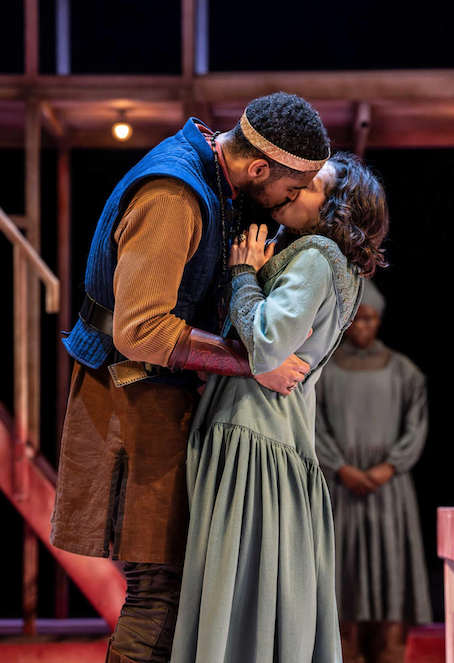
The final Henry wooing of Katherine is difficult. In a way, she is like Hippolyta, the spoils of war. Medieval princesses expected it. Do you play it like this or as a tender love scene? Jude Law and Jessie Buckley nailed it because of his laddish charisma. The physical separation with her high above on the tiered set at first emphasised her as the spoils of war. Then when she descended, the final kiss came from nowhere, and then her response kiss was dubious. It felt uncomfortable. He didn’t seem to have won her affections.
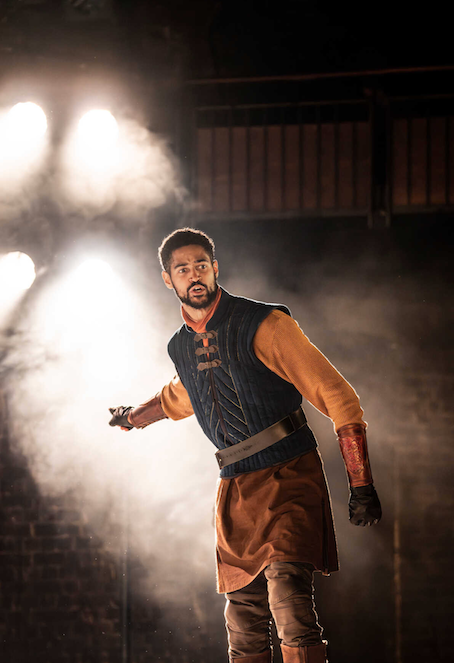
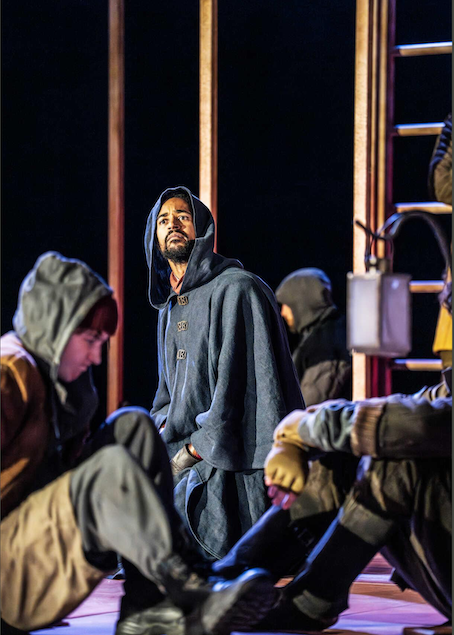
Henry V is an unusually dominant character. Mostly leads have other major characters to offset them, Othello & Iago, Brutus and Mark Antony. Hamlet and Claudius. Macbeth and Banquo and Macduff. Henry V has little competition for stage time and no concrete adversary. Pistol is probably the most likely runner up in stage time. So it’s not a part that interacts, except with Williams, the stroppy soldier. Therefore the role carries a burden for the actor. Alfred Enoch as Henry V follows his lead role in Pericles last year. He looks the part. He might be able to do this part better ten years down the line, with a director who goes with what the play has become post Olivier.
Henry V needs charisma and gravitas. Laurence Olivier, Kenneth Branagh and Jude Law could carry that over from their other work, so they each had it before they spoke a line. Alex Hassell, when the RSC did it a decade ago, hadn’t that fame, but he carried the power of having just done Prince Hal in Henry IV Parts One and Two directly before. Alfred Enoch hasn’t got the back catalogue. Then Henry V has to be multi-faceted. He is the judgmental, cruel, all-powerful ruler with the traitors, violent in the Jude Law version. However he is also the trickster,, conning the traitors and Williams, then he’s the great charismatic hero, then he’s laddish and familiar with the troops, which mutates into heroic when he rouses his men, and finally he is a somewhat bashful romantic lover with Katherine. This Henry V was on one single plane. Then he trashed the St. Crispin’s Day speech, going into funny accents for the references to soldiers. It is a great Shakespeare speech. I have never seen it done this badly. Not only doesn’t he interpret the call to arms, his voice was too light for it. He was simply miscast for the part. I don’t think the production team were into a heroic call to arms anyway. You don’t have to be. War, war, what is it good for. Absolutely nothing. I get that indeed, especially now, but if that’s how you feel, as at the start, don’t attempt Henry V, do another play.
The applause at the end was warm, but no one stood. In contrast the next day, at The Boy Who Harnessed The Wind, we saw the spontaneous standing ovation.
Overall: two stars, **
WHAT THE CRITICS SAID
Seen 20 March before any reviews came out, but it was at full price, so reviewing is fair.
REVIEWS arrived on 25th March:
four star
The Reviews Hub, ****
Sarah Crompton, What’s On Stage ****
three star
Arifa Akbar, Guardian ***
Clive Davis, The Times ***
There’s no mistaking the air of confusion that reigns on the battlefield, especially as the subdued costumes mean it’s not always easy to tell the French and English apart. Perhaps it’s time too that directors gave up using slow-motion as a way of trying to ramp up tension. The effect has worn very thin.
Steve Sutherland, Stratford Herald ***
Real Chrisparkle ***
two star
Domenic Cavendish, Telegraph **
Dave Fargnoli, The Stage **
“Striking visuals and rich symbolic movement cannot bring clarity to this unfocused take on Shakespeare’s study of pride and patriotism”
LINKS ON THIS BLOG
HENRY V
Henry V – Jude Law, Grandage season
Henry V – Alex Hassell, RSC, 2015
Henry V – Ben Hall, Shakespeare at The Tobacco Factory, 2018
Henry V – Alfred Enoch, RSC 2026
TAMARA HARVEY (Director)
The Constant Wife, RSC 2025
Pericles, Prince of Tyre – RSC 2024
Home, I’m Darling, National Theatre 2018
The Famous Five: A New Musical, Chichester 2022
Henry V – Alfred Enoch, RSC 2026
ALFRED ENOCH
Pericles, Prince of Tyre – RSC 2024 (Pericles)
JAMIE BALLARD
The Tempest RSC 2023
Measure for Measure, RSC 2012 (Angelo)
The Merchant of Venice, The RSC, 2015 (Antonio)
King John, Rose, Kingston (King John)
Macbeth, Trafalgar Studios, 2013 (MacDuff)
The White Devil, Wanamaker Playhouse, 2017 (Bracciano)
MICAH BALFOUR
All’s Well That Ends Well, RSC 2022
Richard III, RSC 2022 (Hastings)
Much Ado About Nothing, RSC 2022 (Don John)
The Barber Shop Chronicles, The Roundhouse 2019
MICHAEL ELCOCK
Romeo & Juliet, Globe 2025 (Mercutio)
The Comedy of Errors, Globe 2023
PAUL HUNTER
Life of Galileo, Young Vic 2017
NATALIE KIMMERLING
The Tempest RSC 2023
SION PRITCHARD
Measure For Measure, RSC 2025
SAM PARKS
Pericles, Prince of Tyre – RSC 2024
EWAN WARDROP
North By Northwest, by Emma Rice, Bath 2025 (Roger Thornhill)
The Buddah of Suburbia, RSC 2024
A Midsummer Night’s Dream, Globe 2016 (Bottom)
Much Ado About Nothing, Globe 2017 (Dogberry)
EMMANUEL OLUSANYA
Pericles, Prince of Tyre – RSC 2024
 Peter Viney's Blog
I had not opened the comments box, so these were on the home page:
knight410
Thank you for your review. It sounds like a bit of a car crash – the sort of production we might have expected 3 or 4 years ago. Sadly I shall be going to see it in 3 days time – not with any degree of enthusiasm I might add.
bevelieshember
I think this review matches my experience at the RSC on 20/3/26. I shan’t try to expand on the thoughtful description of the production, read the review and you will understand what a disappointment it was. Last season I saw Hamlet and Titus Andronicus so I was pleased to book, it’s an favourite play and I was expecting great things, I’ll hope for improvements as the season progresses.
Andrew Topley
Fir me it was a very disappointing and underwhelming experience. Have seen many productions at Stratford but sadly this is probably the worst Enoch was mis-cast, certainly not the warrior king. I cannot say more other than I pretty much agree with the review.
LikeLike
Another from the home page:
Milady de Winter
I saw this production on 21 March and I agree with this dismal assessment. I hate the import of unnecessary text from another play, plus massive cuts from the play supposedly being presented, plus numerous rewrites in the redistribution of lines to characters for whom they were not intended (Chorus) or the substitution of certain words for others (the closing sonnet in paricular). These changes served no purpose and did not improve upon the original. To add insult to injury, the wordless fight scenes were overly long and dull. I like Alfred Enoch, but this definitely is not the right vehicle for him.
My RSC memory goes back as far as Alan Howard in Henry V in 1975. I’ve seen most of them since then and this is the least interesting. It would more properly be described as an adaptation of the play.
LikeLiked by 1 person