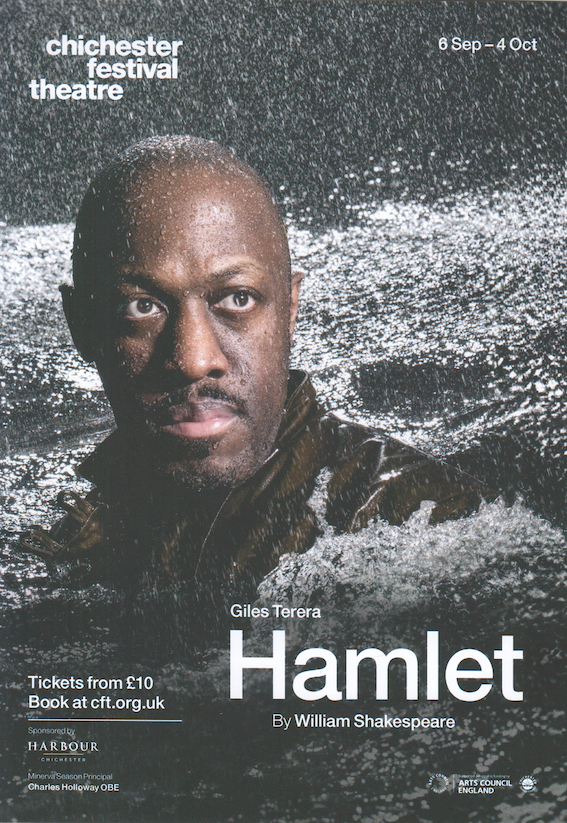
By William Shakespeare
Directed by Justin Audibert
Lily Arnold Designer
Jonathan Girling composer
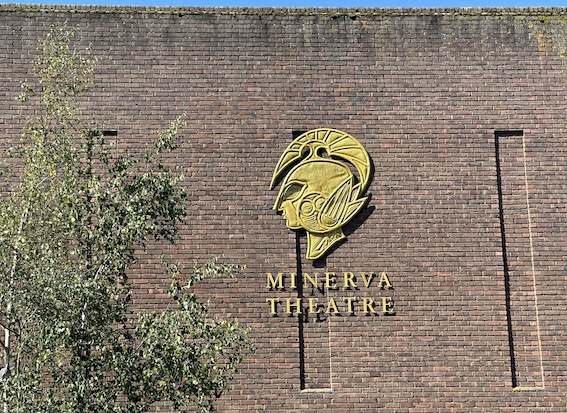
The Minerva Theatre
Chichester Festival Theatre
Saturday 13th September 2025, 14.15
CAST
Hamlet – Giles Terera
Claudius – Ariyon Bakare
Gertrude- Sarah Powell
Old Hamlet / Player King- Geoff Aymer
Horatio, Hamlet’s oldest friend- Sam Swann
Polonius, councillor to Denmark – Keir Charles
Ophelia, daughter of Polonius – Eve Ponsonby
Laertes, son of Polonius – Ryan Hutton
Barnardo / Gravedigger Two- Simon Darwen
Player Queen . Gravedigger One- Beatie Edney
Rosencrantz – Tim Preston
Guildenstern – Jay Saighal
Fortinbras, Prince of Norway – Ozzy Aigbomian
Osric, a courtier – David Angland
Marcellus – Nana Amoo-Gottfried
Voltemand, Ambassador to Norway – Nick Howard Brown
The fourth Hamlet of 2025. Chichester Festival Theatre have never done Hamlet before. CFT are rightly disinclined to do too much Shakespeare. After all, we have the Royal Shakespeare Company and Shakespeare’s Globe / Wanamaker Playhouse, and then the National tend to do one a year. Chichester does all the other plays and lots of new ones as well as classic repetoire. Thinking back, three major Shakespeare productions have been in the smaller Minerva Theatre with the audience on three sides, which gives the same feel at the Royal Shakespeare Company theatres, or The Globe. The Minerva was the location for two King Lear (Frank Langella 2013, Ian McKellen 2016) and before I started reviews, Macbeth with Patrick Stewart in 2007. Over on the main stage, they presented the RSC’s Love’s Labour’s Lost / Much Ado About Nothing in 2016. Other than that, before I started reviews again there was Twelfth Night with Patrick Stewart as Malvolio in 2007, and we saw a very young Emily Blunt in Romeo & Juliet in 2002, both on the main stage. We were very selective until about 2011, so will have missed some. Whatever, there are a lot that have never been done here.
Having decided to do the big one, Hamlet, they have decided to do it properly. All three Hamlets (if we include Fat Ham) this year have been greatly cut versions with a major concept: a Royal Danish Yacht / Titanic version, another set to Radiohead’s music and the third at a North Carolina barbecue. Hamlet gets the major concepts thrust upon it: The West Wing, a lunatic asylum, a boarding school, West Africa, female Hamlet (twice). So what was it going to be this time? Answer: none of the above. No concept is imposed.
Then the main thing, they’ve done nearly all of it. It’s long. A totally uncut Hamlet runs to four hours. Kenneth Branagh’s 1996 film boasted the full text and ran to four hours and two minutes. This is not that long, but it has restored so much that is frequently cut. According to the notice on the door, Act One is 1 hour 40 minutes, and Act 2 is 1 hour 20 minutes plus a 20 minute interval. It started at 14.15. We were seated on the gangway near the exit, and already standing for the well-deserved ovation. We walked out almost first and down the stairs first. We got to the car, parked in the closest non-disabled space at 17.49. I’d say it finished at 17.45, which means a run time of 3 hours 10 minutes. Then think about this. That was the matinee. The evening performance starts at 19.15. They can’t have a longer interval between performances, because they would run into ‘last bus syndrome aka staff overtime syndrome.’ That is a marathon for the actors.
The length, in spite of a sore bottom, is a virtue, in that so many speeches seemed to come fresh, because cutting them is standard. I know the text. I did it for A level, then again in Drama. I’ve reviewed in a dozen times. I have laboured on an alternative modern version in recent years, so have re-read it frequently.
The main text survivor is the whole Fortinbras, Prince of Norway sub-plot. Both versions at the RSC eliminated it. I would automatically cut it, because my Drama tutor at Hull insisted the Fortinbras sub-plot was stage management. They wanted a dramatic ending on the open air Globe stage in daylight, so Fortinbras’s role was merely to carry off the dead bodies, instead of them standing up. His preference was to black out on Hamlet’s The rest is silence (my choice) with as runner-up Horatio’s Good night sweet prince and flights of angels sing thee to thy rest. The only time Fortinbras made great sense to me was the National’s West Wing Hamlet where he takes over Claudius’s role to a TV news camera showing nothing has changed. Anyway, you get it all here. Therefore Voltemand, as the statesman-like Ambassador to Norway, is restored to the story as an important character. I pondered that nothing changes much. As this week, the “Polacks” were still beset by interfering foreign powers though it was pre-drones.
Then the Players do the introductory scene and the performance scene in full. That’s a popular cut. Shakespeare was lampooning a declamatory style. Recent productions have used a mime show, dance and Japanese Kabuki theatre instead, or presented a heavily cut version. I’d forgotten most of it.
You also get longer scenes with the soldiers who observed old Hamlet’s ghost, a full explanation of what happened to Rosencrantz and Guildenstern in England, the full mad Ophelia.
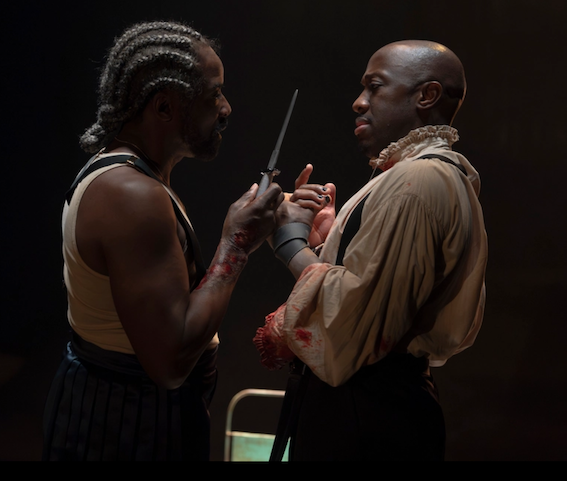
A major innovation is the break. The interval comes as Claudius finishes his prayer and Hamlet stands behind him, dagger raised to strike. The second half resumes from the same freeze frame with Hamlet’s speech, not wanting to kill him right after a confession when he will go to heaven. So that’s halfway through Act III Scene 3. Others have cut at the exit of the players, halfway through Act III Scene II or the death of Polonius in Act III Scene 4, which if we accept the conventional act breaks, is probably where Shakespeare would have cut it.
There are two views on Hamlet with Karen being of the first. The younger Hamlet is the better. She saw David Warner play him at 24 and swears he has never been surpassed. As Yorick died 23 years earlier, Hamlet must have been intended to be 27 to 30. We’ve seen young ones this year. The other view, as here, is an actor at the height of his powers whose name can go on the fliers with the title. Olivier played him at 41, Gielgud at 44, Cumberbatch at 39, Branagh and Rory Kinnear both at 36. (Ian McKellen did him at 85, but that was a concept). Giles Terera is playing him at 48, though he would easily pass as mid 30s.
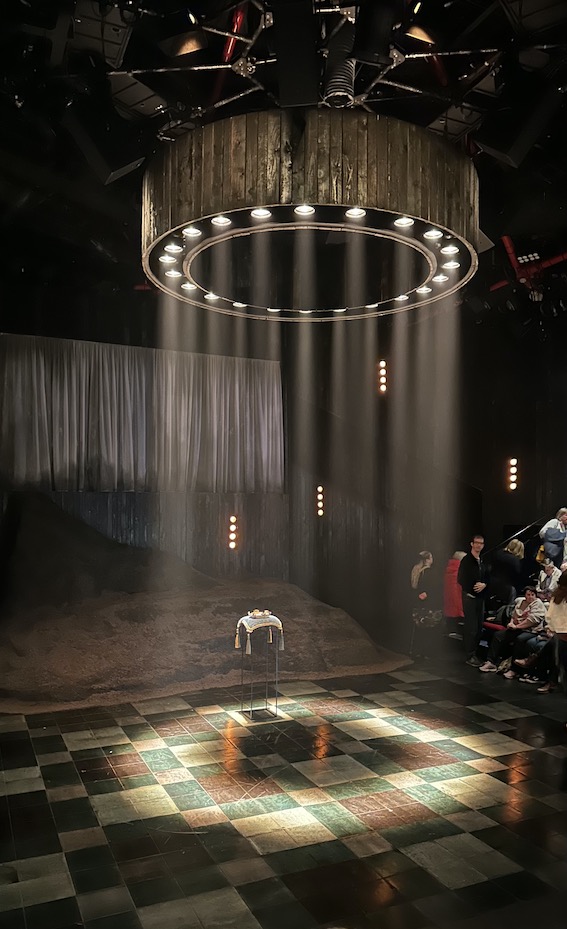
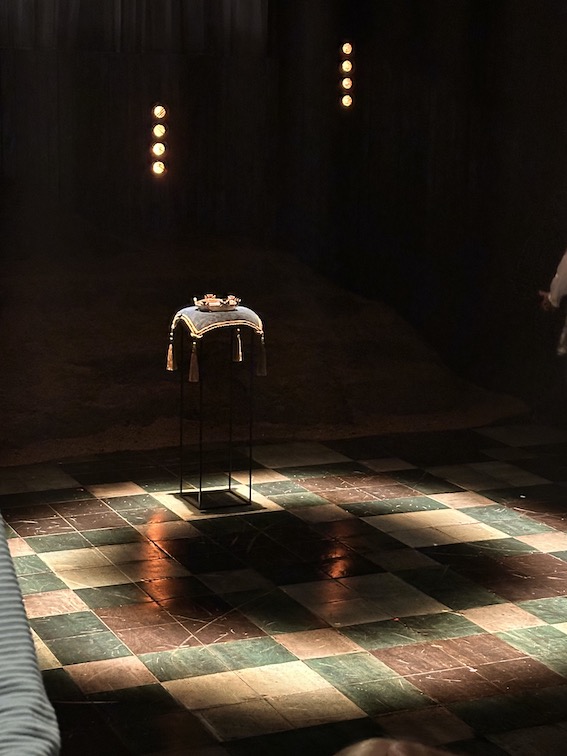
The stage before the start. The crown appears suspended in the air. The curtains cover the balcony area. The mound is below.
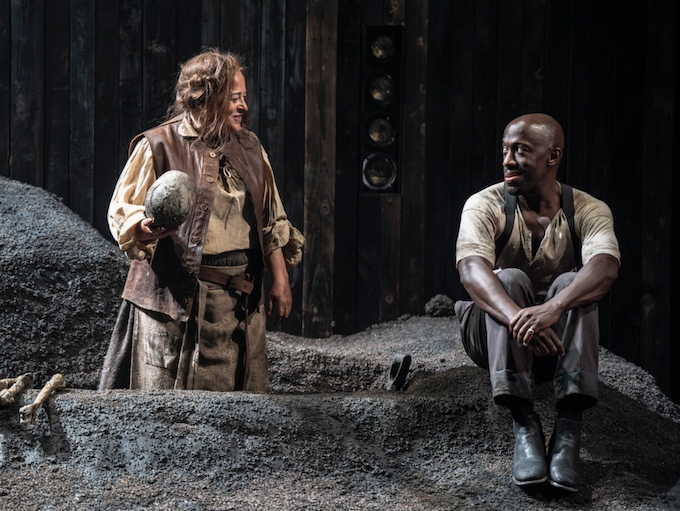
But the plays the thing. The stage comes first. It’s a complex set with multiple areas. There is a high central balcony room which serves as battlements, Ophelia’s chamber, Gertrude’s chamber. There are more battlements at balcony level stage right. At stage left there is a long staircase, which is used as an acting area. It’s best use is having people walking noisily up and down, causing Hamlet to drop to a conspiratorial whisper. It suggests a surveillance state. Then there is a dusty mound with a slope up to the balcony, filling the centre (which also will accommodate the grave). There is the front area of the main thrust stage. Then both ground level entrances, stage left and right are used for overhearing. The ghost (and others) enters through the central entrance through the audience. While the upper balcony looks good, and sound and projection absolutely clear, I felt its use for Polonius’s advice to Ophelia and Laertes, then for the Hamlet / Gertrude bedroom scene with arras, sacrificed the intimacy of the Minerva’s thrust stage for these scenes.
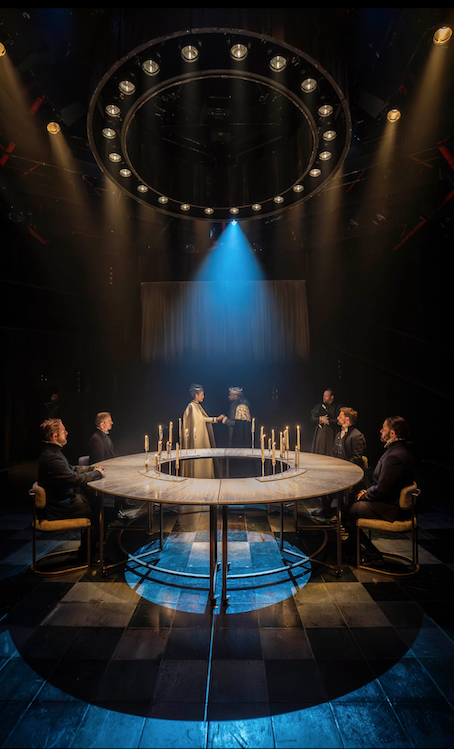
Lighting is complex. For the early scene with Claudius and Gertrude at court, four quarter circle tables are pushed on with real candles, and the candles made me think Wanamaker Playhouse. It doesn’t happen again.
Music is used under action to good effect without ever drowning speech. The Minerva is a good acoustic anyway, but we agreed we never had trouble hearing any of the cast, nor of interpreting (thankfully mild) accents. That should not be unusual, where everyone in the cast speaks with clarity and can project, but it is unusual. I was thinking, ‘At last. So it’s NOT my hearing going.’
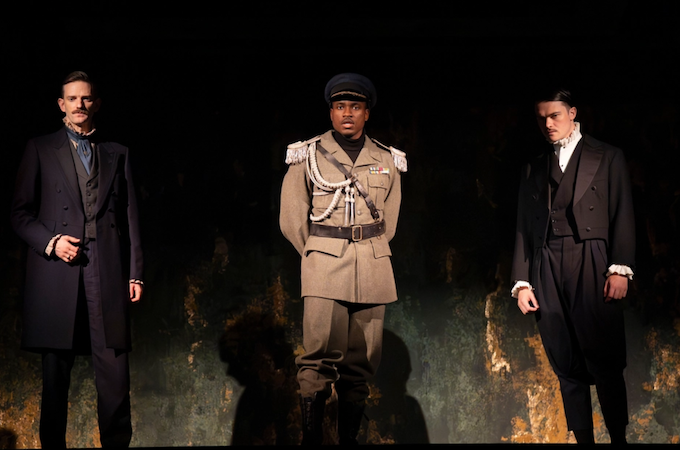
Costume is odd. There must be a concept which we didn’t grasp. The courtiers are in late 19th century / early 20th century formal black suits, but most have trousers falling six inches above their assorted shoes. Claudius and Gertrude are in a kind of fantasy video game costume at the start. Game of Thrones? Then Ophelia starts in a 1930s midwest yellow frock, goes into floor sweeping pre-19th century green gown and ends in a white shift. Claudius has blue baggy early 17th century trousers later, but ends in a black early 17th century costume. Meanwhile, Fortinbras is a 1930s Ruritanian general with modern soldiers. I don’t think it’s the much maligned Globe “pick it from the costume box” approach though. There is a plan. It does not reveal itself to us. It’s not a plan for those seeking historical consistency.
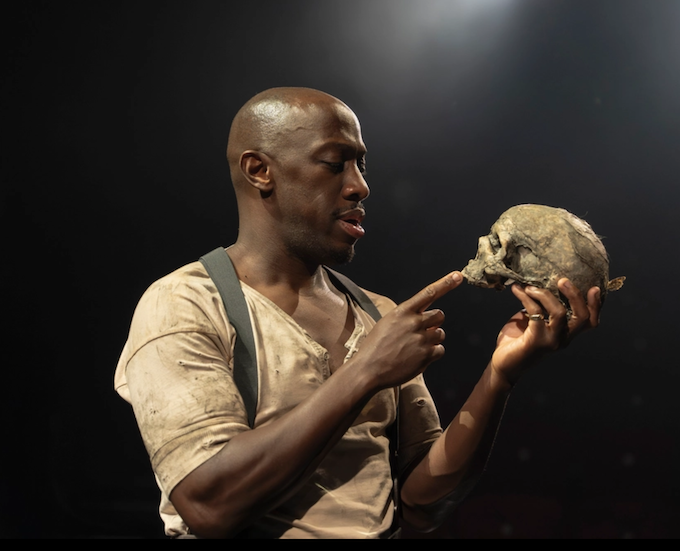
Giles Terera as Hamlet, Unknown person as Yorick (deceased)
Giles Terera is a fine Hamlet. We have seen him in Hamilton and Blues For An Alabama Sky, so he was an extra reason for booking this first during online booking. His delivery is impeccable.
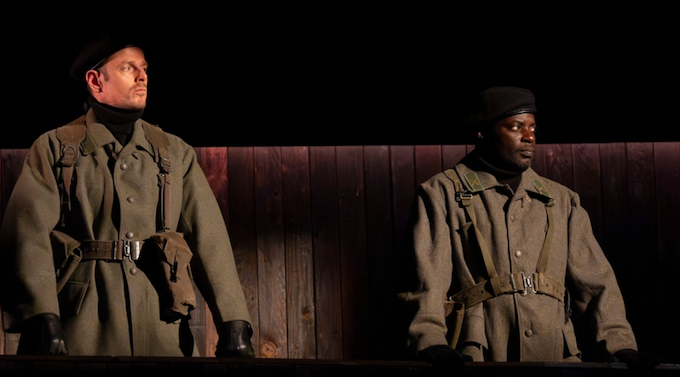
The ghost is manifest, cross-cast with the Player King (who will lie down as the soon to be murdered king in the players scene). The soldiers on the battlements see a solid figure. This not played as a potential figment of imagination, but as Shakespeare is alleged to have played the ghost himself, he’d want the full lines.
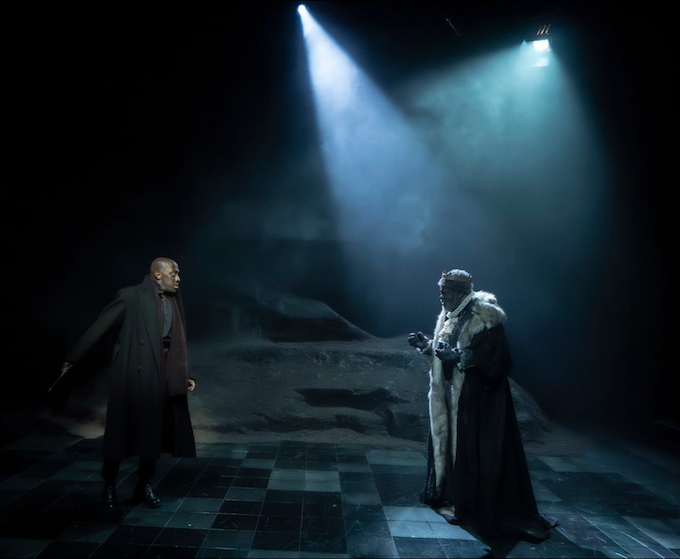
Claudius and Gertrude are less sexual than in recent ones (which may have gone over the top on that aspect). She remains observing, wary, suspicious. You never get the idea that she was complicit in Old Hamlet’s murder or was passionate about Claudius. Is she more of a Hippolyta style prize? Aloofness is radiated.
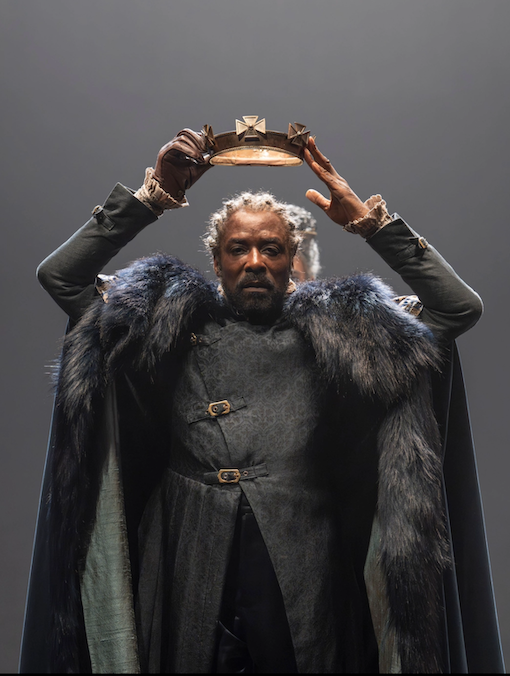
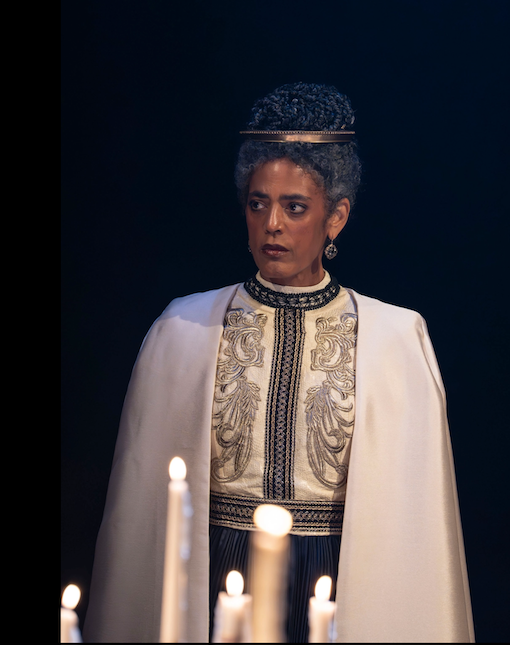
Ariyon Bakare as Claudius, Sarah Powell as Gertrude
The confrontation scene leading to the death of Polonius was well above us in the balcony, but remained powerful.
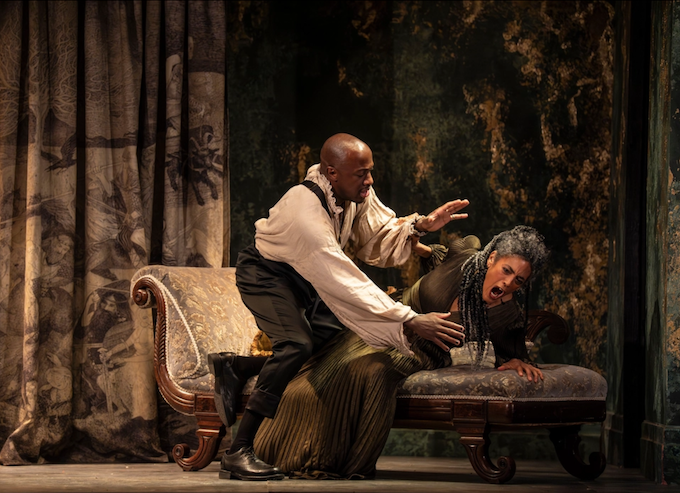
Hamlet’s discussion with Claudius also turns into explicit physical threats.
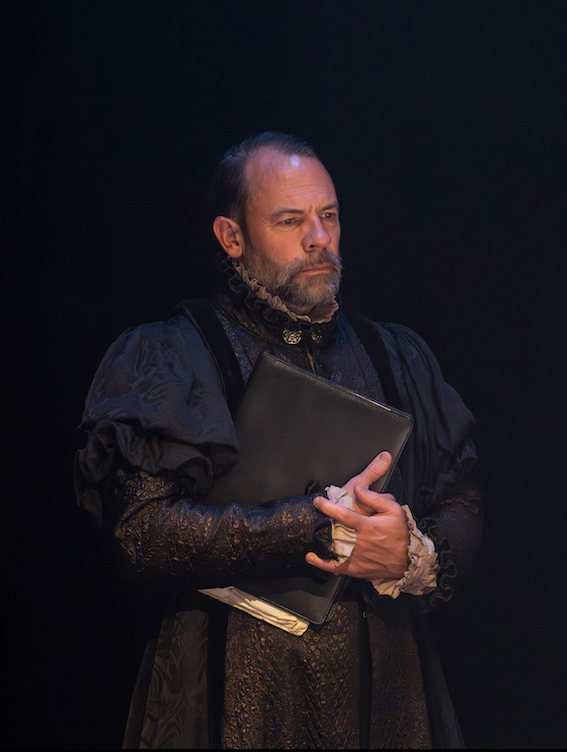
Polonius (Keir Charles) was outstanding. I thought he had a weaker start, in that being distanced right up on the balcony took a lot away from the advice to Ophelia and Laertes scene, but once he got down on the main floor he came into his own. He delivered several lines directly to audience members as if asking their advice. It was a Polonius (and there have been a few) where you groan at his death, because you know you’re going to miss his presence for the rest of the play. It was well executed (or he was well executed?) with the arras collapsing around him so there was no need for a blood bath.
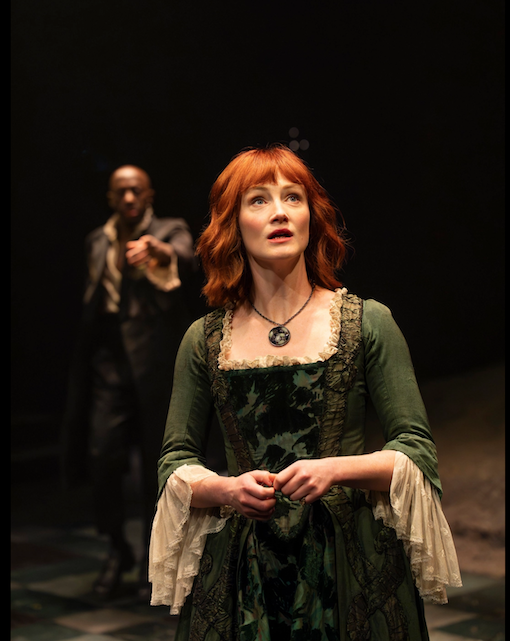
Plot interpretations? Probably Ophelia stands out. It is generally agreed by female actors that being cast is Ophelia is a poisoned chalice. It’s a very difficult part to get through. This Ophelia (Eve Ponsonby) was genuinely terrified of Hamlet.
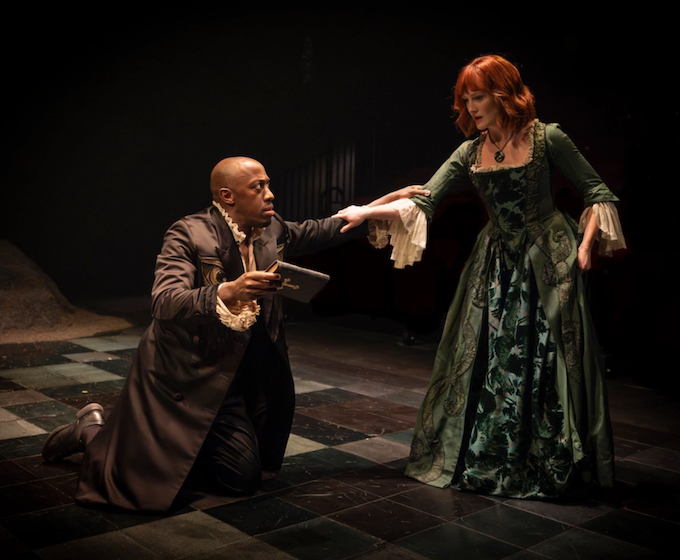
The Get thee to a nunnery scene was savage. As for interpretation, it has been said recently (a theatre programme) that as well as the normal resonances in the text, the herbs she offers include fennel and rue, early 1600s contraceptives and abortifacients. When she appears with them, the back and front of her shift are heavily bloodstained. That’s making it more explicit than usual that she was pregnant and miscarried, added by the priest’s distaste about a ‘maiden’s’ funeral. They went for the full raving mad too. (I thought fennel tea was a digestive aid, but there you go.)
Then there’s Laertes, and we got the full story here of his return, acclaimed by the mob, and actually fighting Claudius. First we had a fist fight with Hamlet, which was outstanding. The final sword fight was as good as I’ve seen it. This is what Globe audiences loved, and I believe they probably had sword fights several minutes long. The way each of them gets cut by the poisoned sword was innovative and really worked.
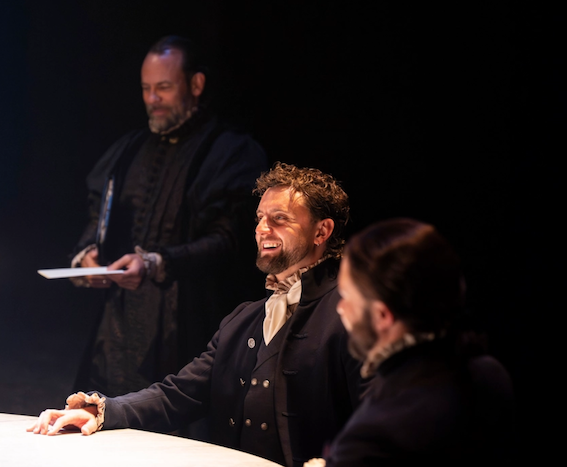
There are no small parts, and the programme makes it clear by choosing three cast interviews. Nana Amoo-Gottfried as Marcellus, Beatrice Edney as First Gravedigger and Player Queen, David Angland as Osric the fawning courtier. The first gravedigger gets all the early lines that are cuttable puns and she is greatly aided by having a proper grave with dirt to chuck about and plenty of bones to polish. Simon Darwen, doubling as Marcellus and Second Gravedigger added to the scene.
Osric, perpetually ready with sword flourishes is amusing throughout.
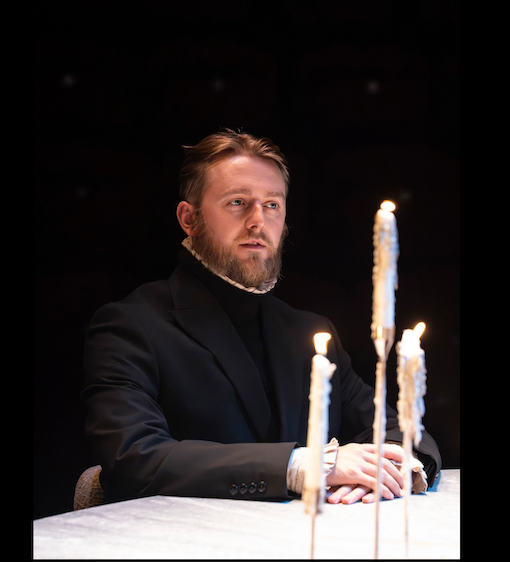
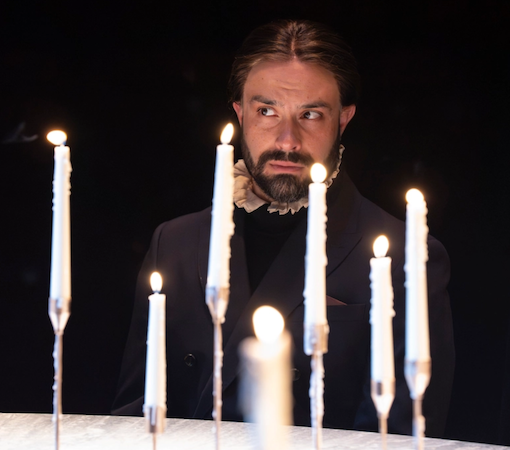
Tim Preston as Rosencrantz, Jay Saighal as Guildenstern
Rosencrantz (Tim Preston) and Guildenstern (Jay Saighal) were straight-foward sycophants as written. No one added sub plots here.
OVERALL
I thought it a clear four star. Karen was less enthusiastic than me, which is why I won’t go for a five.
****
WHAT THE CRITICS SAID
No reviews had been seen when I wrote this. I have to say, the Sunday Times constantly pisses me off, reviewing tiny sold-out plays in London, yet never venturing to Chichester or Stratford to review if they can help it. At this point, we are half way through the run. When was press night? Tuesday 16th. Very late.
five star
Jasmine, Theatre & Tonic *****
four star
Chris Wiegand, The Guardian ****
Nick Wayne, West End Best Friend ****
three star
Gareth Carr, What’s On Stage ***
Dave Fargnoli The Stage ***
LINKS ON THIS BLOG
HAMLET
Hamlet – NT 2010 Rory Kinnear as Hamlet
Hamlet- Young Vic 2011 Michael Sheen as Hamlet
Hamlet RSC 2013 Jonathan Slinger as Hamlet
Hamlet – Globe 2014
Hamlet – Maxine Peake, NT Live Broadcast from Manchester Royal Exchange
Hamlet- Benedict Cumberbatch, 2015, Barbican, London
Hamlet, RSC 2016 Paapa Essiedu as Hamlet, Stratford
Hamlet, Almeida 2017, BBC 2018, Andrew Scott as Hamlet
Hamlet, RSC 2025, Luke Thallon as Hamlet
Hamlet: Hail To The Thief, RSC 2025, Samuel Blenkin as Hamlet
Hamlet, Chichester 2025 Giles Terera as Hamlet
Hamlet, National Theatre 2025, Hiran Abeysekera as Hamlet
+
Fat Ham, by James IJames, RSC 2025
JUSTIN AUDIBERT (DIRECTOR)
Redlands by Charlotte Jones, Chichester 2024
The Caretaker, by Harold Pinter, Chichester July 2024
The Taming of The Shrew, RSC 2019
Snow in Midsummer, RSC 2017
The Jew of Malta, by Christopher Marlowe, RSC 2015
Flare Path by Terence Rattigan, Salisbury Playhouse 2015
GILES TERERA
Blues for An Alabama Sky, National Theatre 2022
Hamilton, by Lin-Manuel Miranda, London 2018 (Aaron Burr)
The Resistible Rise of Arturo Ui, Bertold Brecht, Donmar Warehouse 2017
King John, Shakespeare, The Globe 2015
SAM SWANN
Jerusalem by Jez Butterworth, Watermill 2018
EVE PONSONBY
A Midsummer Night’s Dream, Bath 2016 (Hermia)
‘Tis Pity She’s A Whore – Cheek by Jowl , Nuffield, by John Ford
KEIR CHARLES
South Pacific, Chichester 2021
Quiz by James Graham, Chichester Minerva 2017 (Chris Tarrant)
The White Devil, by Webster, RSC 2014
The Roaring Girl by Dekker RSC 2014
Arden of Faversham, RSC 2014
RYAN HUTTON
A Midsummer Night’s Dream, RSC 2024 (Lysander)
GEOFF AYMER
Jitney by August Wilson, Bath 2022
A Midsummer Night’s Dream, Young Vic 2017
SIMON DARWEN
Flare Path by Terence Rattigan, Salisbury Playhouse 2015
King Lear, Bath 2013
JAY SAIGHAL
Ross by Rattigan, Chichester 2016
As You Like It, National 2015
Othello, RSC 2015
TIM PRESTON
First Light, Chichester 2016
 Peter Viney's Blog
Leave a comment