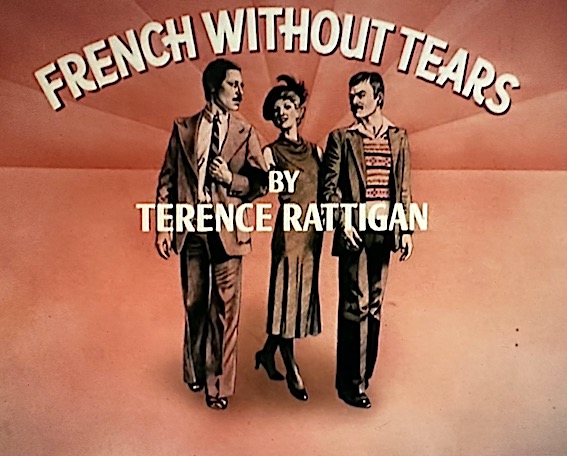
By Terence Rattigan
TV Adaptation by Anatole de Grunwald
Directed by John Gorrie
Produced by Cedric Messina
BBC Play of The Month, May 1976
CAST
Nigel Havers – Kenneth Lake (‘Babe’)
Anthony Andrews – Hon. Alan Howard
David Robb – Brian Curtis
Natalie Caron – Marianne
Vernon Dobtcheff- Monsieur Maingot
Michel Gambon – Lt. Commander Bill Rogers
Nicola Pagett – Diana Lake, Kenneth’s sister
Tim Woodward – Kit Neilan
Barbara Kellerman – Jacqueline Maingot
Adam Birdsall – Lord Heybrook
SEE ALSO: French Without Tears, English Touring Theatre, Poole 2016. This will repeat some information, but there is also more there.

This was our second choice from the Terence Rattigan Collection, because I have reviewed a stage version. It was Rattigan’s first play, and his first hit in 1936, and it started Rex Harrison’s career when he played Alan, alongside Trevor Howard and Jessica Tandy. The play was an unexpected major success. There was a 1940 film version and it played well in repertory through the 50s and into the 60s. I readily admit we’re watching it because we’re stuck home with Covid, but we are really enjoying some of the older films.
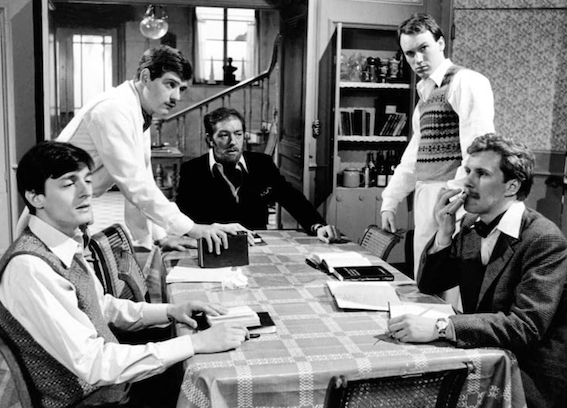
The BBC version is 1976. These BBC Plays of The Month had excellent sets and costumes and tremendous casts … look at this, Michael Gambon (fresh then from much Shakespeare, plus Ayckbourn’s The Norman Conquests), a young-looking Nigel Havers (who had just been in the Glittering Prizes TV series), Nicola Pagett (Upstairs Downstairs), Anthony Andrews (Brideshead Revisited). Nicola Pagett played Silvia in the film of Privates on Parade later, a not dissimilar role to Diana. But then Anthony Andrews as Alan is like Sebastian Flyte in Brideshead Revisited and this possibly helped Anthony Andrews to get the role. He had earlier appeared in Upstairs Downstairs with Nicola Pagett. The Alan role, camp, clever, studying hard, then giving it up to be a writer is always said to be Rattigan himself. David Robb, as Brian, was about to go into I, Claudius. He’s never stopped working … he was in Downton Abbey between 2010 and 2022. Tim Woodward was to star in Wings a year later.
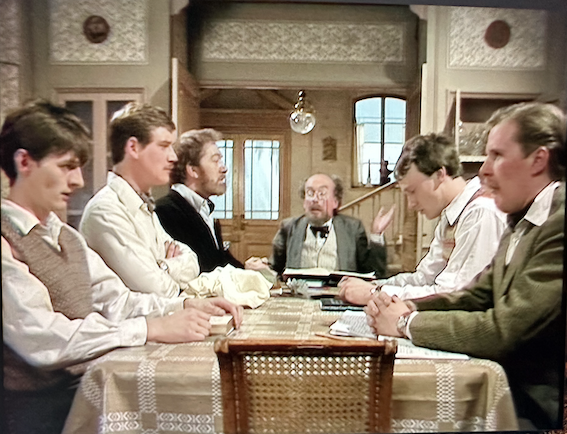
It’s set in 1936 in a residential French intensive study school, run by Monsieur Maingot and his daughter Jacqueline. (Reviews online always call it a ‘crammer’ which is inaccurate). They have five male students, and Diana, the sister of one of them is also resident. Her brother is Kenneth, known as ‘Babe.’ Three of them are studying for the Civil Service Diplomatic exams, then one, Bill Rogers is a Naval Lieutenant Commander, and the fifth, Brian, wants it for business. Alan is the most likely to pass the exam, but doesn’t know whether he wants to. Kit is the sincere one, desperately trying. Kenneth doesn’t have much hope. The plot revolves around Diana who plays with their affections.
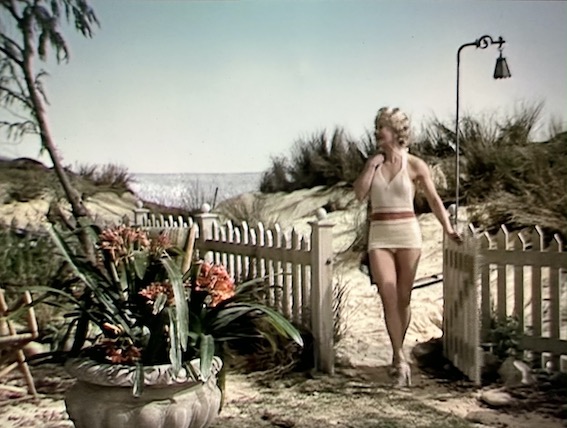
On stage, it’s one location. At the BBC studio, they even have a full-size sports car for Brian to drive off. As in Separate Tables the BBC decided to double the set location with a walk through to the garden / edge of beach with buildings in the distance. This aids Diana’s first appearance in a stunning bathing suit. Alan hears she’s made Kit go for a morning swim, which Alan says is against his principles. This is a lovely three part scene. Diana is sexy. The Commander is defensive about his own heartiness. Alan is purely bitchy in his banter with Diana.
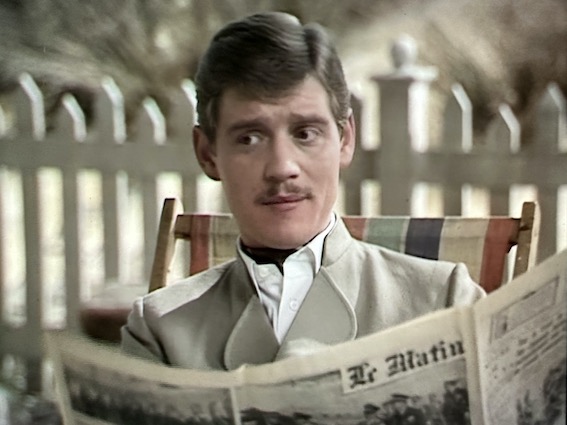
Commander: What principle is that, might I ask?
Diana: Never under any circumstances do anything hearty.
Commander: I rather enjoy an early morning dip.
Alan: An early morning dip?
Commander: Yes. That’s hearty I suppose.
Alan: Well …
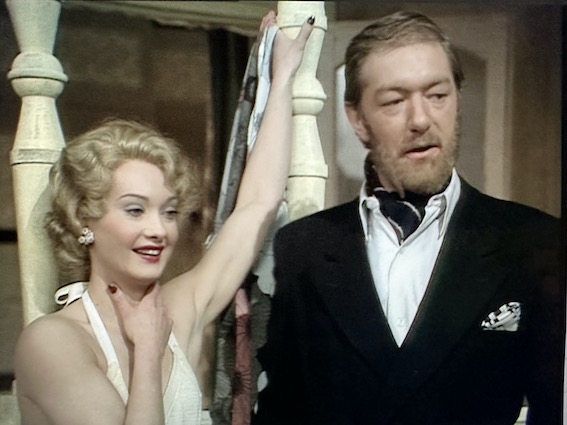
Diana: I quite agree with you, Commander Rogers. I don’t think there’s anything nicer than a swim before breakfast?
Alan: You’d like anything that gave you a chance to come down to breakfast in a bathing dress.
Diana: Does it shock you, Alan?
Alan: Unutterably.
Diana: Ah, well, I’ll go and dress then.
Alan: Oh, no point in that. You’ve made one successful entrance. Don’t spoil it by making another.
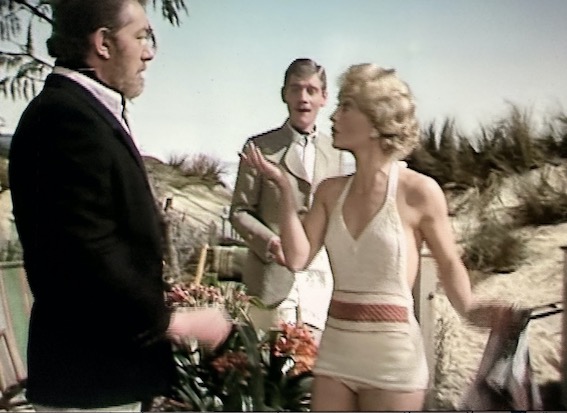
She will wear the same at the end, when having failed with Kit, Bill and Alan, she descends the stairs to meet her anticipated next devotee, Lord Heybrook. The end is guessable.
The setting first. Language teaching has been my career, so I’ll go on a bit. Rattigan had just finished a similar course in Germany. He was only twenty-five and Alan in the play is considered to be a self-portrait. So why not “German Without Tears?” I936? A potentially dodgy area. More, he knew he had to have a lot of lines in French, and had to be careful not to go so far that those in an audience who couldn’t follow it would get irritated. The chances of at least some French being understood in a theatre audience were much higher than German. Moreover, the English have always considered the French funny. In 1936, there was nothing funny about Germans. He sets it firmly in 1936. Alan has also done a German course, and wears a Bavarian style jacket and has mentioned Hitler ‘to annoy Monsieur Maingot.’
Could you take it out of 1936? The jacket and German lines could easily be cut. The BBC didn’t change the time zone, nor did the touring version we saw in 2016. Both also stuck with clipped Advanced RP accents, but then that’s how it is written. It won’t shift past World War II, or not far past, I think. The ex-public school boys (all of them) are terrified and puzzled by women, having only seen Mummy and their sister briefly in the hols, and what with Matron in the school House being very big and burly and inquiring about bowel movements. There are four types of women to them:
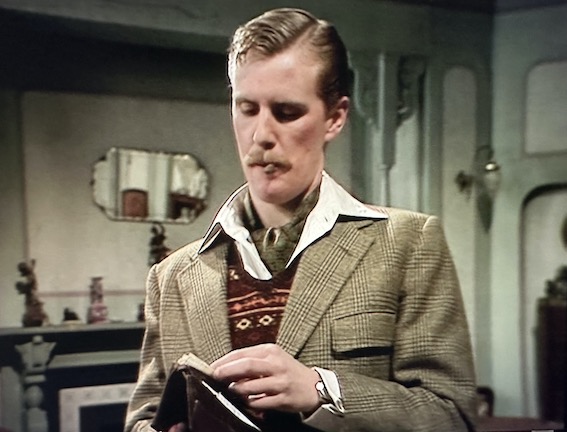
Tarts. The bluff and beery Brian pursues only Chi-Chi from the town and pays 50 francs each time. Chi-Chi is transparently a cheerful prostitute, though we never see her. Brian says she is ‘S-shaped from the side.’ When he advises Kit to try her he says ‘Just walk into the bar. She’ll find you.’ Tarts are French. Sex is French. French letters. French kissing. The British have had that attitude going back to Shakespeare where Mistress Quickly is killed by the ‘French disease.’
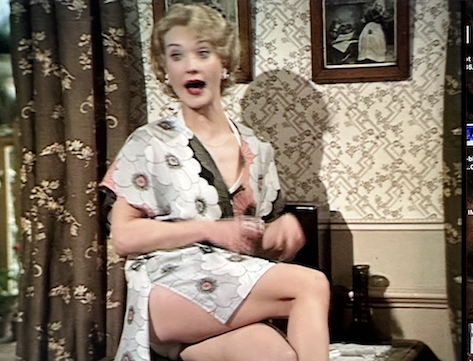
Upper-class girls. Diana. Their own class. Cleverer than the boys. Ruthless. Beautiful. Terrifying. Totally manipulative. They will make you fall in love with them for their own amusement. Your sister and her friends are scary and mock you in the hols. Nicola Pagett is the perfect Diana. She has the looks, she has the figure, she has the costumes to play this young Venus. The male reactions prove her power. When she catches three in horseplay, they line up like naughty kids to be told off. In the picture above she is brilliantly seductive: crossing her leg to reveal her thigh, pausing long enough for all to notice, before pulling the top down coyly to cover herself. Diana, the Moon, the Goddess of Hunting.
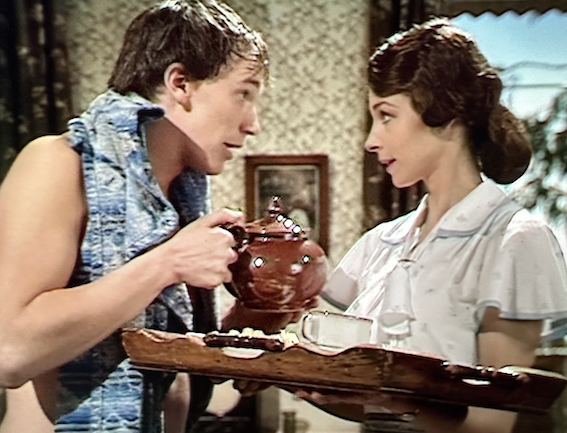
Nice girls. Middle class. This is Jacqueline, helping her father with the teaching. Sweet. Trustworthy. Intelligent. Friends not lovers. Chums. That’s what Kit thinks … until the end. Barbara Kellerman is excellent, and truly looks Gallic. She had come from The Glittering Prizes earlier that year too. (In the same year she was in Satan’s Slave!)
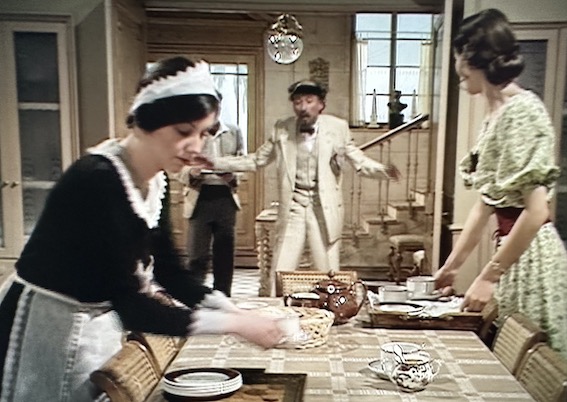
Servant class. Marianne. Simply invisible. Only there to serve stuff and pick stuff up.
So, yes, it’s sexist. It’s stereotyped. If Monsieur Maingot was any more French he’d need a beret, a striped shirt, an old bike and a string of onions.
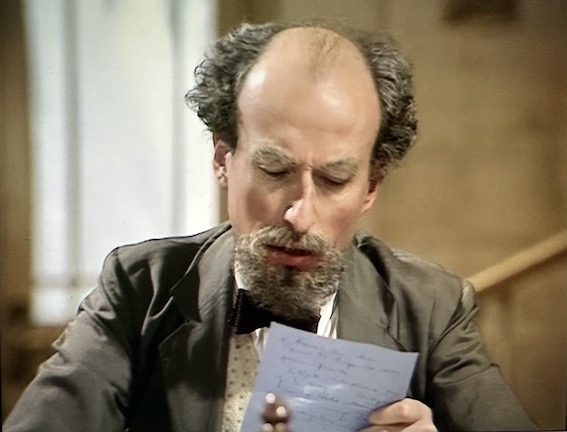
I guess that’s a problem for a production in 2023. It has a truth in it for the period though, and it works, never more so with such an accomplished cast.
What about the school? It’s not a total anachronism. I met diplomats in the 80s who had done just such an intensive programme, staying in their teacher’s house in Mexico. The school is up-to-date in using the Direct Method. They are taught the language in French. They are supposed to use French among themselves. In the afternoons, they listen to lectures in French (we call that extensive listening). That’s how I started teaching in the 1970s. Rattigan undermines it for laughs. M. Maingot has written a book with useful everyday phrases such as: Why is the Guard waving a red flag? Because the train has run off the rails. (I misquoted that in the 2016 review). This goes back to the infamous 18th century Portuguese phrase book: My postilion has been struck by lightning. He also undermines it because Jacqueline is teaching Kit translation from literature (and has fallen in love with him). Then Rattigan’s own elite educational background (Harrow and Oxford) comes into play, because Monsieur Maingot takes the students off one at a time for one-to-one tuition rather than more sensibly teaching them as a class with interaction. The students always fail to speak French among themselves. This is why it’s so hard to avoid the mother tongue in monolingual classes. In the 70s our classes were multilingual, and so was the seating arrangement so that it was natural for students to use the target language rather than revert to mother tongues.
The BBC version had a decision to make. This is a comedy in the Play of The Month series, and a version of a stage play. It is not a sit-com, so there is neither a studio audience, nor the alternative, a laugh track. That leaves it a little ‘cold’ compared to sitcom. I’m not sure whether 2016 was the first time I saw it, because it was very much 60s and 70s Bournemouth summer theatre fare and I saw a lot. It’s not a farce either. See the 2016 review.
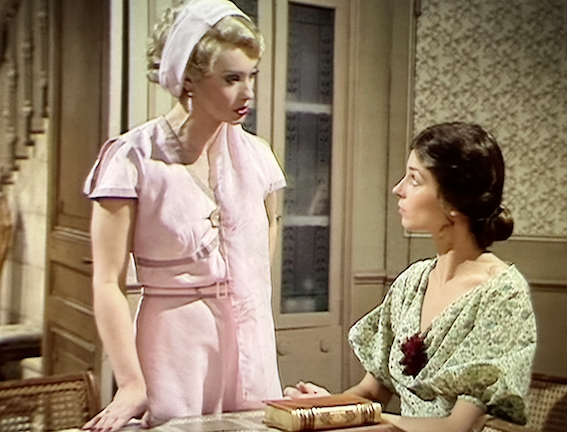
There are some funny scenes between Diana and Jacqueline. They are in competition for Kit’s affections.

Diana: If you want Kit, you must win him in a fair fight.
Jacqueline: But I don’t stand a chance against you!
Diana: To be perfectly honest, I agree with you, darling.

It utilises the ‘known character appears in funny costume’ cliché, lightly twice (Kenneth, Jacqueline), strongly twice (Kit, M. Maingot).

There is a Fancy Dress Battle of Flowers in the town. Kit dresses up as a Greek soldier, with skirt. This is usually the full Greek soldier with thick wool tights. Here he’s bare-legged which is funnier. this is the point where Kit’s contest with Commander Rogers for Diana reaches its climax. A fight is about to begin, but the Commander is laughing too much to continue. So they compare notes and realise that Diana has said exactly the same to each of them.

Then Monsieur Maingot appears in full Highland dress. That’s also improved here because kilts come below the knee, while his is worn a couple of inches above.
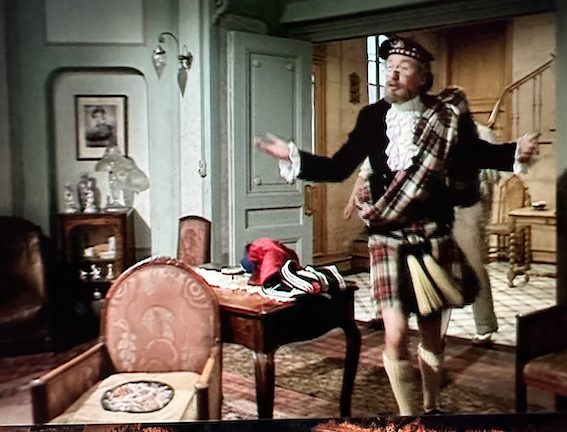
The nearest it gets to farce is later, where they get drunk, decide to remove Kit’s skirt (well, they’re all public school boys) and while they’re rolling on the floor, Diana appears in an exquisite dress. They scramble to their feet and stand to face her. At this point her affections switch to a horrified Alan.
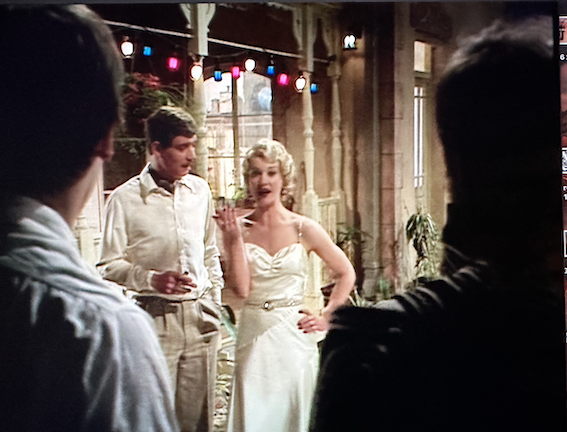
There is a short serious section where Alan describes the contents of his novel, about two men who go off to East Africa to avoid the army. One takes his wife. ‘Conchies,’ responds Lieutenant-Commander Bill. (Conscientious Objectors). There’s also a pointer to Rattigan’s own sexuality. The two men go back together to Europe deciding you can’t escape the fight (and by 1936, many knew a fight was looming), but leave the wife. Why? She’s a bitch, says Alan. i.e. Group Two. Upper Class girls. That brief discussion over whether to fight for your country is almost missable, but it would have rung bells in 1936. Rattigan answers that question for himself … in spite of his wealth and theatrical value, he joined the RAF and became a tail gunner on bombers.
It’s old-fashioned. It’s not Rattigan’s best work by any means, and when we saw it in 2016 I felt the RP dialogue creaked and the overt 1930s boys school sexism was obviously anachronistic, so the cast were better than the play. It did benefit from the Daisy Pulls It Off aspect of lampooning the era. Take it back 47 years and the cast were much more used to doing that sort of thing, they were all major stage and TV actors (or about to be) and it works very well. The advantage of RP accents is clarity, and these all have well-trained diction. We had blocked noses and fuzzy hearing but we didn’t need to use the subtitles! As last time, Diana is the plum part.
- TERENCE RATTIGAN
After The Dance by Terence Rattigan, BBC TV play 1992
All On Her Own by Terence Rattigan, Kenneth Branagh Company 2015
Flare Path, by Terence Rattigan, 2015 Tour, at Salisbury Playhouse
Harlequinade by Terence Rattigan, Kenneth Branagh Company 2015
Man & Boy, by Terence Rattigan,National Theatre 2026
Ross by Terence Rattigan, Chichester Festival Theatre 2016
Separate Tables by Terence Rattigan, Salisbury Playhouse 2014
Separate Tables, by Terence Rattigan, BBC TV version 1970
Separate Tables by Terence Rattigan (Table Number 7, Summer 1954) Bath 2024
Summer 1954 by Terence Rattigan (Table Number 7 / The Browning Version), Bath 2024
While The Sun Shines by Terence Rattigan, Bath, 2016
French Without Tears, by Terence Rattigan, English Touring Theatre 2016
French Without Tears, by Terence Rattigan, BBC Play of The Month 1976
The Deep Blue Sea by Terence Rattigan (FILM VERSION)
The Deep Blue Sea by Terence Rattigan, BBC TV Play, 1994
The Deep Blue Sea, by Terence Rattigan, Chichester Minerva, 2019
The Deep Blue Sea, by Terence Rattigan, National 2016, NT Live 2020
The Deep Blue Sea, by Terence Rattigan, Bath Ustinov 2024
The Winslow Boy, by Terence Rattigan, BBC Play of The Month, 1977
The Browning Version, by Terence Rattigan, BBC TV play 1985
The Browning Version by Terence Rattigan (as Summer 1954), Bath 2024
The Browning Version by Terence Rattigan (as Summer 1954), Bath 2024
NIGEL HAVERS
The Importance of Being Earnest 2014 directed by Lucy Bailey
Private Lives by Noel Coward, on tour 2021-2023
MICHAEL GAMBON
Dad’s Army (2016)
 Peter Viney's Blog
Leave a comment