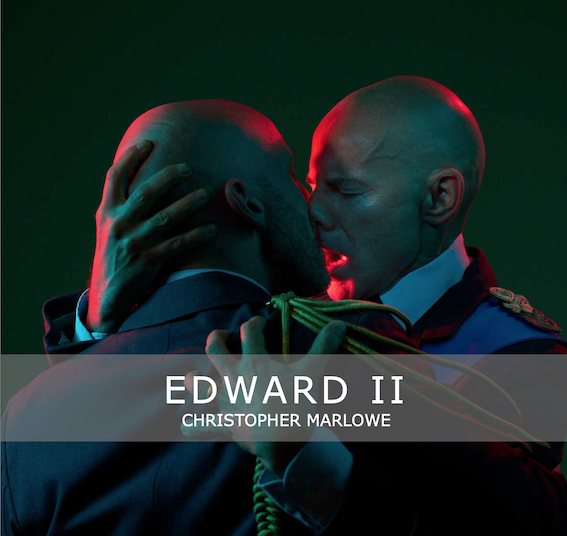
By Christopher Marlowe
Directed by Daniel Raggett
Set & Costume by Leslie Travers
Composer Tommy Reilly
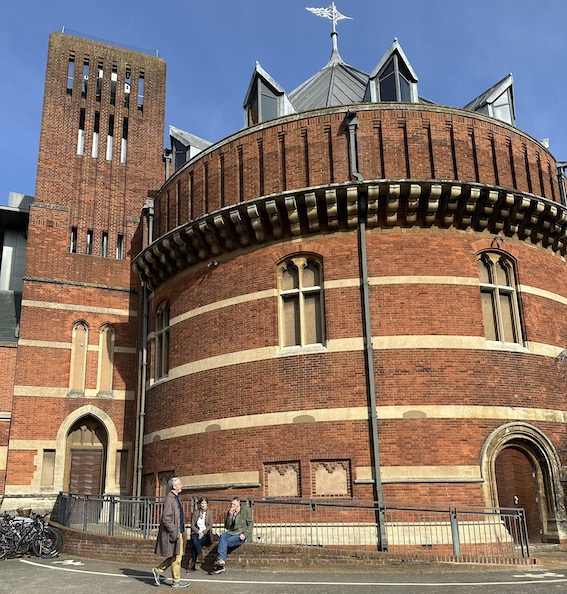
Royal Shakespeare Company
Swan Theatre
Stratford-upon-Avon
Saturday 8th March 2025, 13.30
CAST
Daniel Evans – Edward II
Eloka Ivo – Piers Gaveston
Enzo Cilenti- Mortimer
Ruta Gedmintas – Queen Isabella
Henry Pettigrew – Kent, brother of Edward II
Geoffrey Lumb- Warwick
Evan Milton – Lancaster
Emilio Doogasingh – Pembroke
Freddie Beck / Joel Tennant / Zak Walker- Prince Edward, the king’s son
James Hayes – Archbishop of Canterbury
Christopher Patrick Nolan – Bishop of Coventry
Stavros Demetraki – Spencer, Gaveston’s ally
Kwaki Mills- Baldock, Gaveston’s ally
Jacob James Beswick- Lightborn, an assassinMichael Cusick – ensemble (missing)
Amy Dunn -ensemble
Joseph Rowe – ensemble
Neil Sheffield – ensemble
The production was one short.
Daniel Evans is the co-Artistic Director at the RSC, following his time at Chichester which elevated that already great theatre. Unlike other artistic directors, he has not leapt in to direct a play immediately. His first public commitment comes as an actor, in Edward II. We hadn’t seen him act before (he has two Olivier Awards) and he kept off the stage once appointed Artistic Director at Chichester in 2015. Unlike Michelle Terry, the artistic director at The Globe he has shown no signs of casting himself as the lead in everything. He will be in 4: 48 Psychosis, later in the year but that is a revival of his Royal Court role of 2001.
The play probably dates from 1592. The history is highly conflated. This is a short version too, played without an interval in one hour forty minutes. The full title is Edward the Second: The troublesome reign and lamentable death of Edward the second, King of England: with the tragical fall of proud Mortimer: That doesn’t fit the posters. ‘II’ was not a lucky number for kings. William II? Shot by an arrow in the New Forest. Henry II? Betrayed and died of an ulcer. Edward II? Watch this space. Deposed and murdered. Richard II ditto. James II? Deposed and exiled.
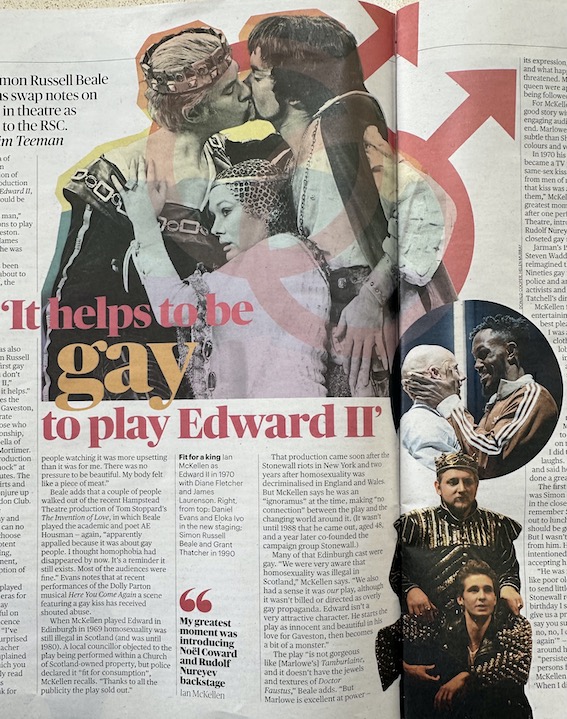
The RSC last did Edward II thirty-five years ago, with Simon Russell Beale. This production comes with a double page spread in The Sunday Times published the day after we saw it, quoting Beale, Evans and Ian McKellan, who all played Edward.
Gay issues have not always been perceived as central to the play. For much of the 20th century Edward II rode on the back of Shakespeare’s Richard II : often staged as the rarer half of a double bill, its interest lay in it being an important relative of the better-known play. Accordingly, attention focussed on Marlowe’s political action of a weak king deposed by barons …and (the gay theme) was toned down in production to suit the prevailing canons of sexual morality … all homosexual acts remained criminal in Britain until 1967. More recent productions were able to explore the play’s gay themes … the risk to the play in a modern liberal community is that critics and productions will merely invert the emphasis of earlier generations and concentrate exclusively on personal concerns at the expense of public ones.
Martin Wiggins, New Mermaids edition of Edward II, reprinted 1998.
(The reprint contains photos of the 1990 RSC production)
Does it do that? That introduction notes that earlier productions emphasised Gaveston’s foreign origins to divert from the gay theme. He was French and liked Italian masques and cloaks and a Tuscan cap. Xenophobia is no longer in fashion theatrically, and it is not emphasised here. Marlowe intended a gay theme though … in the play other gay heroes such as Patrocolus and Achilles are listed in the text.
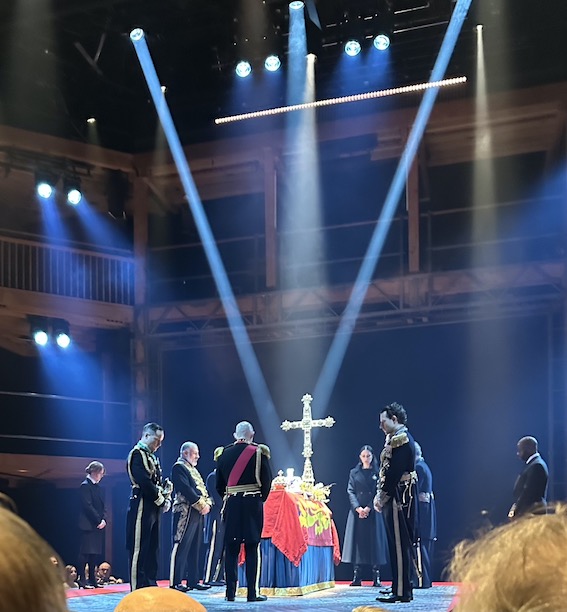
We were surprised at the long slow queue to get in. That was because you were invited to join ‘the funeral procession’ and walk around the stage before taking your seat. You came in to find the cast standing motionless around the casket of King Edward I.
To the production. The programme would have benefitted from the Bridge Theatre’s programme for Richard II (only a week ago, and as noted, a similar story) in having a noble family tree with photos of the cast. Early on they are well differentiated by the different gilt, medal rows and garter adorned coats. Later they switch to white shirts with red braces and it is confusing. In the Sunday Times, it notes that this references both 1930s Fascism and the Bullingdon Club at Oxford, beloved of future Tory politicians (Cameron, Johnson, Osborne) as well as King Edward VII and Edward VIII. I hadn’t made the connection.
Part of the confusion is that it’s pretty dark and the white shirts stand out strongly. Given that though, the lighting design is superb, picking out the characters against black backgrounds. They utilise the now common LED lighting frame for changes – take the main lights off, leave the bright frame lit and you effectively have a blackout from the audience points of view.
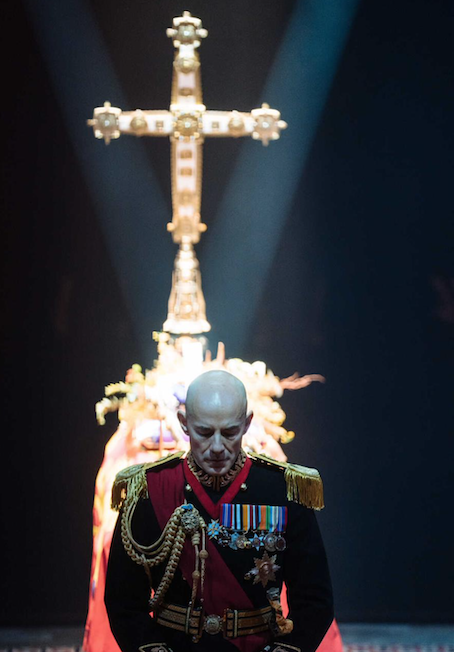
How familiar is the story? Edward becomes king, and immediately insists on the return of his favourite, Gaveston, from exile. After the funeral, we switch high up to the balcony where Gaveston and his ‘allies’ Spencer and Baldock are clad in towels, presumably at a bath house, discussing his imminent return to England. I thought at first that the impossibly muscled Eloka Ivo as Gaveston was wearing the adult equipment of my grandson’s He-Man body suit. As at the Wanamaker in 2019, Edward is white, Gaveston is black. Is that an unstated racism theme?
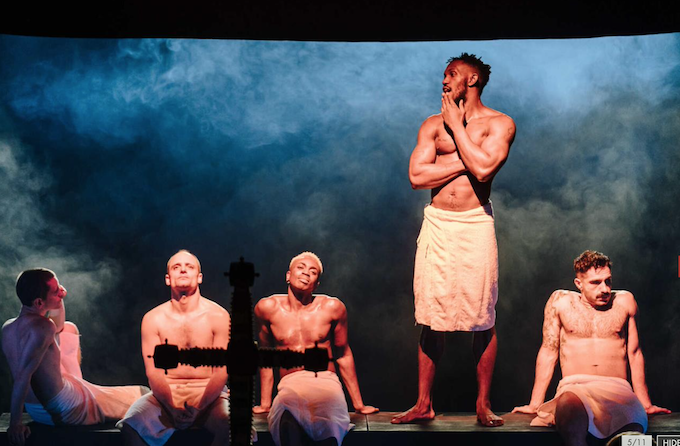
The gay aspect is dominant in this version, but it’s no Gay Pride march. Gaveston is the king’s favourite, so laden with new titles and honours. But he’s a foreigner, completely unqualified for the assigned roles and the king’s male lover. The barons don’t like it. They don’t like the king using powers without consultation. Whether gay or heterosexual, no one likes an ascent to power solely via a sexual relationship with a powerful person. Gaveston had returned in 1311, so one hundred years after Magna Carta had established that the king had to consult the barons and was subject to the law. These barons are a tough and burly bunch, even in modern diplomatic state occasion’ dress.

Edward is brutal and dismissive of his queen, Isabella of France, mother of his son. Not fancying your spouse must have been common whether you were gay or not, in that marriages were diplomatic arrangements between countries.
Then when the bishop of Coventry, the papal legate, berates Edward, he has him beaten and his lands given to Gaveston.

The barons force reforms on Edward, and then arrange to capture and kill Gaveston, which is done vigorously and extremely nastily.
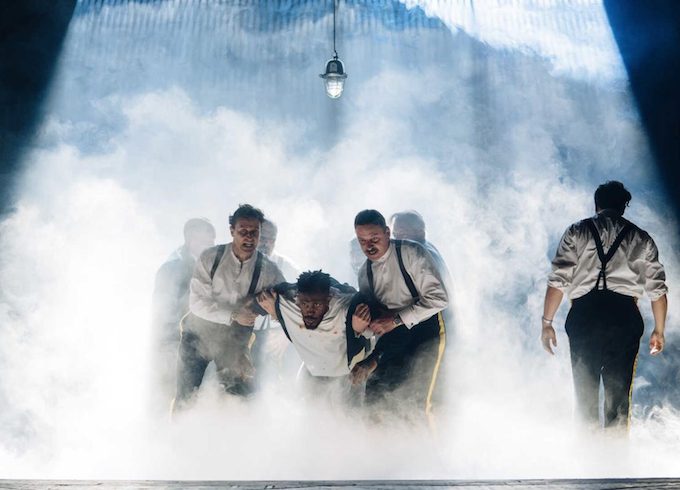
Edward is distraught, but appoints two allies of Gaveston, Spencer and Baldock as his replacements. They arrive snogging and dry humping each other while rolling all over the stage. Possibly not in the Marlowe text. There is a lot of male snogging.

The king’s brother, Kent, tries to mediate. Two of the killers are executed on Edward’s orders. Did we see that? I think maybe not.

Mortimer establishes himself as the leader of the barons, and embarks on an affair with the abandoned Isabella. They force Edward to abdicate in favour of his young son. Incidentally, the lad (one of three juveniles sharing the part) was brilliant and clearly audible when we saw it.
Edward is confined to a dungeon, at the bottom of Berkeley castle. His brother Kent pleads on his behalf, but is executed on the orders of Mortimer and Isabella, confirmed by his nephew who is now Edward III.

The stage slides back to reveal the dungeon is a filthy pit, where the excrement of the castle ends up. They were hoping for him to die naturally from starvation and filth-induced disease (regicide being a moral issue). He doesn’t, so Lightborne (the name reflects ‘Lucifer’) is sent to murder him. Lightborne lists his sadistic murder techniques. One is to befriend the victim and get him relaxed. Edward is stripped naked and killed with a red hot poker up his anus, so as to leave no marks on the torso or head.
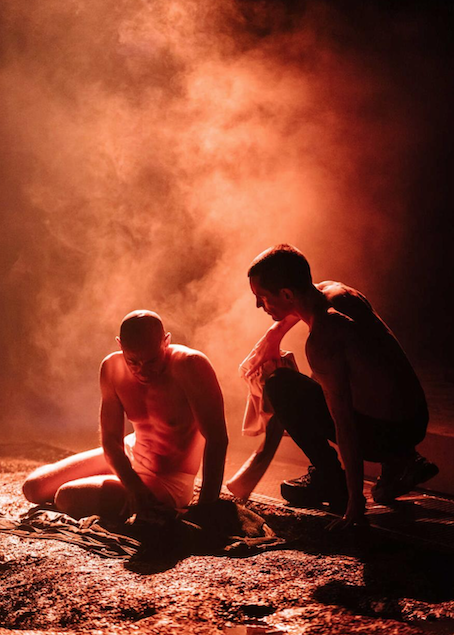
We could draw parallels, with a narcissistic world leader who appoints a totally unqualified and arrogant favourite, a foreigner, South African perhaps, to run the USA country and sack everyone in site. The play draws no modern parallels. The eventual deaths of Gaveston and the king will be horrifying, spine chilling. Had the parallels been drawn, we’d probably have simply applauded. I’d love to see one … no two … world leaders suffer Edward’s fate.
There are links to Hamlet, which we had seen the evening before. Both are so totally dominated by a charismatic lead actor (here Daniel Evans) that the other roles are inevitably diminished. This is especially true of Queen Isabella(Ruta Gedmintas). It’s not helped by her voice being quieter than the men, but she doesn’t get the lines to establish herself sufficiently. Evans is outstanding. especially in the prison and death scenes. Yes he is naked.
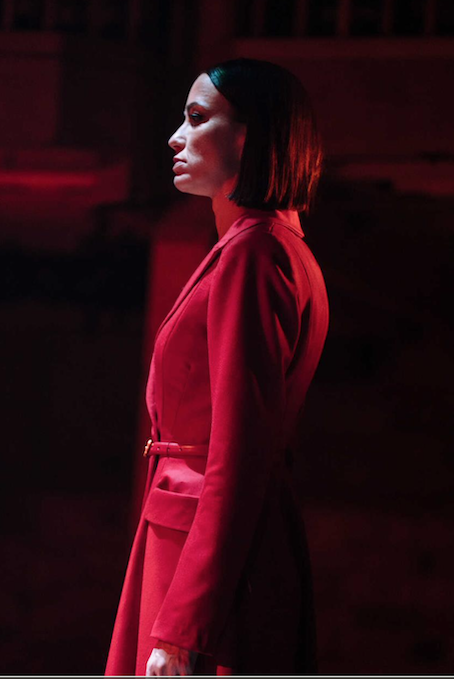
Karen really disliked the Marlowe play while admiring the great production qualities and the acting. As she said, it’s a load of violent men with just one female role, and one which is particularly feeble. I’m not fond of Marlowe. There’s none of Shakespeare’s light and shade. However, by eliminating many roles and drastically cutting Marlowe’s long, long speeches, this is a dramatic and exciting version. I’ll quote Clare Brennan’s review below as she knows the play far better than I do.
The lead acting, the lighting, the stage direction, the costumes are all superb.
I’m going for *** and that’s an issue with Marlowe, not the production.
WHAT THE PAPERS SAID
4 star
Mark Fisher, The Guardian ****
Domenic Cavendish, The Telegraph ****
Dave Fargnoli, The Stage ****
3 star
Clare Brennan, The Observer ***
Director Daniel Raggett’s RSC production conveys the main points of the action but emphasises spectacle (and snogging) at the expense of drama’s political intrigues (Ruta Gedmintas’s Queen Isabella, in particular, loses out). Key characters and scenes are slashed or jumbled together, making way for interpolated visuals: an audience procession around Edward I’s coffin; Gaveston’s murder and his long-present corpse. With the text reduced to a pretext for the images, poetry is mangled, lines gabbled or else drowned out by omnipresent sonic effects. Images and music offer wonderful moments but, like the passions of the tragic heroes, their rightness is marred by excess. Clare Brennan.
Dominic Maxwell, The Times ***
Michael Davies What’s On Stage ***
LINKS ON THIS BLOG
PLAYS BY CHRISTOPHER MARLOWE
Dido, Queen of Carthage by Christopher Marlowe, RSC 2017
Tamburlaine, by Christopher Marlowe, RSC 2018
Doctor Faustus by Christopher Marlowe, RSC, 2016
Jew of Malta, by Christopher Marlowe, RSC, 2015
Edward II by Christopher Marlow, Wanamaker Playhouse 2019
Edward II by Christopher Marlowe, RSC 2025
DANIEL EVANS (as director)
Local Hero, Chichester 2022
South Pacific, Chichester, 2021
This My Family, Chichester 2019
Me and My Girl, Chichester 2018
Quiz, by James Graham, Chichester 2017
Forty Years On by Alan Bennett, Chichester 2017
American Buffalo, by David Mamet, Wyndham’s Theatre, London
ENZO CILENTI
Present Laughter, by Noël Coward, Old Vic 2019
High Rise (film)
JAMES HAYES
As You Like It, RSC2023
GEOFFREY LUMB
Troilus & Cressida RSC 2018
Coriolanus, RSC 2018
Vice Versa, RSC 2017
HENRY PETTIGREW
Quiz, by James Graham, Chichester 2017
 Peter Viney's Blog
Leave a comment