
Based on the novel by Sebastian Faulks
Stage version by Rachel Wagstaff
Original Theatre / Wiltshire Creative
Directed by Alastair Whatley
Designed by Richard Kent
Composer Sophie Cotton
Salisbury Playhouse,
Saturday 14th September 2024, 14.15
CAST
Max Bowden – Jack Firebrace
Joseph Benjamin Baker – Evans
Raif Clarke – Tipper
James Esler – Stephen Wraysford
James Findlay- Brennan
Gracie Follows- Lisette / Prostitute
Sulin Hasso- Marguerite
Tama Phethean – Arthur Shaw
Natalie Radmall-Quirke -Jeanne
Roger Ringrose – Berard / Soldier / Medic / Colonel
Charlie Russell – Isabelle Azaire
Sargon Yelda – Renee Azaire / Captain
This will be on an extensive tour. We were about to book Chichester in November and realised it was starting in Salisbury. It is a new production of the play.
It’s thirty years since the novel was published. It’s 110 years since The Great War started. The play was touring in 2018. We are listening to Precipice, the new Robert Harris novel in the car. It starts in July 1914 with Asquith’s romance with Venetia Stanley. The preface states that the letters are real, except for those from Venetia Stanley to Asquith. The telling point is that George V’s petulant telegrams to the Kaiser and the Czar are addressed to ‘Willie’ and ‘Nicky’ and signed ‘Georgie.’ The war of the three cousins who played soldiers as boys and who communicated with each other in English. We were listening to the story for the 45 minute drive to Salisbury.
I remember the two part TV series better than the novel, though I read it at the time. The issue is the amount of plot, rather like The Other Boleyn Girl this year. This means short scenes and a set that can take such rapid shifts. This is an excellent set, using a panel that descends for underground scenes. The decision is right. You can’t do a tour as long as this with revolve stages and detailed sets. The rapid short scenes gives an ‘epic scale’ narration style.
The cast list doesn’t tell you much. Parts are doubled, tripled, quadrupled. Most of the cast are French strikers, then British soldiers. I’ve indicated a few only. Roger Ringrose for example does at least four AND everyone is involved in carrying props / set on and off.
Unusually for 2024, it is a three act play with two intervals. It runs to three hours five minutes, but that includes a 20 minute interval and a 15 minute interval. It never seemed long. The tendency for three act plays is to have one interval and possibly a five minute gap later. Here, the play dictates staying with three acts – they’re even lengths, all around 45 minutes. Most directors would give us a two act 90 minute / 45 minute split. It wouldn’t work. Between Act One (France, 1910) and Act Two (1916) every cast member has a major costume change – the set change they could handle. The end of Act 2 is the major dramatic point of the whole play, so demands an interval. (Think Blackadder IV, last episode). A description, but I’ll keep it thin so as not to plot spoil, though I should tell you now that Britain won the war.
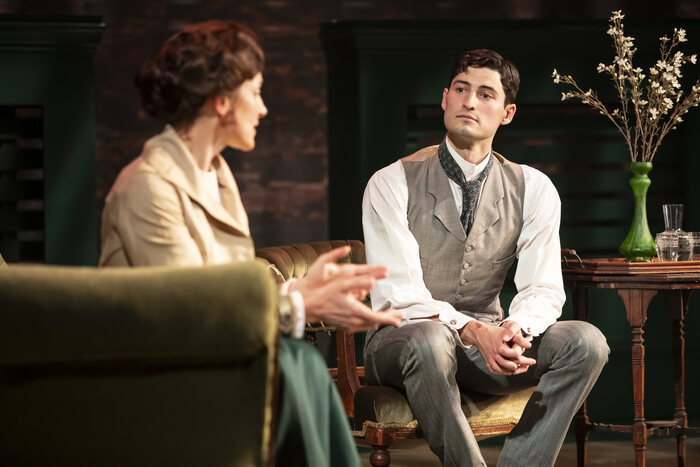
Act one is Amiens in France. There is a frame tale, set “now.” A grandson is looking for a grave.
A later mention indicates it’s six years earlier than Act two, so 1910.
Stephen Wraysford (James Esler) is an Englishman who has been sent to check a factory for potential investment.
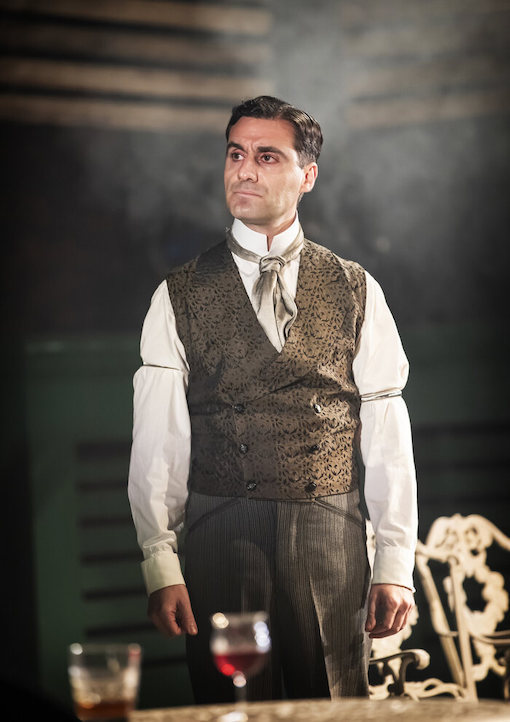
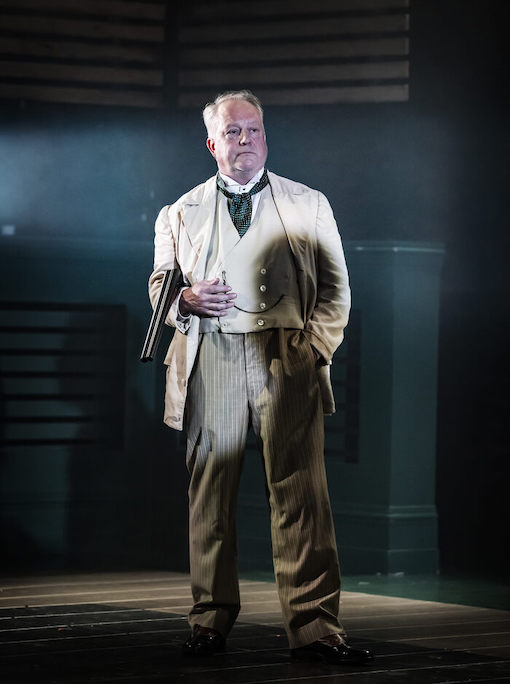
Sargon Yelda as Renée Azair. Roger Ringrose as Berard,
The owner is Renée Azair (Sargon Yelda). He is an old-fashioned brutal capitalist, aided and abetted by jocular local councillor Berard (Roger Ringrose). M. Azair is also brutal to his wife, Isabelle (Charlie Russell). Machinery is to be introduced which will reduce the work force by 40%.
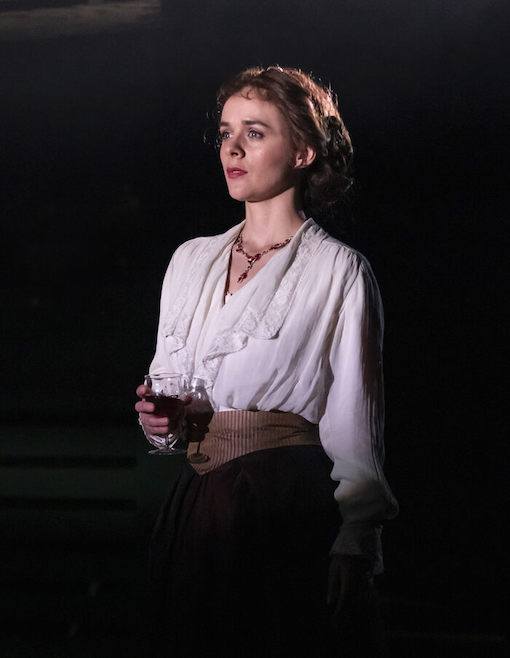
His daughter by the first marriage, Lisette, takes a fancy to Stephen. There’s trouble at t’ mill, and Isabelle takes food to the strikers as she has been doing for some time. Stephen helps her by warning them of a police attack orchestrated by her husband.

Stephen gets into a fight after a remark about Isabelle by the strikers. They fall in love. He meets Isabelle’s sister, Jeanne (Natalie Radmall-Quirke) who is trying to avoid being forced into marriage with an equally unpleasant man.
As the posters on the door tell you, there is a scene of nudity and sexual activity. It’s a long one too, though not as the actress said to the bishop. Is it a bums on seats ploy? Probably. It’s obviously in the Outlander TV series style in the sex (a TV series with perpetual bonking). We questioned whether a diffident young Englishman in 1910, with one previous sexual encounter, would initiate matters in their first physical encounter by sticking his head up her skirt and referencing that Irish heroine of Lady Lovely’s Chatter, Connie Lingus (an old Private Eye joke. Sorry). Then they have to undress. The light is dim, and they both manage to position so as to keep their own eternal triangles concealed. However, this inexperienced young woman of 1910 soon leaps on top. Girls on top is the preferred TV position for all sexual encounters because the audience to get to see breasts more clearly rather than heaving bums. Yes, it looks much better. We both thought it demeaning for the actors, and more graphic than the story demands.
Overall, we didn’t like Act One at all. The characters are walking clichés. They were right in deciding that it’s all taking place in French, we assume, so there are no French accents. Everyone speaks normal English. The plotting was very good, but we found the dialogue wooden and stilted. The funny bits from Berard aren’t funny. Maybe the adaptor was trying to suggest the formality of early 20th century French in a wealthy household. Or maybe the adaptor doesn’t have an ear for dialogue. We were charitable in assuming the first.
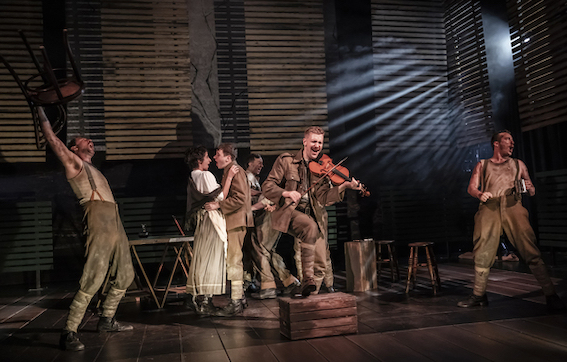
Act Two leaps to 1916 on the Somme. Stephen Wraysford has now grown an officer’s moustache. We have the sappers and the soldiers. The sappers or ‘Sewer Rats’ are miners, though Jack Firebrace (Max Bowden) got his experience digging underground tube lines in London.
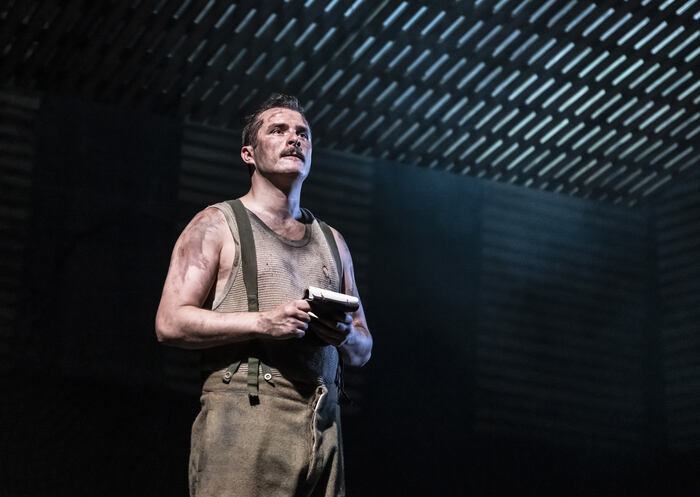
Undermining enemy lines was a tactic in WW1. The major one was at Messines in 1917. The British sappers dug a 6000 yard tunnel under a German munitions dump. The resulting explosion is considered to have killed more people than any other single non-nuclear man-made explosion in history. Jack Firebrace now becomes the leading character. Wraysford is trying to foretell the future by examining rat entrails, a move on from his palm reading in Act One.
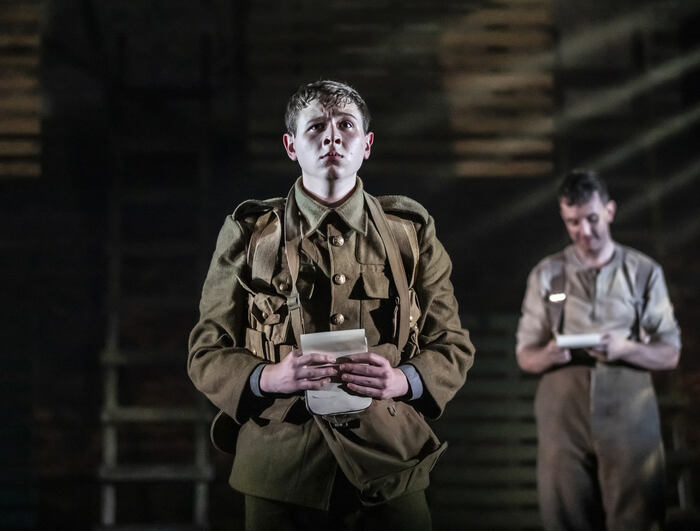
Tipper is a terrified 15 year old who faked his age to sign up. This is the best act in the play. The play develops the comradeship bond between Jack Firebrace and Arthur Shaw (Tama Phethean). I still can’t work out why Jack writes letters home (so is not illiterate), but always asks Arthur to read the letters from his wife aloud to him. Jack’s son back in England has diptheria. It is a tender male bonding.
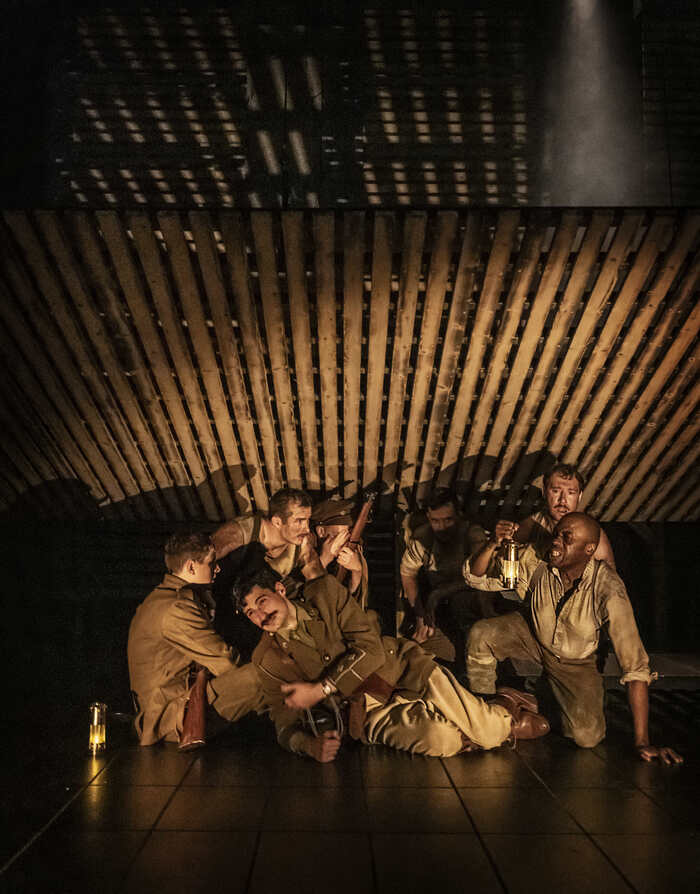
The underground scenes are remarkable, though given the smoke and sound effects they are also confusing and unintelligible. But they would be. Firebrace saves Wraysford’s life when he was presumed dead. The ‘over the top’ ending is superb. Genuinely moving. The singing before that of an Irish song is a high point in the play. The same singer does The 23rd Psalm and On A Green Hill Faraway in Act 3.
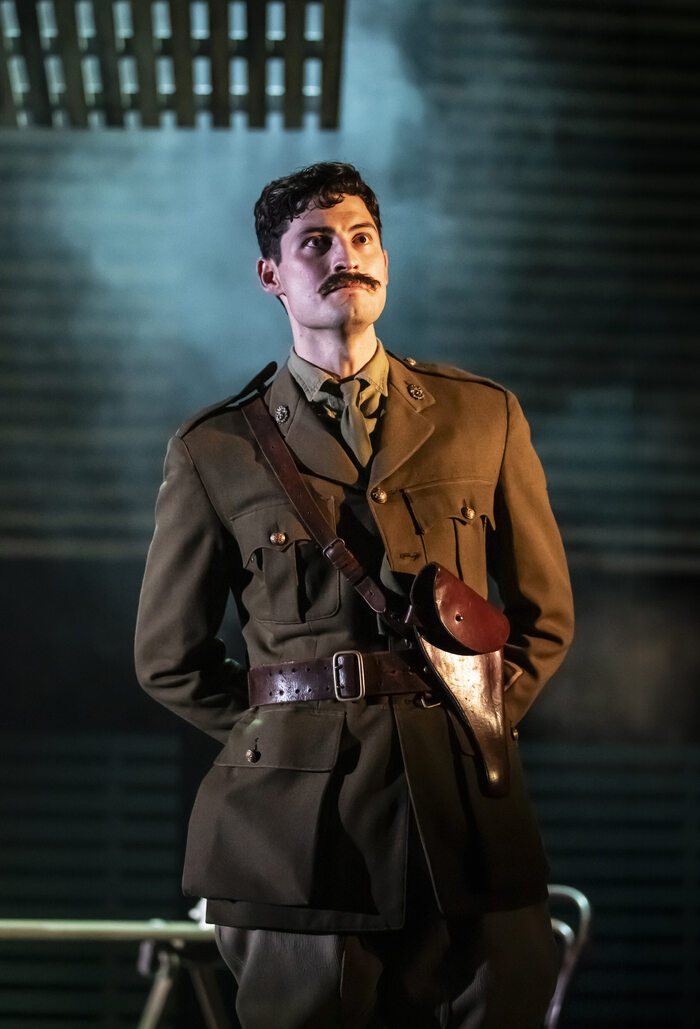
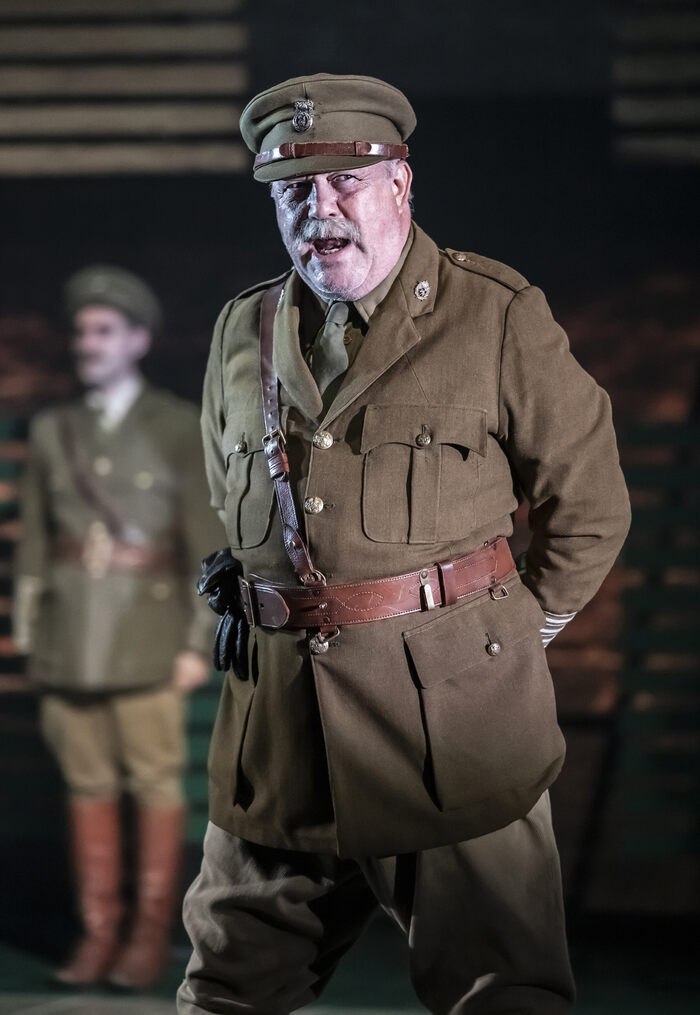
James Esler as Stephen Wraysford, Roger Ringrose as The Colonel
Act three is after the Somme. Stephen has been wounded. He describes what happened to the soldiers. The sappers had survived … so far. We see scenes in a French village too. Stephen is seeking Isabelle. He doesn’t know why she left him.

He does find her, but she is intent on marrying a German occupier of her house who was kind to her. There is the action back in the tunnels. No plot spoilers. The other kindly German, and ‘this may never happen again’ are a tad trite, but that’s the story.
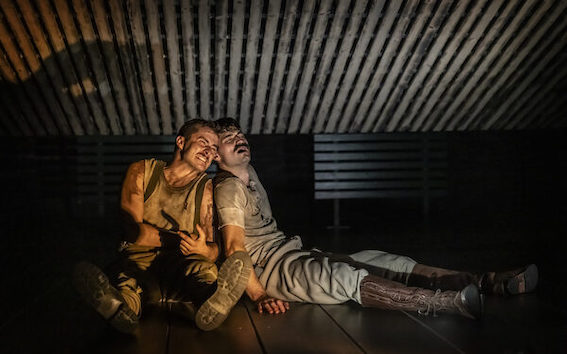
In the end we were moved. I thought of my maternal grandad, Jack. My paternal grandad, Bert, was a train driver so in a reserved occupation. Karen thought of both grandfathers, Albert and Eric. Three grandfathers were In France. Jack lost one brother at Gallipoli, and another to a sniper in Serbia on 12th November 1918. They didn’t know the war was over. When he was terminally ill, Albert told Karen about operating a horse ambulance at the front line. He told her he saw things no human should ever see.
SOUND
They have an issue with production sound. We assume everyone in the cast is mic’d. You can see see mics on foreheads with some, and clearly on Roger Ringrose. Karen has hearing aids which have been fine at Salisbury previously, Poole, Old Vic, West End theatres, both Chichester theatres, the three National stages, both Stratford stages, Southampton MAST and Mayflower. She has not needed to access the Loop systems at any so didn’t try here. She found much of it very hard to hear. I had the same issue, which I haven’t had at other theatres this year. Salisbury Playhouse has intrinsically excellent sound too. There is too great a range in projection volume between the actors. Lisette would have had me shouting ‘Speak up! Project!’ in rehearsal. Even though Jack Firebrace is mainly loud and clear, the quiet pieces when he’s seated stage right were too quiet. Even though they have mics, it doesn’t even out such wide variation. I guess (though my days of sound are long ago) that the mics are all pre-set. A rock band with thirteen or fourteen mics would not rely entirely on pre-sets but would be adjusting continually. Or rather, should be. It’s exacerbated by the (brilliant) sound effects and music, which they sometimes have to speak through. They just about got away with it at Salisbury. They really will have to tweak both the systems and look at individual actors projection as they move around the country. Chichester Festival Theatre is three times the size. They are facing a lot of different spaces on the tour. From experience, Salisbury is at the ‘easy theatre to get right’ end.
This is week one out of seventeen. They need to work on sound and projection. Performance was a little stiff generally, but that should ease in quickly. The thing is, it’s a big production. And you can see it somewhere near you.
I’m being mean, I believe it will improve, but three stars.
***
THE TOUR 2024-2025
It specializes in five day runs. You should be able to see it. It goes on to:
Leeds
Cambridge
Richmond
Liverpool
Nottingham
Cheltenham
Guildford
Chichester
Norwich
Malvern
Bath
Newcastle
Birmingham
Brighton
Aylesbury
Aberdeen
WHAT THE CRITICS SAID
The 5 star (Telegraph, Times) and 4 star (Mail) reviews on the adverts are on previous productions in 2018.
At the point we’re seeing it there are no national reviews. The nationals are mainly too busy attending 100 seater studios in London or West End theatres where seats start at three figure prices, to get out of town, and comment on what people in SEVENTEEN large provincial theatres can see. Ah, but not central London. BUT it could be the producers want to give it a week or two more to bed in. If reviews come later, I’ll add the ratings.
LINKS ON THIS BLOG
It’s a tribute to the depth of theatrical talent in the UK that we have not seen most of this cast before.
ROGER RINGROSE
The Other Boleyn Girl, Chichester 2024 (Wolseley, Thomas Cromwell)
SARGON YELDA
Private Lives, Donmar Warehouse 2023 (Victor)
The Tempest, RSC 2012
Twelfth Night, RSC 2012
Comedy of Errors, RSC 2012
 Peter Viney's Blog