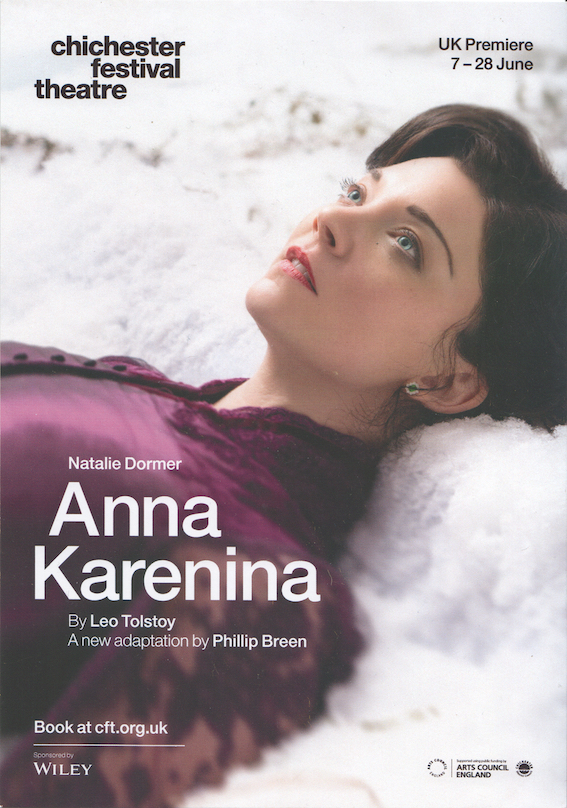
By Leo Tolstoy
A new adaptation by Phillip Breen
Directed by Phillip Breen
Set Design by Max Jones
Costume by Ruth Hall
Music composed by Paddy Cunnen
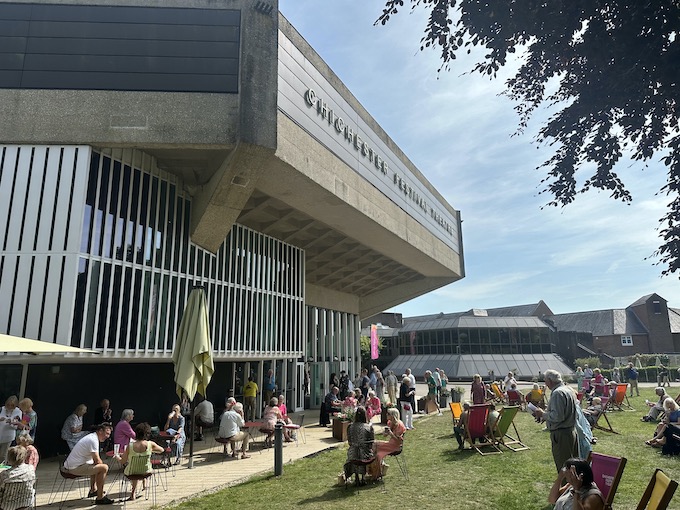
Chichester Festival Theatre
Tuesday 17th June 2025 14.30
CAST
Natalie Dormer- Anna Karenina
Tomiwa Edun – Alexei Karenin, her husband
Jonnie Broadbent – Stiva, Anna’s brother
Naomi Sheldon – Dolly, Stiva’s wife
Shalisa James-Davis – Kitty, Dolly’s younger sister
Seamus Dillane – Count Alexei Vronsky, a cavalry officer
David Oakes – Levin, a landowner and farmer
Ivan Ivashkin – Nikolai, Levin’s brother
Florence Dobson – Marya, Niklai’s partner
Marcia Lecky – Princess Shcherbatskaya, Dolly & Kitty’s mother
John Ramm – Prince Shcherbatsky, Dolly & Kitty’s father
Donna Berlin – Countess Vronskaya, Alexei Vronsky’s mother
Sandy Foster – Countess Lydia, admirer of Karenin
Les Dennis – Petka, Levin’s land steward
Anne Lacy – Agafya, housekeeper, Levin’s old nanny
Riad Richie – Titus, a muzhik
Jacob Isaacs- Seryozha, Anna’s son, age eight
MUSIC
Kotaro Hata – piano / accordion
Akiko Ishikawa – violin, viola
Shin Kawahara – double bass
The 2012 film of Anna Karenina starring Keira Knightley and Jude Law (linked) was the most read review on this site for several years. I never worked out why. We would have chosen this stage version on the basis of Phillip Breen directing and writing, and Jonnie Broadbent acting. After the Garden Theatre version of a Comedy of Errors, we said the RSC should give Breen the Garden Theatre every year, with Jonnie Broadbent taking the lead comedy role. Naomi Sheldon (Dolly) took over as Adriana in that, but not the day we saw it. Here they play husband and wife. Then we have the lead role of Anna played by Natalie Dormer, one of the main actors in Game of Thrones for several seasons.
Anna Karenina is a big one to take on, around 800 pages of it. The 2012 film set it in a theatre and moved out.
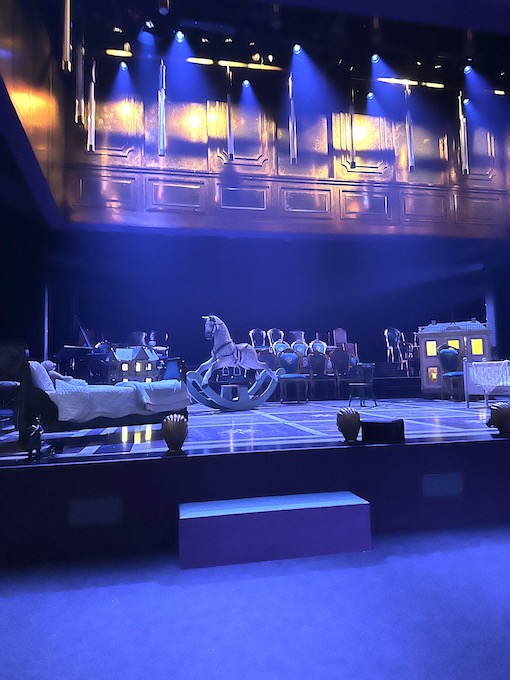
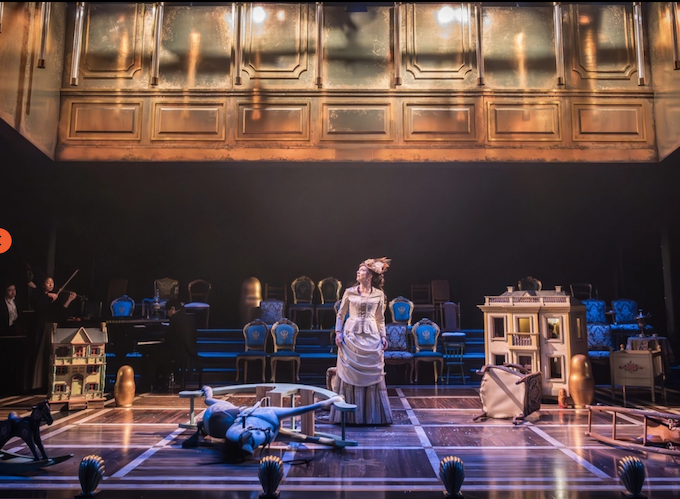
Here it’s like a children’s nursery with dolls houses, a cot, rocking horses in part one. When we move to Levin’s country estate, the black back wall drops to reveal an orange sky. The stage loses its usual half moon front, so has an acting area flat with the auditorium which is used. We were in the front row (I went to this one early on Theatre Friends Booking online) and I was terrified of extending my feet for fear of tripping cast members in the blackouts. They make much use of the two entrances / exits in the auditorium, which means it’s very much like the Royal Shakespeare Theatre lay out.
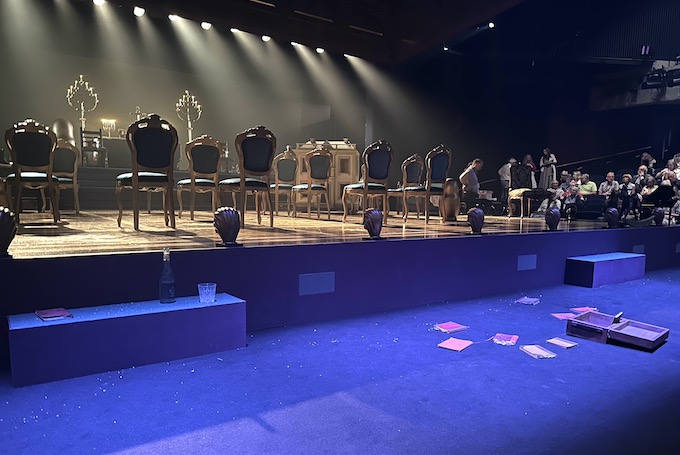
The production has a lot of high speed rushing (Russian –delete, not funny. Ed) about, and on and off, with the large cast, carefully choreographed too.

The cast do sterling ensemble work, coming on as a mass of aristocrats, then as a mass of peasants (muzhiks). They have three children in the cast, where they only really need one, Anna’s son. Still, once you have to book a chaperone, you may as well use them. Anna’s son spends a lot of time sitting in front of the raised stage, just listening. He was very good.
Who’s who
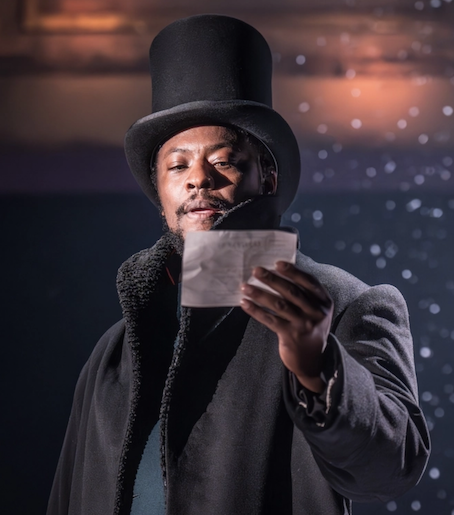
Basics: Anna Karenina is married to Karenin, an older man, a government official. They have one son.
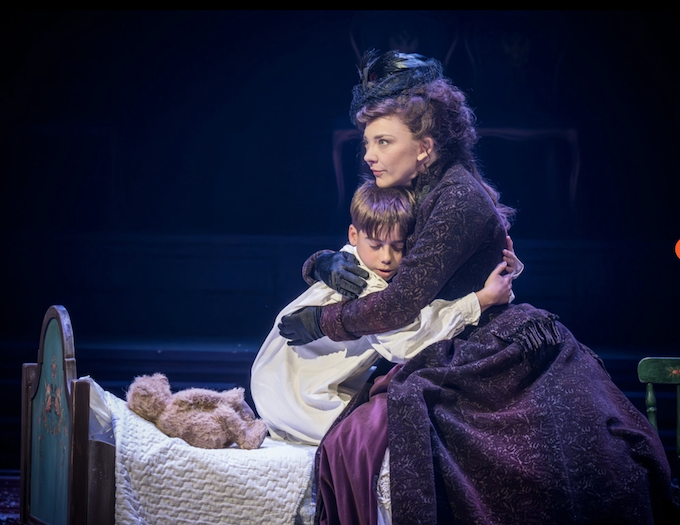
Her brother Silva is a philanderer, and married to Dolly, who has five living children and who is fed up of perpetual pregnancy. The play opens with them arguing.

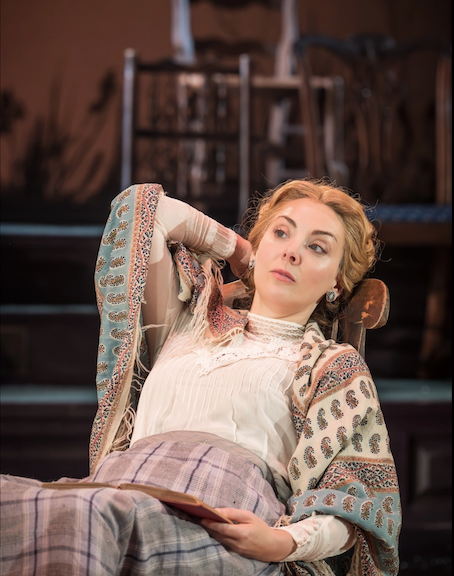
Jonnie Broadbent as Silva, Naomi Sheldon as Dolly: Act 1 Scene 1
Dolly’s younger sister Kitty hopes that the dashing cavarty officer, Count Alexei Vronsky will propose to her. She has refused Levin, a worthy landowner / farmer / writer (who is held to be Tolstoy’s alter ego).
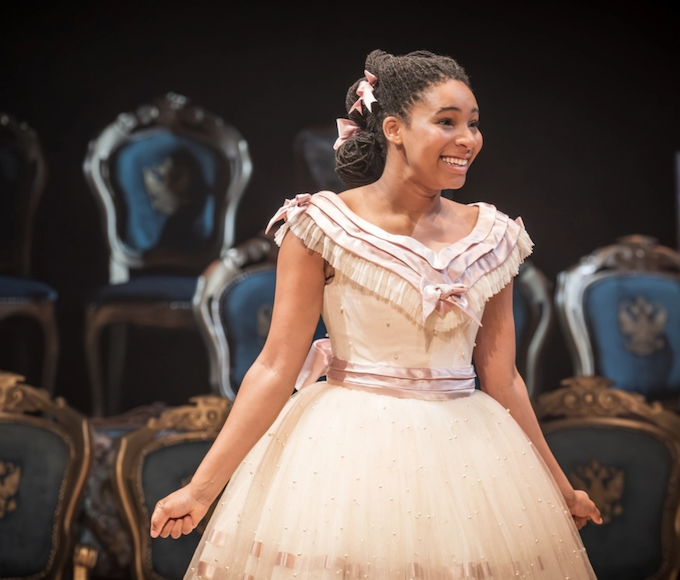

Shalisa James-Davis as Kitty, Seamus Dillane as Count Vronsky
At the ball, Vronsky abandons Kitty and pursues Anna instead. This dance sequence was well done, but in the film was the most stunning sequence of all. They become lovers, the eternal triangle ‘tings’ and she leaves Karenin. Karenin is characterised by rarely being seen without a tightly buttoned-up outdoor coat, which represents his chaaracter. No photos sadly.
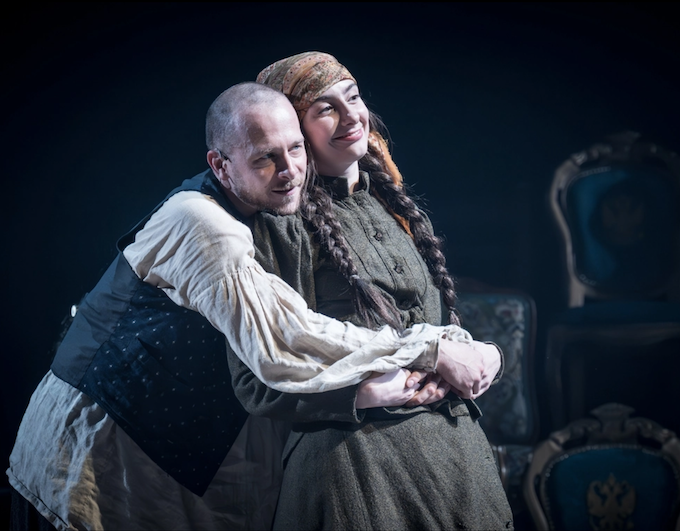
Nikolai is Levin’s alcoholic brother, partnered with Marya, both revolutionaries in spirit.
Levin does propose to Kitty again, they marry and retire to his remote estate.
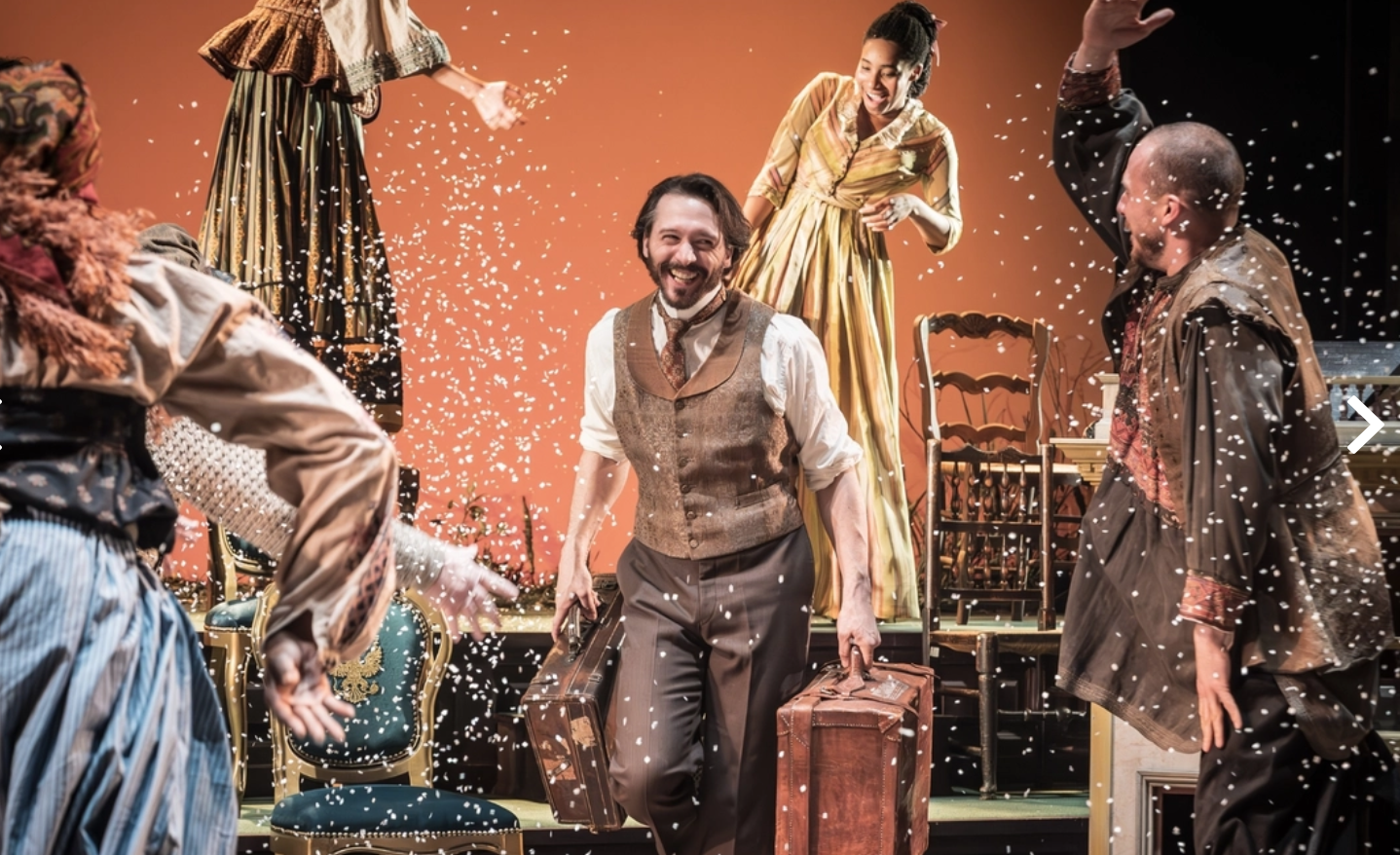
Return after their honeymoon
References say it is set in the late 1870s, first produced in 1877. However, Count Vrosnky is younger than Anna and apparently fought in the Crimean War, which was 1855 to 1856, and it says in the play text he’s 25, so it would be late 1850s. I have no idea. The full novel plot is on Wikipedia.
This version displays a dazzling display of theatrical styles. Importantly, the Japanese musical trio (who travelled for the production) are always there, and add ambient music as well as sudden effects on piano, violin or bass. They are a vital part of the concept.
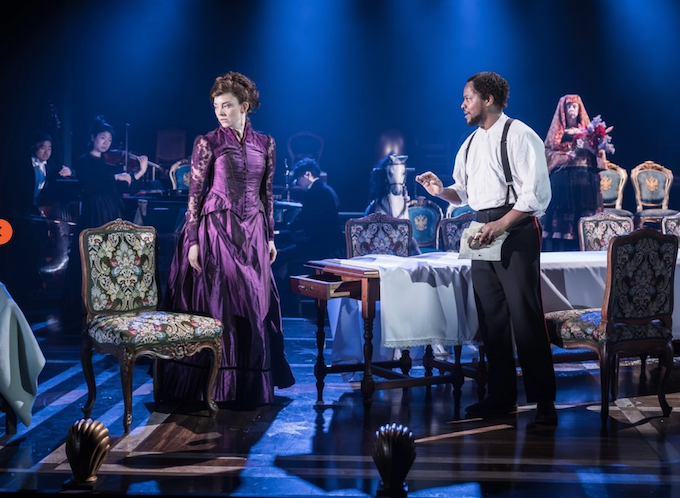
Take one aspect. Breaking the fourth wall. This is done in three ways. First is the soliloquay straight on to the audience. Then there are dialogues where a character (e.g. Anna and Vronsky) address each other in dialogue, but turn aside and express the true feeling to the audience.
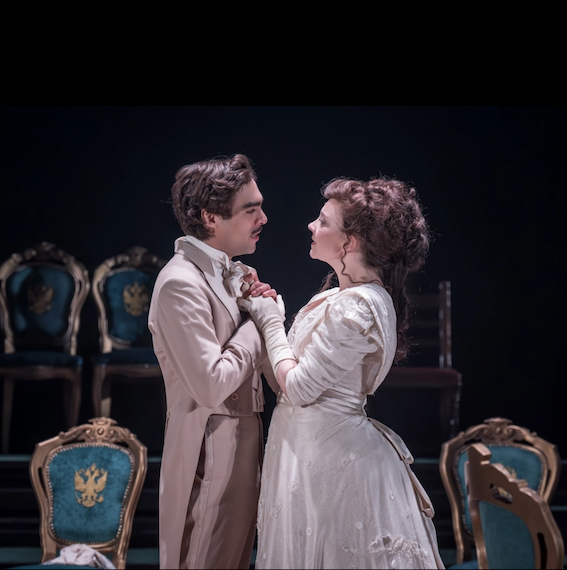
VRONSKY I love you.
ANNA: Again.
And mean it.
VRONSKY (aside) (Sometimes you have to say these thngs, don’t you).
ANNA: Do you really?
VRONSKY: How could you doubt it?
ANNA: Say it again
(aside) (Give me my morphine and let me sleep)
VRONSKY: I Love you
(Aside) (I have never been more terrified)
There is much more, but I found the technique highly effective.
Then you get asides NOT as a character, but as an actor chatting outside their role:
Kitty (Shalisa James-Davis) is using a pair of scissors
KITTY: (Aside) (Don’t worry. The scissors have no poetic significance. They’re not going to be used in the fifth act or anything.)
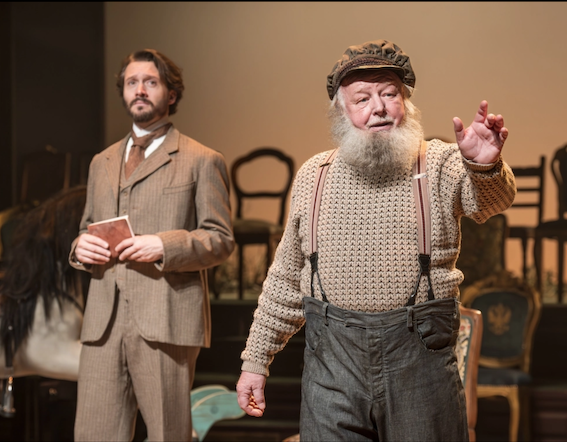
Similarly, Dolly (Naomi Sheldon) has a long impassioned speech full of effing and blinding. She is in a carriage we assume. The servant, Penska (Les Dennis), sits below her chair on the edge of the stage pretending to whip a small toy rocking horse along. His wry expressions (Ouch!) as she effs and blinds behind him were a joy to watch and very funny. Note that Les Dennis also did a butler, an aristocrat and a peasant.
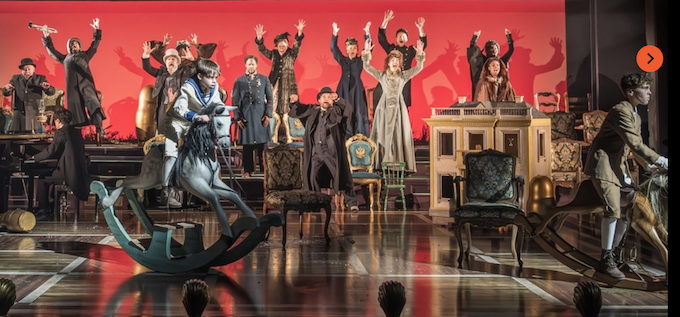
One of the hardest things to do is the horse race in which Count Vronsky (Seamus Dillane)’s horse falls and has to be shot. The whole cast watch declaiming as a Greek chorus, sometimes in unison, sometimes singly. The three children ride their rocking horses to show the race.
Then Nikolai’s death is another change of style with DEATH projected on the top of the set, and the dying Nikolai changing position dramatically in fast blackouts.
There is a sequence of Anna and Dolly as very very short interchanges broken by blackouts.
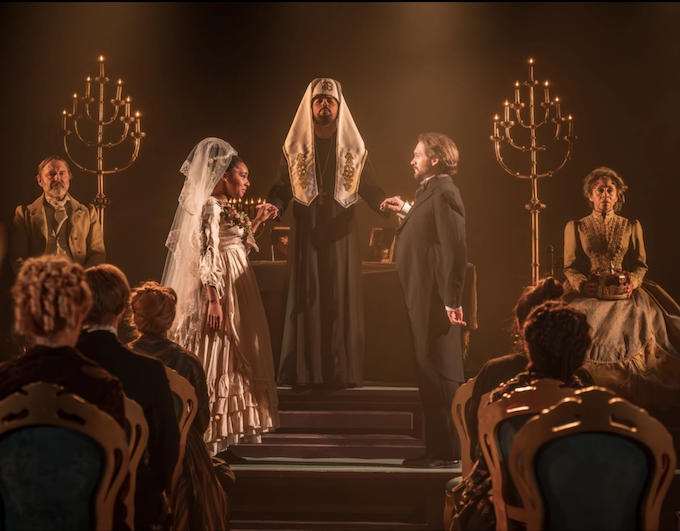
As a whole it is exciting to watch and the focus is on the feminist message resoundingly from Anna, the ever pregnant Dolly and the young married (Kitty marries Levin) giving birth for the first time. Add Anna’s near death in childbirth that ends the first part.
A minor point, but the casting director has a fixed idea of female beauty, in that to us, Natalie Dormer and Naomi Sheldon could be sisters in face shape and features, except Natalie is dark, and Naomi is blonde. Apart from hair. Sandy Foster as Lydia could even be a cousin. Given the frequent changes of costume we had to look twice sometimes to establish who had just come on. Similarly the beard meant it took a couple of minutes to realize we were watching Jonnie Broadbent as Silva.
It is a natural play for us. Karen has been working on family history, tracing her great grandmother who left her husband and two children and went off to Canada then the USA with the love of her life. That was 1912.
LENGTH
Few plays can break the rule that the second part should be shorter than the first. The Importance of Being Earnest is the exception where the sensible break point is after Act One because of the major location shift. This one has a slightly longer second half – we got into the lobby at 17.35, part one was eighty minutes, so part two was a few minutes longer. Even such a small difference feels unbalanced. It’s odd because the text is written in five acts (very Shakespearean), and it breaks at the end of Act 3. Acts 1-3 fill 72 pages, Acts 4 & 5 fill 72 pages. Maybe the curtain call was the difference.
Karen thought it needed a ten minute cut. Mind you, she thinks most plays need a ten minute cut. When we were writing video scripts the editors sent me out while they cut text with her. This year, we have had a Much Ado About Nothing with Dogberry & The Watch cut, and two RSC Hamlets with Fortinbras cut. A firm delineated cut works better than snipping, and here the power is in the three main female roles: Anna, Dolly, Kitty. I wouldn’t snip at them, I’d cut the whole Nikolai subplot (Levin’s alcoholic brother). His death scene is long, done extremely well, but seems from another play. As soon as you think ‘That’s too good to cut,’ you cut it. That’s an old film editing maxim. It would never occur to you that it was ‘too good to cut’ if it was absolutely essential to the story. The Nikolai plot does show a different way of a man and woman (Marya) living together, and they are a fourth vision of a couple, but even so, it is a sub plot. It’s one where if you know and love the book, you can’t cut it. But a play is not the book and has a narrower focus.
There is so much stagecraft and fine acting, plus so much movement. It’s not a “5” and I’m not sure why. I enjoyed reading the text afterwards too.
****
WHAT THE CRITICS SAID
5 star
Chloe Rabinowitz, Broadway World *****
4 star
Gareth Carr, What’s On Stage ****
Theatre South-East ****
3 star
Arifa Akbar, Guardian ***
Domenic Cavendish, The Telegraph ***
Amelia, Theatre & Tonic ***
Holly O’Mahoney, The Stage ***
LINKS ON THIS BLOG
ANNA KARENINA
Anna Karenina (film, 2012), screenplay by Tom Stoppard
PHILLIP BREEN
Comedy of Errors, RSC Garden Theatre 2021
The Shoemaker’s Holiday, by Thomas Dekker, RSC 2012
The Merry Wives of Windsor, RSC 2012
The Hypocrite, by Richard Bean, Hull Truck / RSC 2017
DONNA BERLIN
The Chalk Garden by Enid Bagnold, Chichester 2018
JON(NIE) Broadbent
Comedy of Errors, RSC Garden Theatre 2021
A Midsummer Night’s Dream, Filter, 2011
My Night With Reg by Kevin Elyot, Apollo, London 2015
Love for Love by Congreve, RSC 2015
Queen Anne by Helen Edmundson, RSC 2015
Living Together by Alan Ayckbourn, Chichester, 2017
Round and Round The Garden by Alan Ayckbourn, Chichester 2017
Table Manners by Alan Ayckbourn, Chichester 2017
TOMITA EDUN
The Deep Blue Sea, National 2016, streamed 2020
SEAMUS DILANE
Richard II, Bridge Theatre 2025
SANDY FOSTER
Miss Littlewood, RSC2018
The Fantastic Follies of Mrs Rich RSC 2018
Fantastic Mr Fox, Nuffield, 2016
The Shoemaker’s Holiday, RSC 2015
MARCIA LECKY
Cymbeline, RSC 2023
RIAD RICHIE
Comedy of Errors, RSC Garden Theatre 2021
Much Ado About Nothing, National Theatre, 2022
NAOMI SHELDON
The Merry Wives of Windsor, RSC 2012
Comedy of Errors, RSC Garden Theatre 2021 (not when we saw it)
 Peter Viney's Blog
Leave a comment